The worksheet
About this worksheet
Students learn why equations must show equal atoms to keep mass equal. They model atoms with counters and balance symbol equations in pairs. This Year 9 Science worksheet gives students (ages 13–14) five pages of practice on balancing chemical equations, part of the chemistry unit. It goes with our free Balancing chemical equations lesson, which has the slides and a timed lesson plan.
What it covers
By the end, students should be able to:
- Students will represent reactions using formulae and balanced symbol equations.
- Students will balance equations by counting atoms and adding coefficients only.
- Students will explain that balanced atoms keep total mass equal.
How to use it
- Practice (12 minutes): Hand out Worksheet Task D and Task E.
- Support: Counting grid with H, O, N columns for left and right totals.
- Stretch: Balance N2 + H2 → NH3 to N2 + 3H2 → 2NH3 with full recount.
- The answer sheet is the last page, so you can print it on its own or let students check their own work.
Key vocabulary
- reactant: starting chemical on the left side that takes part in change
- product: new chemical made on the right side after change
- coefficient: big number placed before a formula to show how many copies
- subscript: tiny number after a symbol showing atoms joined in that formula
- conservation of mass: rule that total amount stays the same because atoms only rearrange
- balanced equation: formula sentence with equal numbers of each atom on both sides
Mistakes to watch for
- Changing subscripts instead of coefficients to balance, e.g. H2O to H2O2. Remind formulas are fixed, only coefficients change; changing subscript makes a different substance.
- Adding several big numbers at once without recounting. Deal with only one element at a time, recount and repeat until all match.
- Thinking mass can disappear, so unbalanced equation is fine. Stress total mass of reactants equals total mass of products because no atoms are lost or made.
What's on the worksheet
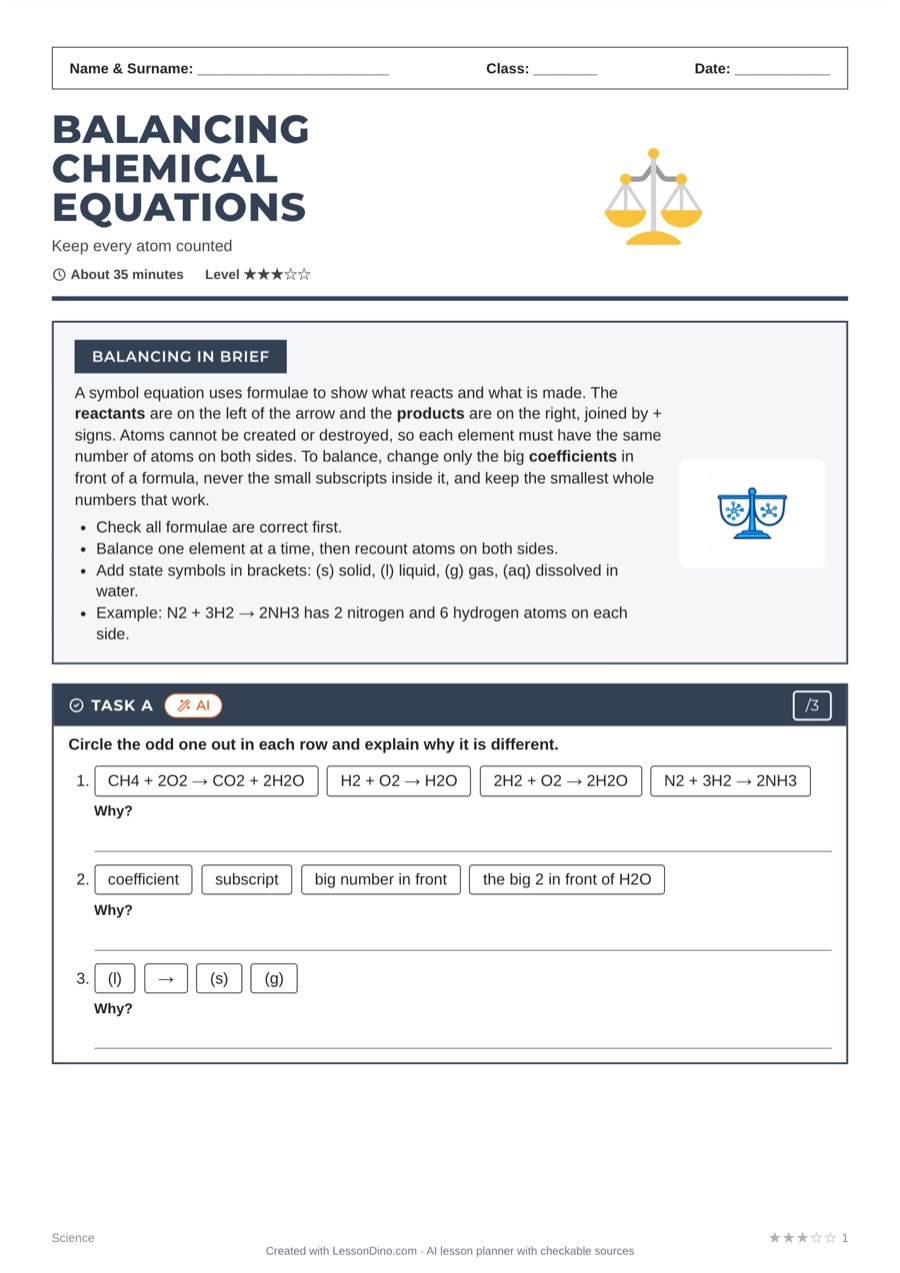
Why Balance Equations?
Learn why atoms must balance and spot the odd one out.
Balancing in brief
- A symbol equation uses formulae to show what reacts and what is made. The reactants are on the left of the arrow and the products are on the right, joined by + signs. Atoms cannot be created or destroyed, so each element must have the same number of atoms on both sides. To balance, change only the big coefficients in front of a formula, never the small subscripts inside it, and keep the smallest whole numbers that work.
- Check all formulae are correct first.
- Balance one element at a time, then recount atoms on both sides.
- Add state symbols in brackets: (s) solid, (l) liquid, (g) gas, (aq) dissolved in water.
- Example: N2 + 3H2 → 2NH3 has 2 nitrogen and 6 hydrogen atoms on each side.
Circle the odd one out in each row and explain why it is different.
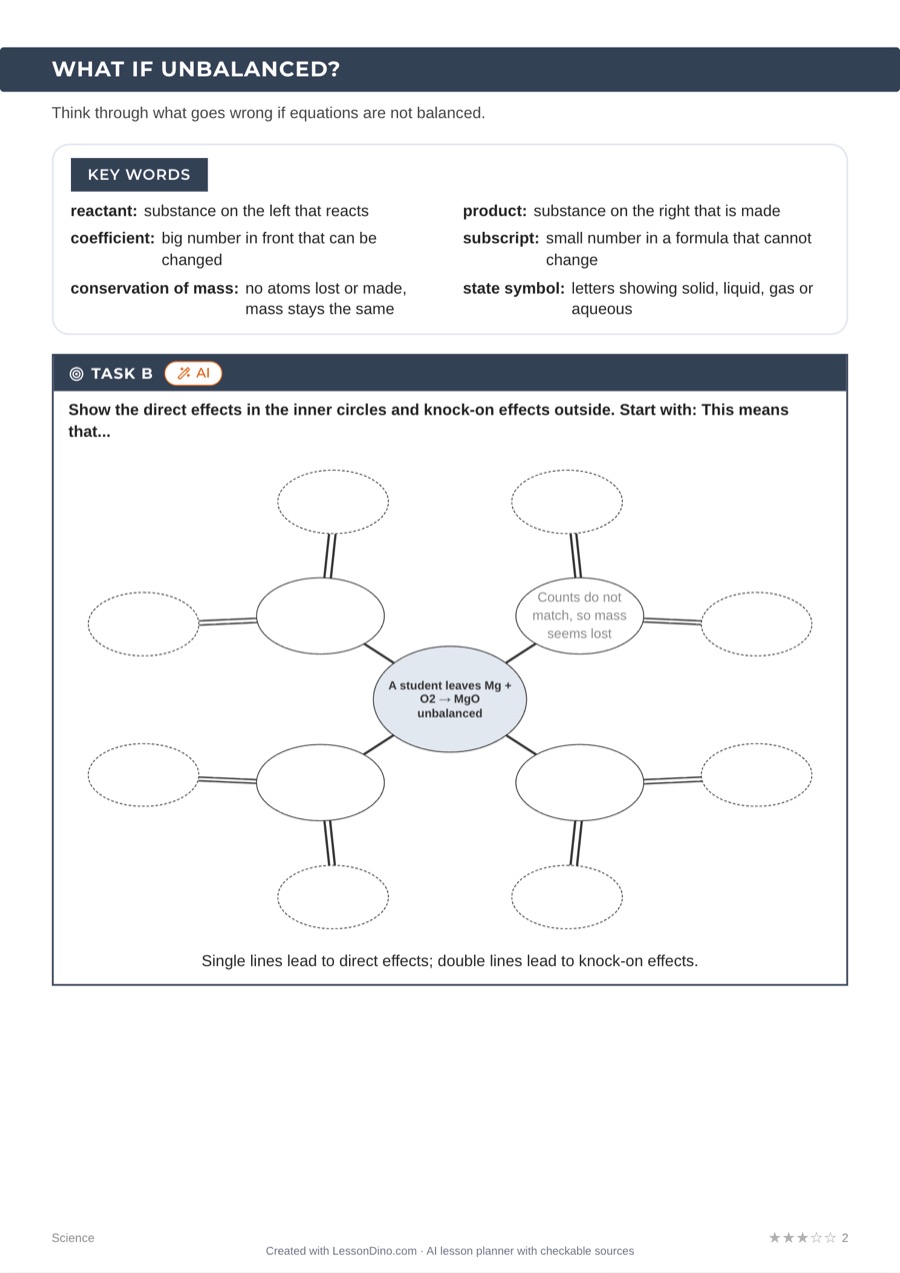
What If Unbalanced?
Think through what goes wrong if equations are not balanced.
| Word | Meaning |
|---|---|
| reactant | substance on the left that reacts |
| product | substance on the right that is made |
| coefficient | big number in front that can be changed |
| subscript | small number in a formula that cannot change |
| conservation of mass | no atoms lost or made, mass stays the same |
| state symbol | letters showing solid, liquid, gas or aqueous |
Show the direct effects in the inner circles and knock-on effects outside. Start with: This means that...
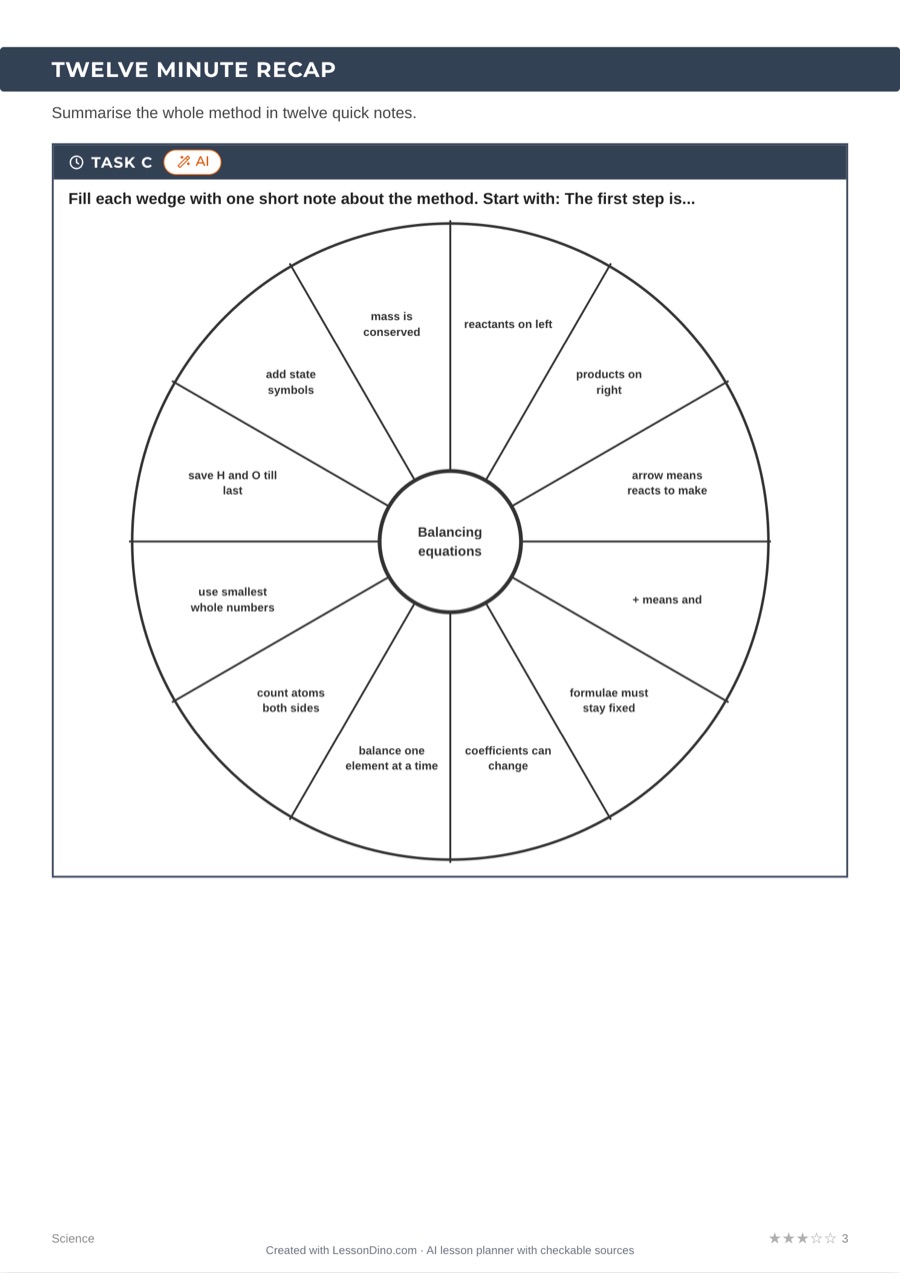
Twelve Minute Recap
Summarise the whole method in twelve quick notes.
Fill each wedge with one short note about the method. Start with: The first step is...
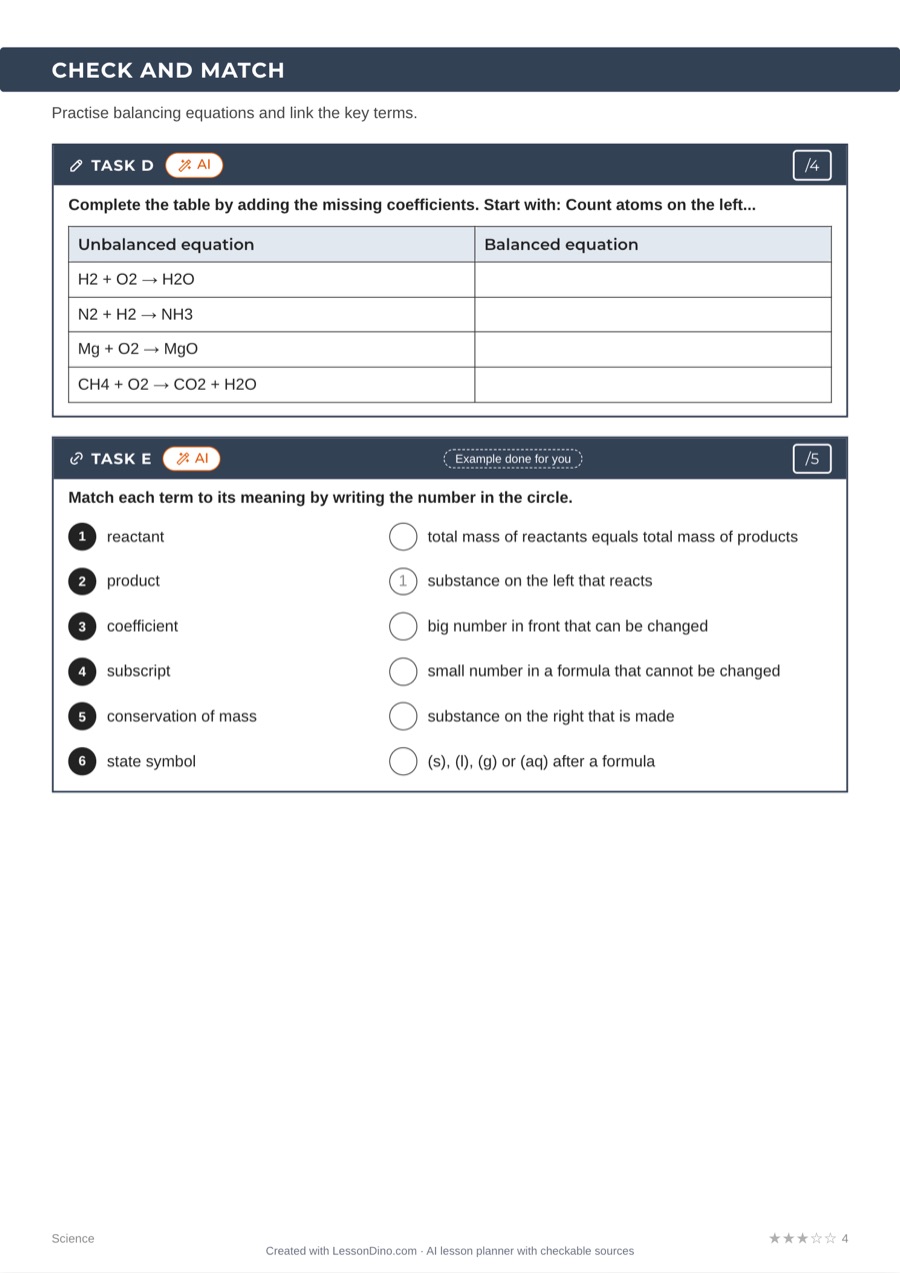
Check and Match
Practise balancing equations and link the key terms.
Complete the table by adding the missing coefficients. Start with: Count atoms on the left...
Match each term to its meaning by writing the number in the circle.
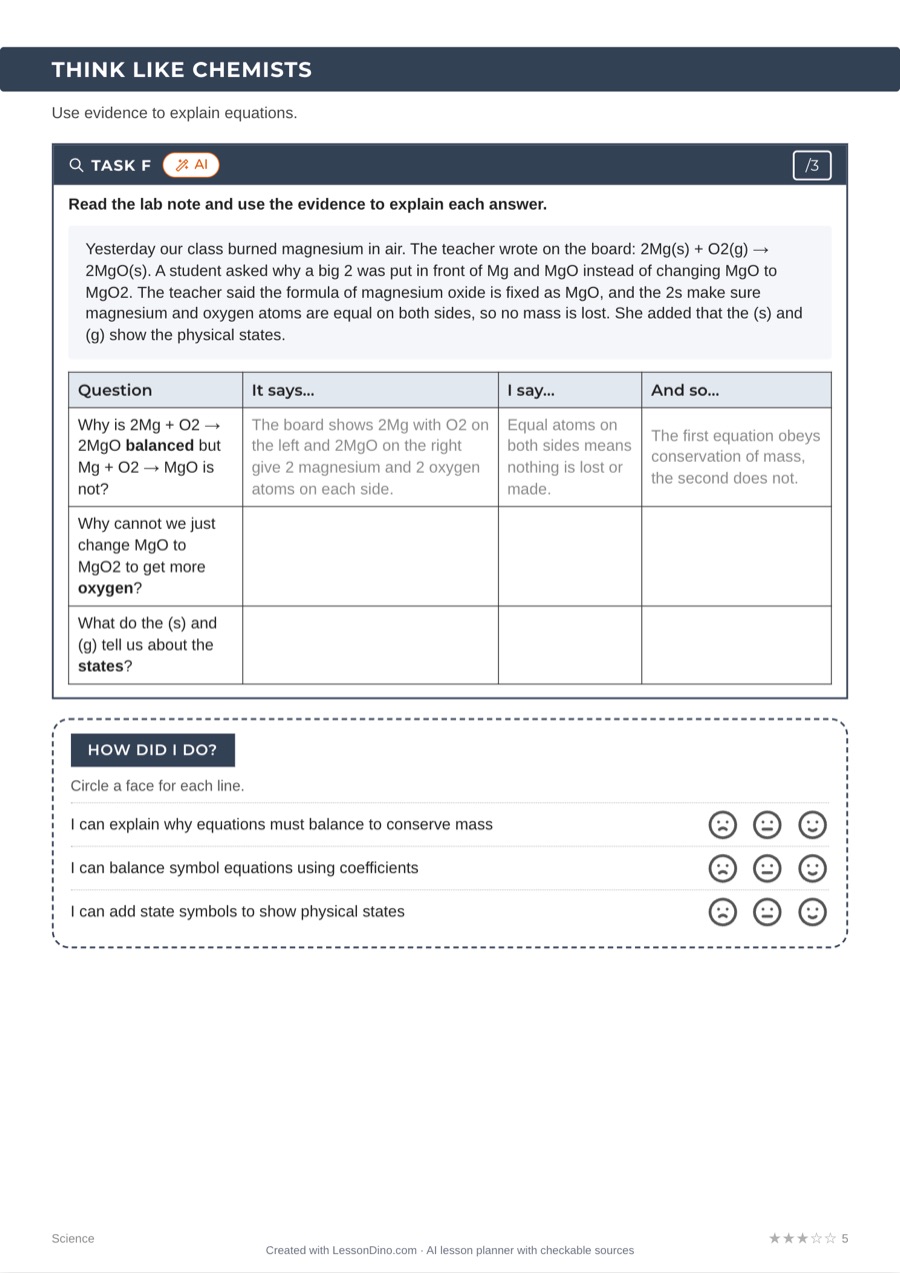
Think Like Chemists
Use evidence to explain equations.
Read the lab note and use the evidence to explain each answer.
- Yesterday our class burned magnesium in air. The teacher wrote on the board: 2Mg(s) + O2(g) → 2MgO(s). A student asked why a big 2 was put in front of Mg and MgO instead of changing MgO to MgO2. The teacher said the formula of magnesium oxide is fixed as MgO, and the 2s make sure magnesium and oxygen atoms are equal on both sides, so no mass is lost. She added that the (s) and (g) show the physical states.
- Why is 2Mg + O2 → 2MgO balanced but Mg + O2 → MgO is not?
- Why cannot we just change MgO to MgO2 to get more oxygen?
- What do the (s) and (g) tell us about the states?
Answers
Show the answers
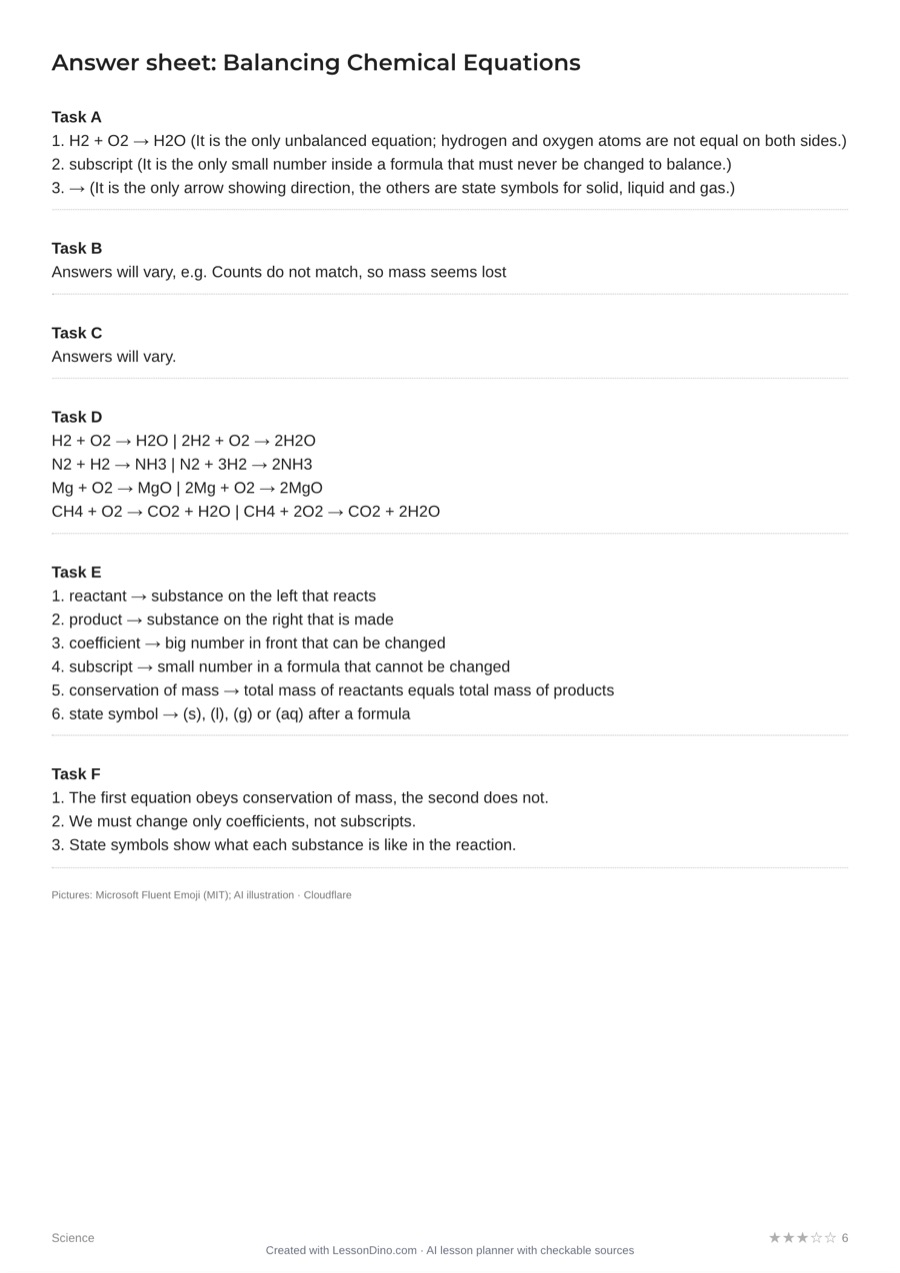
The answers are on the answer sheet, the last picture above.
Curriculum
representing chemical reactions using formulae and using equations
Made with Lesson Dino's AI on 19 October 2026. AI can make mistakes, so check the answers and facts against the sources before you teach.