Slides
Lesson plan
Balancing Atoms to Balance Mass
Students learn why equations must show equal atoms to keep mass equal. They model atoms with counters and balance symbol equations in pairs.
Objectives
- Students will represent reactions using formulae and balanced symbol equations.
- Students will balance equations by counting atoms and adding coefficients only.
- Students will explain that balanced atoms keep total mass equal.
Success criteria
- I can write reactants and products with correct formulae.
- I can balance atoms by changing coefficients only.
- I can explain balanced atoms keeps mass equal.
Key words
| Word | Meaning |
|---|---|
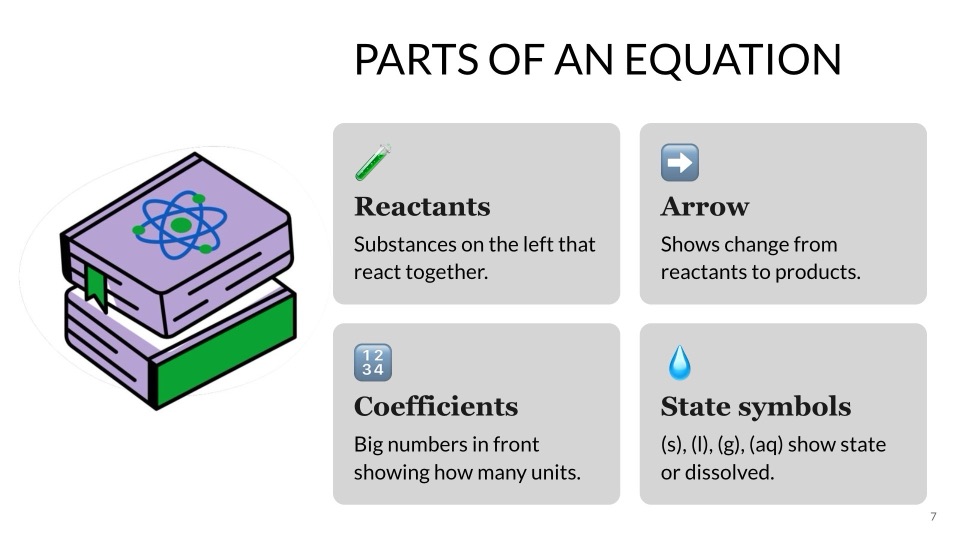
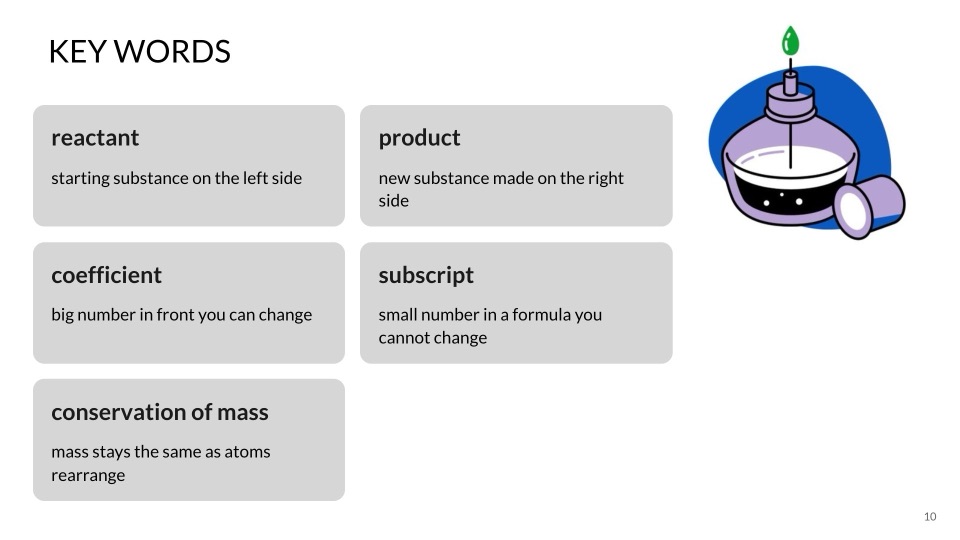
| reactant | starting chemical on the left side that takes part in change |
| product | new chemical made on the right side after change |
| coefficient | big number placed before a formula to show how many copies |
| subscript | tiny number after a symbol showing atoms joined in that formula |
| conservation of mass | rule that total amount stays the same because atoms only rearrange |
| balanced equation | formula sentence with equal numbers of each atom on both sides |
Timed plan (60 minutes)
| Time | Stage | What happens |
|---|---|---|
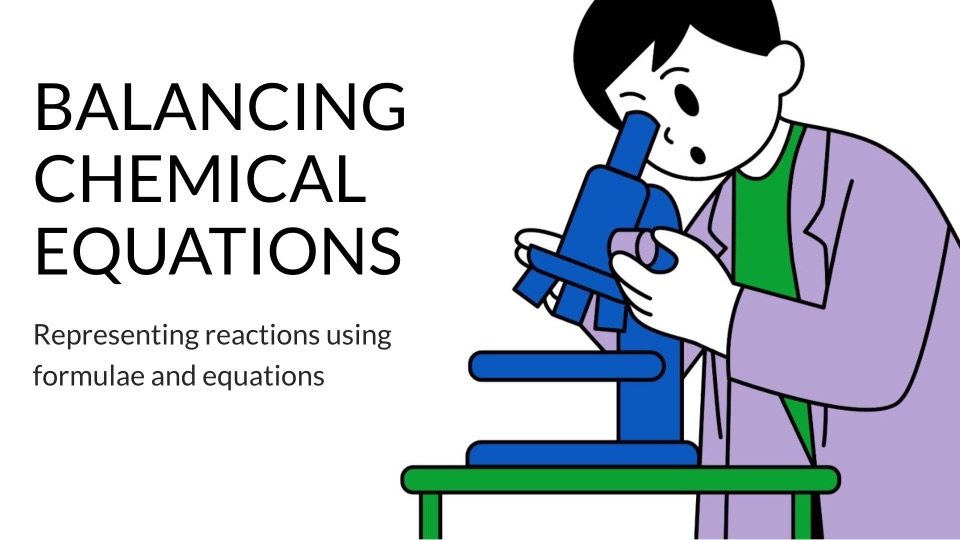
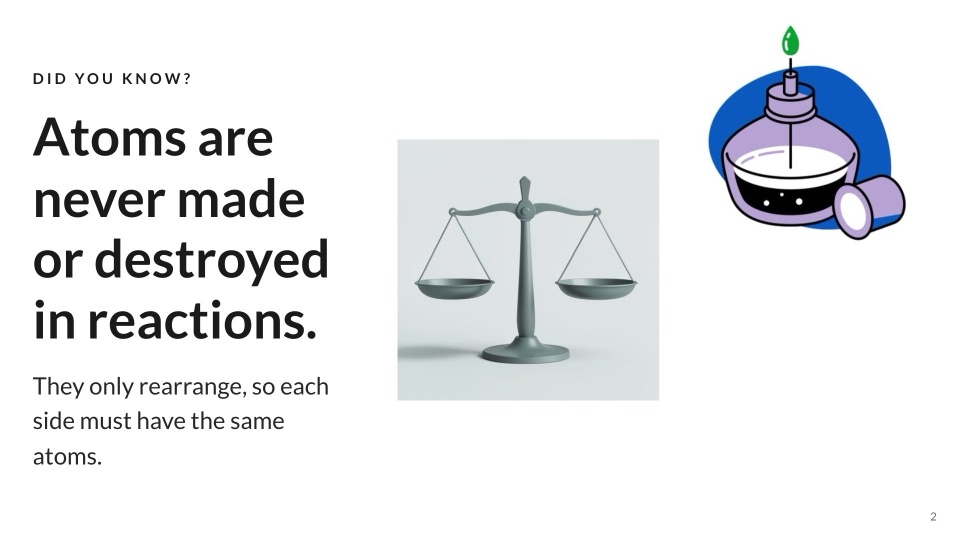
| 8 min | Starter | Recall formulae and create curiosity about unequal atoms. Show Slide 1 and read title: Representing reactions using formulae and equations. Show Slide 2 fact: Atoms are never made or destroyed in reactions. They only rearrange, so each side must have the same atoms. Say the hook and show unbalanced H2 + O2 → H2O on the board. Ask pairs to count H and O on each side on mini whiteboards. |
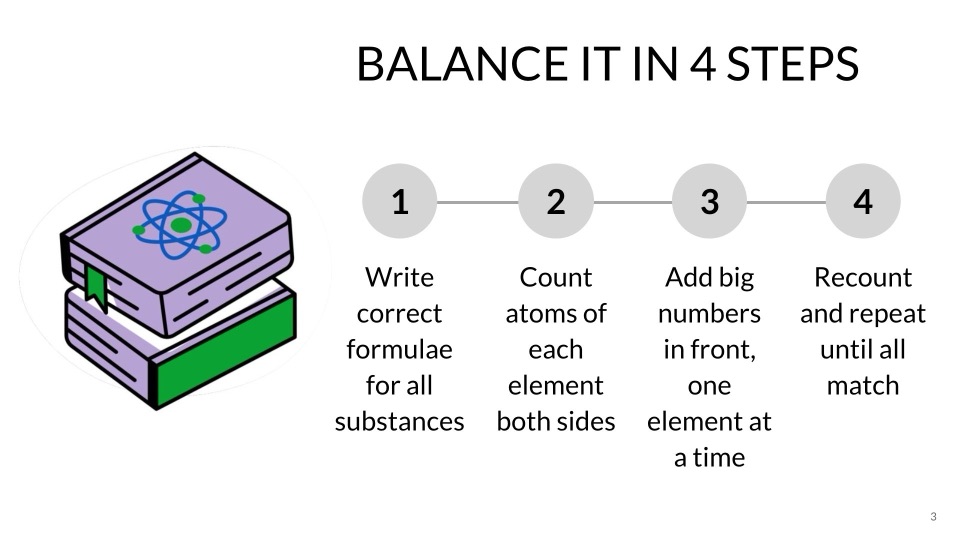
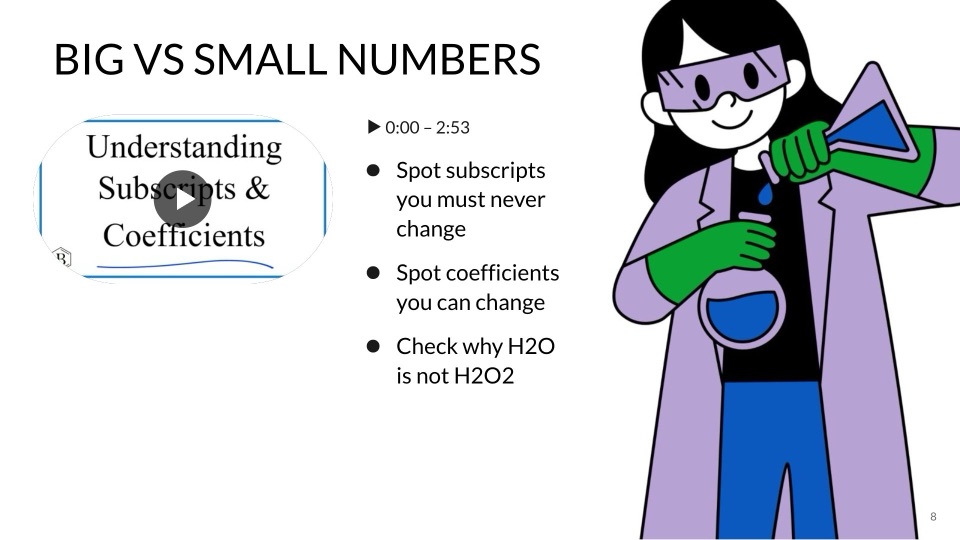
| 12 min | Teaching | Model the 4-step method and the difference between coefficients and subscripts. Display Slide 3 steps: Write correct formulae for all substances, Count atoms of each element both sides, Add big numbers in front, one element at a time. Play Video clip 5 (0:00–2:53) on Slide 8 to spot subscripts you must never change and coefficients you can change. Model balancing H2 + O2 → H2O on the board with tallies, adding one coefficient at a time and recounting. Show Slide 4 statement: Balance the atoms, and you balance the mass. |
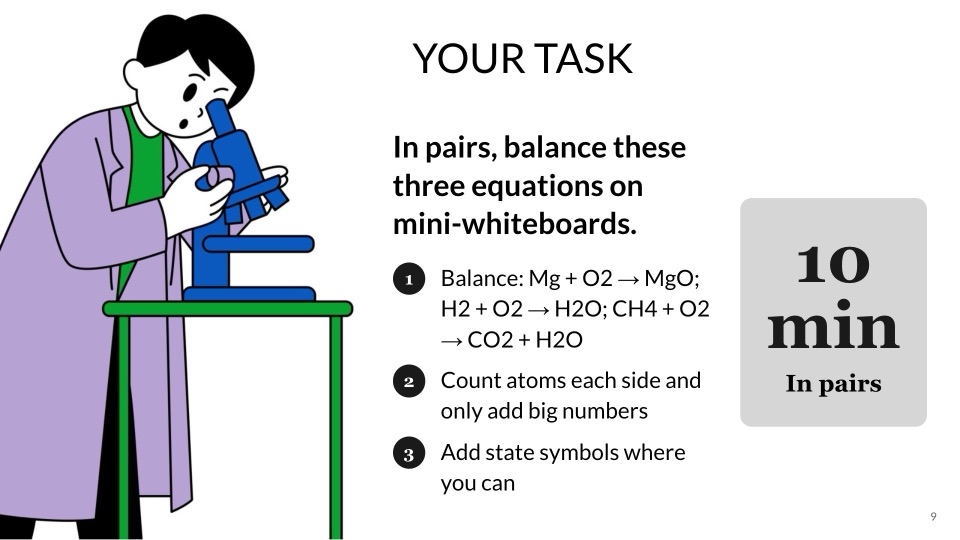
| 20 min | Main activity | Practise balancing simple equations by modelling atoms with counters. Hand out two colours of counters, printed unbalanced equations and mini whiteboards. Demonstrate modelling H2 + O2 → H2O where each counter is one atom and atoms only rearrange. Set pairs to find coefficients for H2 + O2 → H2O and Mg + O2 → MgO by adding one coefficient, then recounting. Remind class to write tallies underneath to prove equal numbers on both sides. |
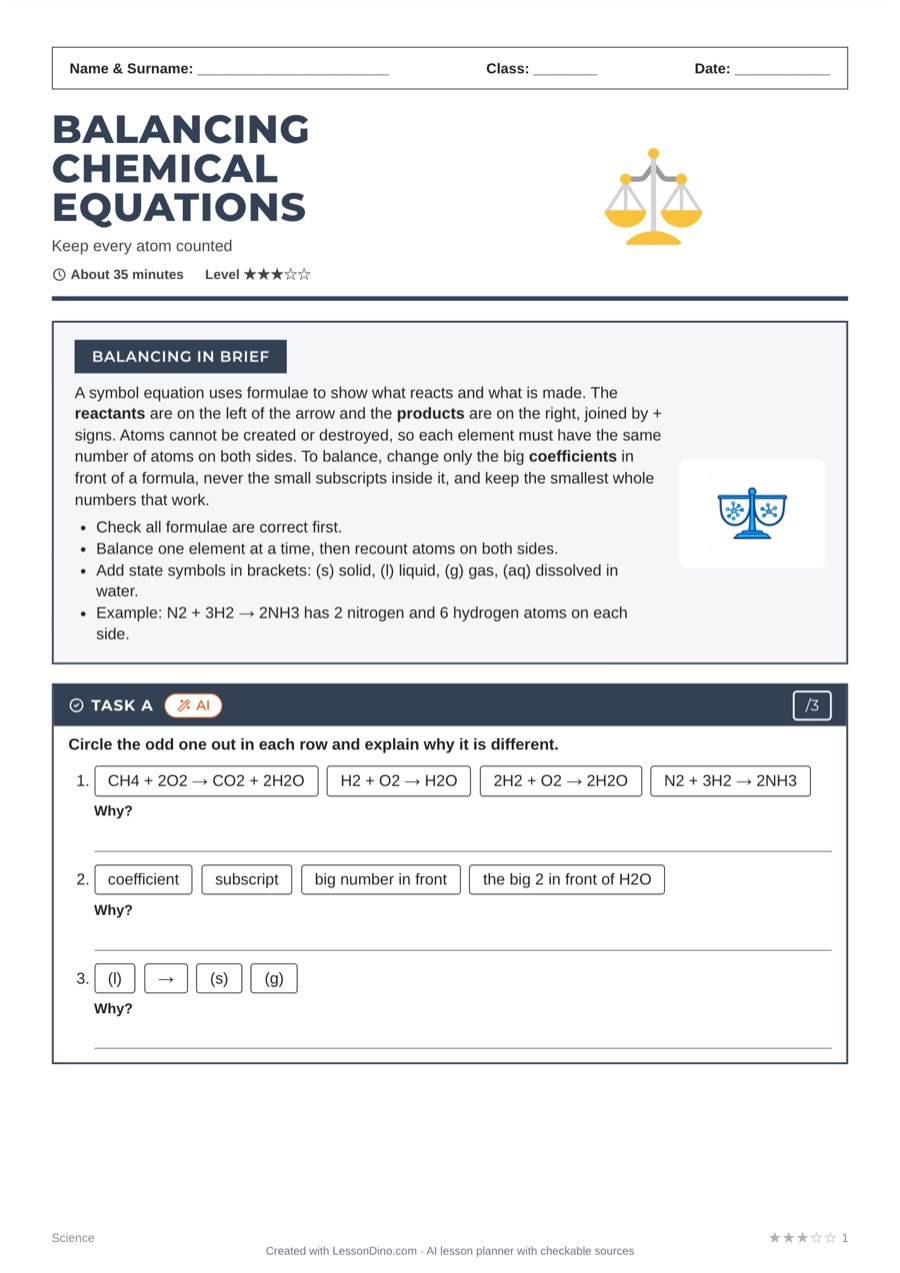
| 12 min | Practice | Apply inspection independently and secure key vocabulary. Hand out Worksheet Task D and Task E. Direct students to Task D instruction: Complete the table by adding the missing coefficients. Start with: Count atoms on the left... Direct students to Task E instruction: Match each term to its meaning by writing the number in the circle. Circulate, prompting use of smallest possible whole-number coefficients. |
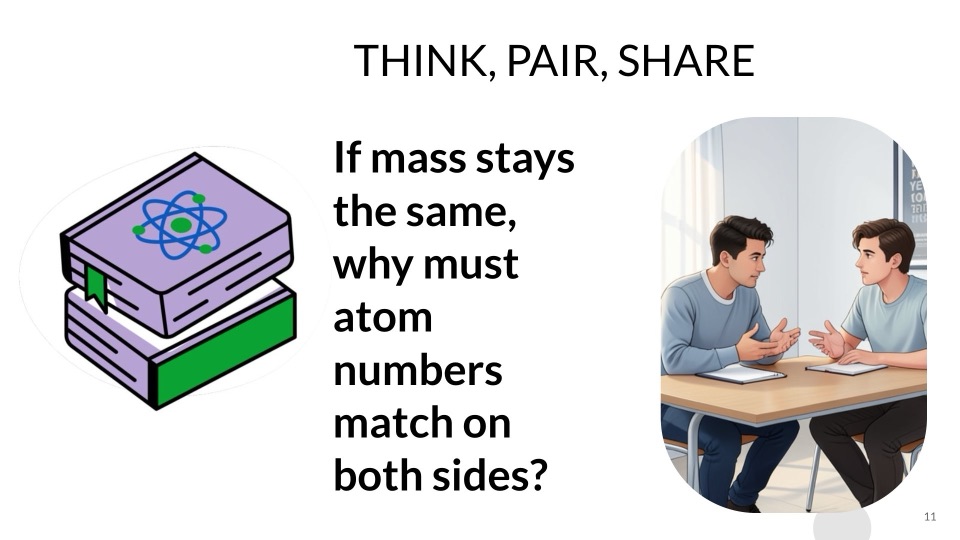
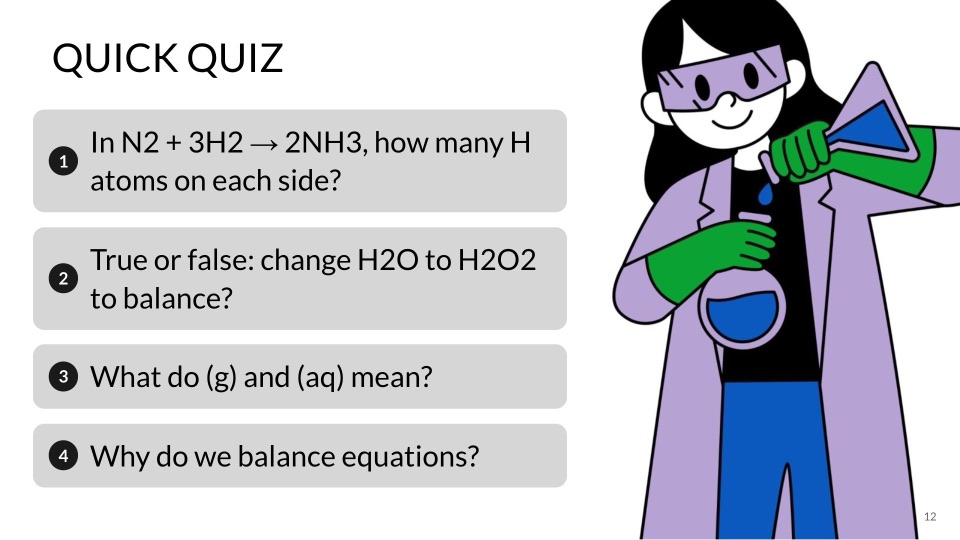
| 8 min | Plenary | Check objectives and link atom balance to mass conservation. Revisit Slide 10 words: reactant - starting substance on the left side, product - new substance made on the right side, coefficient - big number in front you can change. Ask Slide 11 question: If mass stays the same, why must atom numbers match on both sides? Run Slide 12 quiz on N2 + 3H2 → 2NH3 and H2O to H2O2 true or false. Link back to Slide 4: Balance the atoms, and you balance the mass. |
Common mistakes
- Changing subscripts instead of coefficients to balance, e.g. H2O to H2O2
How to spot it: Formula has new small number but coefficient still 1
Remind formulas are fixed, only coefficients change; changing subscript makes a different substance - Adding several big numbers at once without recounting
How to spot it: One element balances but another is now unequal
Deal with only one element at a time, recount and repeat until all match - Thinking mass can disappear, so unbalanced equation is fine
How to spot it: Says ash weighs less so atoms were lost
Stress total mass of reactants equals total mass of products because no atoms are lost or made
Support
- Counting grid with H, O, N columns for left and right totals
- Sentence starters linking counts to conservation
- Correct formulae supplied so focus is on coefficients only
Stretch
- Balance N2 + H2 → NH3 to N2 + 3H2 → 2NH3 with full recount
- Simplify to smallest whole-number coefficients and state ratio e.g. 1:2:1:2
- Add state symbols like (g) and (l) without changing atom balance
Check questions
- In N2 + 3H2 → 2NH3, how many H atoms on each side?
Answer: 6 and 6 - balanced - True or false: you can change H2O to H2O2 to balance an equation?
Answer: False - never change a formula - Balance 2H2 + O2 → 2H2O: how many H and O on each side and why does this keep mass equal?
Answer: H 4 and 4, O 2 and 2; equal atoms means equal mass as atoms only rearrange
Curriculum
representing chemical reactions using formulae and using equations
Video clips
Clips on YouTube, from the start and end times we chose. Check each one before you show it.
-
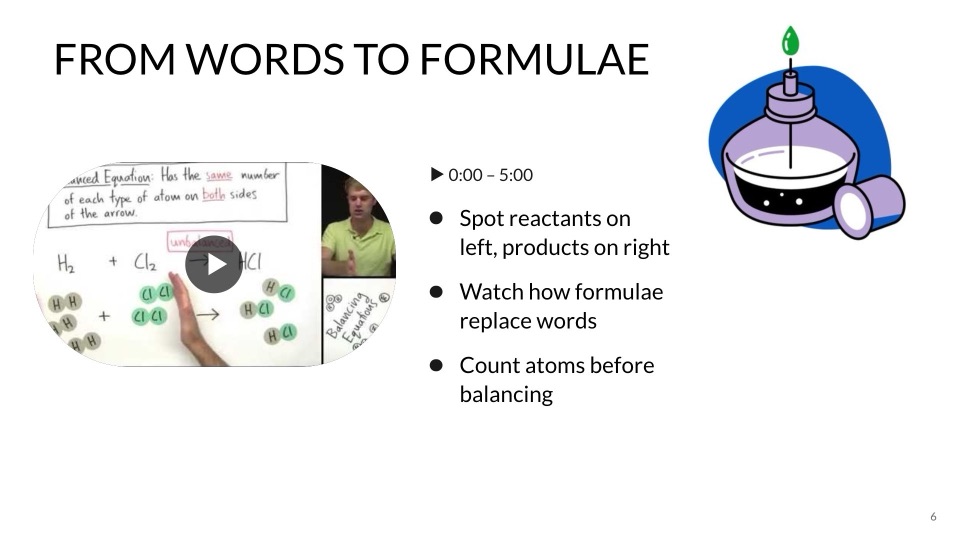
Word equation to balanced from 0:00 to 5:00
Tyler DeWitt: Introduction to Balancing Chemical Equations
Excellent for Year 9 as it starts with a word equation, writes formulae and visualises atoms for 13-14-year-olds.
-
Subscripts vs coefficients from 0:00 to 2:53
Wayne Breslyn (Dr. B.): Understanding Subscripts and Coefficients when Balancing Equations
Essential for Year 9 as it clears up a common misconception for 13-14-year-olds in under 3 minutes.
Worksheet
Sources
- Year 9 Curriculum Knowledge At A Glance kls.herts.sch.uk
- science yr 9 curriculum trinity.bexley.sch.uk
- Balancing equations - Revise: Balanced equations - National 5 Chemistry ... bbc.co.uk
- Balancing chemical equations bam.files.bbci.co.uk
- Chemical Equation Balancer - AllCalculators.co.uk allcalculators.co.uk
- Worked examples: Balancing more complex chemical equations khanacademy.org
- 5.8 Writing and Balancing Chemical Equations – Chemistry Fundamentals pressbooks.online.ucf.edu
- Balancing Chemical Equations - Inquiry based Introduction - Cont… phet.colorado.edu
- Balancing Chemical Equations flexbooks.ck12.org
- Balancing chemical equations: form the perspective of Hilbert ba… arxiv.org
- Flexi answers - How to balance chemical equations? | CK-12 Foundation ck12.org
- Worked example: Balancing a redox equation in acidic solution khanacademy.org
- Research backed method for teaching Balancing Chemical Equations to ... mindmatterspedagogy.com
- How to Balance Chemical Equations Step by Step | Element Lookup elementlookup.com
- BALANCING CHEMICAL EQUATIONS LESSON PLAN - Kesler Science keslerscience.com
- Balancing Chemical Equations Worksheets - Mashup Math mashupmath.com
- School chemistry elementary: Balancing chemical equations (Levelled Books) - Iqbal, Mazhar: 9781530207954 - AbeBooks abebooks.com
- Balanced chemical equations - Atoms, elements and compounds ... bbc.co.uk
- Balancing Chemical Reactions | Brilliant Math & Science Wiki brilliant.org
- Balancing Chemical Equations Chemistry Tutorial ausetute.com.au
Picture credits
- Photo: Republica · Pixabay
- AI illustration · Cloudflare
- Microsoft Fluent Emoji (MIT)
Made with Lesson Dino's AI on 19 October 2026. AI can make mistakes, so check facts against the sources before you teach.