Slides
Lesson plan
Reading the Periodic Table Map
Students learn to find periods and groups and to sort metals from non-metals. They colour-code a blank table so the patterns stand out.
Objectives
- Students will find the period and group of any element from its row and column.
- Students will classify elements as metal or non-metal using the zigzag divide.
- Students will explain why organisation helps predict physical and chemical properties.
Success criteria
- I can give the period and group for an element from its position.
- I can sort elements into metal or non-metal using the zigzag line.
- I can explain why organising elements helps us predict patterns.
Key words
| Word | Meaning |
|---|---|
| period | a row running across the table |
| group | a column running down the table |
| atomic number | the count that decides an element's place in order |
| metal | shiny, bendy material that carries heat well |
| non-metal | dull, breakable substance that carries heat poorly |
Timed plan (60 minutes)
| Time | Stage | What happens |
|---|---|---|
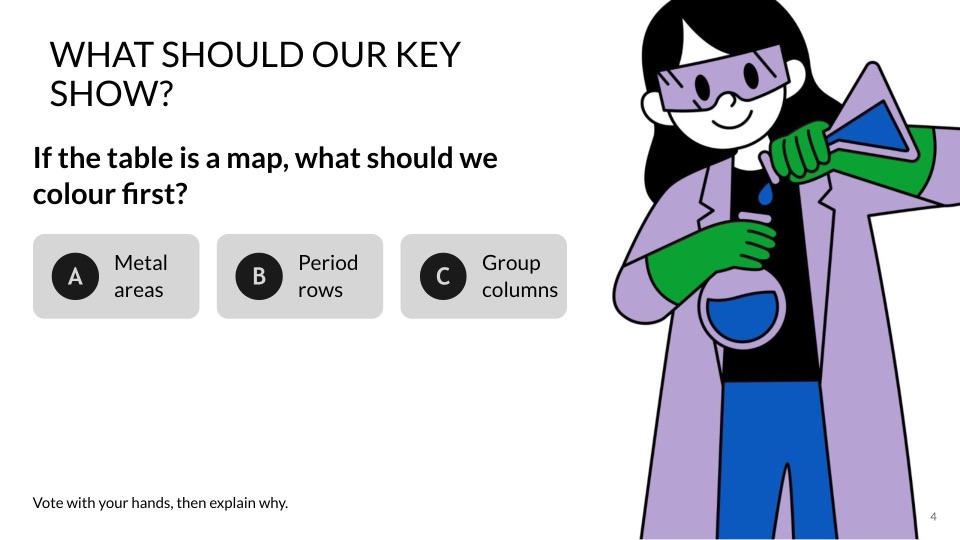
| 5 min | Starter | To spark interest in colour-coding and check what pupils know about table layout. Show Slide 4 and read the vote options: metal areas, period rows and group columns. Ask for hands-up votes on what to colour first if the table is a map. Hold up a grey blank table and give the hook for the main task. Link votes to lesson goal: colour and label metals, non-metals and key groups. |
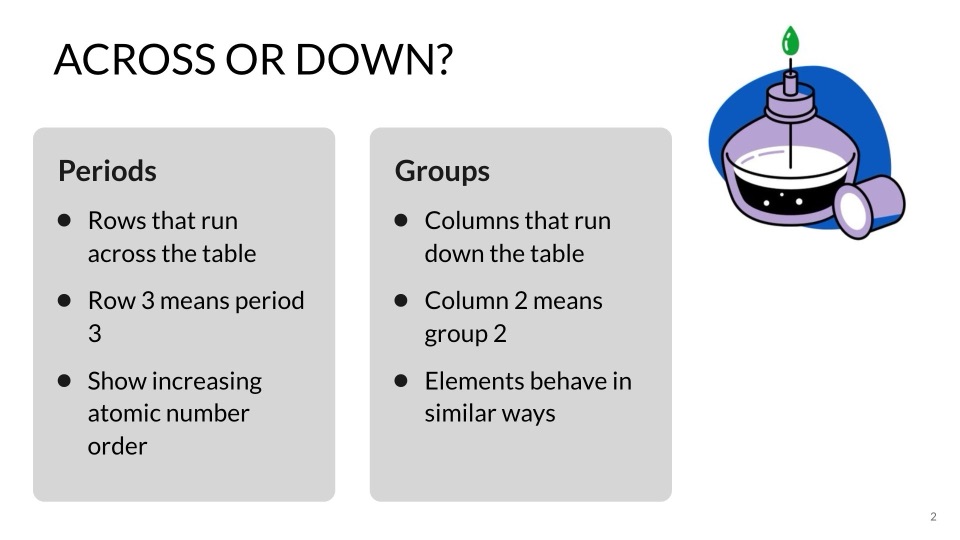
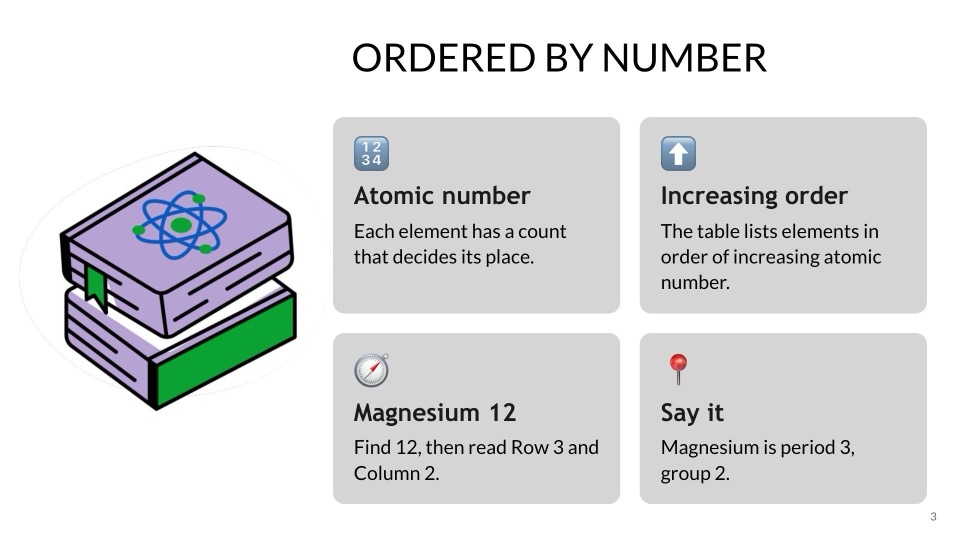
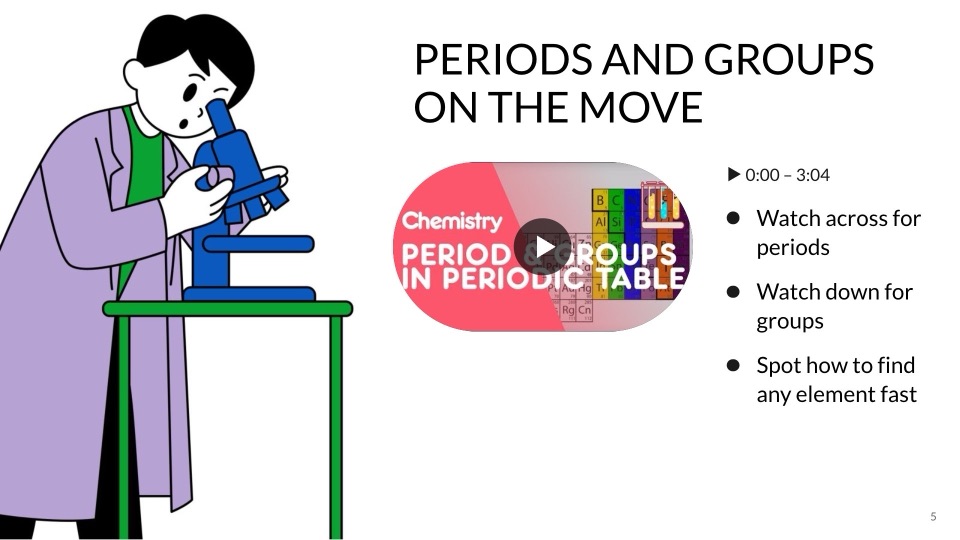
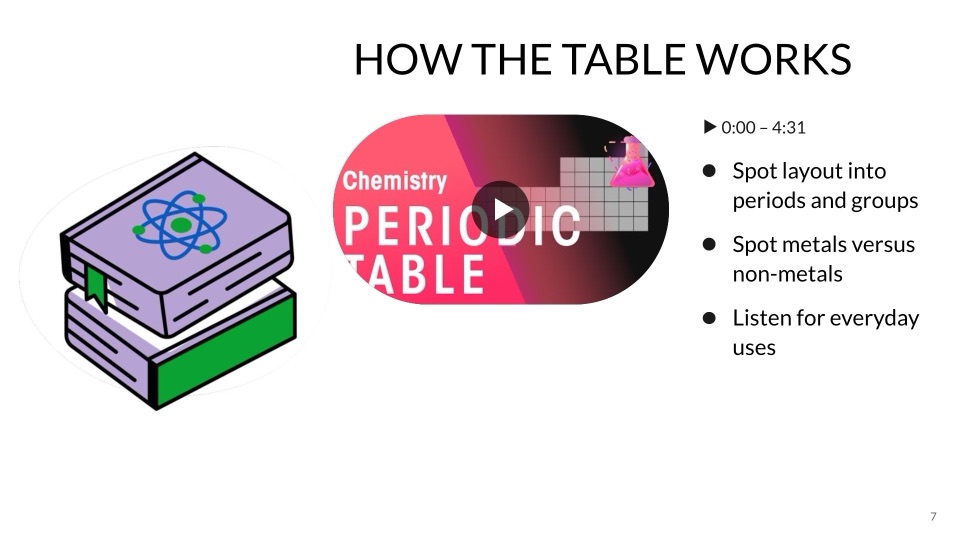
| 10 min | Teaching - Periods and Groups | To teach pupils to read any position as a period and a group. Show Slide 2 and trace Row 3 across for period 3 and Column 2 down for group 2. Show Slide 3 and explain each element has a count that decides its place. Play Slide 5 Video clip 1 and ask pupils to watch across for periods and down for groups. Model reading sodium from the wall table and check with hinge question. |
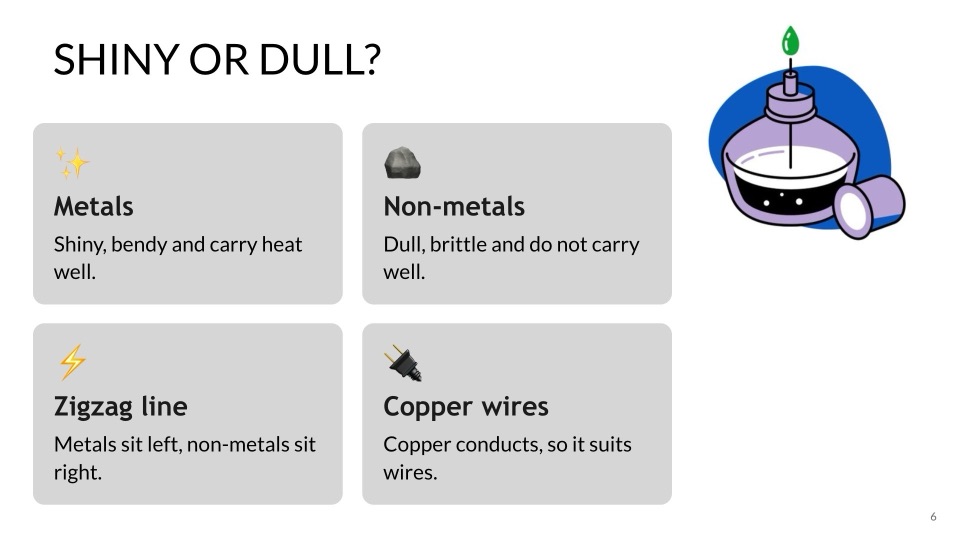
| 10 min | Teaching - Metals and Non-metals | To teach where metals and non-metals sit and why the divide matters. Show Slide 6 cards for shiny, bendy metals and dull, brittle non-metals. Point out metals sit left and non-metals sit right with a zigzag divide. Play Slide 7 Video clip 3 to spot layout and everyday uses. Model sorting two samples by observed properties. |
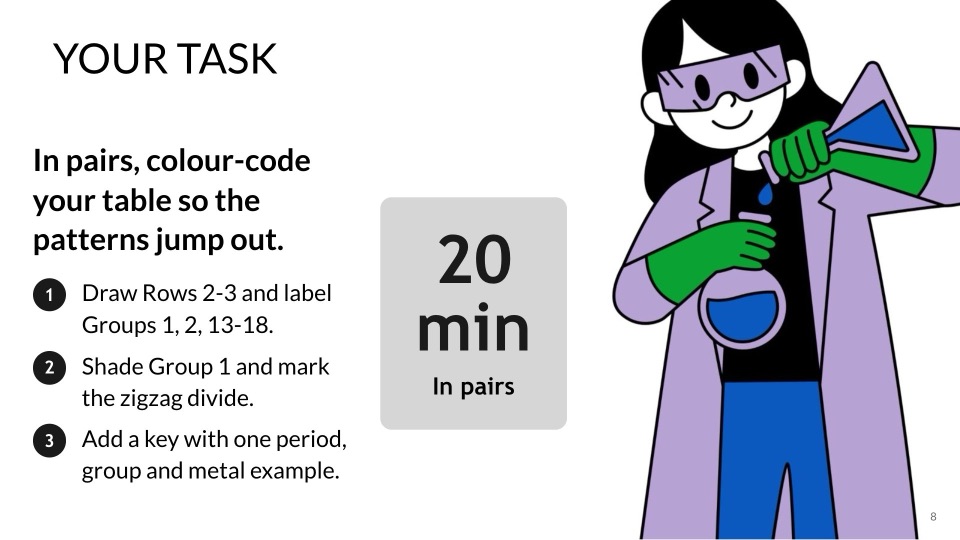
| 25 min | Main Activity - Colour-Code | To colour and label periods, groups, metals and non-metals accurately. Show Slide 8 task and hand out blank tables, coloured pencils and rulers. Model: draw Rows 2-3, label Groups 1, 2, 13-18, shade Group 1 alkali metals and mark the zigzag divide. Send pairs to colour-code using different colours for different groups, with key and one example per colour. Circulate, check keys and prompt explanation of metal side versus non-metal side. |
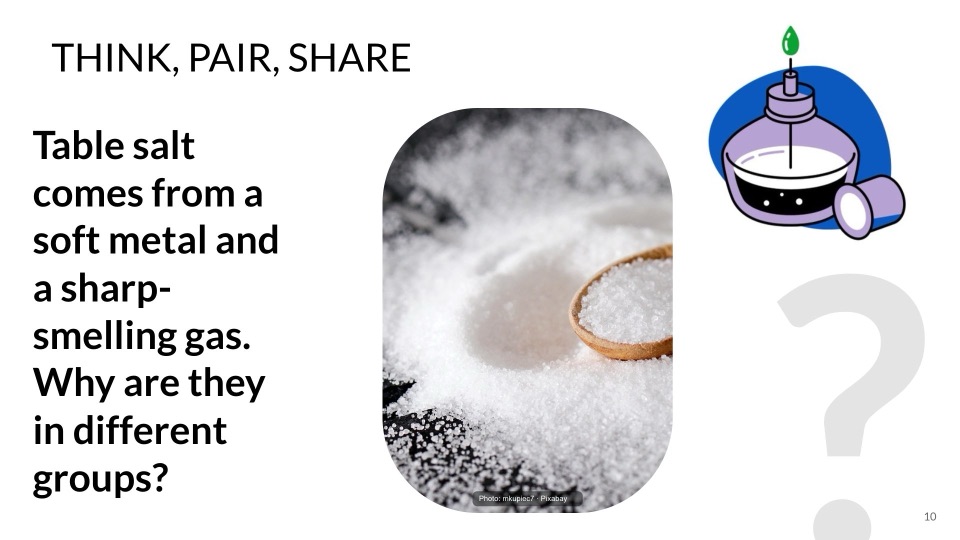
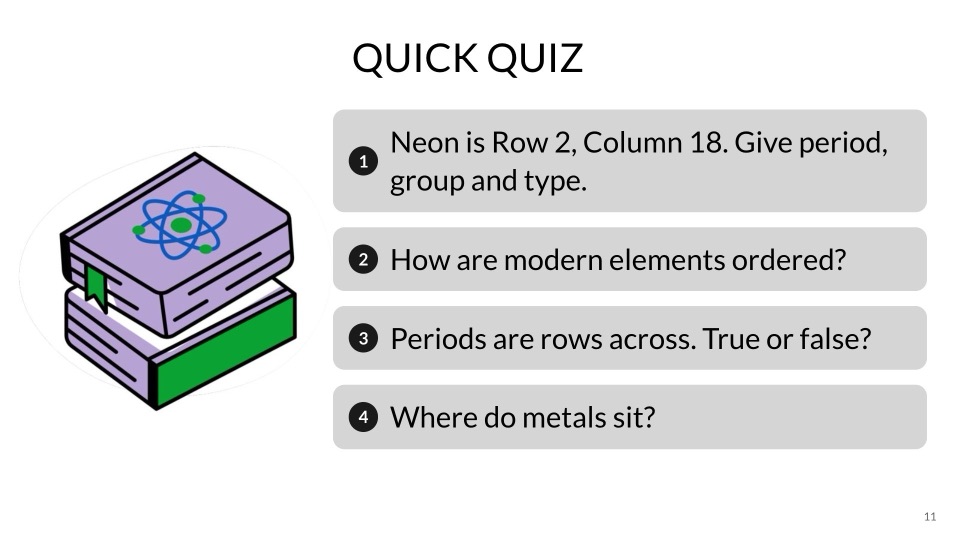
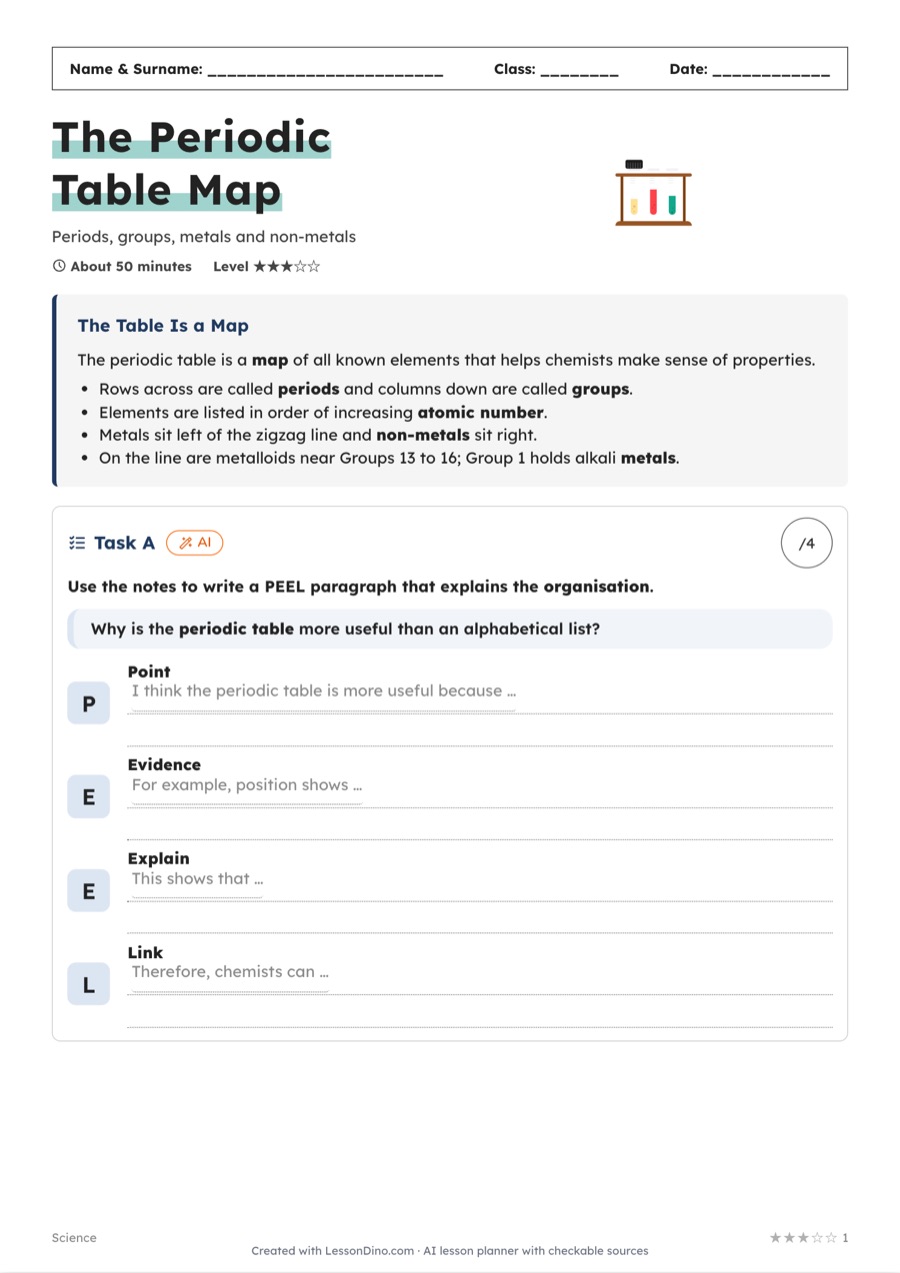
| 10 min | Plenary | To check recall of periods, groups and metal types and link to properties. Hand out Worksheet Task C and give 2 minutes to match period, group, atomic number and metal. Show Slides 9-10 and run think, pair, share on salt from a soft metal and sharp-smelling gas. Show Slide 11 quiz and cold-call period, group and type for neon. |
Common mistakes
- Mixing up period and group
How to spot it: Says period 1, group 3 for an element in Row 3, Column 1
Retrace: rows that run across are periods, columns that run down are groups. Point and say across then down. - Thinking metals are on the right
How to spot it: Labels sulphur or neon as metal because they are on the right
Point to zigzag line between metals and non-metals. Left is mainly metals, right is non-metals. - Thinking order is by mass or alphabet
How to spot it: Looks for element by first letter instead of count
Remind that the table lists elements in order of increasing atomic number and practise finding 11 then 12.
Support
- Half-coloured tables with Group 1 and zigzag pre-marked plus word bank for shiny, dull, bendy and brittle
- Printed table sections showing neighbours in atomic-number order to copy the pattern
Stretch
- Add pattern notes on reactivity or number of electron shells shared in a group
- Predict links between position and electrons in energy levels for confident pairs
Check questions
- Chlorine sits in Row 3, Column 17 on the right of the zigzag. Give period, group and type.
Answer: Period 3, group 17, non-metal. - How are modern elements ordered on the periodic table?
Answer: In order of increasing atomic number. - Why do chemists organise elements into periods and groups?
Answer: To make sense of their physical and chemical properties and spot patterns.
Curriculum
the periodic table: periods and groups; metals and non-metals
Video clips
Clips on YouTube, from the start and end times we chose. Check each one before you show it.
-
Periods and Groups from 0:00 to 3:04
FuseSchool - Global Education: What Are Periods & Groups In The Periodic Table? | Properties of Matter | Chemistry | FuseSchool
Exactly on periods and groups with clear animation made for ages 13-14.
-
How the periodic table works from 0:00 to 4:31
FuseSchool - Global Education: How Does The Periodic Table Work | Properties of Matter | Chemistry | FuseSchool
Explains layout, periods, groups and metals clearly for ages 13-14.
Worksheet
Sources
- Subject: Year 9 Atomic Structure and the Periodic Table ravenswood.bromley.sch.uk
- Year 9 Curriculum Knowledge At A Glance kls.herts.sch.uk
- UC periodic table poster A2 canterbury.ac.nz
- Free Printable Periodic Tables (PDF and PNG) sciencenotes.org
- Fun Periodic Table Activities (Free Printable) littlebinsforlittlehands.com
- Fun Activities for Teaching the Periodic Table ⋆ Sunrise Science sunrisescienceclassroom.com
- book 9780141185149 the periodic table paperback mallbooks.gitlab.io
- the periodic table paperback 9780141185149 colib.netlify.app
- Periodic Table Educational Resources for Ages 15-18 acs.org
Picture credits
Made with Lesson Dino's AI on 17 October 2026. AI can make mistakes, so check facts against the sources before you teach.