The worksheet
About this worksheet
Students learn that cylinder volume is circle area stacked by height. They measure, calculate, and solve cylinder problems in pairs. This Grade 8 Math worksheet gives students (ages 13–14) five pages of practice on volume of cylinders, part of the geometry unit. It goes with our free Volume of cylinders lesson, which has the slides and a timed lesson plan.
What it covers
By the end, students should be able to:
- Students will find the volume of cylinders using V equals pi r squared h.
- Students will solve real-world cylinder problems and report answers in cubic units.
How to use it
- Paired practice (12 minutes): Hand out Worksheet Task D: Solve each volume problem. Use 3.14 for pi.
- Plenary (8 minutes): Preview homework from Worksheet Task B.
- Support: Give circles with radius labeled and formula cards with squared numbers table.
- Stretch: Ask for missing height from given volume and radius and a second design with same volume but wider base.
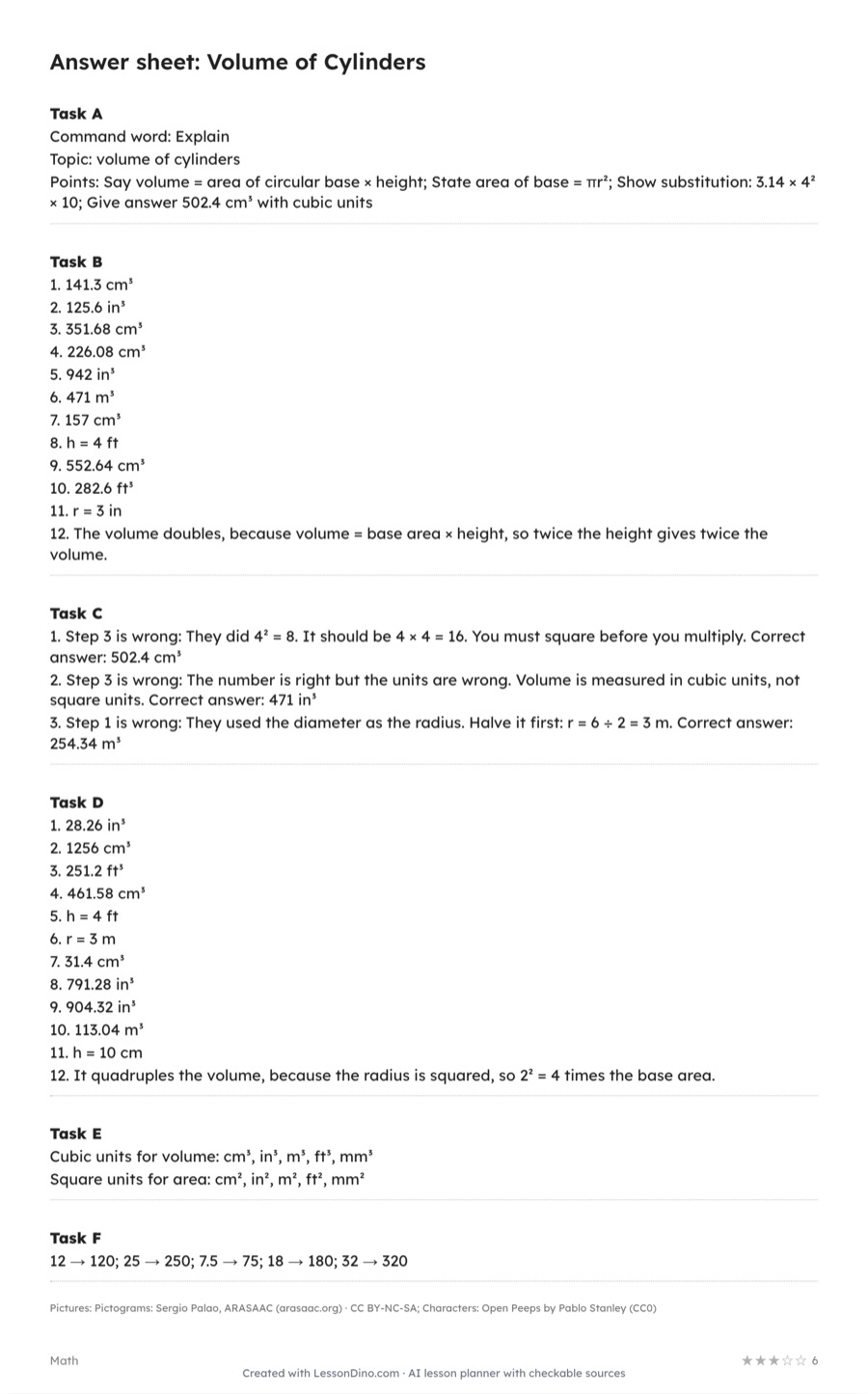
- The answer sheet is the last page, so you can print it on its own or let students check their own work.
Key vocabulary
- volume: the three-dimensional amount of space that an object occupies
- radius: the distance from the center of the circular base to its edge
- height: the distance between the two circular bases
- base area: the flat circular face size found with pi times r squared
- cubic units: units used to report volume, like cubic inches or cubic centimeters
Mistakes to watch for
- Using diameter as radius. If the diameter is provided, divide it by 2 to find the radius.
- Multiplying radius by height before squaring. Remind students of order and link to prism formula: finding the area of the cross-section first.
- Labeling volume in square units or no units. Restate volume is measured in cubic units and capacity in cubic units.
What's on the worksheet
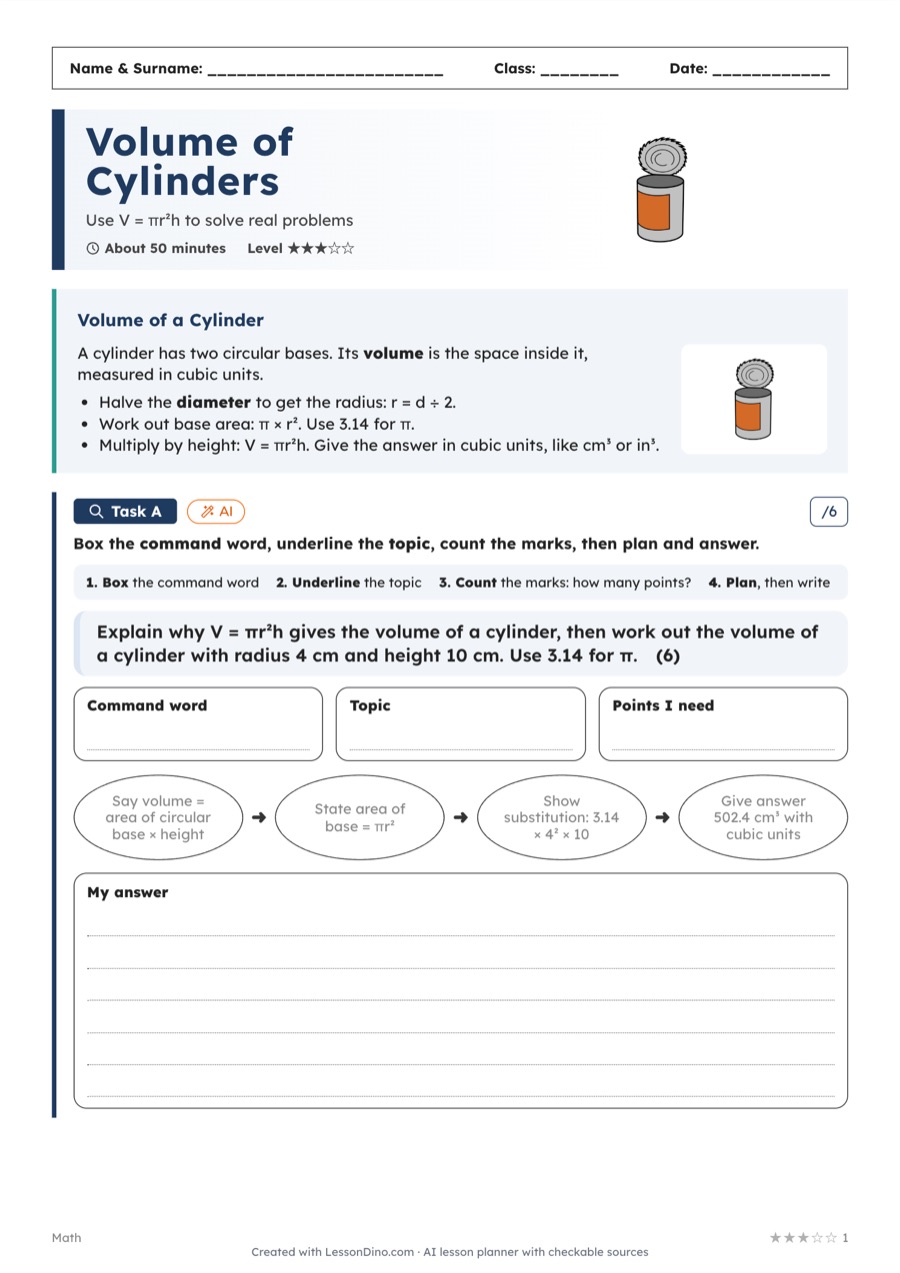
Crack the Question
Recall the formula and break down an exam question.
Volume of a Cylinder
- A cylinder has two circular bases. Its volume is the space inside it, measured in cubic units.
- Halve the diameter to get the radius: r = d ÷ 2.
- Work out base area: π × r². Use 3.14 for π.
- Multiply by height: V = πr²h. Give the answer in cubic units, like cm³ or in³.
Box the command word, underline the topic, count the marks, then plan and answer.
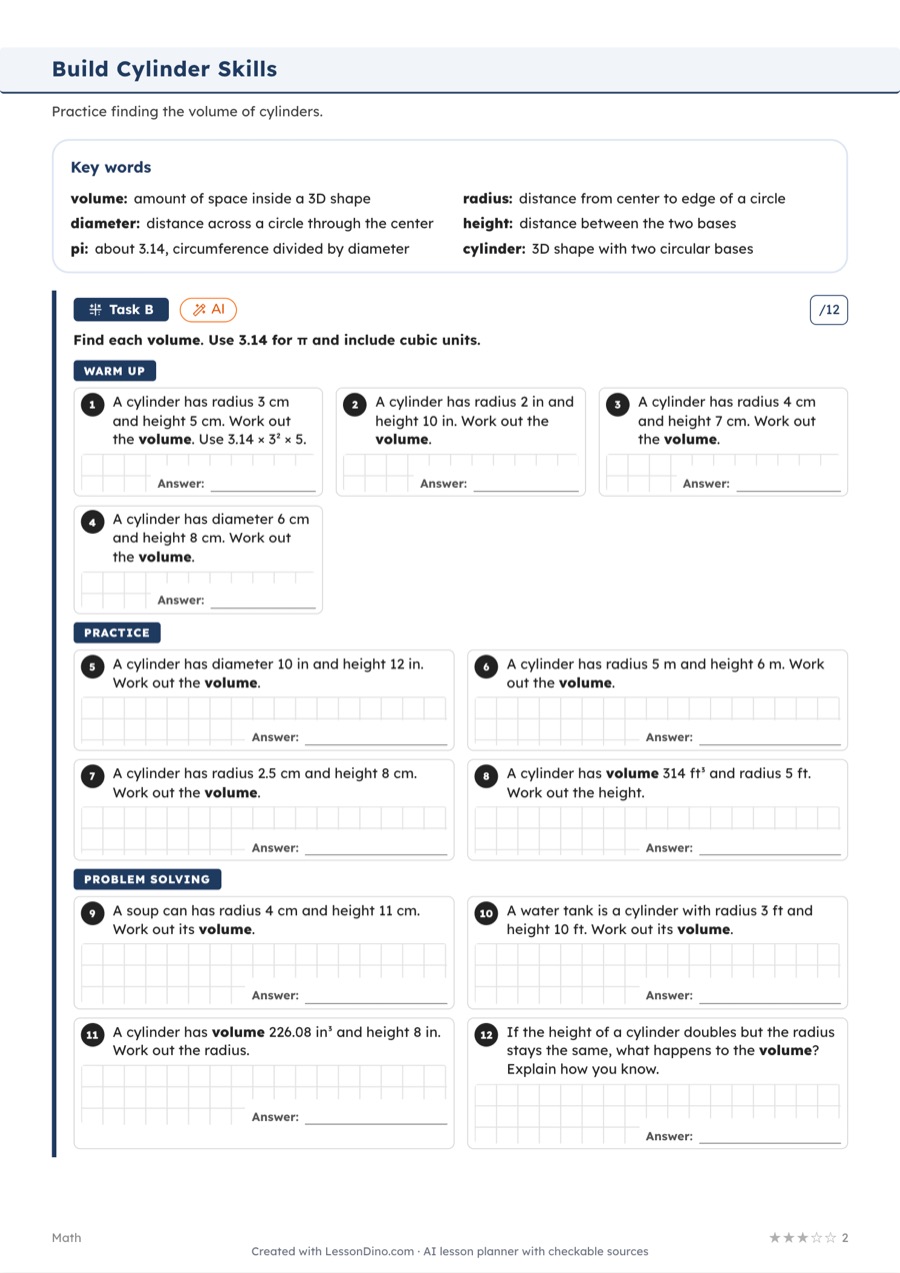
Build Cylinder Skills
Practice finding the volume of cylinders.
| Word | Meaning |
|---|---|
| volume | amount of space inside a 3D shape |
| radius | distance from center to edge of a circle |
| diameter | distance across a circle through the center |
| height | distance between the two bases |
| pi | about 3.14, circumference divided by diameter |
| cylinder | 3D shape with two circular bases |
Find each volume. Use 3.14 for π and include cubic units.
Warm up
- A cylinder has radius 3 cm and height 5 cm. Work out the volume. Use 3.14 × 3² × 5.
- A cylinder has radius 2 in and height 10 in. Work out the volume.
- A cylinder has radius 4 cm and height 7 cm. Work out the volume.
- A cylinder has diameter 6 cm and height 8 cm. Work out the volume.
Practice
- A cylinder has diameter 10 in and height 12 in. Work out the volume.
- A cylinder has radius 5 m and height 6 m. Work out the volume.
- A cylinder has radius 2.5 cm and height 8 cm. Work out the volume.
- A cylinder has volume 314 ft³ and radius 5 ft. Work out the height.
Problem solving
- A soup can has radius 4 cm and height 11 cm. Work out its volume.
- A water tank is a cylinder with radius 3 ft and height 10 ft. Work out its volume.
- A cylinder has volume 226.08 in³ and height 8 in. Work out the radius.
- If the height of a cylinder doubles but the radius stays the same, what happens to the volume? Explain how you know.
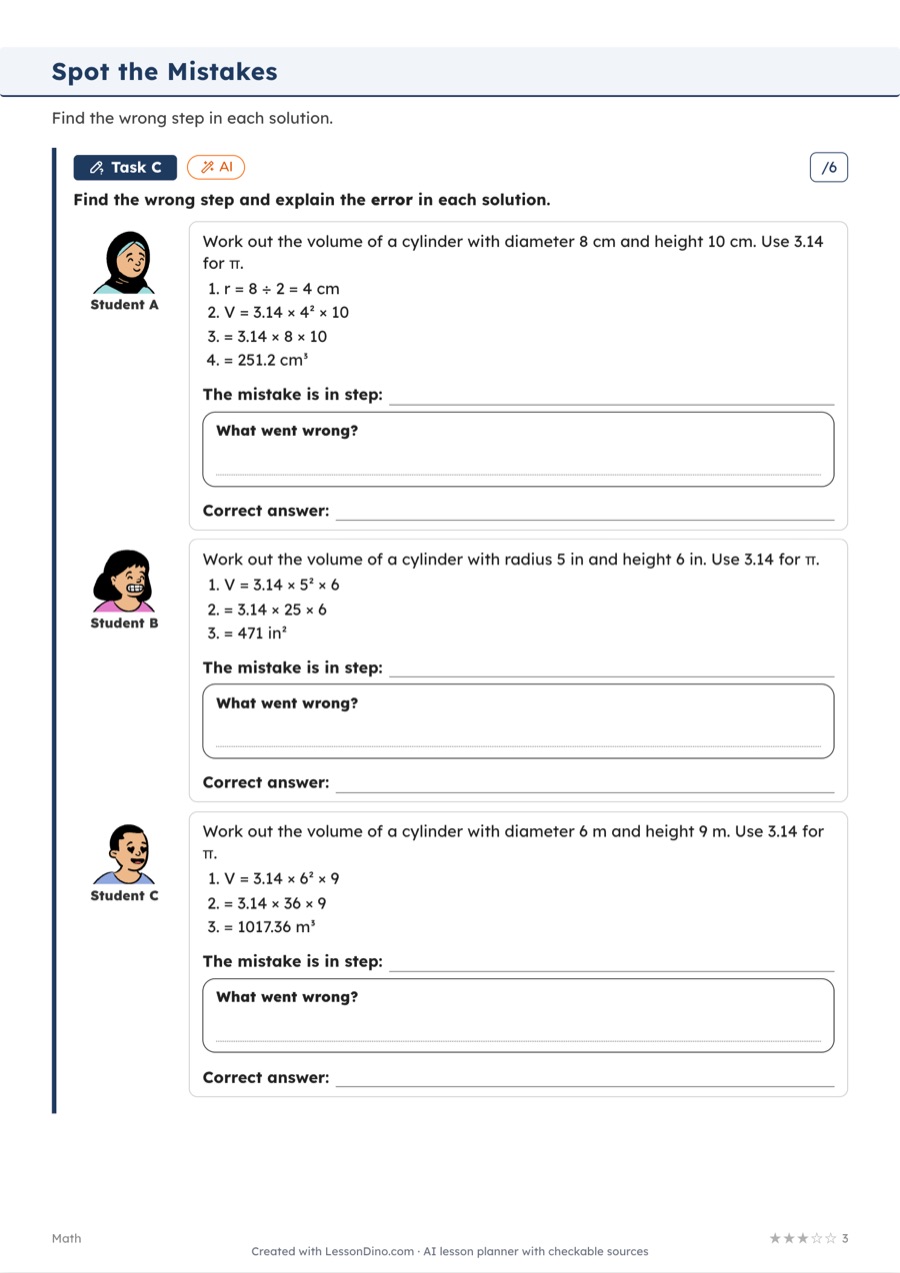
Spot the Mistakes
Find the wrong step in each solution.
Find the wrong step and explain the error in each solution.
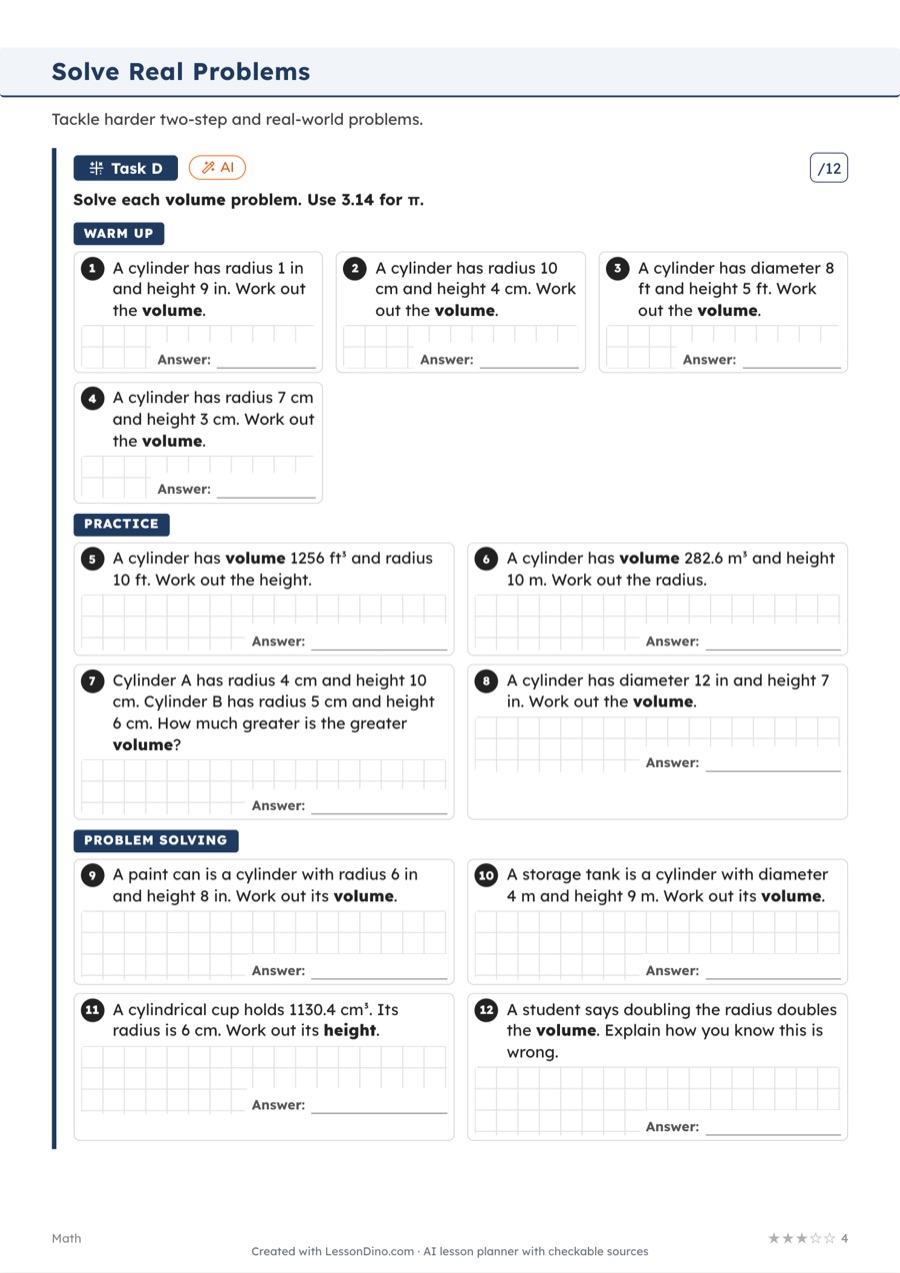
Solve Real Problems
Tackle harder two-step and real-world problems.
Solve each volume problem. Use 3.14 for π.
Warm up
- A cylinder has radius 1 in and height 9 in. Work out the volume.
- A cylinder has radius 10 cm and height 4 cm. Work out the volume.
- A cylinder has diameter 8 ft and height 5 ft. Work out the volume.
- A cylinder has radius 7 cm and height 3 cm. Work out the volume.
Practice
- A cylinder has volume 1256 ft³ and radius 10 ft. Work out the height.
- A cylinder has volume 282.6 m³ and height 10 m. Work out the radius.
- Cylinder A has radius 4 cm and height 10 cm. Cylinder B has radius 5 cm and height 6 cm. How much greater is the greater volume?
- A cylinder has diameter 12 in and height 7 in. Work out the volume.
Problem solving
- A paint can is a cylinder with radius 6 in and height 8 in. Work out its volume.
- A storage tank is a cylinder with diameter 4 m and height 9 m. Work out its volume.
- A cylindrical cup holds 1130.4 cm³. Its radius is 6 cm. Work out its height.
- A student says doubling the radius doubles the volume. Explain how you know this is wrong.
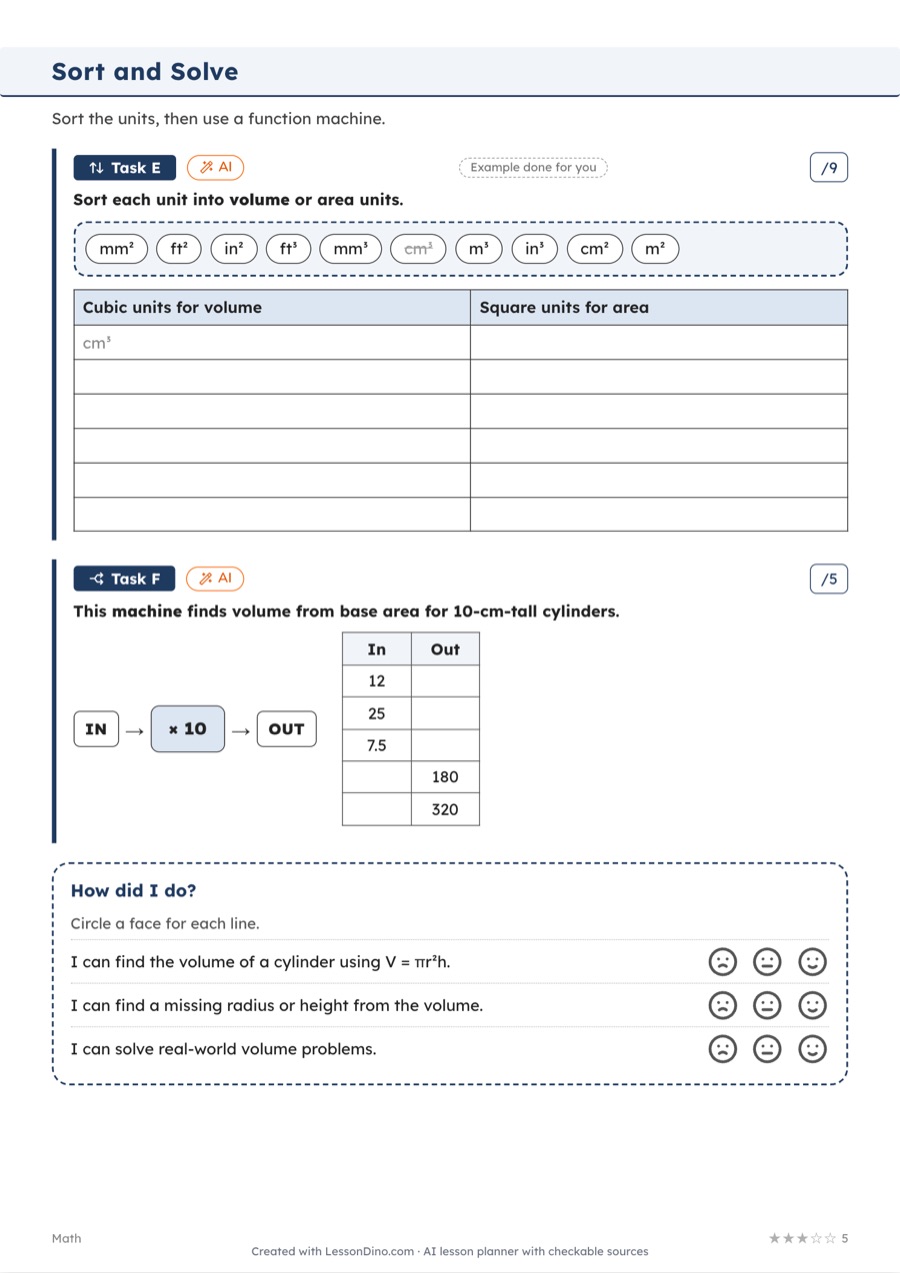
Sort and Solve
Sort the units, then use a function machine.
Sort each unit into volume or area units.
This machine finds volume from base area for 10-cm-tall cylinders.
Answers
Show the answers
- A cylinder has radius 3 cm and height 5 cm. Work out the volume. Use 3.14 × 3² × 5. 141.3 cm³
- A cylinder has radius 2 in and height 10 in. Work out the volume. 125.6 in³
- A cylinder has radius 4 cm and height 7 cm. Work out the volume. 351.68 cm³
- A cylinder has diameter 6 cm and height 8 cm. Work out the volume. 226.08 cm³
- A cylinder has diameter 10 in and height 12 in. Work out the volume. 942 in³
- A cylinder has radius 5 m and height 6 m. Work out the volume. 471 m³
- A cylinder has radius 2.5 cm and height 8 cm. Work out the volume. 157 cm³
- A cylinder has volume 314 ft³ and radius 5 ft. Work out the height. h = 4 ft
- A soup can has radius 4 cm and height 11 cm. Work out its volume. 552.64 cm³
- A water tank is a cylinder with radius 3 ft and height 10 ft. Work out its volume. 282.6 ft³
- A cylinder has volume 226.08 in³ and height 8 in. Work out the radius. r = 3 in
- If the height of a cylinder doubles but the radius stays the same, what happens to the volume? Explain how you know. The volume doubles, because volume = base area × height, so twice the height gives twice the volume.
- A cylinder has radius 1 in and height 9 in. Work out the volume. 28.26 in³
- A cylinder has radius 10 cm and height 4 cm. Work out the volume. 1256 cm³
- A cylinder has diameter 8 ft and height 5 ft. Work out the volume. 251.2 ft³
- A cylinder has radius 7 cm and height 3 cm. Work out the volume. 461.58 cm³
- A cylinder has volume 1256 ft³ and radius 10 ft. Work out the height. h = 4 ft
- A cylinder has volume 282.6 m³ and height 10 m. Work out the radius. r = 3 m
- Cylinder A has radius 4 cm and height 10 cm. Cylinder B has radius 5 cm and height 6 cm. How much greater is the greater volume? 31.4 cm³
- A cylinder has diameter 12 in and height 7 in. Work out the volume. 791.28 in³
- A paint can is a cylinder with radius 6 in and height 8 in. Work out its volume. 904.32 in³
- A storage tank is a cylinder with diameter 4 m and height 9 m. Work out its volume. 113.04 m³
- A cylindrical cup holds 1130.4 cm³. Its radius is 6 cm. Work out its height. h = 10 cm
- A student says doubling the radius doubles the volume. Explain how you know this is wrong. It quadruples the volume, because the radius is squared, so 2² = 4 times the base area.
The answer sheet is the last picture above.
Curriculum
Know the formulas for the volumes of cones, cylinders, and spheres and use them to solve real-world and mathematical problems.
Made with Lesson Dino's AI on 17 October 2026. AI can make mistakes, so check the answers and facts against the sources before you teach.