Slides
Lesson plan
Stacks of Circles: Volume of Cylinders
Students learn that cylinder volume is circle area stacked by height. They measure, calculate, and solve cylinder problems in pairs.
Objectives
- Students will find the volume of cylinders using V equals pi r squared h.
- Students will solve real-world cylinder problems and report answers in cubic units.
Success criteria
- I can calculate base area first and then multiply by height.
- I can find cylinder volume from radius or diameter correctly.
Key words
| Word | Meaning |
|---|---|
| volume | the three-dimensional amount of space that an object occupies |
| radius | the distance from the center of the circular base to its edge |
| height | the distance between the two circular bases |
| base area | the flat circular face size found with pi times r squared |
| cubic units | units used to report volume, like cubic inches or cubic centimeters |
Timed plan (60 minutes)
| Time | Stage | What happens |
|---|---|---|
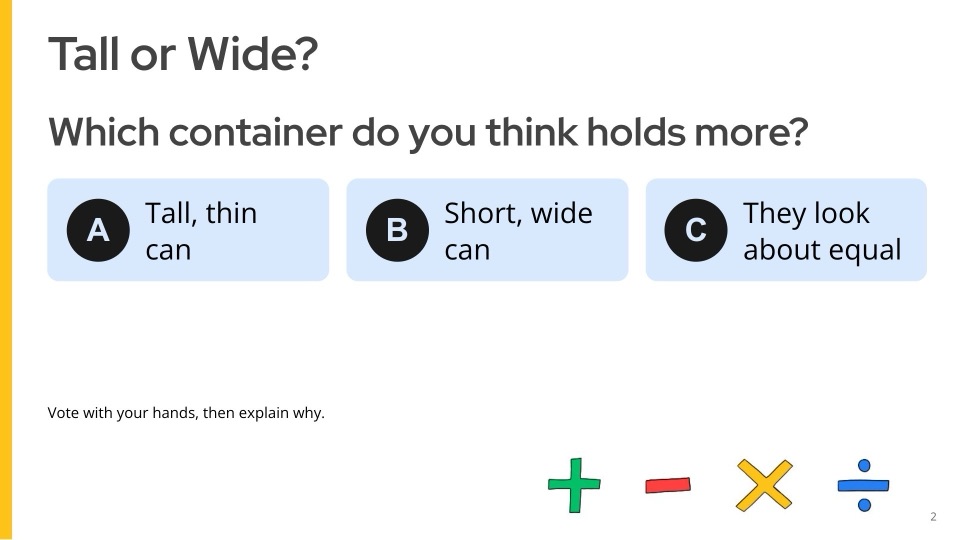
| 8 min | Starter | Spark curiosity about capacity and recall circle area for cylinder volume. Show Slide 1: Volume of Cylinders [title]: How much can it hold inside? and read the title question. Show Slide 2 Tall or Wide? vote and ask: What if a cylinder is just a stack of circles — how many would we need? Take a vote for tall thin can, short wide can, or about equal and ask 2 students to explain. Link answers to lesson goal: find cylinder volume from base area times height. |
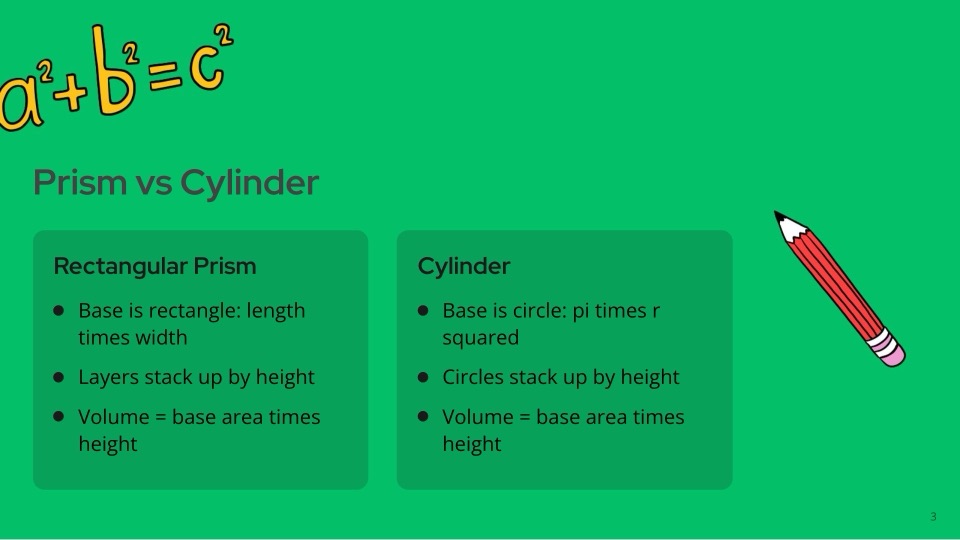
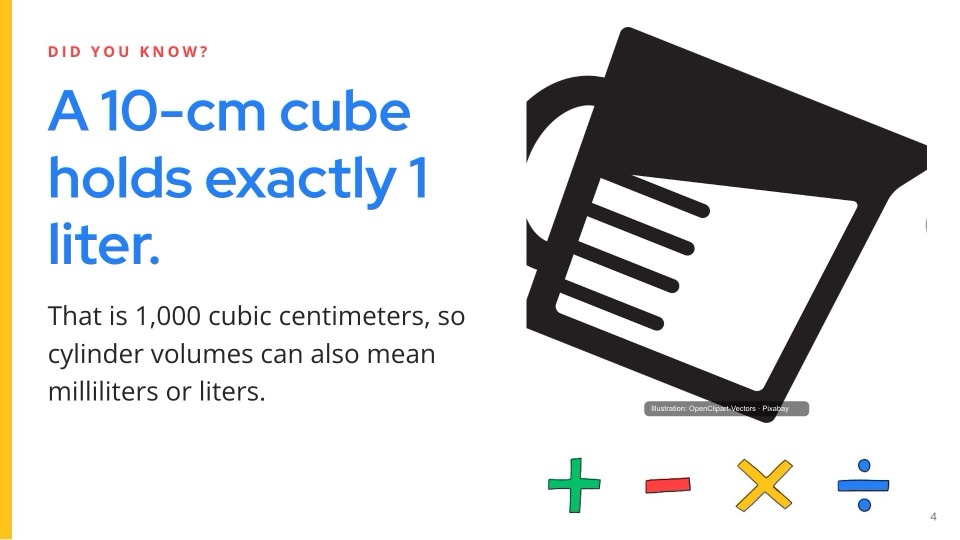
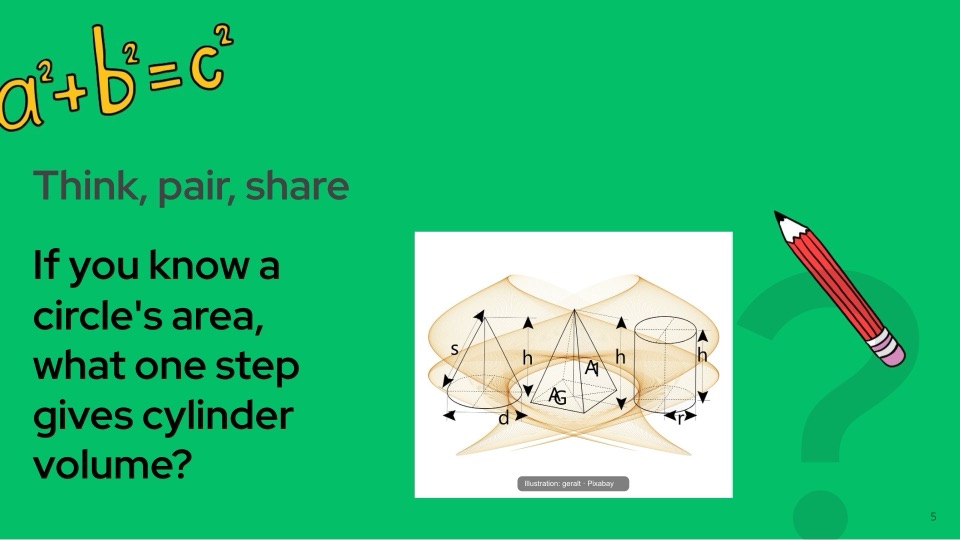
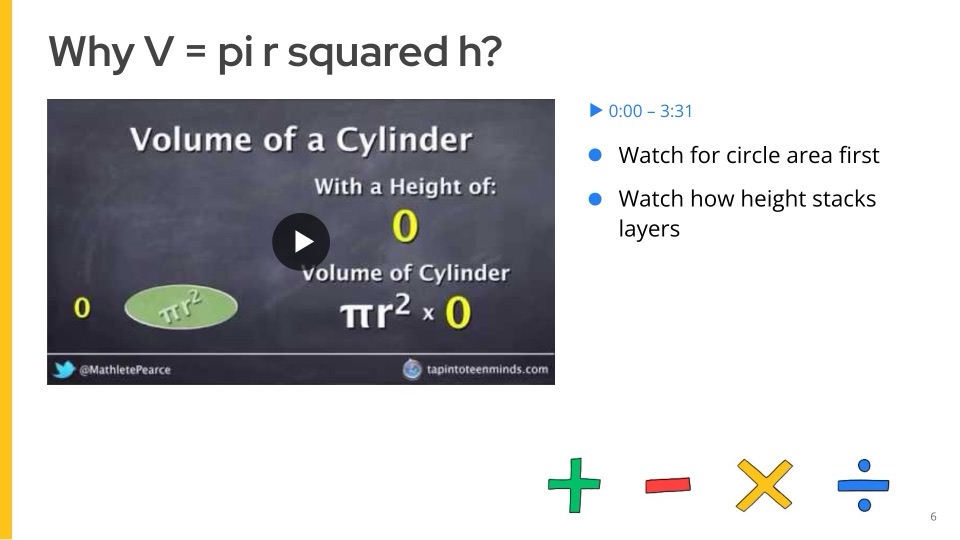
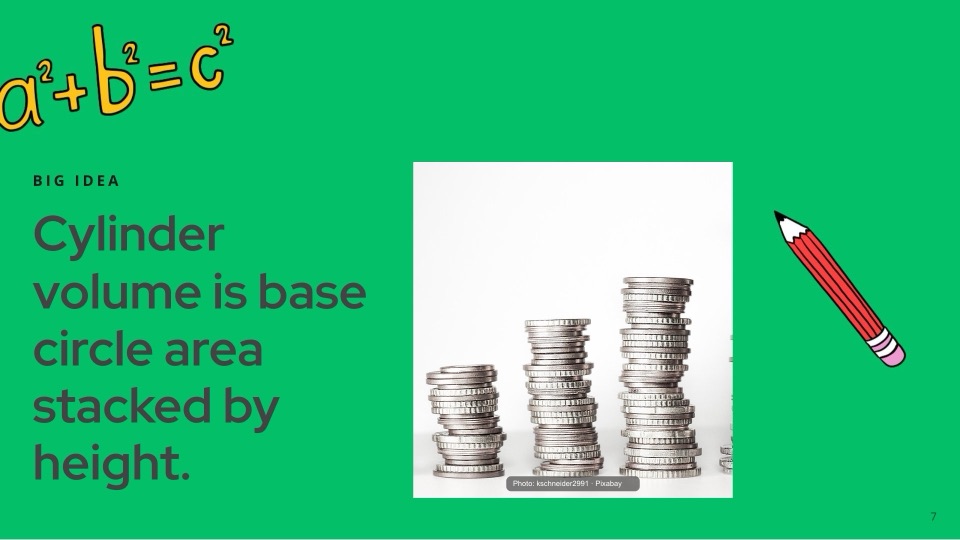
| 12 min | Teaching | Model how base circle area times height gives V equals pi r squared h. Show Slide 3 Prism vs Cylinder compare and explain prism layers stack up by height. Show Slide 4 fact that a 10-cm cube holds 1 liter and Slide 5 Think, pair, share question. Play Slide 6 Video clip 3 (0:00–3:31) with focus: watch for circle area first and how height stacks layers. Model worked example on board and state Slide 7 Big idea: Cylinder volume is base circle area stacked by height. |
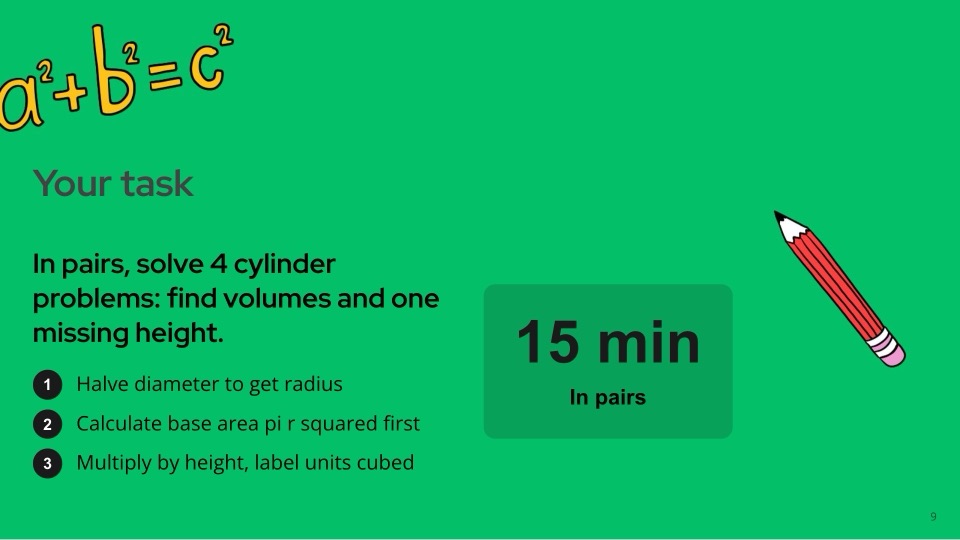
| 20 min | Main activity | Build cylinder volume by measuring circles and multiplying base area by height. Hand out printed circles, rulers, calculators, and tape and show Slide 9 Your task steps. Demo: measure radius, which is the distance from the center of the circular base to its edge, find base area, then multiply by height, which is the distance between the two circular bases. Have pairs build two stacks with same base but different heights and calculate V = pi r squared h, which works because volume is the area of the cross-section multiplied by its height. Circulate, check units in cubic units, and prompt comparison of the two stacks. |
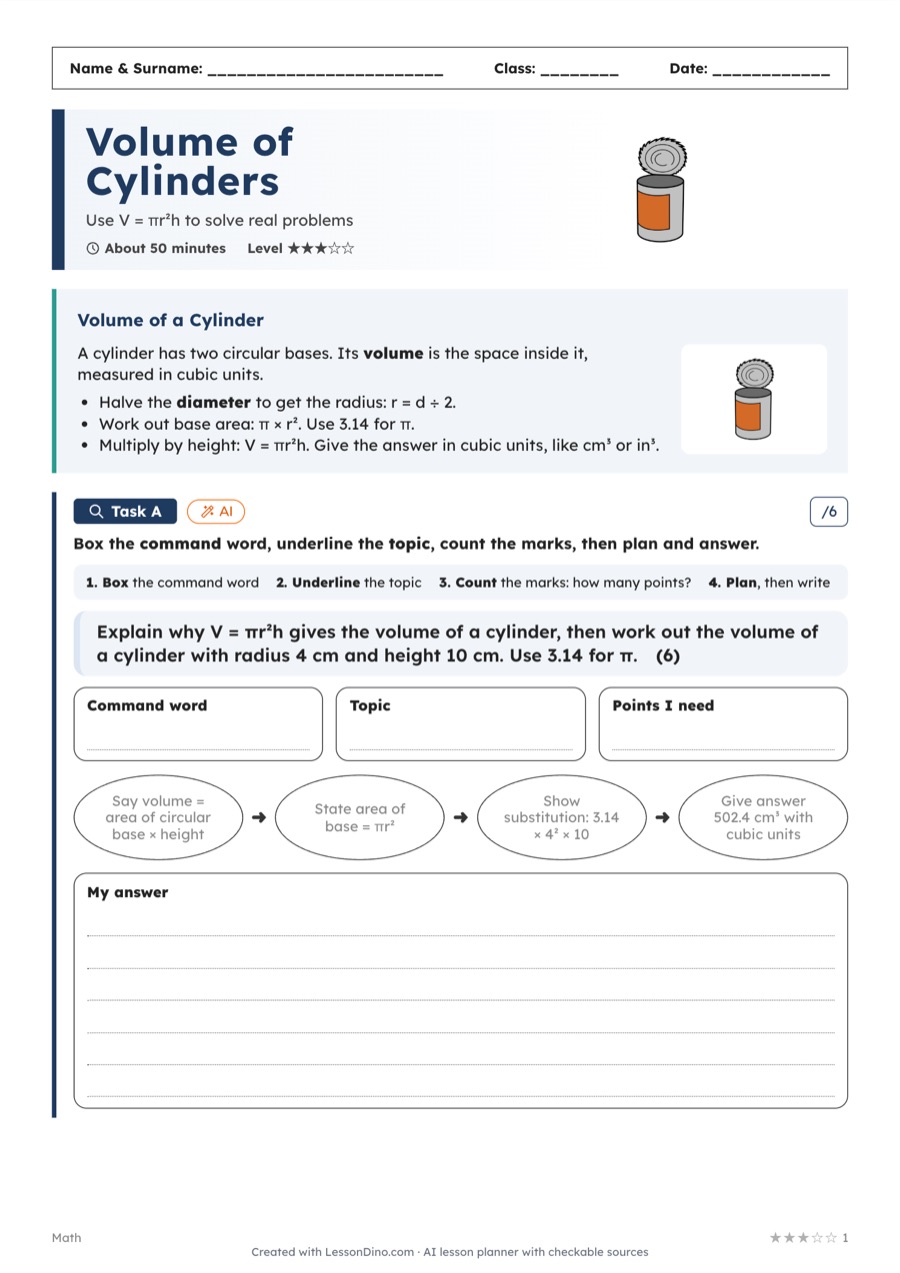
| 12 min | Paired practice | Apply the formula quickly to find volumes from radius and height. Hand out Worksheet Task D: Solve each volume problem. Use 3.14 for pi. Remind class: check radius or diameter, square first then multiply, and keep all lengths in the same unit before multiplying. Set timer for 8 minutes for pairs to solve and label cubic units. Stop and have pairs trade papers to check base area times height matches volume. |
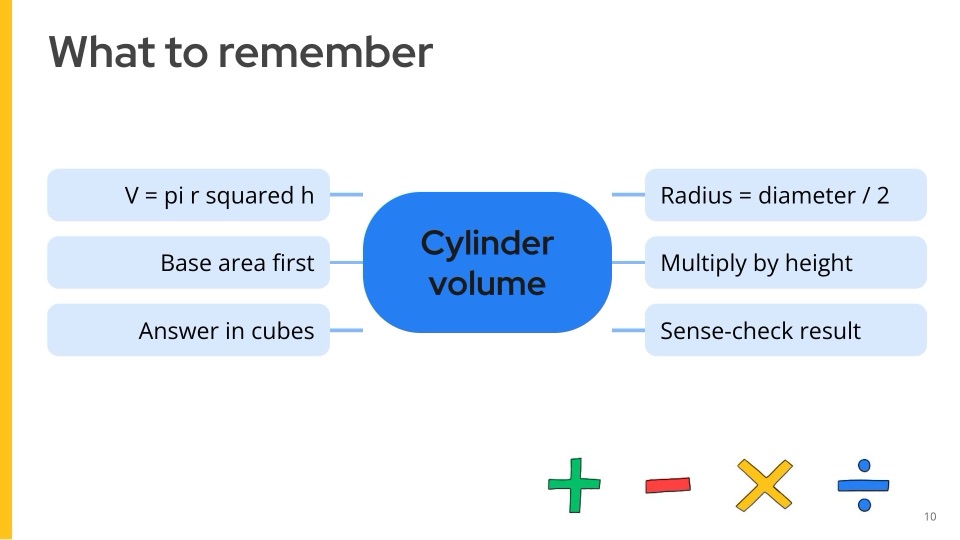
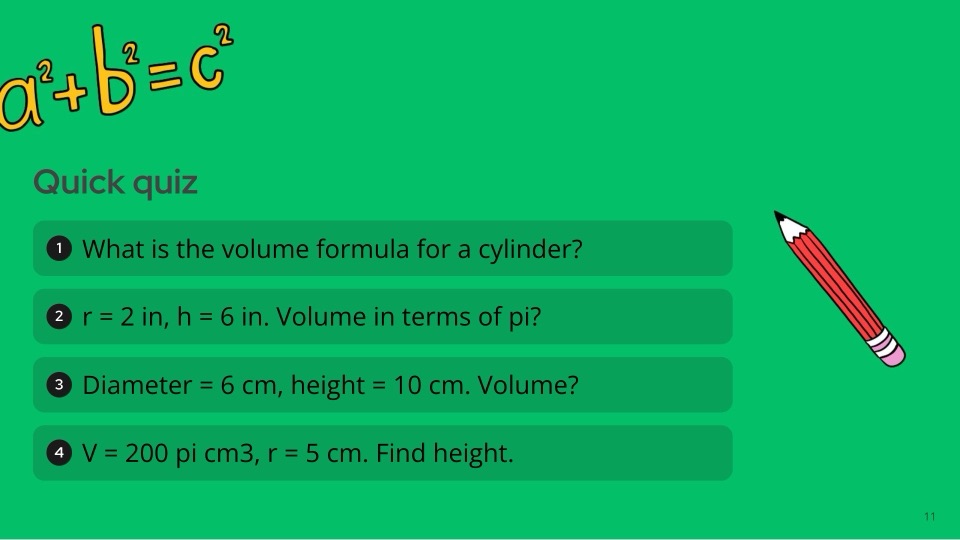
| 8 min | Plenary | Confirm the formula, units, and radius check before leaving. Show Slide 10 What to remember mindmap and ask students to recite V = pi r squared h together. Show Slide 11 Quick quiz and solve r = 2 in, h = 6 in together in terms of pi. Ask exit questions on formula, radius from diameter, and sense-checking result. Preview homework from Worksheet Task B. |
Common mistakes
- Using diameter as radius
How to spot it: Volume 4 times too big, base uses full diameter
If the diameter is provided, divide it by 2 to find the radius - Multiplying radius by height before squaring
How to spot it: Work shows r x h in parentheses squared
Remind students of order and link to prism formula: finding the area of the cross-section first - Labeling volume in square units or no units
How to spot it: Answer says cm2 or just a number
Restate volume is measured in cubic units and capacity in cubic units
Support
- Give circles with radius labeled and formula cards with squared numbers table
Stretch
- Ask for missing height from given volume and radius and a second design with same volume but wider base
Check questions
- What is the volume formula for a cylinder?
Answer: V = pi r squared h - r = 2 in, h = 6 in. Volume in terms of pi?
Answer: 24 pi cubic inches, about 75.4 in3 - Diameter = 6 cm, height = 8 cm. What radius and volume with pi = 3.14?
Answer: r = 3 cm, volume = 226.08 cm3
Curriculum
Know the formulas for the volumes of cones, cylinders, and spheres and use them to solve real-world and mathematical problems.
Video clips
Clips on YouTube, from the start and end times we chose. Check each one before you show it.
-
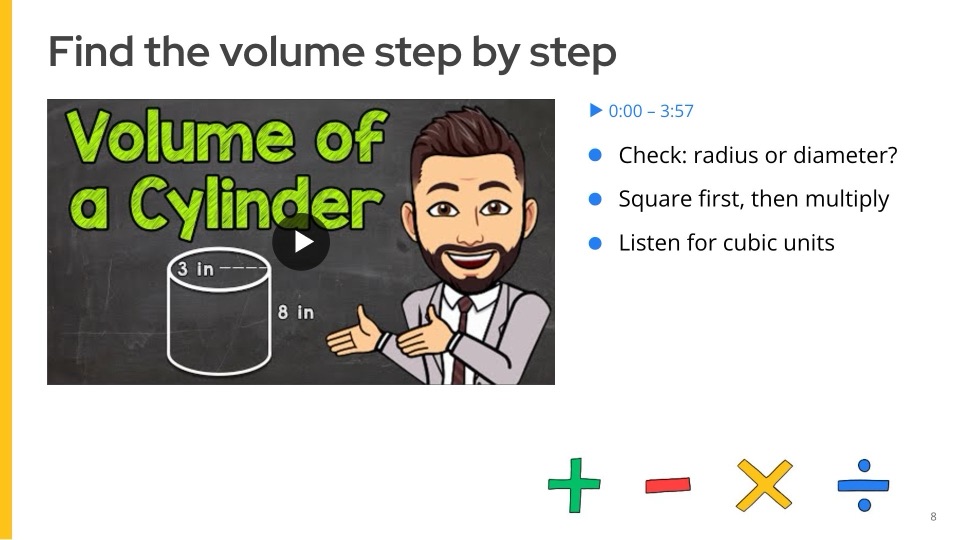
Find the volume of a cylinder from 0:00 to 3:57
Math with Mr. J: How to Find the Volume of a Cylinder | Math with Mr. J
Perfect pace and vocabulary for 13-14 year olds learning V = pi r squared h with worked examples.
-
Where the cylinder formula comes from from 0:00 to 3:31
Kyle Pearce: Where Does The Volume of a Cylinder Formula Come From?
Ideal conceptual fit for age 13-14 to understand why volume is area of circle times height.
Worksheet
Sources
- Grade 8 Math | SFUSD sfusd.edu
- New York State Next Generation Mathematics Learning Standards ... nysed.gov
- Volume - NASA grc.nasa.gov
- Circumference, Area and Volume | NIST nist.gov
- Math Help: Volume of cylinders, cones, spheres and pyramids guides.library.tulsacc.edu
- SURFACE AREA AND VOLUME - University of Houston online.math.uh.edu
- Volume of a Right Circular Cylinder - ResourceCenter resourcecenter.byupathway.edu
- SI Units - Volume | NIST nist.gov
- Volume of a cylinder - Calculating the volume of a standard ... bbc.co.uk
- Surface area and volume of a cylinder - KS3 Maths - BBC bbc.co.uk
- Lesson: Volume of cylinders | Oak National Academy thenational.academy
- Volume of cylinders KS3 | Y8 Maths | Lesson Resources thenational.academy
- Volume of cylinders (practice) | Khan Academy khanacademy.org
- Volume of cylinders (practice) | Geometry | Khan Academy khanacademy.org
- Volume of cylinders (practice) | 4th quarter | Khan Academy en.khanacademy.org
- How to calculate the volume of cylinders and prisms - BBC ... bbc.co.uk
- Cylinder Volume Formula: How to Calculate the Volume of a ... tutoring.k12.com
- Volumes of Cylinders – GeoGebra geogebra.org
- Volume of Cylinders | CK-12 Foundation flexbooks.ck12.org
- Cylinder | Definition, Formula, Volume, Shape, Edges ... britannica.com
- Volume of a Cylinder - Super Teacher Worksheets superteacherworksheets.com
- Teaching Volume of Cylinders, Cones, and Spheres teachertwins.com
- Volume of Cylinders – Explanation & Examples storyofmathematics.com
- Volume of a Cylinder - Formula | How to Find Volume of Cylinder? cuemath.com
- Volume and Surface Area of Cylinders - K12 Math Worksheets k12mathworksheets.com
Picture credits
- Illustration: OpenClipart-Vectors · Pixabay
- Illustration: geralt · Pixabay
- Photo: kschneider2991 · Pixabay
- Pictograms: Sergio Palao, ARASAAC (arasaac.org) · CC BY-NC-SA
Made with Lesson Dino's AI on 17 October 2026. AI can make mistakes, so check facts against the sources before you teach.