Slides
Lesson plan
Making Equivalents With Exponent Rules
Students learn product, quotient, power, zero and negative rules. They play a team relay to make equivalent numerical expressions.
Objectives
- Students will rewrite same-base products, quotients and powers as single powers.
- Students will use zero and negative exponents to generate equivalent expressions.
Success criteria
- I can add exponents to multiply same-base powers.
- I can subtract or multiply exponents to divide or power a power.
- I can rewrite zero and negative exponents as 1 or fractions.
Key words
| Word | Meaning |
|---|---|
| base | the number that is multiplied by itself again and again |
| exponent | the little raised number that shows how many copies to multiply |
| power | a base raised with a count, like 2^3 which equals 8 |
| equivalent | different on paper but equal in value |
| reciprocal | one over a number, like 1 over 2 cubed for 2 to the negative 3 |
Timed plan (60 minutes)
| Time | Stage | What happens |
|---|---|---|
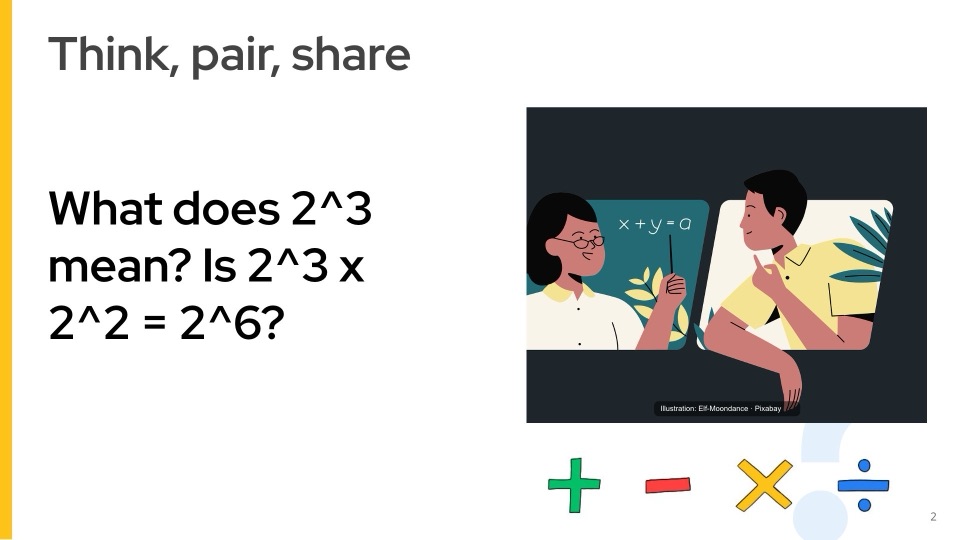
| 7 min | Starter | Recall what exponents mean and hook students into making equivalent forms. Show Slide 1 title and read the goal: make equivalent expressions with exponent rules. Show Slide 2 question and have students think, then tell a partner what 2^3 means. Expand 2^3 as 2 x 2 x 2, which equals 8, and ask if 2^3 x 2^2 equals 2^6. Introduce the relay challenge to the class. |
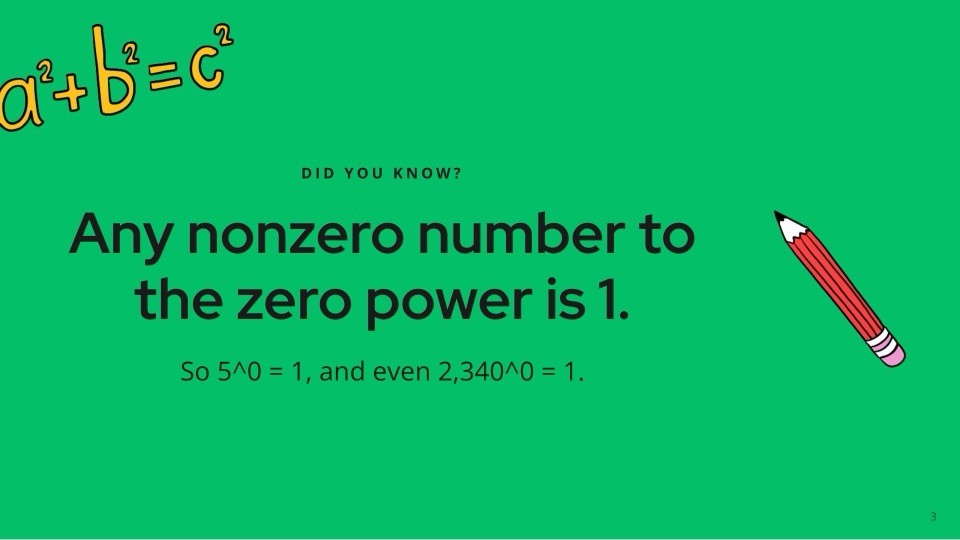
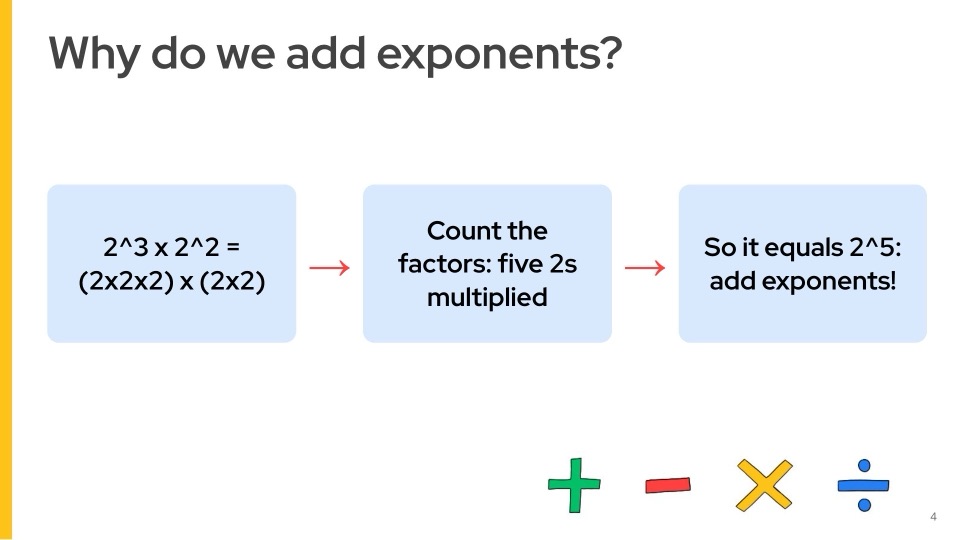
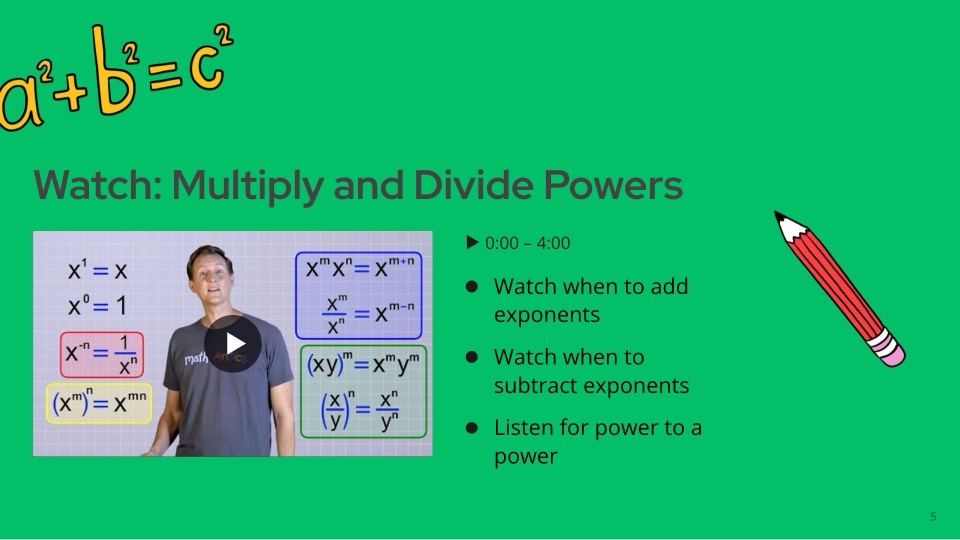
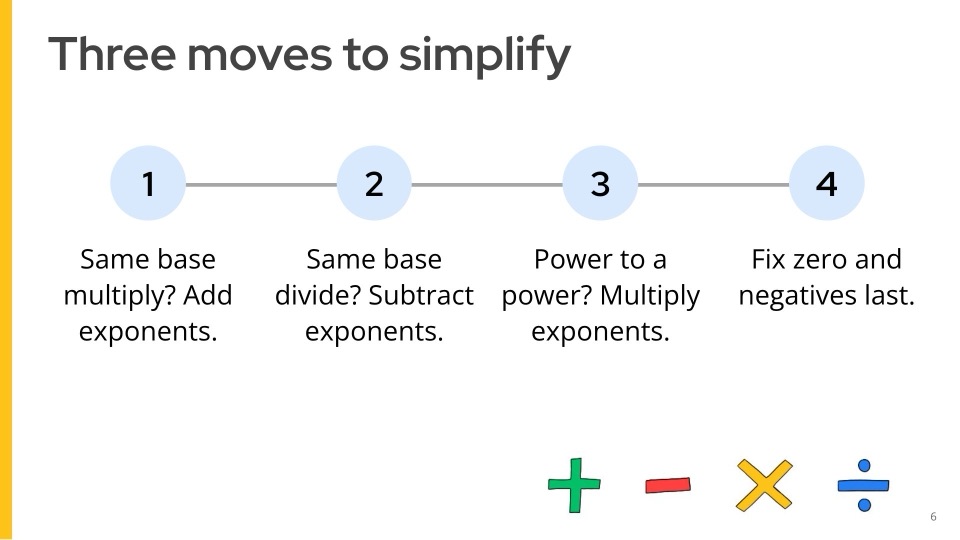
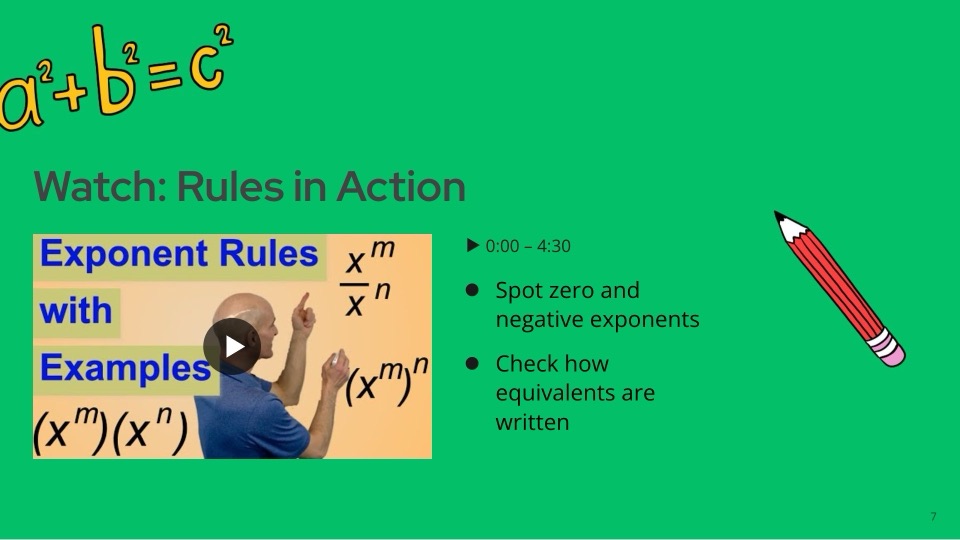
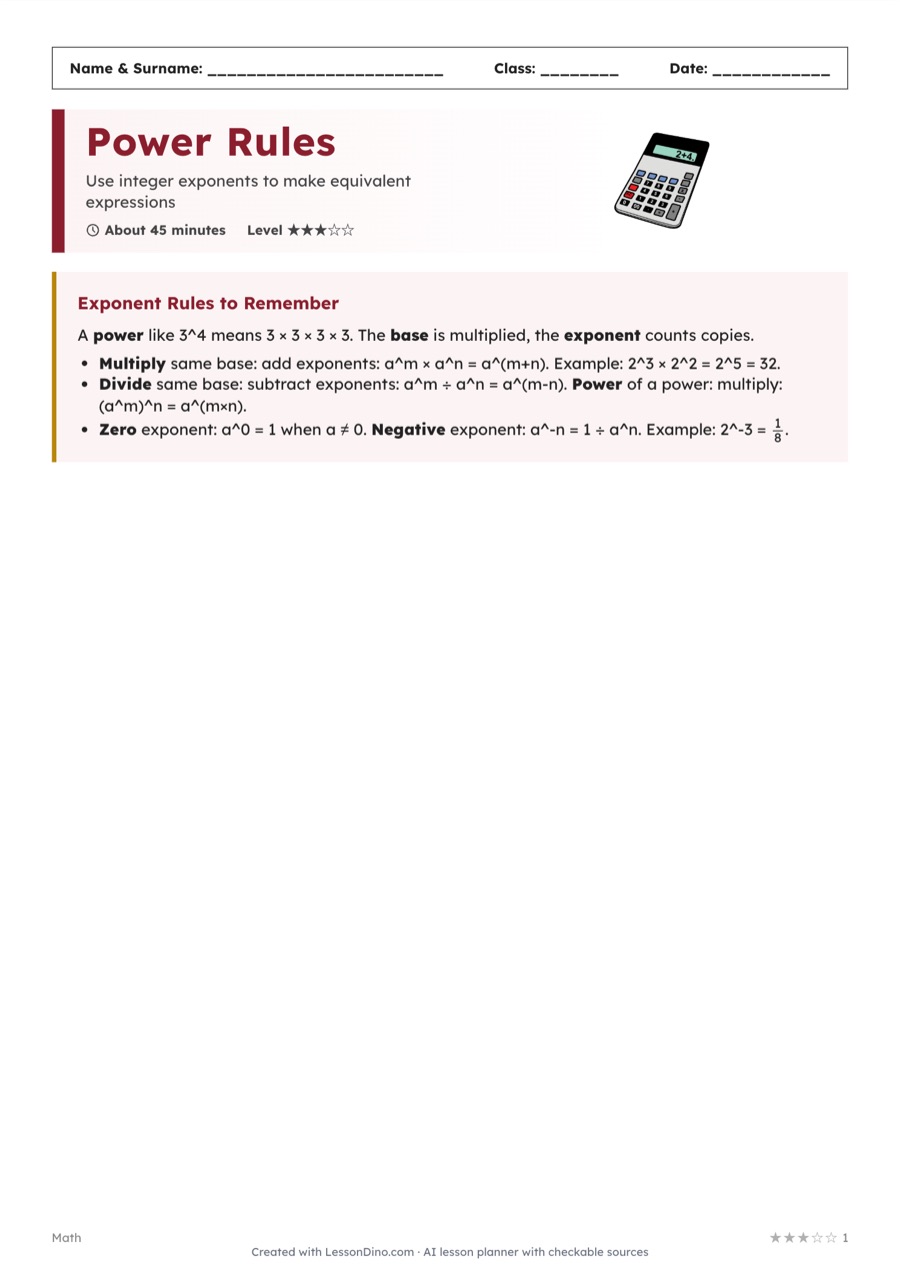
| 13 min | Teaching | Show why we add, subtract and multiply exponents to make equivalent powers. Show Slide 4 chain and expand 2^3 x 2^2 as (2x2x2) x (2x2) to get 2^5, so add exponents when bases match. Show Slide 5 and play Video clip 1, telling students to listen for when to add, when to subtract, and power to a power. Expand x^5 over x^3 and cancel shared factors to leave x squared, so for non-zero x subtract exponents. Show Slide 6 three moves and add that any non-zero number to the zero power is 1 and x to the negative n equals 1 over x to the n. |
| 20 min | Main Activity | Apply two or more rules in teams to generate equivalent numerical expressions. Set clear lanes, hand each team relay task cards, answer sheet, pencils and a rule strip. Model the first card: 5^2 x 5^3 divided by 5^4 becomes 5^5 divided by 5^4, then 5^1, which is 5. Run the relay: one writer at a time, each step must be equivalent, next runner continues. Stop the baton for a non-equivalent step, have the team fix it by expanding, then continue. |
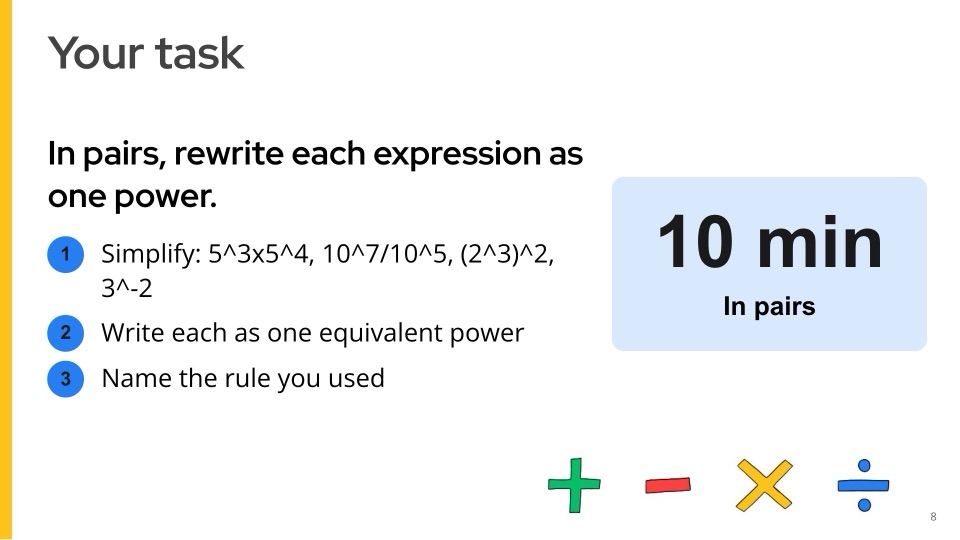
| 12 min | Practice | Practice writing single-power equivalents and naming the rule used. Show Slide 8 task and read the four problems: 5^3x5^4, 10^7/10^5, (2^3)^2, 3^-2. Model one: 4^2 x 4^1 as 4^(2+1), which is 4^3, and 4^3 divided by 4^1 as 4^(3-1), which is 4^2. Hand out Worksheet Task C and have pairs rewrite each expression with the rules, then find the value. Circulate, ask for rule names, and remind students to finish with positive exponents. |
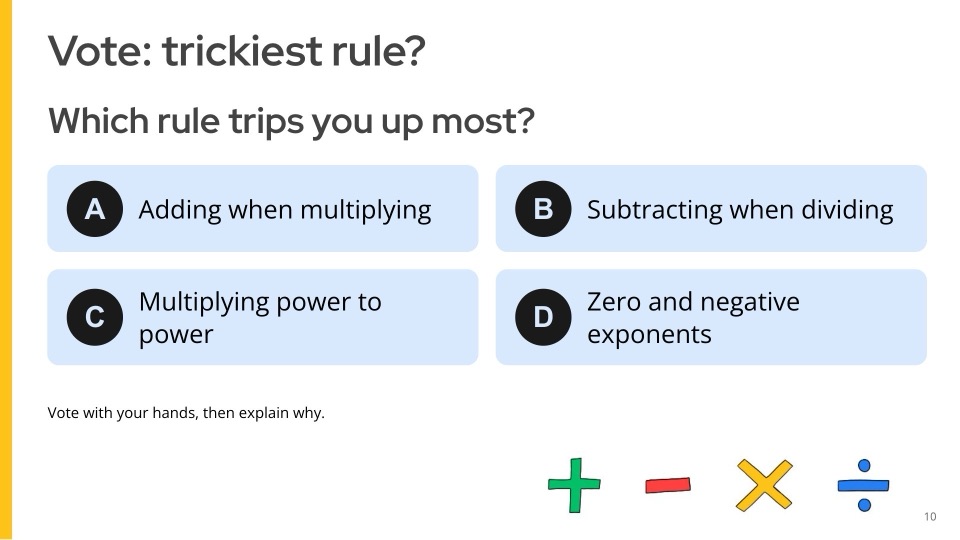
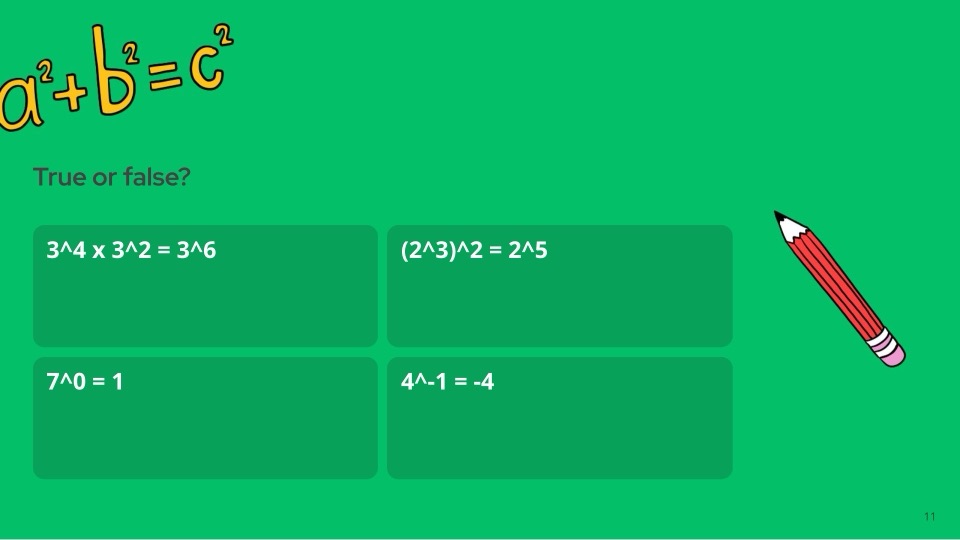
| 8 min | Plenary | Return to objectives and clear up the trickiest exponent rule. Show Slide 10 vote and have students vote which rule trips them up most. Show Slide 11 true or false and work each: 3^4x3^2=3^6 true, (2^3)^2=2^5 false, 7^0=1 true, 4^-1=-4 false. Fix the two false ones: (2^3)^2 = 2^6, multiply 3x2, and 4^-1 = 1 over 4, not -4. Restate success lines and preview exit check. |
Common mistakes
- Adding exponents when adding powers, like 2^3 + 2^3 = 2^6
How to spot it: Student writes 2^6 for a plus problem
Expand to 8 + 8, which is 16, not 64. Add means compute values first. - Using rules with different bases, like 3^2 x 4^2 = 12^4
How to spot it: Student multiplies bases and adds or multiplies exponents
Compute 9 x 16, which is 144. Rules need the same base. - Reading 2^-3 as -8 instead of a fraction
How to spot it: Student keeps a minus sign in the answer
Flip first: 2^-3 = 1 over 2^3 = 1/8 or 0.125. Negative exponent means reciprocal.
Support
- Give each team a rule strip that lists adding exponents when multiplying powers with the same base and subtracting when dividing.
- Provide half-filled expansions with blanks for each factor to count total factors.
- Let students use calculator tables for powers of 2 to see the divide-by-base pattern to 1.
Stretch
- Add a bonus card that requires simplifying 14x^6 divided by x^5 to get 14x.
- Challenge students to expand and simplify 2^4 times 2^3 to get 2^7, which equals 128.
- Ask students to mix rules, like (x^2)^3 times x^4, and show both add and multiply steps.
Check questions
- Simplify 3^4 x 3^2 as one power.
Answer: 3^6 - Simplify (2^3)^2 as one power and value.
Answer: 2^6 = 64 - Write 4^-1 and 7^0 as values.
Answer: 1/4 and 1
Curriculum
Know and apply the properties of integer exponents to generate equivalent numerical expressions.
Video clips
Clips on YouTube, from the start and end times we chose. Check each one before you show it.
-
Laws of Exponents - Product and Quotient from 0:00 to 4:00
mathantics: Algebra Basics: Laws Of Exponents - Math Antics
Directly teaches product, quotient, and power rules for equivalent expressions with pace and visuals made for 13-14-year-olds.
-
Exponent Rules with Examples from 0:00 to 4:30
Mario's Math Tutoring: Exponent Rules with Examples
Covers integer exponent properties with clear numeric examples at the right pace for 13-14-year-olds.
Worksheet
Sources
- Grade 8 | Common Core State Standards Initiative thecorestandards.org
- Grade 8 Math | SFUSD sfusd.edu
- What Is An Exponent? | Learning Blocks | University of Arkansas learningblocks.uark.edu
- Powers, Exponents, and their Dependencies - Emory University math.oxford.emory.edu
- Exponents | Math Blocks | Learning Blocks | University of Arkansas learningblocks.uark.edu
- Section 2.3: Properties of Exponents and Logarithms openbooks.library.baylor.edu
- Basic Exponents - tsc.fl.edu tsc.fl.edu
- Exponents - Emory University mathcenter.oxford.emory.edu
- Expressions with exponents | Algebra basics | Math | Khan Academy khanacademy.org
- Intro to exponents (article) | Khan Academy en.khanacademy.org
- Exponent | mathematics | Britannica britannica.com
- Meaning of exponents (practice) | Exponents | Khan Academy khanacademy.org
- Properties of exponents Study Guide | CK-12 Foundation flexbooks.ck12.org
- Intro to exponents - Khan Academy khanacademy.org
- Capital and Labor Income Pareto Exponents in the United States, 1916-2019 ideas.repec.org
- Exponents & Powers Worksheets (Grades 8–12) — Free PDF mathanvil.com
- Exponents Worksheets with Answer Key (30 Free Printable PDFs ... algebra911.com
- Exponent Formulas - Rules, Examples & Practice Problems | Math for Students workybooks.com
- Exponents: Printable Worksheets superteacherworksheets.com
- Exponents Explained: Definition, Examples, Practice & Video ... pearson.com
- Exponents: Complete Guide with Rules & Examples – HeLovesMath helovesmath.com
- Exponents - IXL ixl.com
- Exponents in Math Explained | Grade 7 Examples and Practice analyzemath.com
- Exponents - Math Steps, Examples & Questions - Third Space Learning thirdspacelearning.com
- Exponents Resources - Education.com education.com
Picture credits
- Photo: Firmbee · Pixabay
- Illustration: Elf-Moondance · Pixabay
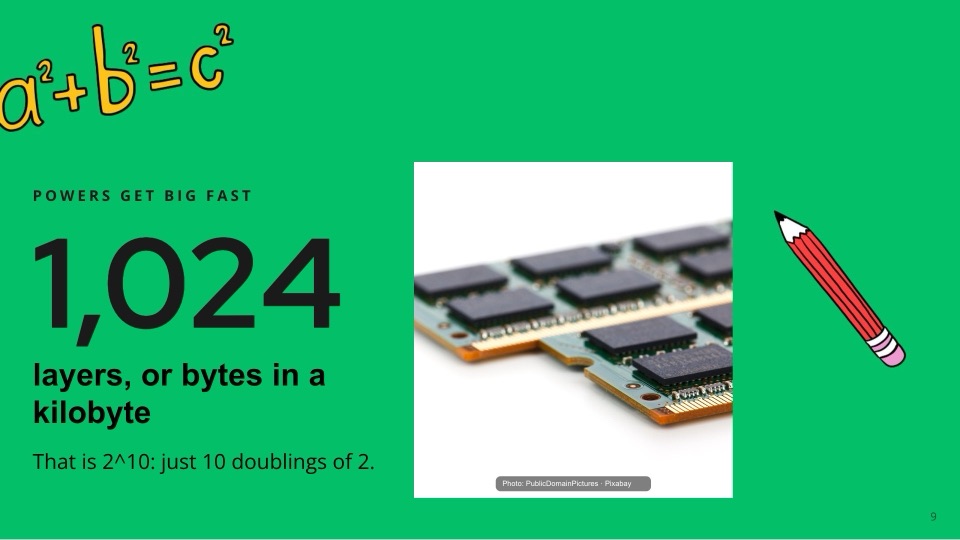
- Photo: PublicDomainPictures · Pixabay
- Pictograms: Sergio Palao, ARASAAC (arasaac.org) · CC BY-NC-SA
Made with Lesson Dino's AI on 17 October 2026. AI can make mistakes, so check facts against the sources before you teach.