The worksheet

About this worksheet
Students learn to use a² + b² = c² for legs, hypotenuses, and box diagonals. They solve ladder, screen, and delivery-box challenges in pairs. This Grade 8 Math worksheet gives students (ages 13–14) seven pages of practice on the Pythagorean theorem, part of the geometry unit. It goes with our free The Pythagorean theorem lesson, which has the slides and a timed lesson plan.
What it covers
By the end, students should be able to:
- Students will find missing hypotenuse and leg lengths with a² + b² = c².
- Students will solve real-world 2D problems with ladders, screens, and shortcuts.
- Students will use two steps to find space diagonals inside rectangular boxes.
How to use it
- Guided Practice (12 minutes): Solve together using Worksheet Task B routine: circle hypotenuse, add or subtract.
- Main Activity (20 minutes): Hand out boxes, rulers, calculators, colored pencils, and Worksheet Task C.
- Support: Two-box template for Step 1 base and Step 2 height to space diagonal.
- Stretch: Largest whole-inch rod that fits and taller vs wider box comparison.
- The answer sheet is the last page, so you can print it on its own or let students check their own work.
Key vocabulary
- hypotenuse: the longest side in a right triangle, across from the right angle
- leg: one of the two shorter sides that meet to make the right angle
- right triangle: a triangle that has one corner exactly 90 degrees
- space diagonal: a straight line through the inside of a box from bottom corner to opposite top corner
- square root: the number that times itself makes the given number
Mistakes to watch for
- Forgetting to take the square root and giving c² as length. Require last line √__ = __ with units; show 9 + 16 = 25 needs √25 = 5 to get side from area.
- Labeling a leg as c, so adding when should subtract. Circle hypotenuse first; hypotenuse is longest side opposite right angle, and use a² + b² = c² with c as hypotenuse.
- Using the theorem on a non-right triangle. Check for right-angle mark first; test 7² + 8² = 113, not 81, so not right since squares of short sides must add to square of long side.
What's on the worksheet
Remember the Rule
Recall the theorem and spot the hypotenuse.
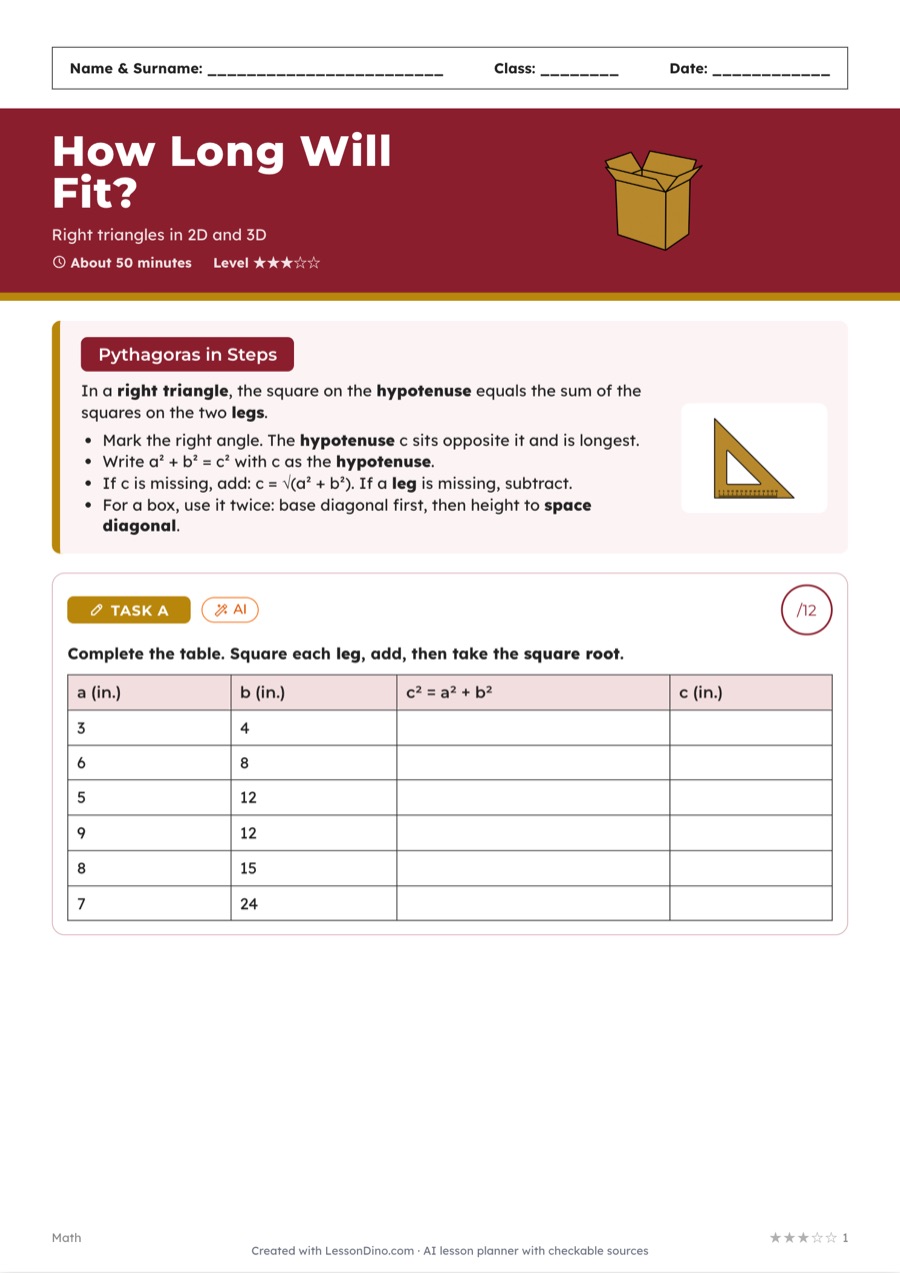
Pythagoras in Steps
- In a right triangle, the square on the hypotenuse equals the sum of the squares on the two legs.
- Mark the right angle. The hypotenuse c sits opposite it and is longest.
- Write a² + b² = c² with c as the hypotenuse.
- If c is missing, add: c = √(a² + b²). If a leg is missing, subtract.
- For a box, use it twice: base diagonal first, then height to space diagonal.
Complete the table. Square each leg, add, then take the square root.
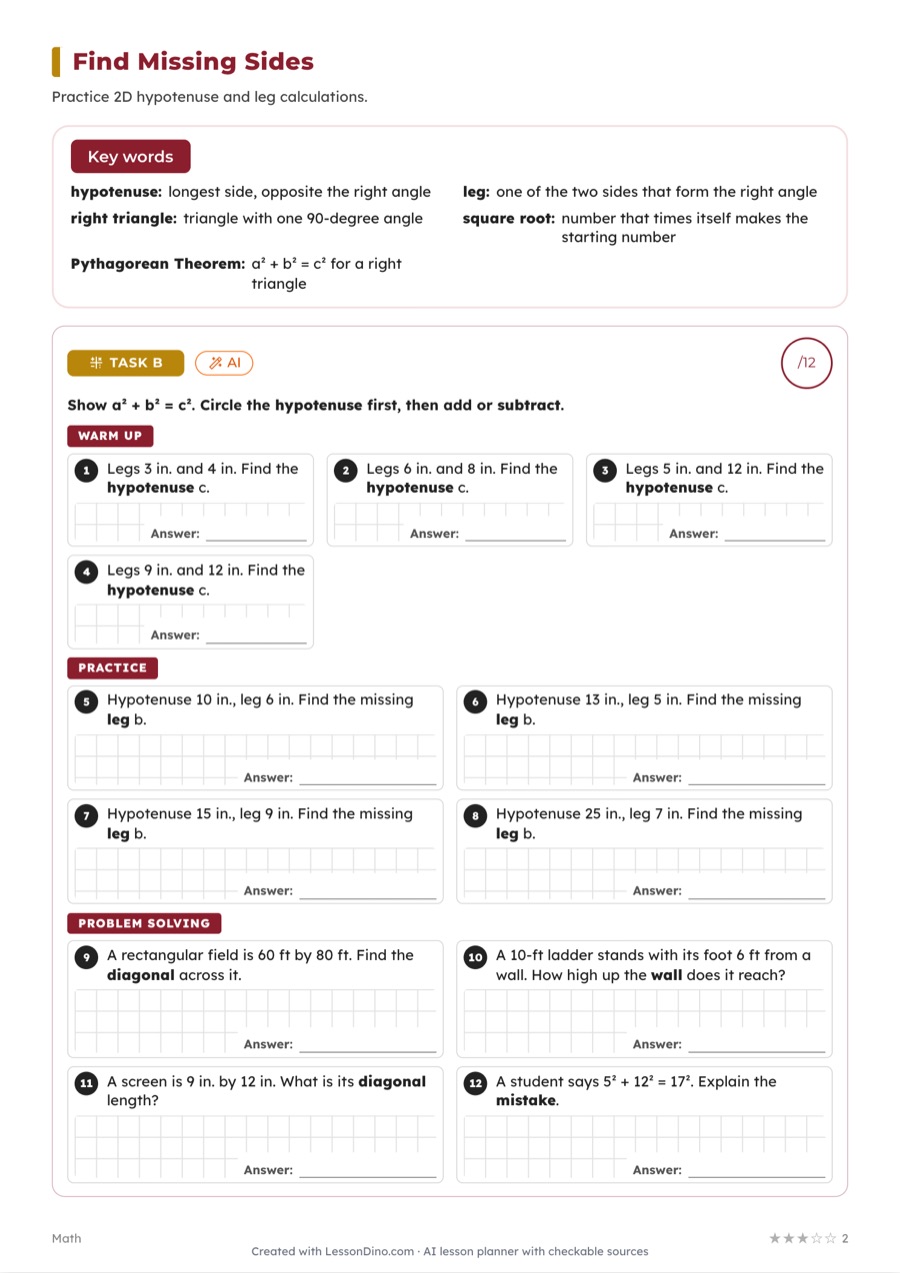
Find Missing Sides
Practice 2D hypotenuse and leg calculations.
| Word | Meaning |
|---|---|
| hypotenuse | longest side, opposite the right angle |
| leg | one of the two sides that form the right angle |
| right triangle | triangle with one 90-degree angle |
| square root | number that times itself makes the starting number |
| Pythagorean Theorem | a² + b² = c² for a right triangle |
Show a² + b² = c². Circle the hypotenuse first, then add or subtract.
Warm up
- Legs 3 in. and 4 in. Find the hypotenuse c.
- Legs 6 in. and 8 in. Find the hypotenuse c.
- Legs 5 in. and 12 in. Find the hypotenuse c.
- Legs 9 in. and 12 in. Find the hypotenuse c.
Practice
- Hypotenuse 10 in., leg 6 in. Find the missing leg b.
- Hypotenuse 13 in., leg 5 in. Find the missing leg b.
- Hypotenuse 15 in., leg 9 in. Find the missing leg b.
- Hypotenuse 25 in., leg 7 in. Find the missing leg b.
Problem solving
- A rectangular field is 60 ft by 80 ft. Find the diagonal across it.
- A 10-ft ladder stands with its foot 6 ft from a wall. How high up the wall does it reach?
- A screen is 9 in. by 12 in. What is its diagonal length?
- A student says 5² + 12² = 17². Explain the mistake.
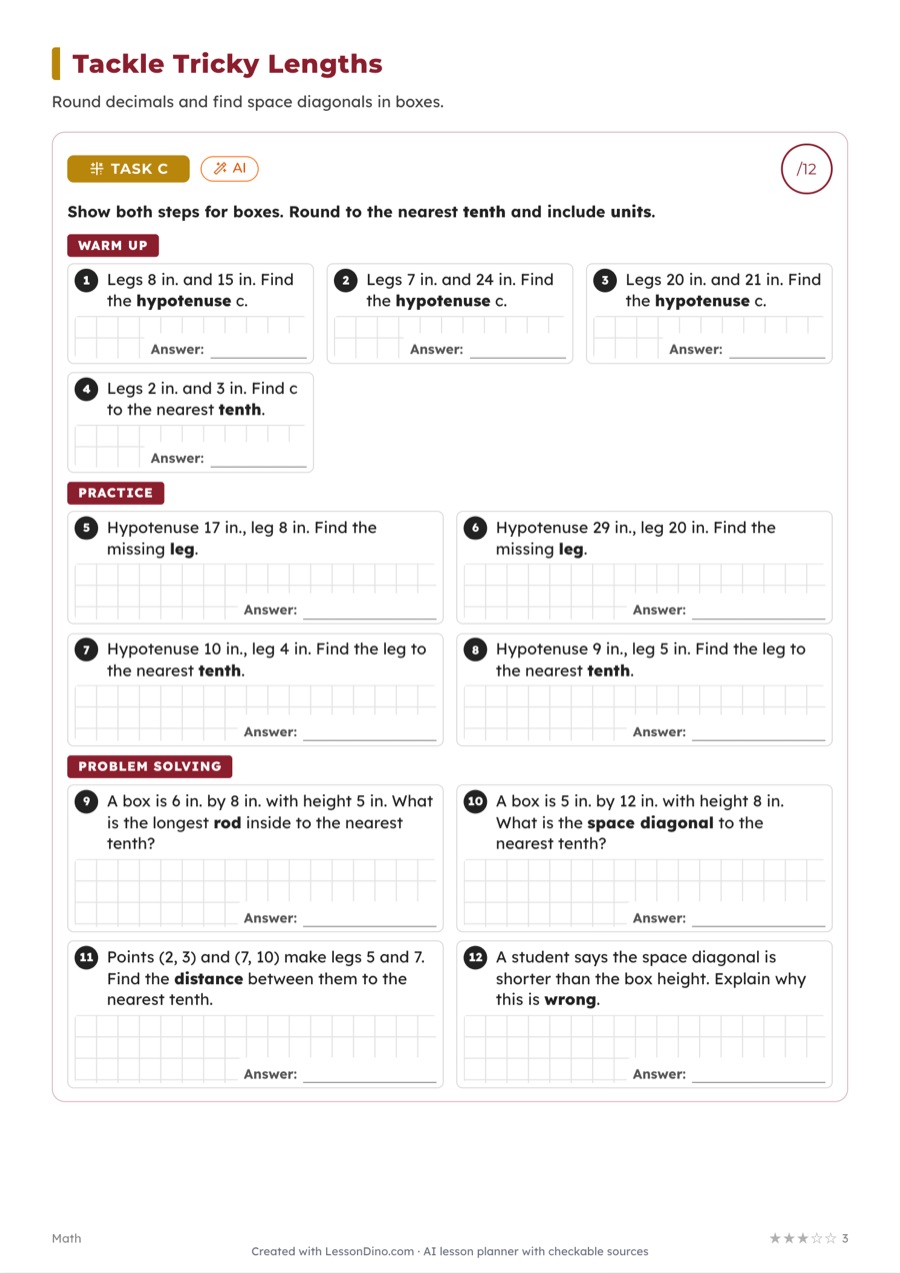
Tackle Tricky Lengths
Round decimals and find space diagonals in boxes.
Show both steps for boxes. Round to the nearest tenth and include units.
Warm up
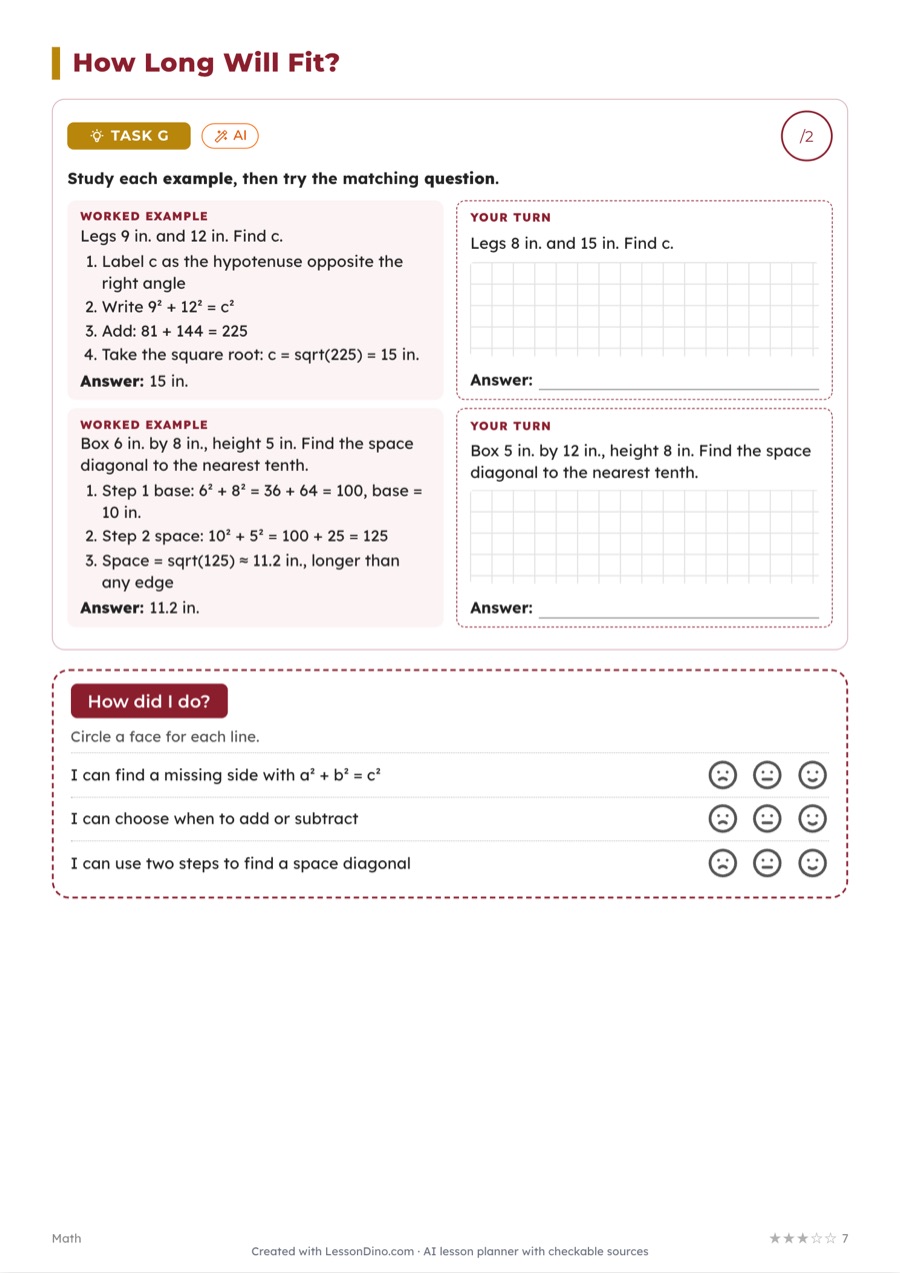
- Legs 8 in. and 15 in. Find the hypotenuse c.
- Legs 7 in. and 24 in. Find the hypotenuse c.
- Legs 20 in. and 21 in. Find the hypotenuse c.
- Legs 2 in. and 3 in. Find c to the nearest tenth.
Practice
- Hypotenuse 17 in., leg 8 in. Find the missing leg.
- Hypotenuse 29 in., leg 20 in. Find the missing leg.
- Hypotenuse 10 in., leg 4 in. Find the leg to the nearest tenth.
- Hypotenuse 9 in., leg 5 in. Find the leg to the nearest tenth.
Problem solving
- A box is 6 in. by 8 in. with height 5 in. What is the longest rod inside to the nearest tenth?
- A box is 5 in. by 12 in. with height 8 in. What is the space diagonal to the nearest tenth?
- Points (2, 3) and (7, 10) make legs 5 and 7. Find the distance between them to the nearest tenth.
- A student says the space diagonal is shorter than the box height. Explain why this is wrong.
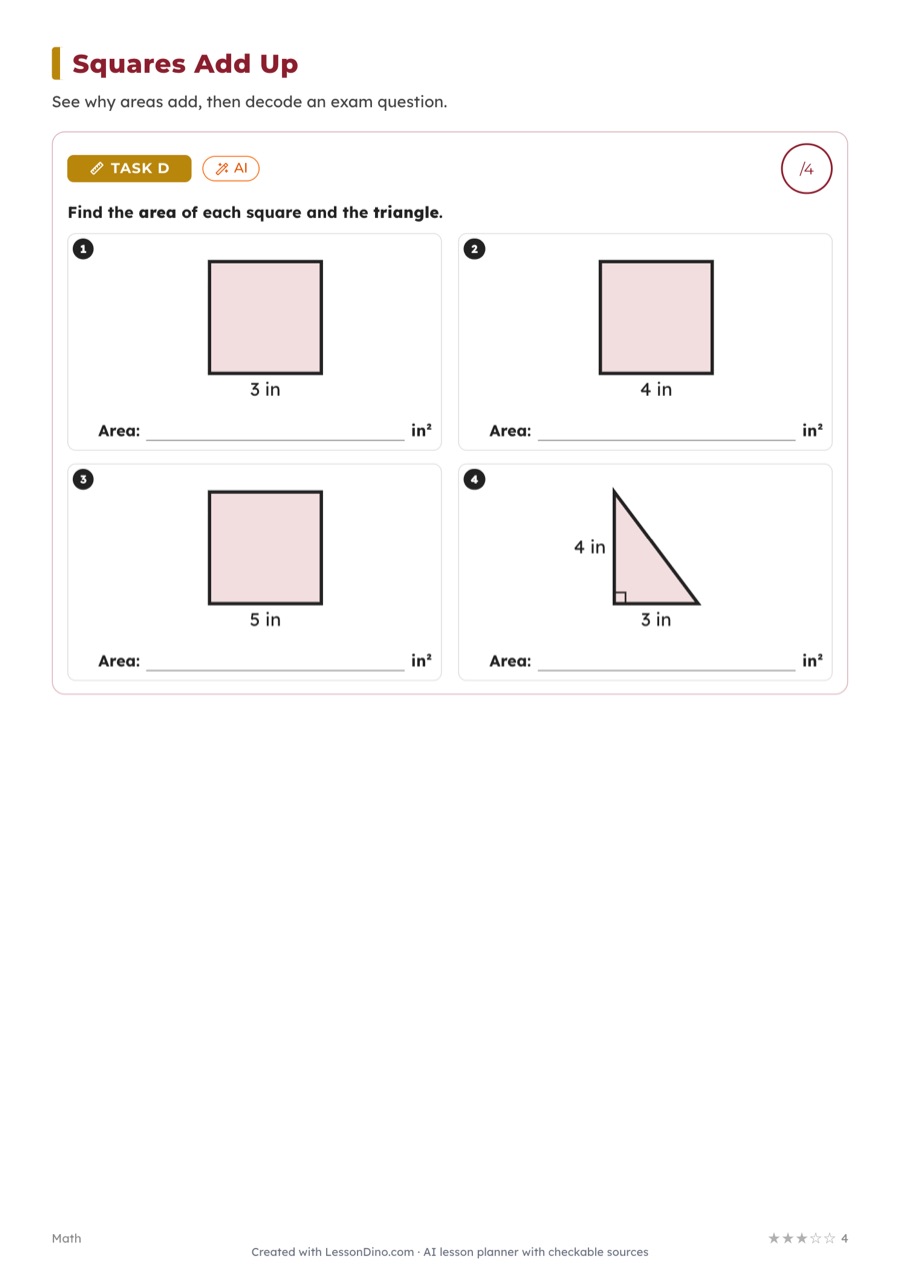
Squares Add Up
See why areas add, then decode an exam question.
Find the area of each square and the triangle.
Page 5
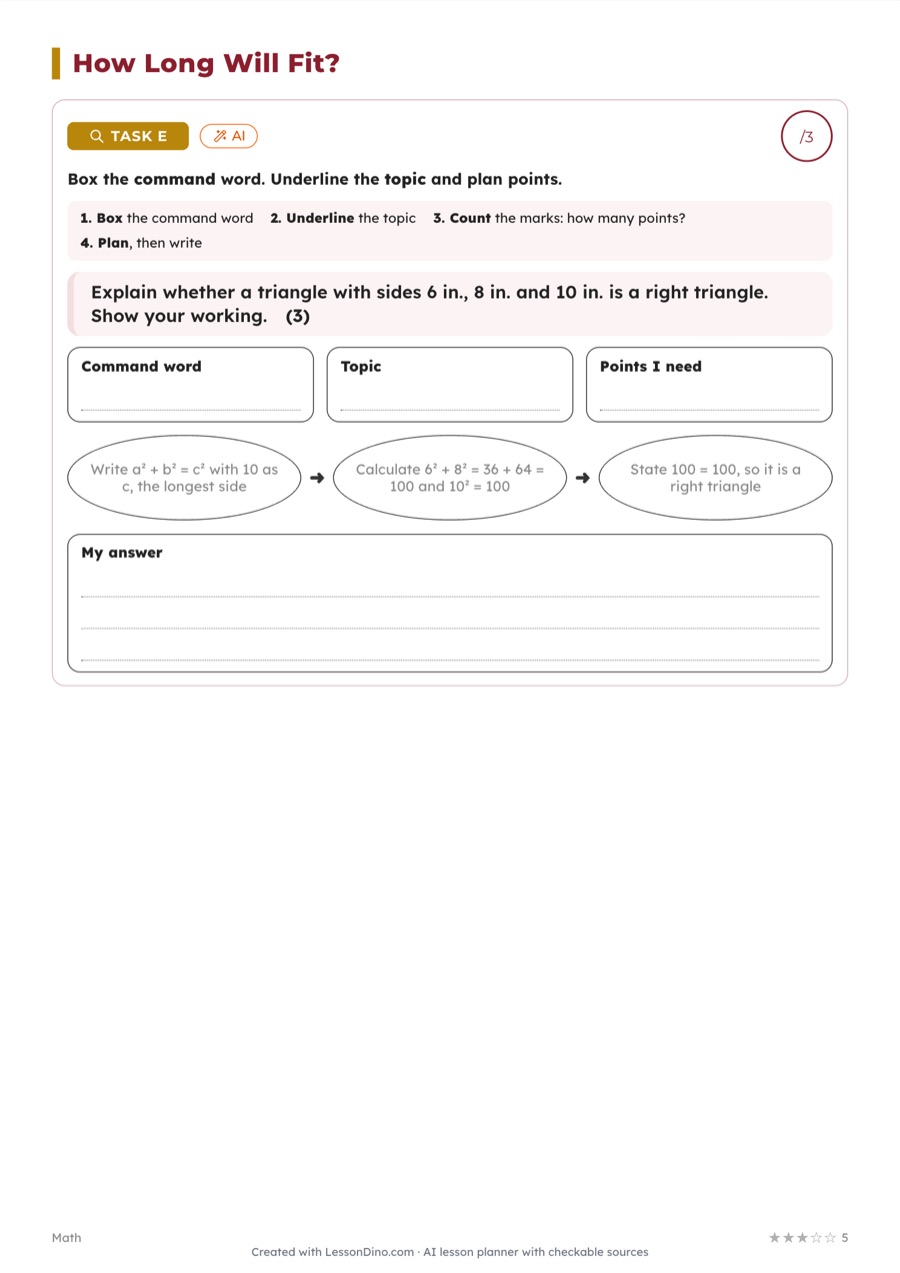
Box the command word. Underline the topic and plan points.
Don't Mix Up
Clear up common confusions and study worked methods.
Explain the difference in each pair in your own words.
Page 7
Study each example, then try the matching question.
Answers
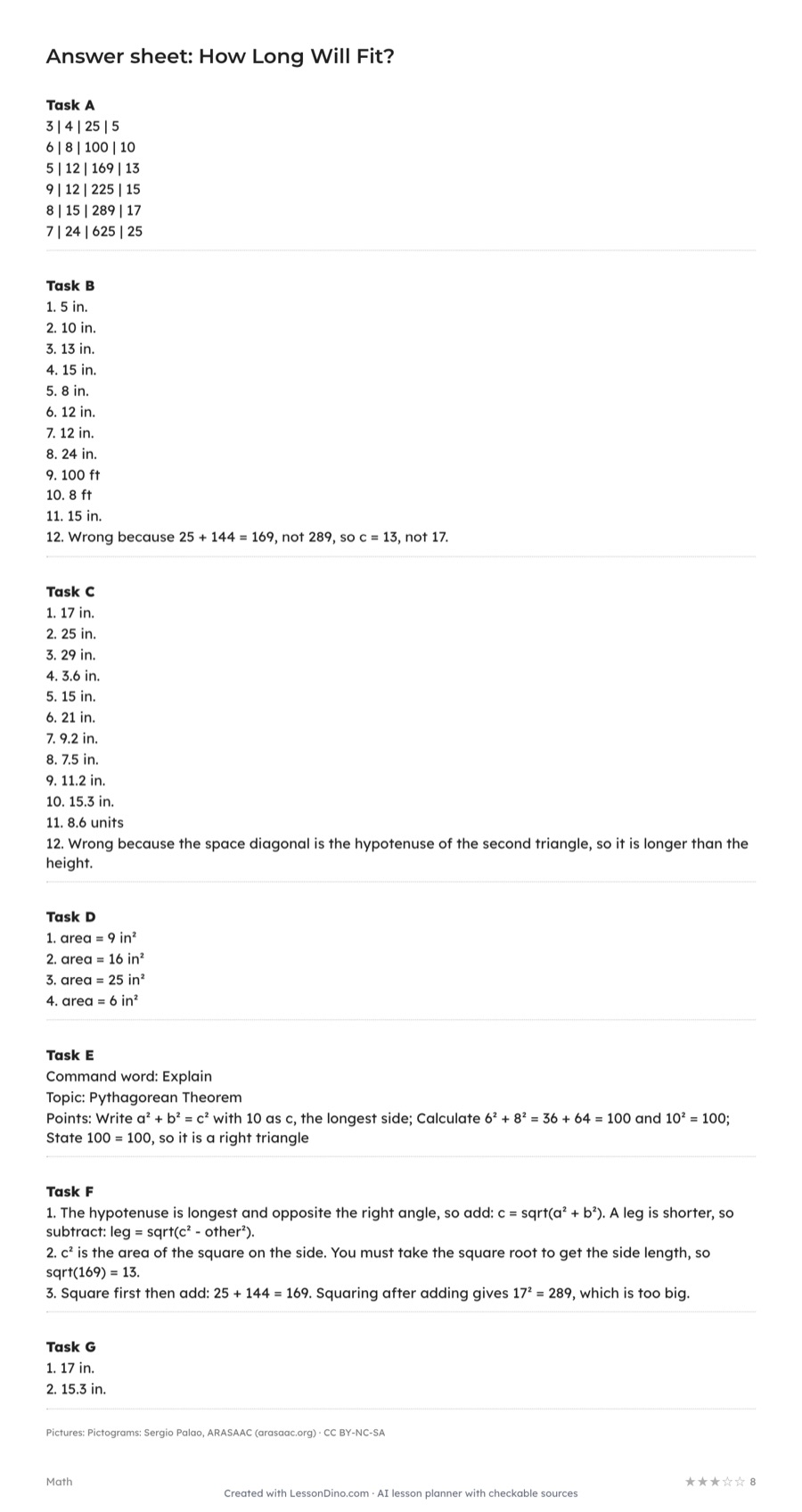
Show the answers
- Legs 3 in. and 4 in. Find the hypotenuse c. 5 in.
- Legs 6 in. and 8 in. Find the hypotenuse c. 10 in.
- Legs 5 in. and 12 in. Find the hypotenuse c. 13 in.
- Legs 9 in. and 12 in. Find the hypotenuse c. 15 in.
- Hypotenuse 10 in., leg 6 in. Find the missing leg b. 8 in.
- Hypotenuse 13 in., leg 5 in. Find the missing leg b. 12 in.
- Hypotenuse 15 in., leg 9 in. Find the missing leg b. 12 in.
- Hypotenuse 25 in., leg 7 in. Find the missing leg b. 24 in.
- A rectangular field is 60 ft by 80 ft. Find the diagonal across it. 100 ft
- A 10-ft ladder stands with its foot 6 ft from a wall. How high up the wall does it reach? 8 ft
- A screen is 9 in. by 12 in. What is its diagonal length? 15 in.
- A student says 5² + 12² = 17². Explain the mistake. Wrong because 25 + 144 = 169, not 289, so c = 13, not 17.
- Legs 8 in. and 15 in. Find the hypotenuse c. 17 in.
- Legs 7 in. and 24 in. Find the hypotenuse c. 25 in.
- Legs 20 in. and 21 in. Find the hypotenuse c. 29 in.
- Legs 2 in. and 3 in. Find c to the nearest tenth. 3.6 in.
- Hypotenuse 17 in., leg 8 in. Find the missing leg. 15 in.
- Hypotenuse 29 in., leg 20 in. Find the missing leg. 21 in.
- Hypotenuse 10 in., leg 4 in. Find the leg to the nearest tenth. 9.2 in.
- Hypotenuse 9 in., leg 5 in. Find the leg to the nearest tenth. 7.5 in.
- A box is 6 in. by 8 in. with height 5 in. What is the longest rod inside to the nearest tenth? 11.2 in.
- A box is 5 in. by 12 in. with height 8 in. What is the space diagonal to the nearest tenth? 15.3 in.
- Points (2, 3) and (7, 10) make legs 5 and 7. Find the distance between them to the nearest tenth. 8.6 units
- A student says the space diagonal is shorter than the box height. Explain why this is wrong. Wrong because the space diagonal is the hypotenuse of the second triangle, so it is longer than the height.
The answer sheet is the last picture above.
Curriculum
Apply the Pythagorean Theorem to determine unknown side lengths in right triangles in real-world and mathematical problems in two and three dimensions.
Made with Lesson Dino's AI on 17 October 2026. AI can make mistakes, so check the answers and facts against the sources before you teach.