The worksheet
About this worksheet
Students learn to multiply, divide, add and subtract in scientific notation. They find errors in mixed decimal and scientific solutions and fix them. This Grade 8 Math worksheet gives students (ages 13–14) six pages of practice on scientific notation, part of the expressions and equations unit. It goes with our free Scientific notation lesson, which has the slides and a timed lesson plan.
What it covers
By the end, students should be able to:
- Students will multiply and divide in scientific notation and renormalize answers.
- Students will add and subtract by matching exponents after converting decimals.
- Students will spot and fix errors in mixed-notation operation solutions.
How to use it
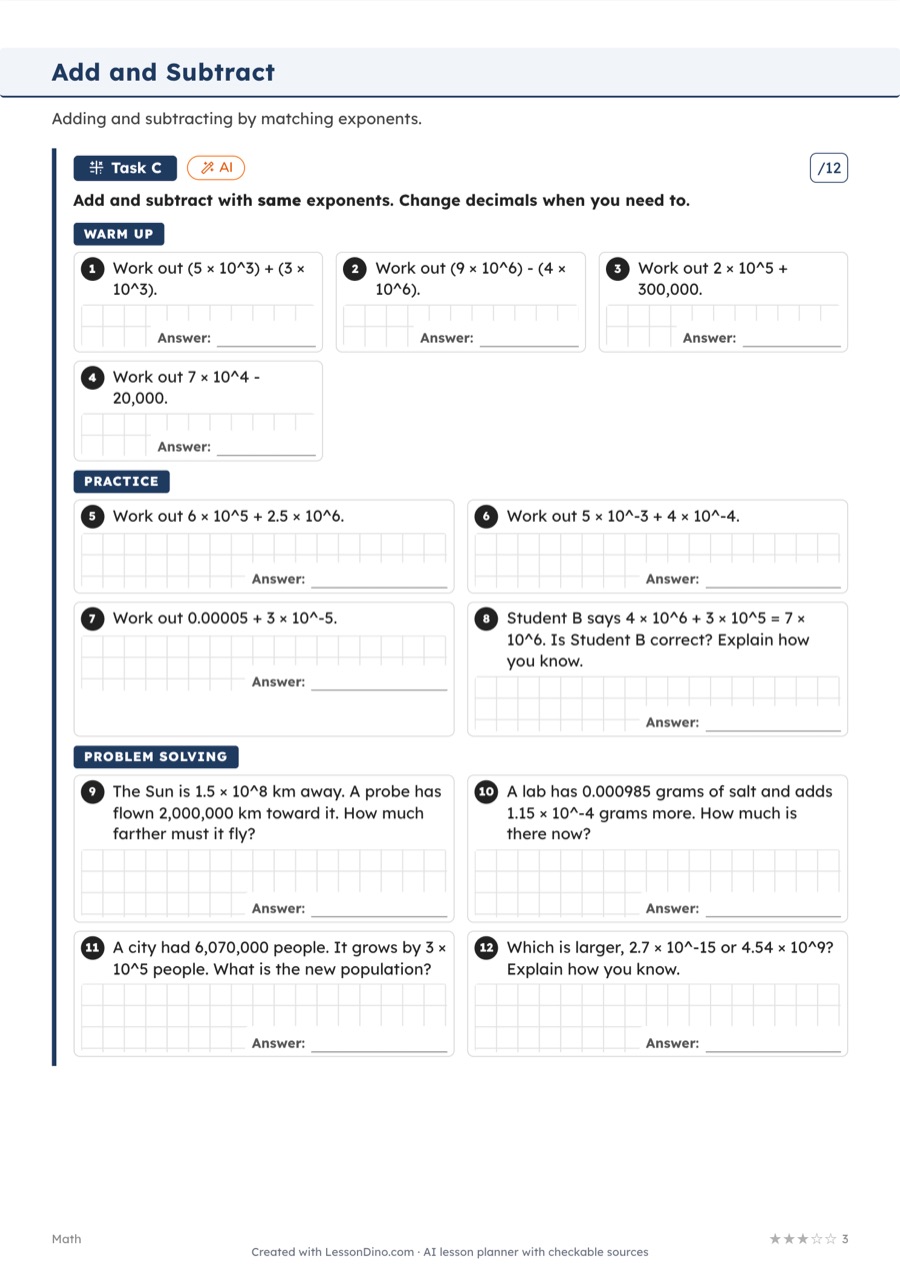
- Teaching: add and subtract mixed (12 minutes): Start Worksheet Task C (Add and subtract with same exponents. Change decimals when you need to.) together for one same-exponent problem.
- Support: Provide a checklist: 1. Converted? 2. Same exponent for add/subtract? 3. Coefficient between 1 and 10?
- Stretch: Have partners create one new error problem for another pair to fix, including a negative exponent.
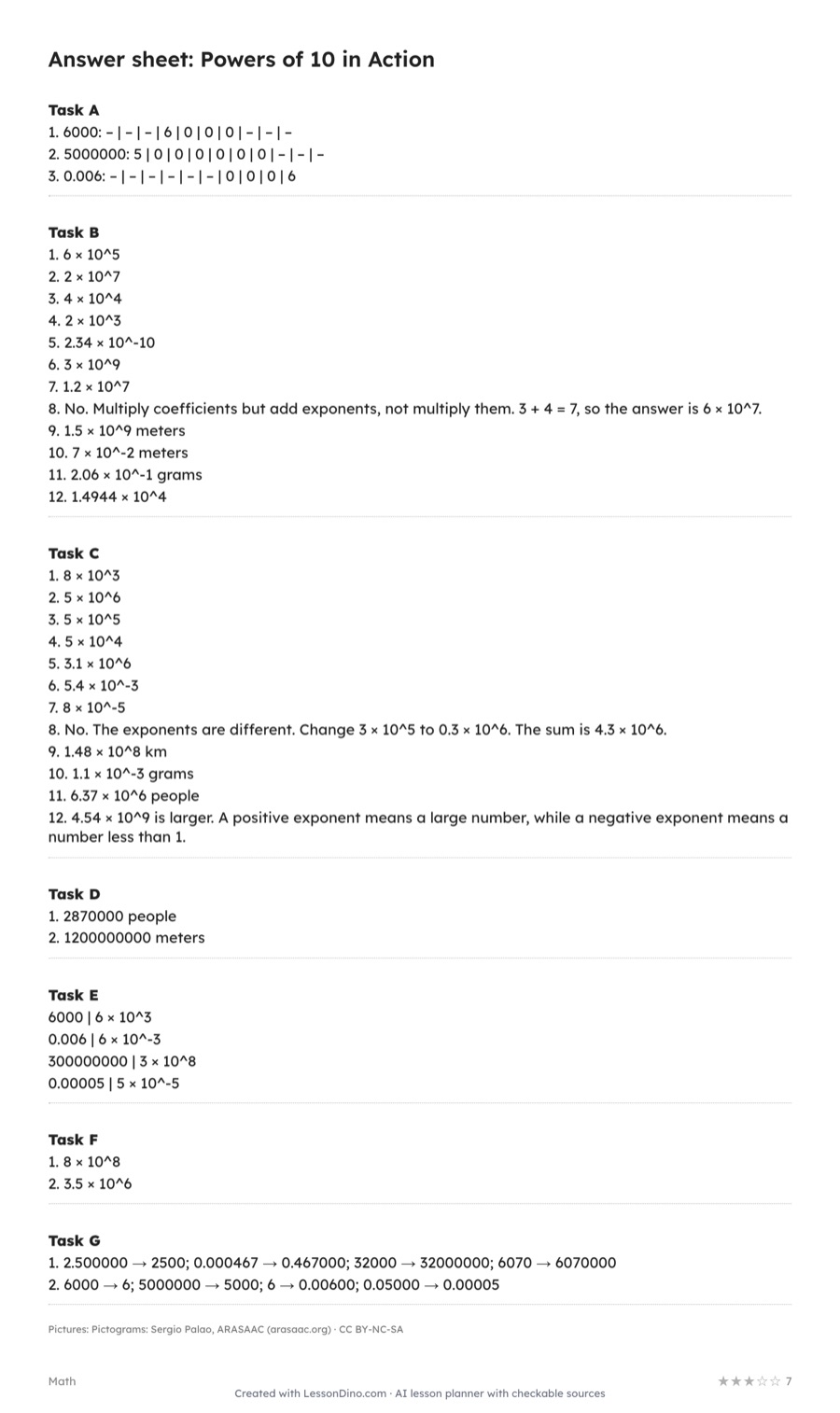
- The answer sheet is the last page, so you can print it on its own or let students check their own work.
Key vocabulary
- scientific notation: short way to write very big or very tiny numbers using 10 raised to a power
- coefficient: front number that is 1 or more but less than 10
- exponent: tiny raised number showing how many places the point moves
- normalized form: fixed writing with the front number kept from 1 up to less than 10
Mistakes to watch for
- Adding or subtracting exponents when adding or subtracting, like 3 x 10^4 + 5 x 10^5 = 8 x 10^9. Rewrite to same power first, add coefficients only, keep power; 0.3 x 10^5 + 5 x 10^5 = 5.3 x 10^5.
- Leaving answer not normalized, like 23.4 x 10^-11 or 0.01 x 10^6. Shift point so absolute value is at least 1 but less than 10, adjust exponent, to 2.34 x 10^-10.
- Operating on a decimal without converting, like adding 0.000467 directly. First write 0.000467 as 4.67 x 10^-4, match powers, then operate.
What's on the worksheet
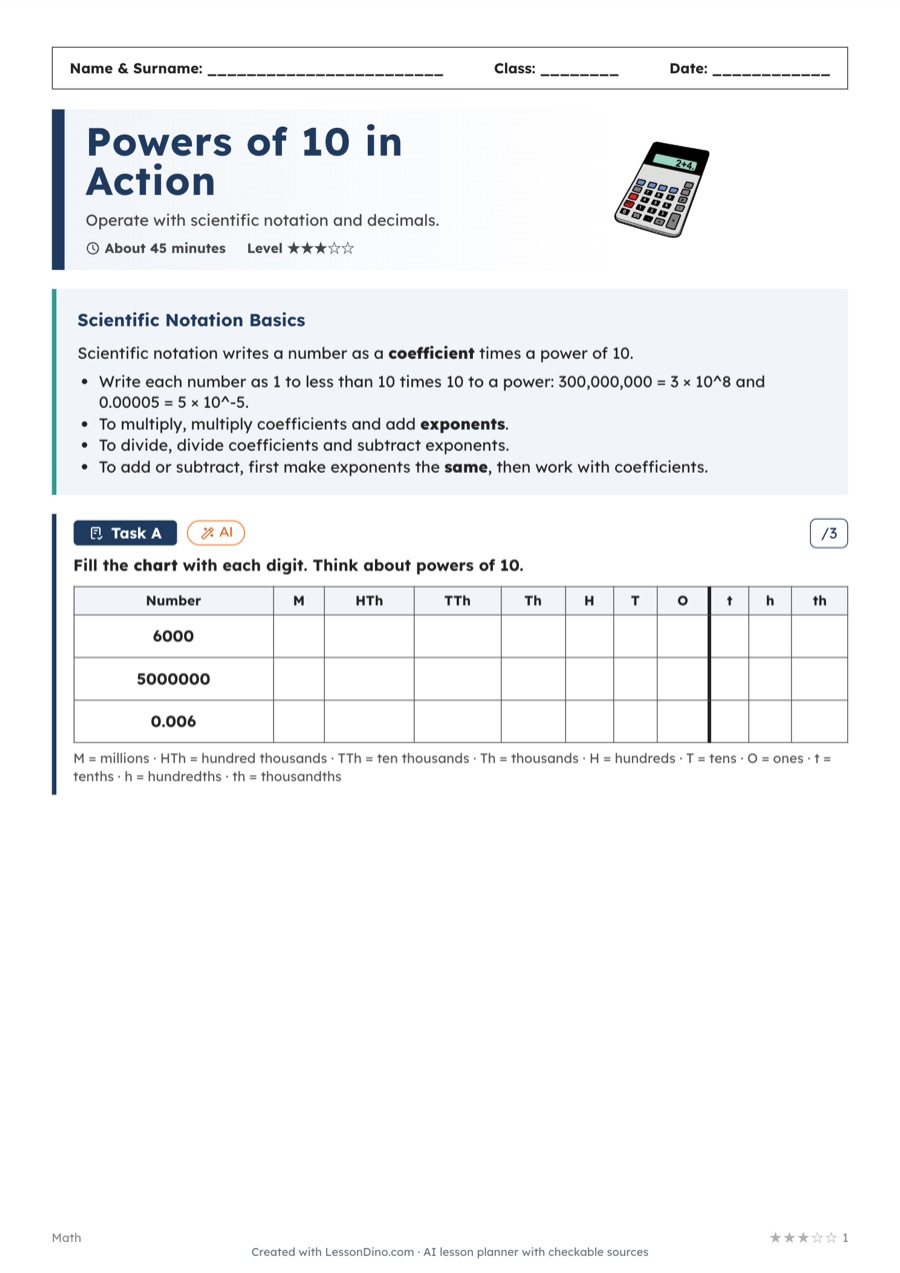
Huge and Tiny
How scientific notation works and why place value matters.
Scientific Notation Basics
- Scientific notation writes a number as a coefficient times a power of 10.
- Write each number as 1 to less than 10 times 10 to a power: 300,000,000 = 3 × 10^8 and 0.00005 = 5 × 10^-5.
- To multiply, multiply coefficients and add exponents.
- To divide, divide coefficients and subtract exponents.
- To add or subtract, first make exponents the same, then work with coefficients.
Fill the chart with each digit. Think about powers of 10.
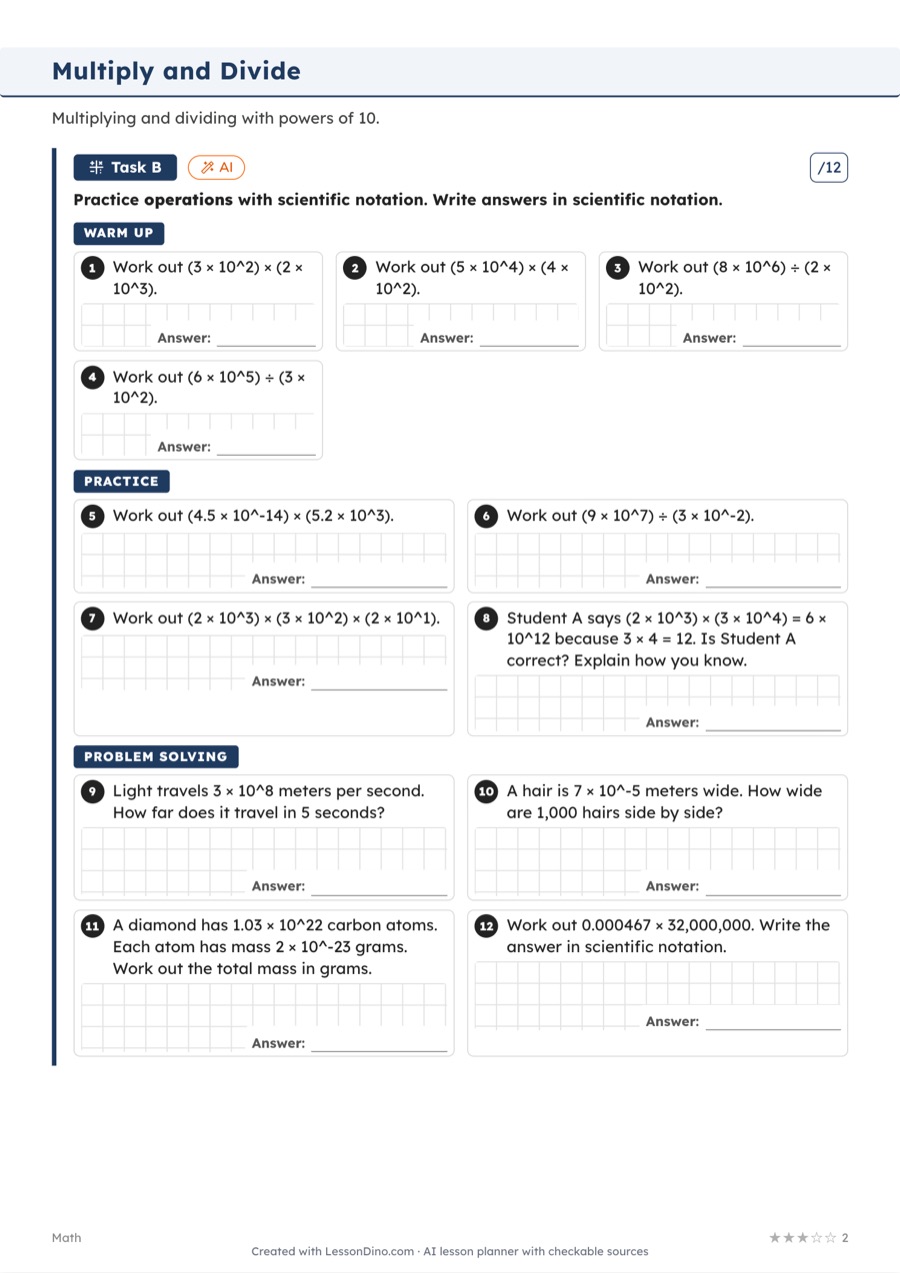
Multiply and Divide
Multiplying and dividing with powers of 10.
Practice operations with scientific notation. Write answers in scientific notation.
Warm up
- Work out (3 × 10^2) × (2 × 10^3).
- Work out (5 × 10^4) × (4 × 10^2).
- Work out (8 × 10^6) ÷ (2 × 10^2).
- Work out (6 × 10^5) ÷ (3 × 10^2).
Practice
- Work out (4.5 × 10^-14) × (5.2 × 10^3).
- Work out (9 × 10^7) ÷ (3 × 10^-2).
- Work out (2 × 10^3) × (3 × 10^2) × (2 × 10^1).
- Student A says (2 × 10^3) × (3 × 10^4) = 6 × 10^12 because 3 × 4 = 12. Is Student A correct? Explain how you know.
Problem solving
- Light travels 3 × 10^8 meters per second. How far does it travel in 5 seconds?
- A hair is 7 × 10^-5 meters wide. How wide are 1,000 hairs side by side?
- A diamond has 1.03 × 10^22 carbon atoms. Each atom has mass 2 × 10^-23 grams. Work out the total mass in grams.
- Work out 0.000467 × 32,000,000. Write the answer in scientific notation.
Add and Subtract
Adding and subtracting by matching exponents.
Add and subtract with same exponents. Change decimals when you need to.
Warm up
- Work out (5 × 10^3) + (3 × 10^3).
- Work out (9 × 10^6) - (4 × 10^6).
- Work out 2 × 10^5 + 300,000.
- Work out 7 × 10^4 - 20,000.
Practice
- Work out 6 × 10^5 + 2.5 × 10^6.
- Work out 5 × 10^-3 + 4 × 10^-4.
- Work out 0.00005 + 3 × 10^-5.
- Student B says 4 × 10^6 + 3 × 10^5 = 7 × 10^6. Is Student B correct? Explain how you know.
Problem solving
- The Sun is 1.5 × 10^8 km away. A probe has flown 2,000,000 km toward it. How much farther must it fly?
- A lab has 0.000985 grams of salt and adds 1.15 × 10^-4 grams more. How much is there now?
- A city had 6,070,000 people. It grows by 3 × 10^5 people. What is the new population?
- Which is larger, 2.7 × 10^-15 or 4.54 × 10^9? Explain how you know.
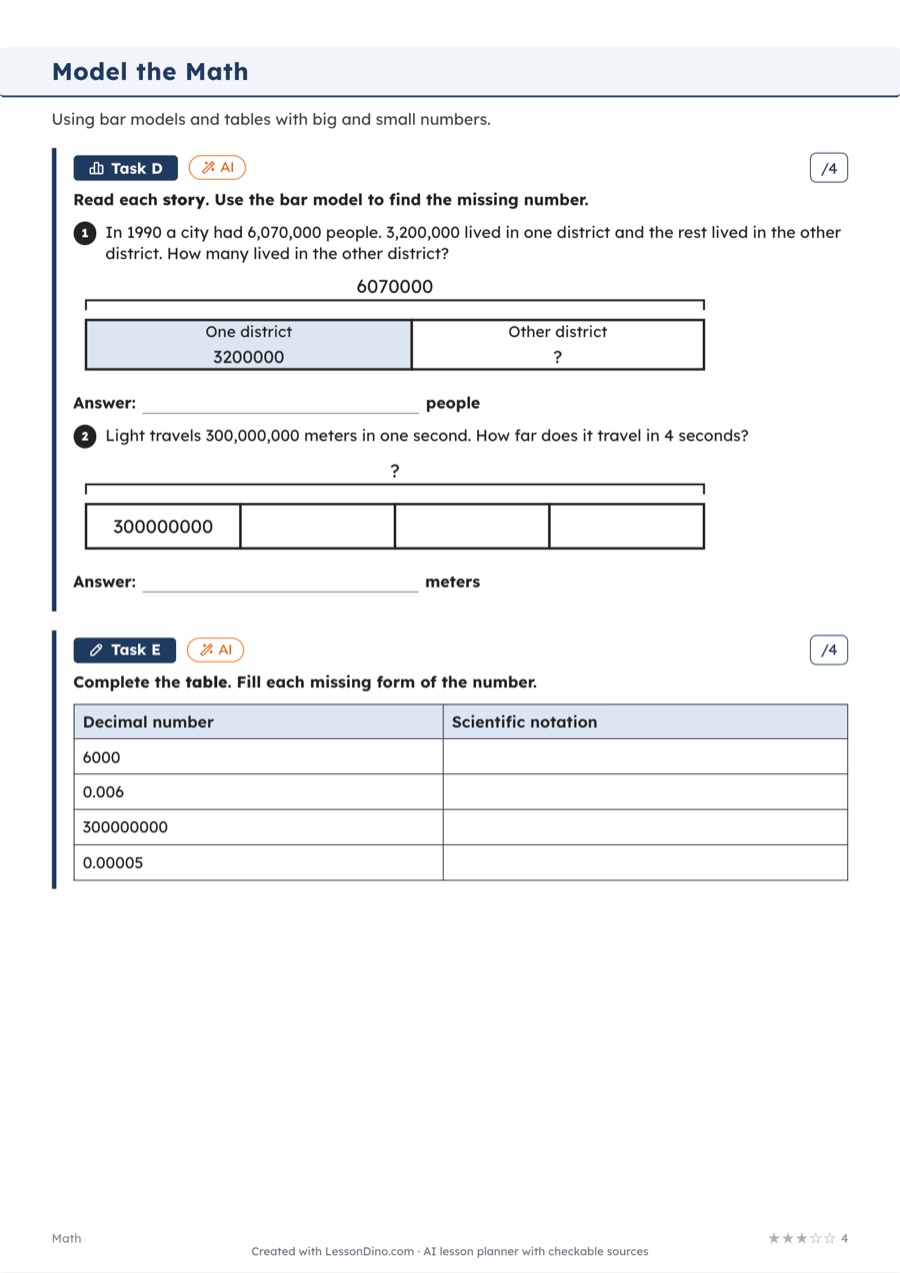
Model the Math
Using bar models and tables with big and small numbers.
Read each story. Use the bar model to find the missing number.
Complete the table. Fill each missing form of the number.
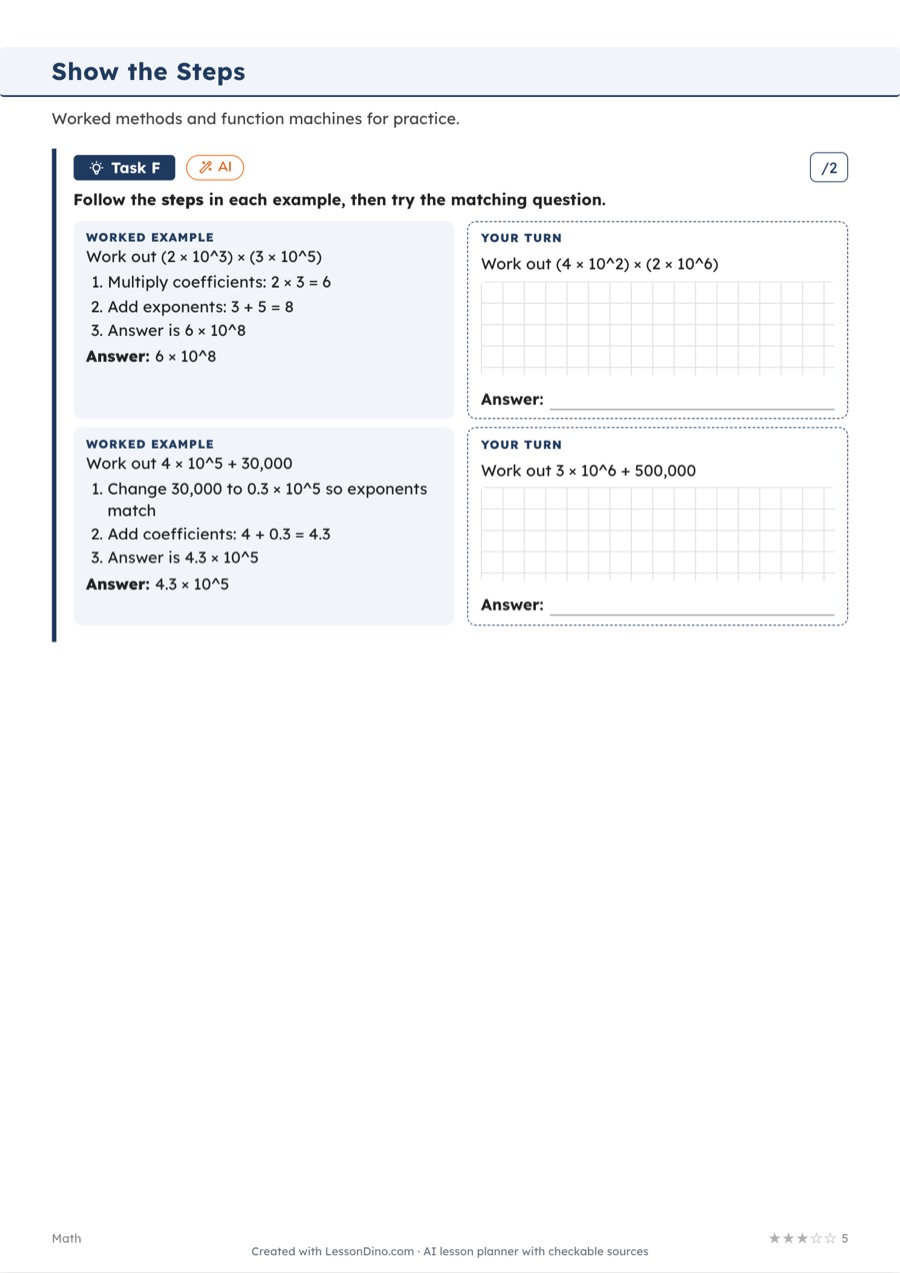
Show the Steps
Worked methods and function machines for practice.
Follow the steps in each example, then try the matching question.
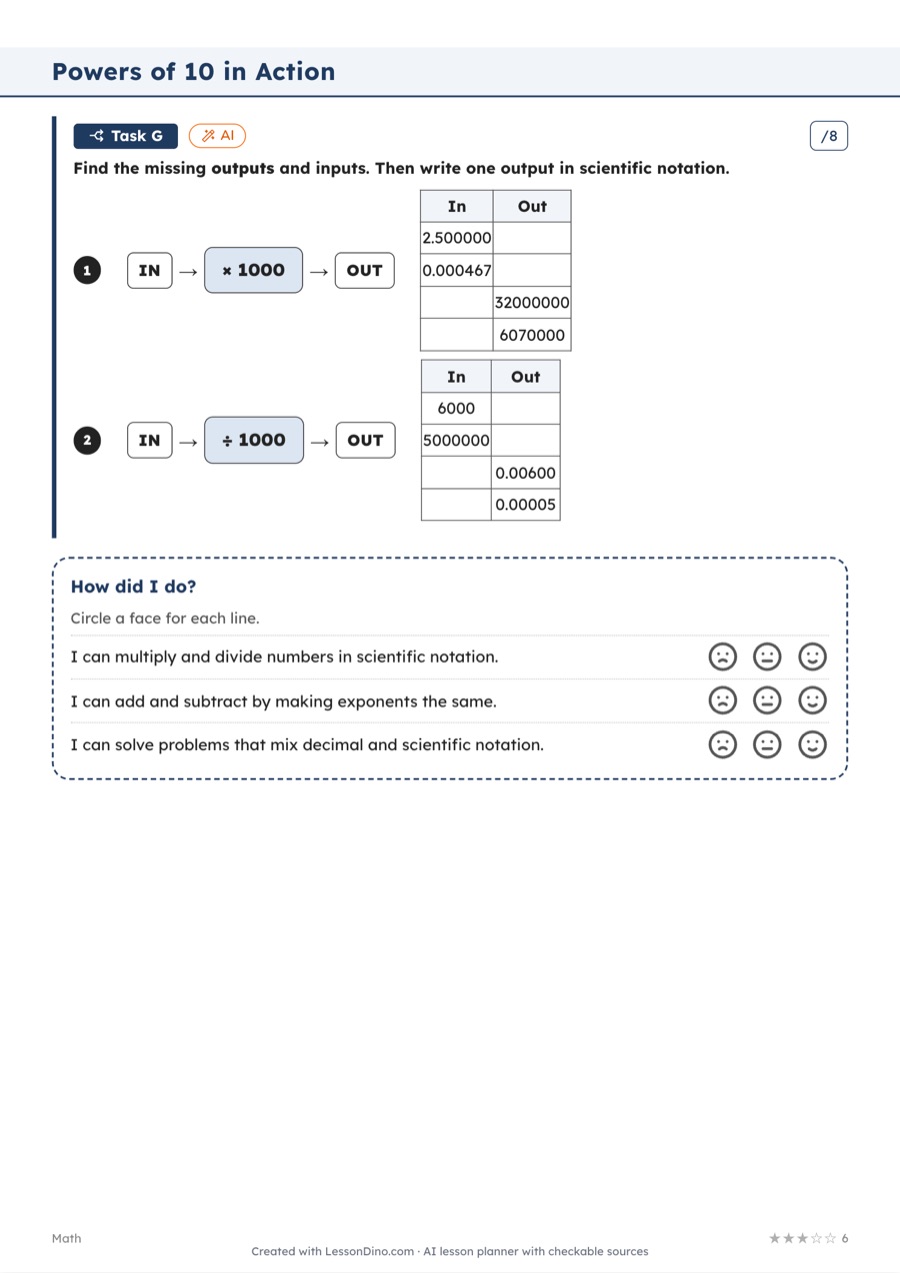
Page 6
Find the missing outputs and inputs. Then write one output in scientific notation.
Answers
Show the answers
- Work out (3 × 10^2) × (2 × 10^3). 6 × 10^5
- Work out (5 × 10^4) × (4 × 10^2). 2 × 10^7
- Work out (8 × 10^6) ÷ (2 × 10^2). 4 × 10^4
- Work out (6 × 10^5) ÷ (3 × 10^2). 2 × 10^3
- Work out (4.5 × 10^-14) × (5.2 × 10^3). 2.34 × 10^-10
- Work out (9 × 10^7) ÷ (3 × 10^-2). 3 × 10^9
- Work out (2 × 10^3) × (3 × 10^2) × (2 × 10^1). 1.2 × 10^7
- Student A says (2 × 10^3) × (3 × 10^4) = 6 × 10^12 because 3 × 4 = 12. Is Student A correct? Explain how you know. No. Multiply coefficients but add exponents, not multiply them. 3 + 4 = 7, so the answer is 6 × 10^7.
- Light travels 3 × 10^8 meters per second. How far does it travel in 5 seconds? 1.5 × 10^9 meters
- A hair is 7 × 10^-5 meters wide. How wide are 1,000 hairs side by side? 7 × 10^-2 meters
- A diamond has 1.03 × 10^22 carbon atoms. Each atom has mass 2 × 10^-23 grams. Work out the total mass in grams. 2.06 × 10^-1 grams
- Work out 0.000467 × 32,000,000. Write the answer in scientific notation. 1.4944 × 10^4
- Work out (5 × 10^3) + (3 × 10^3). 8 × 10^3
- Work out (9 × 10^6) - (4 × 10^6). 5 × 10^6
- Work out 2 × 10^5 + 300,000. 5 × 10^5
- Work out 7 × 10^4 - 20,000. 5 × 10^4
- Work out 6 × 10^5 + 2.5 × 10^6. 3.1 × 10^6
- Work out 5 × 10^-3 + 4 × 10^-4. 5.4 × 10^-3
- Work out 0.00005 + 3 × 10^-5. 8 × 10^-5
- Student B says 4 × 10^6 + 3 × 10^5 = 7 × 10^6. Is Student B correct? Explain how you know. No. The exponents are different. Change 3 × 10^5 to 0.3 × 10^6. The sum is 4.3 × 10^6.
- The Sun is 1.5 × 10^8 km away. A probe has flown 2,000,000 km toward it. How much farther must it fly? 1.48 × 10^8 km
- A lab has 0.000985 grams of salt and adds 1.15 × 10^-4 grams more. How much is there now? 1.1 × 10^-3 grams
- A city had 6,070,000 people. It grows by 3 × 10^5 people. What is the new population? 6.37 × 10^6 people
- Which is larger, 2.7 × 10^-15 or 4.54 × 10^9? Explain how you know. 4.54 × 10^9 is larger. A positive exponent means a large number, while a negative exponent means a number less than 1.
The answer sheet is the last picture above.
Curriculum
Perform operations with numbers expressed in scientific notation, including problems where both decimal and scientific notation are used.
Made with Lesson Dino's AI on 17 October 2026. AI can make mistakes, so check the answers and facts against the sources before you teach.