The worksheet
About this worksheet
Students learn product, quotient, power, zero and negative rules. They play a team relay to make equivalent numerical expressions. This Grade 8 Math worksheet gives students (ages 13–14) seven pages of practice on exponents, part of the expressions and equations unit. It goes with our free Exponents lesson, which has the slides and a timed lesson plan.
What it covers
By the end, students should be able to:
- Students will rewrite same-base products, quotients and powers as single powers.
- Students will use zero and negative exponents to generate equivalent expressions.
How to use it
- Practice (12 minutes): Hand out Worksheet Task C and have pairs rewrite each expression with the rules, then find the value.
- Support: Give each team a rule strip that lists adding exponents when multiplying powers with the same base and subtracting when dividing.
- Stretch: Add a bonus card that requires simplifying 14x^6 divided by x^5 to get 14x.
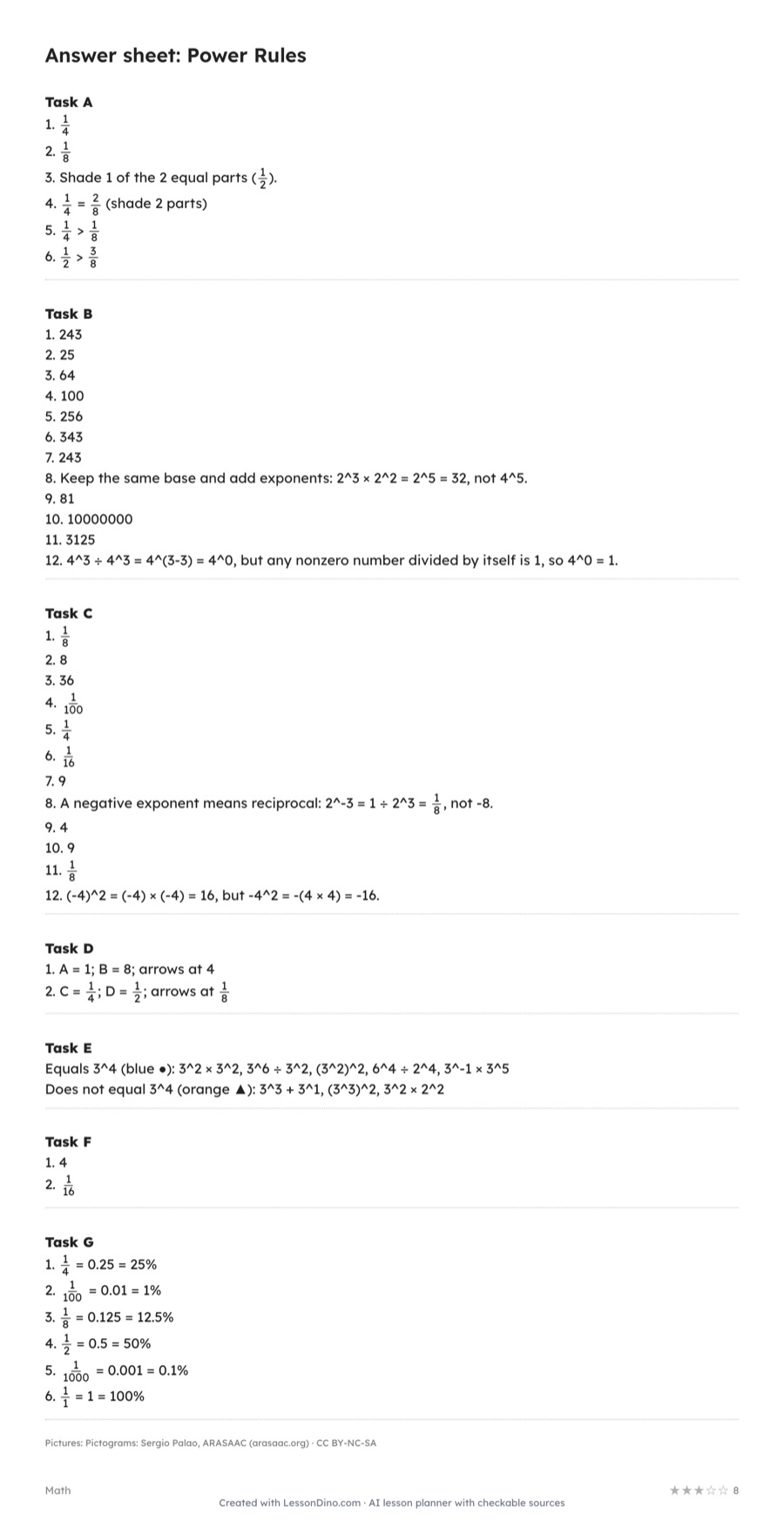
- The answer sheet is the last page, so you can print it on its own or let students check their own work.
Key vocabulary
- base: the number that is multiplied by itself again and again
- exponent: the little raised number that shows how many copies to multiply
- power: a base raised with a count, like 2^3 which equals 8
- equivalent: different on paper but equal in value
- reciprocal: one over a number, like 1 over 2 cubed for 2 to the negative 3
Mistakes to watch for
- Adding exponents when adding powers, like 2^3 + 2^3 = 2^6. Expand to 8 + 8, which is 16, not 64. Add means compute values first.
- Using rules with different bases, like 3^2 x 4^2 = 12^4. Compute 9 x 16, which is 144. Rules need the same base.
- Reading 2^-3 as -8 instead of a fraction. Flip first: 2^-3 = 1 over 2^3 = 1/8 or 0.125. Negative exponent means reciprocal.
What's on the worksheet
How Powers Work
Review the rules, then see negative powers as fractions.
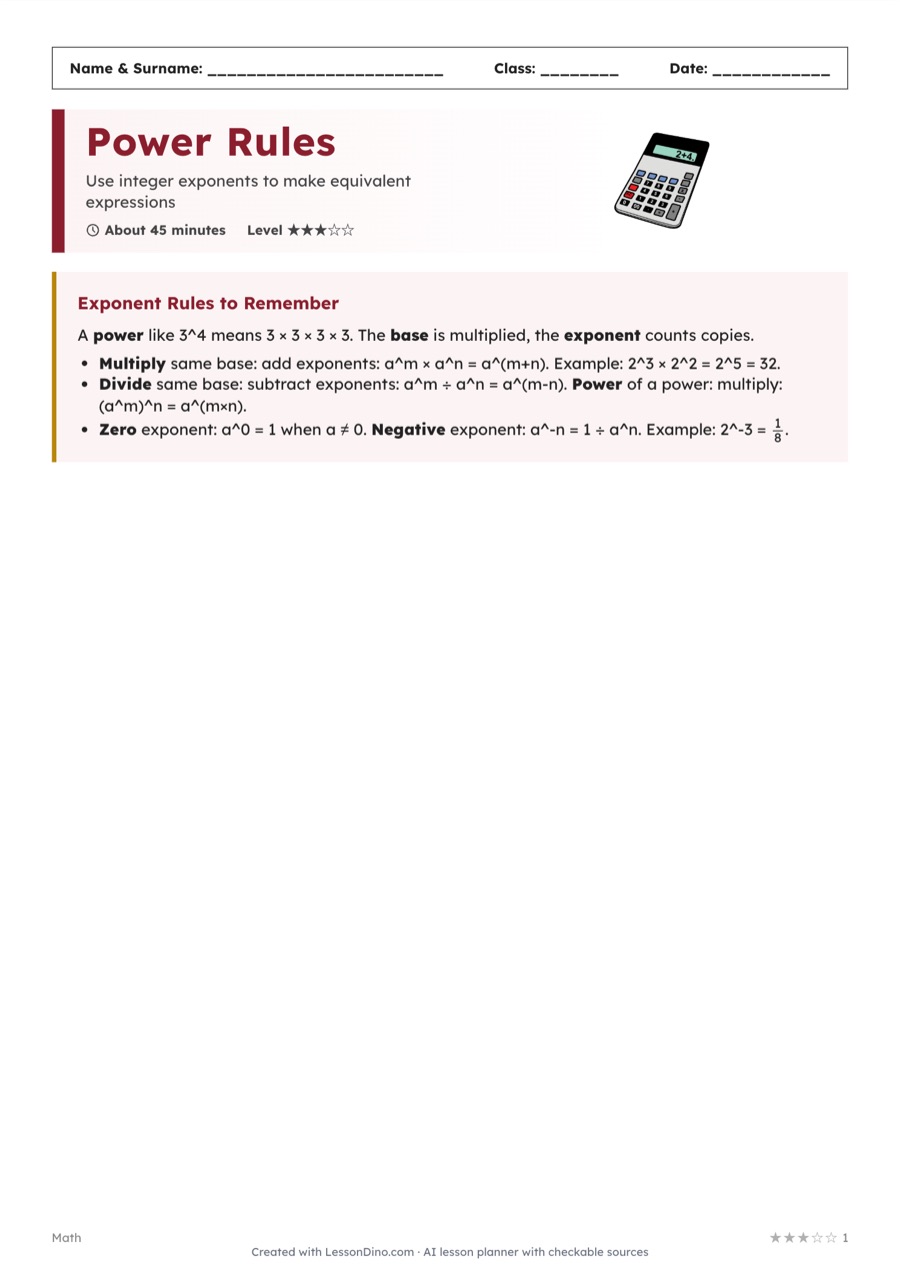
Exponent Rules to Remember
- A power like 3^4 means 3 × 3 × 3 × 3. The base is multiplied, the exponent counts copies.
- Multiply same base: add exponents: a^m × a^n = a^(m+n). Example: 2^3 × 2^2 = 2^5 = 32.
- Divide same base: subtract exponents: a^m ÷ a^n = a^(m-n). Power of a power: multiply: (a^m)^n = a^(m×n).
- Zero exponent: a^0 = 1 when a ≠ 0. Negative exponent: a^-n = 1 ÷ a^n. Example: 2^-3 = 1/8.
Page 2
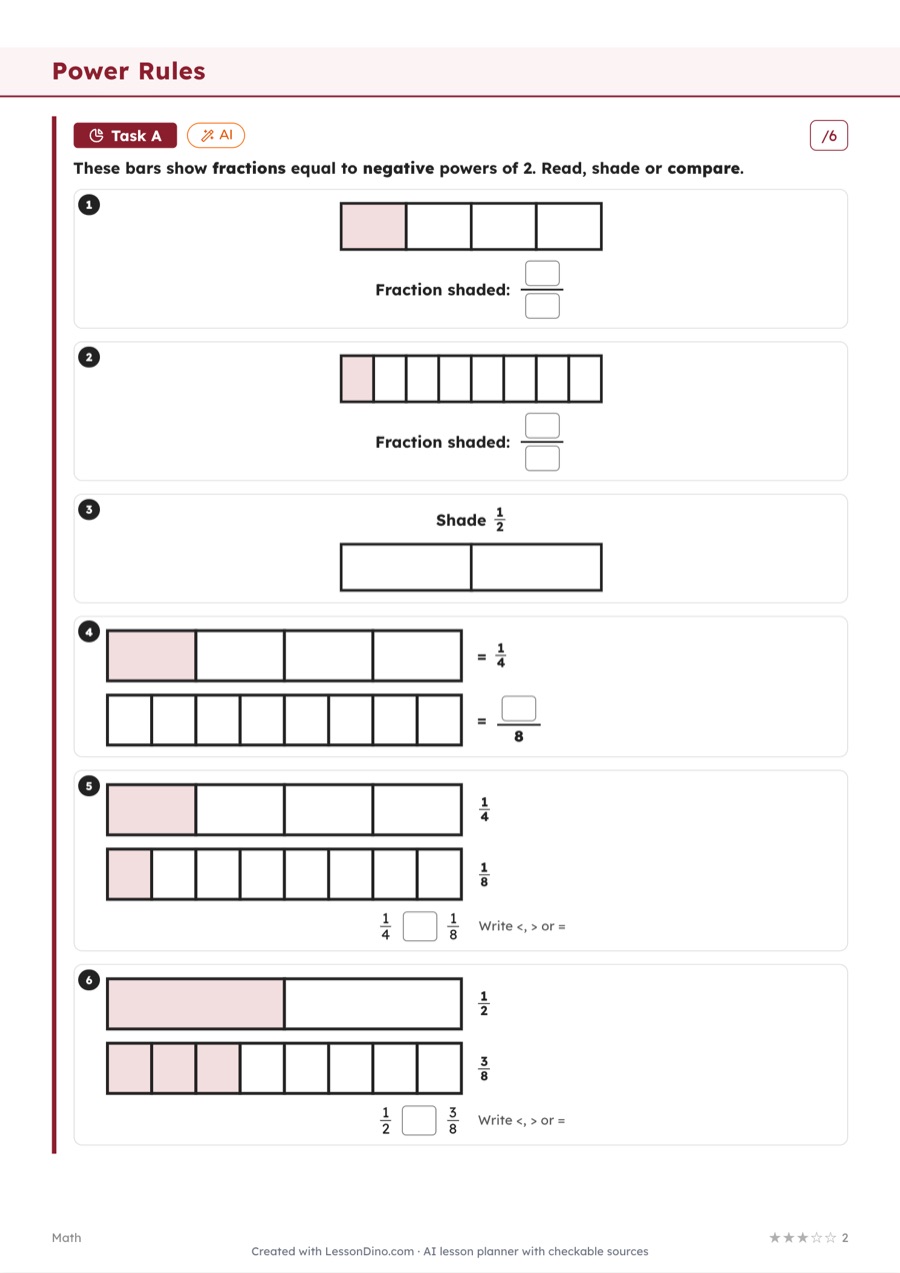
These bars show fractions equal to negative powers of 2. Read, shade or compare.
Multiply and Divide
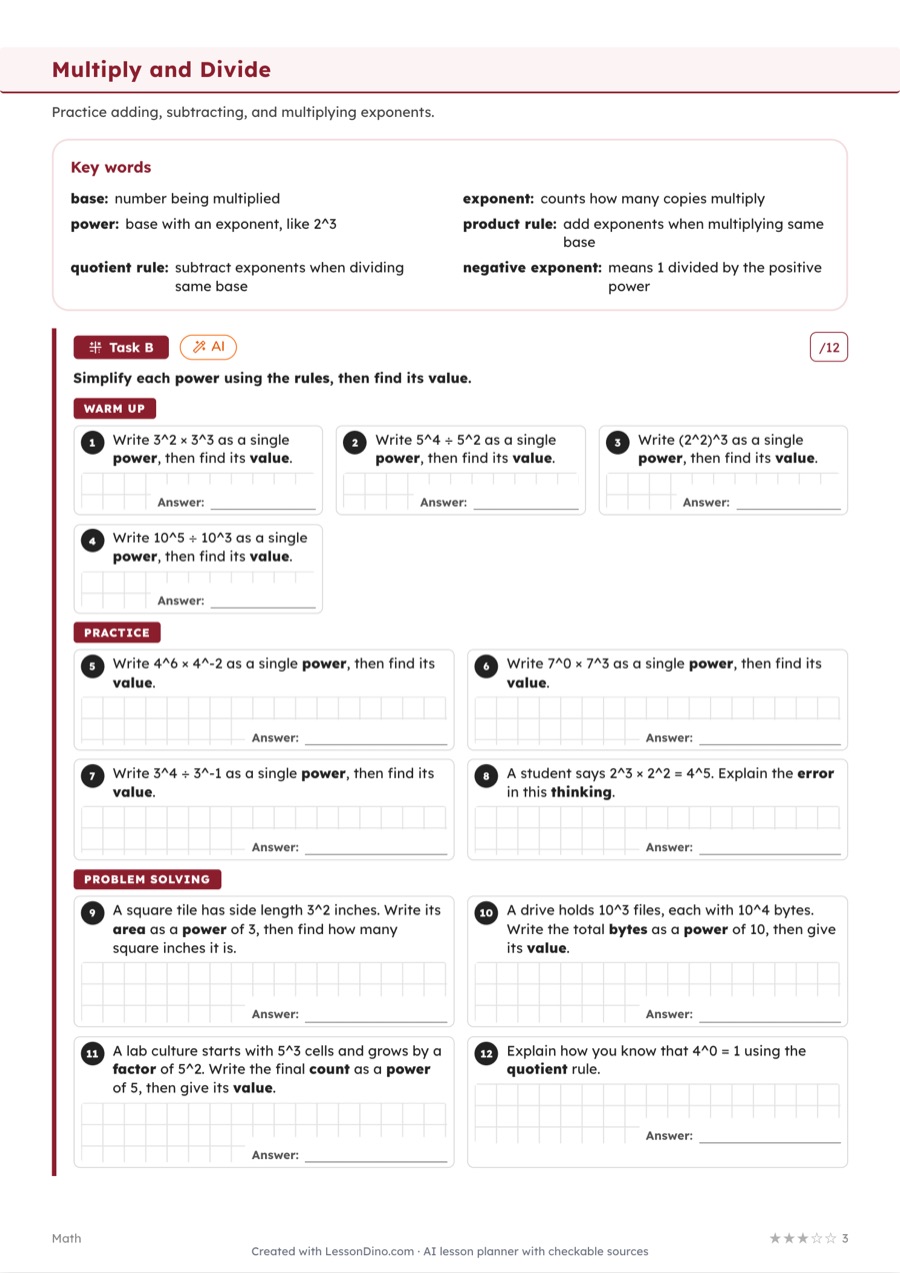
Practice adding, subtracting, and multiplying exponents.
| Word | Meaning |
|---|---|
| base | number being multiplied |
| exponent | counts how many copies multiply |
| power | base with an exponent, like 2^3 |
| product rule | add exponents when multiplying same base |
| quotient rule | subtract exponents when dividing same base |
| negative exponent | means 1 divided by the positive power |
Simplify each power using the rules, then find its value.
Warm up
- Write 3^2 × 3^3 as a single power, then find its value.
- Write 5^4 ÷ 5^2 as a single power, then find its value.
- Write (2^2)^3 as a single power, then find its value.
- Write 10^5 ÷ 10^3 as a single power, then find its value.
Practice
- Write 4^6 × 4^-2 as a single power, then find its value.
- Write 7^0 × 7^3 as a single power, then find its value.
- Write 3^4 ÷ 3^-1 as a single power, then find its value.
- A student says 2^3 × 2^2 = 4^5. Explain the error in this thinking.
Problem solving
- A square tile has side length 3^2 inches. Write its area as a power of 3, then find how many square inches it is.
- A drive holds 10^3 files, each with 10^4 bytes. Write the total bytes as a power of 10, then give its value.
- A lab culture starts with 5^3 cells and grows by a factor of 5^2. Write the final count as a power of 5, then give its value.
- Explain how you know that 4^0 = 1 using the quotient rule.
Zero and Negatives
Practice zero, negative, and product and quotient powers.
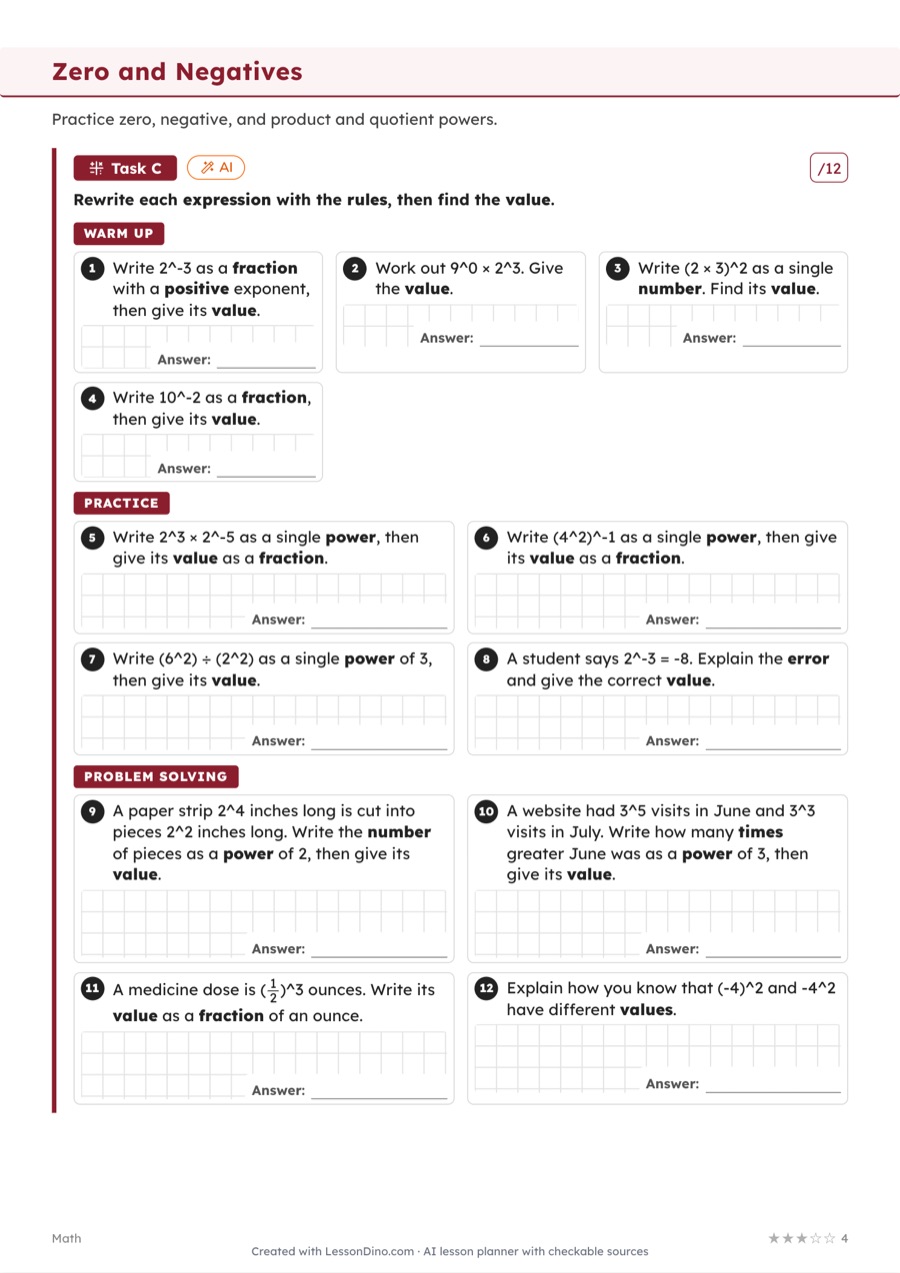
Rewrite each expression with the rules, then find the value.
Warm up
- Write 2^-3 as a fraction with a positive exponent, then give its value.
- Work out 9^0 × 2^3. Give the value.
- Write (2 × 3)^2 as a single number. Find its value.
- Write 10^-2 as a fraction, then give its value.
Practice
- Write 2^3 × 2^-5 as a single power, then give its value as a fraction.
- Write (4^2)^-1 as a single power, then give its value as a fraction.
- Write (6^2) ÷ (2^2) as a single power of 3, then give its value.
- A student says 2^-3 = -8. Explain the error and give the correct value.
Problem solving
- A paper strip 2^4 inches long is cut into pieces 2^2 inches long. Write the number of pieces as a power of 2, then give its value.
- A website had 3^5 visits in June and 3^3 visits in July. Write how many times greater June was as a power of 3, then give its value.
- A medicine dose is (1/2)^3 ounces. Write its value as a fraction of an ounce.
- Explain how you know that (-4)^2 and -4^2 have different values.
Spot the Match
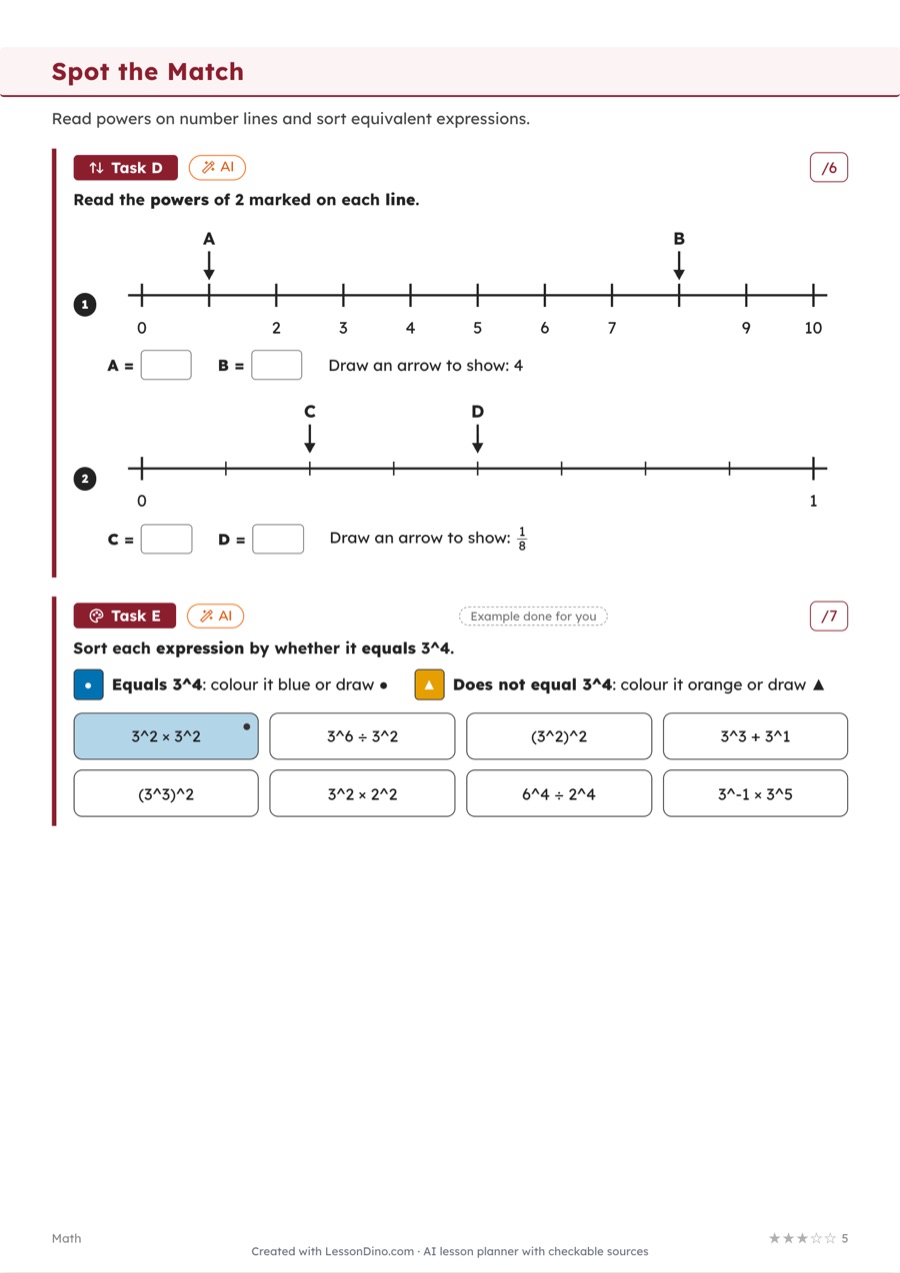
Read powers on number lines and sort equivalent expressions.
Read the powers of 2 marked on each line.
Sort each expression by whether it equals 3^4.
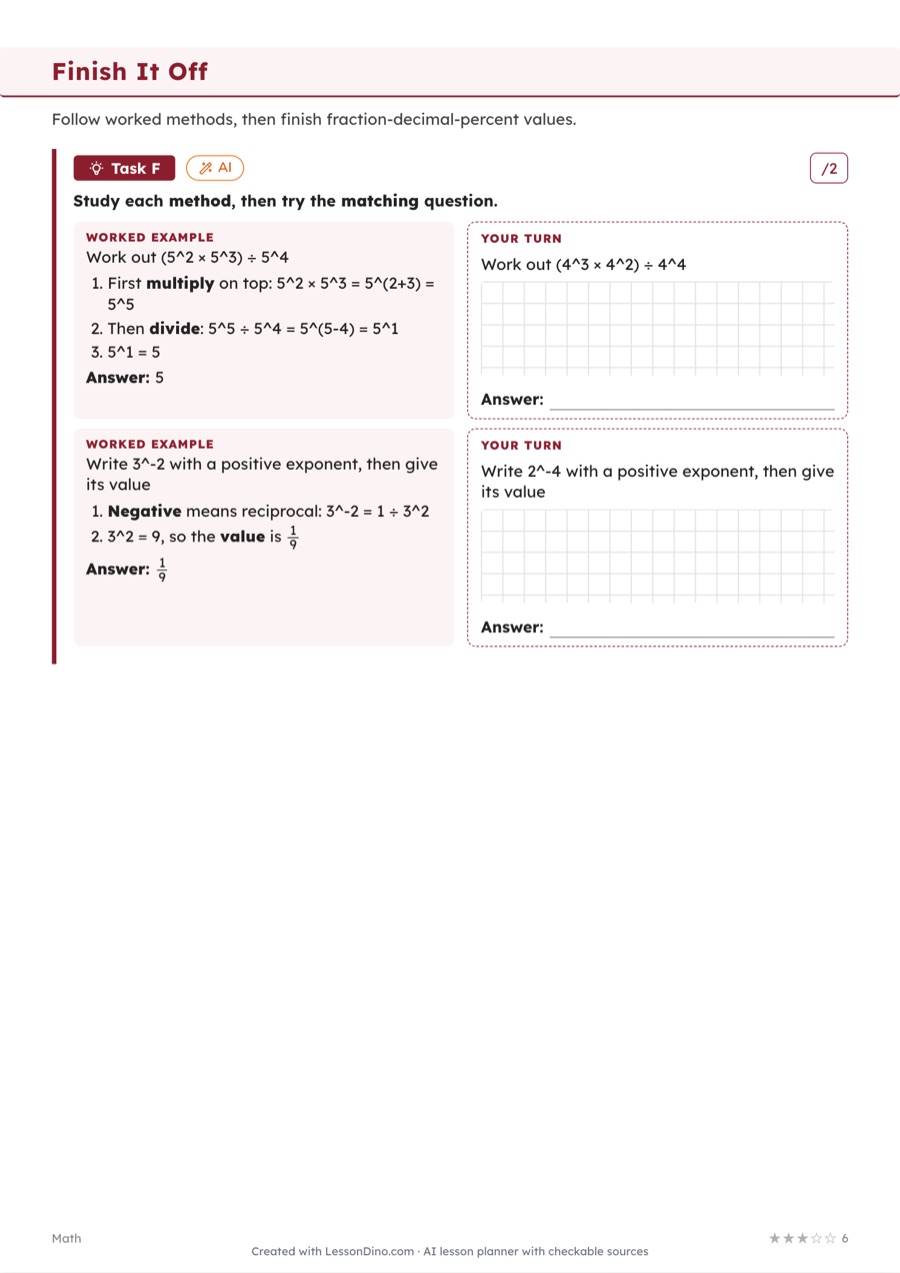
Finish It Off
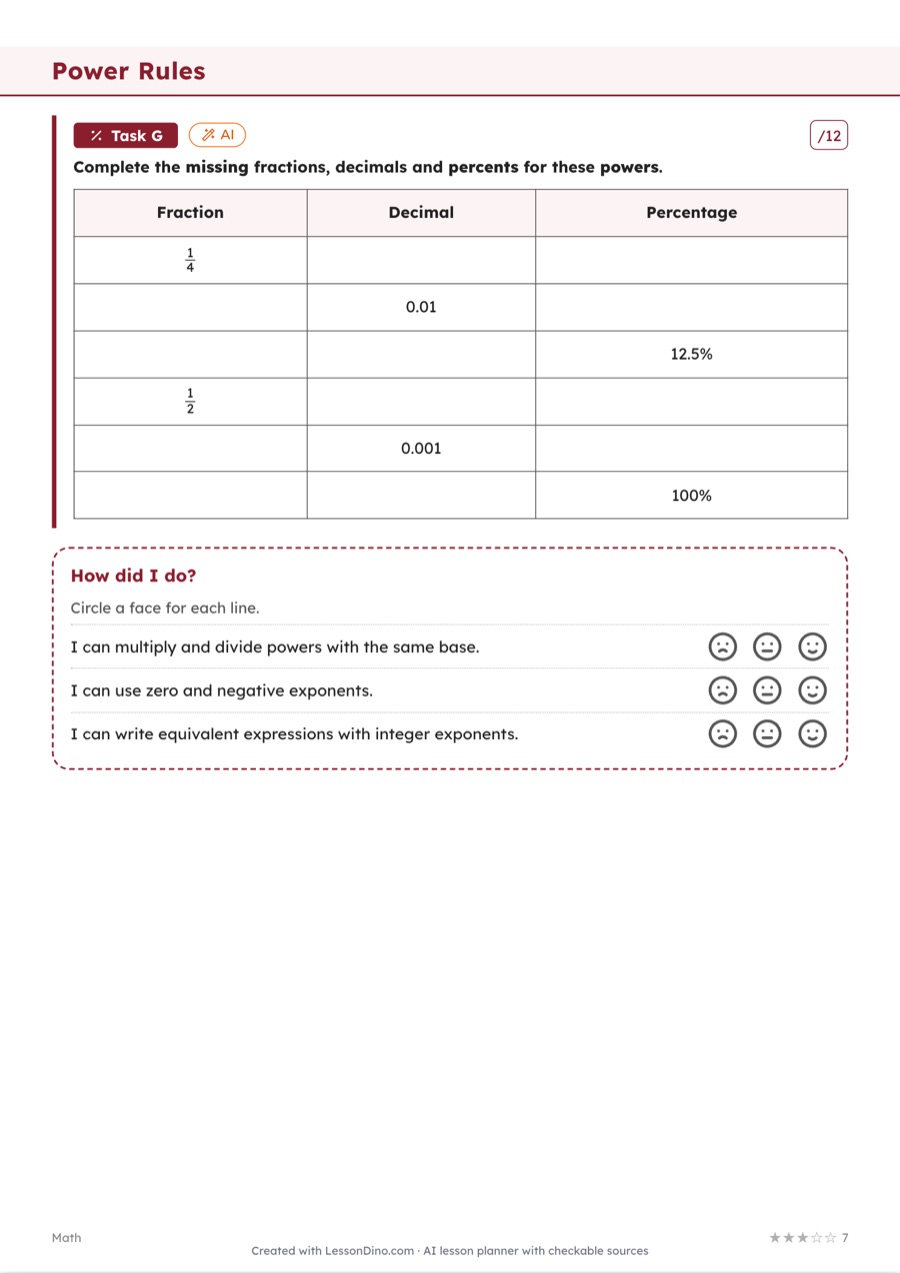
Follow worked methods, then finish fraction-decimal-percent values.
Study each method, then try the matching question.
Page 7
Complete the missing fractions, decimals and percents for these powers.
Answers
Show the answers
- Write 3^2 × 3^3 as a single power, then find its value. 243
- Write 5^4 ÷ 5^2 as a single power, then find its value. 25
- Write (2^2)^3 as a single power, then find its value. 64
- Write 10^5 ÷ 10^3 as a single power, then find its value. 100
- Write 4^6 × 4^-2 as a single power, then find its value. 256
- Write 7^0 × 7^3 as a single power, then find its value. 343
- Write 3^4 ÷ 3^-1 as a single power, then find its value. 243
- A student says 2^3 × 2^2 = 4^5. Explain the error in this thinking. Keep the same base and add exponents: 2^3 × 2^2 = 2^5 = 32, not 4^5.
- A square tile has side length 3^2 inches. Write its area as a power of 3, then find how many square inches it is. 81
- A drive holds 10^3 files, each with 10^4 bytes. Write the total bytes as a power of 10, then give its value. 10000000
- A lab culture starts with 5^3 cells and grows by a factor of 5^2. Write the final count as a power of 5, then give its value. 3125
- Explain how you know that 4^0 = 1 using the quotient rule. 4^3 ÷ 4^3 = 4^(3-3) = 4^0, but any nonzero number divided by itself is 1, so 4^0 = 1.
- Write 2^-3 as a fraction with a positive exponent, then give its value. 1/8
- Work out 9^0 × 2^3. Give the value. 8
- Write (2 × 3)^2 as a single number. Find its value. 36
- Write 10^-2 as a fraction, then give its value. 1/100
- Write 2^3 × 2^-5 as a single power, then give its value as a fraction. 1/4
- Write (4^2)^-1 as a single power, then give its value as a fraction. 1/16
- Write (6^2) ÷ (2^2) as a single power of 3, then give its value. 9
- A student says 2^-3 = -8. Explain the error and give the correct value. A negative exponent means reciprocal: 2^-3 = 1 ÷ 2^3 = 1/8, not -8.
- A paper strip 2^4 inches long is cut into pieces 2^2 inches long. Write the number of pieces as a power of 2, then give its value. 4
- A website had 3^5 visits in June and 3^3 visits in July. Write how many times greater June was as a power of 3, then give its value. 9
- A medicine dose is (1/2)^3 ounces. Write its value as a fraction of an ounce. 1/8
- Explain how you know that (-4)^2 and -4^2 have different values. (-4)^2 = (-4) × (-4) = 16, but -4^2 = -(4 × 4) = -16.
The answer sheet is the last picture above.
Curriculum
Know and apply the properties of integer exponents to generate equivalent numerical expressions.
Made with Lesson Dino's AI on 17 October 2026. AI can make mistakes, so check the answers and facts against the sources before you teach.