The worksheet
About this worksheet
Students learn how chapters, scenes, and stanzas build on each other. They order chapters into a chain and explain the whole structure. This Grade 5 ELA worksheet gives students (ages 10–11) four pages of practice on story structure, part of the reading literature unit. It goes with our free Story structure lesson, which has the slides and a timed lesson plan.
What it covers
By the end, students should be able to:
- Students will explain how chapters build on each other to make overall story structure.
- Students will name chapters, scenes, and stanzas and describe their jobs in texts.
How to use it
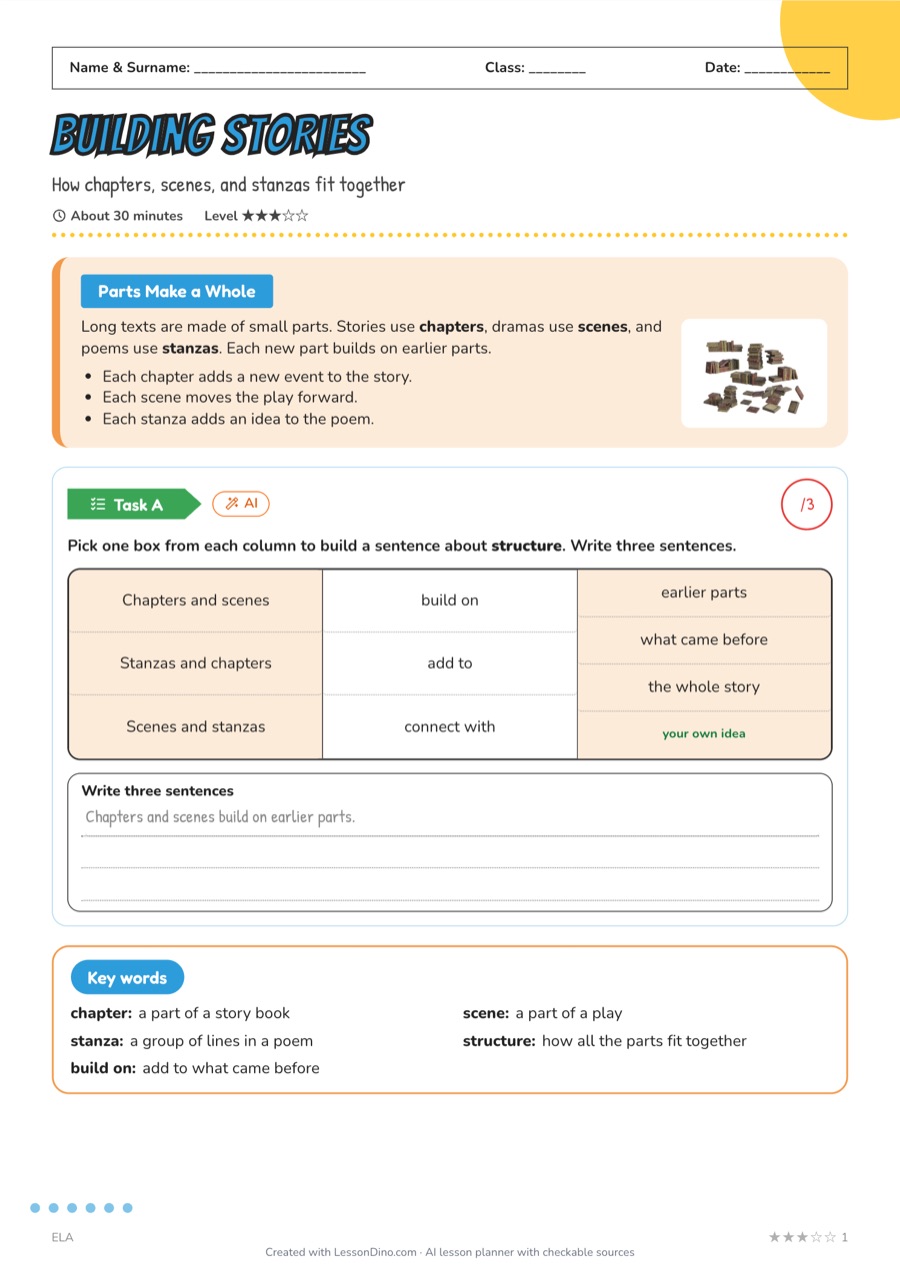
- Guided practice (11 minutes): Model Worksheet Task A by picking one box from each column to build a sentence about structure.
- Support: Give a version with first-line clues underlined to show setting and problem in order.
- Stretch: Have students write one sentence to predict what a fourth chapter would add to the overall structure.
- The answer sheet is the last page, so you can print it on its own or let students check their own work.
Key vocabulary
- chapter: a separate part of a story book
- scene: a separate part of a play with talking and action
- stanza: a grouped set of lines that form a part of a poem
- structure: how all the small parts fit together to make a whole
- resolution: the part near the end where the problem gets fixed
Mistakes to watch for
- Thinking each chapter is a separate story. Point to Paragraph 2 line This part builds on the first part and have them name the repeated key.
- Mixing up chapter, scene, and stanza. Sort three labels to story, drama, poem and use each term when speaking about the text.
- Saying order does not matter. Remove Paragraph 2 and show the ending danger has no setup, so larger portions must lead to the next.
What's on the worksheet
Stories Fit Together
Learn how small parts build a whole text.
Parts Make a Whole
- Long texts are made of small parts. Stories use chapters, dramas use scenes, and poems use stanzas. Each new part builds on earlier parts.
- Each chapter adds a new event to the story.
- Each scene moves the play forward.
- Each stanza adds an idea to the poem.
Pick one box from each column to build a sentence about structure. Write three sentences.
| Word | Meaning |
|---|---|
| chapter | a part of a story book |
| scene | a part of a play |
| stanza | a group of lines in a poem |
| structure | how all the parts fit together |
| build on | add to what came before |
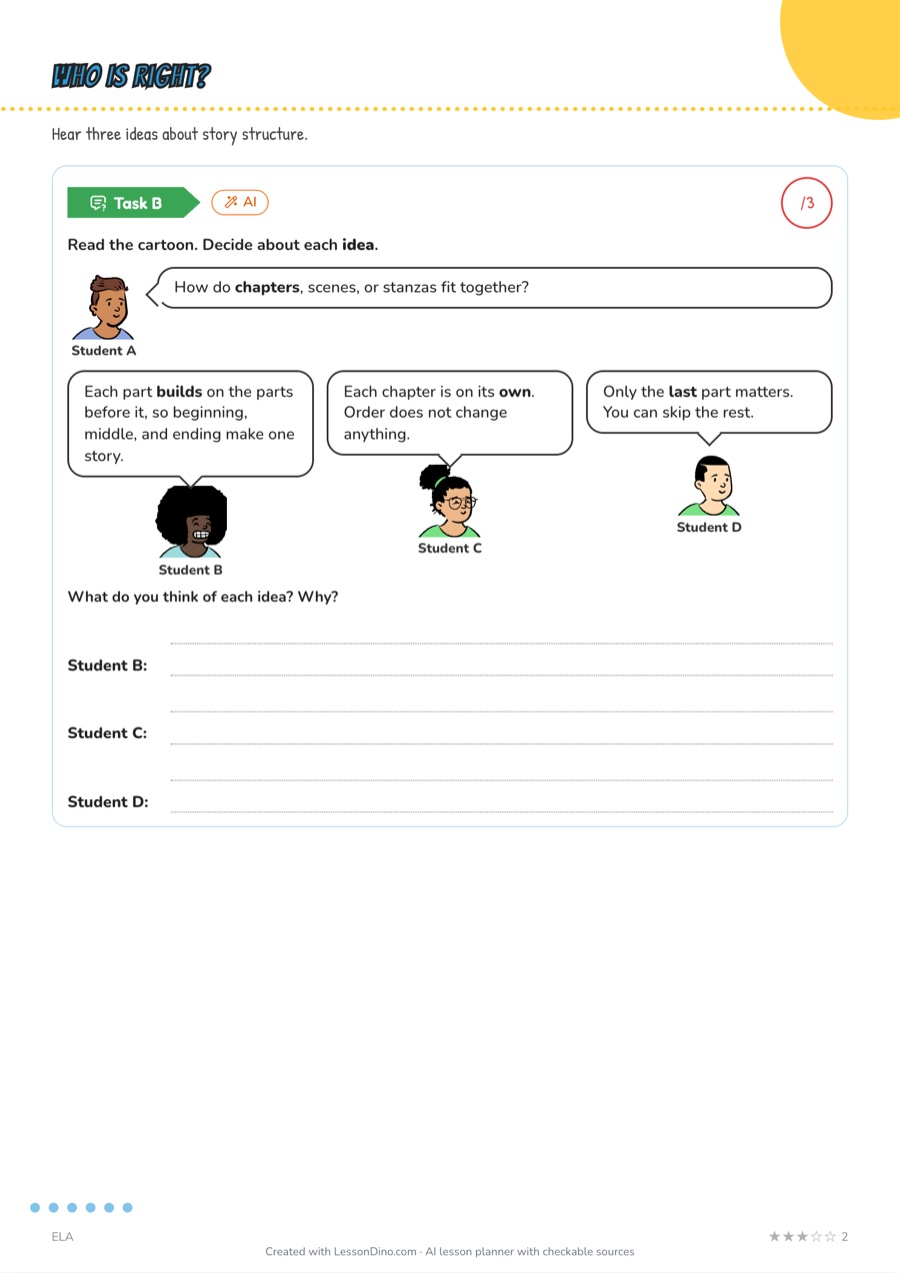
Who Is Right?
Hear three ideas about story structure.
Read the cartoon. Decide about each idea.
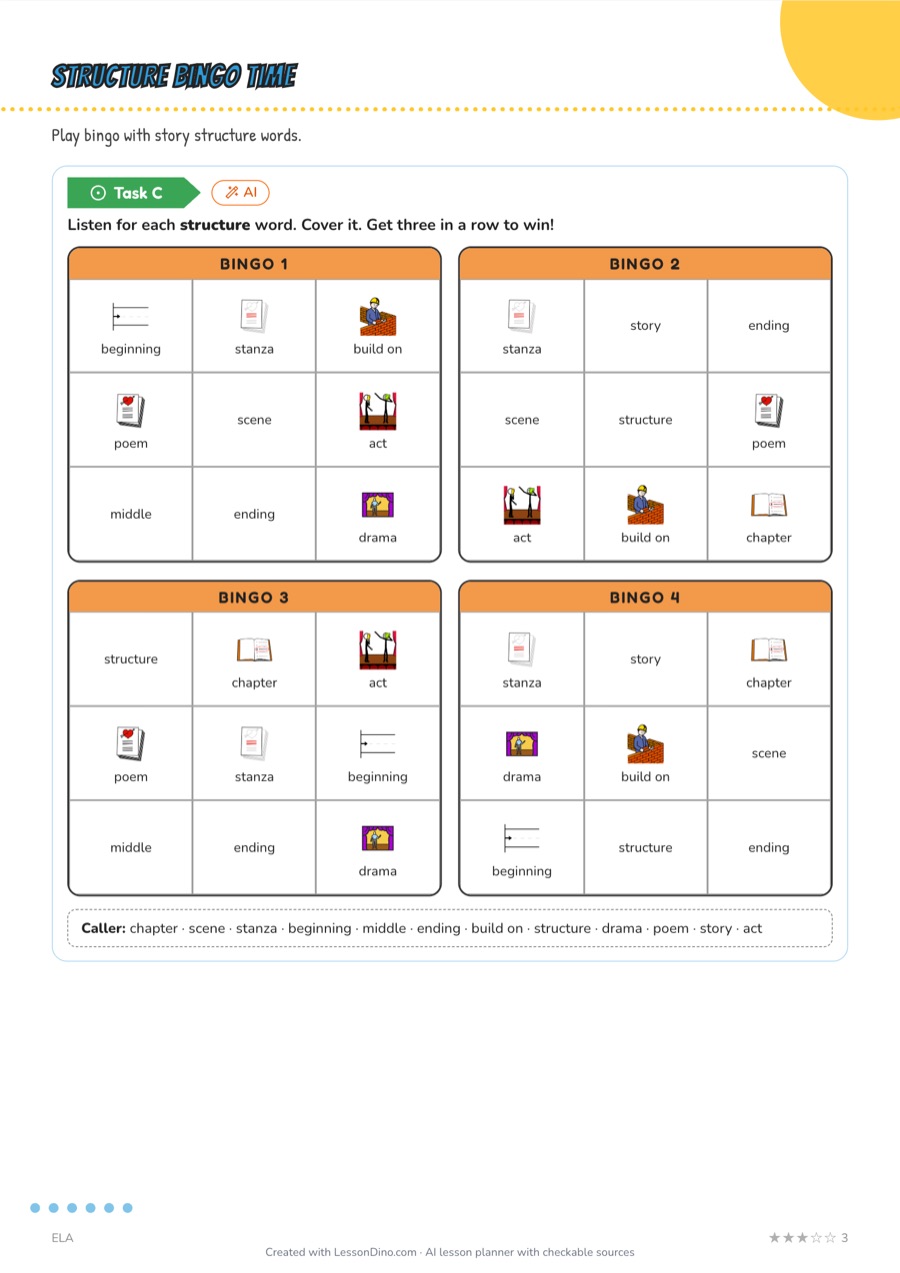
Structure Bingo Time
Play bingo with story structure words.
Listen for each structure word. Cover it. Get three in a row to win!
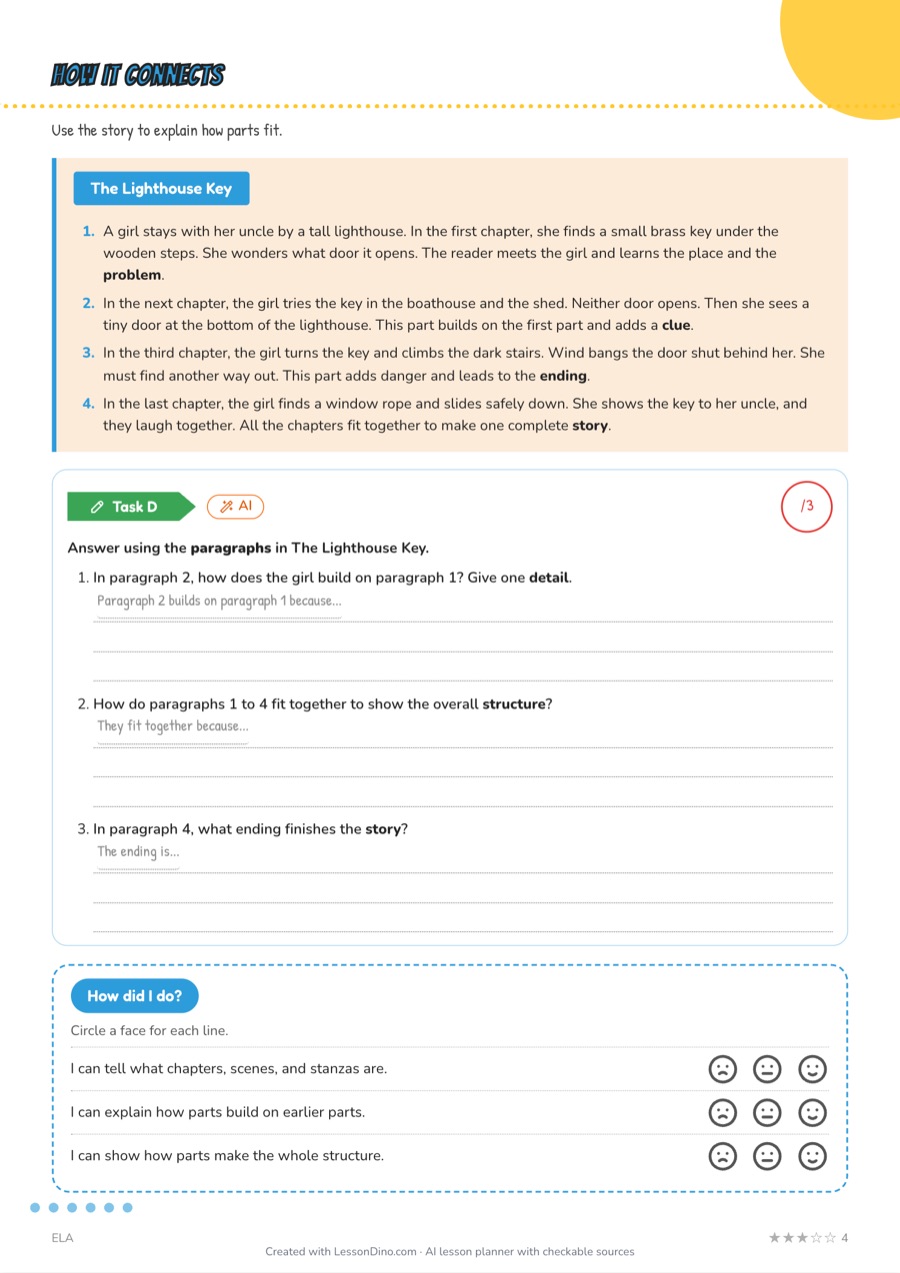
How It Connects
Use the story to explain how parts fit.
The Lighthouse Key
Answer using the paragraphs in The Lighthouse Key.
- In paragraph 2, how does the girl build on paragraph 1? Give one detail.
- How do paragraphs 1 to 4 fit together to show the overall structure?
- In paragraph 4, what ending finishes the story?
Answers
Show the answers
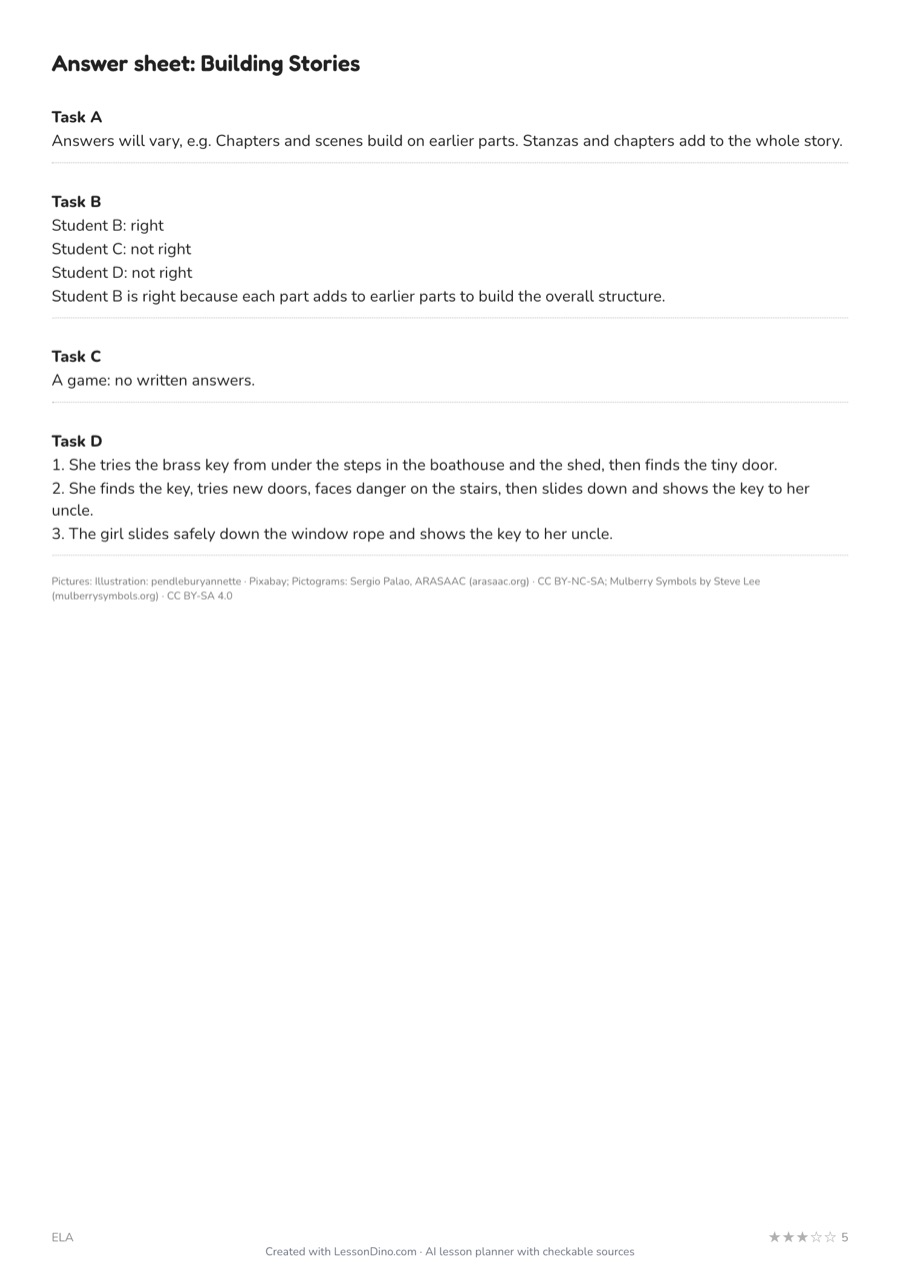
- In paragraph 2, how does the girl build on paragraph 1? Give one detail. She tries the brass key from under the steps in the boathouse and the shed, then finds the tiny door.
- How do paragraphs 1 to 4 fit together to show the overall structure? She finds the key, tries new doors, faces danger on the stairs, then slides down and shows the key to her uncle.
- In paragraph 4, what ending finishes the story? The girl slides safely down the window rope and shows the key to her uncle.
The answer sheet is the last picture above.
Curriculum
Explain how a series of chapters, scenes, or stanzas fits together to provide the overall structure of a particular story, drama, or poem.
Made with Lesson Dino's AI on 17 October 2026. AI can make mistakes, so check the answers and facts against the sources before you teach.