Slides



Lesson plan
How Chapters Build the Whole Story
Students learn how chapters, scenes, and stanzas build on each other. They order chapters into a chain and explain the whole structure.
Objectives
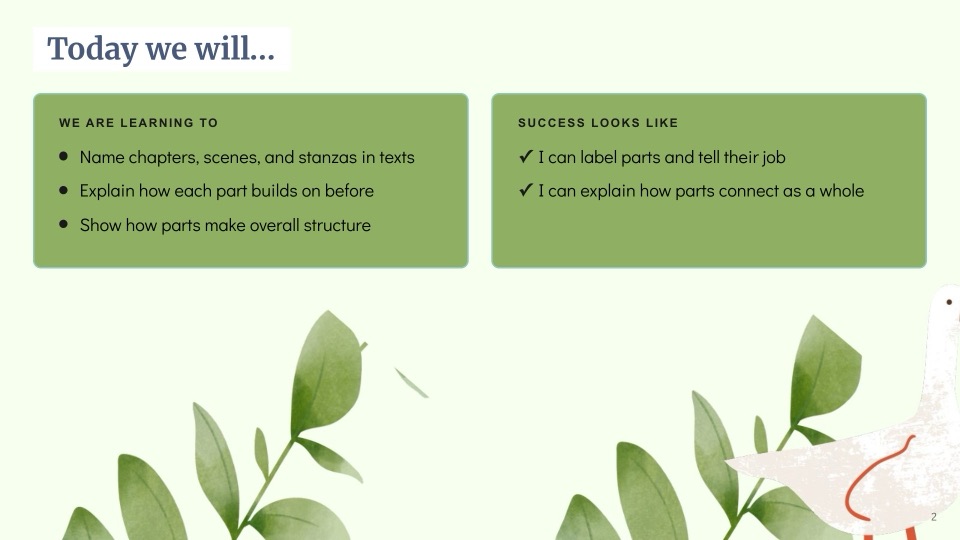
- Students will explain how chapters build on each other to make overall story structure.
- Students will name chapters, scenes, and stanzas and describe their jobs in texts.
Success criteria
- I can label chapters, scenes, and stanzas and tell their job.
- I can explain how Chapter 2 builds on Chapter 1.
- I can explain how all parts together make the whole story.
Key words
| Word | Meaning |
|---|---|
| chapter | a separate part of a story book |
| scene | a separate part of a play with talking and action |
| stanza | a grouped set of lines that form a part of a poem |
| structure | how all the small parts fit together to make a whole |
| resolution | the part near the end where the problem gets fixed |
Timed plan (60 minutes)
| Time | Stage | What happens |
|---|---|---|
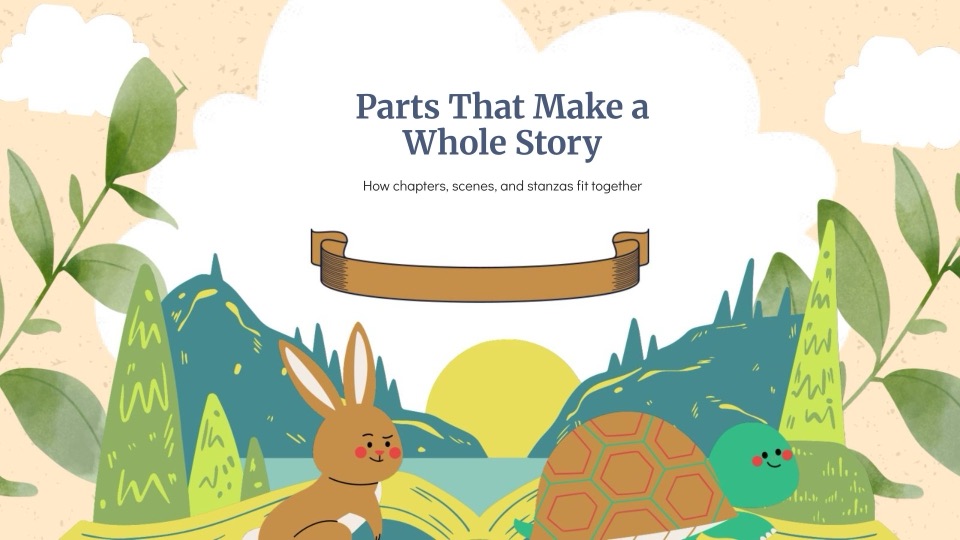
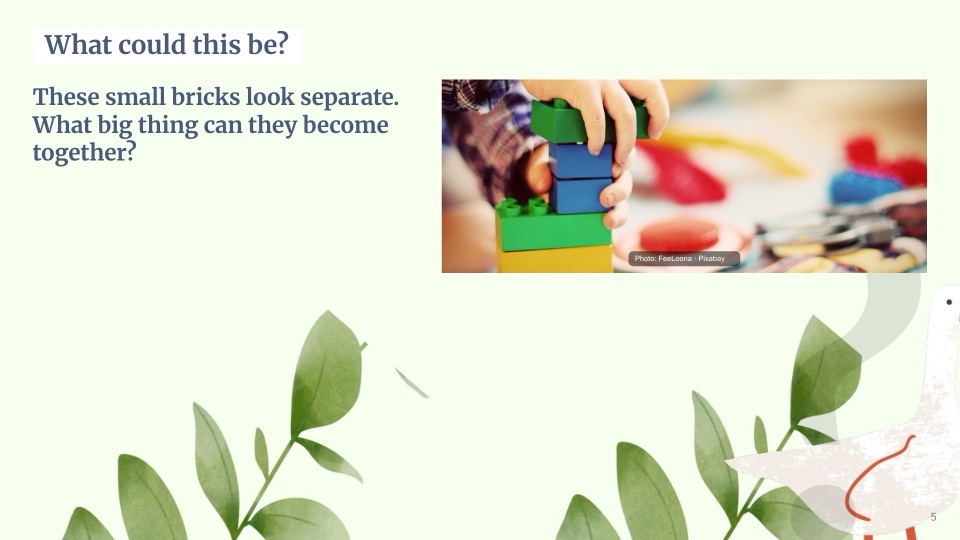
| 7 min | Starter | Hook curiosity about missing chapters and recall beginning-middle-end to frame structure. Show Slide 1 title and Slide 2 objectives and read the goals in student words. Say the hook: What if we ripped chapter two right out of a book? Would the story still make sense? Show Slide 5 mystery bricks and explain that small bricks can make one strong tower like chapters make one story. Have partners turn and talk for 30 seconds about what would be confusing if Chapter 2 was gone. |
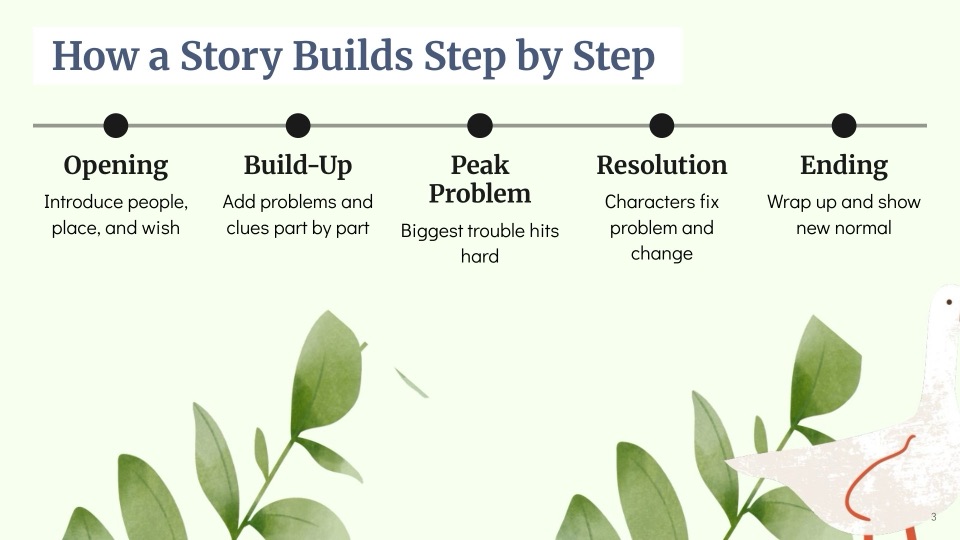
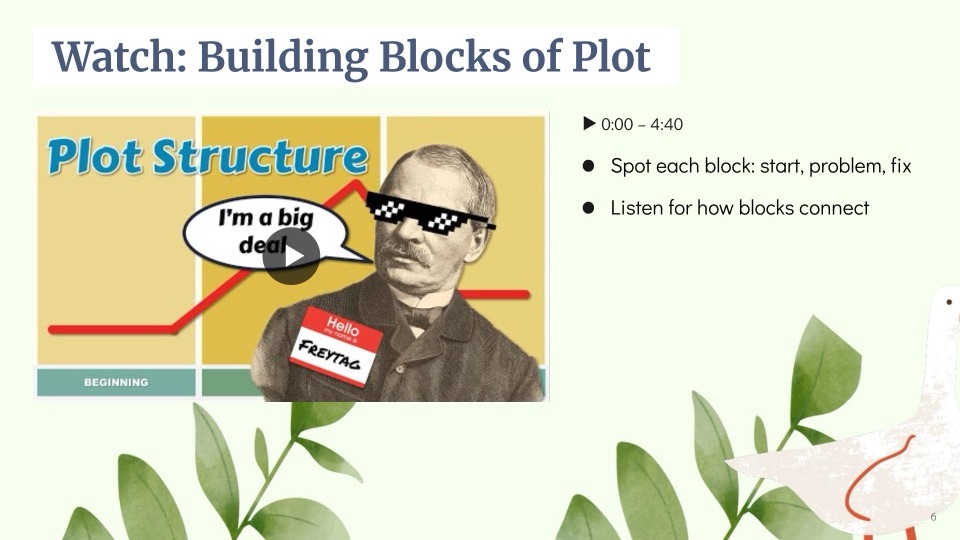
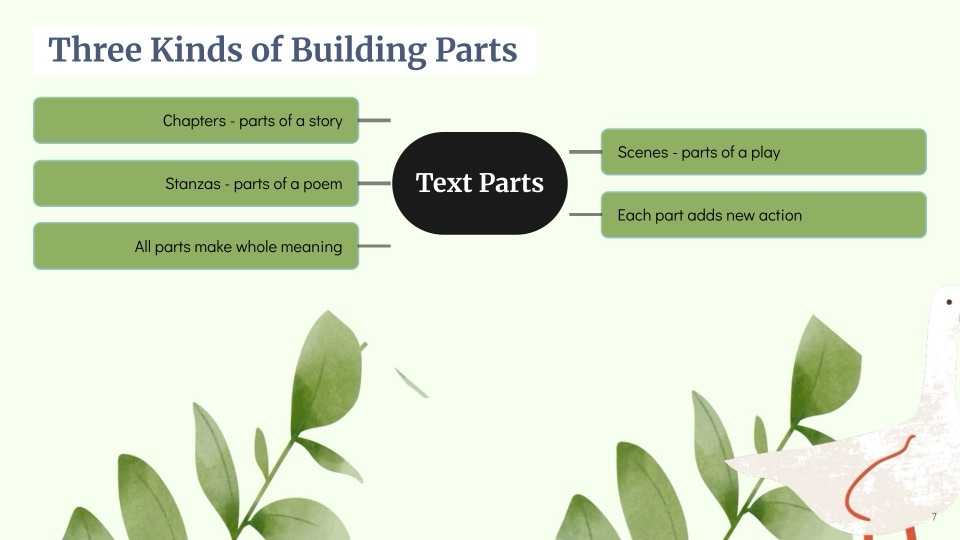
| 12 min | Teaching | Teach the names and jobs of chapters, scenes, and stanzas and how they build step by step. Show Slide 3 timeline and walk through Opening, Build-Up, Peak Problem, and Resolution. Show Slide 4 photo and explain each chapter adds like a new block that holds up the whole story. Play Video clip 2 (0:00–4:40) on Slide 6 and tell students to spot the start, problem, and fix and how blocks connect. Show Slide 7 mindmap and name chapters as parts of a story, scenes as parts of a play, and stanzas as parts of a poem, where each part adds new action and larger portions build meaning. |
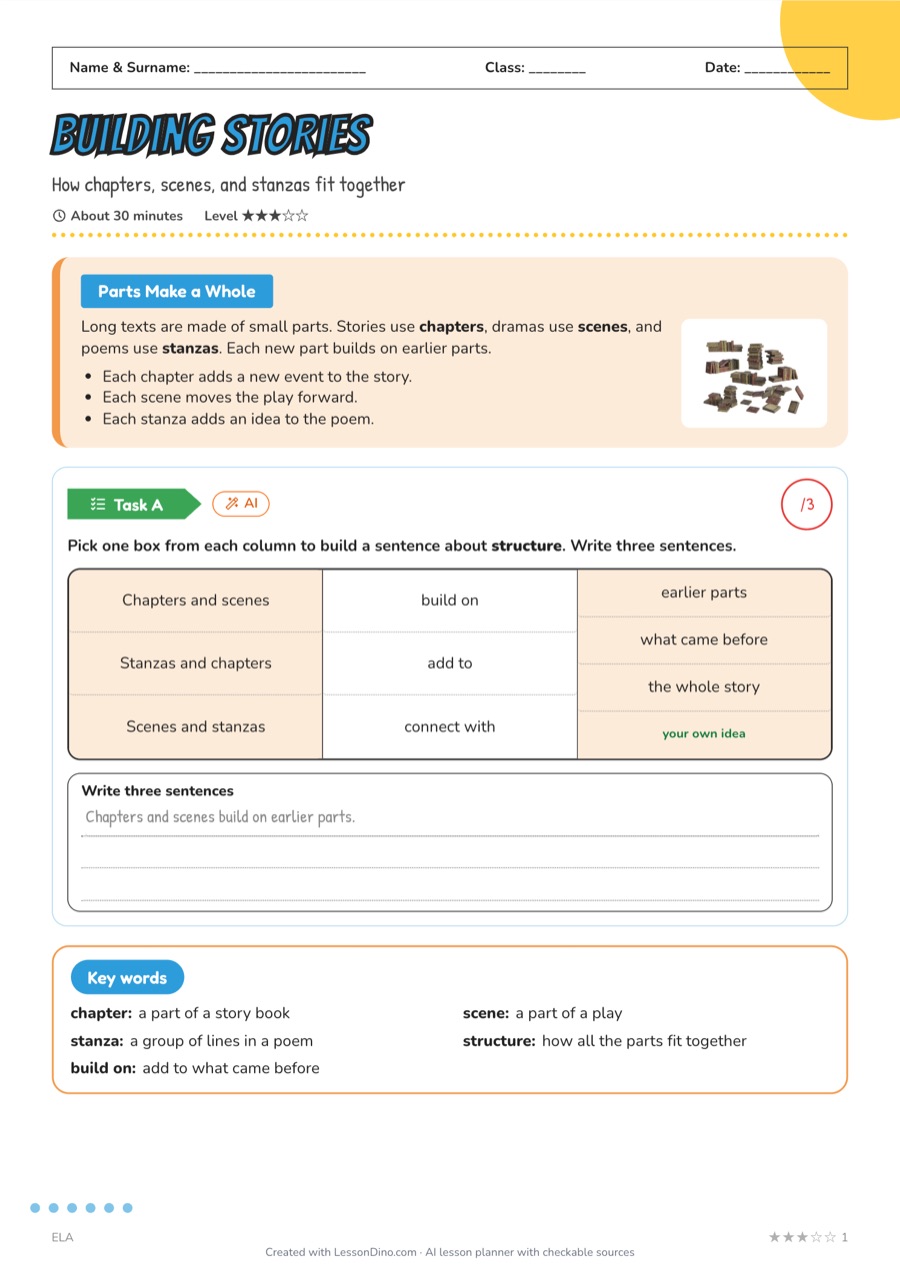
| 11 min | Guided practice | Practice structure language together using sentence frames before building chains. Show Slide 10 bullets and read: each part answers and asks something new, earlier details set up later surprises. Model Worksheet Task A by picking one box from each column to build a sentence about structure. Have pairs write three sentences and then read one aloud. Fix word use by reminding pairs to use chapter, scene, and stanza correctly when speaking about the text. |
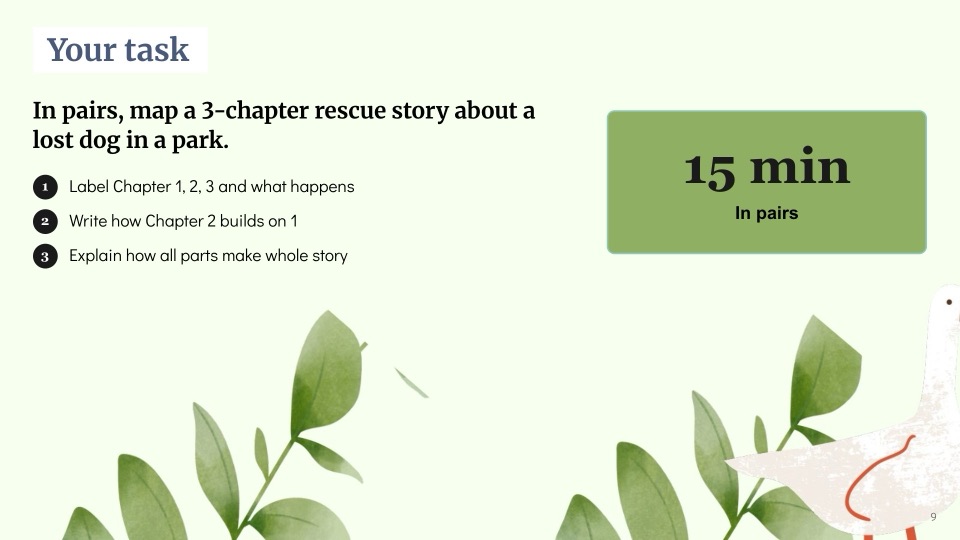
| 20 min | Main activity | Order chapter strips into a chain and explain how each part builds to make overall structure. Show Slide 9 task and hand out mixed-up sentence strips of The Lighthouse Key Paragraphs 1-3. Direct groups to order the strips, label Chapter 1, 2, 3 and what each adds, and discuss how each successive part builds on earlier sections. Remind groups to check that the beginning introduces the story and the ending concludes the action. Have each group tape its chain to the wall and explain in 2 sentences why Chapter 2 could not come first. |
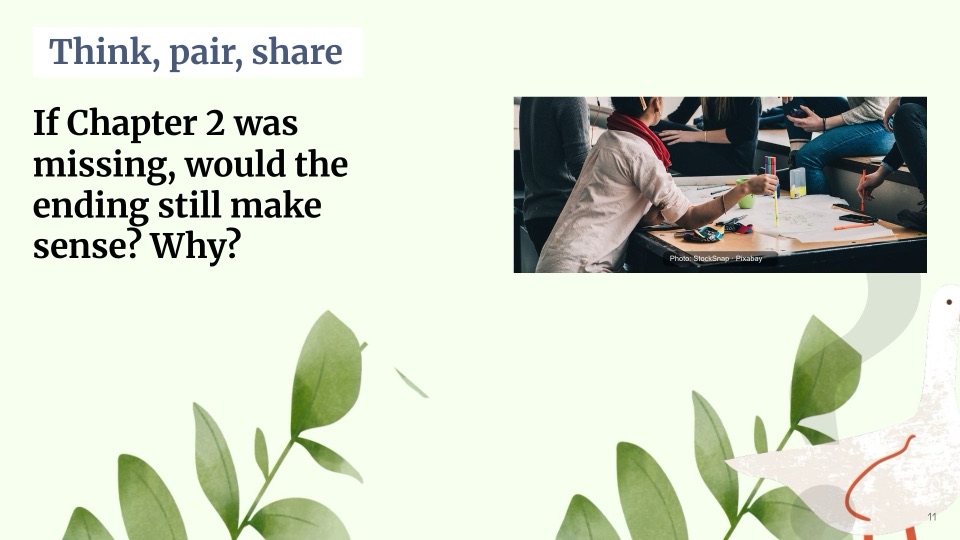
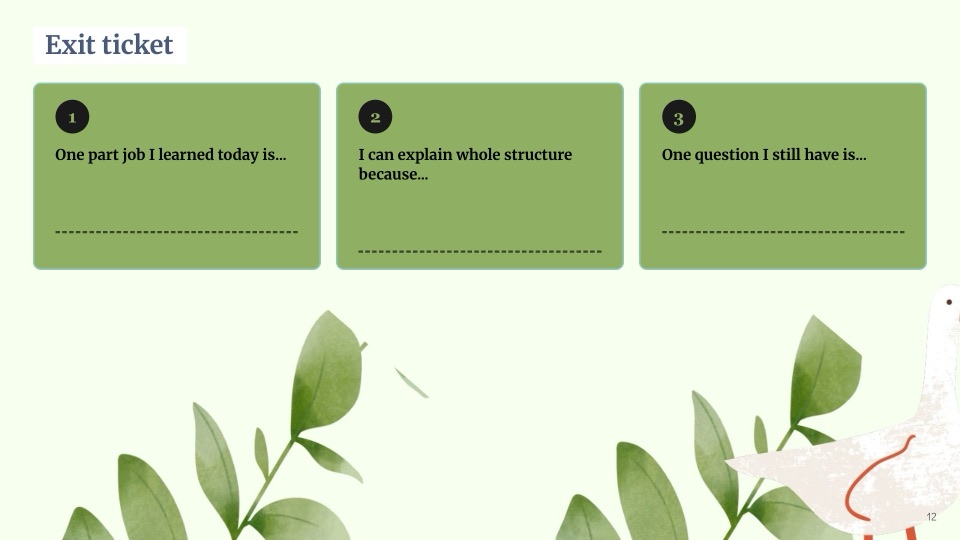
| 10 min | Plenary | Link each part to the whole story and check the objectives with an exit ticket. Show Slide 10 and restate that the last part shows change from the first part and details earlier set up surprises later. Use Slide 11 question for think, pair, share: If Chapter 2 was missing, would the ending still make sense? Why? Connect to drama and poem: scenes connect the same way in a play and stanzas add ideas step by step in a poem. Hand out Slide 12 exit tickets and collect them at the door. |
Common mistakes
- Thinking each chapter is a separate story
How to spot it: Student retells chapters with no links between them
Point to Paragraph 2 line This part builds on the first part and have them name the repeated key. - Mixing up chapter, scene, and stanza
How to spot it: Student calls a poem part a chapter or a play part a stanza
Sort three labels to story, drama, poem and use each term when speaking about the text. - Saying order does not matter
How to spot it: Student says any order works as long as all parts are there
Remove Paragraph 2 and show the ending danger has no setup, so larger portions must lead to the next.
Support
- Give a version with first-line clues underlined to show setting and problem in order.
- Provide sentence starters and a word bank with chapter, scene, stanza to organize ideas.
Stretch
- Have students write one sentence to predict what a fourth chapter would add to the overall structure.
- Have students add one line that would make the link between two parts stronger.
Check questions
- What is the job of Chapter 1 in The Lighthouse Key?
Answer: Paragraph 1 meets the girl and learns the place and the problem. - How does Chapter 2 build on Chapter 1?
Answer: Paragraph 2 tries the key and adds the clue of the tiny lighthouse door. - How do all the chapters make overall structure?
Answer: Each successive part builds on earlier sections until Paragraph 4 makes one complete story.
Curriculum
Explain how a series of chapters, scenes, or stanzas fits together to provide the overall structure of a particular story, drama, or poem.
Video clips
Clips on YouTube, from the start and end times we chose. Check each one before you show it.
-
elements of a story from 0:00 to 5:00
Khan Academy: The elements of a story | Reading | Khan Academy
Directly explains story parts and how they build structure with vocabulary and pace perfect for ages 10-11 in Grade 5.
-
plot building blocks from 0:00 to 4:40
The ELA Connection: Plot Structure: The Building Blocks to Every Story
Clearly teaches plot structure as building blocks that fit together, made for upper-elementary ELA at ages 10-11.
Worksheet
Sources
- College and Career Readiness Anchor Standards for Reading thecorestandards.org
- Tennessee English Language Arts Standards - TN.gov tn.gov
- Story Structure – The Narrative Transformation Lab tntlab.carterschool.gmu.edu
- Storytelling: Story Structure - CMU School of Computer Science cs.cmu.edu
- The Structure of Narrative cseweb.ucsd.edu
- The Inverted Pyramid Structure - Purdue OWL® owl.purdue.edu
- How to structure a story - BBC Bitesize bbc.co.uk
- How is a story structured? - BBC Bitesize bbc.co.uk
- Story Structure for Kids: a Step-by-Step Guide - BookBildr ... edu.bookbildr.com
- Story structure - Wikipedia en.wikipedia.org
- Step-by-Step Guide to Teaching Kids Story Structure magicalstories.ai
- Plot Diagram for Kids: Easy Story Structure Guide prodigycreekside.com
- Story Structure | Night Zookeeper nightzookeeper.com
- Story Structure Worksheets | Reading Activities ereadingworksheets.com
- How To Structure Plot – Core Story Elements - Wiki - Twinkl twinkl.com
- Story Structure - The National Children's Book and Literacy ... thencbla.org
- Fiction Story Elements and Text Structure - This Reading Mama thisreadingmama.com
Picture credits
- Photo: Sunriseforever · Pixabay
- Illustration: Vilkasss · Pixabay
- Photo: FeeLoona · Pixabay
- Photo: TomDaskoFoto · Pixabay
- Photo: StockSnap · Pixabay
- Illustration: pendleburyannette · Pixabay
- Pictograms: Sergio Palao, ARASAAC (arasaac.org) · CC BY-NC-SA
- Mulberry Symbols by Steve Lee (mulberrysymbols.org) · CC BY-SA 4.0
Made with Lesson Dino's AI on 17 October 2026. AI can make mistakes, so check facts against the sources before you teach.