The worksheet
About this worksheet
Students learn to use place value to round to the nearest 10 or 100. They practice by talking, signaling, and explaining with a partner. This Grade 3 Math worksheet gives students (ages 8–9) six pages of practice on rounding, part of the number and operations in base ten unit. It goes with our free Rounding lesson, which has the slides and a timed lesson plan.
What it covers
By the end, students should be able to:
- Students will round whole numbers to the nearest 10 using place value.
- Students will round whole numbers to the nearest 100 using place value.
- Students will explain how place value tells them to round up or down.
How to use it
- Main Activity (20 minutes): Circulate as pairs use Worksheet Task B numbers as spoken prompts, chanting place then next digit.
- Support: Start only with tens with sentence frame and pre-marked halfway number lines for 20-30 and 70-80.
- Stretch: Roll three dice to make three-digit numbers and round those to nearest 10, then to nearest 100.
- The answer sheet is the last page, so you can print it on its own or let students check their own work.
Key vocabulary
- round: make a number simpler but still close
- place value: what a digit is worth from its spot in a number
- nearest 10: closest tens count that ends with zero
- nearest 100: closest hundreds count that ends with two zeros
- round up: go to the next greater ten or hundred
- round down: stay with the lower ten or hundred
Mistakes to watch for
- Rounding 25, 35, or 75 down instead of up. Mark halfway 75 and show values at 75 or above round up to 80. Chant 5-9 go up.
- Looking at the wrong digit for hundreds. Underline hundreds, circle tens decider. If tens is less than 5 stay, if 5 or more go to next hundred.
- Forgetting zeros after rounding. Remind change right digits to zero. Check tens end in 0 and hundreds end in 00.
What's on the worksheet
Round With Confidence
Learn how place value helps you round numbers.
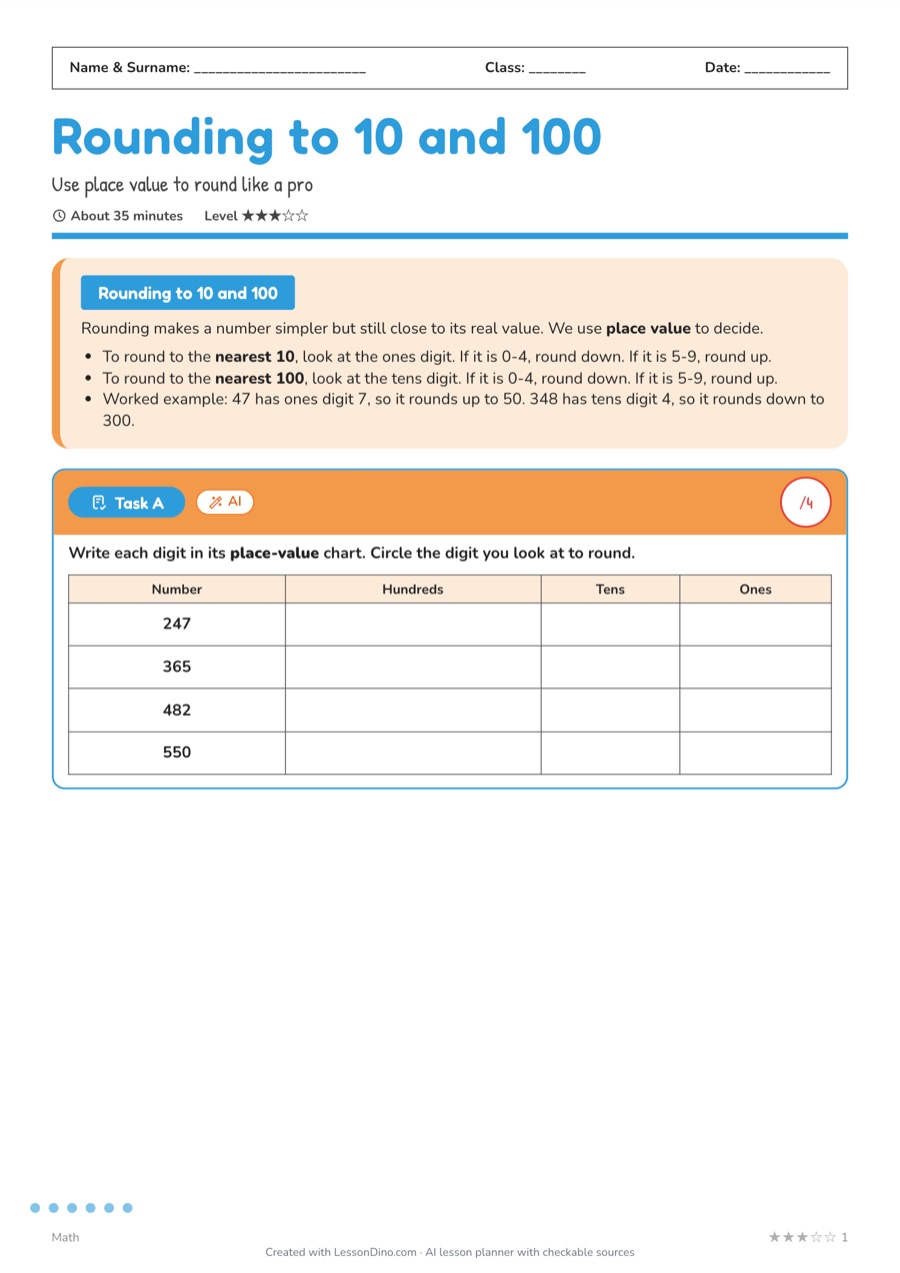
Rounding to 10 and 100
- Rounding makes a number simpler but still close to its real value. We use place value to decide.
- To round to the nearest 10, look at the ones digit. If it is 0-4, round down. If it is 5-9, round up.
- To round to the nearest 100, look at the tens digit. If it is 0-4, round down. If it is 5-9, round up.
- Worked example: 47 has ones digit 7, so it rounds up to 50. 348 has tens digit 4, so it rounds down to 300.
Write each digit in its place-value chart. Circle the digit you look at to round.
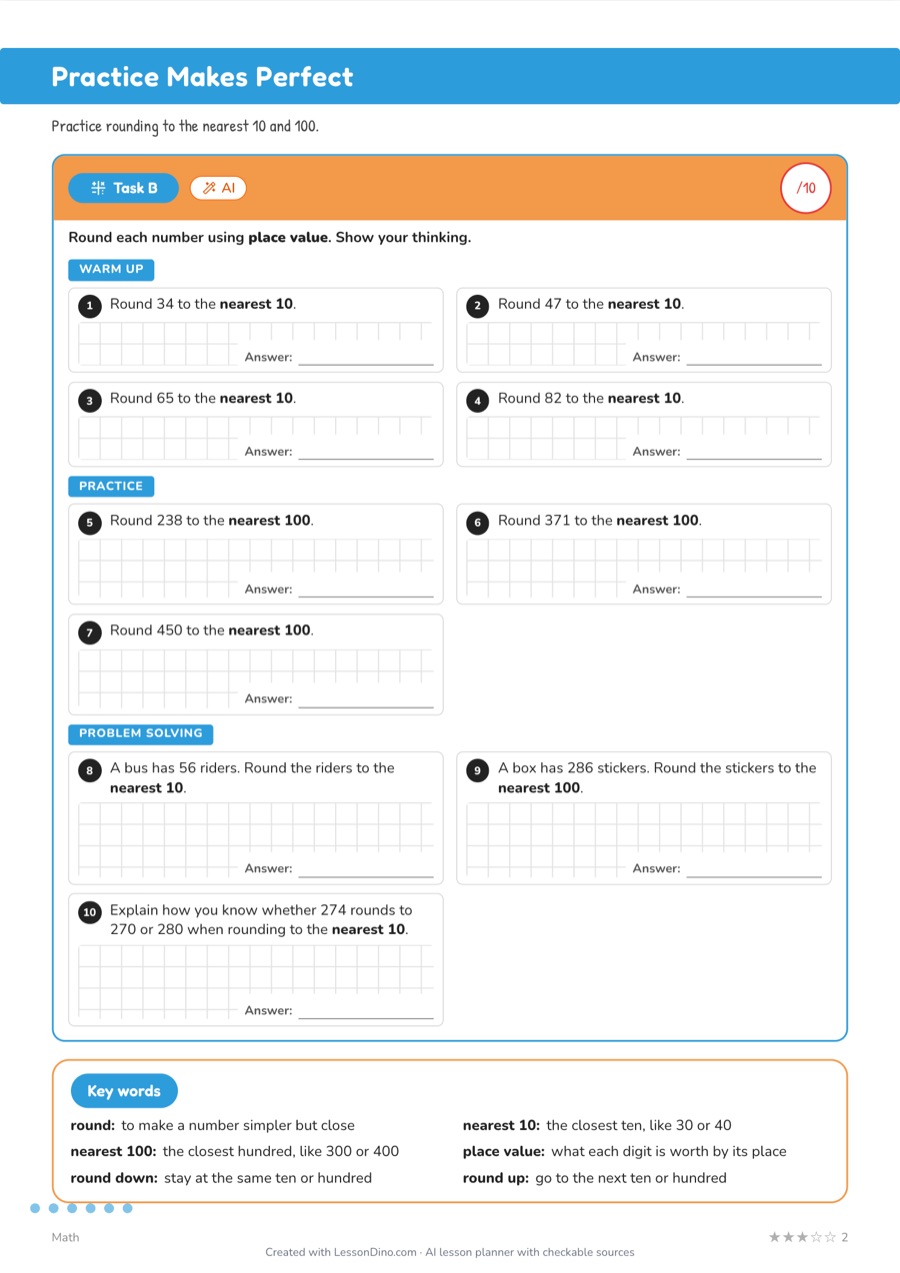
Practice Makes Perfect
Practice rounding to the nearest 10 and 100.
Round each number using place value. Show your thinking.
Warm up
- Round 34 to the nearest 10.
- Round 47 to the nearest 10.
- Round 65 to the nearest 10.
- Round 82 to the nearest 10.
Practice
- Round 238 to the nearest 100.
- Round 371 to the nearest 100.
- Round 450 to the nearest 100.
Problem solving
- A bus has 56 riders. Round the riders to the nearest 10.
- A box has 286 stickers. Round the stickers to the nearest 100.
- Explain how you know whether 274 rounds to 270 or 280 when rounding to the nearest 10.
| Word | Meaning |
|---|---|
| round | to make a number simpler but close |
| nearest 10 | the closest ten, like 30 or 40 |
| nearest 100 | the closest hundred, like 300 or 400 |
| place value | what each digit is worth by its place |
| round down | stay at the same ten or hundred |
| round up | go to the next ten or hundred |
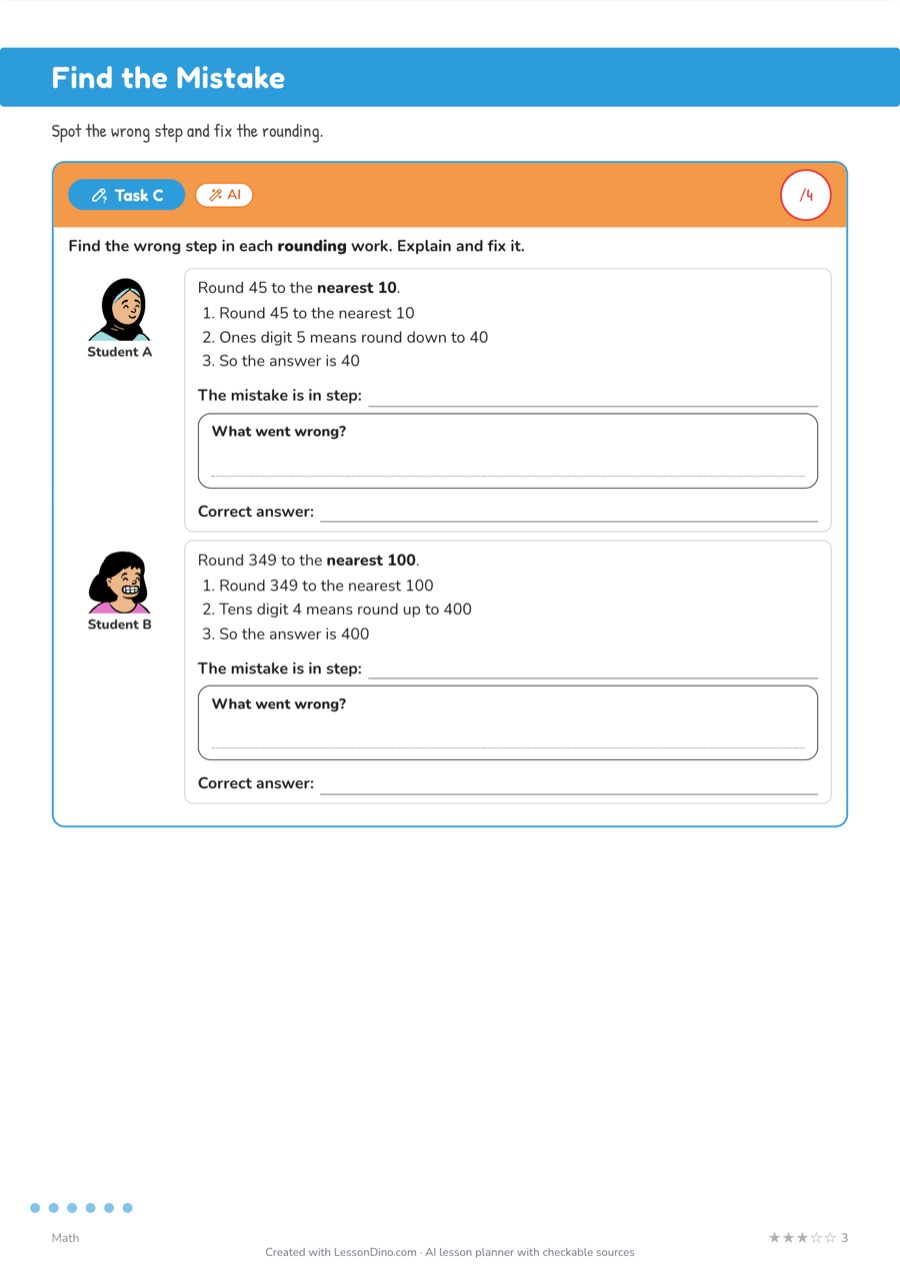
Find the Mistake
Spot the wrong step and fix the rounding.
Find the wrong step in each rounding work. Explain and fix it.
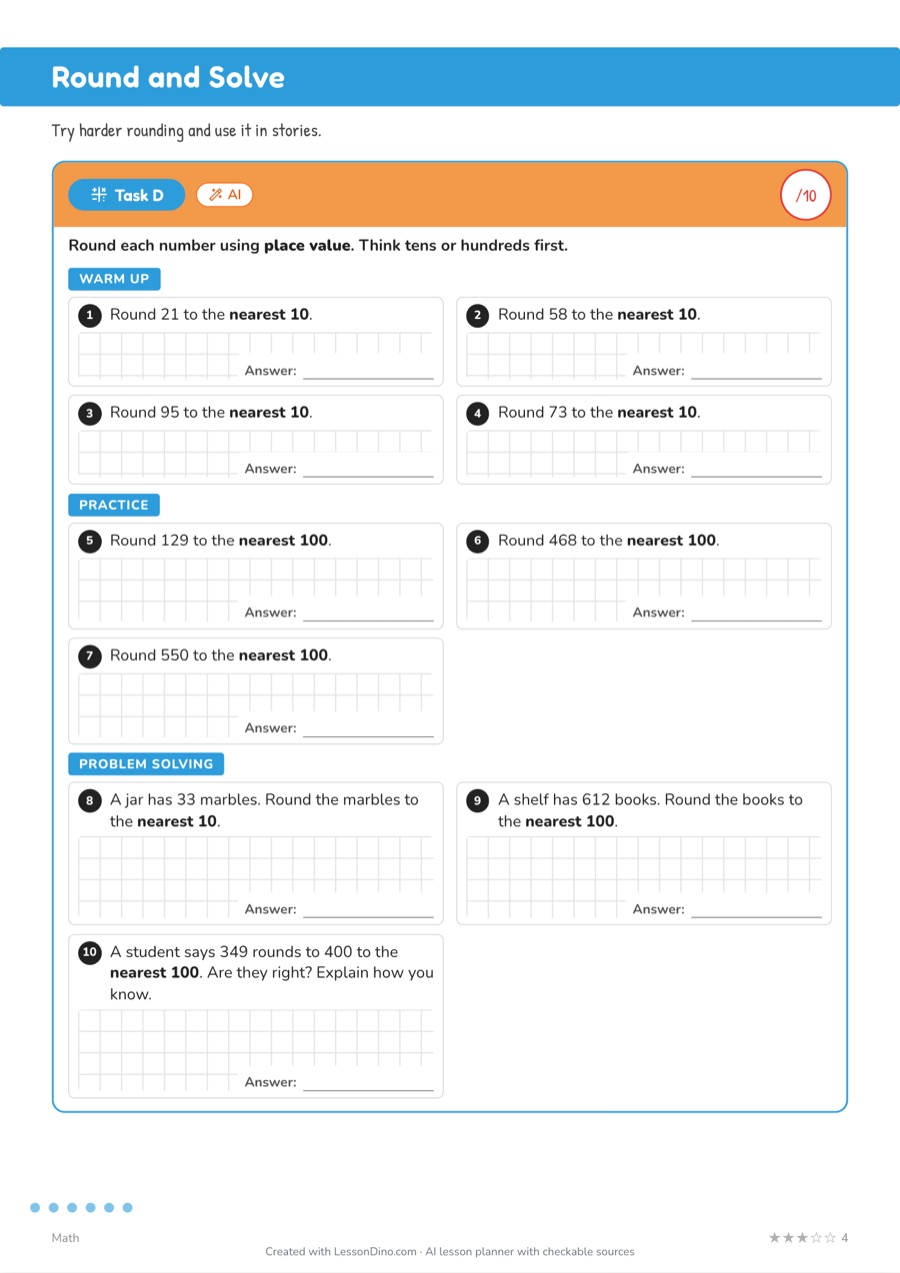
Round and Solve
Try harder rounding and use it in stories.
Round each number using place value. Think tens or hundreds first.
Warm up
- Round 21 to the nearest 10.
- Round 58 to the nearest 10.
- Round 95 to the nearest 10.
- Round 73 to the nearest 10.
Practice
- Round 129 to the nearest 100.
- Round 468 to the nearest 100.
- Round 550 to the nearest 100.
Problem solving
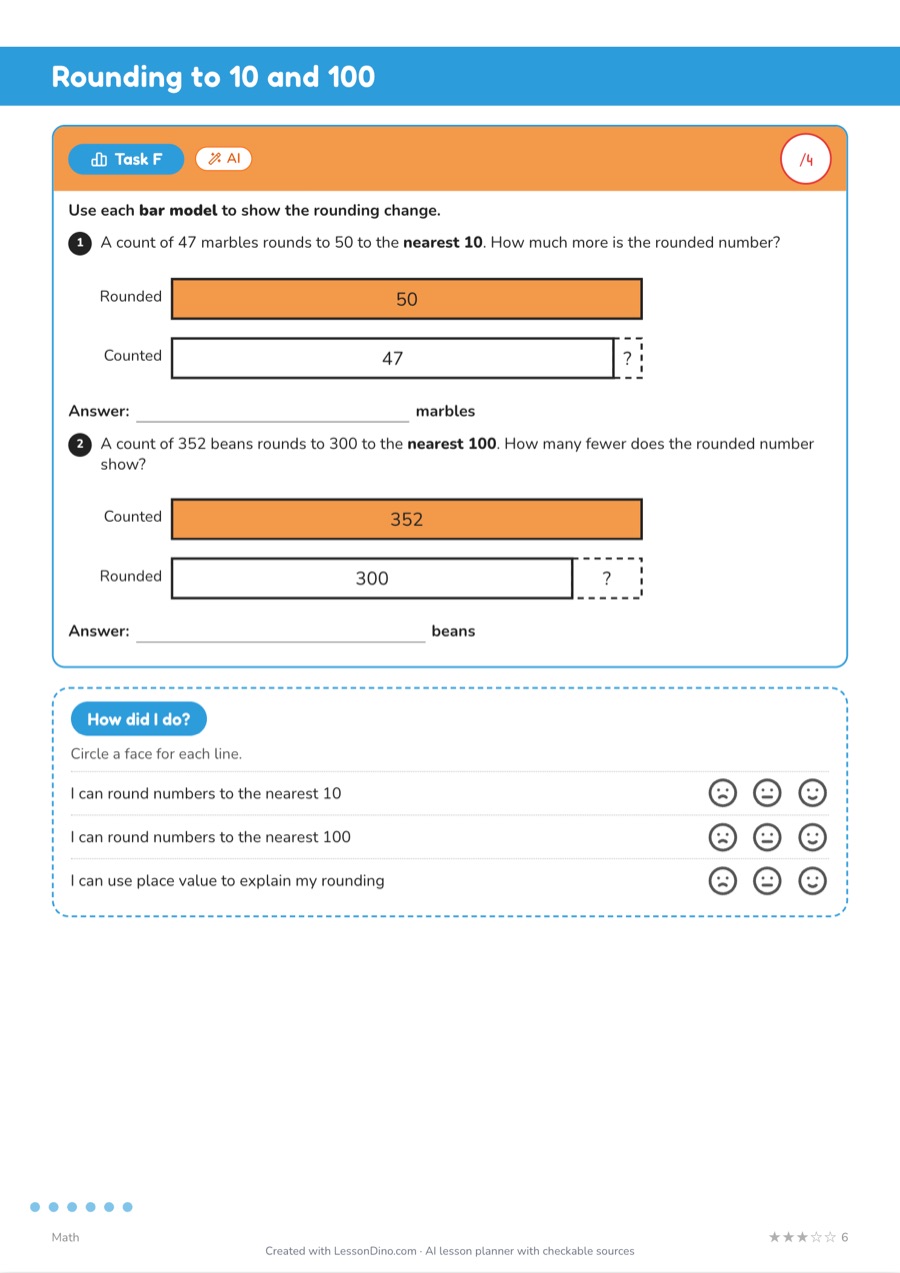
- A jar has 33 marbles. Round the marbles to the nearest 10.
- A shelf has 612 books. Round the books to the nearest 100.
- A student says 349 rounds to 400 to the nearest 100. Are they right? Explain how you know.
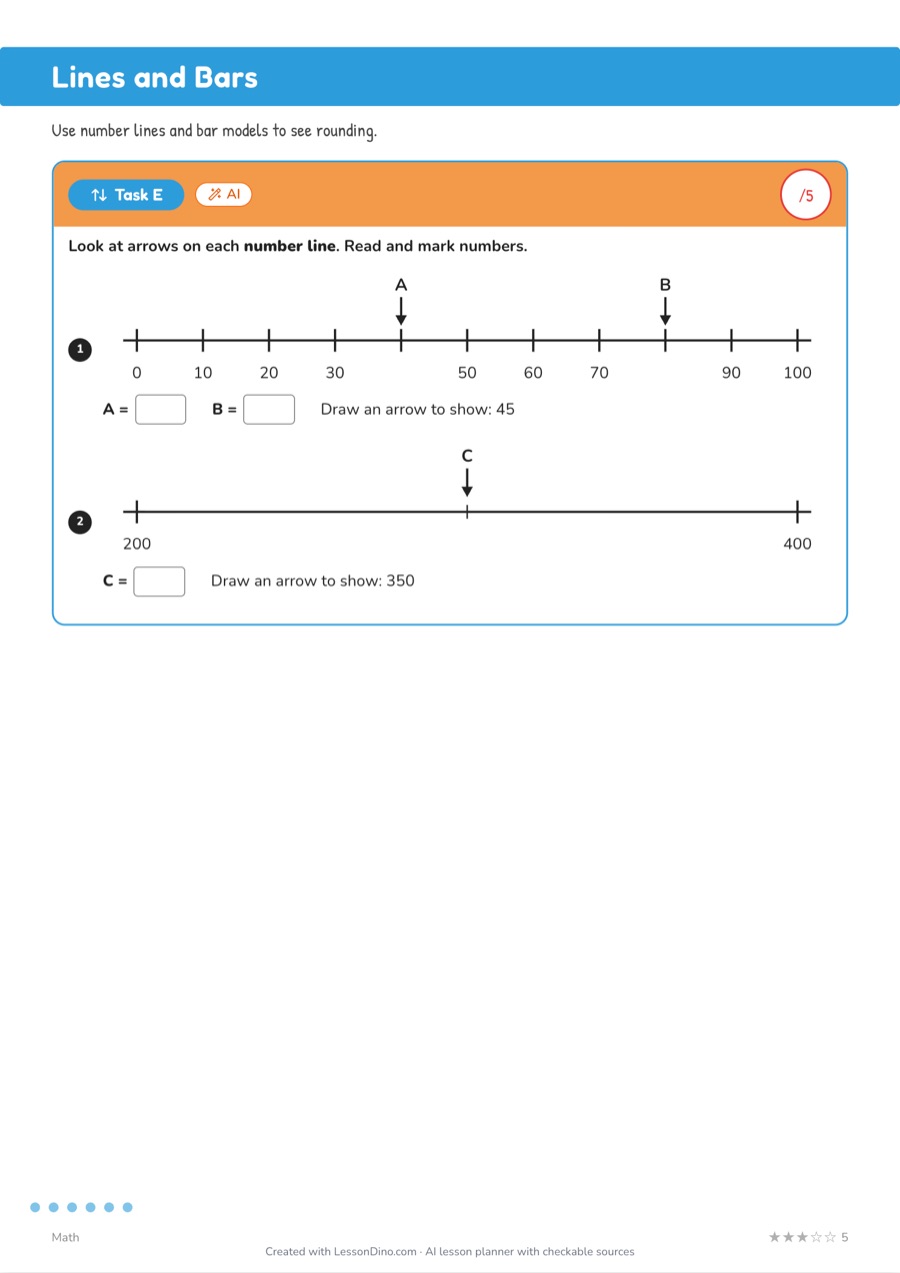
Lines and Bars
Use number lines and bar models to see rounding.
Look at arrows on each number line. Read and mark numbers.
Page 6
Use each bar model to show the rounding change.
Answers
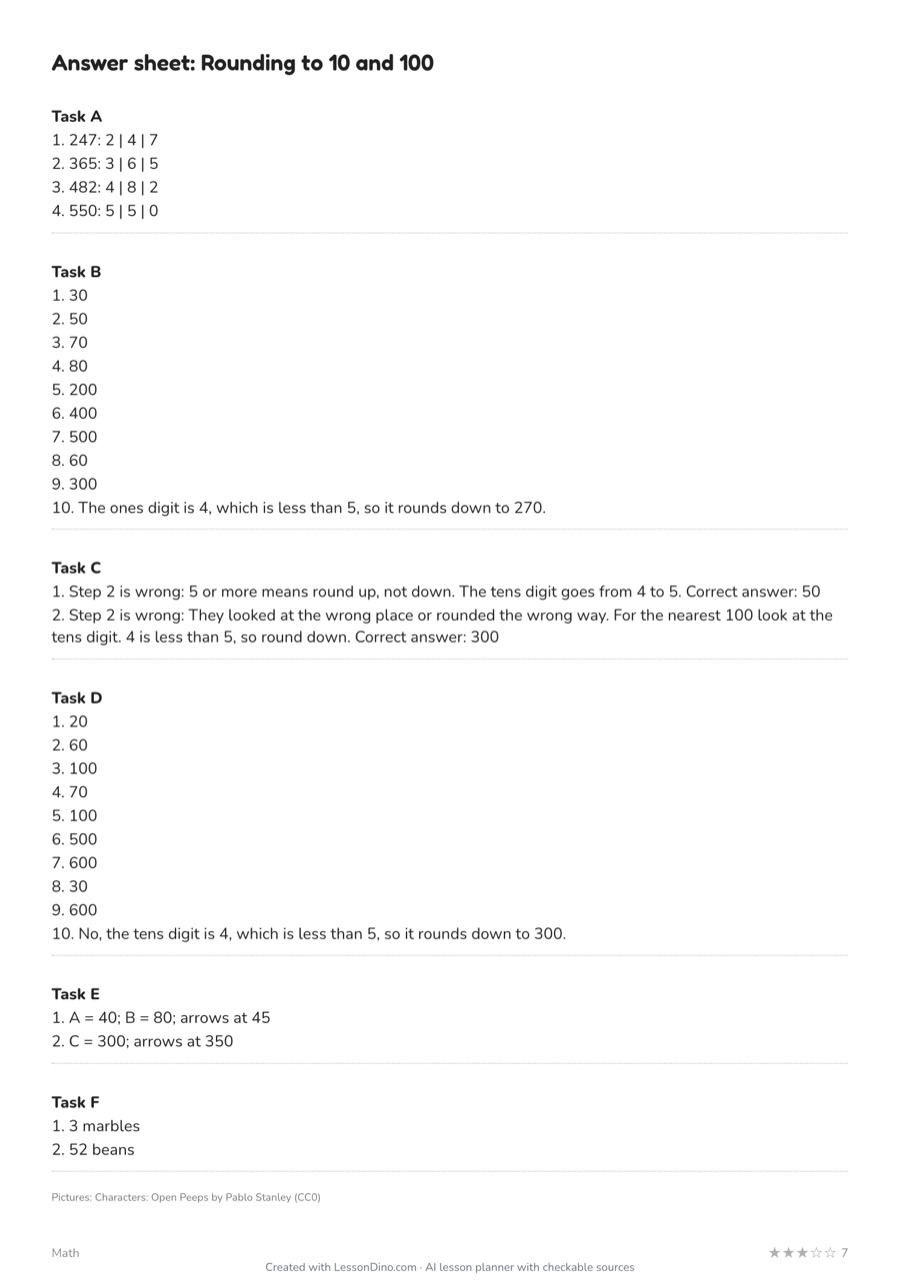
Show the answers
- Round 34 to the nearest 10. 30
- Round 47 to the nearest 10. 50
- Round 65 to the nearest 10. 70
- Round 82 to the nearest 10. 80
- Round 238 to the nearest 100. 200
- Round 371 to the nearest 100. 400
- Round 450 to the nearest 100. 500
- A bus has 56 riders. Round the riders to the nearest 10. 60
- A box has 286 stickers. Round the stickers to the nearest 100. 300
- Explain how you know whether 274 rounds to 270 or 280 when rounding to the nearest 10. The ones digit is 4, which is less than 5, so it rounds down to 270.
- Round 21 to the nearest 10. 20
- Round 58 to the nearest 10. 60
- Round 95 to the nearest 10. 100
- Round 73 to the nearest 10. 70
- Round 129 to the nearest 100. 100
- Round 468 to the nearest 100. 500
- Round 550 to the nearest 100. 600
- A jar has 33 marbles. Round the marbles to the nearest 10. 30
- A shelf has 612 books. Round the books to the nearest 100. 600
- A student says 349 rounds to 400 to the nearest 100. Are they right? Explain how you know. No, the tens digit is 4, which is less than 5, so it rounds down to 300.
The answer sheet is the last picture above.
Curriculum
Use place value understanding to round whole numbers to the nearest 10 or 100.
Made with Lesson Dino's AI on 17 October 2026. AI can make mistakes, so check the answers and facts against the sources before you teach.