The worksheet
About this worksheet
Students learn what habitats give living things and that each habitat has different life. They sort plant and animal cards and count to compare diversity. This Grade 2 Science worksheet gives students (ages 7–8) six pages of practice on plants and animals in different habitats, part of the biological evolution: unity and diversity unit. It goes with our free Plants and animals in different habitats lesson, which has the slides and a timed lesson plan.
What it covers
By the end, students should be able to:
- Students will explain that a habitat gives food, water, shelter, and space.
- Students will match plants and animals to forest, pond, and desert habitats.
- Students will count kinds of life to compare diversity in different habitats.
How to use it
- Main activity (25 minutes): Tell groups to look closely at forest and pond pictures, count plants and animals in each, and record on Worksheet Task B.
- Plenary (5 minutes): Collect Worksheet Task B and exit lines.
- Support: Give cards with a colored dot on the back that matches the mat color so students can check after they try.
- Stretch: Add a fourth photo, like a grassland, and have students explain why some pond cards do not fit there.
- The answer sheet is the last page, so you can print it on its own or let students check their own work.
Key vocabulary
- habitat: the home where living things find food, water, shelter, and space to survive
- forest: a place with many tall trees where birds and other animals live
- pond: a small body of still fresh water where lilies and frogs live
- desert: a hot, dry place where cactus and lizards live
- diversity: how many different kinds of living things are in a place
- shelter: a safe place to live and hide
Mistakes to watch for
- Thinking a habitat is only shelter, not food, water, and space too. Point to food, water, shelter cards and ask where the animal finds each in its photo.
- Thinking any plant or animal can live in any habitat. Ask what the living thing needs and compare hot and dry desert with freshwater pond.
- Counting the same kind twice instead of counting different kinds. Model touching each different picture once and sorting doubles together before counting diversity.
What's on the worksheet
Homes for Living Things
Learn what a habitat gives plants and animals.
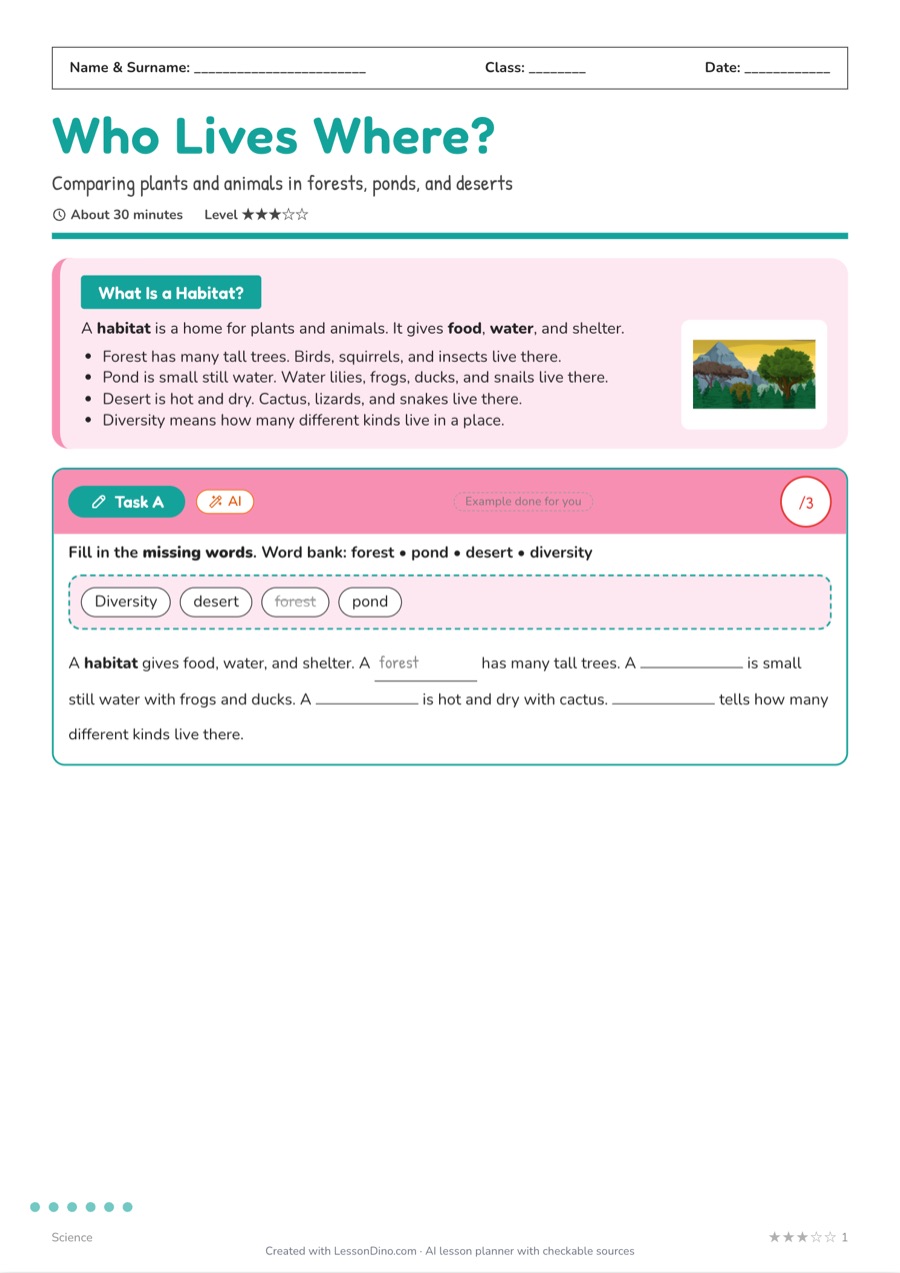
What Is a Habitat?
- A habitat is a home for plants and animals. It gives food, water, and shelter.
- Forest has many tall trees. Birds, squirrels, and insects live there.
- Pond is small still water. Water lilies, frogs, ducks, and snails live there.
- Desert is hot and dry. Cactus, lizards, and snakes live there.
- Diversity means how many different kinds live in a place.
Fill in the missing words. Word bank: forest • pond • desert • diversity
- A habitat gives food, water, and shelter. A [[forest]] has many tall trees. A [[pond]] is small still water with frogs and ducks. A [[desert]] is hot and dry with cactus. [[Diversity]] tells how many different kinds live there.
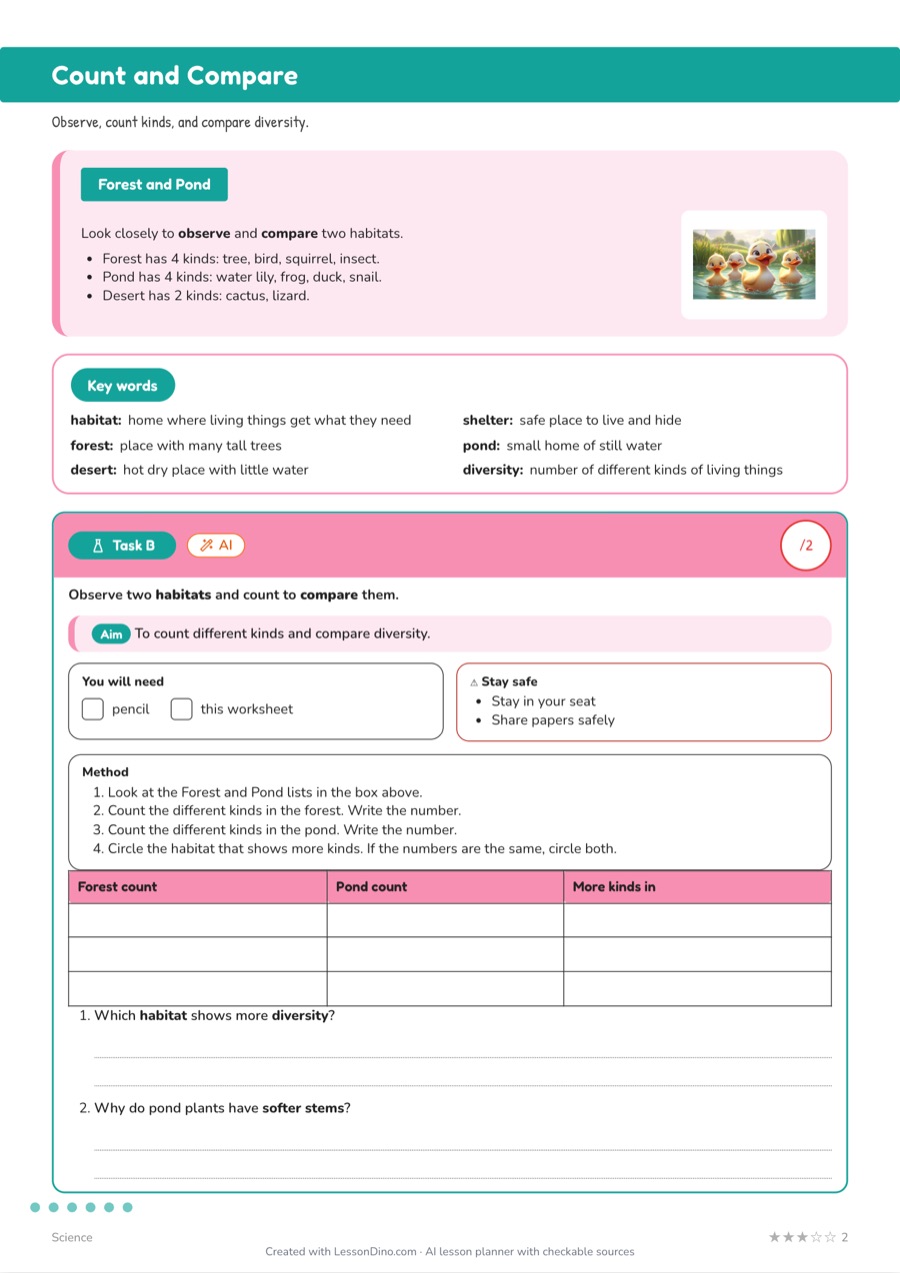
Count and Compare
Observe, count kinds, and compare diversity.
Forest and Pond
- Look closely to observe and compare two habitats.
- Forest has 4 kinds: tree, bird, squirrel, insect.
- Pond has 4 kinds: water lily, frog, duck, snail.
- Desert has 2 kinds: cactus, lizard.
| Word | Meaning |
|---|---|
| habitat | home where living things get what they need |
| shelter | safe place to live and hide |
| forest | place with many tall trees |
| pond | small home of still water |
| desert | hot dry place with little water |
| diversity | number of different kinds of living things |
Observe two habitats and count to compare them.
- Which habitat shows more diversity?
- Why do pond plants have softer stems?
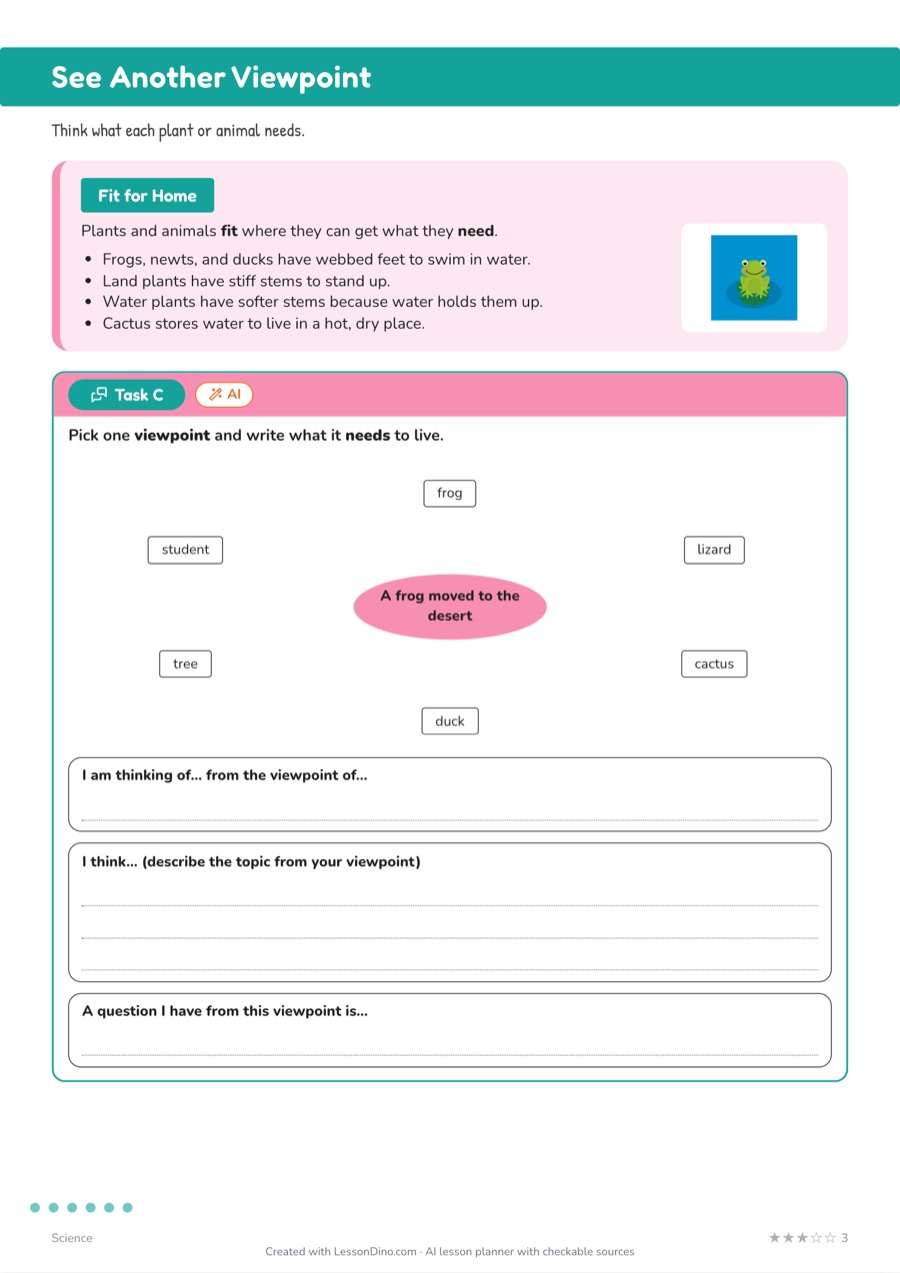
See Another Viewpoint
Think what each plant or animal needs.
Fit for Home
- Plants and animals fit where they can get what they need.
- Frogs, newts, and ducks have webbed feet to swim in water.
- Land plants have stiff stems to stand up.
- Water plants have softer stems because water holds them up.
- Cactus stores water to live in a hot, dry place.
Pick one viewpoint and write what it needs to live.
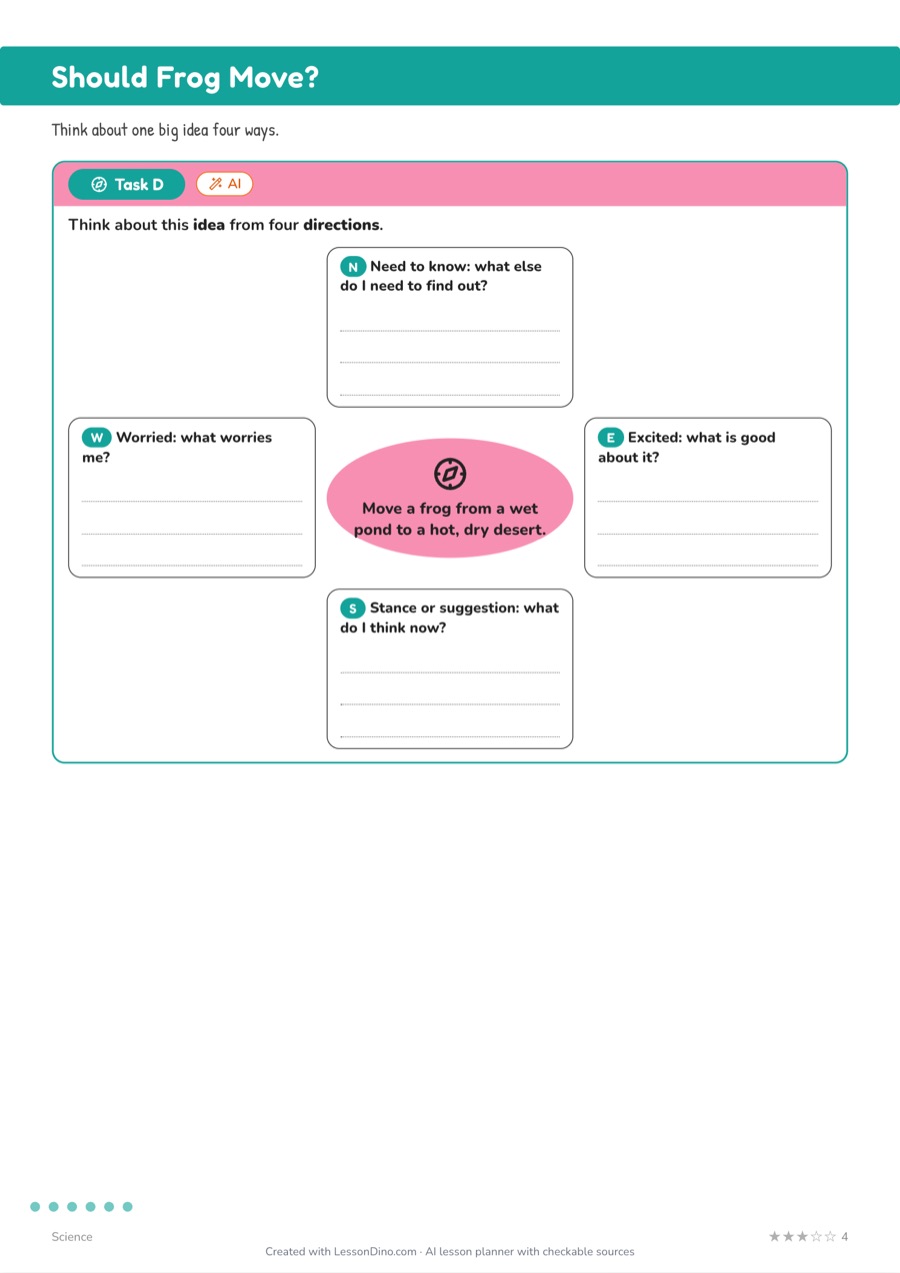
Should Frog Move?
Think about one big idea four ways.
Think about this idea from four directions.
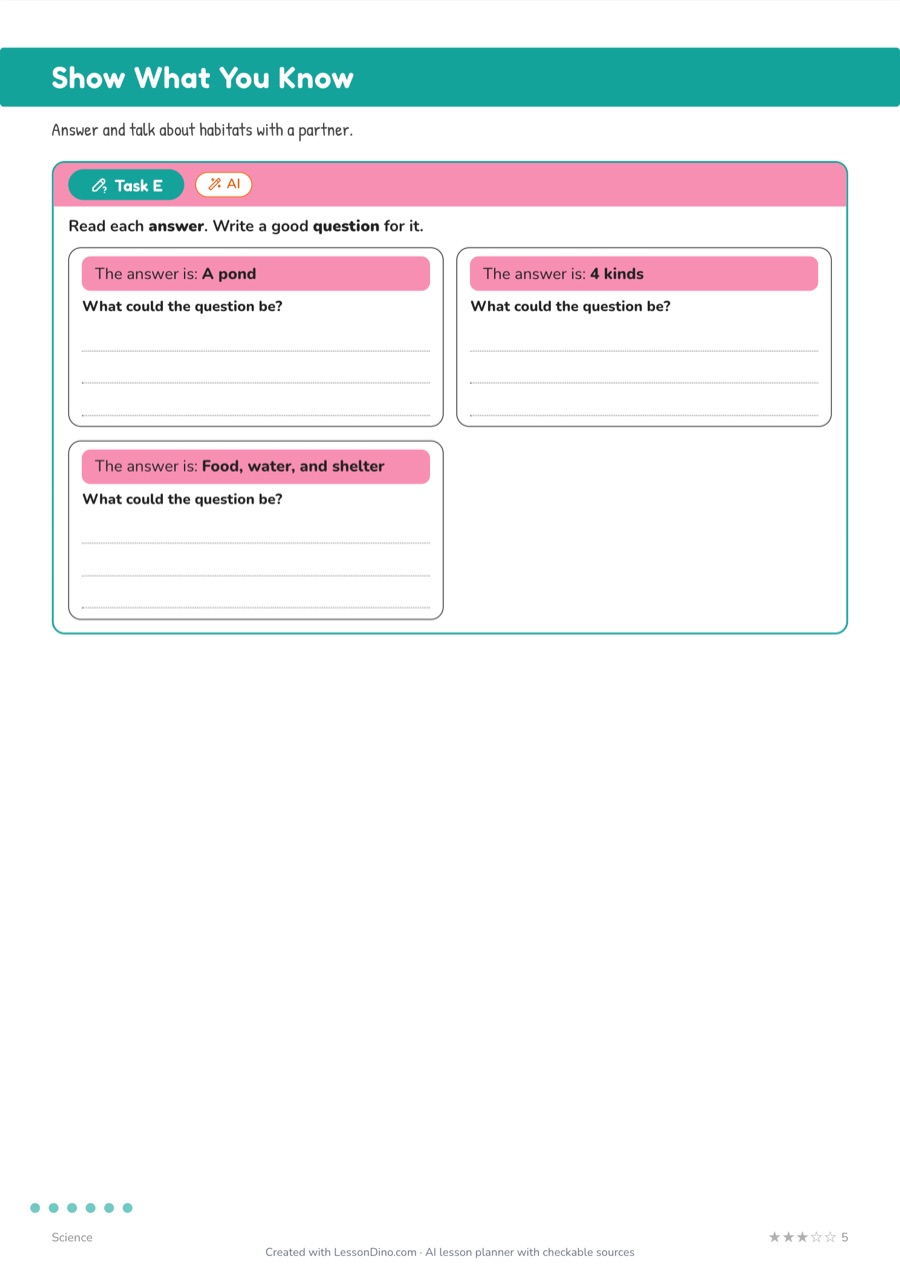
Show What You Know
Answer and talk about habitats with a partner.
Read each answer. Write a good question for it.
Page 6
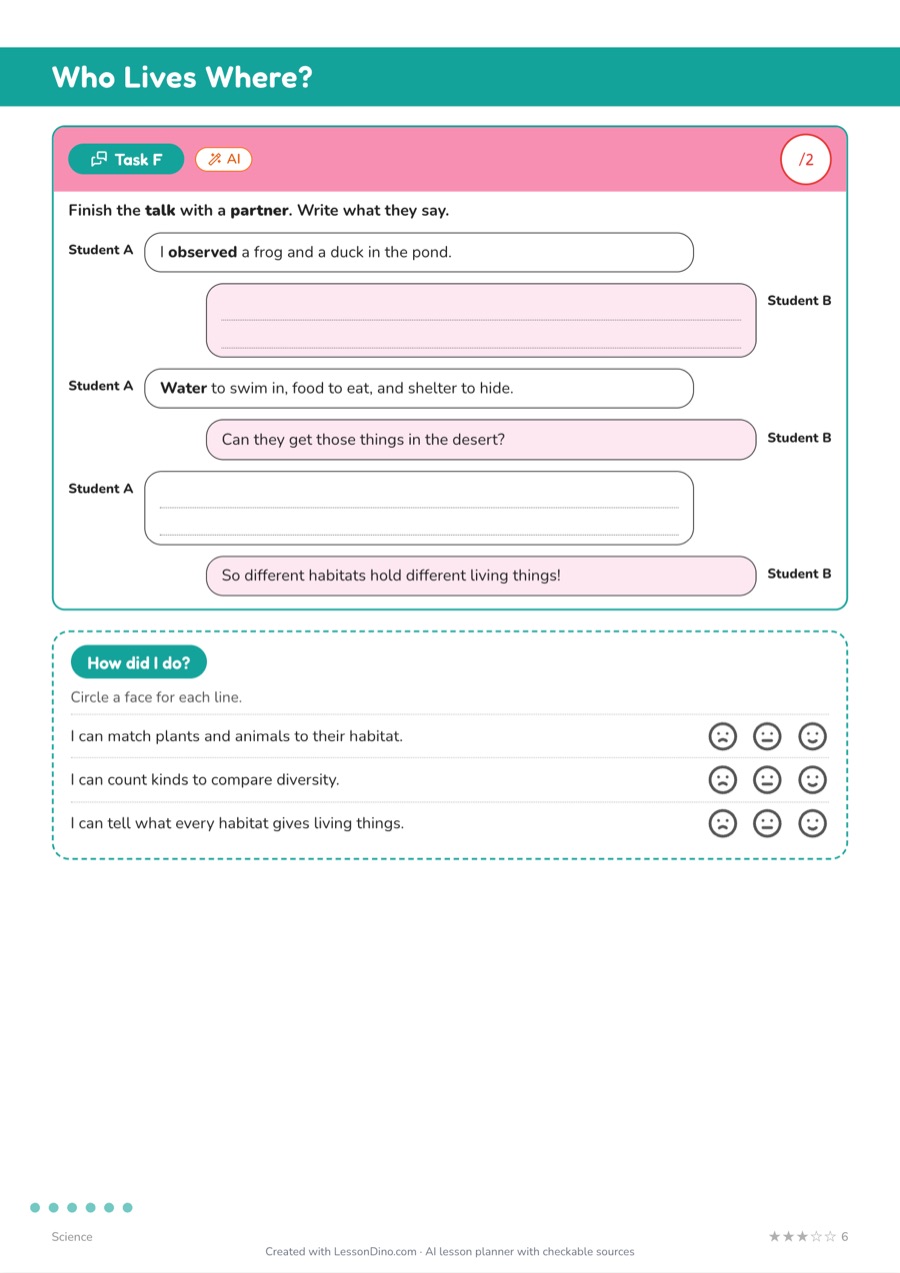
Finish the talk with a partner. Write what they say.
Answers
Show the answers
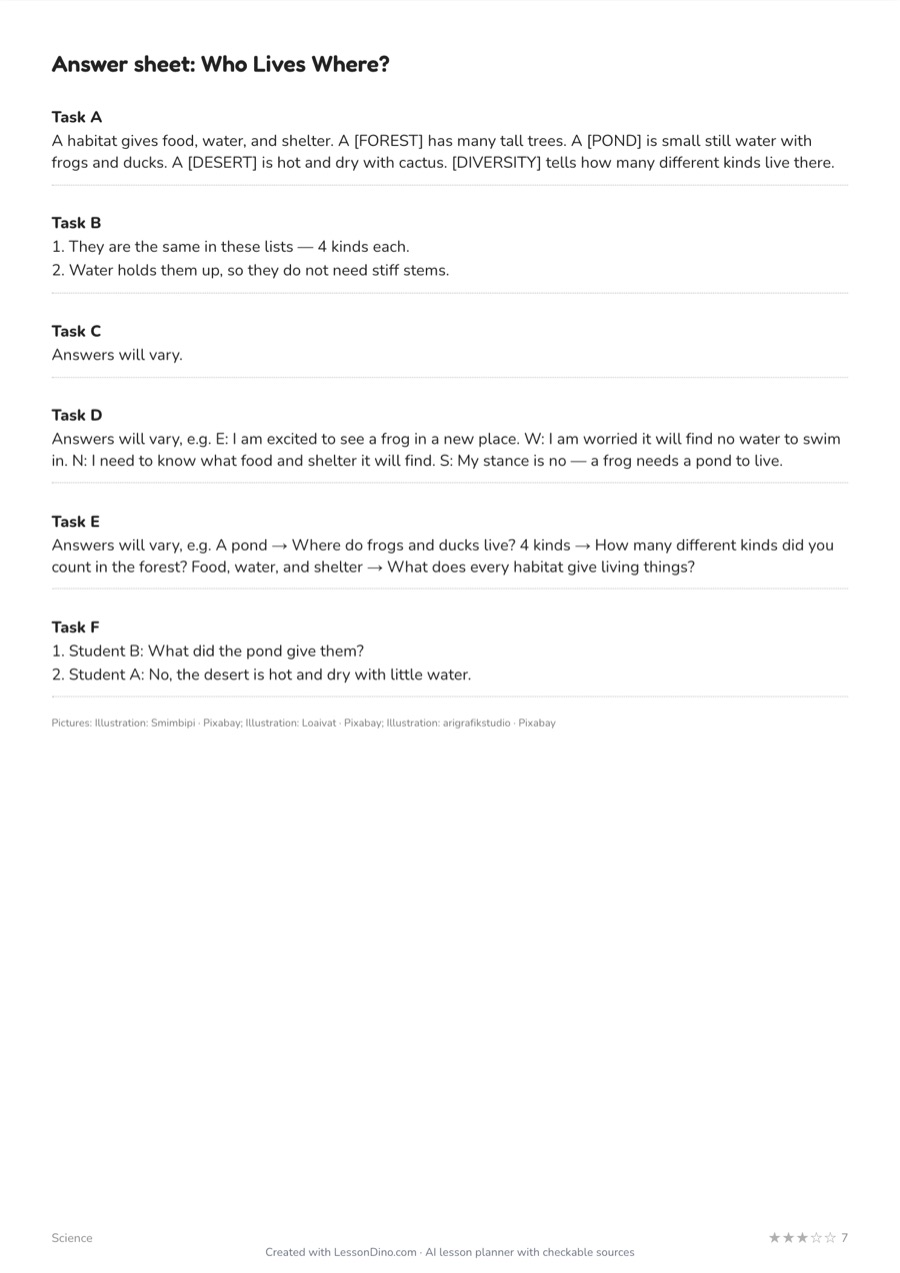
- Which habitat shows more diversity? They are the same in these lists — 4 kinds each.
- Why do pond plants have softer stems? Water holds them up, so they do not need stiff stems.
The answer sheet is the last picture above.
Curriculum
Make observations of plants and animals to compare the diversity of life in different habitats.
Made with Lesson Dino's AI on 17 October 2026. AI can make mistakes, so check the answers and facts against the sources before you teach.