Slides
Lesson plan
Who Lives Where? Comparing Habitat Diversity
Students learn what habitats give living things and that each habitat has different life. They sort plant and animal cards and count to compare diversity.
Objectives
- Students will explain that a habitat gives food, water, shelter, and space.
- Students will match plants and animals to forest, pond, and desert habitats.
- Students will count kinds of life to compare diversity in different habitats.
Success criteria
- I can tell what every habitat gives living things.
- I can match plants and animals to their habitat.
- I can count kinds and tell which habitat has more.
Key words
| Word | Meaning |
|---|---|
| habitat | the home where living things find food, water, shelter, and space to survive |
| forest | a place with many tall trees where birds and other animals live |
| pond | a small body of still fresh water where lilies and frogs live |
| desert | a hot, dry place where cactus and lizards live |
| diversity | how many different kinds of living things are in a place |
| shelter | a safe place to live and hide |
Timed plan (60 minutes)
| Time | Stage | What happens |
|---|---|---|
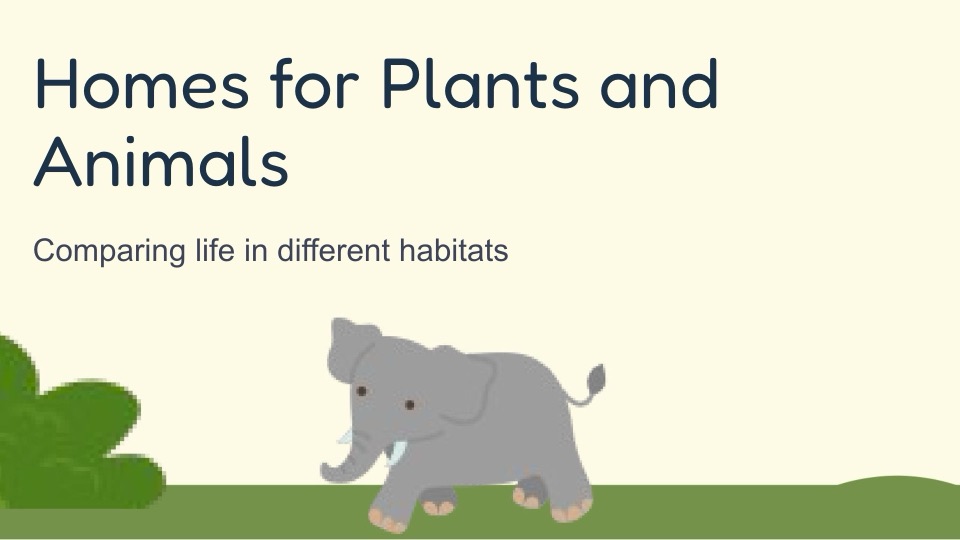
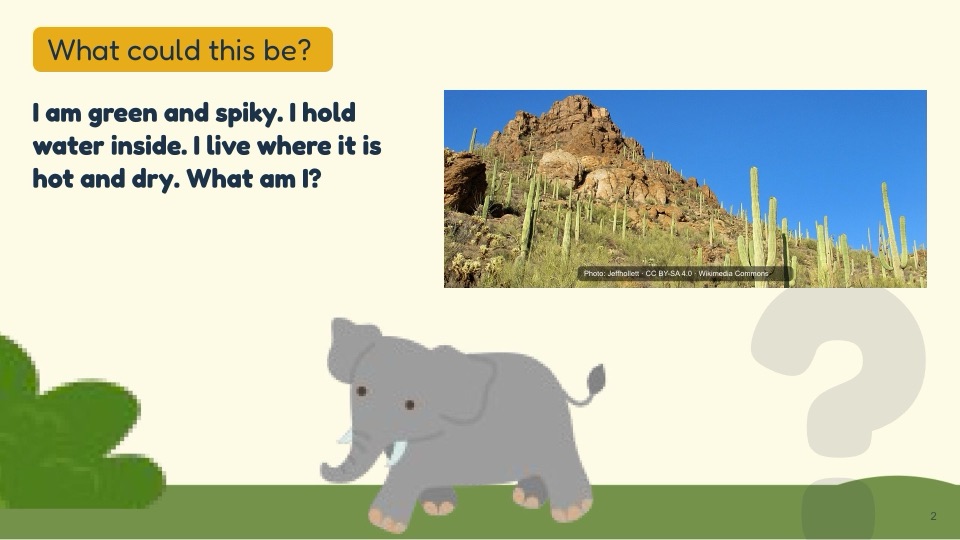
| 10 min | Starter | Hook students and recall that plants and animals live in different homes. Show Slide 1 Homes for Plants and Animals: Comparing life in different habitats. Say the hook: I have three homes and a pile of neighbors. Can you move each plant and animal to the right home? Show Slide 2 mystery and read the riddle aloud: I am green and spiky. I hold water inside. I live where it is hot and dry. What am I? Take guesses, then reveal: A cactus living in a desert habitat. |
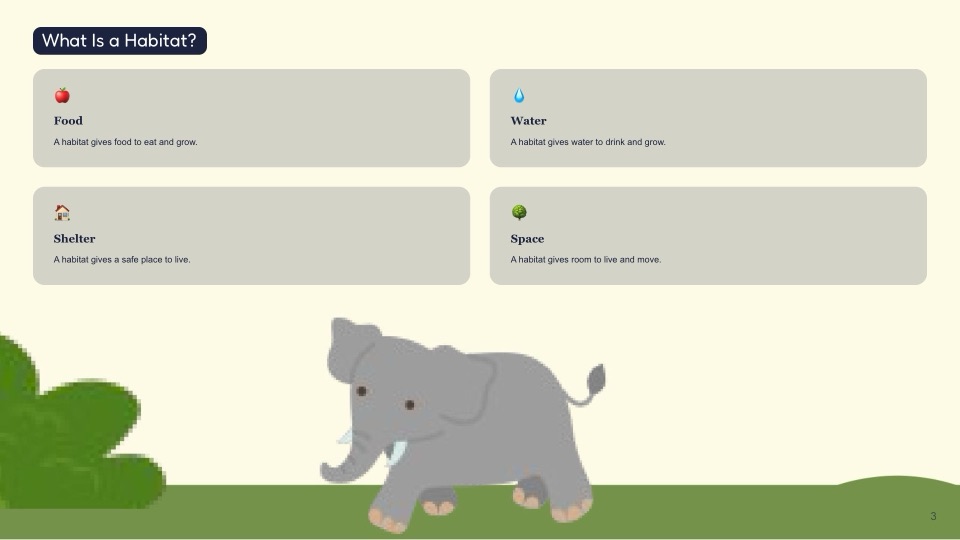
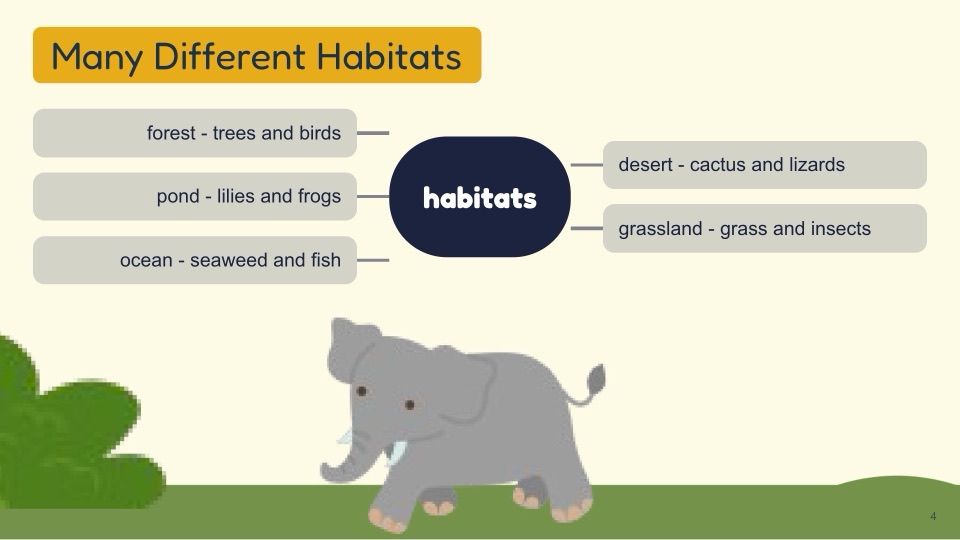
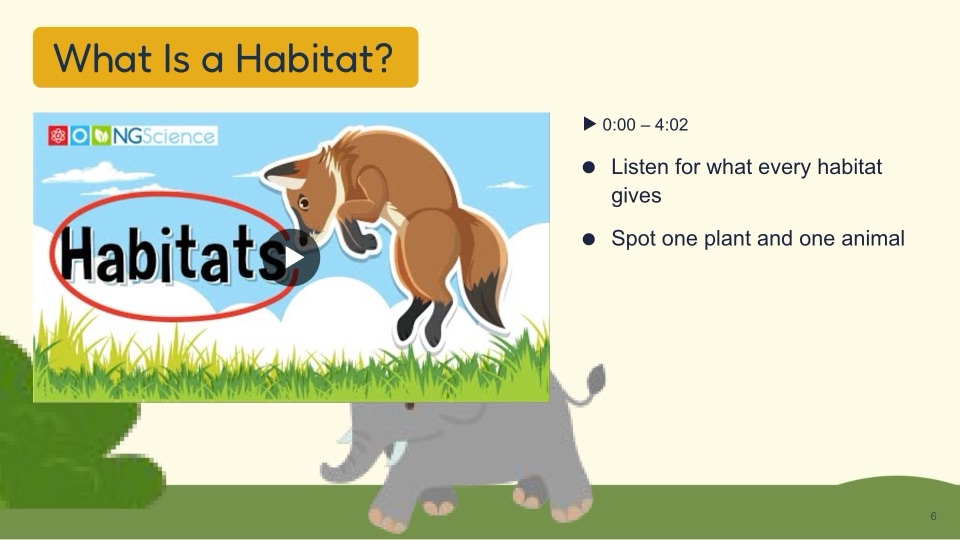
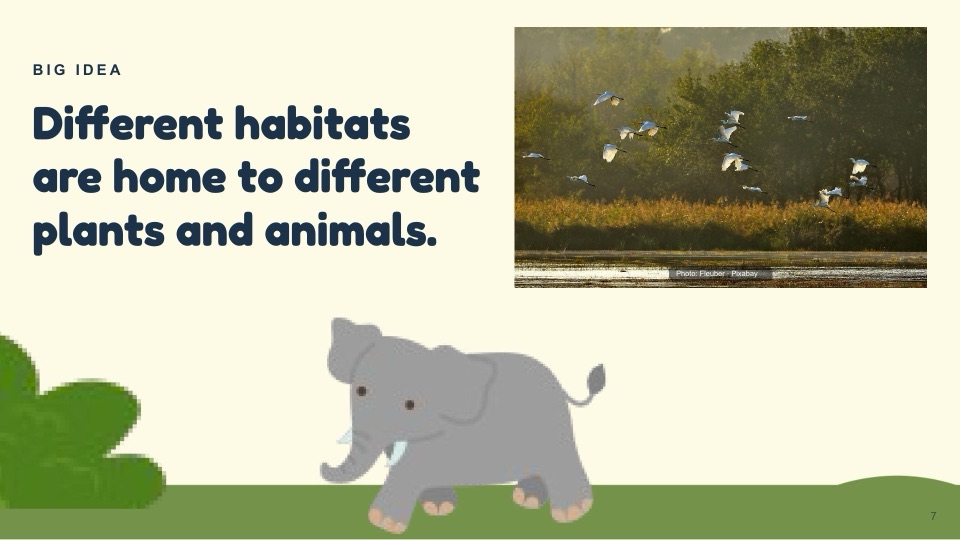
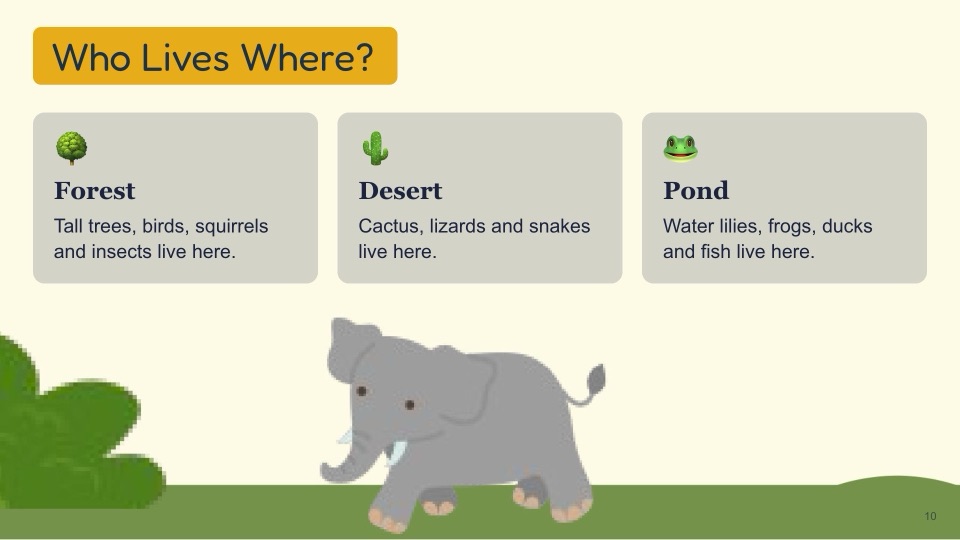
| 10 min | Teaching | Teach what every habitat gives and that different habitats have different life. Show Slide 3 and read each card: A habitat gives food to eat and grow. A habitat gives water to drink and grow. A habitat gives a safe place to live. Add space, explaining a habitat is a home where a plant or animal finds food, water, shelter, and space to survive. Show Slide 4 mindmap and Slide 7 statement: Different habitats are home to different plants and animals. Play Video clip 2 What Is a Habitat (0:00–4:02) on Slide 6: Listen for what every habitat gives, spot one plant and one animal. |
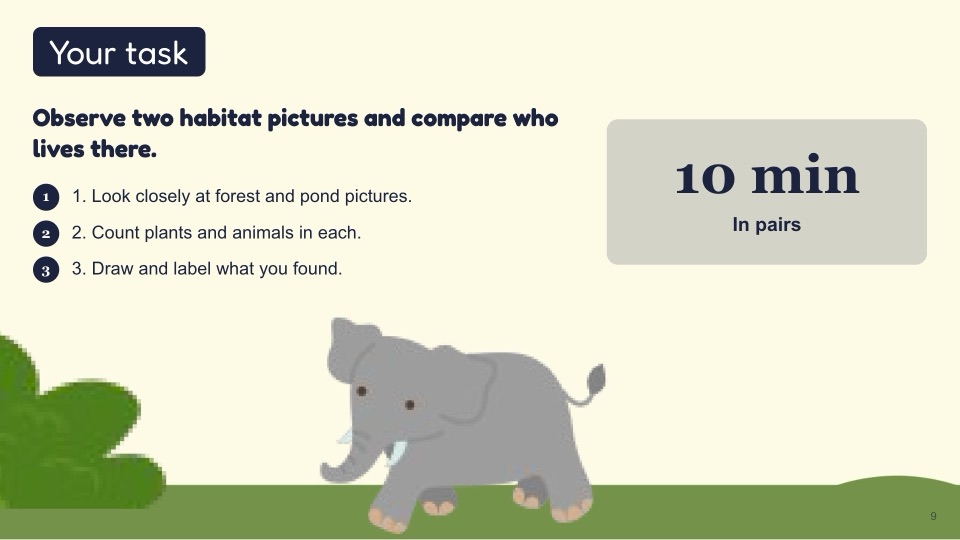
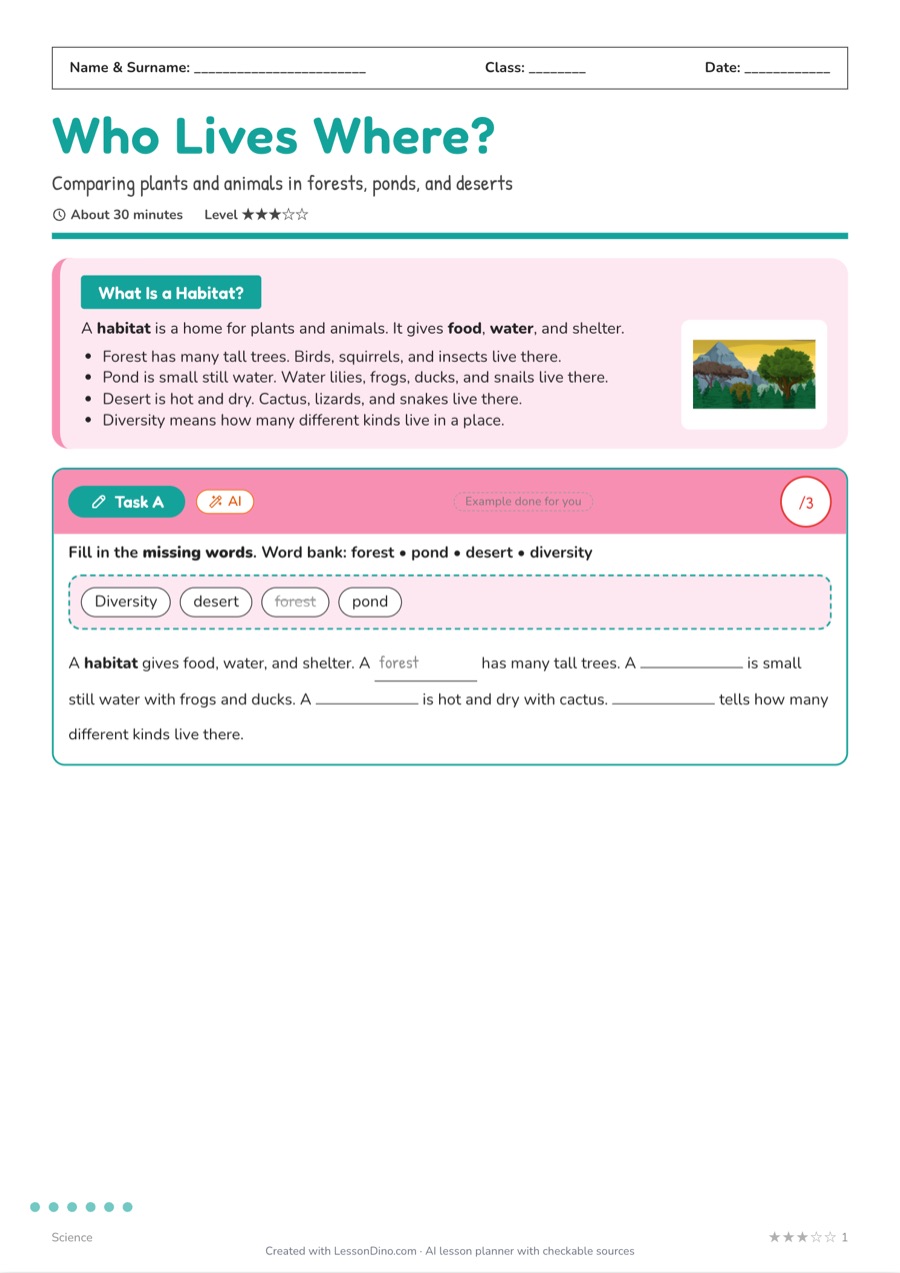
| 25 min | Main activity | Sort plants and animals into habitats and count to compare diversity. Hand out 3 sorting mats, habitat photos, and shuffled picture cards to each small group. Model with two cards: read clues, match to photo, place on mat: Observe two habitat pictures and compare who lives there. Tell groups to look closely at forest and pond pictures, count plants and animals in each, and record on Worksheet Task B. Walk around, ask why each card fits, then have groups count how many different cards are on each mat to compare the diversity of life. |
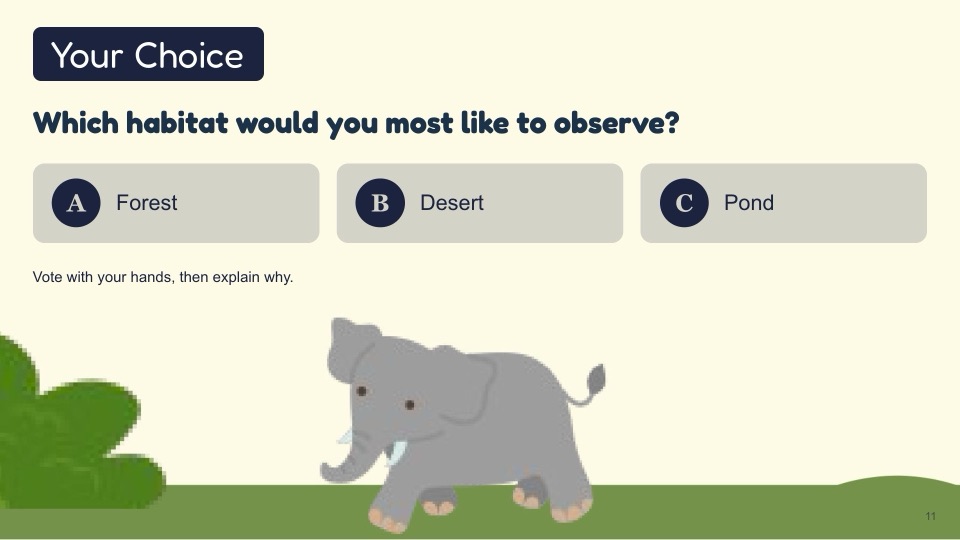
| 10 min | Share | Compare class results and state which habitat showed more diversity. Have each group report its three numbers and write them on the class chart. Reread Slide 7: Different habitats are home to different plants and animals. Ask groups to tell which habitat had the most kinds of living things in the pictures. Show Slide 11 and take a quick vote: Which habitat would you most like to observe? |
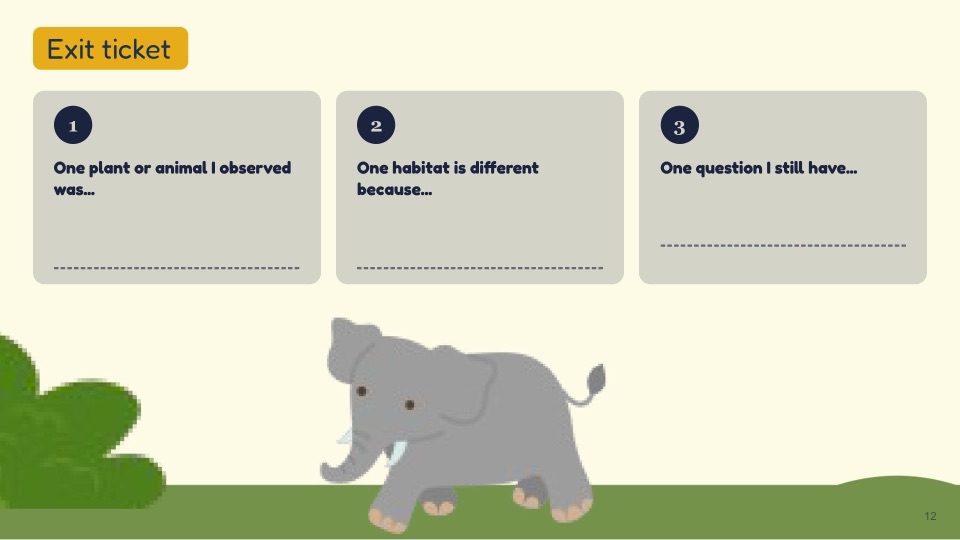
| 5 min | Plenary | Review what habitats give and what we found about diversity. Show Slide 12 exit lines and read them aloud. Ask students to answer aloud first, then write two short lines. Restate objectives: sorted forest, pond, desert and counted to compare diversity. Collect Worksheet Task B and exit lines. |
Common mistakes
- Thinking a habitat is only shelter, not food, water, and space too.
How to spot it: Student names only the home part and leaves out drinking or growing needs.
Point to food, water, shelter cards and ask where the animal finds each in its photo. - Thinking any plant or animal can live in any habitat.
How to spot it: Student puts a water lily or frog on the desert mat.
Ask what the living thing needs and compare hot and dry desert with freshwater pond. - Counting the same kind twice instead of counting different kinds.
How to spot it: Counts are much higher than cards because duplicates are counted twice.
Model touching each different picture once and sorting doubles together before counting diversity.
Support
- Give cards with a colored dot on the back that matches the mat color so students can check after they try.
- Use picture labels and sentence frames for food, water, and shelter answers.
Stretch
- Add a fourth photo, like a grassland, and have students explain why some pond cards do not fit there.
- Have fast finishers write one reason a pond animal could not get what it needs in the desert.
Check questions
- Name one plant or animal you observed and the habitat where it lives.
Answer: Example: water lily in the pond; cactus in the desert. - What four things does every habitat give?
Answer: Food, water, shelter, and space. - Which habitat had the most kinds in your group, and what does that mean?
Answer: Names the highest-count habitat; it shows more diversity in those pictures.
Curriculum
Make observations of plants and animals to compare the diversity of life in different habitats.
Video clips
Clips on YouTube, from the start and end times we chose. Check each one before you show it.
-
What Is a Habitat from 0:00 to 4:02
Next Generation Science: Habitats
Explains habitats with plants and animals side by side using slow, simple vocabulary ideal for ages 7-8.
-
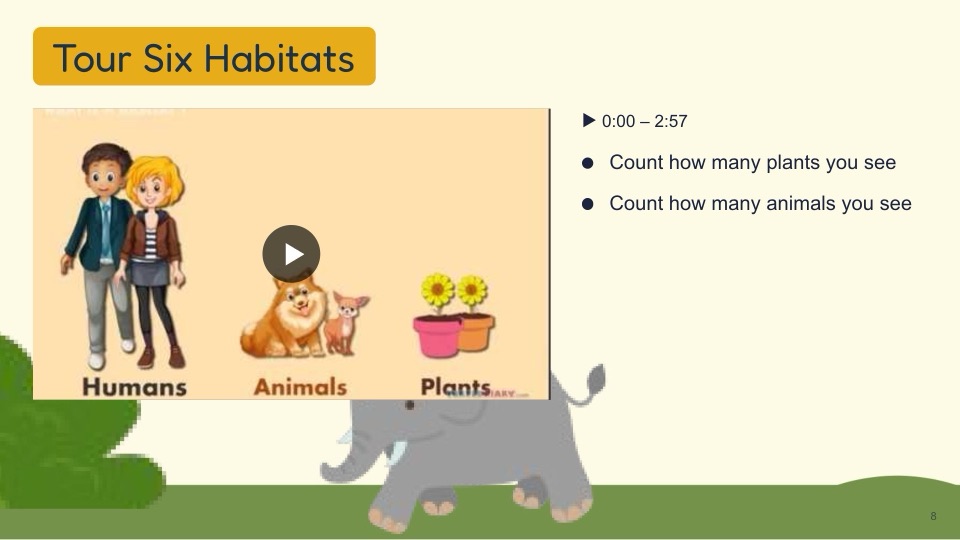
Six Habitats Tour from 0:00 to 2:57
Turtlediary: 6 Habitats Where Animals & Plants Live! AMAZING Science for Kids
Tours six habitats with plants and animals using bright visuals and kid-paced narration just right for ages 7-8.
Worksheet
Sources
- Download the Lesson List science.edu
- Science Grade 2 - Chicago Public Schools cps.edu
- Plant and Animal Habitats repository.library.noaa.gov
- Food, Water, Shelter, Space - U.S. National Park Service nps.gov
- Plant and Animal Interactions - Government of New York extapps.dec.ny.gov
- Classroom Investigation Series Habitats and Wildlife blm.gov
- Plants, Animals, and Ecosystems | A Student's Guide to Global ... archive.epa.gov
- Living things and their habitats - KS1 Science - BBC Bitesize bbc.co.uk
- What is a habitat? - KS1 Science curriculum - BBC Bitesize bbc.co.uk
- Habitat investigation: Science primary resource | National ... natgeokids.com
- Habitats Primary Resources | National Geographic Kids natgeokids.com
- Habitat destruction en.wikipedia.org
- Habitat Facts for Kids kids.kiddle.co
- Freshwater Habitat | National Geographic Kids kids.nationalgeographic.com
Picture credits
Made with Lesson Dino's AI on 17 October 2026. AI can make mistakes, so check facts against the sources before you teach.