The worksheet
About this worksheet
Students learn to tell time to five minutes on analog and digital clocks. They draw secret times, swap with a partner, and use a.m. and p.m. This Grade 2 Math worksheet gives students (ages 7–8) six pages of practice on telling time to five minutes, part of the measurement and data unit. It goes with our free Telling time to five minutes lesson, which has the slides and a timed lesson plan.
What it covers
By the end, students should be able to:
- Students will tell time to the nearest five minutes on analog clocks.
- Students will write matching digital times with hours and minutes.
- Students will use a.m. and p.m. correctly for morning and night.
How to use it
- Guided practice (12 minutes): Hand out Worksheet Task C and do first two matches together.
- Support: Use rim-number clocks and skip-count strips for all reading tasks.
- Stretch: Set and write three times in a row with no model, then check with partner.
- The answer sheet is the last page, so you can print it on its own or let students check their own work.
Key vocabulary
- hour hand: short pointer that shows which number it has just passed
- minute hand: long pointer that shows how far past the o'clock it is
- digital clock: time shown with numbers, like 3:15
- a.m.: time in the morning, after midnight and before noon
- p.m.: time in the afternoon and night, after noon and before midnight
- skip-count: going up by jumps, like 5, 10, 15, 20
Mistakes to watch for
- Reading 8:50 as 9:50 because hour hand looks almost at 9. Cover minute hand, name last number hour hand passed, then skip-count minutes.
- Counting minute hand by ones, like hand on 4 means 4 minutes. Remind each number is 5 minutes, count 5, 10, 15, 20 together.
- Writing :05 as :5 and mixing a.m. and p.m. Practice describing digital as hours and minutes with two digits and sorting morning vs night.
What's on the worksheet
Count by Fives
Learn how hands and skip counting show the time.
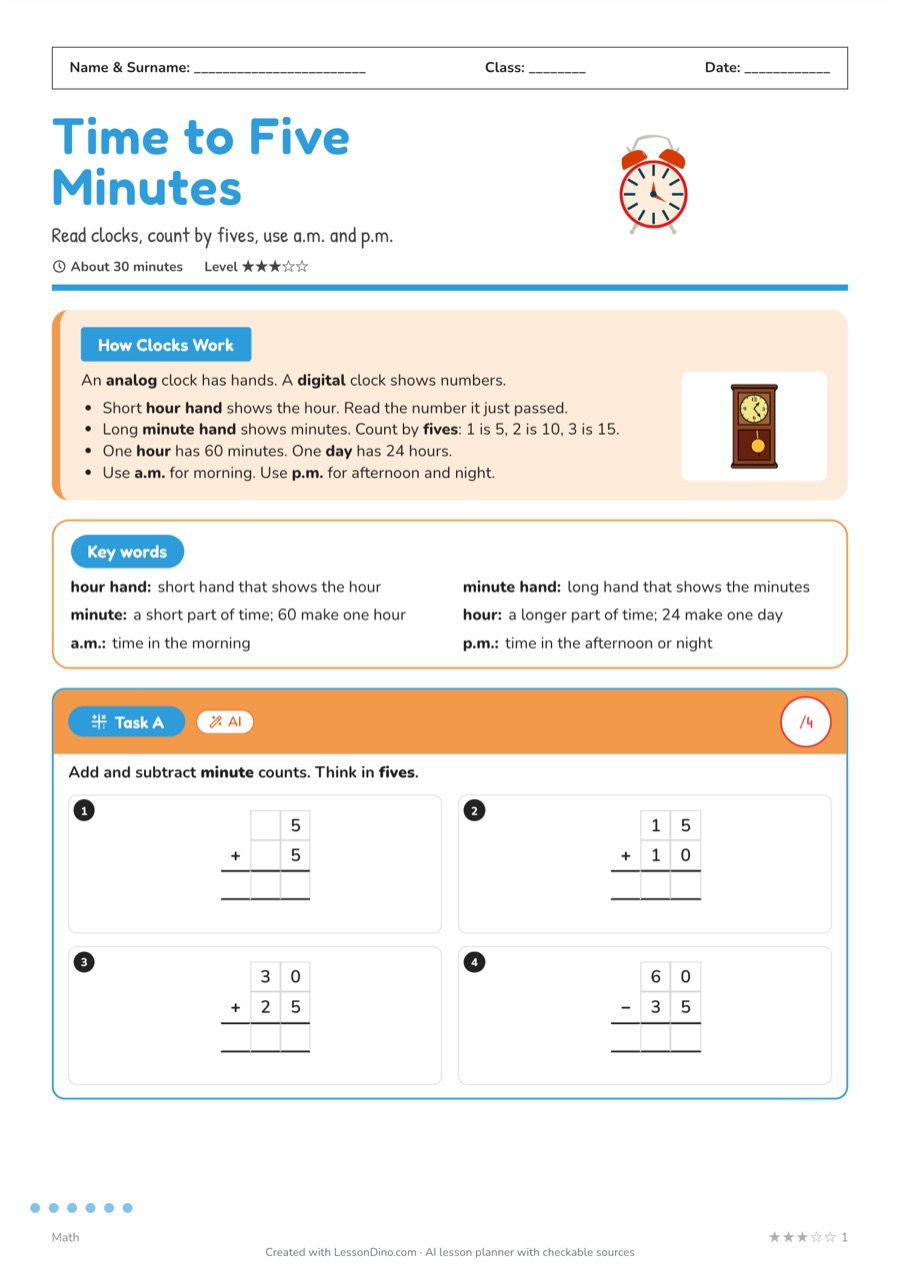
How Clocks Work
- An analog clock has hands. A digital clock shows numbers.
- Short hour hand shows the hour. Read the number it just passed.
- Long minute hand shows minutes. Count by fives: 1 is 5, 2 is 10, 3 is 15.
- One hour has 60 minutes. One day has 24 hours.
- Use a.m. for morning. Use p.m. for afternoon and night.
| Word | Meaning |
|---|---|
| hour hand | short hand that shows the hour |
| minute hand | long hand that shows the minutes |
| minute | a short part of time; 60 make one hour |
| hour | a longer part of time; 24 make one day |
| a.m. | time in the morning |
| p.m. | time in the afternoon or night |
Add and subtract minute counts. Think in fives.
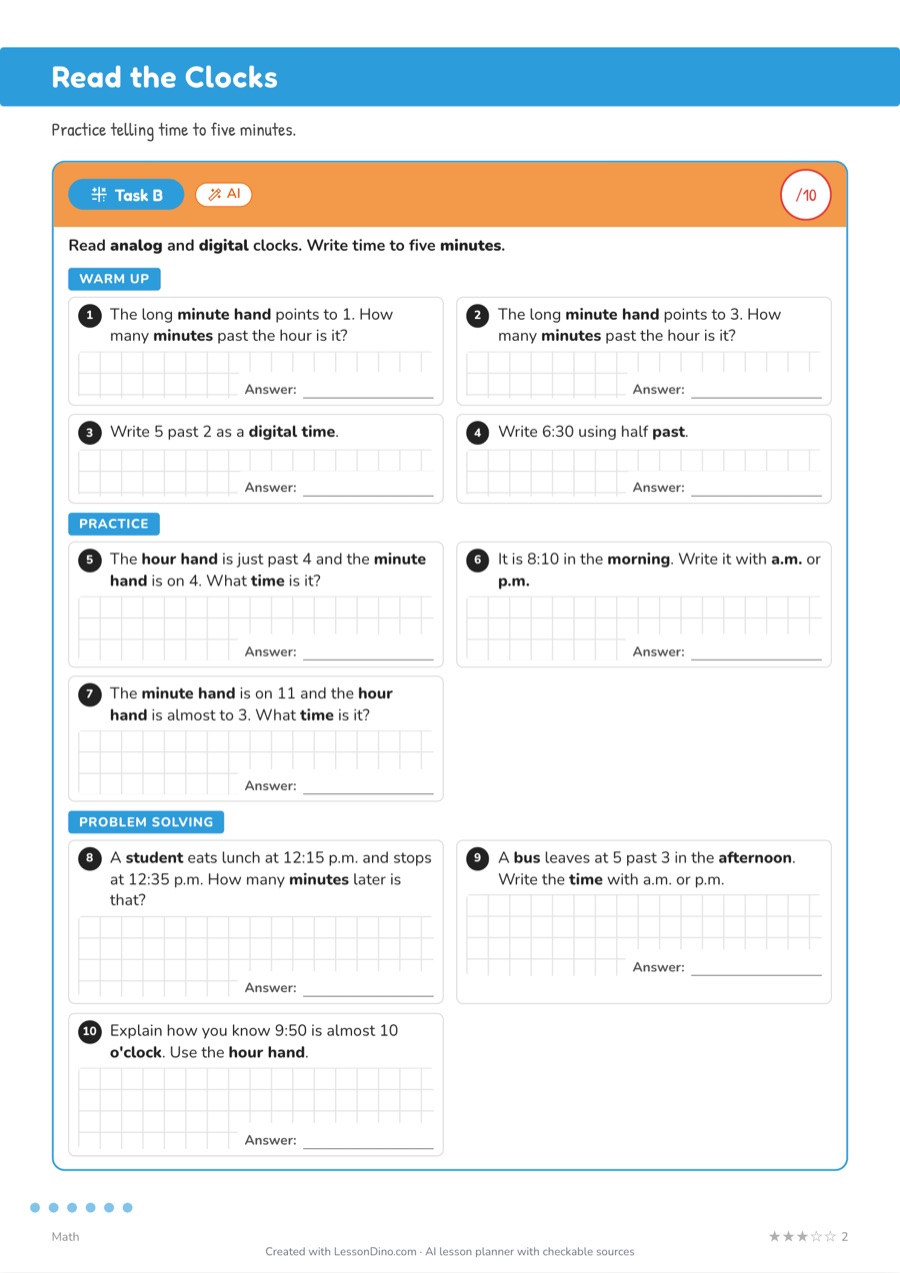
Read the Clocks
Practice telling time to five minutes.
Read analog and digital clocks. Write time to five minutes.
Warm up
- The long minute hand points to 1. How many minutes past the hour is it?
- The long minute hand points to 3. How many minutes past the hour is it?
- Write 5 past 2 as a digital time.
- Write 6:30 using half past.
Practice
- The hour hand is just past 4 and the minute hand is on 4. What time is it?
- It is 8:10 in the morning. Write it with a.m. or p.m.
- The minute hand is on 11 and the hour hand is almost to 3. What time is it?
Problem solving
- A student eats lunch at 12:15 p.m. and stops at 12:35 p.m. How many minutes later is that?
- A bus leaves at 5 past 3 in the afternoon. Write the time with a.m. or p.m.
- Explain how you know 9:50 is almost 10 o'clock. Use the hour hand.
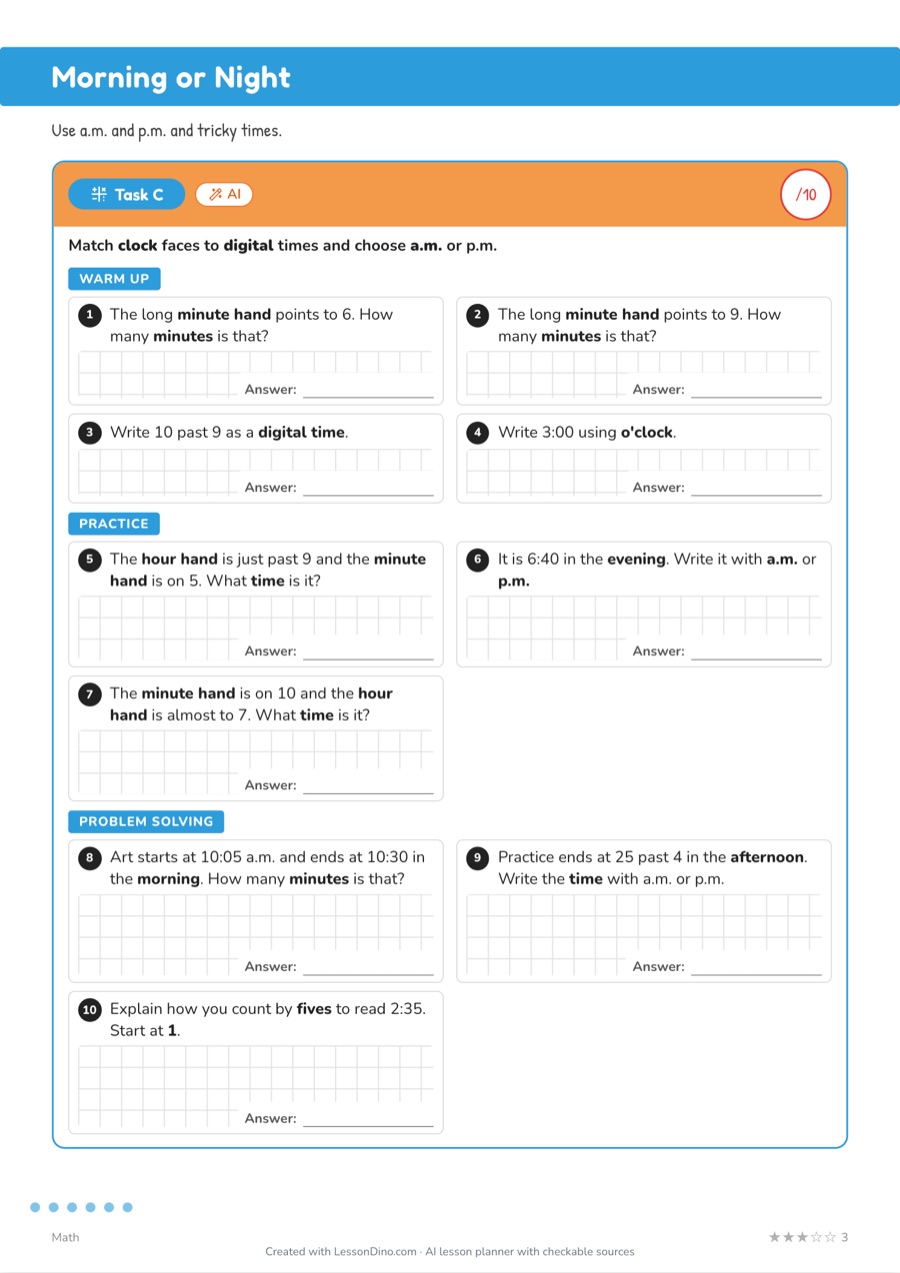
Morning or Night
Use a.m. and p.m. and tricky times.
Match clock faces to digital times and choose a.m. or p.m.
Warm up
- The long minute hand points to 6. How many minutes is that?
- The long minute hand points to 9. How many minutes is that?
- Write 10 past 9 as a digital time.
- Write 3:00 using o'clock.
Practice
- The hour hand is just past 9 and the minute hand is on 5. What time is it?
- It is 6:40 in the evening. Write it with a.m. or p.m.
- The minute hand is on 10 and the hour hand is almost to 7. What time is it?
Problem solving
- Art starts at 10:05 a.m. and ends at 10:30 in the morning. How many minutes is that?
- Practice ends at 25 past 4 in the afternoon. Write the time with a.m. or p.m.
- Explain how you count by fives to read 2:35. Start at 1.
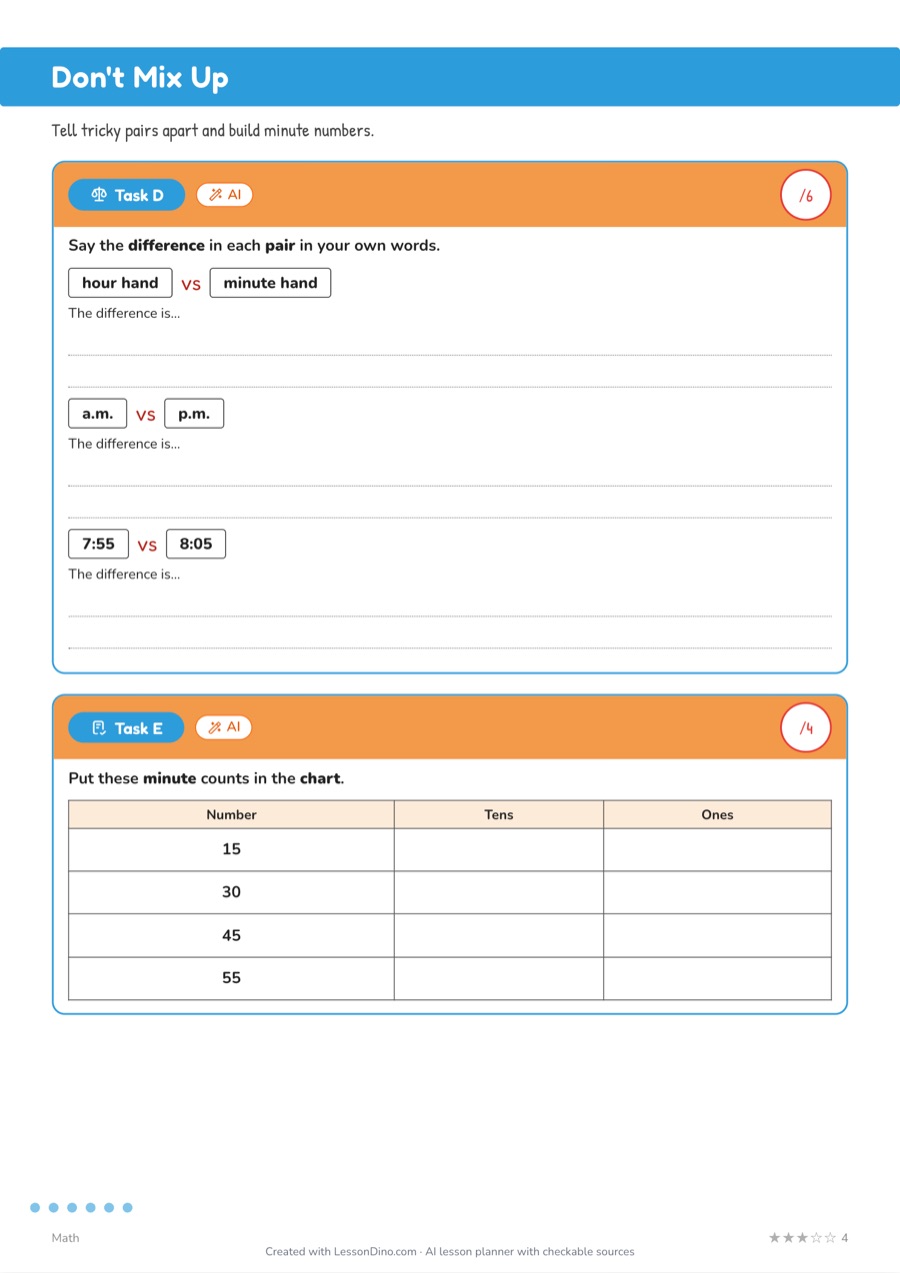
Don't Mix Up
Tell tricky pairs apart and build minute numbers.
Say the difference in each pair in your own words.
Put these minute counts in the chart.
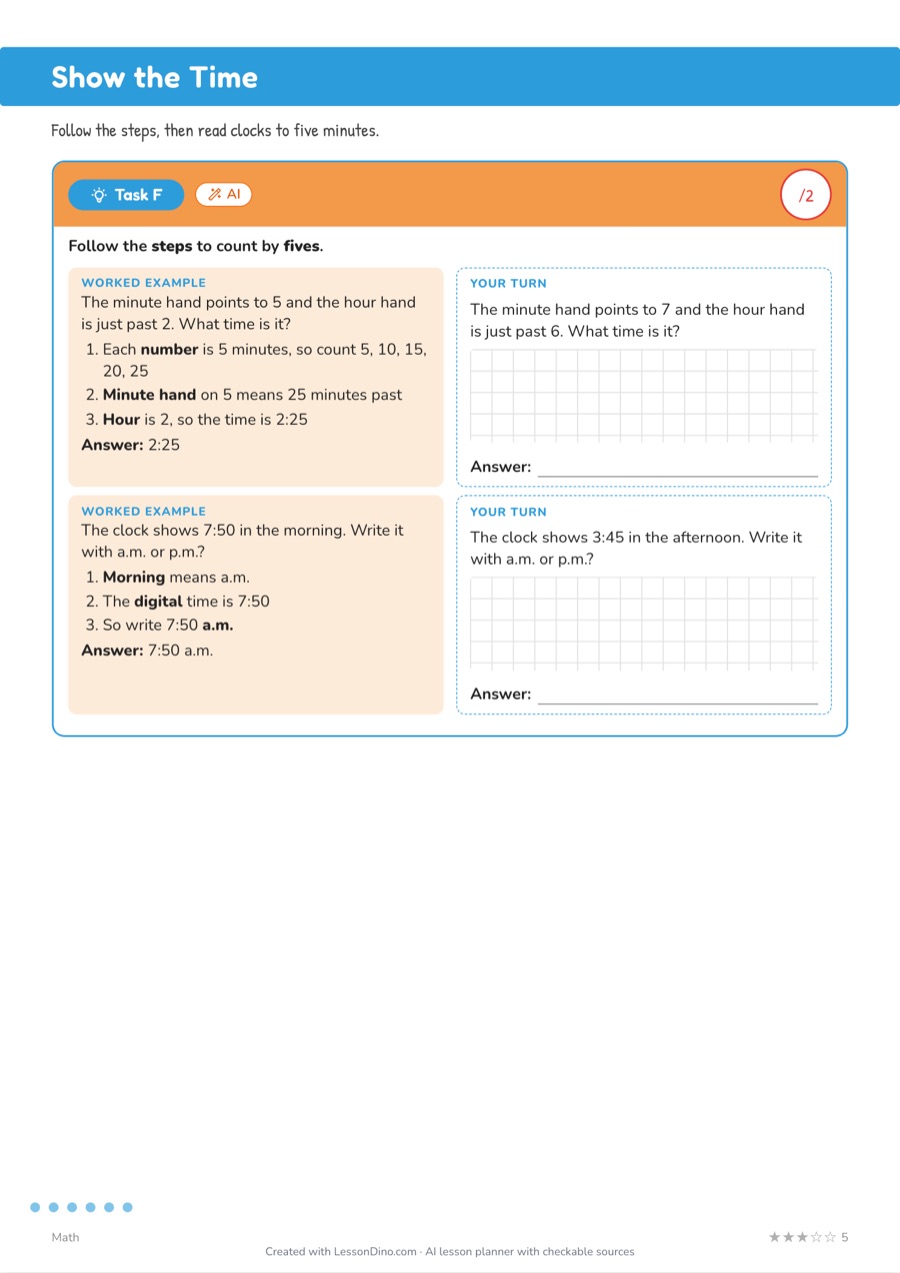
Show the Time
Follow the steps, then read clocks to five minutes.
Follow the steps to count by fives.
Page 6
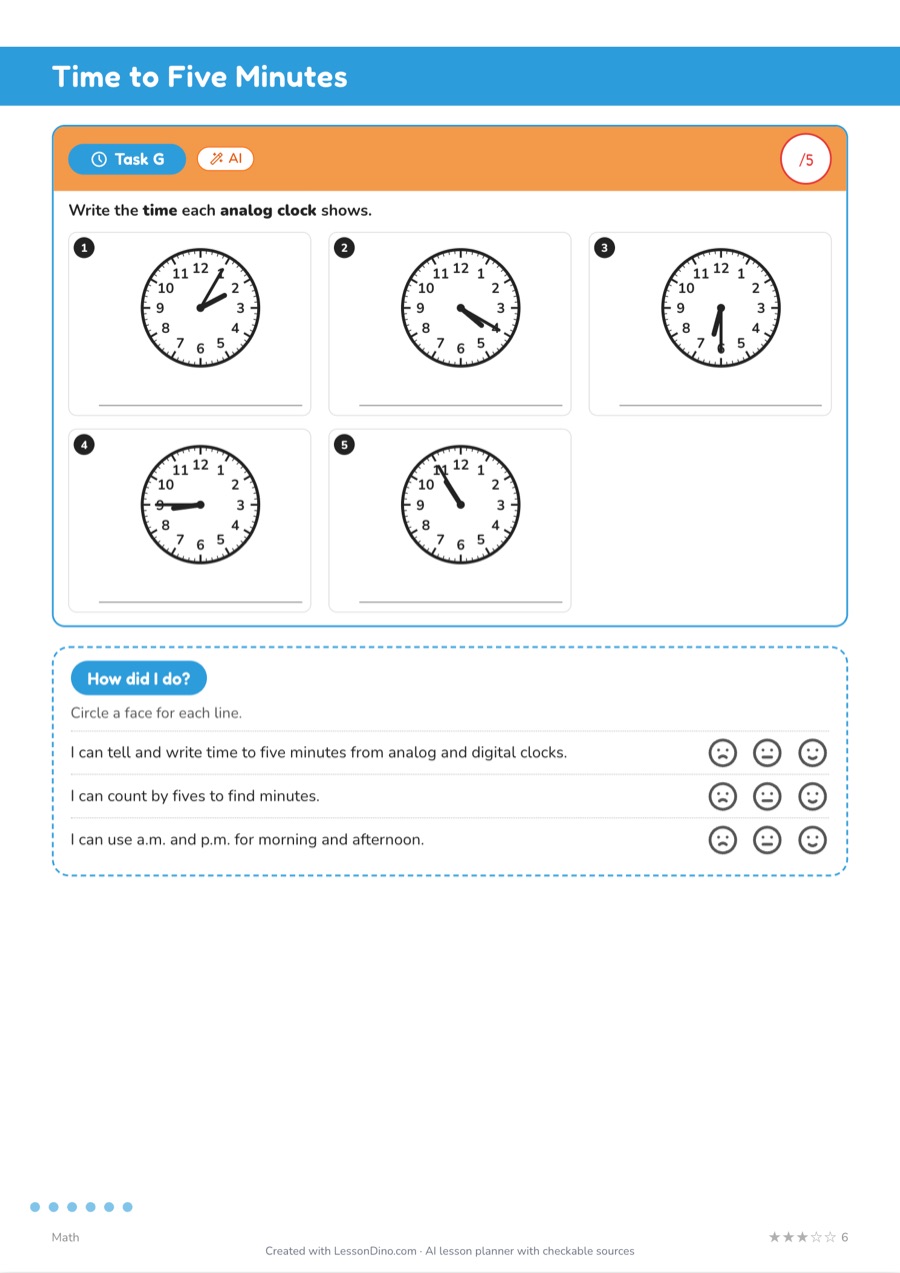
Write the time each analog clock shows.
Answers
Show the answers
- The long minute hand points to 1. How many minutes past the hour is it? 5 minutes
- The long minute hand points to 3. How many minutes past the hour is it? 15 minutes
- Write 5 past 2 as a digital time. 2:05
- Write 6:30 using half past. half past 6
- The hour hand is just past 4 and the minute hand is on 4. What time is it? 4:20
- It is 8:10 in the morning. Write it with a.m. or p.m. 8:10 a.m.
- The minute hand is on 11 and the hour hand is almost to 3. What time is it? 2:55
- A student eats lunch at 12:15 p.m. and stops at 12:35 p.m. How many minutes later is that? 20 minutes
- A bus leaves at 5 past 3 in the afternoon. Write the time with a.m. or p.m. 3:05 p.m.
- Explain how you know 9:50 is almost 10 o'clock. Use the hour hand. The minute hand is on 10 for 50 minutes and the hour hand is almost to 10.
- The long minute hand points to 6. How many minutes is that? 30 minutes
- The long minute hand points to 9. How many minutes is that? 45 minutes
- Write 10 past 9 as a digital time. 9:10
- Write 3:00 using o'clock. 3 o'clock
- The hour hand is just past 9 and the minute hand is on 5. What time is it? 9:25
- It is 6:40 in the evening. Write it with a.m. or p.m. 6:40 p.m.
- The minute hand is on 10 and the hour hand is almost to 7. What time is it? 6:50
- Art starts at 10:05 a.m. and ends at 10:30 in the morning. How many minutes is that? 25 minutes
- Practice ends at 25 past 4 in the afternoon. Write the time with a.m. or p.m. 4:25 p.m.
- Explain how you count by fives to read 2:35. Start at 1. Count 5, 10, 15, 20, 25, 30, 35 to 7, and the hour is still 2.
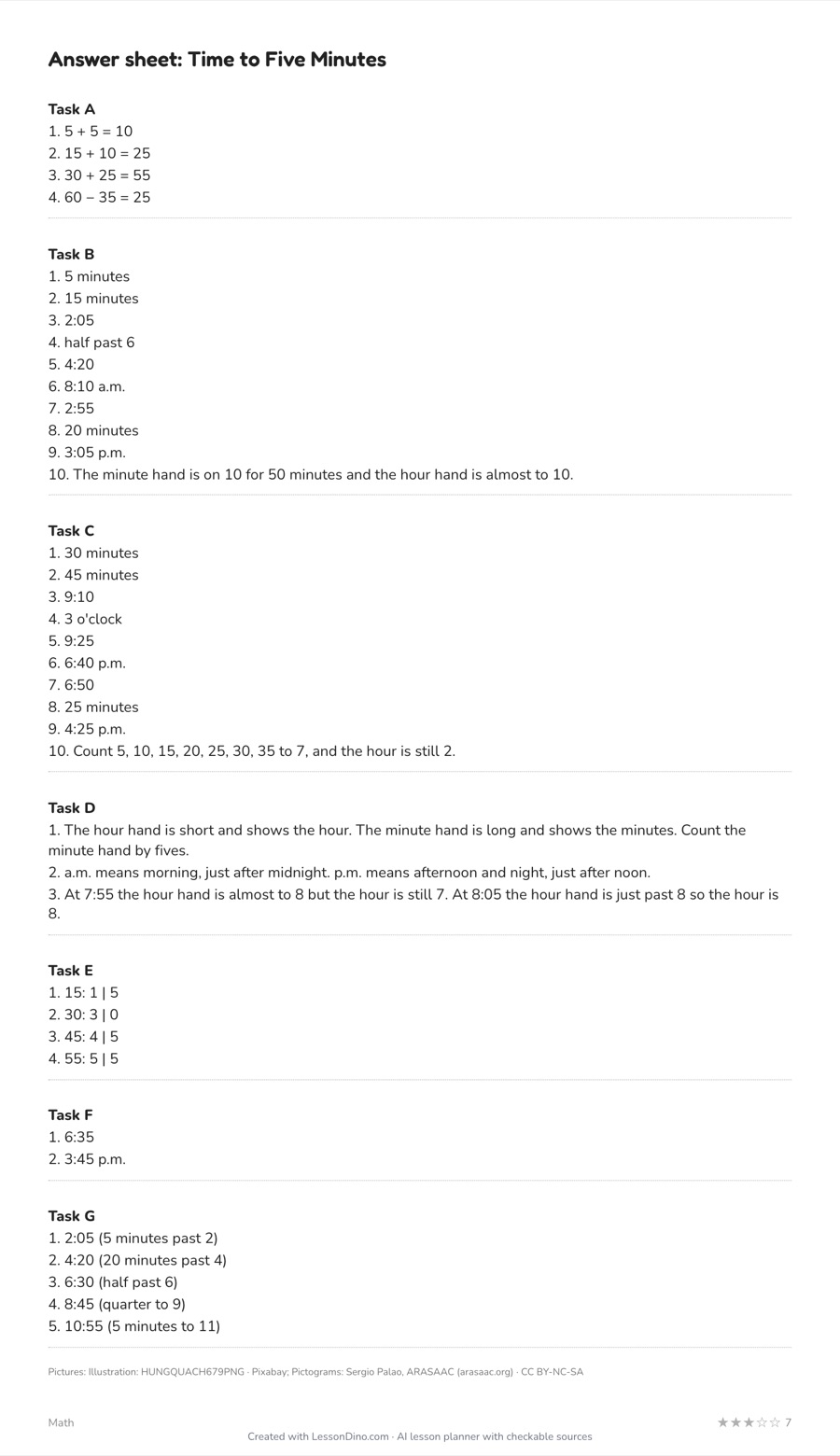
The answer sheet is the last picture above.
Curriculum
Tell and write time from analog and digital clocks to the nearest five minutes, using a.m. and p.m.
Made with Lesson Dino's AI on 16 October 2026. AI can make mistakes, so check the answers and facts against the sources before you teach.