Slides
Lesson plan
Bills and Coins Word Problems
Students learn to solve money word problems with bills and coins. They play a relay to add totals and write $ and ¢ correctly.
Objectives
- Students will solve word problems using $1, $5, $10 bills and coins.
- Students will add bills first, then coins, then combine both totals.
- Students will write answers correctly with $ for dollars and ¢ for cents.
Success criteria
- I can count bills and coins to solve a word problem.
- I can add bills, add coins, then add together.
- I can write $ when $1 or more and ¢ when less.
Key words
| Word | Meaning |
|---|---|
| cent | Tiny part of money. One hundred make $1. |
| dollar | Big unit of money. Written with $ like $2. |
| quarter | Silver coin worth 25 tiny parts. |
| dime | Small silver coin worth 10 tiny parts. |
| nickel | Coin worth 5 tiny parts. |
| total | All the money counted together as one amount. |
Timed plan (60 minutes)
| Time | Stage | What happens |
|---|---|---|
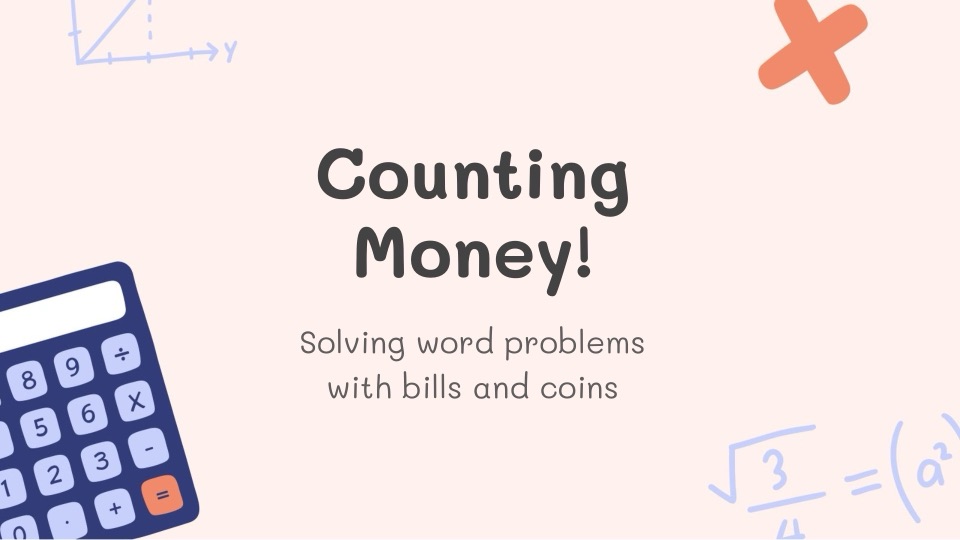
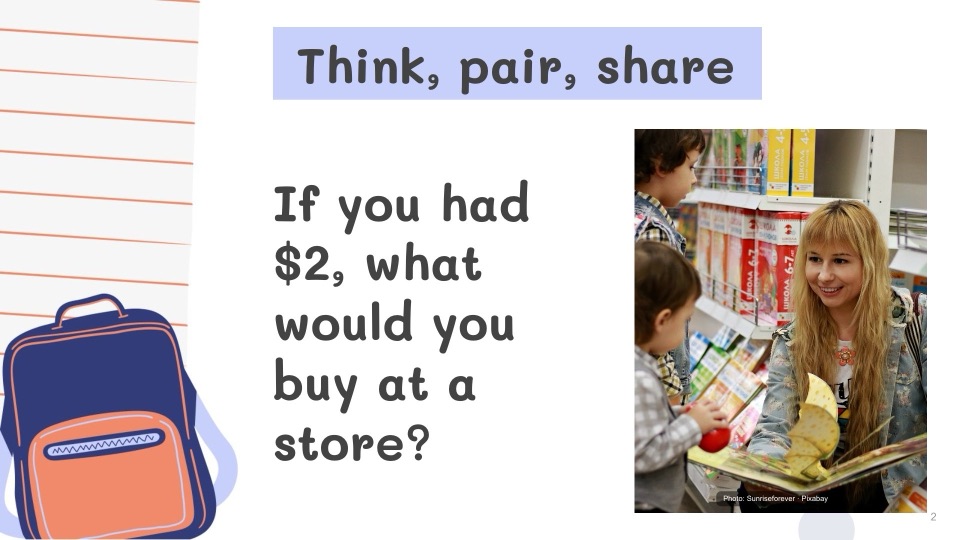
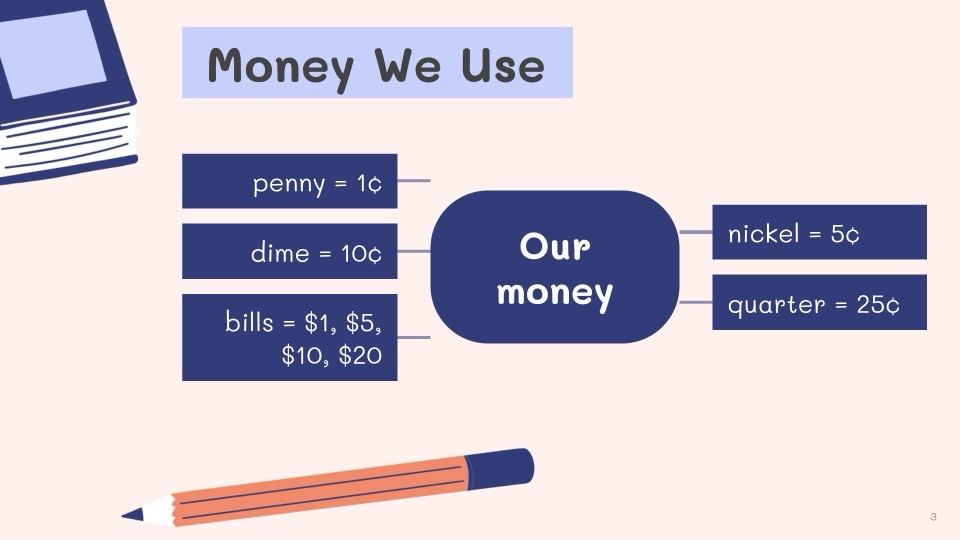
| 10 min | Starter | Recall coin and bill values and hook students into solving word problems. Show Slide 1 Counting Money! Solving word problems with bills and coins and read the title together. Show Slide 2 Think, pair, share question: If you had $2, what would you buy at a store? Give 2 minutes to share. Show Slide 3 Money We Use mindmap: penny = 1¢, nickel = 5¢, dime = 10¢, quarter = 25¢, bills = $1, $5, $10, $20 and chant values. Use the hook: The shopkeeper has a long line at the register! Which team can add the money fast and get it right? |
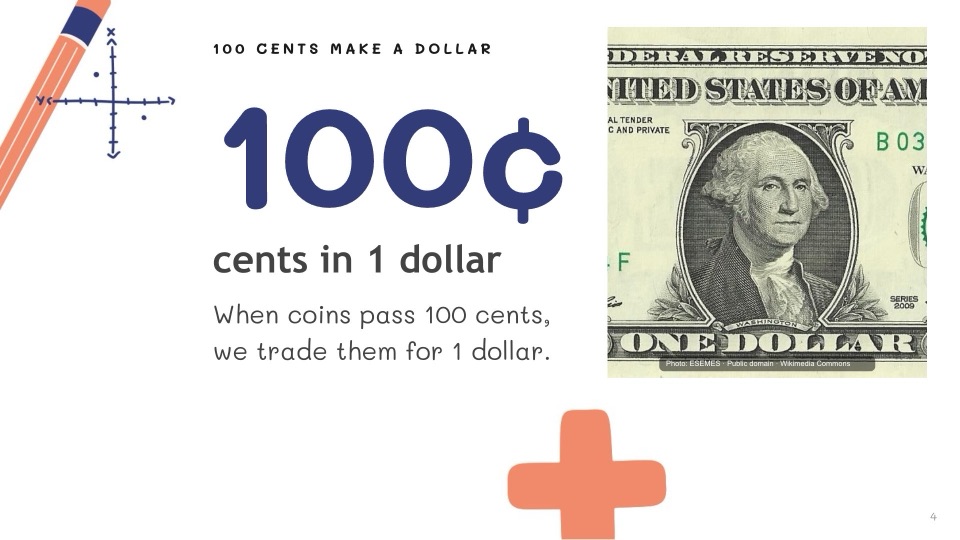
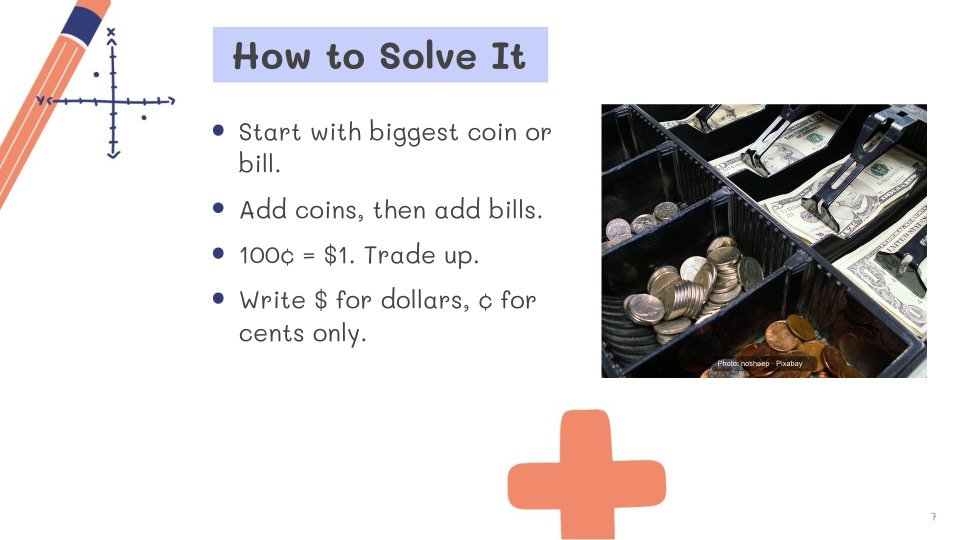
| 10 min | Teaching | Model the biggest-first 3-step plan for bills-and-coins problems. Show Slide 4 100 Cents Make a Dollar: When coins pass 100 cents, we trade them for 1 dollar. Every 100 cents is 1 dollar. Show Slide 7 How to Solve It: Start with biggest coin or bill. Add coins, then add bills. 100¢ = $1. Trade up. Write $ for dollars, ¢ for cents only. Model with play money biggest first: lay $5 and $1 in one row, 2 dimes and 1 penny in another row. Think aloud adding larger bills first, then smaller ones, then coins, then the two totals together. |
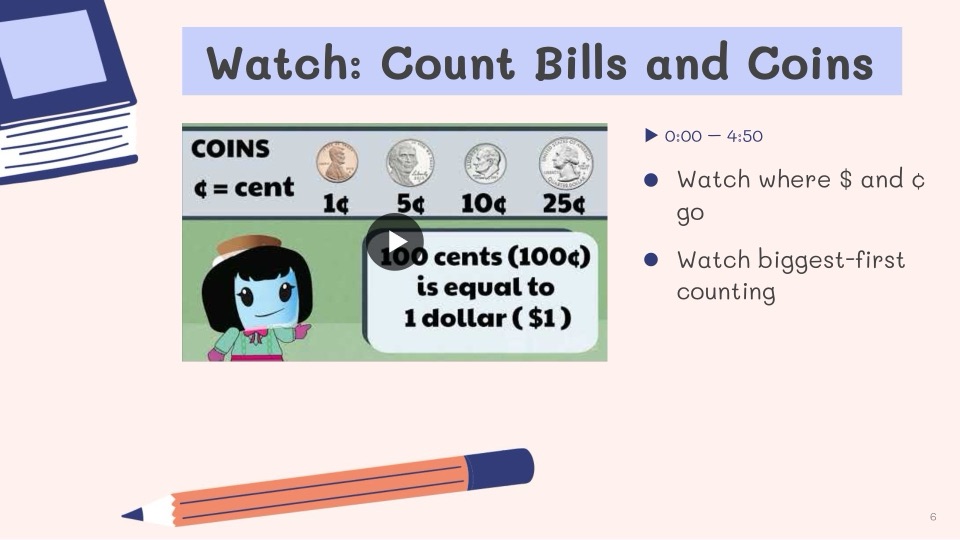
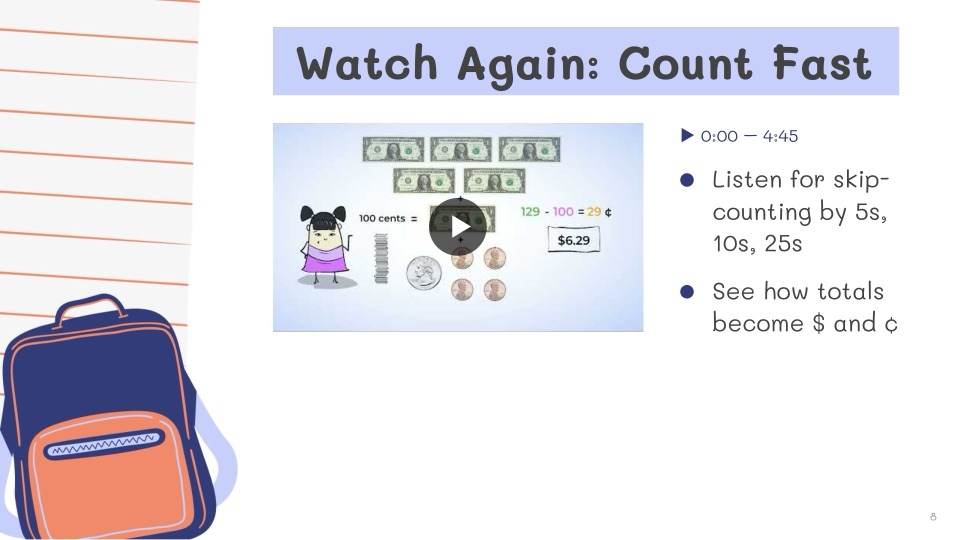
| 10 min | Guided Practice | See biggest-first counting and $ and ¢ writing in a worked video example. Show Slide 6 Watch: Count Bills and Coins. Tell class: Watch where $ and ¢ go. Watch biggest-first counting. Play Video clip 1 dollar bills and coins - 2.MD.8 (0:00–4:50). Pause once to point to biggest-first order. Rebuild the video total with class play money using skip counting by 5s, 10s, and 25s. Compare a cents-only total with a dollars-and-cents total on the board. |
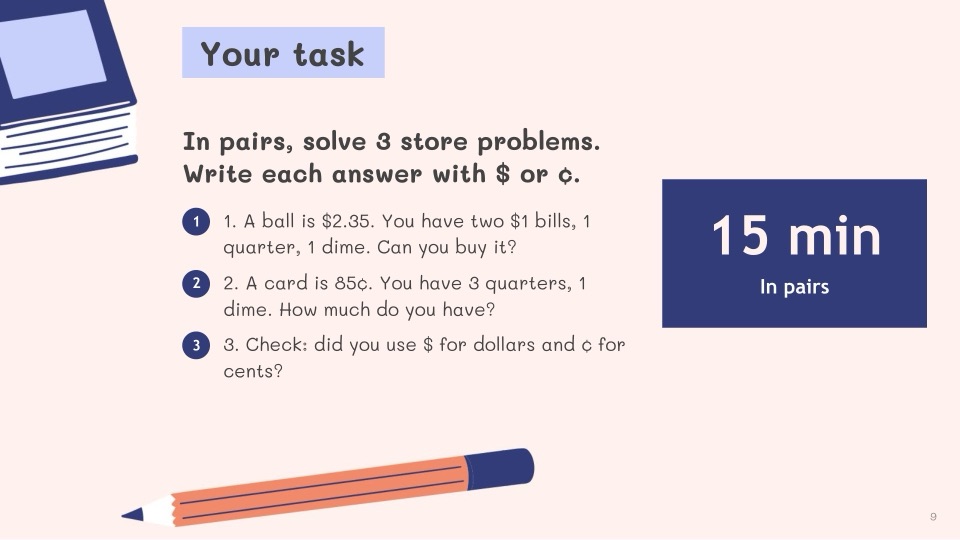
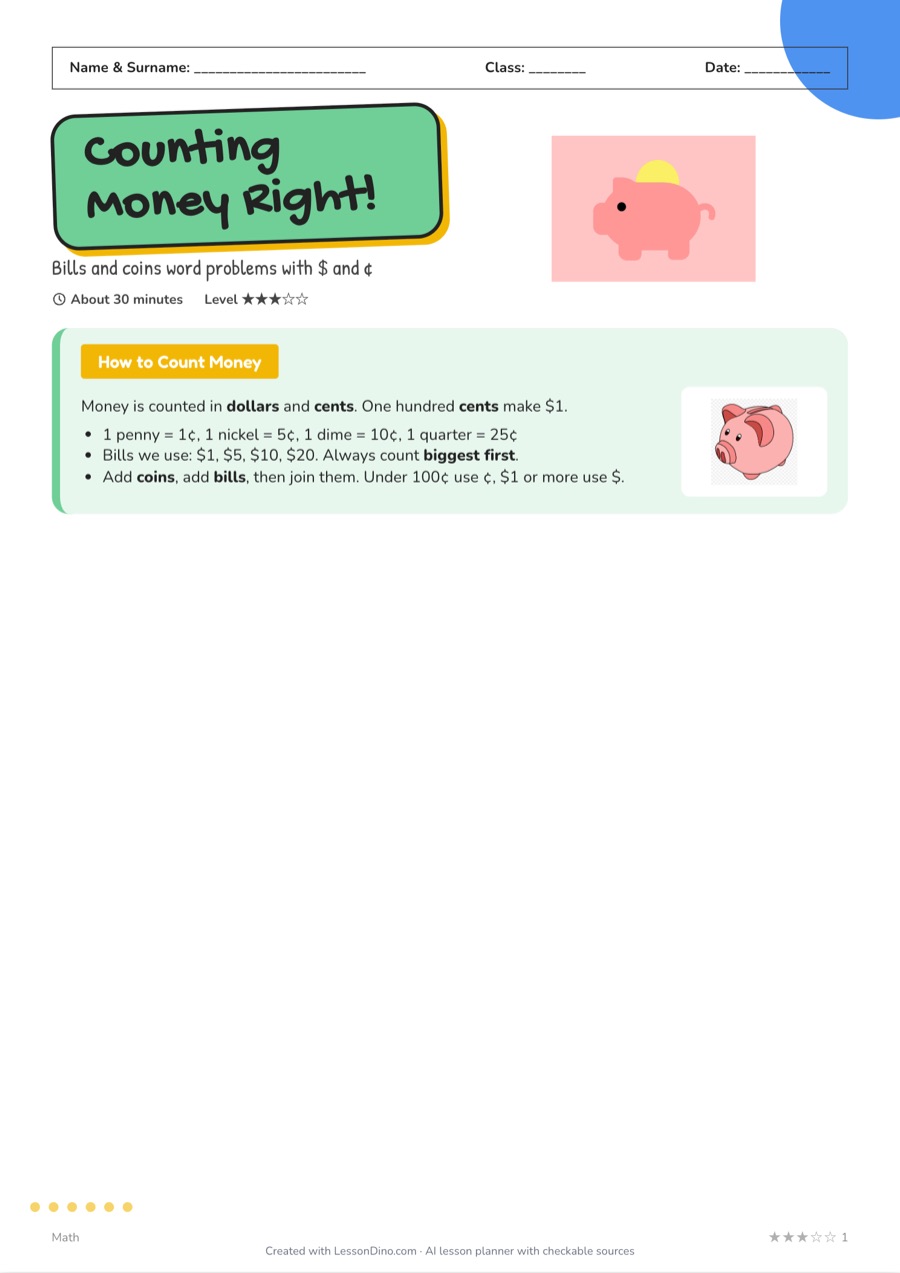
| 20 min | Main Activity | Solve bills-and-coins word problems in the Bills First Relay. Hand out Worksheet Task C: Add bills first, then coins, then join them, plus play money and team boards. Read Problem 1 aloud: A student pays for a book with one $5 bill, one $1 bill, 2 dimes, and 1 penny. How much is that? Read Problem 2 aloud: A student buys pencils with one $1 bill, 1 quarter, 1 nickel, and 2 pennies. How much is that? Read Problem 3 aloud: A student pays for a ball with one $5 bill, 2 quarters, and 1 dime. How much is that? Start relay rounds and check boards. |
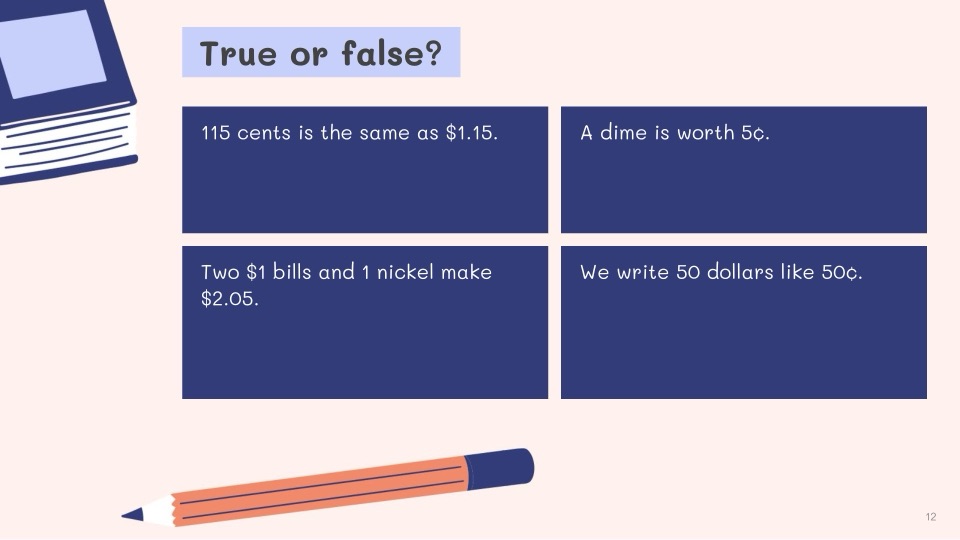
| 10 min | Plenary | Check correct use of $ and ¢ and fix common counting errors. Show Slide 12 True or false? Read: 115 cents is the same as $1.15. Read next lines: A dime is 10¢. A nickel is 5¢. A dime is worth 5¢. $1 + $1 + 5¢ = $2.05. Vote true or false with $ and ¢ cards, then fix the false one together. Return to success lines and have students say which I can they met. |
Common mistakes
- Forgetting a coin so total is too low
How to spot it: Running total jumps short, like 25, 50, 60 and stops
Rebuild largest to smallest and recount all coins and bills - Mixing dime and nickel values
How to spot it: Counts dime as 5 or nickel as 10
Point to chart and repeat dime is 10 cents and nickel is 5 cents - Writing $ for cents-only amounts or ¢ for dollar amounts
How to spot it: Writes $57 for 57 cents or 147¢ for $1.47
Recall each dollar is worth 100 cents so 100¢ or more trades to $
Support
- Lay bills in one row and coins in another row, then add each row
- Use picture coin chart with cent values for quick reference
Stretch
- Write a one-sentence word problem to match a new money set
- Explain why 99¢ uses ¢ and $1.01 needs $ using 100 cents = $1
Check questions
- A student has 1 quarter, 1 dime, and 1 penny. How much? Write with correct symbol.
Answer: 36¢ - A student pays with one $5 bill, one $1 bill, and 1 nickel. How much?
Answer: $6.05 - True or false: 100 cents makes $1. Write 100¢ = ?
Answer: True, 100¢ = $1.00
Curriculum
Solve word problems involving dollar bills, quarters, dimes, nickels, and pennies, using $ and ¢ symbols appropriately.
Video clips
Clips on YouTube, from the start and end times we chose. Check each one before you show it.
-
dollar bills and coins - 2.MD.8 from 0:00 to 4:50
Boddle Learning: Understanding Money (Dollar Bills, Quarters, Dimes, Nickels, and Pennies) - 2nd Grade Math (2.MD.8)
Covers dollar bills, quarters, dimes, nickels, and pennies with $ and ¢ exactly for this standard in a clear style ideal for ages 7-8.
-
coin and bill values for 2nd grade from 0:00 to 4:45
MightyOwl: Counting coins - the value of coins and bills | MightyOwl Math | 2nd Grade
Made for 2nd grade and explains value of coins and bills and how to count them at a perfect pace for ages 7-8.
Worksheet
Sources
- Money Math: Counting Money - Ducksters ducksters.com
- Money - 1st level Maths and Numeracy - BBC Bitesize bbc.co.uk
- Counting Money — Worksheets, Lessons & Coin Activities moneyinstructor.com
- Money for Kids (KS1 & KS2) – Counting, calculating, comparing superbrainybeans.com
- How to teach money and counting coins - Sum Math Fun summathfun.com
- summary pdf learnestedu.com
- Money - BBC Bitesize bbc.co.uk
- A Simple Guide for Teaching Children to Count Money primarydelightteaching.com
- How to Teach Kids to Count Money - Kids' Money kidsmoney.org
Picture credits
Made with Lesson Dino's AI on 17 October 2026. AI can make mistakes, so check facts against the sources before you teach.