Slides
Lesson plan
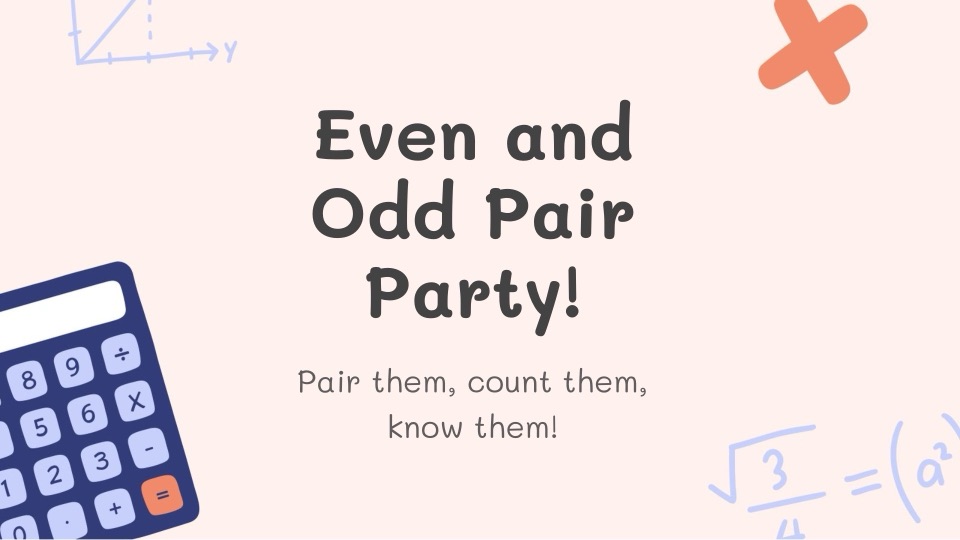
Even or Odd Picnic to 20
Students learn to tell even and odd to 20 by pairing and counting by 2s. They deal counters onto two plates and write evens as equal addends.
Objectives
- Students will decide if groups to 20 are even or odd by pairing or counting by 2s.
- Students will make two equal groups to test even and odd to 20.
- Students will write even numbers to 20 as sums of two equal addends.
Success criteria
- I can pair objects to 20 and say even or odd.
- I can count by 2s to check for a leftover.
- I can write an even number as two equal addends.
Key words
| Word | Meaning |
|---|---|
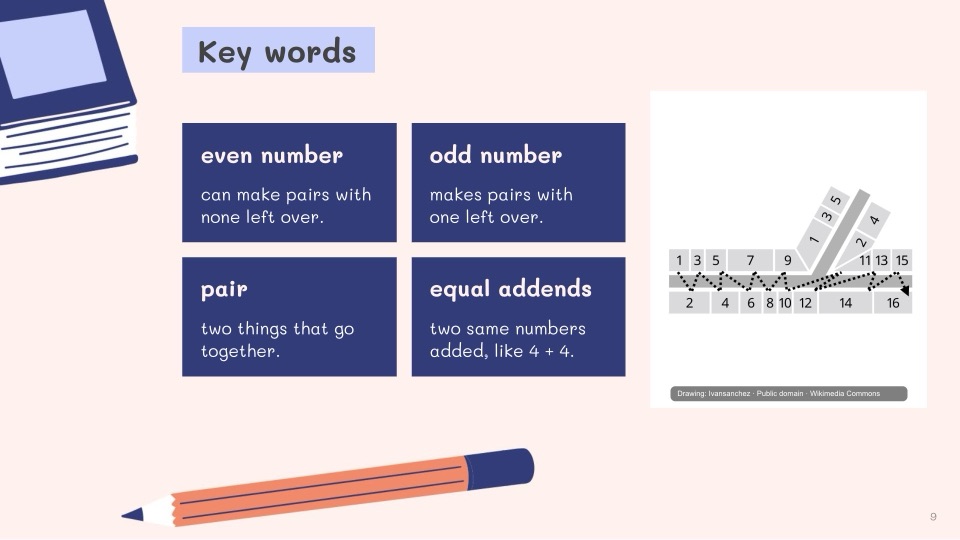
| even number | a count where everything finds a partner with none left over |
| odd number | a count where pairs are made and one thing has no partner |
| pair | two things that go together |
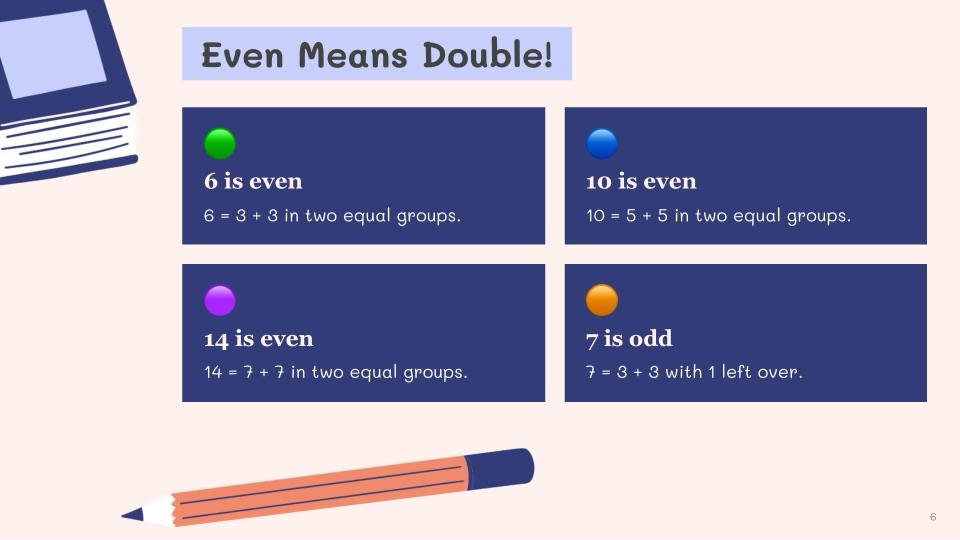
| equal addends | two same parts put together with plus, like 6 = 3 + 3 |
| leftover | one extra thing with no partner or group |
Timed plan (60 minutes)
| Time | Stage | What happens |
|---|---|---|
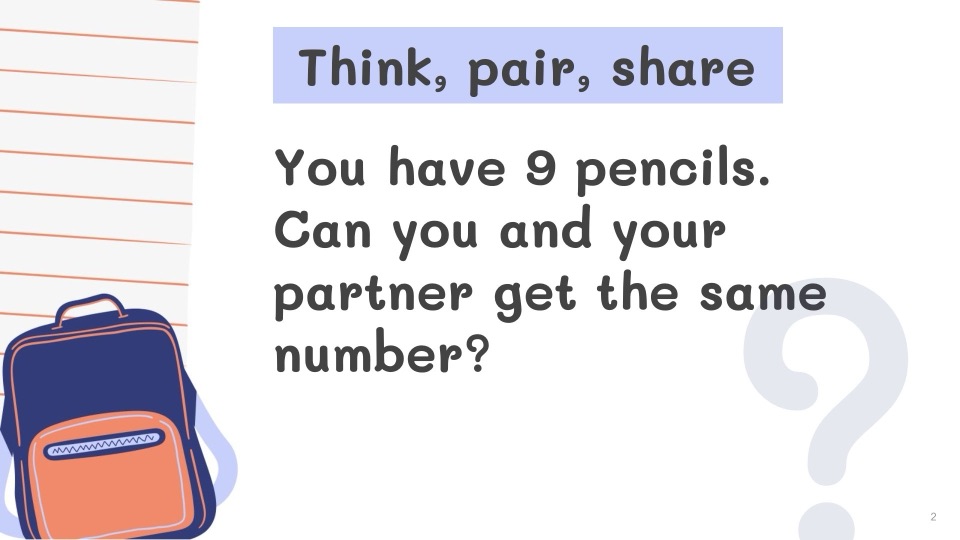
| 10 min | Starter | Hook interest in fair sharing and recall what two same groups look like. Show Slide 1 and give the hook for the picnic. Show Slide 2 and read its exact question: You have 9 pencils. Can you and your partner get the same number? Deal 9 counters one-by-one onto two paper plates while the class whisper-counts. Ask pairs to decide if the plates match and to name any leftover. |
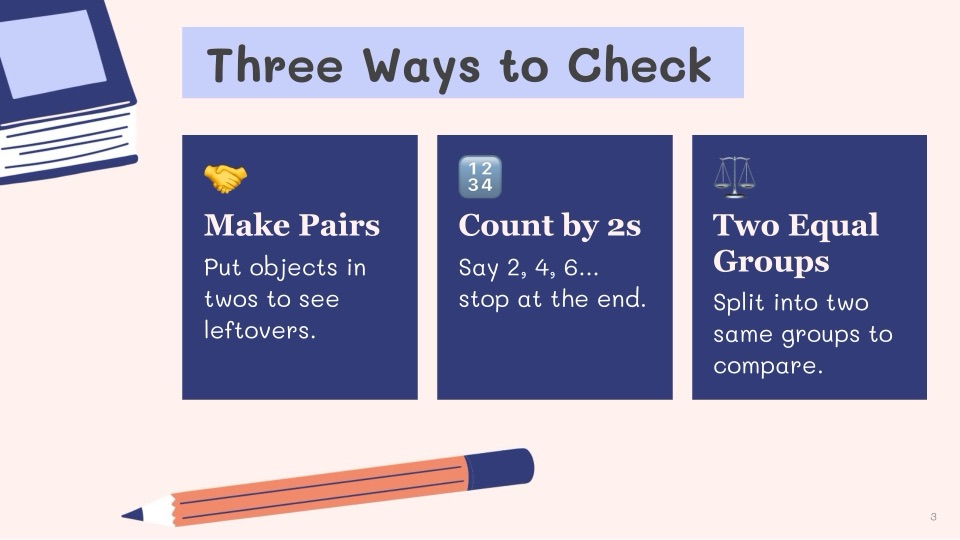
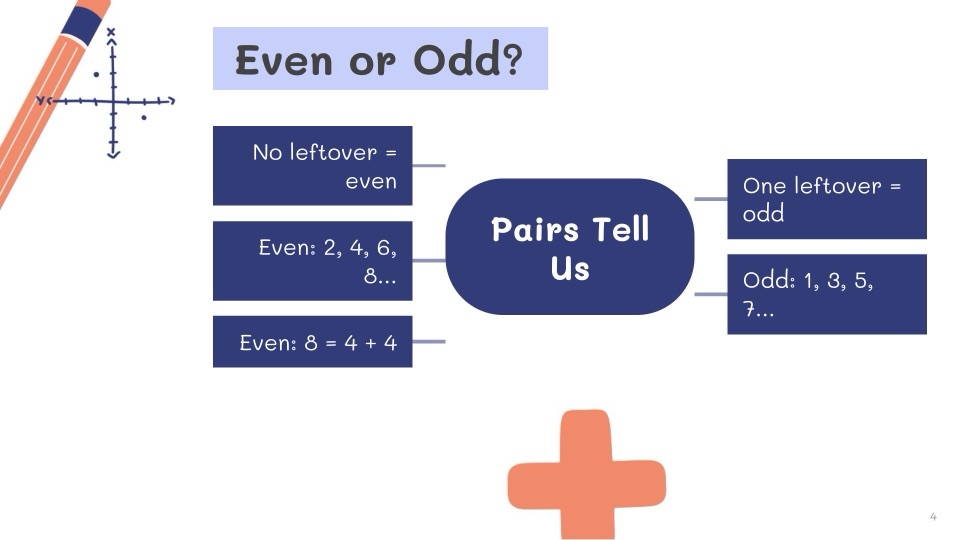
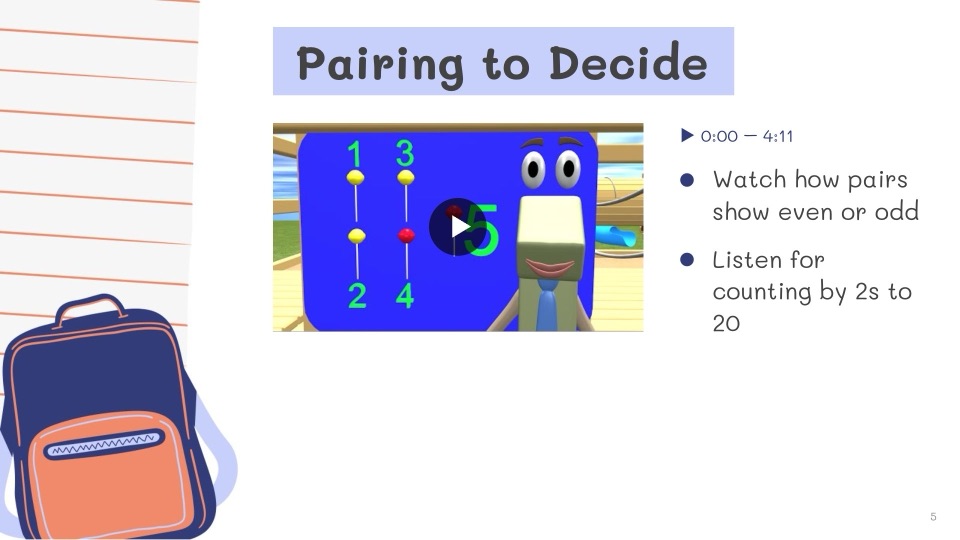
| 15 min | Teaching | Model pairing, counting by 2s, and two equal groups to name even and odd. Show Slides 3-4 and point to No leftover = even and One leftover = odd. Make 14 counters into pairs on the board and count together by 2s: 2, 4, 6, 8, 10, 12, 14. Show Slide 5 and play Video clip 1 (0:00–4:11) to watch pairs show even or odd. Split the 14 into two same groups of 7 and write 14 = 7 + 7, linking to 6 = 3 + 3 in two equal groups. |
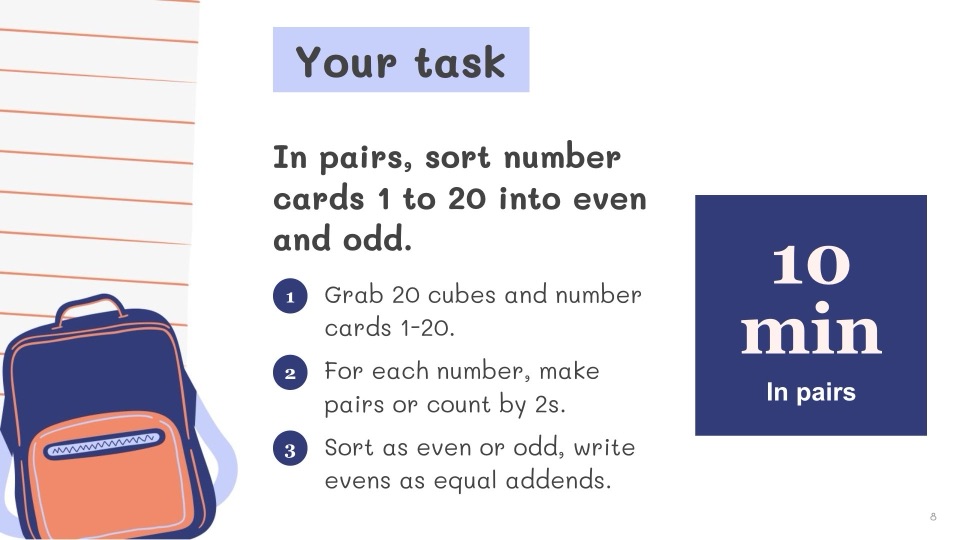
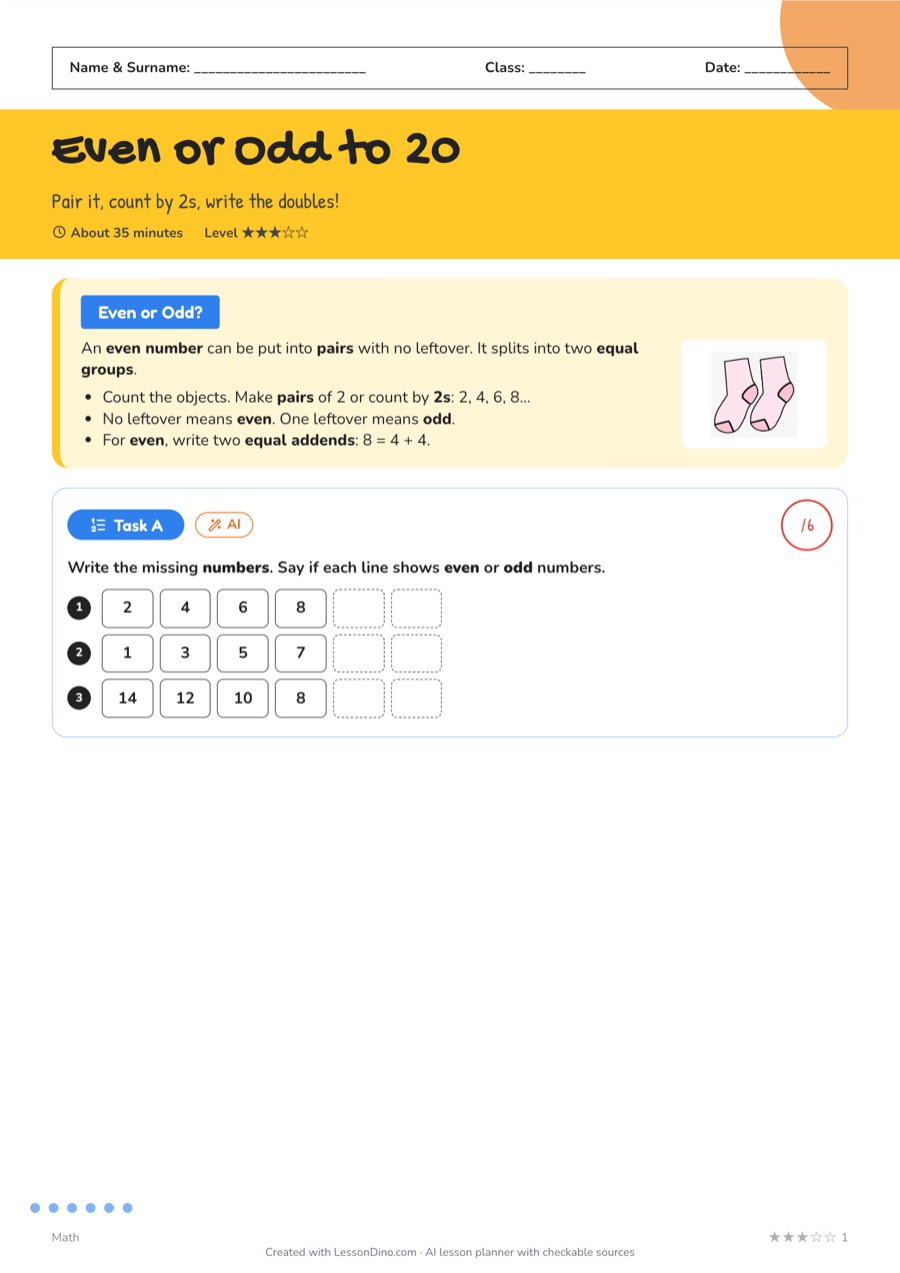
| 20 min | Main activity | Test numbers to 20 by making two equal groups and writing evens as equal addends. Demonstrate Two Plates Picnic with 10 counters: deal one-by-one onto two plates. Write the match as 10 = 5 + 5 and say even means no leftover. Show Slide 8 and give out plates, counters, number cards 1-20, and Worksheet Task B to decide even or odd by pairing and write the equal addends with pencils. Circulate, ask pairs to explain pairs and equations, and prompt recording. |
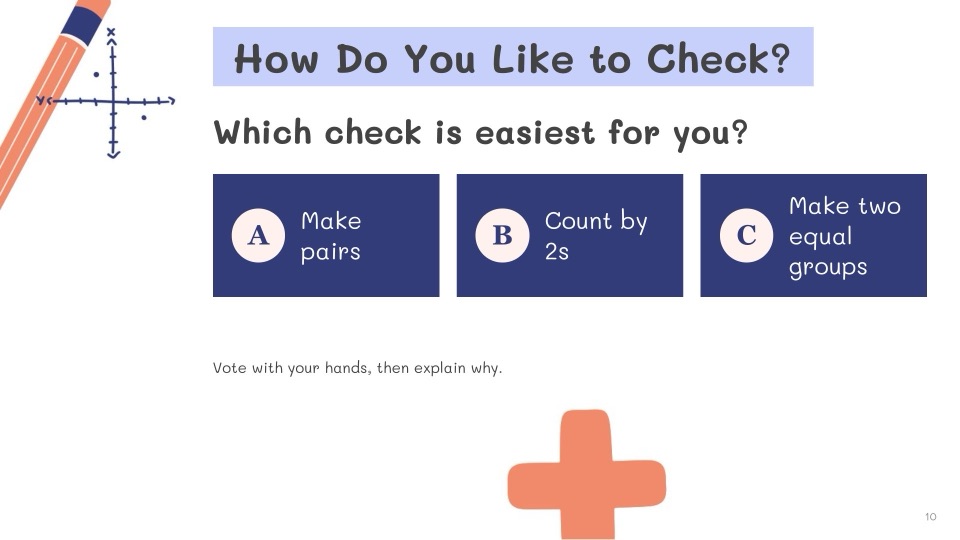
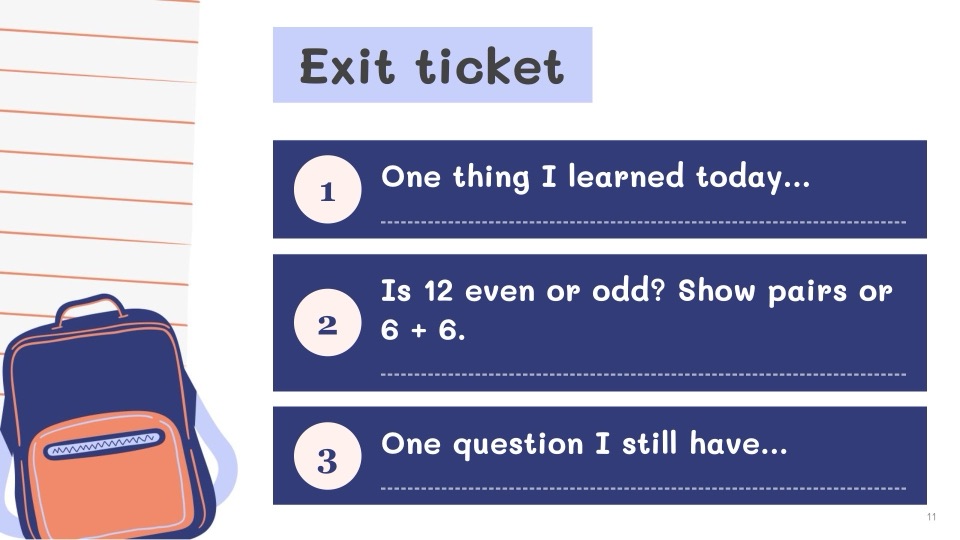
| 15 min | Plenary | Agree key words and check even or odd to 20 with explanations. Show Slide 9 and rehearse even number, odd number, pair, and equal addends meanings. Invite pairs to finish: It is odd because two equal groups leave one leftover. Show Slide 10 and take a vote on easiest check: Make pairs, Count by 2s, or Make two equal groups. Show Slide 11 and guide the exit: Is 12 even or odd? Show pairs or 6 + 6. |
Common mistakes
- Saying an odd number can be split into two equal groups with nothing left.
How to spot it: Writes 9 = 4 + 4 and calls 9 even.
Deal 9 onto plates to see 4 and 4 plus 1 extra; odd numbers need two equal addends plus 1. - Miscounting when counting by 2s and stopping early.
How to spot it: Counts 2, 4, 6 for 14 and says leftover.
Touch each pair while saying 2, 4, 6, 8, 10, 12, 14; even has no leftover after full count. - Writing unequal addends for an even number.
How to spot it: Writes 10 = 6 + 4 and says it shows doubles.
Check plates match exactly; even as a sum of two equal addends needs two same parts, like 10 = 5 + 5.
Support
- Start with only 6, 8, or 10 objects, then build up to 20.
- Use ten-frames to line up the two groups for easy comparing.
- Give word cards for pair, equal groups, and leftover to use in explanations.
Stretch
- Write how many pairs were made, like 14 has 7 pairs.
- Show where the extra counter goes when the number is odd.
- Name the next even number and predict its equal-addend equation.
Check questions
- Is 12 even or odd? Show pairs or 6 + 6.
Answer: Even; pairs cover all with none left; 12 = 6 + 6. - Is 15 even or odd? How do pairs show it?
Answer: Odd; pairs leave one leftover with no partner. - Write an even number to 20 as two equal addends.
Answer: For example, 8 = 4 + 4 or 10 = 5 + 5.
Curriculum
Determine whether a group of objects (up to 20) has an odd or even number of members, e.g., by pairing objects or counting them by 2s; write an equation to express an even number as a sum of two equal addends.
Video clips
Clips on YouTube, from the start and end times we chose. Check each one before you show it.
-
Odd and even for 2nd grade from 0:00 to 4:11
Math & Learning Videos 4 Kids: Learning Odd and Even Numbers for Kids - 1st and 2nd Grade
Made specifically for 1st and 2nd grade, it teaches even/odd vocabulary and pairing at the perfect pace for ages 7-8.
-
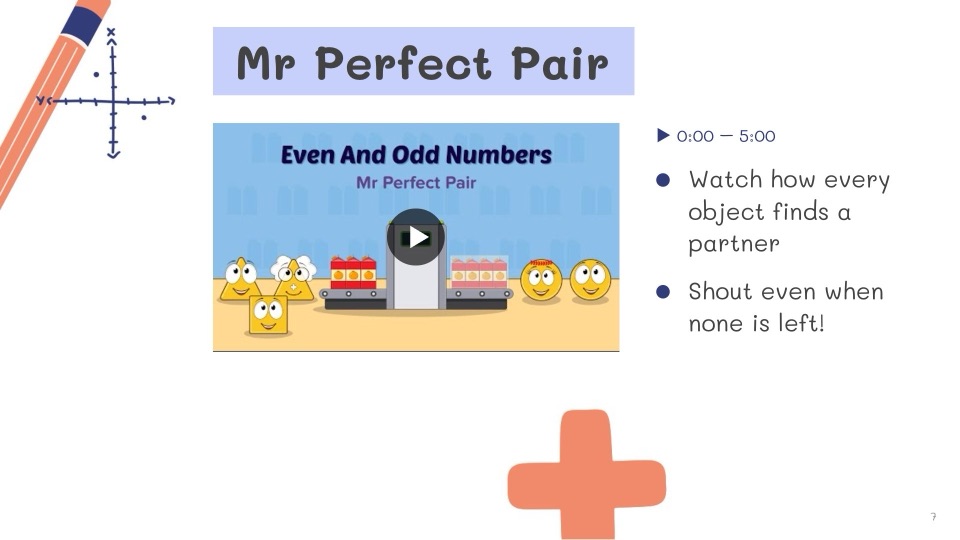
Mr Perfect Pair from 0:00 to 5:00
Uncle Math Lab: Math Video : Even and Odd Numbers | Mr Perfect Pair | Kids Stories | Homeschool
Its pairing story is made for young elementary kids and directly models pairing objects for ages 7-8.
Worksheet
Sources
- Grade 2 Math Curriculum - Fairfax County Public Schools fcps.edu
- Curriculum Map: iReady Classroom Mathematics Course: MATH 2 ... ltsd.k12.pa.us
- Why odd numbers are dodgy, evens are good, and 7 is everyone's f… theguardian.com
- Odd and Even Numbers Explained - Definition with Examples | Nobellearn nobellearn.com
- Even and Odd Integers - #9 by rob - Pitches - Swift Forums forums.swift.org
Picture credits
Made with Lesson Dino's AI on 17 October 2026. AI can make mistakes, so check facts against the sources before you teach.