The worksheet
About this worksheet
Students learn to solve money word problems with bills and coins. They play a relay to add totals and write $ and ¢ correctly. This Grade 2 Math worksheet gives students (ages 7–8) seven pages of practice on counting money, part of the measurement and data unit. It goes with our free Counting money lesson, which has the slides and a timed lesson plan.
What it covers
By the end, students should be able to:
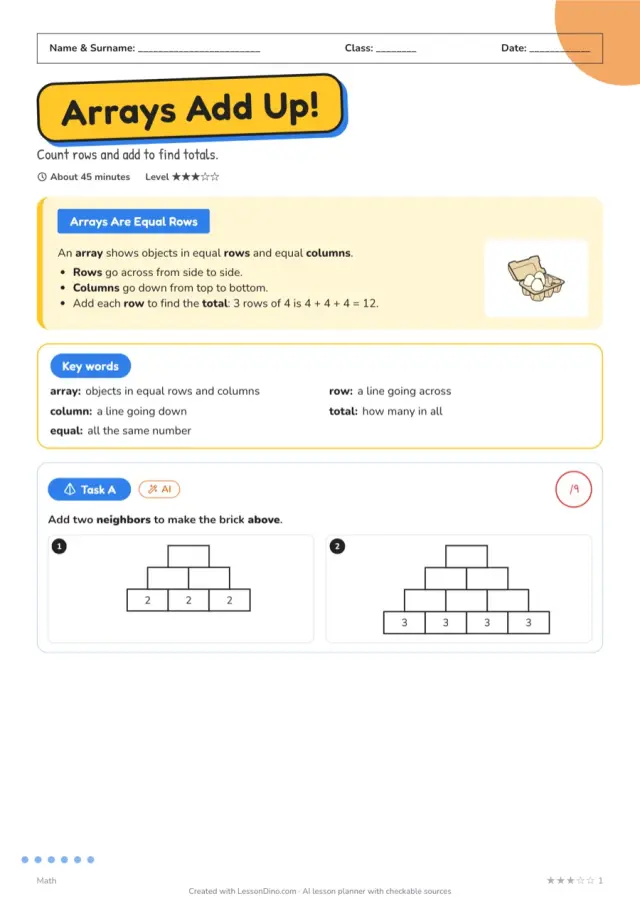
- Students will solve word problems using $1, $5, $10 bills and coins.
- Students will add bills first, then coins, then combine both totals.
- Students will write answers correctly with $ for dollars and ¢ for cents.
How to use it
- Main Activity (20 minutes): Hand out Worksheet Task C: Add bills first, then coins, then join them, plus play money and team boards.
- Support: Lay bills in one row and coins in another row, then add each row.
- Stretch: Write a one-sentence word problem to match a new money set.
- The answer sheet is the last page, so you can print it on its own or let students check their own work.
Key vocabulary
- cent: Tiny part of money. One hundred make $1.
- dollar: Big unit of money. Written with $ like $2.
- quarter: Silver coin worth 25 tiny parts.
- dime: Small silver coin worth 10 tiny parts.
- nickel: Coin worth 5 tiny parts.
- total: All the money counted together as one amount.
Mistakes to watch for
- Forgetting a coin so total is too low. Rebuild largest to smallest and recount all coins and bills.
- Mixing dime and nickel values. Point to chart and repeat dime is 10 cents and nickel is 5 cents.
- Writing $ for cents-only amounts or ¢ for dollar amounts. Recall each dollar is worth 100 cents so 100¢ or more trades to $.
What's on the worksheet
Money Values First
Remember coin and bill values and how to count biggest first.
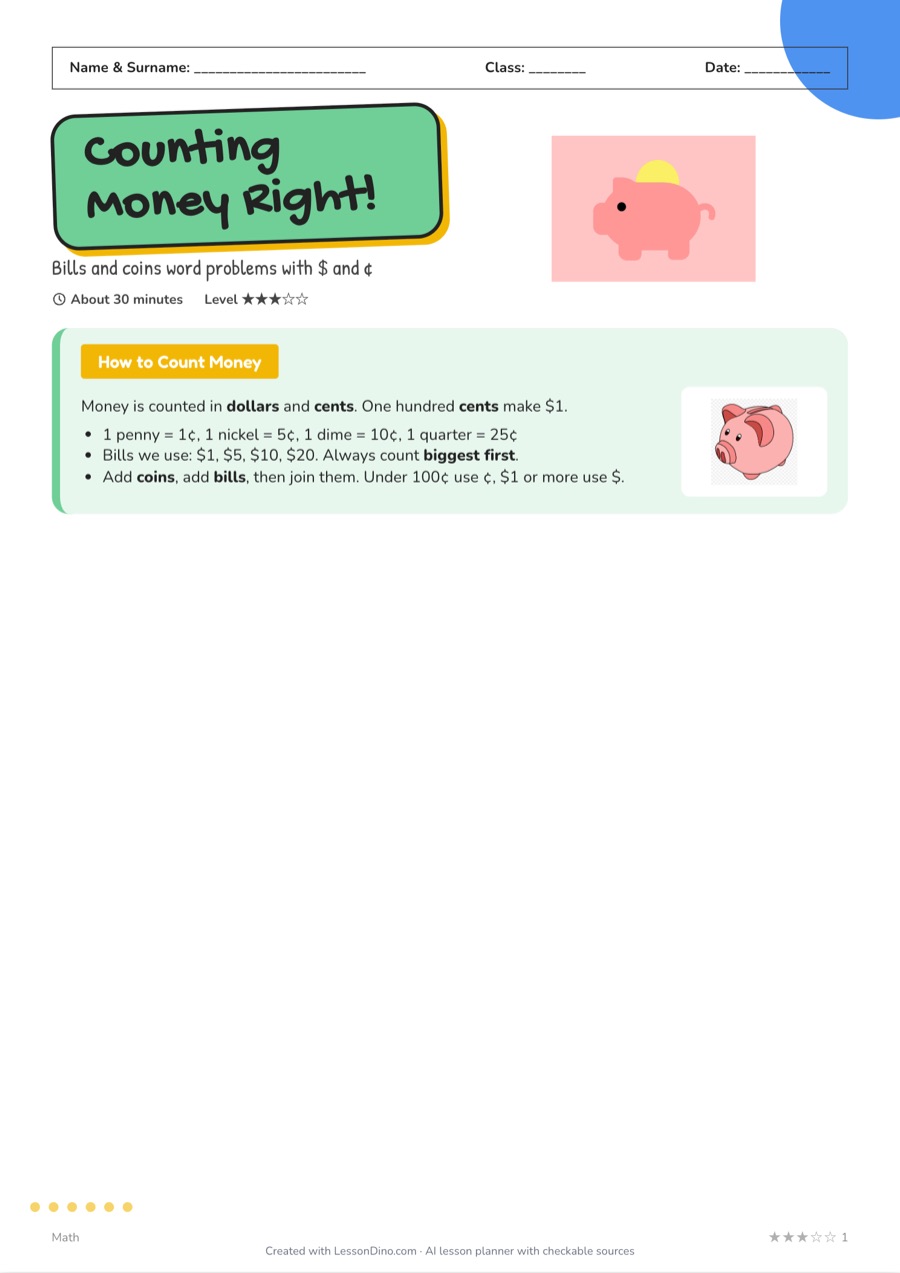
How to Count Money
- Money is counted in dollars and cents. One hundred cents make $1.
- 1 penny = 1¢, 1 nickel = 5¢, 1 dime = 10¢, 1 quarter = 25¢
- Bills we use: $1, $5, $10, $20. Always count biggest first.
- Add coins, add bills, then join them. Under 100¢ use ¢, $1 or more use $.
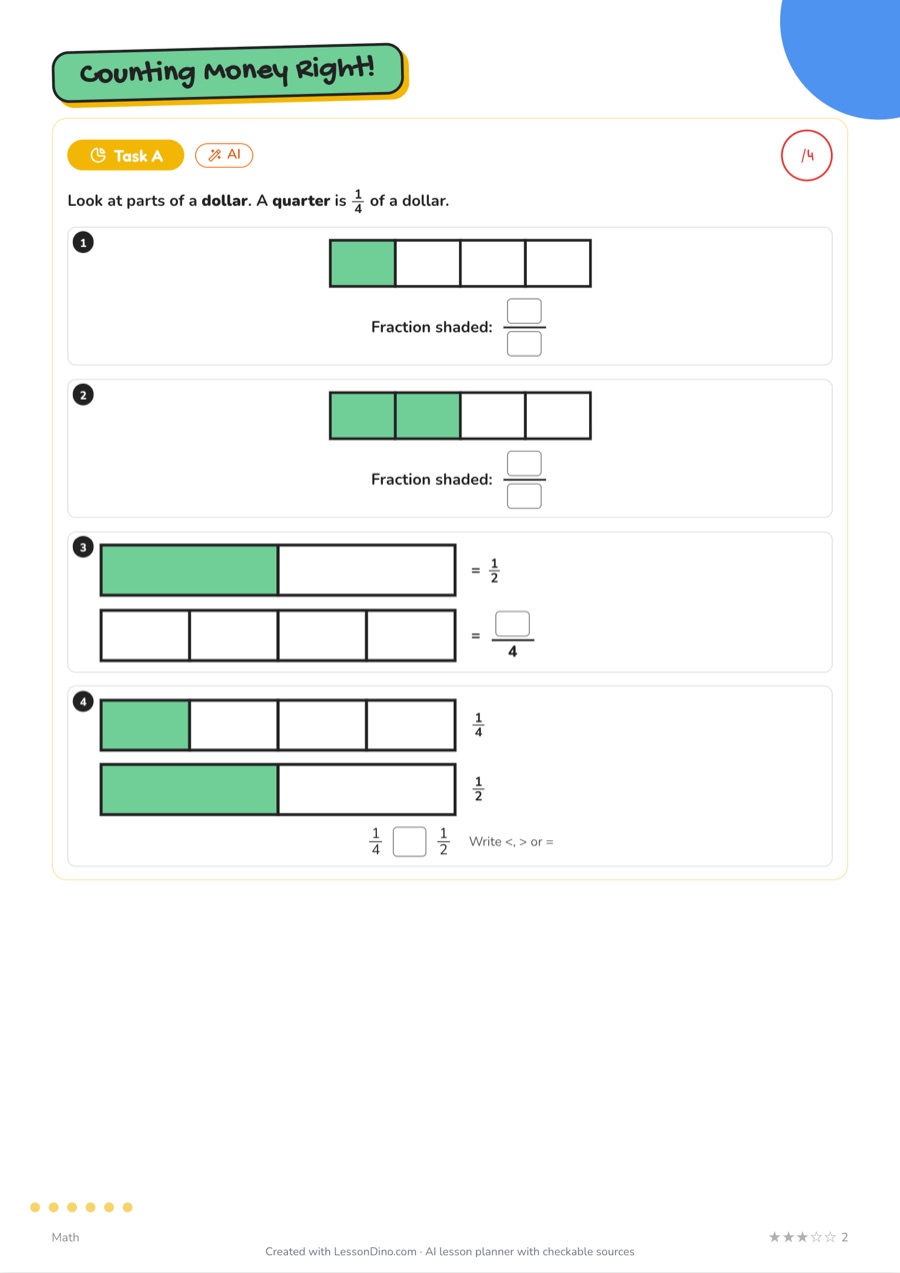
Page 2
Look at parts of a dollar. A quarter is 1/4 of a dollar.
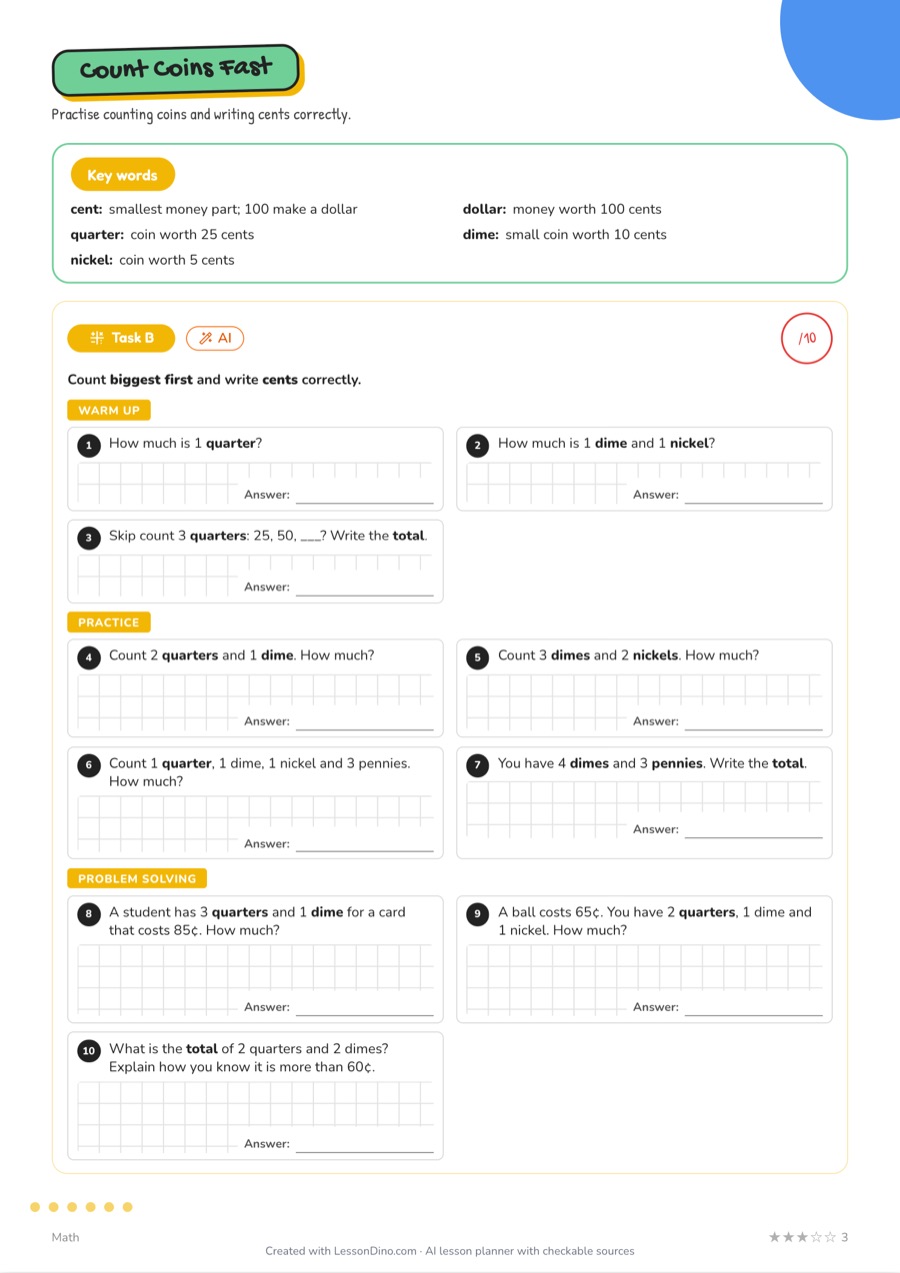
Count Coins Fast
Practise counting coins and writing cents correctly.
| Word | Meaning |
|---|---|
| cent | smallest money part; 100 make a dollar |
| dollar | money worth 100 cents |
| quarter | coin worth 25 cents |
| dime | small coin worth 10 cents |
| nickel | coin worth 5 cents |
Count biggest first and write cents correctly.
Warm up
- How much is 1 quarter?
- How much is 1 dime and 1 nickel?
- Skip count 3 quarters: 25, 50, ___? Write the total.
Practice
- Count 2 quarters and 1 dime. How much?
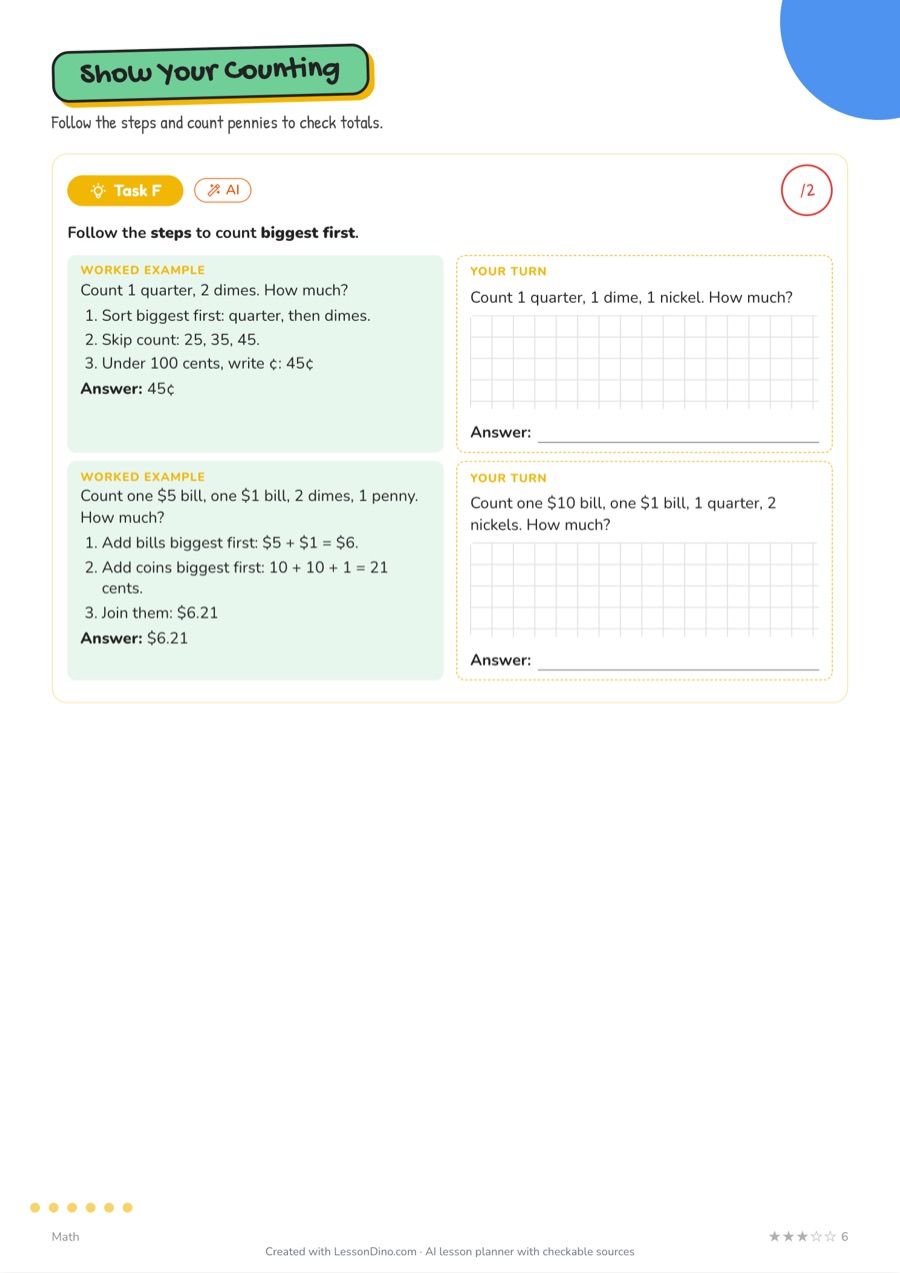
- Count 3 dimes and 2 nickels. How much?
- Count 1 quarter, 1 dime, 1 nickel and 3 pennies. How much?
- You have 4 dimes and 3 pennies. Write the total.
Problem solving
- A student has 3 quarters and 1 dime for a card that costs 85¢. How much?
- A ball costs 65¢. You have 2 quarters, 1 dime and 1 nickel. How much?
- What is the total of 2 quarters and 2 dimes? Explain how you know it is more than 60¢.
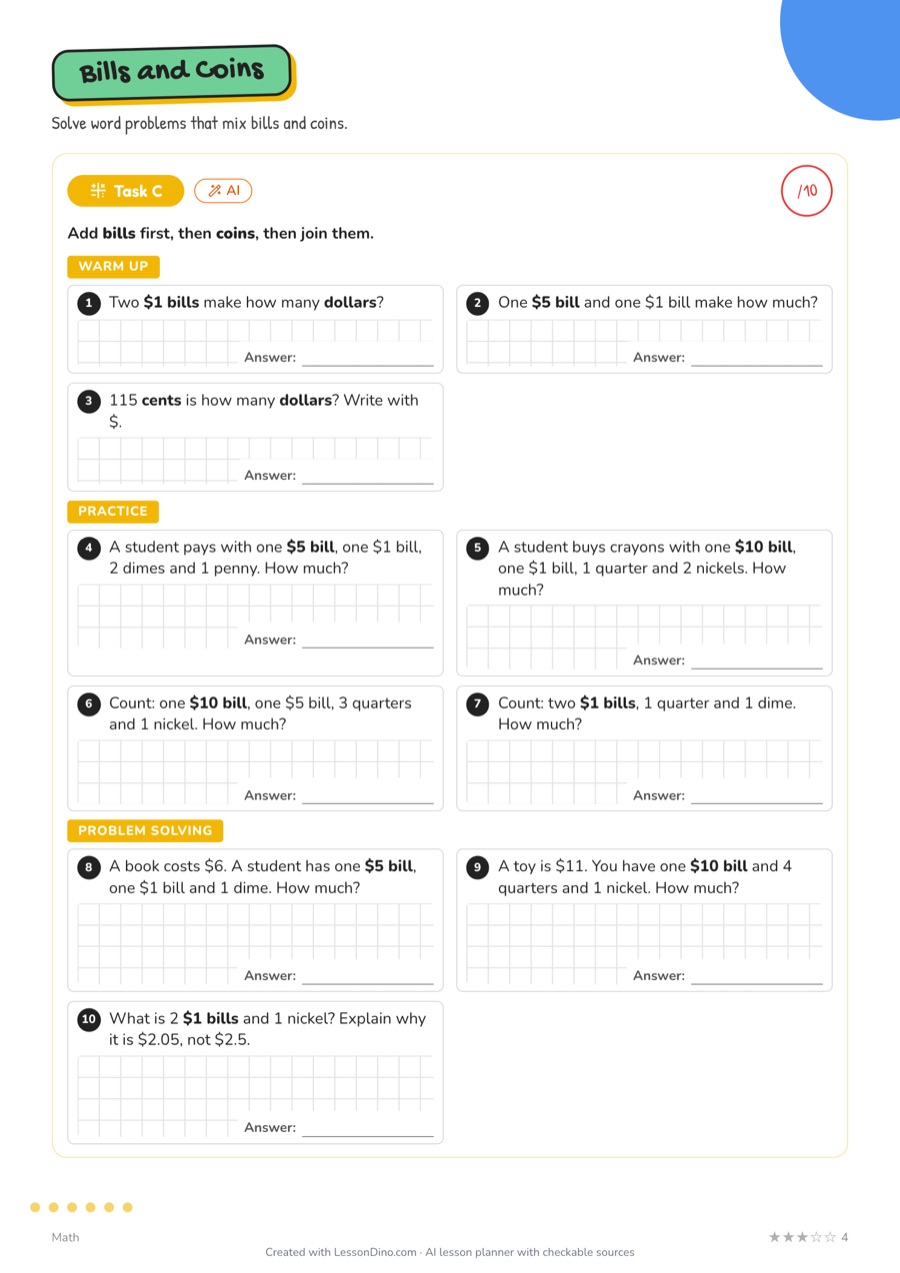
Bills and Coins
Solve word problems that mix bills and coins.
Add bills first, then coins, then join them.
Warm up
- Two $1 bills make how many dollars?
- One $5 bill and one $1 bill make how much?
- 115 cents is how many dollars? Write with $.
Practice
- A student pays with one $5 bill, one $1 bill, 2 dimes and 1 penny. How much?
- A student buys crayons with one $10 bill, one $1 bill, 1 quarter and 2 nickels. How much?
- Count: one $10 bill, one $5 bill, 3 quarters and 1 nickel. How much?
- Count: two $1 bills, 1 quarter and 1 dime. How much?
Problem solving
- A book costs $6. A student has one $5 bill, one $1 bill and 1 dime. How much?
- A toy is $11. You have one $10 bill and 4 quarters and 1 nickel. How much?
- What is 2 $1 bills and 1 nickel? Explain why it is $2.05, not $2.5.
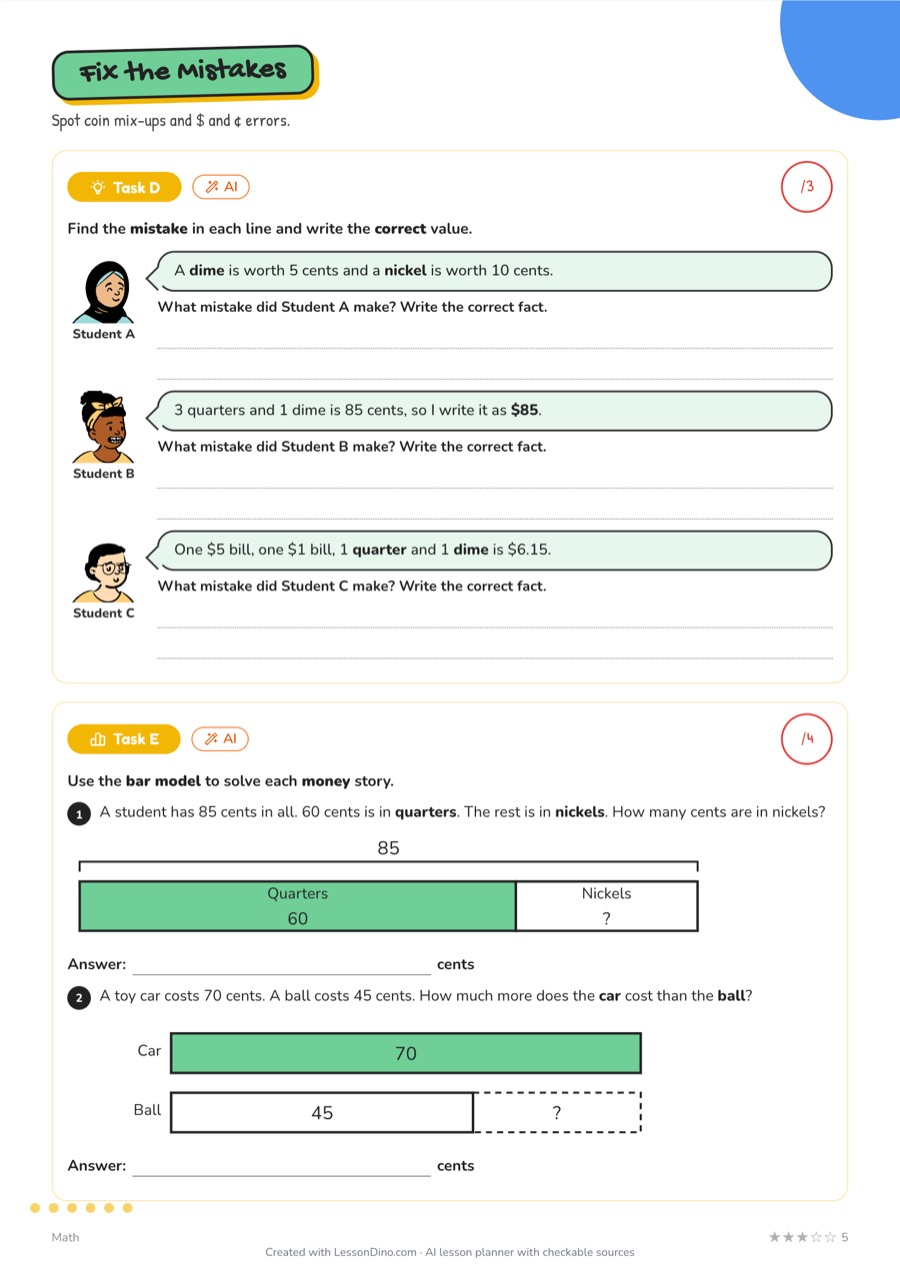
Fix the Mistakes
Spot coin mix-ups and $ and ¢ errors.
Find the mistake in each line and write the correct value.
Use the bar model to solve each money story.
Show Your Counting
Follow the steps and count pennies to check totals.
Follow the steps to count biggest first.
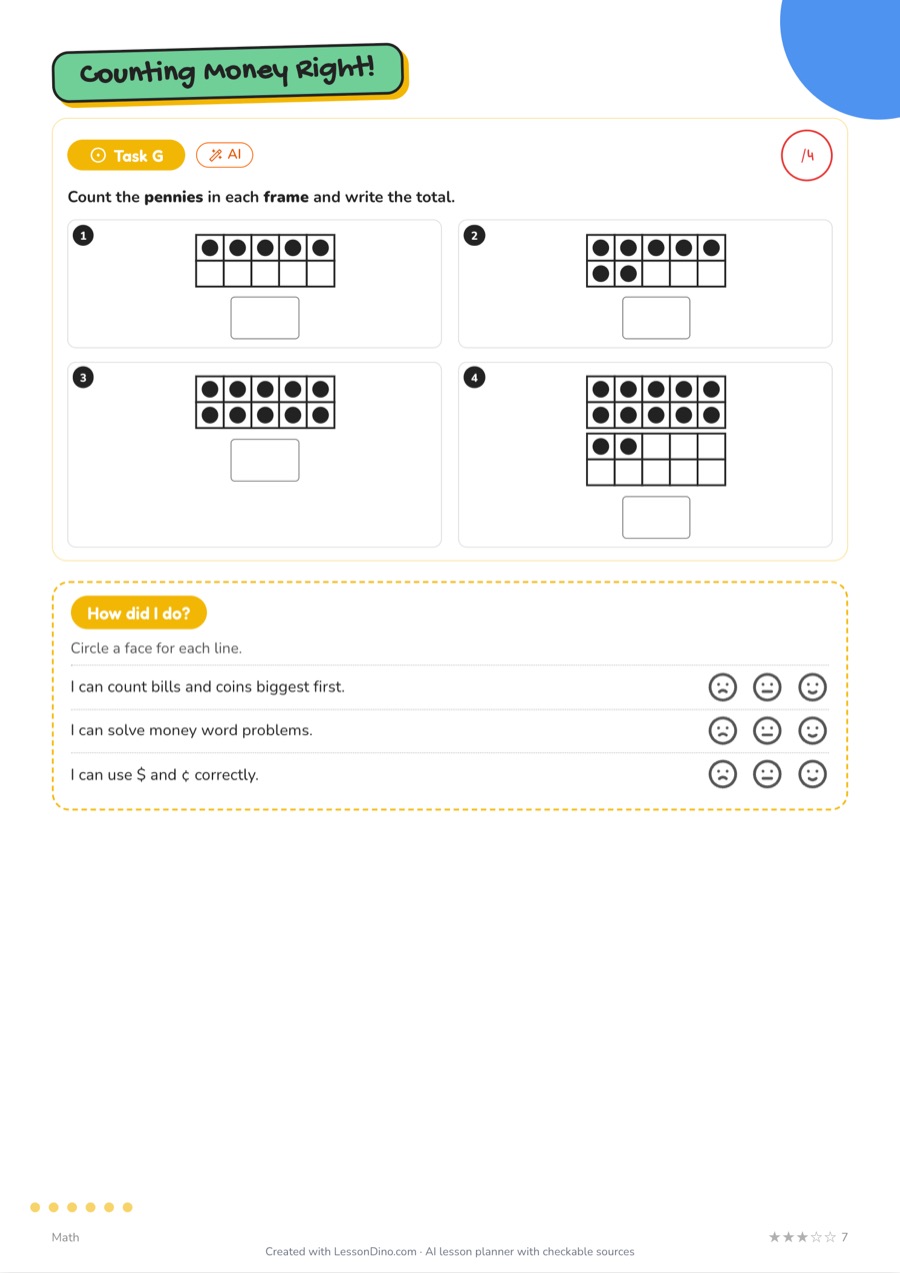
Page 7
Count the pennies in each frame and write the total.
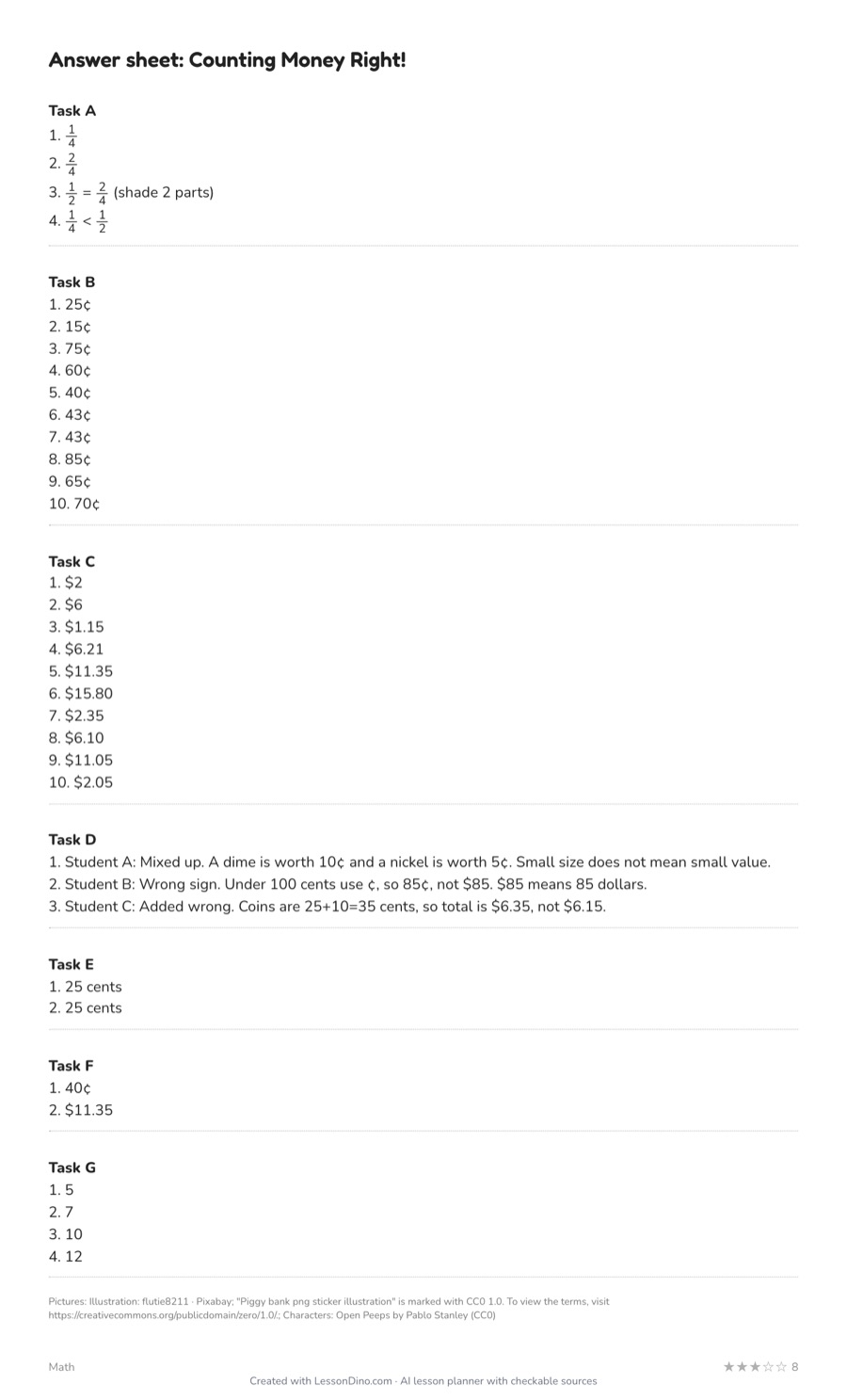
Answers
Show the answers
- How much is 1 quarter? 25¢
- How much is 1 dime and 1 nickel? 15¢
- Skip count 3 quarters: 25, 50, ___? Write the total. 75¢
- Count 2 quarters and 1 dime. How much? 60¢
- Count 3 dimes and 2 nickels. How much? 40¢
- Count 1 quarter, 1 dime, 1 nickel and 3 pennies. How much? 43¢
- You have 4 dimes and 3 pennies. Write the total. 43¢
- A student has 3 quarters and 1 dime for a card that costs 85¢. How much? 85¢
- A ball costs 65¢. You have 2 quarters, 1 dime and 1 nickel. How much? 65¢
- What is the total of 2 quarters and 2 dimes? Explain how you know it is more than 60¢. 70¢
- Two $1 bills make how many dollars? $2
- One $5 bill and one $1 bill make how much? $6
- 115 cents is how many dollars? Write with $. $1.15
- A student pays with one $5 bill, one $1 bill, 2 dimes and 1 penny. How much? $6.21
- A student buys crayons with one $10 bill, one $1 bill, 1 quarter and 2 nickels. How much? $11.35
- Count: one $10 bill, one $5 bill, 3 quarters and 1 nickel. How much? $15.80
- Count: two $1 bills, 1 quarter and 1 dime. How much? $2.35
- A book costs $6. A student has one $5 bill, one $1 bill and 1 dime. How much? $6.10
- A toy is $11. You have one $10 bill and 4 quarters and 1 nickel. How much? $11.05
- What is 2 $1 bills and 1 nickel? Explain why it is $2.05, not $2.5. $2.05
The answer sheet is the last picture above.
Curriculum
Solve word problems involving dollar bills, quarters, dimes, nickels, and pennies, using $ and ¢ symbols appropriately.
Made with Lesson Dino's AI on 17 October 2026. AI can make mistakes, so check the answers and facts against the sources before you teach.