The worksheet
About this worksheet
Students learn to picture stories and write equations with ? for any missing number. They solve one-step and two-step addition and subtraction stories within 100. This Grade 2 Math worksheet gives students (ages 7–8) six pages of practice on addition and subtraction word problems, part of the operations and algebraic thinking unit. It goes with our free Addition and subtraction word problems lesson, which has the slides and a timed lesson plan.
What it covers
By the end, students should be able to:
- Students will solve one-step stories within 100 with unknowns in any spot.
- Students will draw bars and write equations with ? to show each story.
- Students will solve two-step stories within 100 using two equations.
How to use it
- Use it for practice after the teaching part of the lesson, once students have seen the worked examples on the slides.
- Support: Start with totals under 20 using counters on a part-part-whole mat and ten-frame.
- Stretch: Add two-step cards where students must write two equations with ? to reach the final answer.
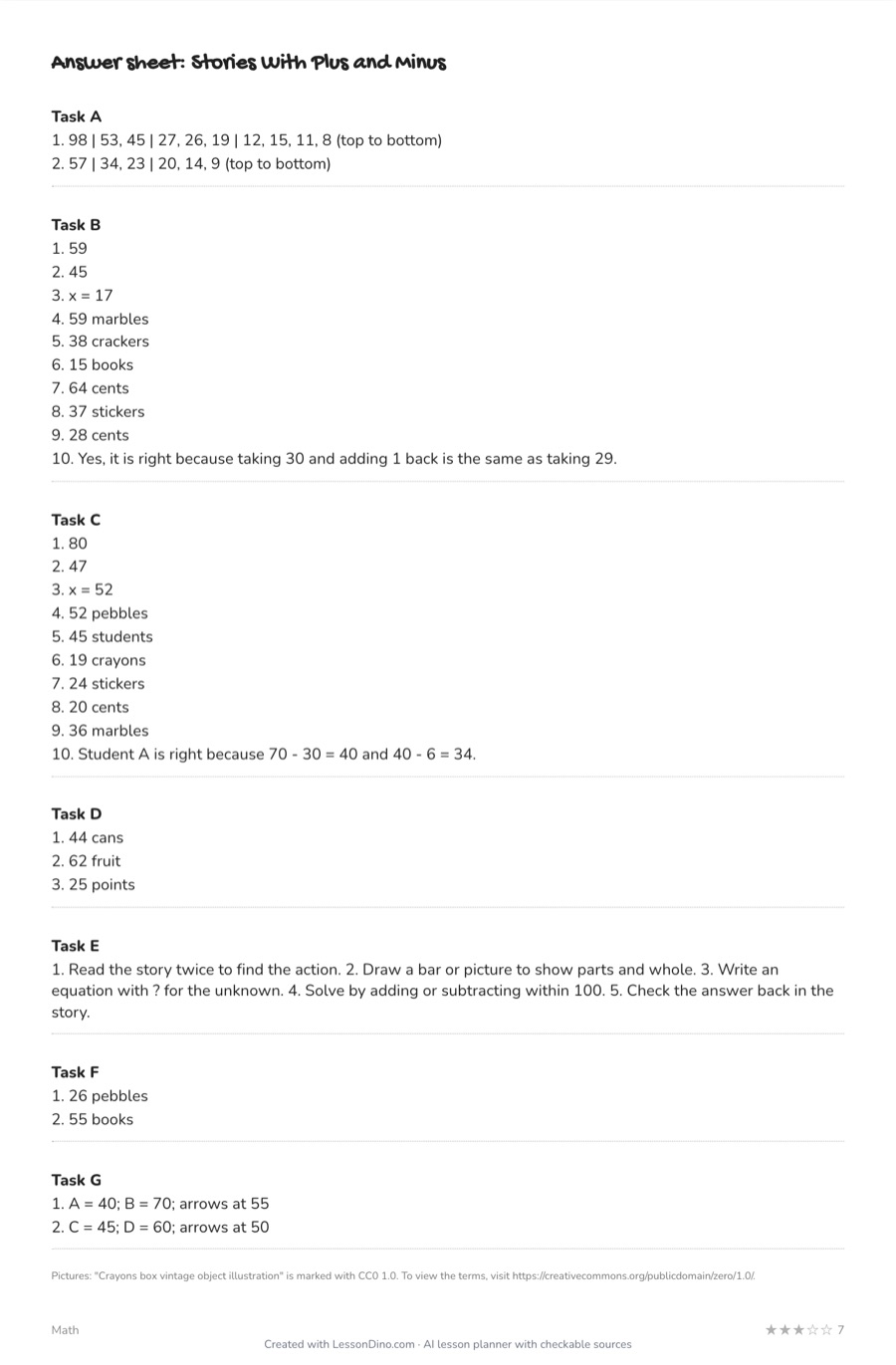
- The answer sheet is the last page, so you can print it on its own or let students check their own work.
Key vocabulary
- equation: a number sentence with plus, minus and equals to show amounts
- unknown: a missing number shown by ? in a story
- whole: all pieces joined together into one total
- part: one piece of a larger total
- compare: looking at two amounts to find the extra gap
Mistakes to watch for
- Adding when story says more, e.g., 52 + 35 for how many more. Line up towers and show gap must be smaller; subtract smaller from larger to find difference.
- Using key words only, e.g., circling gave and adding. Cover numbers, ask Is something being joined or separated, then draw bar before choosing.
- Missing second step in two-step story, stopping at 14 for 32 - 18. Use two-box storyboard for step one and step two and write two equations to show steps.
What's on the worksheet
Solve Story Problems!
Learn how to turn stories into pictures and equations.
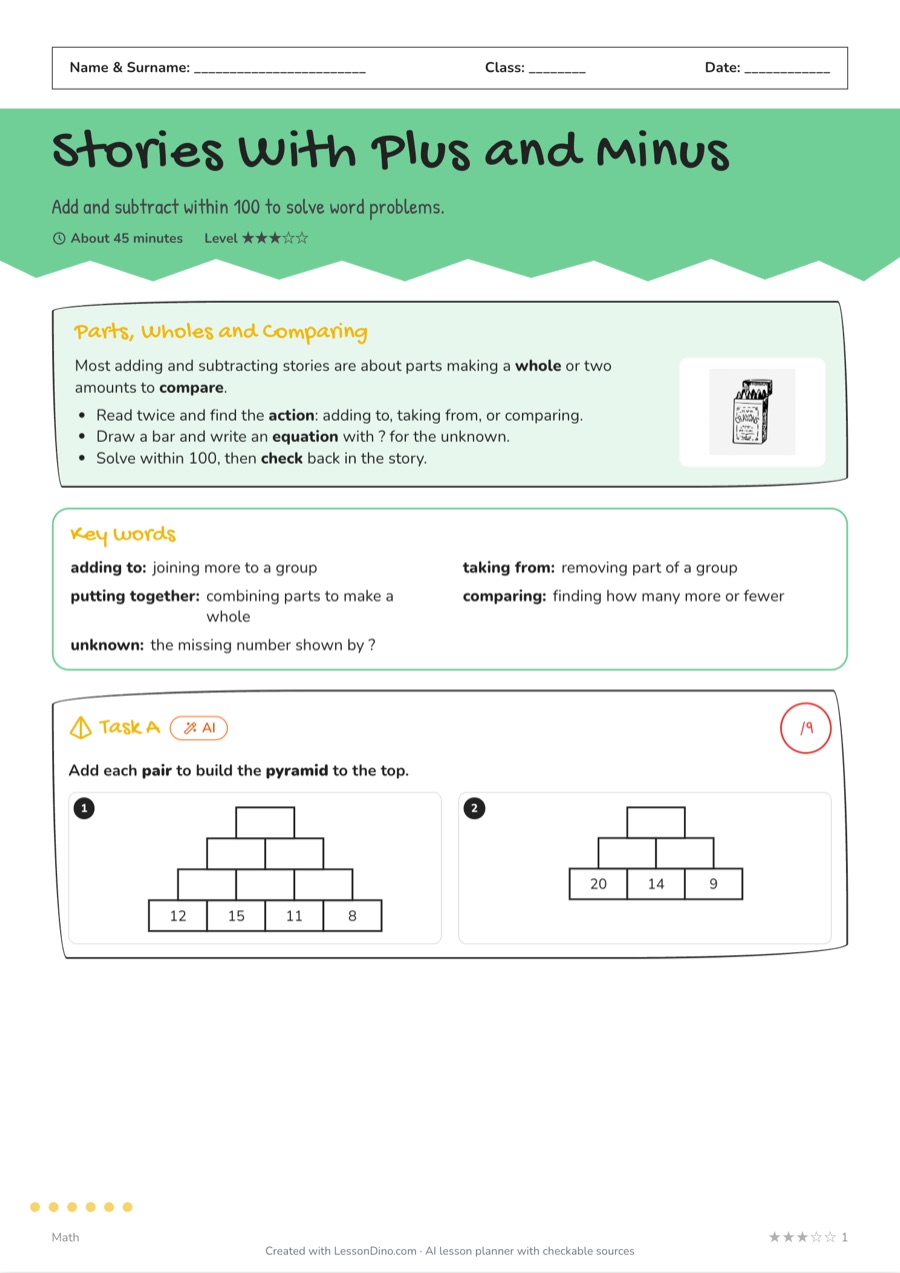
Parts, Wholes and Comparing
- Most adding and subtracting stories are about parts making a whole or two amounts to compare.
- Read twice and find the action: adding to, taking from, or comparing.
- Draw a bar and write an equation with ? for the unknown.
- Solve within 100, then check back in the story.
| Word | Meaning |
|---|---|
| adding to | joining more to a group |
| taking from | removing part of a group |
| putting together | combining parts to make a whole |
| comparing | finding how many more or fewer |
| unknown | the missing number shown by ? |
Add each pair to build the pyramid to the top.
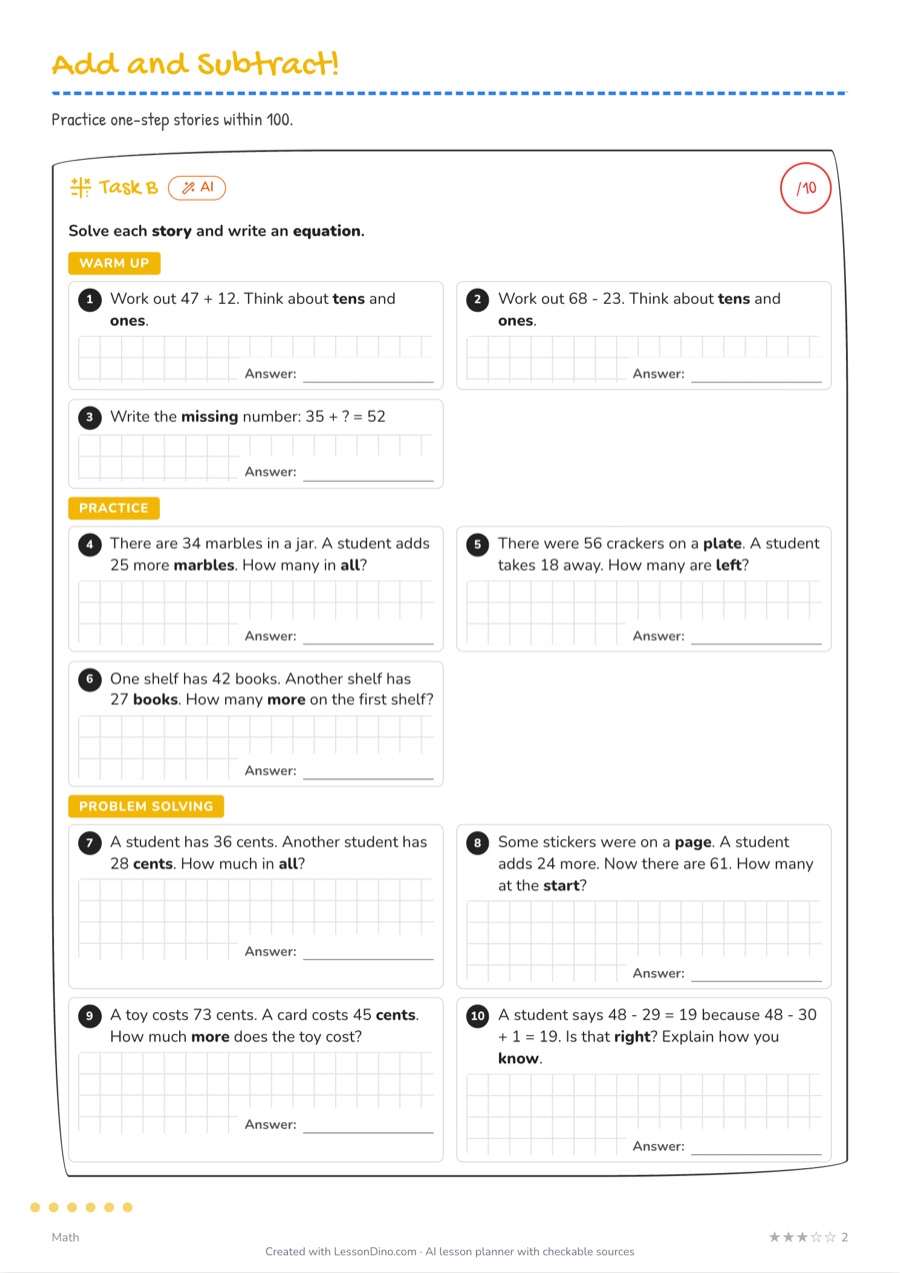
Add and Subtract!
Practice one-step stories within 100.
Solve each story and write an equation.
Warm up
- Work out 47 + 12. Think about tens and ones.
- Work out 68 - 23. Think about tens and ones.
- Write the missing number: 35 + ? = 52
Practice
- There are 34 marbles in a jar. A student adds 25 more marbles. How many in all?
- There were 56 crackers on a plate. A student takes 18 away. How many are left?
- One shelf has 42 books. Another shelf has 27 books. How many more on the first shelf?
Problem solving
- A student has 36 cents. Another student has 28 cents. How much in all?
- Some stickers were on a page. A student adds 24 more. Now there are 61. How many at the start?
- A toy costs 73 cents. A card costs 45 cents. How much more does the toy cost?
- A student says 48 - 29 = 19 because 48 - 30 + 1 = 19. Is that right? Explain how you know.
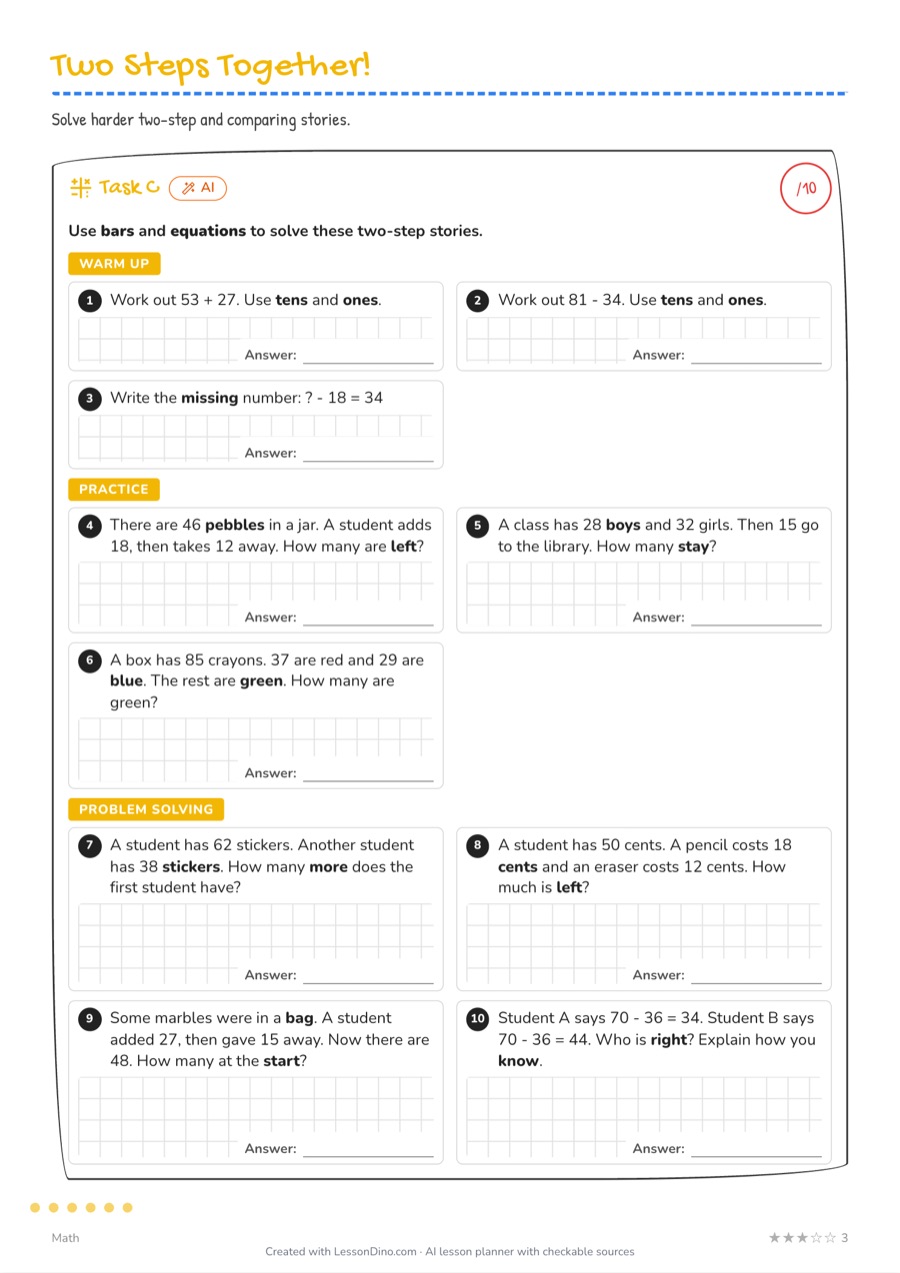
Two Steps Together!
Solve harder two-step and comparing stories.
Use bars and equations to solve these two-step stories.
Warm up
- Work out 53 + 27. Use tens and ones.
- Work out 81 - 34. Use tens and ones.
- Write the missing number: ? - 18 = 34
Practice
- There are 46 pebbles in a jar. A student adds 18, then takes 12 away. How many are left?
- A class has 28 boys and 32 girls. Then 15 go to the library. How many stay?
- A box has 85 crayons. 37 are red and 29 are blue. The rest are green. How many are green?
Problem solving
- A student has 62 stickers. Another student has 38 stickers. How many more does the first student have?
- A student has 50 cents. A pencil costs 18 cents and an eraser costs 12 cents. How much is left?
- Some marbles were in a bag. A student added 27, then gave 15 away. Now there are 48. How many at the start?
- Student A says 70 - 36 = 34. Student B says 70 - 36 = 44. Who is right? Explain how you know.
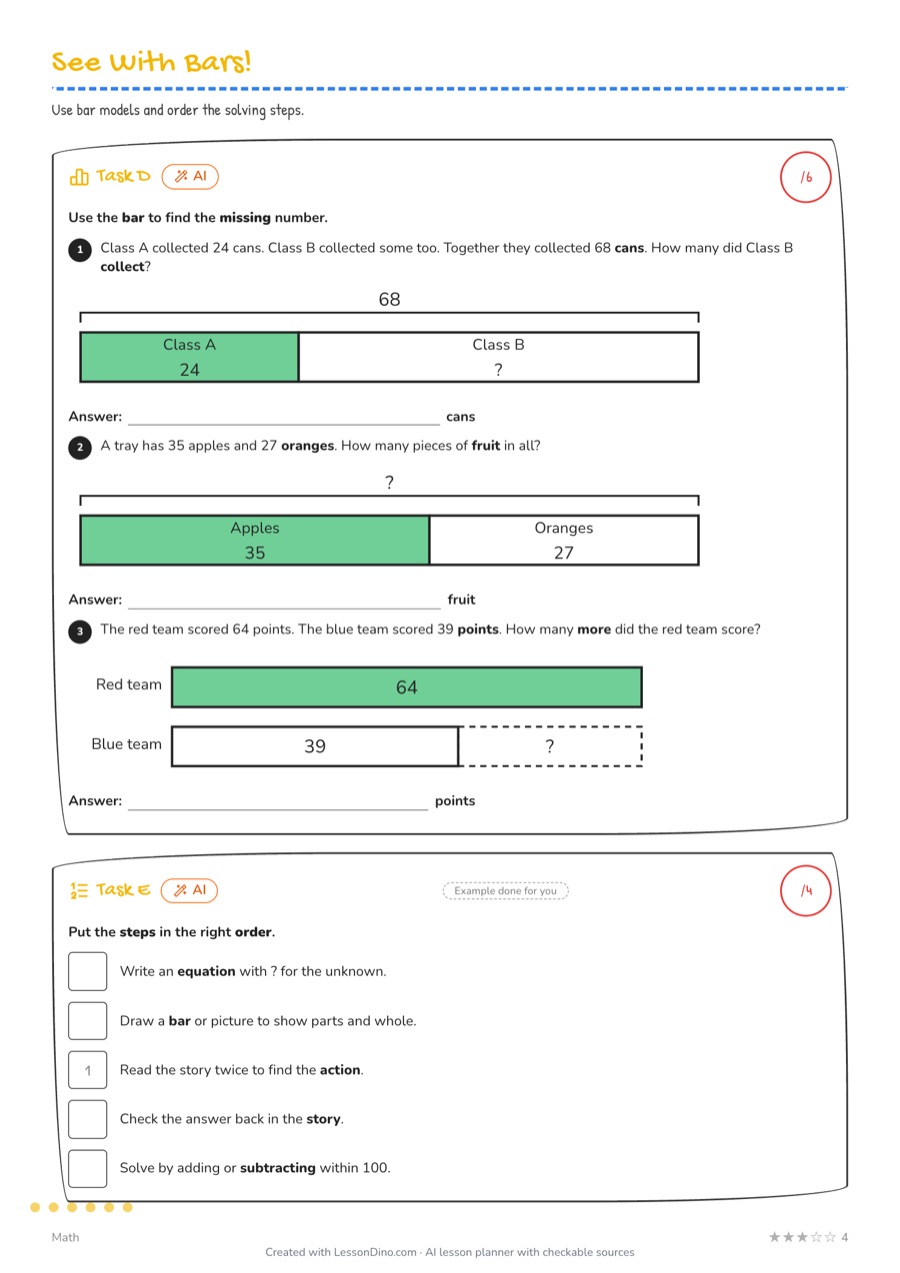
See With Bars!
Use bar models and order the solving steps.
Use the bar to find the missing number.
Put the steps in the right order.
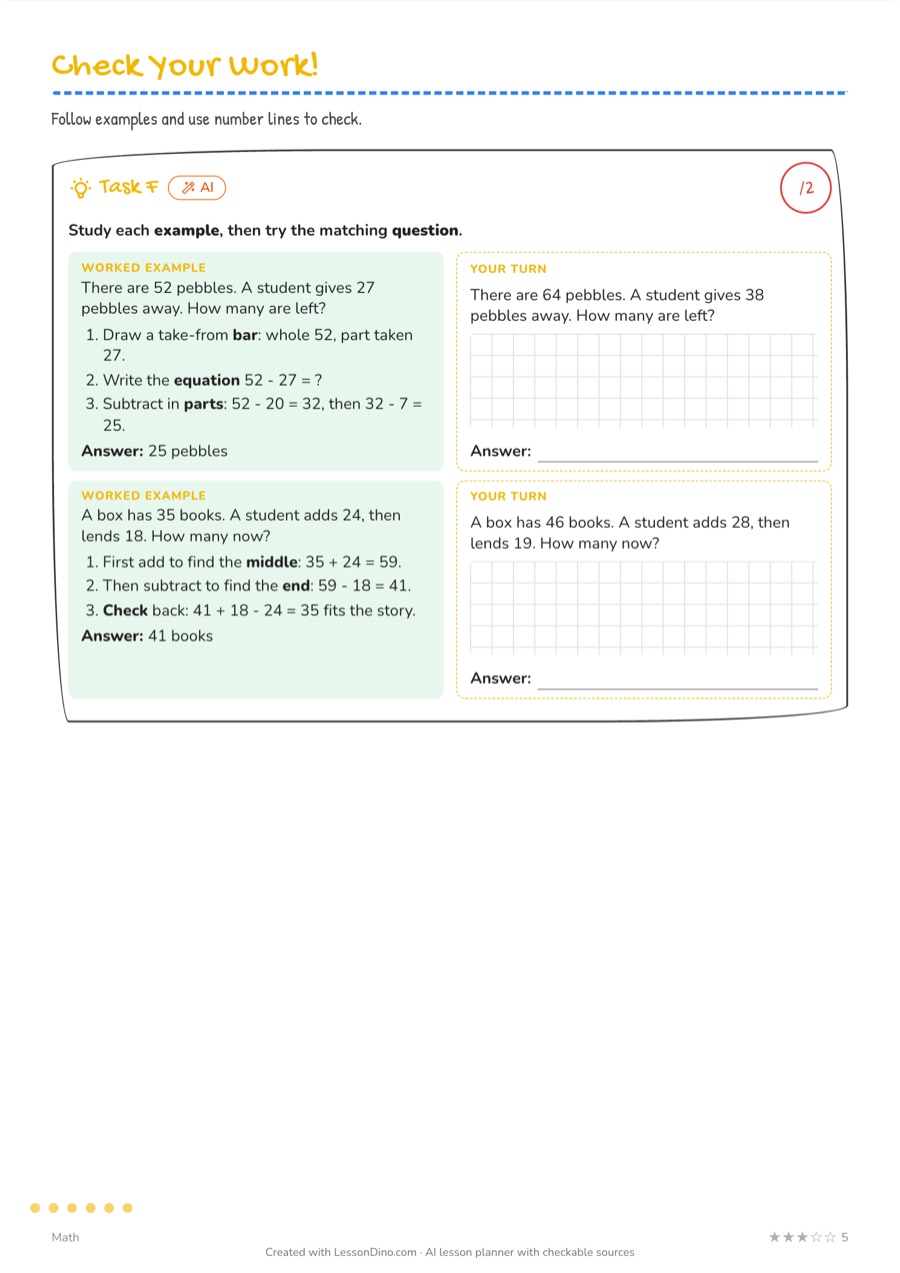
Check Your Work!
Follow examples and use number lines to check.
Study each example, then try the matching question.
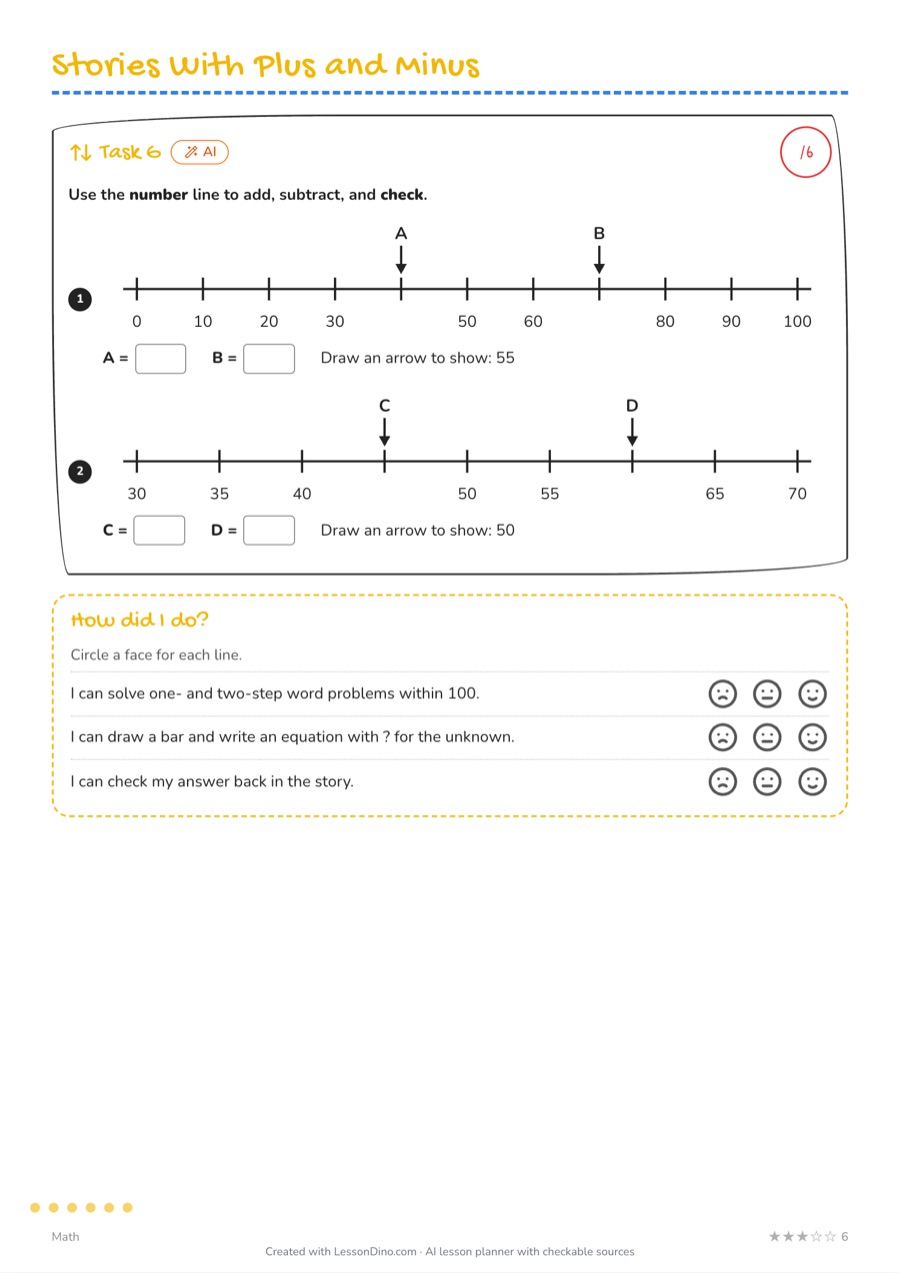
Page 6
Use the number line to add, subtract, and check.
Answers
Show the answers
- Work out 47 + 12. Think about tens and ones. 59
- Work out 68 - 23. Think about tens and ones. 45
- Write the missing number: 35 + ? = 52 x = 17
- There are 34 marbles in a jar. A student adds 25 more marbles. How many in all? 59 marbles
- There were 56 crackers on a plate. A student takes 18 away. How many are left? 38 crackers
- One shelf has 42 books. Another shelf has 27 books. How many more on the first shelf? 15 books
- A student has 36 cents. Another student has 28 cents. How much in all? 64 cents
- Some stickers were on a page. A student adds 24 more. Now there are 61. How many at the start? 37 stickers
- A toy costs 73 cents. A card costs 45 cents. How much more does the toy cost? 28 cents
- A student says 48 - 29 = 19 because 48 - 30 + 1 = 19. Is that right? Explain how you know. Yes, it is right because taking 30 and adding 1 back is the same as taking 29.
- Work out 53 + 27. Use tens and ones. 80
- Work out 81 - 34. Use tens and ones. 47
- Write the missing number: ? - 18 = 34 x = 52
- There are 46 pebbles in a jar. A student adds 18, then takes 12 away. How many are left? 52 pebbles
- A class has 28 boys and 32 girls. Then 15 go to the library. How many stay? 45 students
- A box has 85 crayons. 37 are red and 29 are blue. The rest are green. How many are green? 19 crayons
- A student has 62 stickers. Another student has 38 stickers. How many more does the first student have? 24 stickers
- A student has 50 cents. A pencil costs 18 cents and an eraser costs 12 cents. How much is left? 20 cents
- Some marbles were in a bag. A student added 27, then gave 15 away. Now there are 48. How many at the start? 36 marbles
- Student A says 70 - 36 = 34. Student B says 70 - 36 = 44. Who is right? Explain how you know. Student A is right because 70 - 30 = 40 and 40 - 6 = 34.
The answer sheet is the last picture above.
Curriculum
Use addition and subtraction within 100 to solve one- and two-step word problems involving situations of adding to, taking from, putting together, taking apart, and comparing, with unknowns in all positions, e.g., by using drawings and equations with a symbol for the unknown number to represent the problem.
Made with Lesson Dino's AI on 16 October 2026. AI can make mistakes, so check the answers and facts against the sources before you teach.