Slides
Lesson plan
Story Problem Detectives Within 100
Students learn to picture stories and write equations with ? for any missing number. They solve one-step and two-step addition and subtraction stories within 100.
Objectives
- Students will solve one-step stories within 100 with unknowns in any spot.
- Students will draw bars and write equations with ? to show each story.
- Students will solve two-step stories within 100 using two equations.
Success criteria
- I can picture parts and total and choose adding or subtracting.
- I can write an equation with ? and solve it.
- I can solve a two-step story in two steps and check it.
Key words
| Word | Meaning |
|---|---|
| equation | a number sentence with plus, minus and equals to show amounts |
| unknown | a missing number shown by ? in a story |
| whole | all pieces joined together into one total |
| part | one piece of a larger total |
| compare | looking at two amounts to find the extra gap |
Timed plan (60 minutes)
| Time | Stage | What happens |
|---|---|---|
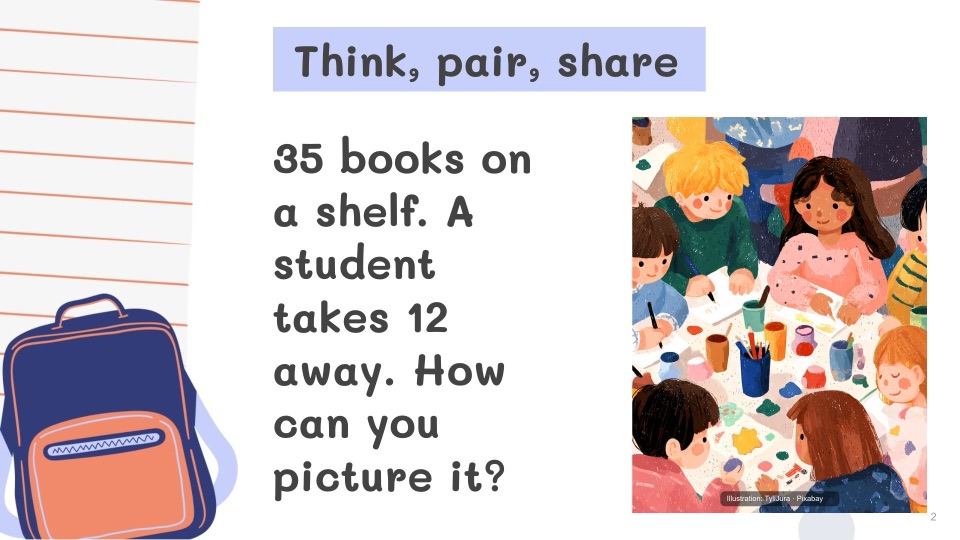
| 5 min | Starter | To hook students and recall picturing take-away stories. Welcome class as Story Problem Detectives and say the hook: The starting number ran away and left a question mark. Can you detectives find it? Show Slides 1-2 and read the question: 35 books on a shelf. A student takes 12 away. How can you picture it? Lead turn-and-talk: ask partners how to draw it fast with tens sticks and ones dots. Collect 2 ideas and link to today's goal: find a missing number anywhere in the story. |
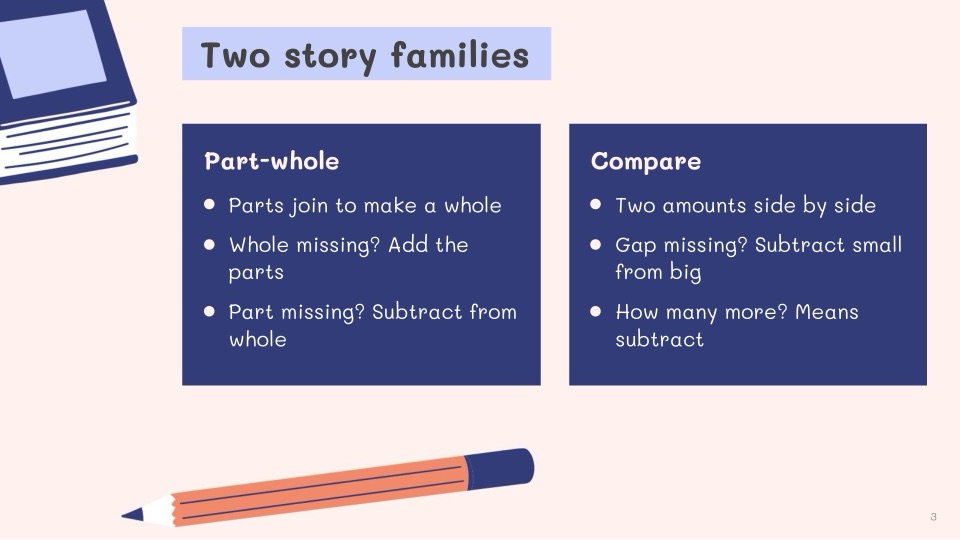
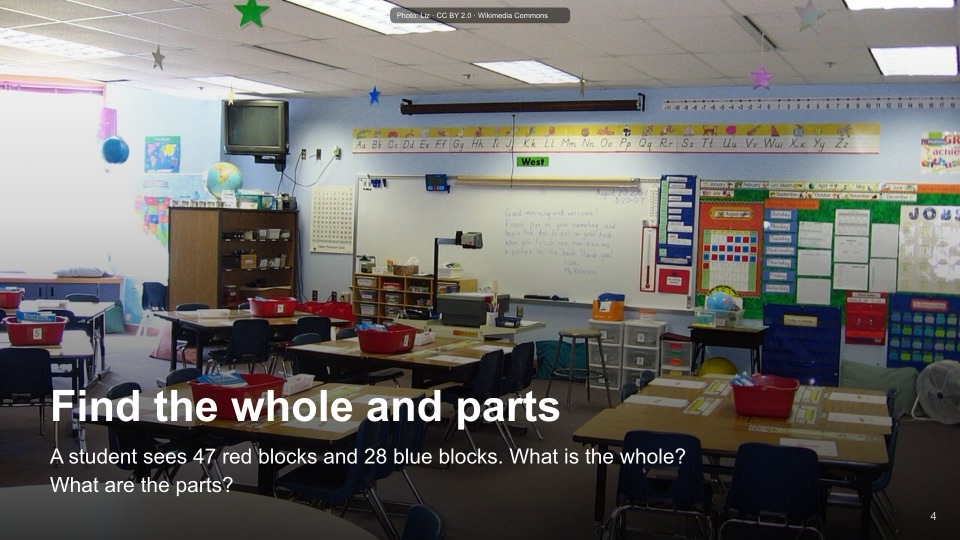
| 12 min | Teaching - Model | To model bar pictures and ? equations for part-whole and compare stories. Show Slides 3-5 and explain two story families: parts join to make a total, and two amounts side by side where you find the gap. Model Card 1 with bars: lay 47 strip and 28 strip under a whole strip. Both pieces are known and the total is missing, so add. Model compare with 52-cube and 35-cube towers side by side. Show the gap is found by subtracting the smaller from the larger. Write both equations with ? and check by putting the answer back into the story. |
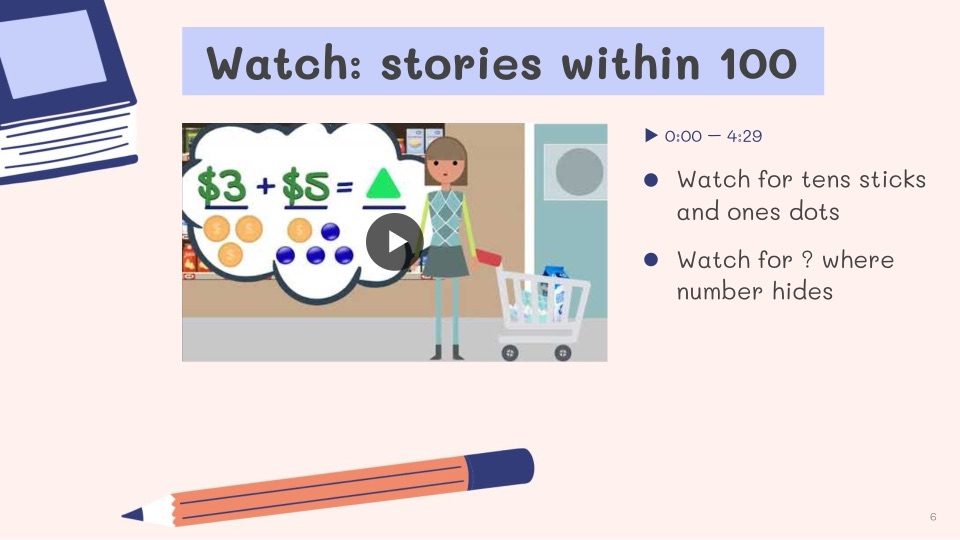
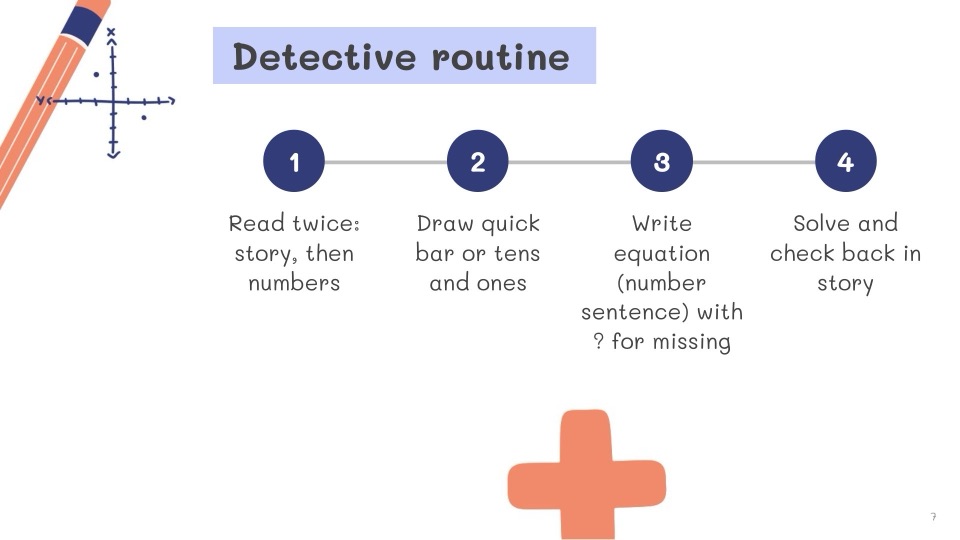
| 13 min | Guided Practice | To practise the detective routine and start-unknown stories together. Play Video clip 1 and tell students to watch for tens sticks and ones dots and for ? where the number hides. Show Slide 7 routine: read twice, draw quick bar or tens and ones, write equation with ?, solve and check back in story. Model start-unknown together: The supply box had some pencils. A helper put in 5 more pencils. Now there are 13 pencils. How many pencils were in the box to start? Write ? + 5 = 13, solve by counting on from 5 to 13 or by 13 - 5 = 8, and check 8 + 5 = 13. |
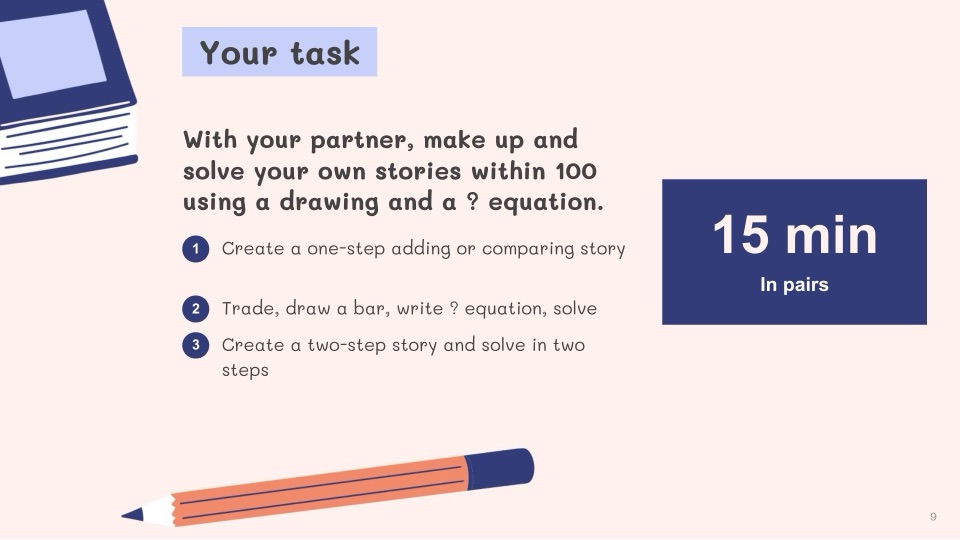
| 20 min | Main Activity | To solve join and separate stories with the unknown in any position. Hand out story cards, boards, and ? box. Explain teams draw, model with cubes, write ? equation, solve within 100, then sort into Start Unknown, Change Unknown, Result Unknown piles. Read cards aloud: Card 1: The art shelf has 47 blue crayons and 28 red crayons. How many crayons are there in all? Card 2: There were 61 students signed up for art class. 59 students showed up. How many students missed the class? Card 3: The supply box had some pencils. A helper put in 5 more pencils. Now there are 13 pencils. How many pencils were in the box to start? Card 4: One tower has 52 cubes. The other tower has 35 cubes. How many more cubes does the taller tower have? Circulate, prompt bar drawing and equation with symbol for unknown, and ask teams to show, solve and explain in two steps for two-step cards. Add two-step Card 5 for finishers: There are 32 small toy prizes on a table. Students win 18 prizes. Then a helper adds 10 more prizes. How many prizes are on the table now? |
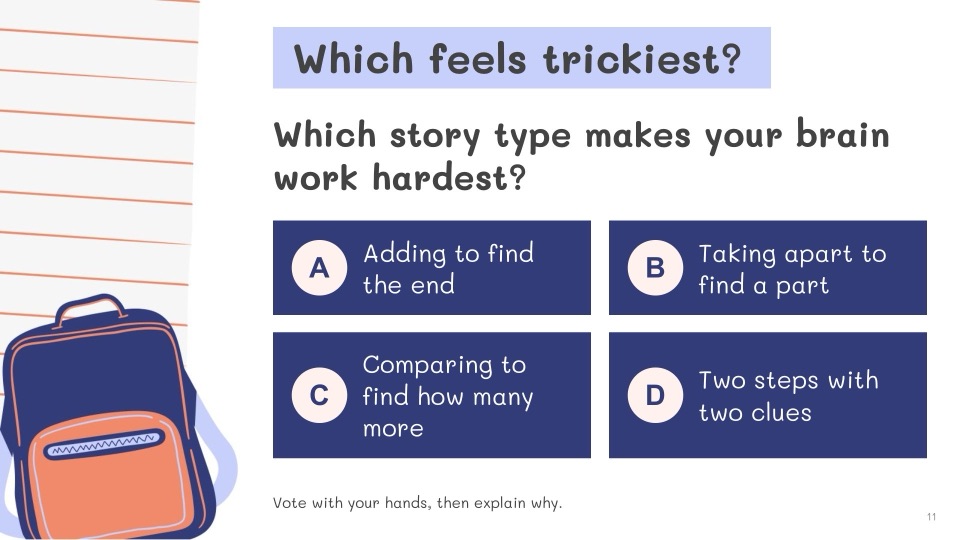
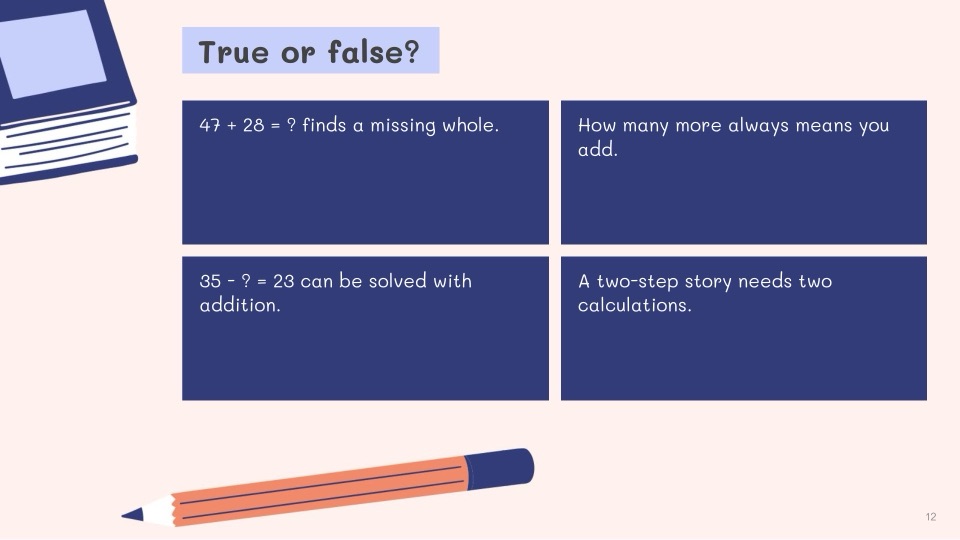
| 10 min | Plenary | To review whole-part thinking and check one-step and two-step solving. Show Slide 10 big idea: picture total and pieces, and let ? show where to solve. Run Slide 12 true-false: 47 + 28 = ? finds missing total; How many more always means you add; 35 - ? = 23 needs subtraction. Take Slide 11 vote on trickiest type and have partners defend with bar: whole or piece? Give 3-question exit ticket on boards. |
Common mistakes
- Adding when story says more, e.g., 52 + 35 for how many more
How to spot it: Answer larger than both towers and no gap shown
Line up towers and show gap must be smaller; subtract smaller from larger to find difference. - Using key words only, e.g., circling gave and adding
How to spot it: Wrong operation though drawing does not match story
Cover numbers, ask Is something being joined or separated, then draw bar before choosing. - Missing second step in two-step story, stopping at 14 for 32 - 18
How to spot it: Only one equation with ? and answer does not fit end of story
Use two-box storyboard for step one and step two and write two equations to show steps.
Support
- Start with totals under 20 using counters on a part-part-whole mat and ten-frame
- Pre-drawn bars and two-box storyboard for step one and step two
Stretch
- Add two-step cards where students must write two equations with ? to reach the final answer
- Turn same numbers into missing-piece or compare question and to subtraction check
Check questions
- There are 34 stickers and a helper gives 26 more. Write equation and solve.
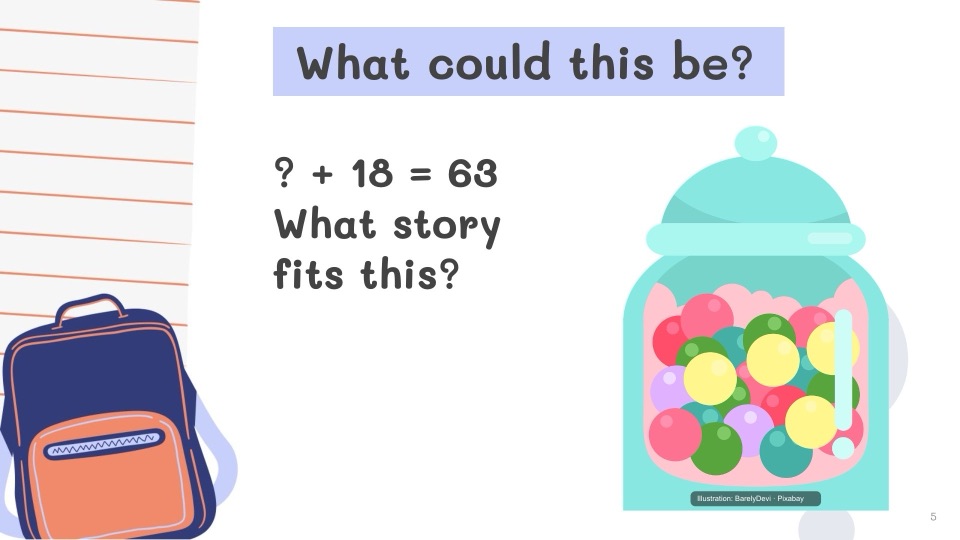
Answer: 34 + 26 = ?; ? = 60 stickers - A box had some crayons. 18 were added. Now 63. How many to start?
Answer: ? + 18 = 63; ? = 45 crayons (63 - 18 = 45) - 32 prizes, 18 won, then 10 added. How many now? Show two steps.
Answer: 32 - 18 = 14; 14 + 10 = 24 prizes
Curriculum
Use addition and subtraction within 100 to solve one- and two-step word problems involving situations of adding to, taking from, putting together, taking apart, and comparing, with unknowns in all positions, e.g., by using drawings and equations with a symbol for the unknown number to represent the problem.
Video clips
Clips on YouTube, from the start and end times we chose. Check each one before you show it.
-
2nd grade word problems from 0:00 to 4:29
Education Galaxy: 2nd Grade - Math - Addition and Subtraction: Word Problems - Topic Video
Made specifically for 2nd grade and directly models addition and subtraction word problems within 100.
-
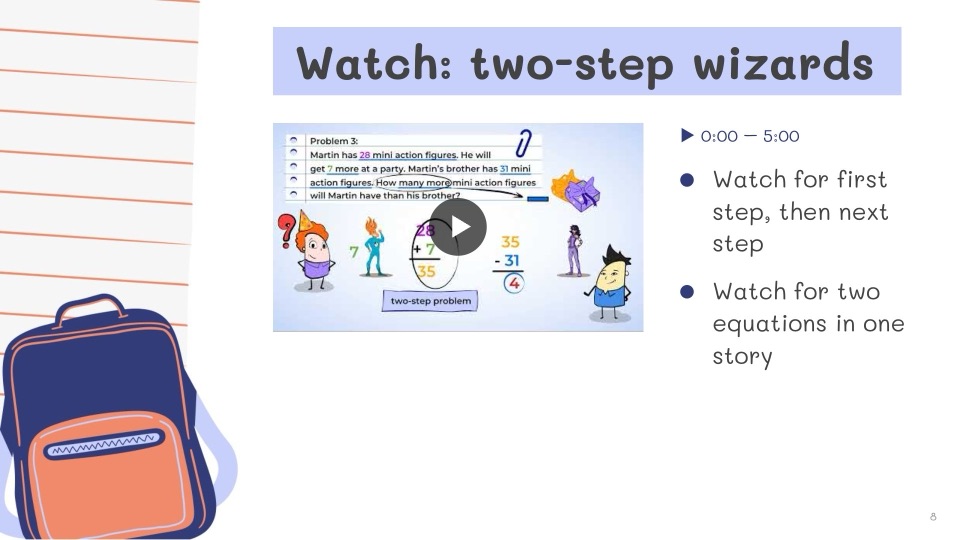
Two-step wizards from 0:00 to 5:00
MightyOwl: Word problem wizards, double trouble - two-step math problems | MightyOwl Math | 2nd Grade
Made for 2nd grade and perfect for 7-8-year-olds to learn two-step addition and subtraction problems.
Worksheet
Sources
- Grade 2 Math Curriculum - Fairfax County Public Schools fcps.edu
- 2025-2026 2nd Grade Math Curriculum boepublic.parkhill.k12.mo.us
- Sample Grade 2 Math Lesson CCSS.MATH.CONTENT.2.OA.A.1 Use addition and ... portal.ct.gov
- Addition & Subtraction within 20 - Ohio State University mcp-coaching.osu.edu
- Teaching Addition and Subtraction Word Problems to Children teachers.yale.edu
- Word Problem Taxonomy: Addition and Subtraction ttac.odu.edu
- The Relationship between Addition and Subtraction in Problem Solving teachersinstitute.yale.edu
- Word Problems Mixing Addition and Subtraction: Which Operation and Why schoolofmath.us
- Money Math: Word Problems with Addition and Subtraction ducksters.com
- Addition and Subtraction Word Problems | Math | EducaWeb educaweb.org
- Addition and Subtraction Word Problems Worksheets - Math Worksheets 4 Kids mathworksheets4kids.com
- Addition & Subtraction Word Problems (solutions, examples, videos) onlinemathlearning.com
- Math Game: Addition & Subtraction Word Problems - I Know It iknowit.com
- How to Teach Addition and Subtraction Word Problems to Kindergarten primarylearning.org
- Addition and Subtraction Word Problems Worksheets brighterly.com
- How to Teach Word Problems: Addition and Subtraction whatihavelearnedteaching.com
- Addition and Subtraction Word Problems - Solvent Learning solventlearning.com
- 1st Grade Addition and Subtraction Word Problems math-salamanders.com
- Addition and subtraction - Year 6 - P7 - Maths Collection - Home ... - BBC bbc.co.uk
- Kids Math: Solving Algebra Equations with Addition and Subtraction ducksters.com
- Addition Facts for Kids kids.kiddle.co
- Mixed+Addition+&+Subtraction+Word+Problems+(A) static1.squarespace.com
Picture credits
Made with Lesson Dino's AI on 16 October 2026. AI can make mistakes, so check facts against the sources before you teach.