Slides
Lesson plan
Comma Power After Sentence Starters
Pupils learn to spot a fronted adverbial and put a comma after it. They match starters to main clauses and arrest the missing comma.
Objectives
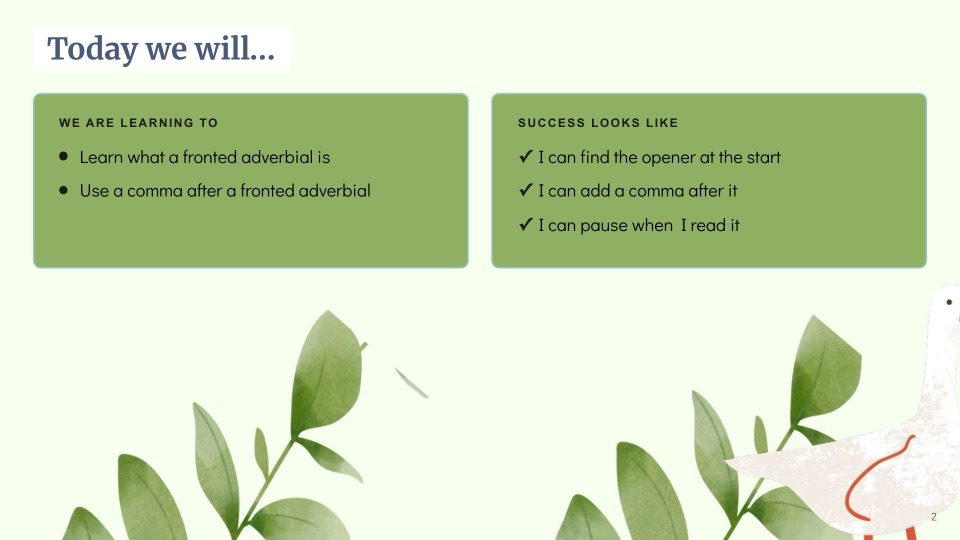
- Students will spot fronted adverbials that tell when, where or how.
- Students will put a comma straight after a fronted adverbial.
- Students will read sentences aloud pausing where the comma sits.
Success criteria
- I can find the starter words at the beginning of a sentence.
- I can add a comma straight after the starter words.
- I can pause when I read the comma aloud.
Key words
| Word | Meaning |
|---|---|
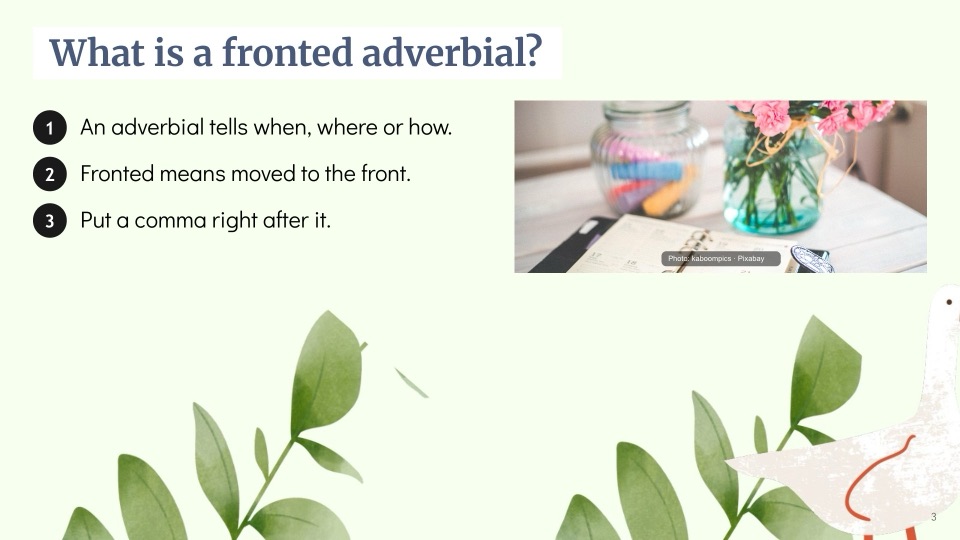
| fronted adverbial | words at the start of a sentence that give more news about the action |
| comma | little curl mark that tells the reader to take a short stop |
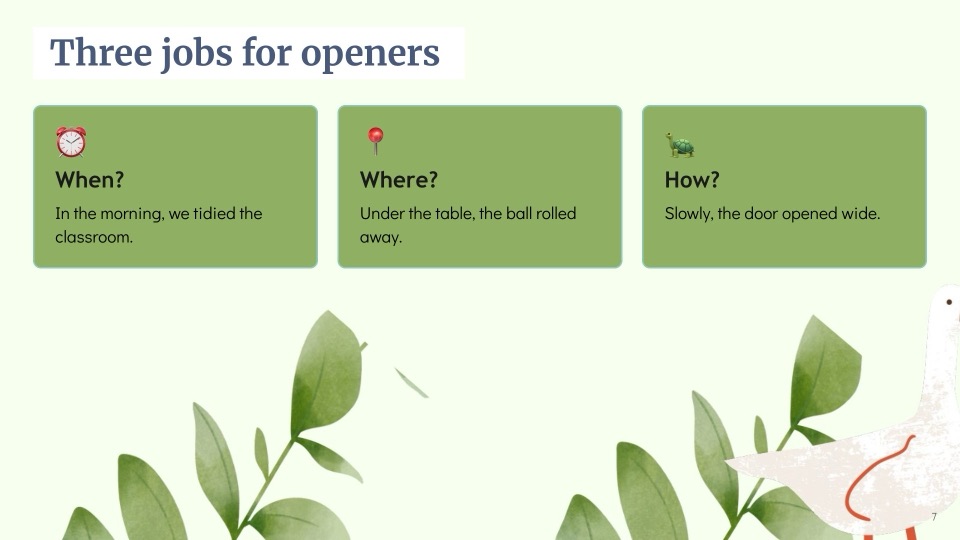
| when | tells about the time something happens |
| where | tells about the place something happens |
| how | tells about the way something happens |
Timed plan (60 minutes)
| Time | Stage | What happens |
|---|---|---|
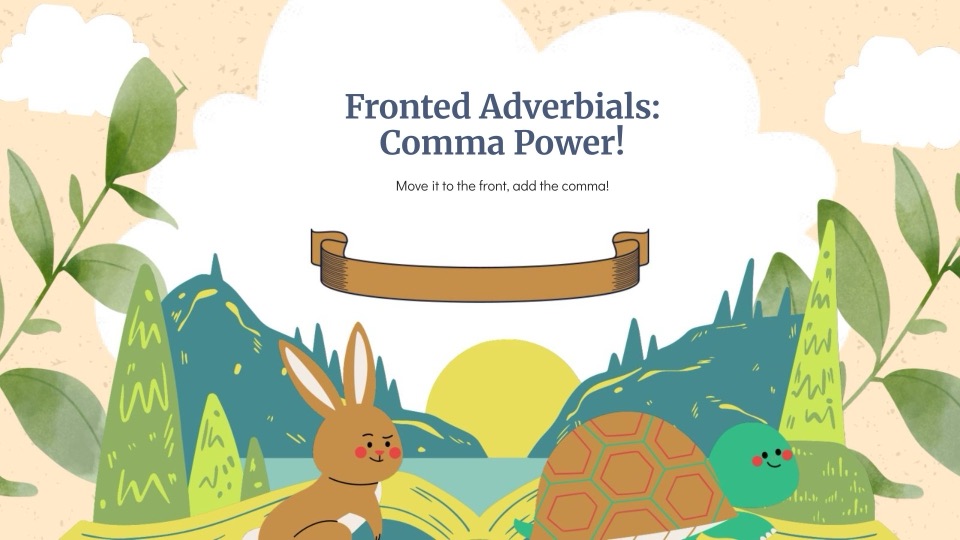
| 5 min | Starter | Hook pupils with the missing comma and share the lesson goals. Show Slide 1 Fronted Adverbials: Comma Power! and say the hook in a police voice. Show Slide 2 Today we will objectives and read the three I can lines together. Show Slide 5 mystery comma example and point to the tiny tail at the start. Ask what starters pupils already use and take two quick ideas. |
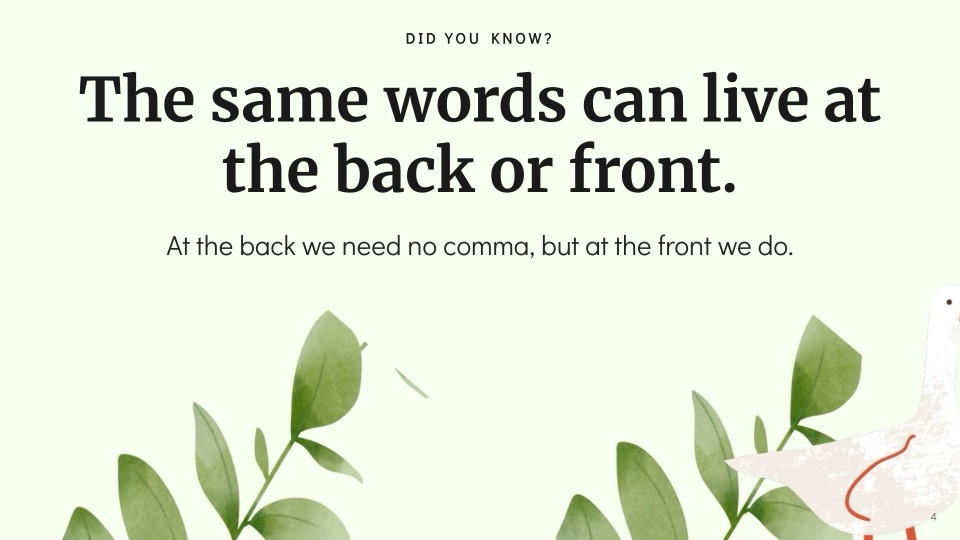
| 10 min | Teaching | Explain what a fronted adverbial is and why it needs a comma. Show Slide 3 and explain an adverbial tells when, where or how, fronted means moved to the front. Show Slide 4 and move the same words from back to front to show the comma rule. Model underlining the starter and drawing the comma right after it in red. Read both versions aloud with a clear pause at the comma. |
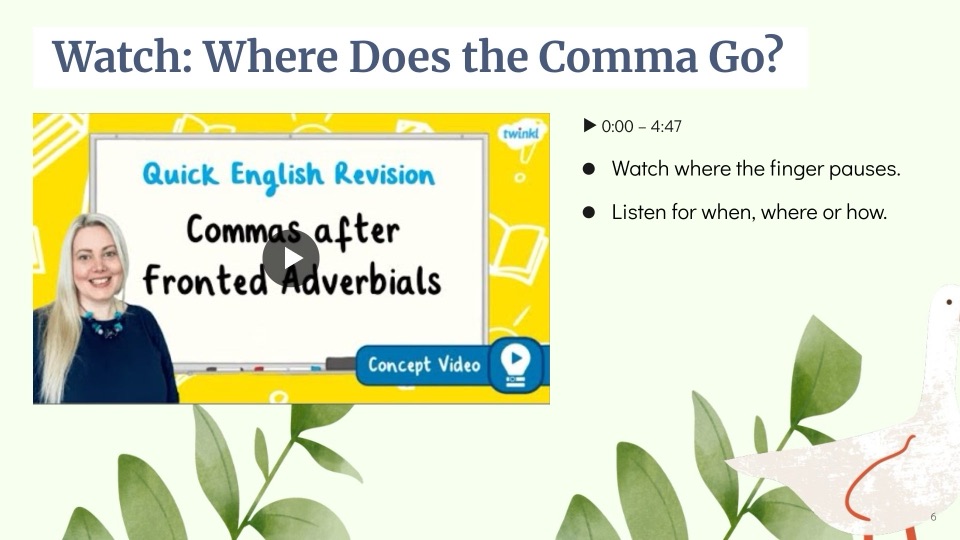
| 10 min | Guided practice | Practise hearing starters and seeing the comma pause together. Play Slide 6 Video clip 1 0:00-4:47 and ask pupils to listen for when, where or how. Pause when the finger pauses and ask pupils to shout comma. Show Slide 7 Three jobs for openers and read the three sentences together. Sort the three starters into When, Where and How with class votes. |
| 25 min | Main activity | Build sentences by matching starters to main clauses and placing the comma. Give each group starter cards, main clause cards and red comma cards with glue sticks. Model one match: lay starter, lay red comma right after it, then lay main clause. Send groups to make three arrests: match, stick comma, underline starter. Stop class halfway to hear one sentence read with pause and point to comma. |
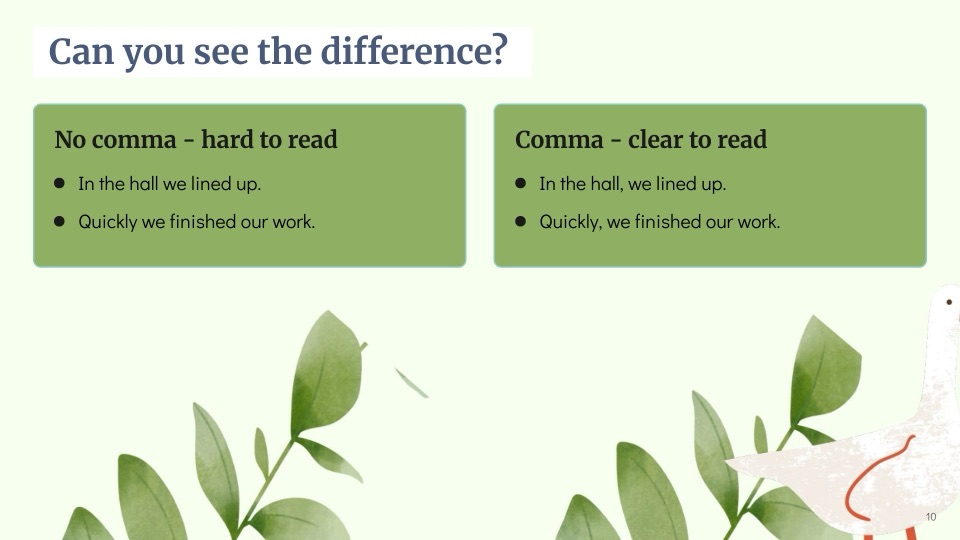
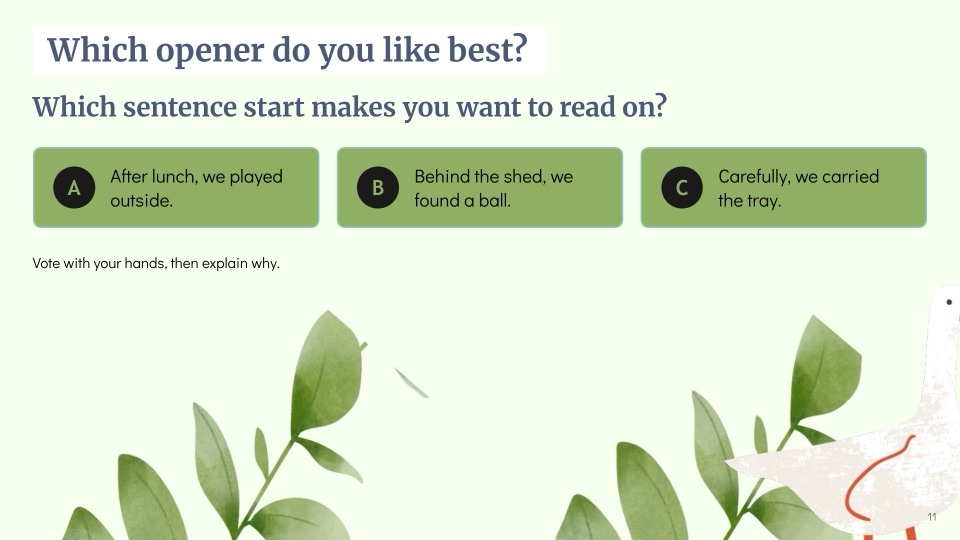
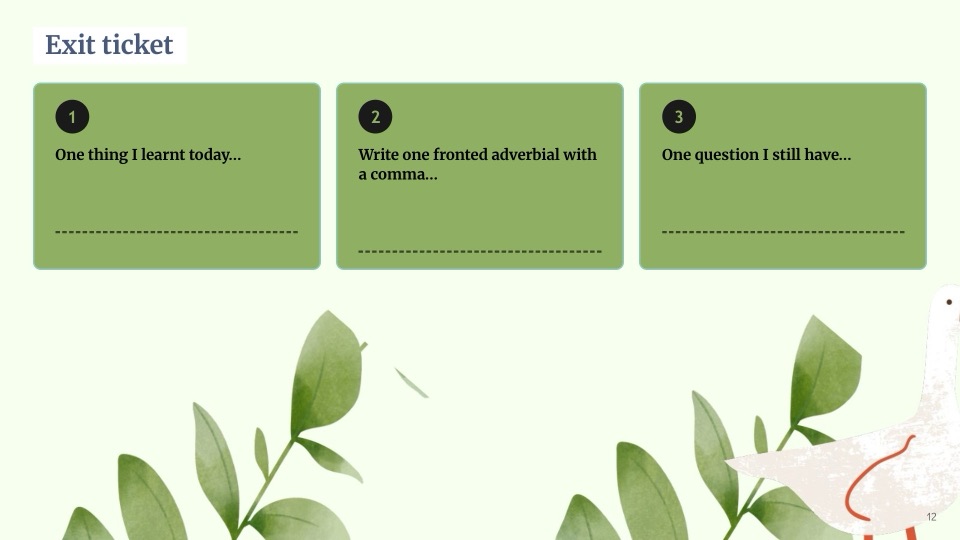
| 10 min | Plenary | Compare with and without commas and check learning against goals. Show Slide 10 and read In the hall we lined up with no pause, then In the hall, we lined up with pause. Show Slide 11 vote and let pupils choose best opener and say why. Hand out Worksheet Task F and do True or false together for comma rule. Show Slide 12 exit ticket and set the one-sentence write. |
Common mistakes
- Leaving out the comma after the starter
How to spot it: Sentence runs together with no pause, like After lunch we played outside
Underline the starter and add the comma immediately after it, then reread with a pause - Putting the comma in the wrong gap
How to spot it: Comma lands inside the starter or in the main clause
Cover the starter with a finger, put the comma at its end, check it sits right after the whole starter - Thinking no comma is needed because the back version has none
How to spot it: Pupil says In the morning needs no comma because we need none at the back
Show both orders: at the back we need no comma, but at the front we do, so add it after fronting
Support
- Give three ready-made pairs with the fronted adverbial already underlined so pupils only choose the comma place.
- Use short starters and printed comma cards in red plus sentence frames to copy.
Stretch
- Pupils swap the main clause to make a sillier sentence but keep the same starter and comma.
- Pupils add one manner starter and one place starter without repeating the same starter twice.
Check questions
- Where do you put the comma with a fronted adverbial?
Answer: Immediately after it, before the main clause. - Tick the fronted adverbial: Carefully, we carried the tray.
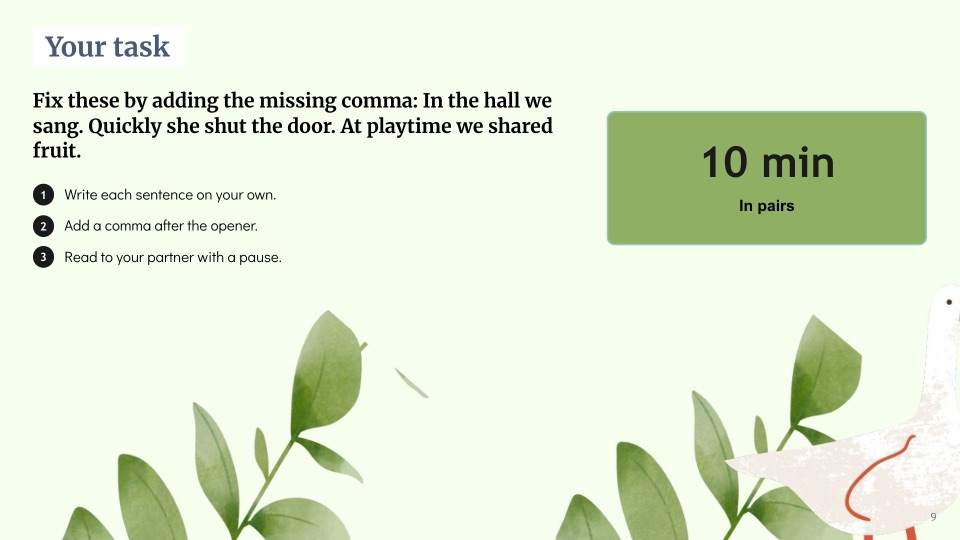
Answer: Carefully - Fix it: Behind the shed we found a ball.
Answer: Behind the shed, we found a ball.
Curriculum
indicate grammatical and other features by: using commas after fronted adverbials
Video clips
Clips on YouTube, from the start and end times we chose. Check each one before you show it.
-
commas after fronted adverbials from 0:00 to 4:47
Twinkl Educational Publishing: How Do You Use Commas after a Fronted Adverbial? | KS2 English Concept for Kids
Exactly matches using commas after fronted adverbials with clear KS2 vocabulary and pace perfect for ages 7-8.
-
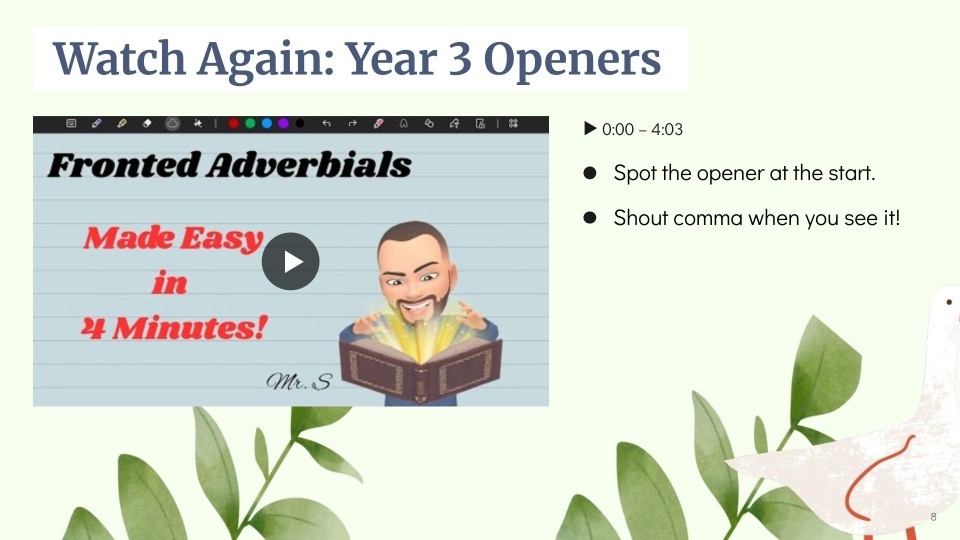
Year 3 fronted adverbials in 4 minutes from 0:00 to 4:03
Learn With Mr S: How To Use Fronted Adverbials in 4 Minutes! (Year 3, 4 and 5 English)
Made for Year 3, 4 and 5 so vocabulary and pace are perfect for 7-8-year-olds learning fronted adverbials.
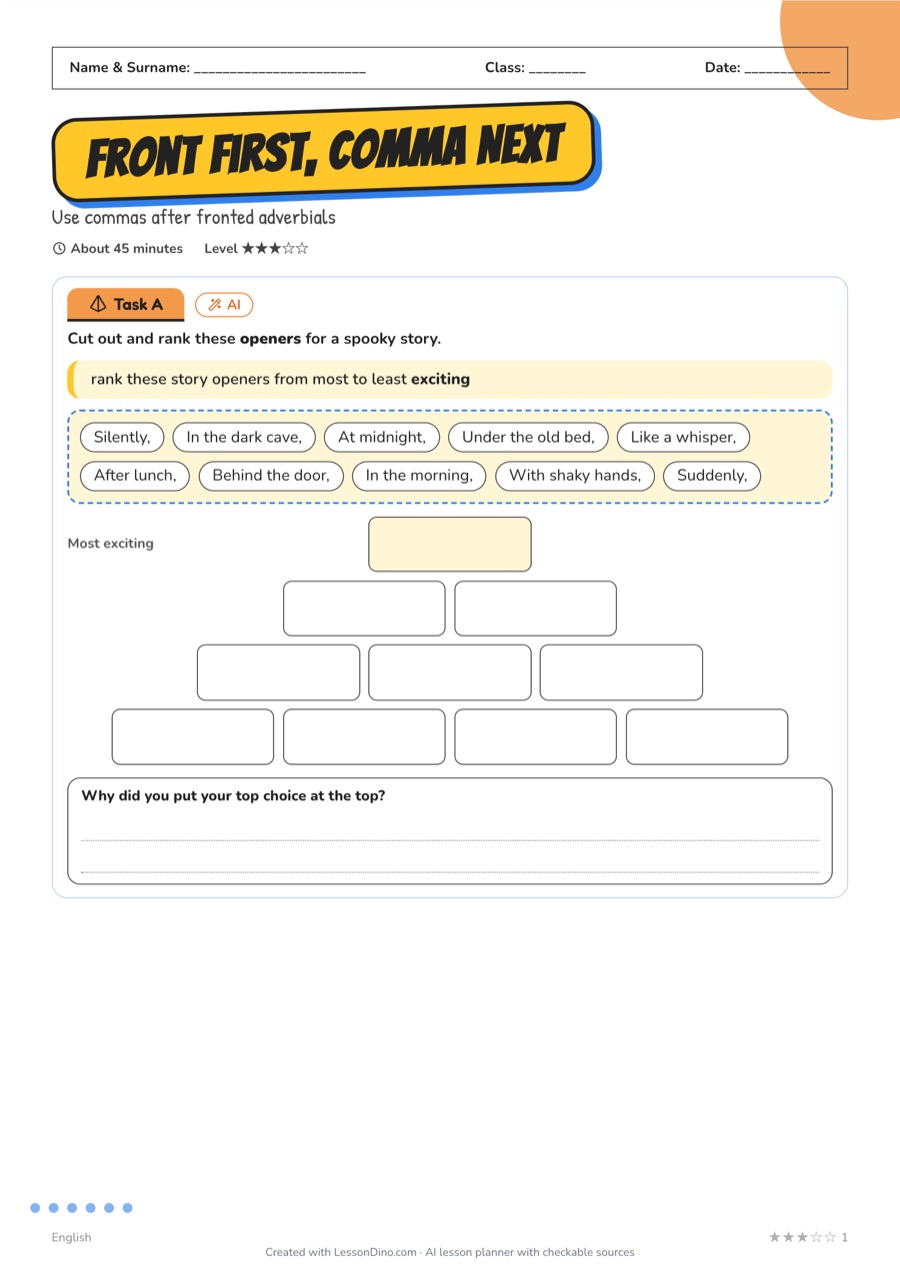
Worksheet
Sources
- english curriculum year 3 fieldjm.herts.sch.uk
- English Key Stage 3 National Curriculum audit jmhs.hereford.sch.uk
- MEDIUM - Fronted Adverbials Test godinton.kent.sch.uk
- Adverbial Phrases for Sentence Starters trinity.shropshire.sch.uk
- What is a fronted adverbial? - KS2 English - BBC Bitesize bbc.co.uk
- What is a fronted adverbial? - BBC Bitesize bbc.co.uk
- What are Fronted Adverbials? Your Grammar Guide achievelearning.co.uk
- What is a Fronted Adverbial? KS2 Guide. - Resourcefully resourcefully.co.uk
- Fronted adverbials: single words, phrases and clauses thenational.academy
- Fronted adverbials: A complete guide to improving sentence ... englishlearningtips.com
- What is a Fronted Adverbial? A Fun Guide for Kids! learningcorner.co
- What are fronted adverbials? - Learning Street learningstreet.co.uk
- How To Teach Children to Use Fronted Adverbials theteachingcouple.com
- Fronted Adverbials: 41 Example Sentences naturalenglishcentral.com
- What is a fronted adverbial? Exam Ninja Explains! examninja.co.uk
- Fronted adverbials – Best KS2 worksheets and lesson ideas ... teachwire.net
- Teaching Kids About the Fronted Adverbial - Pedagogue pedagogue.app
- Writing News from Author Anita Belli anitabelli.com
- Fronted Adverbials (Year 4) | CGP+ Primary Online - CGP Plus cgpplus.co.uk
Picture credits
Made with Lesson Dino's AI on 17 October 2026. AI can make mistakes, so check facts against the sources before you teach.