Slides
Lesson plan
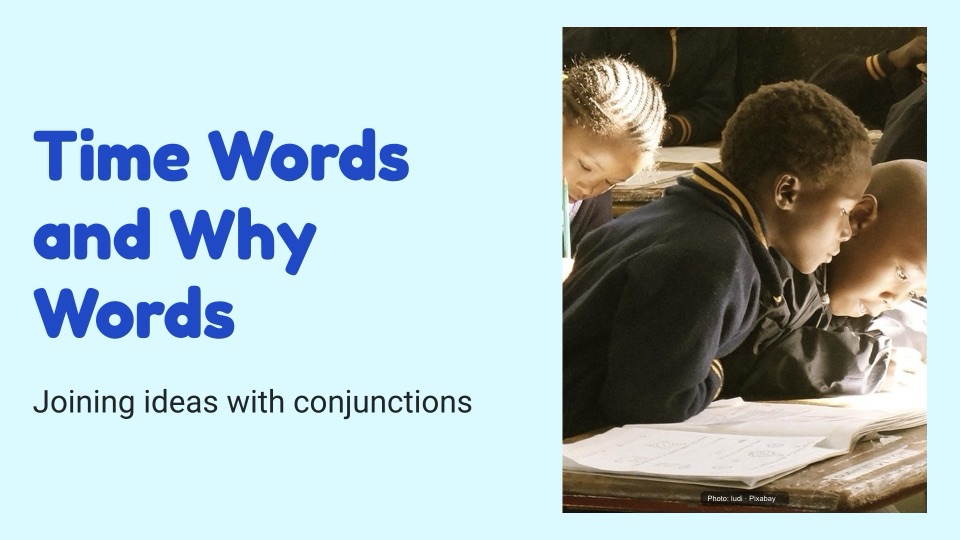
Time Words and Why Words
Pupils learn to show time and cause with joining words. They build longer sentences with strips, cards and writing.
Objectives
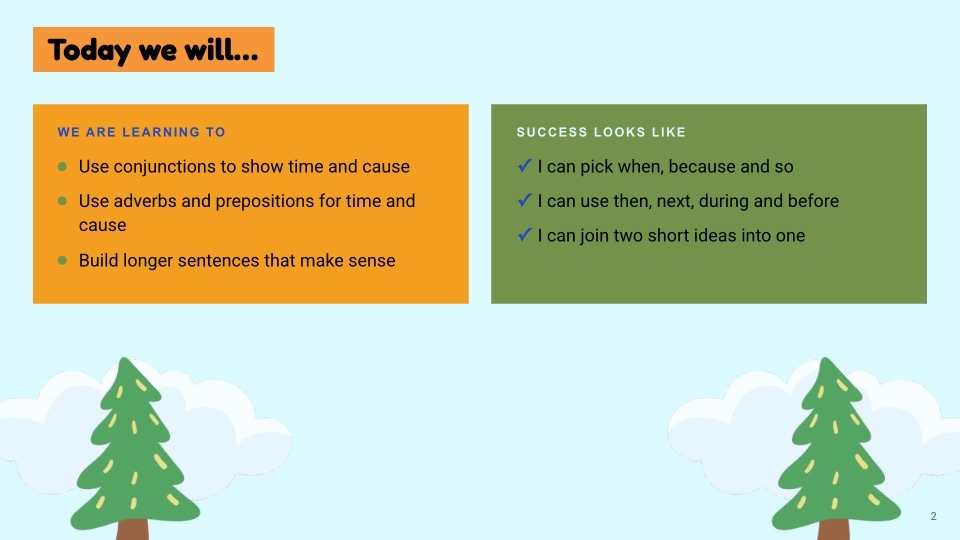
- Students will use time conjunctions when, before, after and while to join clauses.
- Students will use because, so and therefore to explain cause and result clearly.
- Students will use adverbs and prepositions such as then, during and in for time.
Success criteria
- I can join two ideas with when, before, after or while.
- I can explain why with because, so or therefore.
- I can show time with then, during, in, before or after.
Key words
| Word | Meaning |
|---|---|
| conjunction | a joining word that links two words or ideas together |
| adverb | a word that tells when or why, like then and therefore, and can make relations between words clear |
| preposition | a word that sits before a thing to show time or place, like during and in, and can describe relations of time |
| when | a joining word that tells at what moment something happens |
| because | a joining word that tells the reason why something happens |
Timed plan (60 minutes)
| Time | Stage | What happens |
|---|---|---|
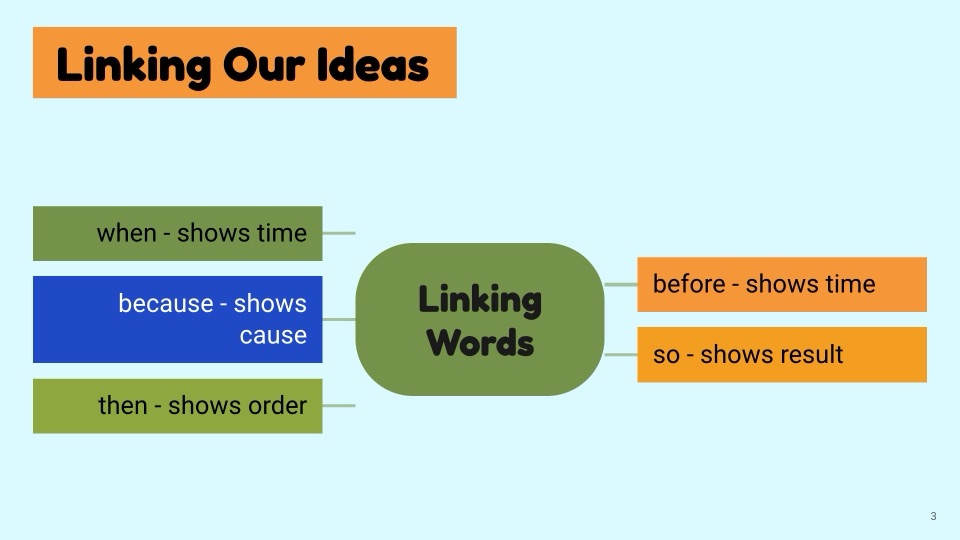
| 8 min | Starter | To hook pupils and recall joining words for time and cause. Welcome the class and use the hook: I got my morning all muddled — I cleaned my teeth after I woke up, or was it before? Help me fix it! Show Slide 1 and Slide 2 and read the aims in pupil words. Show Slide 3 mindmap and point to when, before, because, so and then. Take quick hands-up ideas for which words show time and which show cause. |
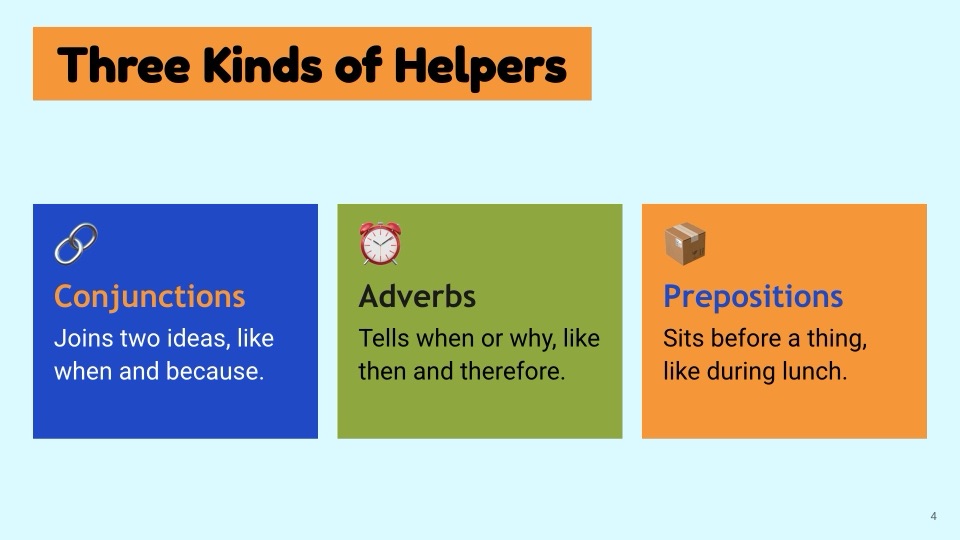
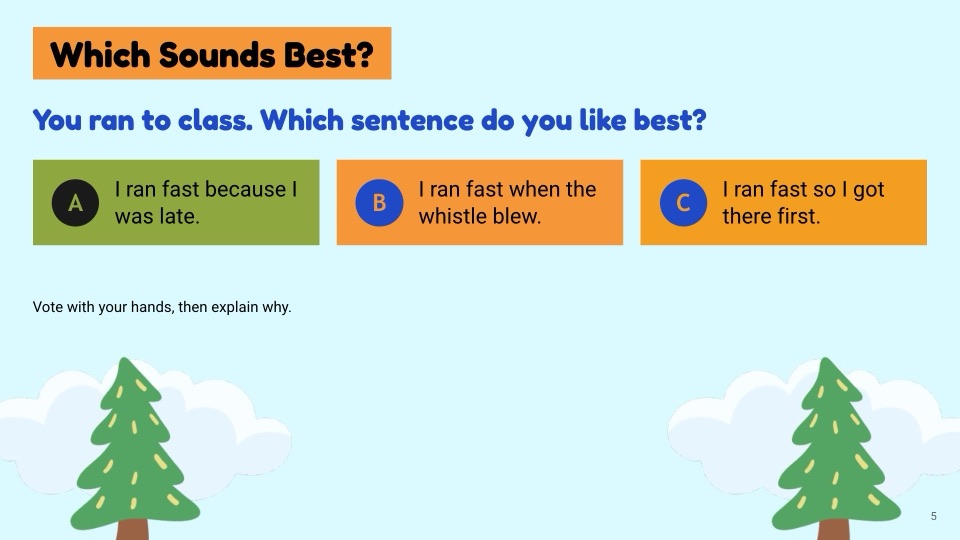
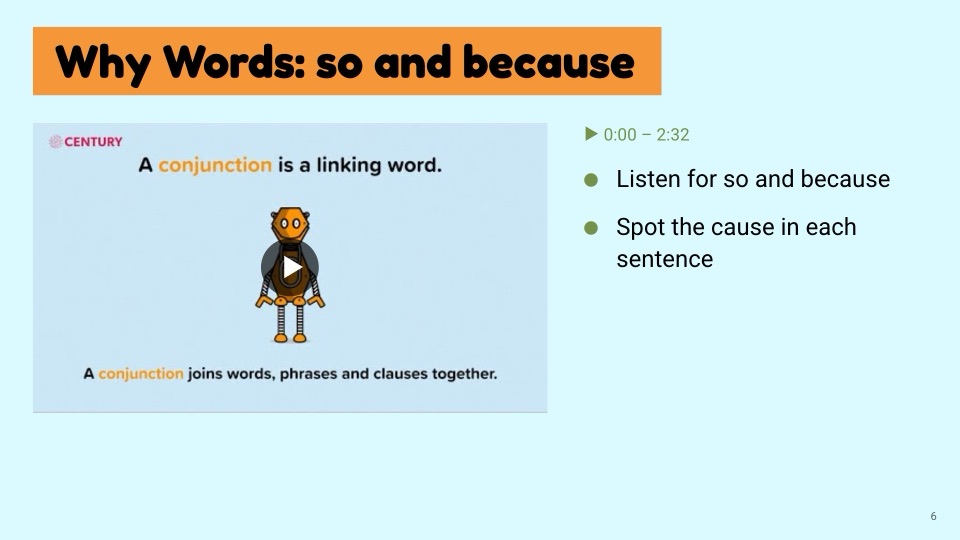
| 12 min | Teaching | To model how conjunctions, adverbs and prepositions show time and cause. Show Slide 4 and explain the three helpers with actions for joining, telling when, and sitting before a thing. Show Slide 5 vote: read I ran fast because I was late, I ran fast when the whistle blew, I ran fast so I got there first. Play Slide 6 Video clip 1 (0:00–2:32) and ask pupils to listen for so and because. Model joining on the board and label time or cause. |
| 15 min | Main activity | To use when, before, after and while to show time in longer sentences. Give each pair sentence strips, time word cards with when, before, after, while, and glue sticks. Model matching: pick I cleaned my teeth and I woke up, test before and after, pick the sensible time link. Send pairs to make and glue three joined sentences and underline each time word. Stop halfway, read two good pairs aloud and fix one muddled order together. |
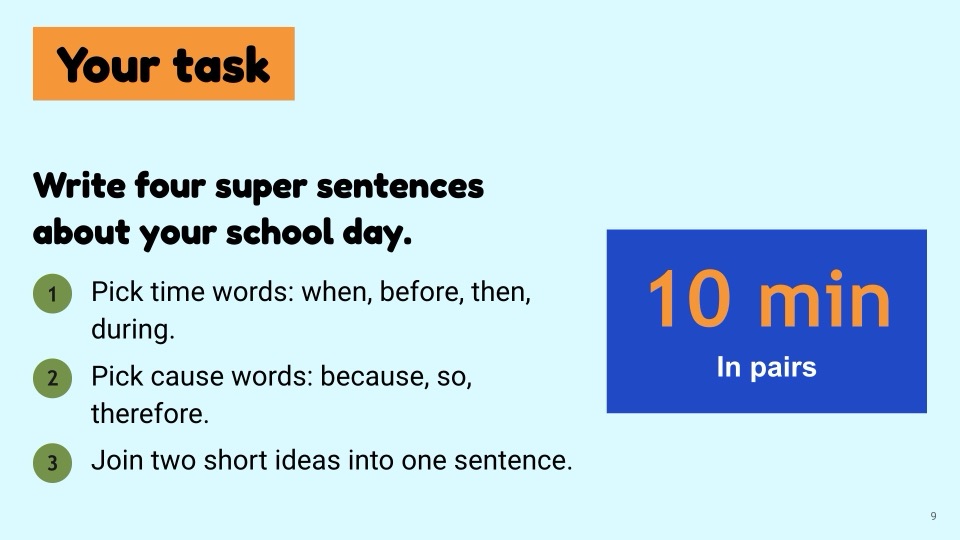
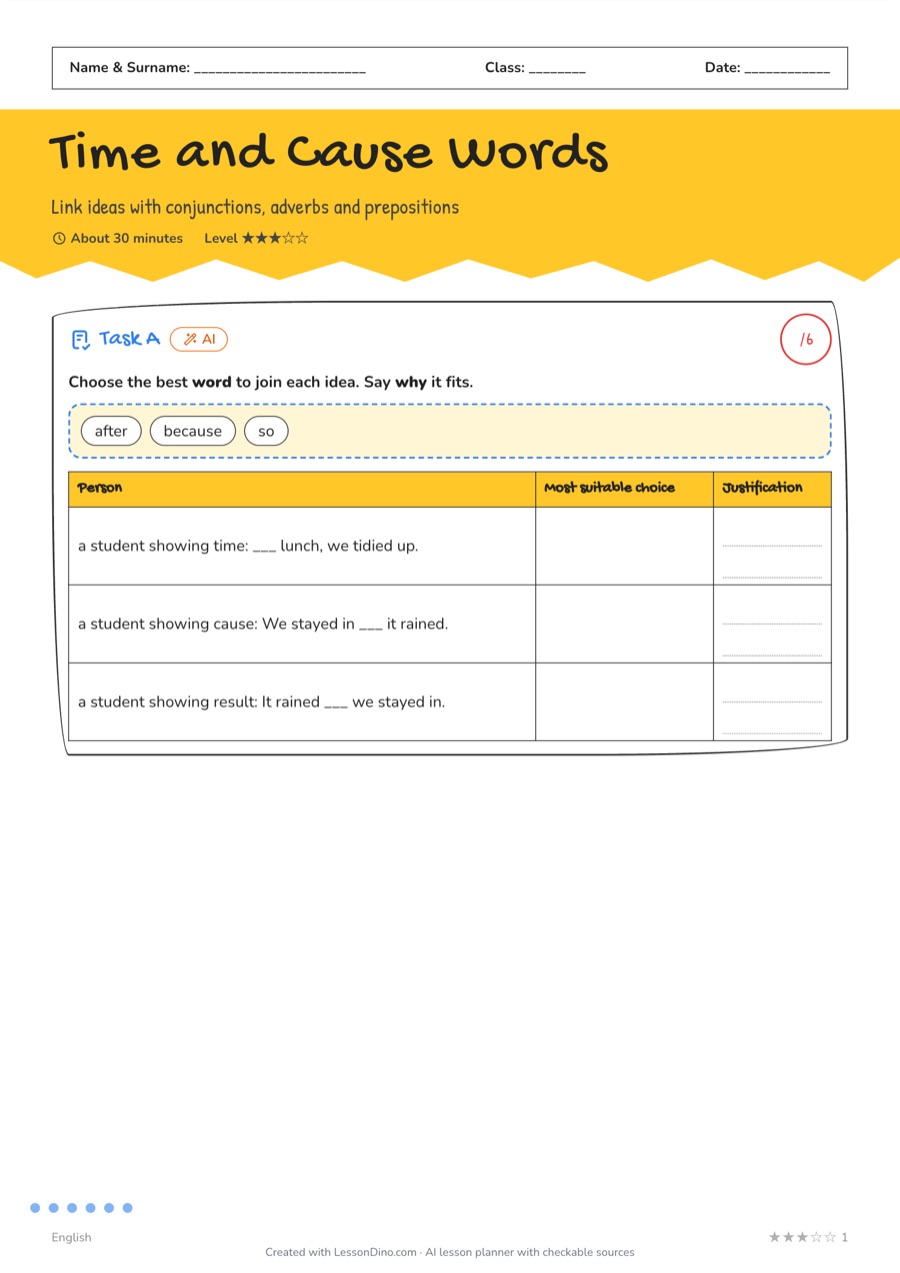
| 15 min | Practice | To choose time and cause words and justify the choice in writing. Show Slide 9 word lists: time words when, before, then, during and cause words because, so, therefore. Model one Worksheet Task A item: read both ideas, try two words, pick and say why it fits. Give out Task A for pupils to complete on their own with pencils. Stop for two pupils to read a joined sentence and explain time or cause. |
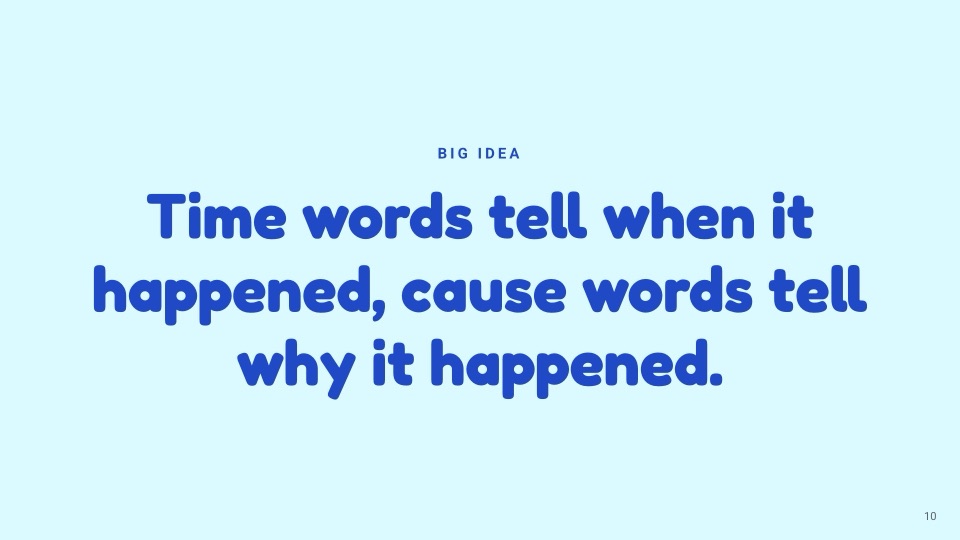
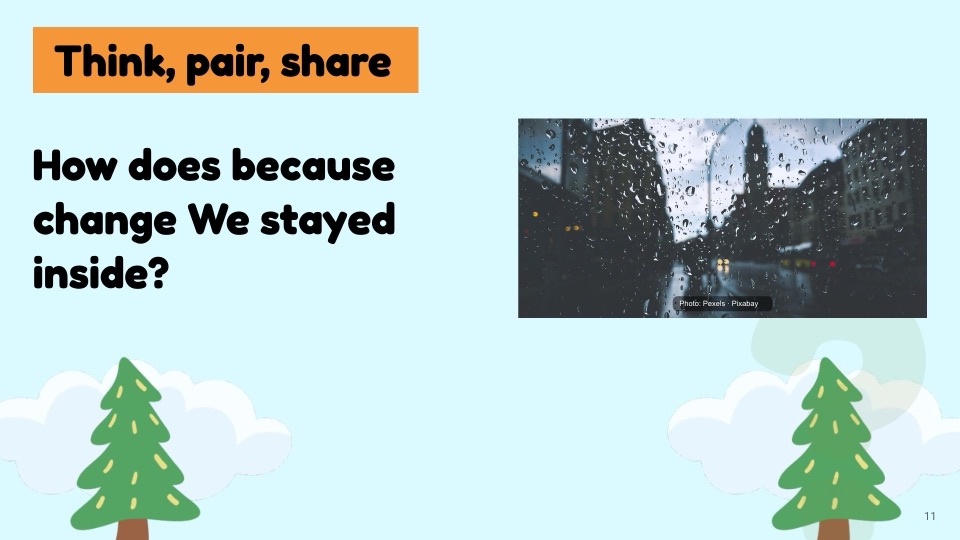
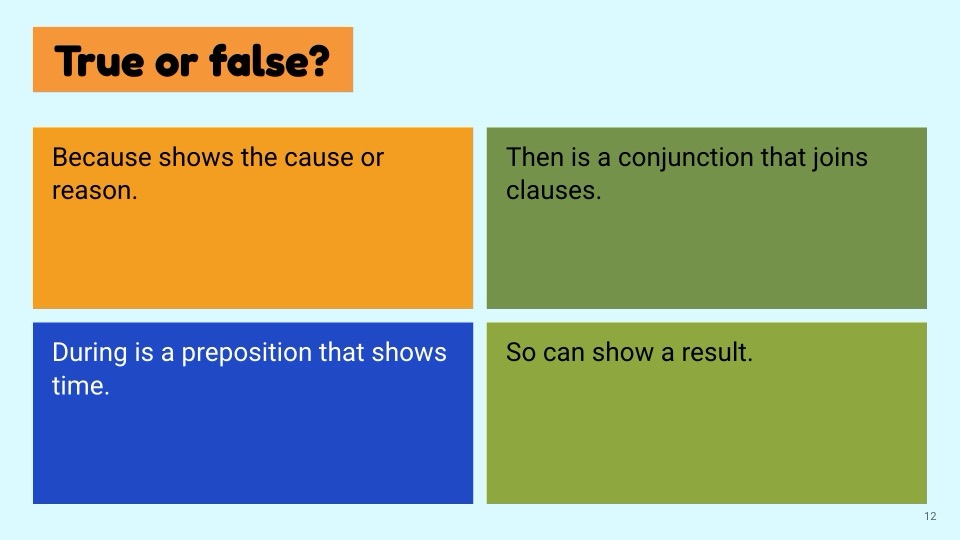
| 10 min | Plenary | To check pupils can tell time words from cause words. Show Slide 10 and read the big idea together. Show Slide 11 and do think, pair, share on How does because change We stayed inside? Show Slide 12 true or false and vote with fingers. Link back to success lines and praise clear time and cause sentences. |
Common mistakes
- Calling then a joining conjunction
How to spot it: Pupil writes First we ran then we hid and says then joined the clauses
Show then is an adverb that shows order, not a conjunction; use and or when to join, keep then to order: First we ran and then we hid - Using because of before a full clause with a verb
How to spot it: Pupil writes We stopped the game because of it rained
Remind because joins a clause with a verb, because of sits before a thing: because it rained or because of the rain - Picking a time word for a cause link
How to spot it: Pupil writes We hurried when we were late to mean why
Ask when or why: if it answers why, use because or so to express cause; keep when, before, after, while for time
Support
- Give word banks with when, before, after, while and picture clauses to choose from
- Give sentence frames with because or so already in place and two sensible endings to pick
- Limit preposition sort to during and after with pictures before adding in and before
Stretch
- Add a second time linker to grow the same idea into two sentences
- Turn a so sentence round into a because sentence with the same meaning
- Write one new pair showing both uses of after: after lunch and after we eat
Check questions
- Pick the time word: We waved ___ the bus left.
Answer: when / before / after — any sensible time link, e.g. when the bus left - Pick the cause word: It was cold, ___ we wore coats.
Answer: so, it shows result; therefore also correct as adverb - Is during in during lunch a conjunction or preposition?
Answer: preposition, it sits before a thing to show time
Curriculum
using conjunctions, adverbs and prepositions to express time and cause
Video clips
Clips on YouTube, from the start and end times we chose. Check each one before you show it.
-
Year 3 and, but, or, so, because from 0:00 to 2:32
CENTURY Tech: Conjunctions Explained | And, But, Or, So, Because | KS2 SPaG Year 3
Made for Year 3 and perfect for age 7-8, covers cause conjunctions so and because.
-
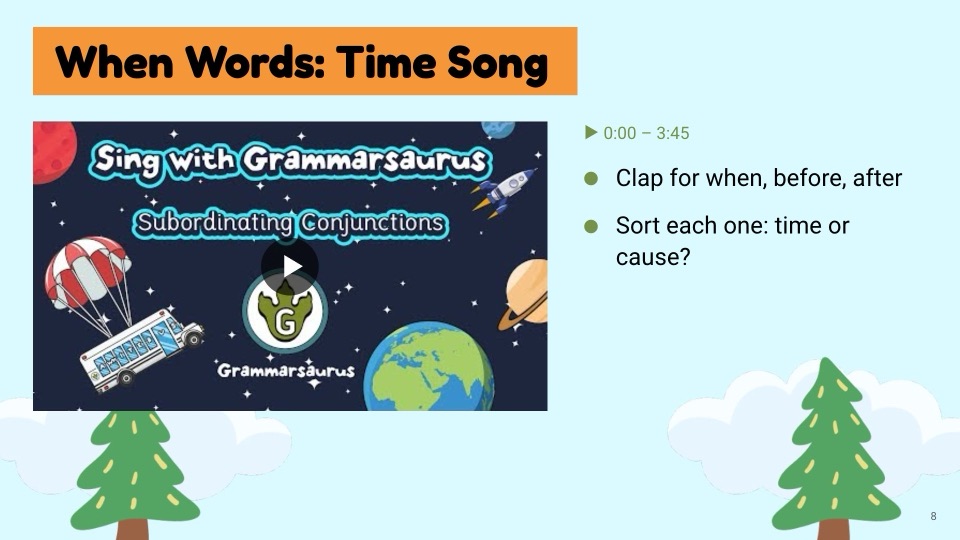
A WHITE BUS time and cause song from 0:00 to 3:45
Grammarsaurus: Sing with Grammarsaurus - Subordinating Conjunctions (A WHITE BUS)
Subordinating conjunctions song ideal for age 7-8 to learn time and cause words like when, before, after and because.
Worksheet
Sources
- glossary gov.uk
- National curriculum in England: English programmes of study assets.publishing.service.gov.uk
- Using conjunctions to build sentences - KS2 English - BBC bbc.co.uk
- Using conjunctions to join ideas - KS1 English - Learning ... bbc.co.uk
- Conjunction | TeachingEnglish | British Council teachingenglish.org.uk
- Using Conjunctions | Definition, Rules & Examples - Scribbr scribbr.co.uk
- Conjunctions in English, FANBOYS & More | ELS elitelanguage.co.uk
- List of English Conjunctions english-grammar-lessons.co.uk
- Learn about conjunctions and how they are used. - BBC Bitesize bbc.co.uk
- Conjunction (grammar) Facts for Kids kids.kiddle.co
- Conjunction Facts for Kids kids.kiddle.co
- CONJUNCTIONS - Towson University webapps.towson.edu
- Conjunctions - Excelsior OWL owl.excelsior.edu
- Conjunctions | Writing Center writing-center.phsc.edu
- Compound sentences with correct conjunctions - Level 2 ... arc.educationapps.vic.gov.au
- Conjunctions and Interjections - Grammar and Vocabulary ... gallaudet.edu
- Conjunctions for Kids - Grammar Monster grammar-monster.com
- Conjunctions for Kids: Types, Examples, Rules, and Practice engrary.com
- What Are Conjunctions? | Grammar for Kids kidsworldfun.com
- Conjunction Words List for Kids: A Complete Guide to Connecting Ideas ... grammardiary.com
- Conjunctions for Kids — FANBOYS & More | Grammar Hut grammarhut.com
- Conjunctions Examples, Definition & Worksheets For Kids kidskonnect.com
- Fun and Educational Conjunctions for Kids: Learn Language ... - Edulyte edulyte.com
- Explain Conjunctions - Kidpid members.kidpid.com
- Conjunctions and Interjections – College Reading & Writing: A ... pressbooks.howardcc.edu
Picture credits
Made with Lesson Dino's AI on 17 October 2026. AI can make mistakes, so check facts against the sources before you teach.