Slides
Lesson plan
Sides, Corners and Mirror Lines
Pupils learn sides, corners and vertical mirror lines of 2-D shapes. They count and fold paper shapes in pairs to test for matching halves.
Objectives
- Students will name triangle, square, rectangle and circle and count sides and corners.
- Students will describe 2-D shapes by number of straight sides and corners.
- Students will identify a vertical mirror line by folding shapes to match halves.
Success criteria
- I can count sides and corners to name triangle, square, rectangle and circle.
- I can describe a shape using its number of sides and corners.
- I can fold a shape to find its vertical mirror line.
Key words
| Word | Meaning |
|---|---|
| side | straight edge round a flat shape |
| corner | pointy place where two edges meet |
| triangle | flat shape with three edges and three points |
| square | flat shape with four equal edges and four points |
| mirror line | crease down the middle where halves match exactly |
Timed plan (60 minutes)
| Time | Stage | What happens |
|---|---|---|
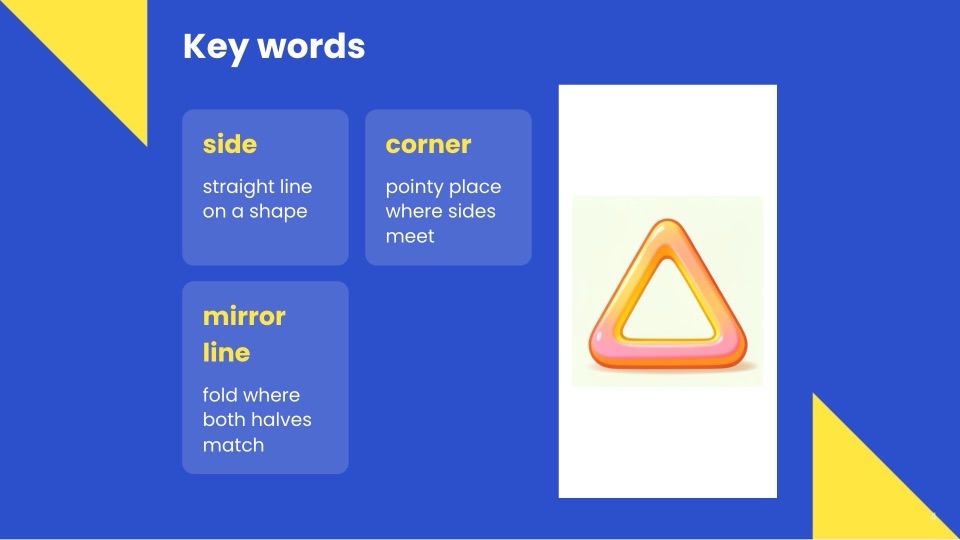
| 10 min | Starter | Recall shape names and spark curiosity about folding to make matching halves. Show Slide 1 Shape Detectives: Sides and mirror lines and welcome pupils as detectives. Hold up a paper square and say the hook: If I fold this shape down the middle, will the two sides match exactly? Show Slide 5 Vote now: Triangle, Square, Circle, Which shape would you draw? Take a hands-up vote. Show Slide 4 Key words and teach side - straight line on a shape, corner - pointy place where sides meet, mirror line - fold where both halves match. |
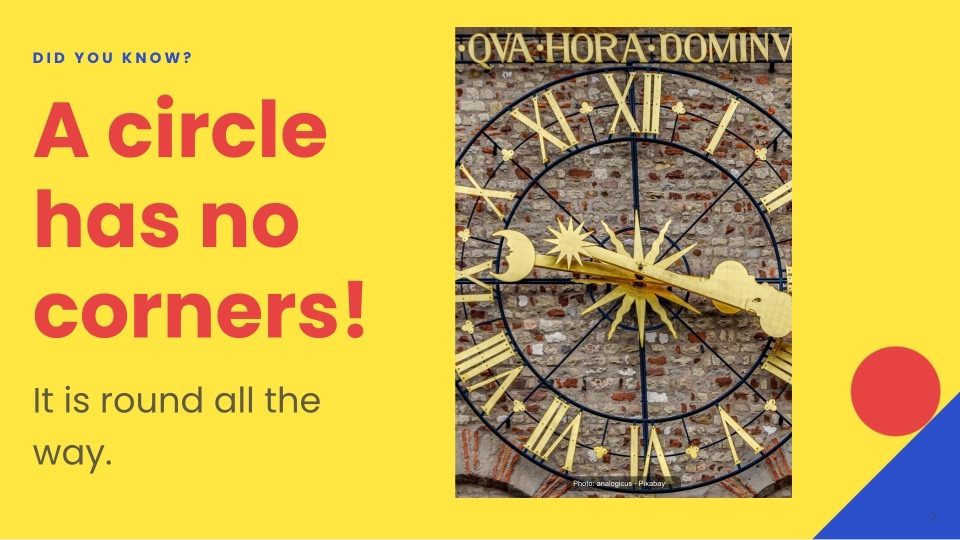
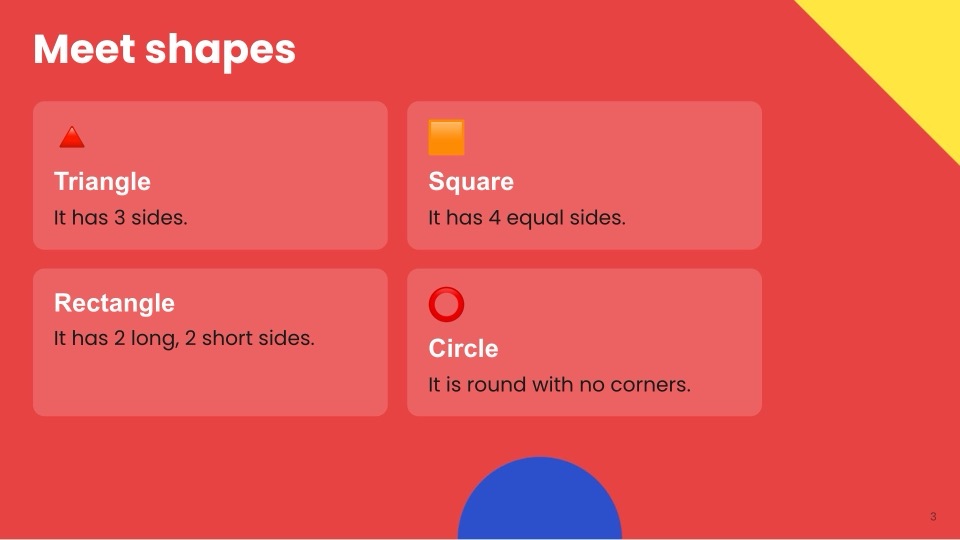
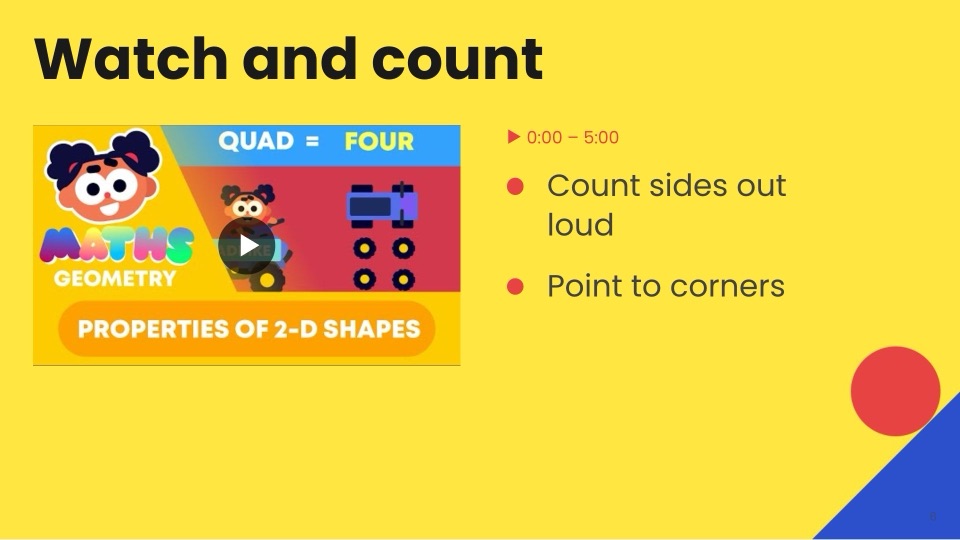
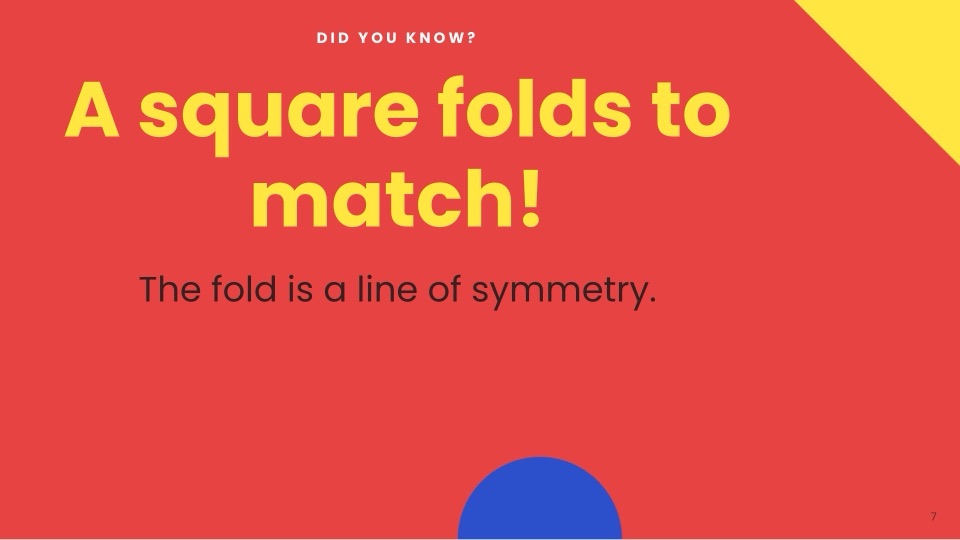
| 12 min | Teaching | Model how to count sides and corners and how folding shows a vertical mirror line. Show Slide 2: A circle has no corners! It is round all the way. Explain circles only have one curved side and circles have no corners. Show Slide 3 cards: It has 3 sides. Triangle, It has 4 equal sides. Square, It has 2 long, 2 short sides. Rectangle, It is round with no corners. Model counting. Play Video clip 1 on Slide 6 and count sides out loud and point to corners with the class. Show Slide 7: A square folds to match! The fold is a line of symmetry. Fold a square down the middle to show two mirror-image halves. |
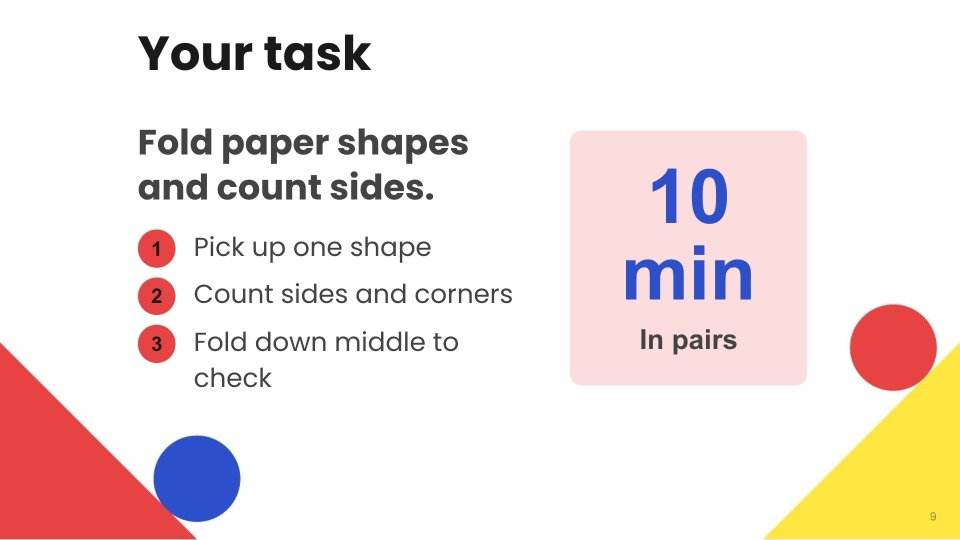
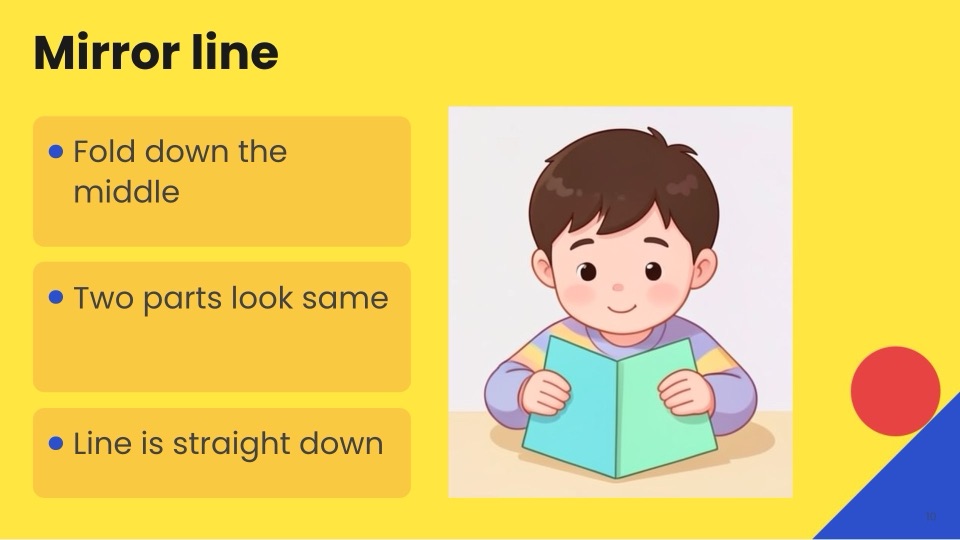
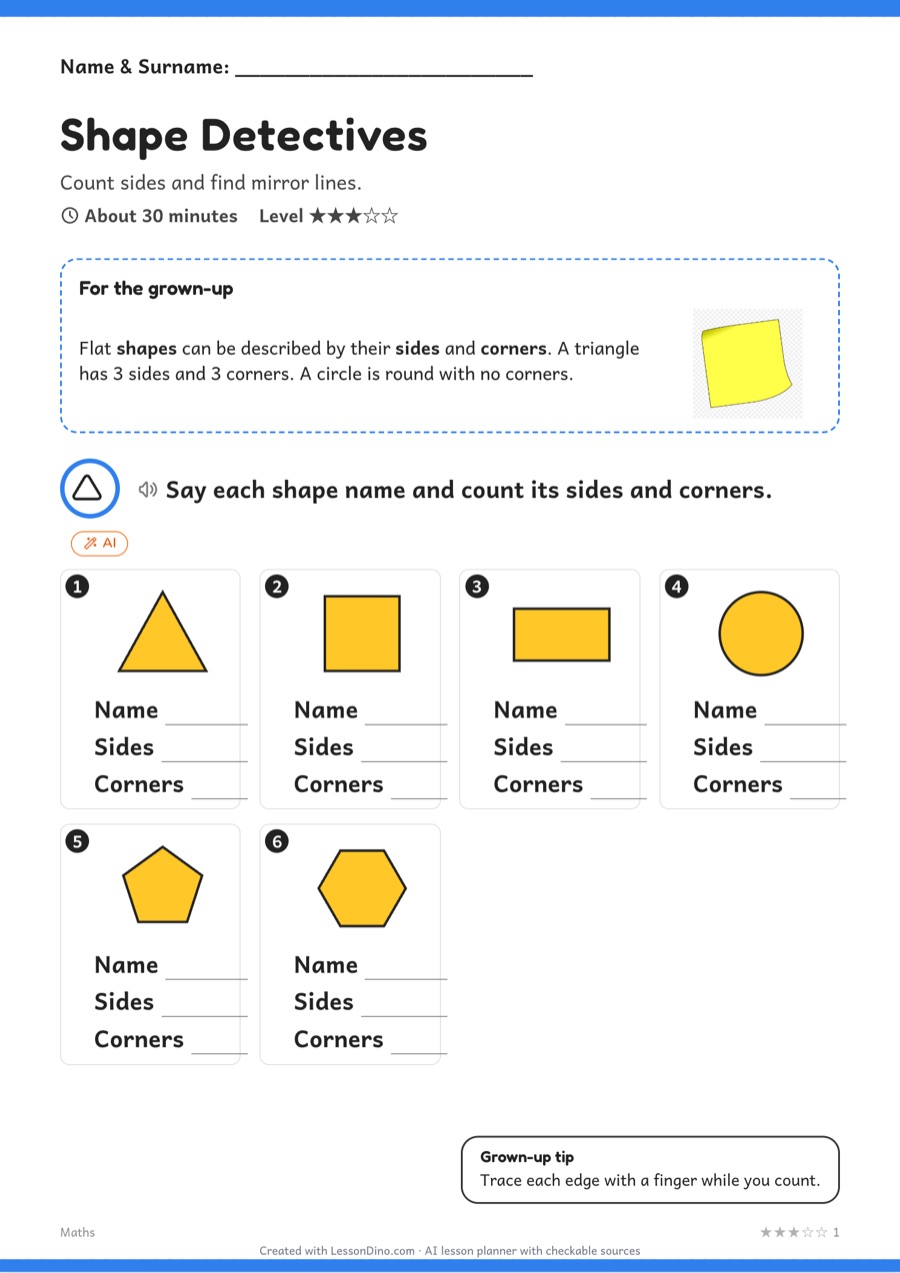
| 25 min | Main activity | Test paper shapes for symmetry in a vertical line by folding and count sides and corners. Show Slide 9 Your task: Fold paper shapes and count sides. Explain steps: Pick up one shape, Count sides and corners, Fold down middle to check. Show Slide 10: Fold down the middle, Two parts look same, Line is straight down. Model with an isosceles triangle. Give each pair paper triangles, squares, rectangles, hearts, Worksheet page 1 and stickers. Pairs count then fold each shape side-to-side to make a vertical crease. Ask pairs to stick only symmetrical shapes on the chart and draw over the crease in colour to show the mirror line. |
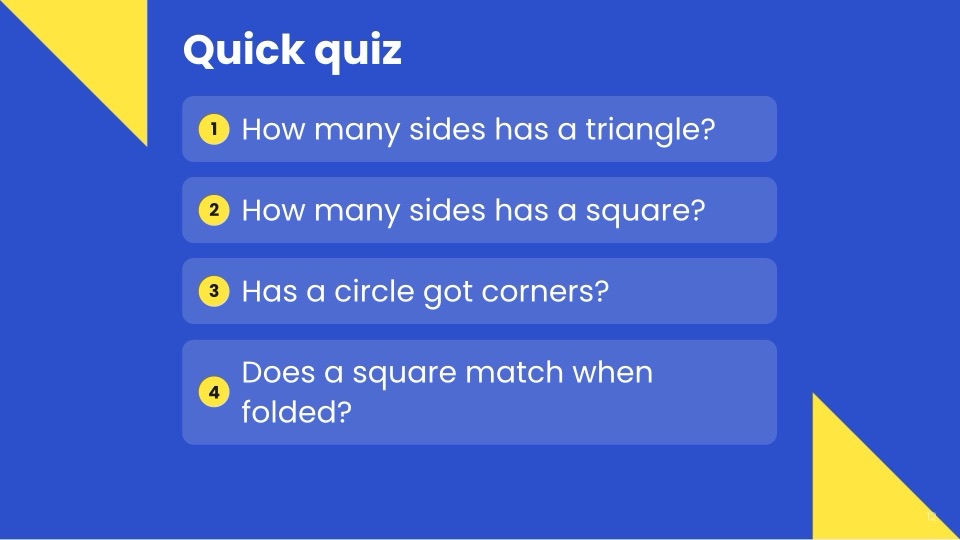
| 13 min | Plenary | Review which shapes match when folded and how many sides they have. Tidy shapes and bring class to carpet with chart. Show Slide 11 Think, pair, share: Which shapes match when folded? Pairs discuss using chart. Show Slide 12 Quick quiz, ask How many sides has a triangle? How many sides has a square? Has a circle got corners? Does a square match when folded? Confirm answers 3, 4, No, Yes and link back to sides and vertical mirror line. |
Common mistakes
- Saying a circle has corners or straight sides
How to spot it: Pupil counts round edge as sides or points to curve as corner
Trace together and restate circles only have one curved side and circles have no corners. - Miscounting sides by missing one or counting twice
How to spot it: Says triangle has 2 or 4 sides, square has 3 or 5
Mark each side with a dot as counted; check triangle has 3 sides and 3 vertices and square has 4 sides and 4 vertices. - Thinking any fold is a mirror line even if halves do not match
How to spot it: Claims wonky fold or diagonal off-centre fold matches
Unfold and check edges line up; a line of symmetry divides a shape into two mirror-image halves.
Support
- Start with only triangles and squares to compare 3 against 4, then add rectangles and hearts.
- Pre-crease shapes lightly and use picture checklists to match without reading.
Stretch
- Offer two different hexagons, regular and long thin, to count and notice both have 6 sides.
- Ask pupils to predict symmetrical or not before folding, then fold to check.
Check questions
- How many sides has a triangle?
Answer: 3 - Has a circle got corners?
Answer: No - Does a square match when folded down the middle?
Answer: Yes, it has a vertical mirror line
Curriculum
identify and describe the properties of 2-D shapes, including the number of sides, and line symmetry in a vertical line
Video clips
Clips on YouTube, from the start and end times we chose. Check each one before you show it.
-
Y2 properties of 2-D shapes from 0:00 to 5:00
FuseSchool Kids: Properties of 2-D Shapes | Geometry | Y2 Maths | FuseSchool Kids
Made for Y2 maths and counts sides slowly with clear pictures that suit 6-7 year olds.
-
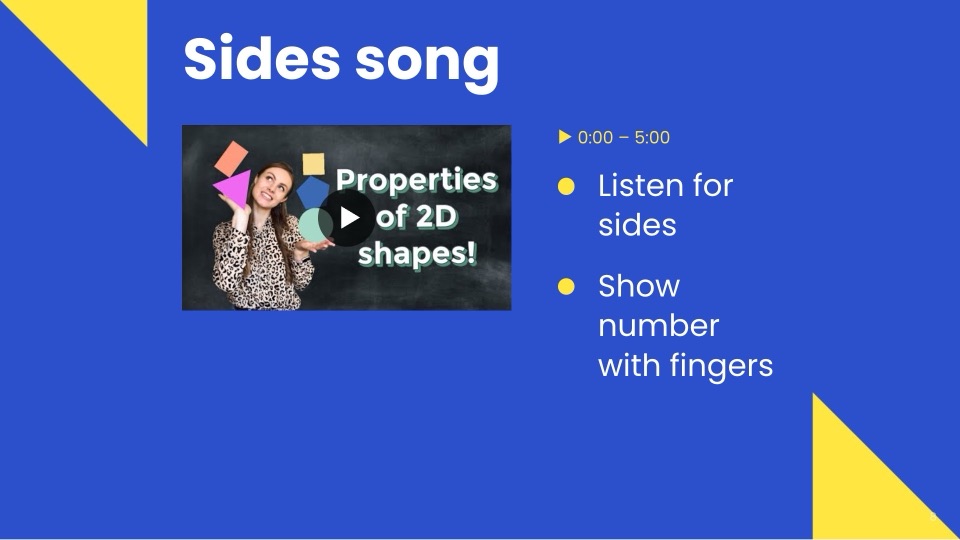
KS1 sides and vertices intro from 0:00 to 5:00
For the Love of Learning: 2D SHAPES FOR KIDS. Properties of 2D shapes explained. Sides and Vertices. Interactive Video for KS1
Made for KS1 ages 5-7 with slow pace and a quiz that suits 6-7 year olds.
Worksheet
Sources
- National curriculum in England: mathematics programmes of study assets.publishing.service.gov.uk
- 2D shapes - KS1 Maths - Year 2 - BBC Bitesize bbc.co.uk
- Properties of 2D Shapes Explained | KS3 Maths revisionlibrary.co.uk
- Properties of 2D shapes for 11+ maths | Academy11+ academy11.co.uk
- Properties of 2D Shapes | GCSE Maths Revision | Teachably teachably.co.uk
- Properties of 2D shapes and 3D objects 1 - The Prescot School prescotschool.org.uk
- Maths Starter! stcypriansprimaryacademy.co.uk
- Properties of 2D shapes - 3rd level Maths Revision - BBC Bitesize bbc.co.uk
- Shapes primary resource: Maths art | National Geographic Kids natgeokids.com
- What are 2D Shapes ⭐ Definition, Names, Properties, Examples brighterly.com
- What are 2D Shapes? Definition, Names, Properties, Examples splashlearn.com
- 2-Dimensional Shapes and Their Properties - MathTeacherCoach mathteachercoach.com
- 2D Shapes - Names, Definition, Properties - Cuemath cuemath.com
- Notes Properties of Two-Dimensional Shapes (Term 3) - for Grade 6 edurev.in
- Shape Facts for Kids kids.kiddle.co
- 2D Shapes: Names, Properties & Characteristics | DoodleLearning doodlelearning.com
- A guide to properties of 2D Shapes by PlanBee planbee.com
Picture credits
- AI illustration · Cloudflare
- Photo: analogicus · Pixabay
- Picture: Miiruuku · CC0 · rawpixel via Openverse
- Microsoft Fluent Emoji (MIT)
- Drawing: Johannes Rössel ( talk ) · Public domain · Wikimedia Commons
- Pictograms: Sergio Palao, ARASAAC (arasaac.org) · CC BY-NC-SA
Made with Lesson Dino's AI on 19 October 2026. AI can make mistakes, so check facts against the sources before you teach.