Slides
Lesson plan
From Messy Facts to Clear Informing
Students learn to group facts to explain a topic clearly. They sort shark facts into piles and write a short informative paragraph.
Objectives
- Students will group facts into 2-3 focused groups to plan body paragraphs.
- Students will organize informative writing with introduction, body, and conclusion.
Success criteria
- I can sort facts into 2-3 groups for body paragraphs.
- I can write an intro, grouped facts, and a conclusion.
Key words
| Word | Meaning |
|---|---|
| informative | teaching true facts about a subject so a reader learns |
| fact | something true that can be checked or proved |
| introduction | opening that names the subject and previews points |
| body paragraph | middle part that groups related facts together |
| conclusion | ending that sums up main points in new words |
| transition | bridge word that shows how thoughts link |
Timed plan (60 minutes)
| Time | Stage | What happens |
|---|---|---|
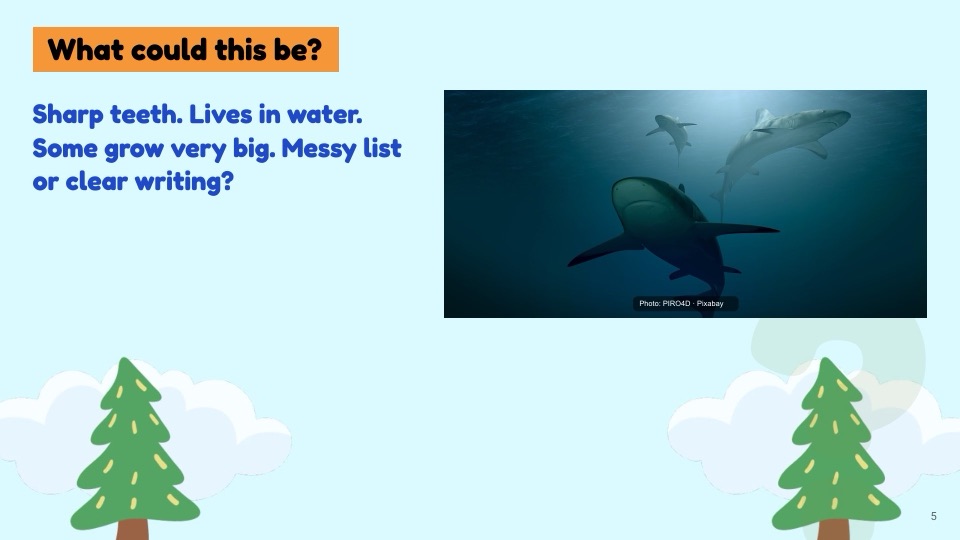
| 7 min | Starter | To spark interest in organizing facts so readers can learn. Say the hook: I can write ten true facts about sharks in one minute — but would you actually learn anything from my messy list? Let's fix it. Show Slide 5 and read the messy list: Sharp teeth. Lives in water. Some grow very big. Ask pairs to turn and talk for 30 seconds about what is hard to learn from the list. Explain that a page of true facts in no order is just a fact dump, and informative writing must organize it so a reader actually learns something. |
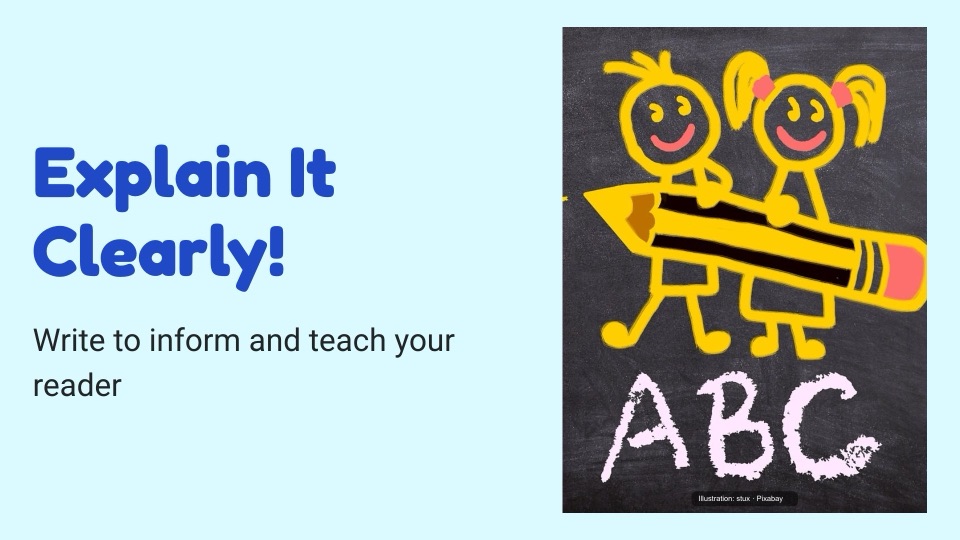
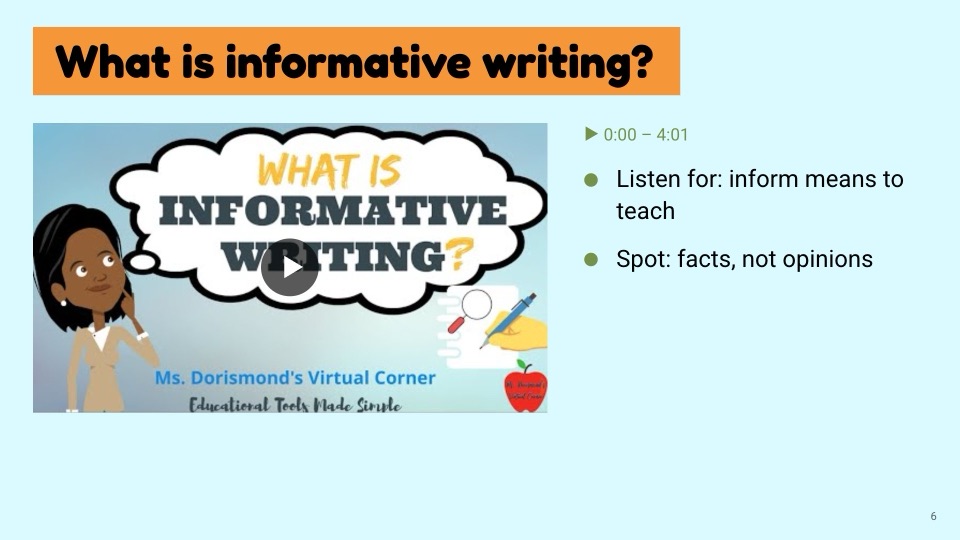
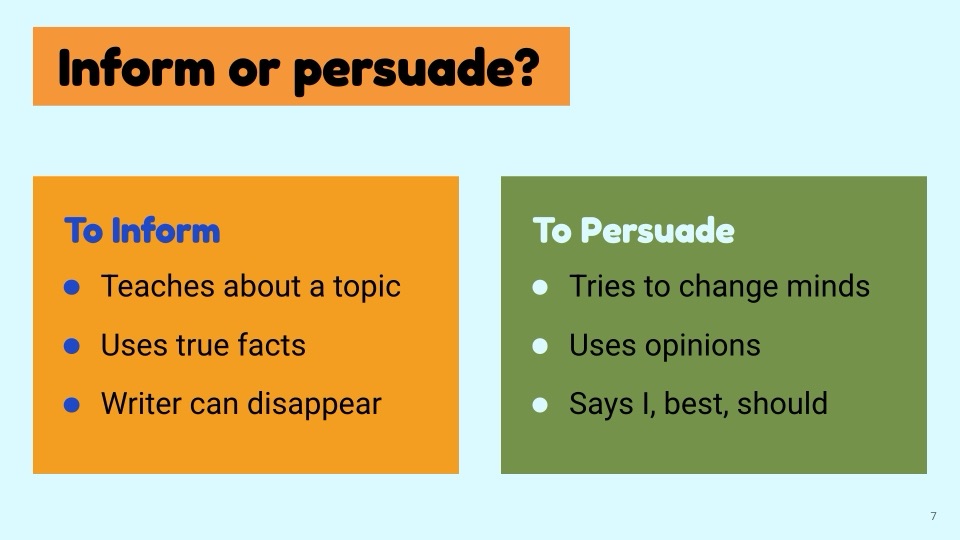
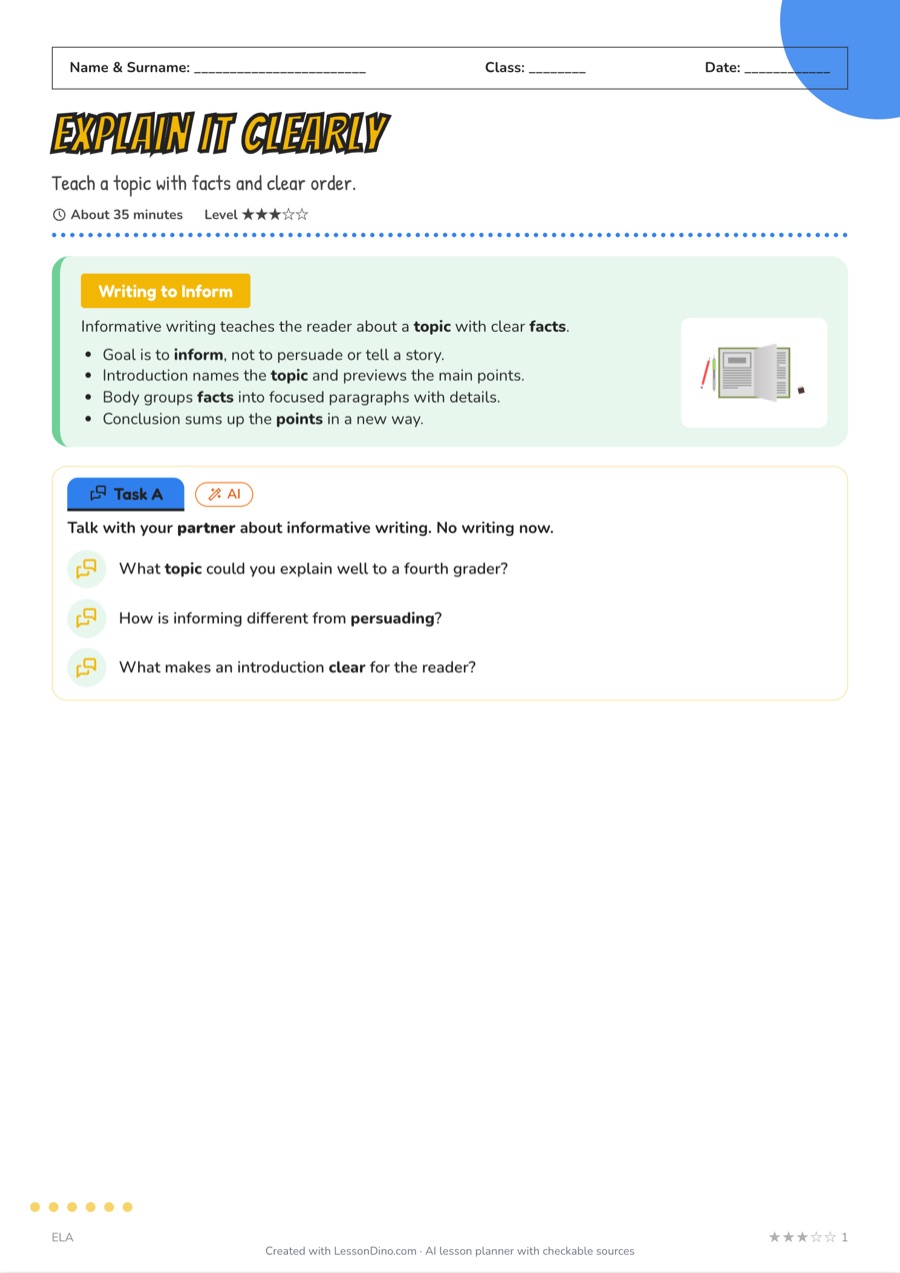
| 12 min | Teaching | To teach what informative writing does and how it differs from opinion. Show Slide 1: Write to inform and teach your reader, then play Video clip 1 (0:00–4:01) on Slide 6. Show Slide 7 and model three types: informative explains or teaches, opinion argues a position, narrative tells a story. Hand out Worksheet Task F and do the first two together, marking fact or opinion. Remind the class that informative writing shares accurate facts without bias or trying to persuade. |
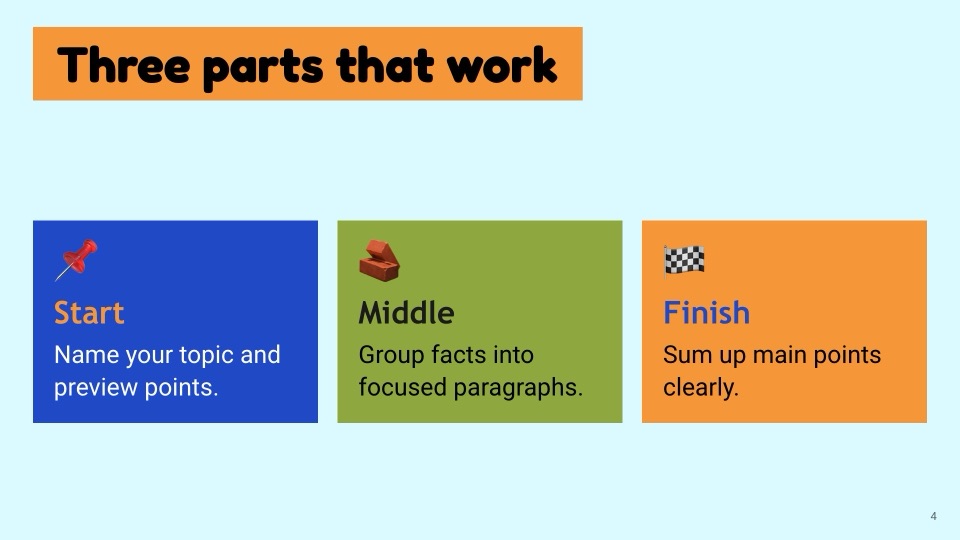
| 20 min | Main activity | To group facts into 2-3 focused piles to plan body paragraphs. Show Slide 4 and name the three parts: Name your topic and preview points, Group facts into focused paragraphs, Sum up main points clearly. Model sorting with sticky notes: write one fact per note, then move notes into piles like what it is, where it lives, and what it does. Give pairs sticky notes, large paper, and markers to write and sort their own facts. Circulate and help pairs label each pile with a heading that could become a body paragraph. |
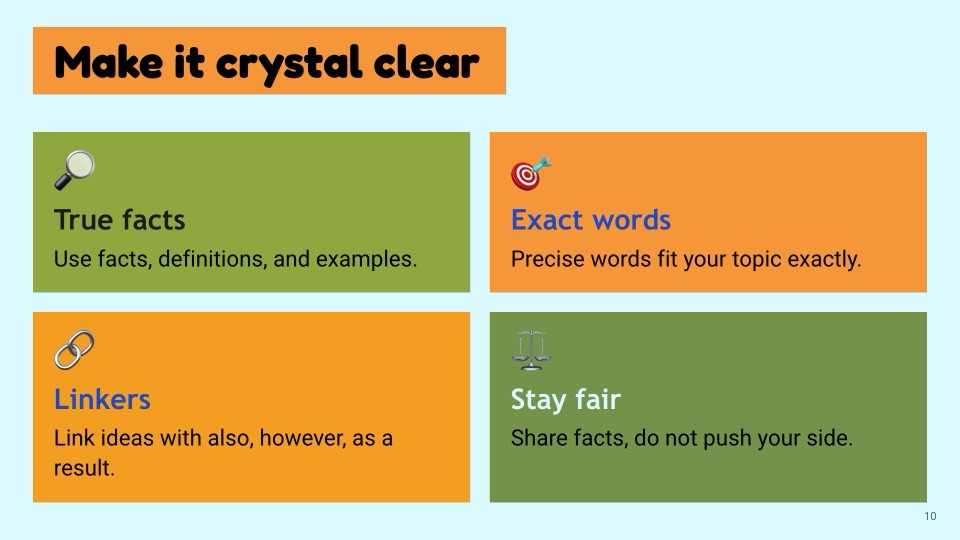
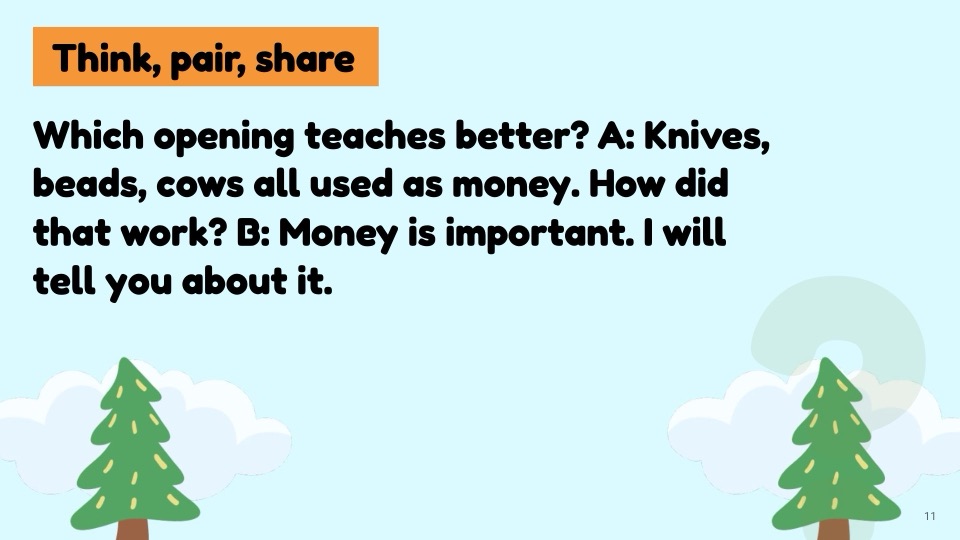
| 13 min | Write and link | To draft a clear informative paragraph using precise words and links. Show Slide 10 and teach precise words fit your topic exactly and link ideas with also, however, as a result. Show Slide 11 and compare openings, pointing out that surprising examples hook faster than announcing what the paper will describe. Model a 4-sentence shark paragraph that uses a pile, a definition, and a transition. Ask pairs to write 3-4 sentences from one pile using one precise word and one bridge word. |
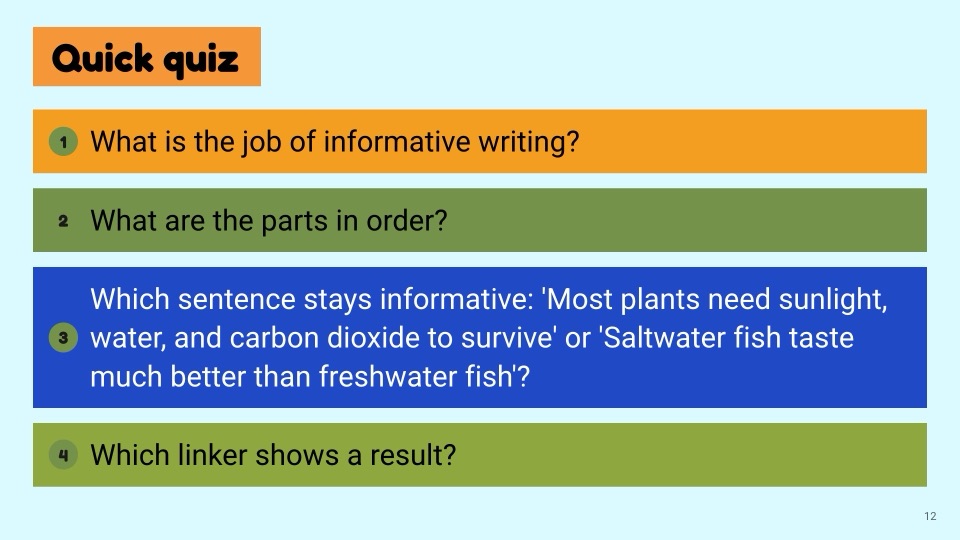
| 8 min | Plenary | To check that students can name the job and parts of informative writing. Show Slide 12 and run the quick quiz on the job and parts of informative writing. Ask pairs to state their best pile heading and one fact it taught. Restate success criteria and link piles to body paragraphs and conclusion that restates the main idea in new words. |
Common mistakes
- Writing a fact dump of true facts in no order
How to spot it: Draft jumps from teeth to home to size with no groups
Sort notes into 2-3 piles like what it is and where it lives, then write one pile at a time - Mixing opinion into informative writing
How to spot it: Draft uses best, favorite, should, or I think
Cross out opinion words and replace with a checkable fact or definition - Weak opening that only announces the topic
How to spot it: Starts with Money is important. I will tell you about it
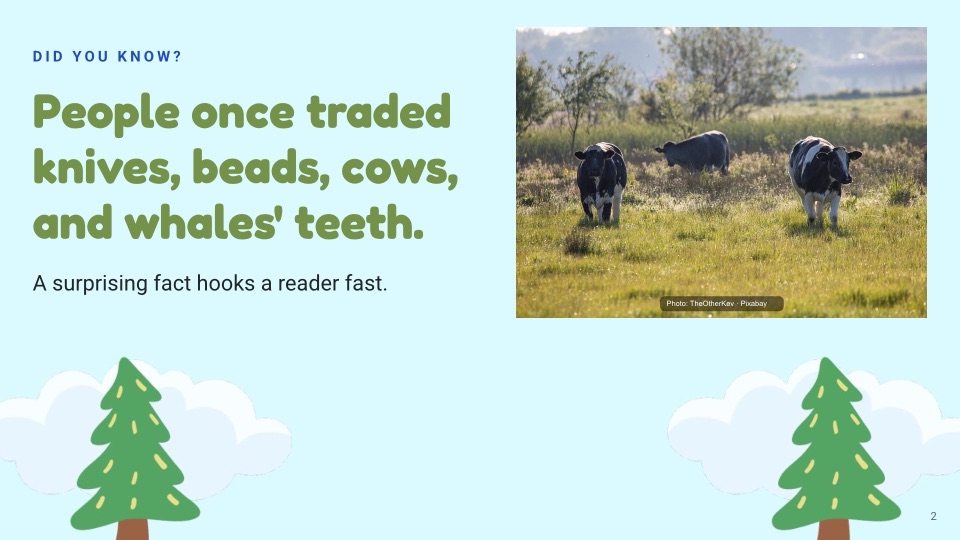
Start with a surprising fact or question, such as knives, beads, cows all used as money
Support
- Give 6 pre-written true facts on cards so students only have to sort, not recall facts.
- Provide sentence frames and a word bank of precise nouns and verbs.
- Limit checklists to three yes-or-no boxes and model one example together first.
Stretch
- Students write a one-sentence main idea for each pile to preview the paragraph.
- Students combine three facts using two different bridge words without repeating.
- Students rewrite a weak hook with a question or surprising fact.
Check questions
- What is the job of informative writing?
Answer: To teach clear facts about a topic. - You have facts about teeth, home, and size. How many body paragraphs and why?
Answer: Three, one focused group per paragraph. - Which is informative: Sharks live in the ocean or Sharks are the best animal?
Answer: Sharks live in the ocean.
Curriculum
Write informative/explanatory texts to examine a topic and convey ideas and information clearly.
Video clips
Clips on YouTube, from the start and end times we chose. Check each one before you show it.
-
What Is Informative Writing? from 0:00 to 4:01
Ms. Dorismond's Virtual Corner: ✏️ What is Informative Writing? | Informational Writing for Kids | Nonfiction Writing
Explains informative writing in kid-friendly language perfect for ages 10-11 learning to examine a topic clearly.
-
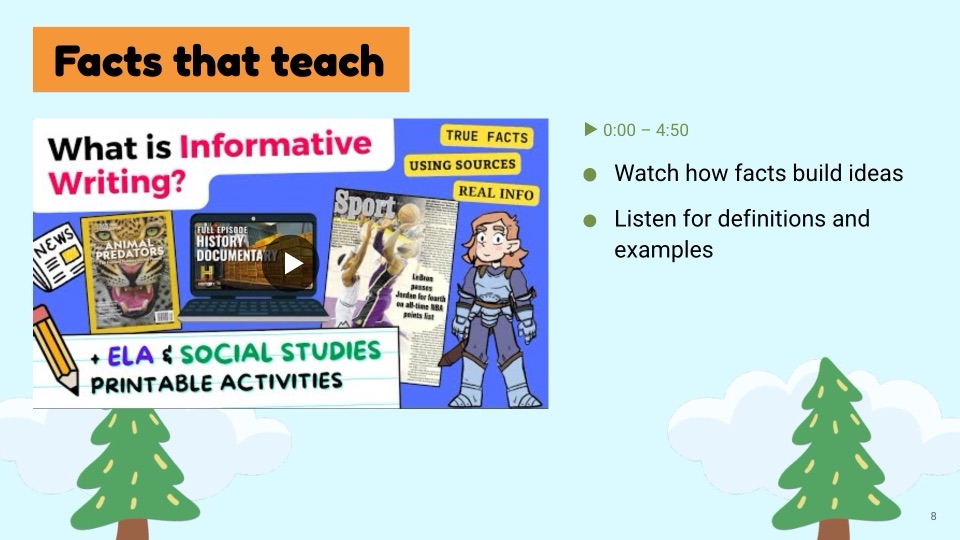
Facts, Research and Sources from 0:00 to 4:50
Hiikoo Learning: Informative/Informational Writing For Kids! (Expository) Using Facts, Research, and Sources✏️📚💻
Shows 10-11-year-olds how to use facts and sources to examine a topic, central to grade 5 informative writing.
Worksheet
Sources
- How to Read the Standards thecorestandards.org
- English Language Arts cps.edu
- Writing to Inform | UMGC Effective Writing Center umgc.edu
- Introduction to Informative Writing – Write What Matters open.maricopa.edu
- Purpose in Informative Writing resourcecenter.byupathway.edu
- Purpose in Informative Writing - Brigham Young University–Idaho content.byui.edu
- Proficiency in Theme Writing: Informative Writing | Strategic ... sim.ku.edu
- Informative language - Literary techniques – WJEC - GCSE ... bbc.co.uk
- Discursive, persuasive and informative writing - 3rd level ... bbc.co.uk
- Informative Writing for Kids: Easy Tips & Fun Examples planetspark.in
- Informative/Explanatory Writing in the Classroom, Grades 3-12 sadlier.com
- How to Teach Informative Writing - Lead in Literacy leadinliteracy.com
- Teaching Informative Writing in Elementary - InstructorWeb instructorweb.com
- CCSS.ELA-Literacy.6.W.9 - Writing Informative Texts with ... homeschoolgenie.com
- What Is Informative Writing? cascadiaauthorservices.com
- What Is Informative Writing? | Teacher Made Resource | Twinkl twinkl.com
- NAEP - Writing 2007: Writing Sample Questions nationsreportcard.gov
- What is Informative Writing? — Kid-Friendly Definition | LearnCrux learncrux.com
- Informative Writing Definition, Purpose & Examples - Study.com study.com
- Informative/Explanatory Writing | PBS LearningMedia pbslearningmedia.org
Picture credits
- Illustration: stux · Pixabay
- Photo: TheOtherKev · Pixabay
- Photo: PIRO4D · Pixabay
- Illustration: janjf93 · Pixabay
- Microsoft Fluent Emoji (MIT)
Made with Lesson Dino's AI on 17 October 2026. AI can make mistakes, so check facts against the sources before you teach.