Slides
Lesson plan
Same Pond, Three Fates
Students learn that one habitat suits some organisms well and others poorly. They sort pond animals and argue each rank with evidence.
Objectives
- Students will rank three pond organisms by how well they survive with evidence.
- Students will construct a spoken survival argument with evidence for each rank.
Success criteria
- I can place each animal as thrives, struggles, or cannot survive.
- I can say my claim and give habitat evidence for it.
Key words
| Word | Meaning |
|---|---|
| habitat | the home place that gives food, water, shelter, and space |
| survive | keep living and growing in a place |
| evidence | true facts you use to show your idea is right |
| claim | an idea you say is true and can prove |
| shelter | a safe hiding place to live in |
Timed plan (60 minutes)
| Time | Stage | What happens |
|---|---|---|
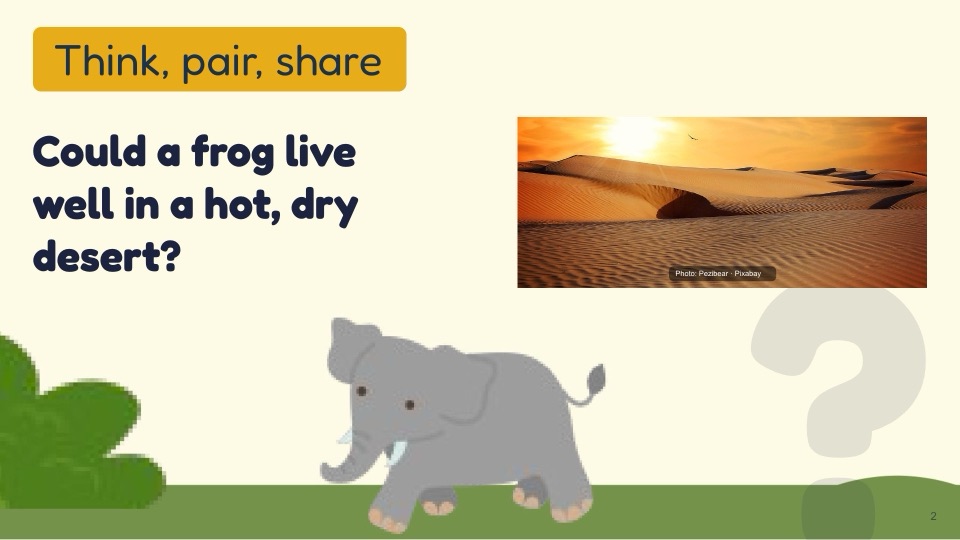
| 7 min | Starter | Hook interest in pond survival and recall what a habitat provides. Show Slide 1 title and welcome the class to pond science. Say the hook and show Slide 2 question: Could a frog live well in a hot, dry desert? Ask pairs to whisper a yes or no with one reason in 1 minute. Take 2 quick answers and link them to habitat needs. |
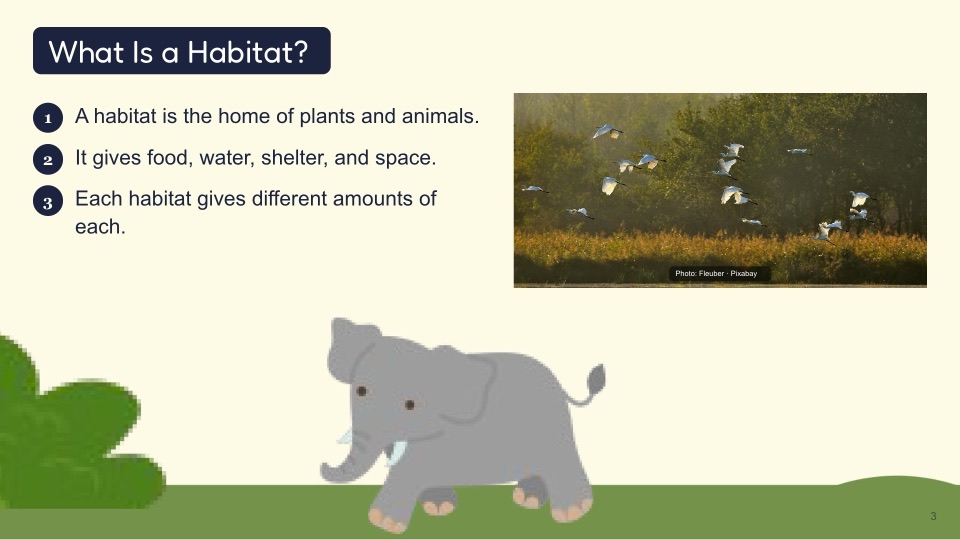
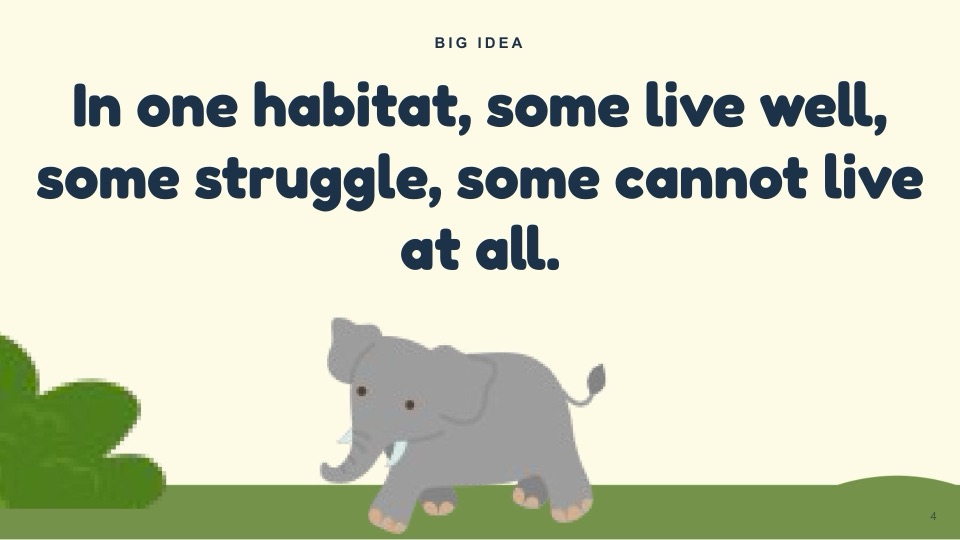
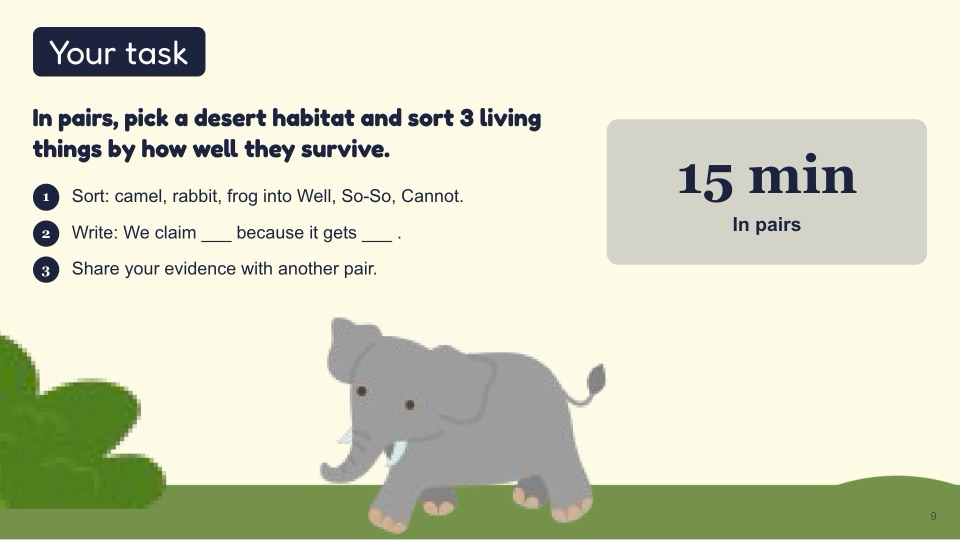
| 10 min | Teaching | Teach that one habitat fits some organisms well and others poorly. Show Slide 3 and read the bullets with the class. Show Slide 4 statement and explain thrives, struggles, cannot survive. Connect pond to science: a pond is a freshwater ecosystem where we study creatures and the conditions they need. Model the sentence frame: We claim _ will _ because it gets _ . |
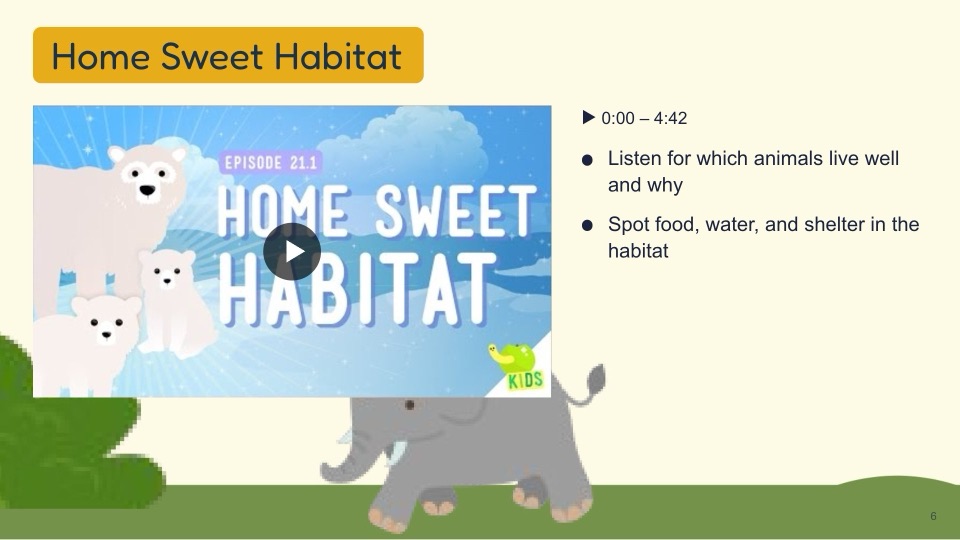
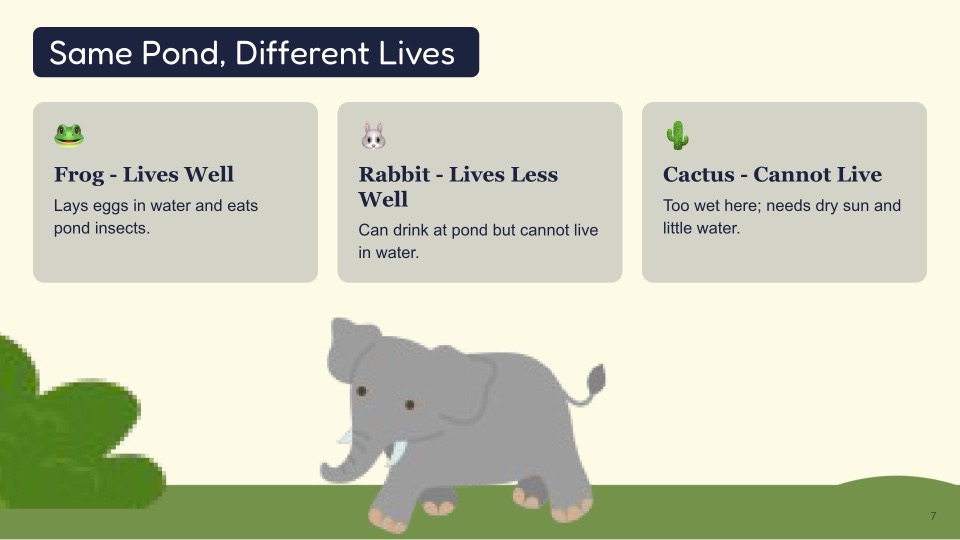
| 12 min | Guided practice | Model evidence-based ranking using video and pond cards. Play Slide 6, Video clip 1 (0:00-4:42) and ask students to spot food, water, and shelter. Show Slide 7 cards and read the frog and rabbit evidence aloud. Think aloud to rank frog as Lives Well and rabbit as Lives Less Well. Show how birds with waterproof feathers keep dry because rain runs off. |
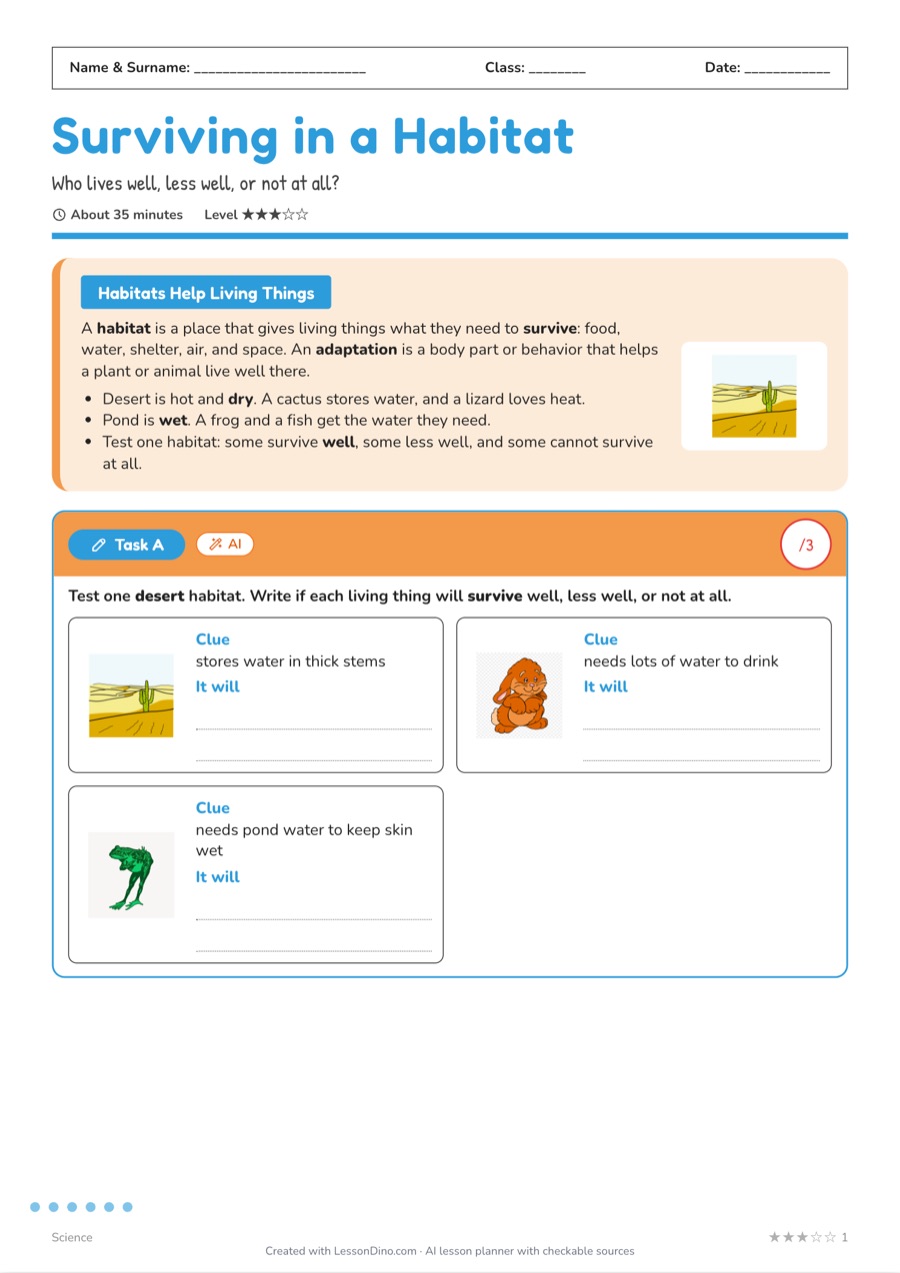
| 21 min | Main activity | Build and share spoken pond arguments with written evidence. Point to the pond poster and three labels: Thrives, Struggles, Cannot survive. Hand out sticky notes and Worksheet Task F and read the task direction together. Send pairs to place a water bird, a penguin that needs icy sea fishing, and a desert camel built for hot, dry sand. Stop at 15 minutes for pair-to-pair sharing of one claim with evidence. |
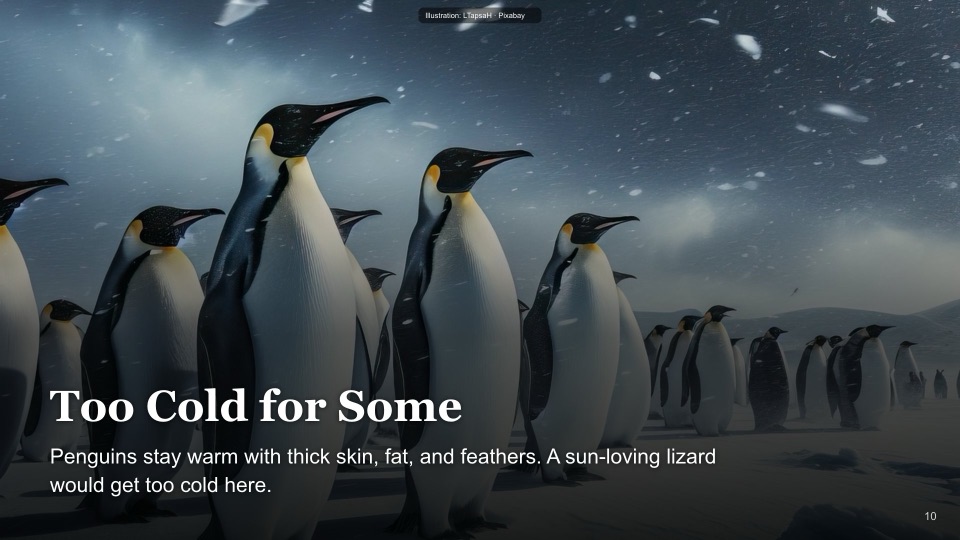
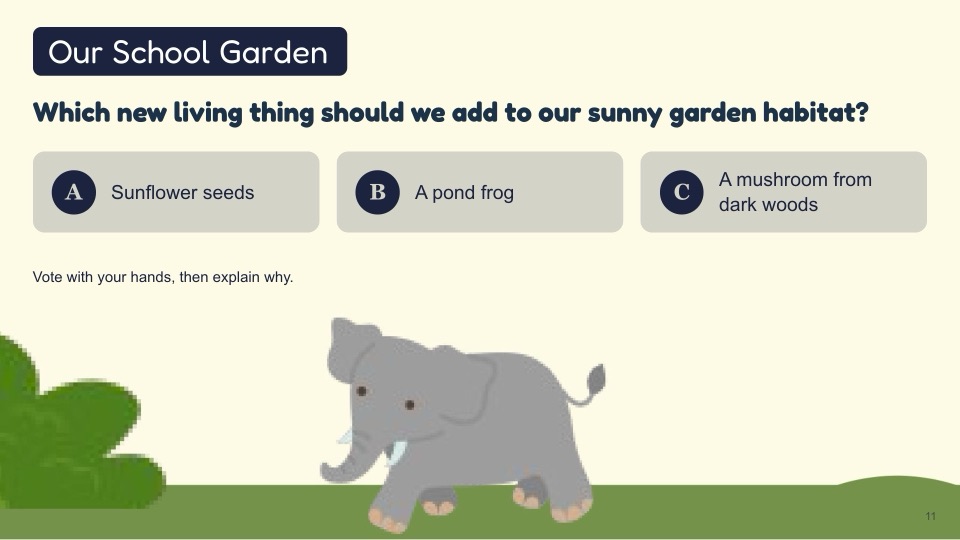
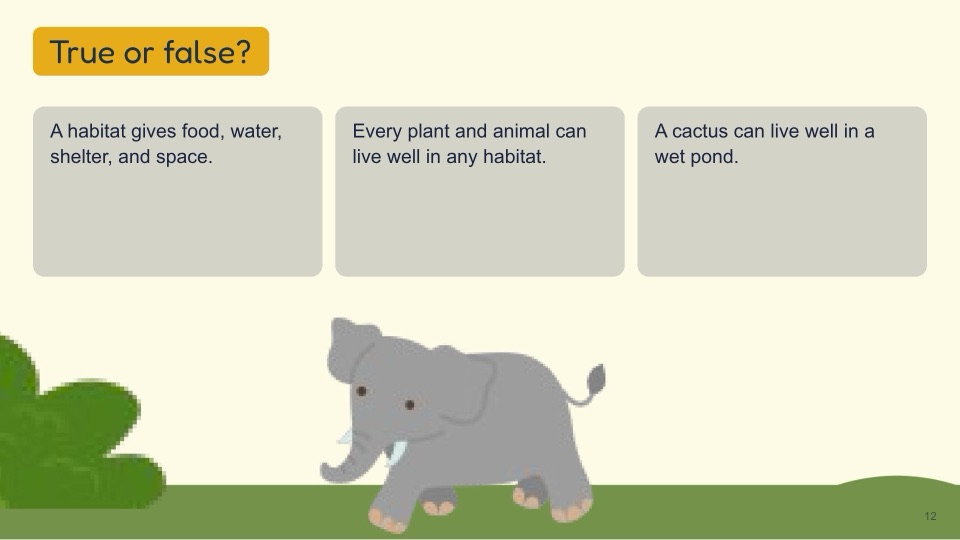
| 10 min | Plenary | Check the big idea and success criteria with true or false and claims. Invite three pairs to state: I claim ___ will ___ because ___ and class checks the because part. Show Slide 12 and vote true or false for each complete statement. Restate that adaptations like waterproof feathers or fat and fur for cold explain fit. Collect Worksheet Task F as exit evidence and preview garden habitat. |
Common mistakes
- Thinking any animal can live well anywhere if it wants to
How to spot it: Student ranks camel as thrives in pond because it can drink water
Match all needs: a desert animal needs hot, dry conditions and sand protection, not just water, so pond shelter and food do not fit. - Mixing up survives less well with cannot survive at all
How to spot it: Student puts rabbit and camel both under cannot survive
Ask: Can it get some needs but not live there? Rabbit can drink at pond but cannot live in water, so it struggles; camel gets almost none, so it cannot survive. - Giving an opinion instead of habitat evidence
How to spot it: Student says I like frogs so it thrives
Point to card facts: use lays eggs in water and eats pond insects to prove food and water match.
Support
- Pair students so one points to the pond need on the poster while the partner says the evidence using the fact that habitats provide water, air, shelter, and food.
- Provide sentence frame I claim ___ will ___ because ___ with picture cues for food, water, shelter.
Stretch
- Have ready students argue how the penguin’s rank would change if the pond froze over in winter and gained fish.
- Have ready students explain what extra habitat needs a struggler would require to thrive.
Check questions
- A pond frog lays eggs in water and eats pond insects. Will it thrive, struggle, or not survive in a pond? Give evidence.
Answer: Thrive, because it gets pond water for eggs and insects for food. - A camel is built for hot, dry desert life. Will it thrive in a pond? Give evidence.
Answer: Cannot survive, because the pond does not give its hot, dry food, water-saving, and shelter needs. - A rabbit can drink at the pond but cannot live in water. Will it thrive or struggle? Why?
Answer: Struggle, because it gets water to drink but not water shelter and pond food to live.
Curriculum
Construct an argument with evidence that in a particular habitat some organisms can survive well, some survive less well, and some cannot survive at all.
Video clips
Clips on YouTube, from the start and end times we chose. Check each one before you show it.
-
Home Sweet Habitat from 0:00 to 4:42
Crash Course Kids: Home Sweet Habitat: Crash Course Kids #21.1
Directly models the Grade 3 claim about who can survive well in a habitat with clear examples and vocabulary perfect for ages 8-9.
-
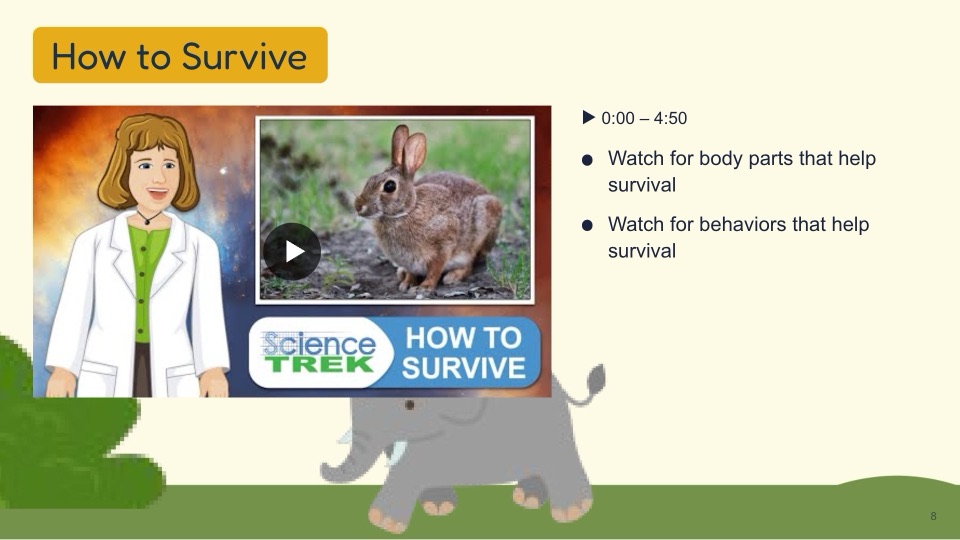
How to Survive from 0:00 to 4:50
Science Trek: Animal Adaptation: How to Survive | Science Trek
Focuses on adaptations for survival with a steady pace and clear language that is ideal for ages 8-9.
Worksheet
Sources
- Core Science Concepts | Grade 3 Curriculum | The Inquiry Project inquiryproject.terc.edu
- Download the Lesson List science.edu
- Slide 2 Let’s begin by reviewing what a habitat is. A habitat ... pa.gov
- Living things and their habitats - KS1 Science - BBC Bitesize bbc.co.uk
- What is a habitat? - KS1 Science curriculum - BBC Bitesize bbc.co.uk
- Habitat investigation: Science primary resource | National ... natgeokids.com
Picture credits
- Photo: Pezibear · Pixabay
- Photo: Fleuber · Pixabay
- Photo: moshehar · Pixabay
- Illustration: LTapsaH · Pixabay
- Pictograms: Sergio Palao, ARASAAC (arasaac.org) · CC BY-NC-SA
- Picture: unknown · CC0 · rawpixel via Openverse
- Picture: unknown · CC0 · rawpixel via Openverse
Made with Lesson Dino's AI on 17 October 2026. AI can make mistakes, so check facts against the sources before you teach.