Slides
Lesson plan
Same Steps, Different Life Stories
Students learn all life cycles share birth, growth, reproduction, and death. They build circle models to compare a butterfly and flowering plant.
Objectives
- Students will build circle models showing birth, growth, reproduction, and death for two different organisms.
- Students will compare life cycles to explain shared steps with different details.
Success criteria
- I can label birth, growth, reproduction, and death on my models.
- I can give one way two life cycles start or grow differently.
- I can order a life cycle so it can start again.
Key words
| Word | Meaning |
|---|---|
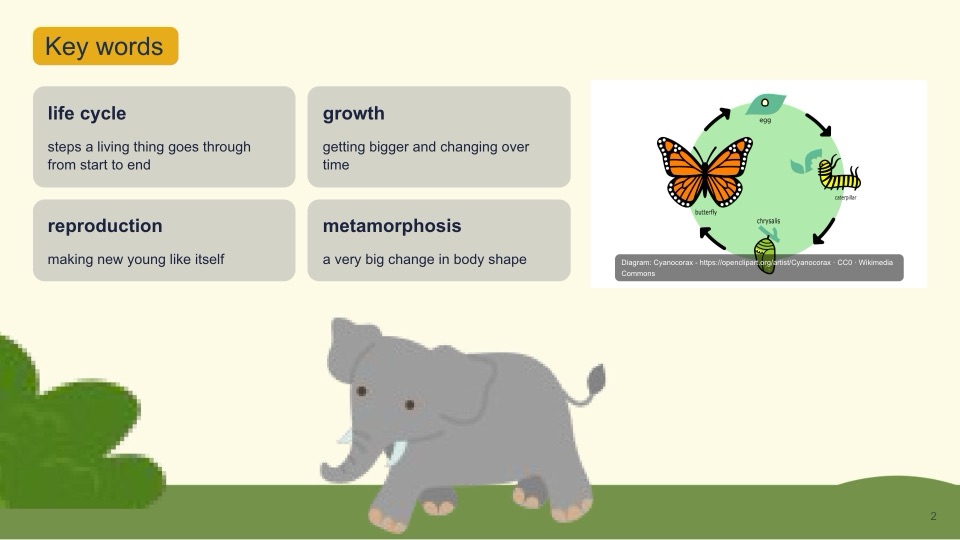
| life cycle | steps a living thing goes through from start to end |
| birth | starting life, such as hatching from an egg or sprouting from a seed |
| growth | getting bigger and changing over time |
| reproduction | making new young like itself, such as developing seeds or laying eggs that hatch |
| death | the end of a normal life span, and length of life can differ |
Timed plan (60 minutes)
| Time | Stage | What happens |
|---|---|---|
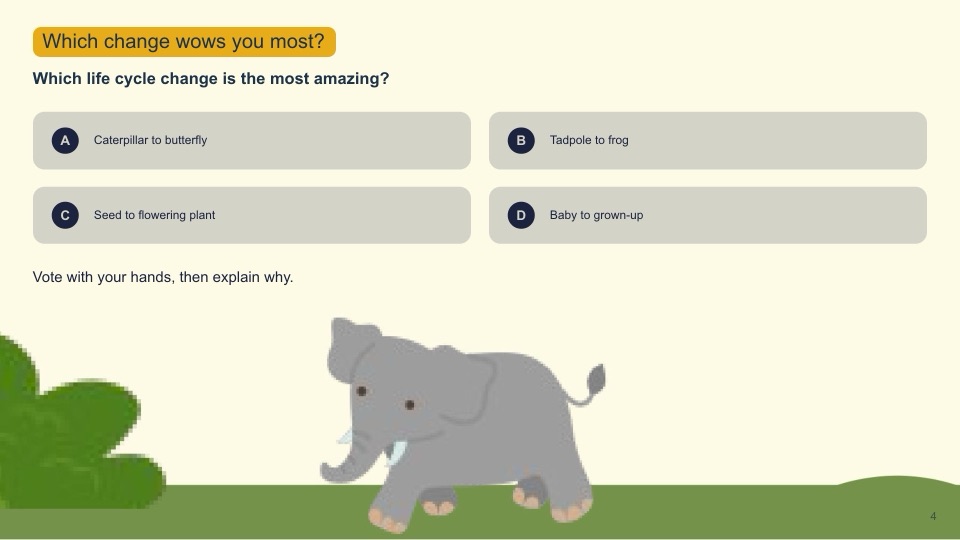
| 5 min | Starter | Hook curiosity and recall that living things grow and change. Show Slide 1 and read the question: How do living things grow, change, and begin again? Say the hook and show picture cards of seed, tadpole, and caterpillar. Show Slide 4 and take a quick vote on which change wows you most. Show Slide 2 and read the three key words together. |
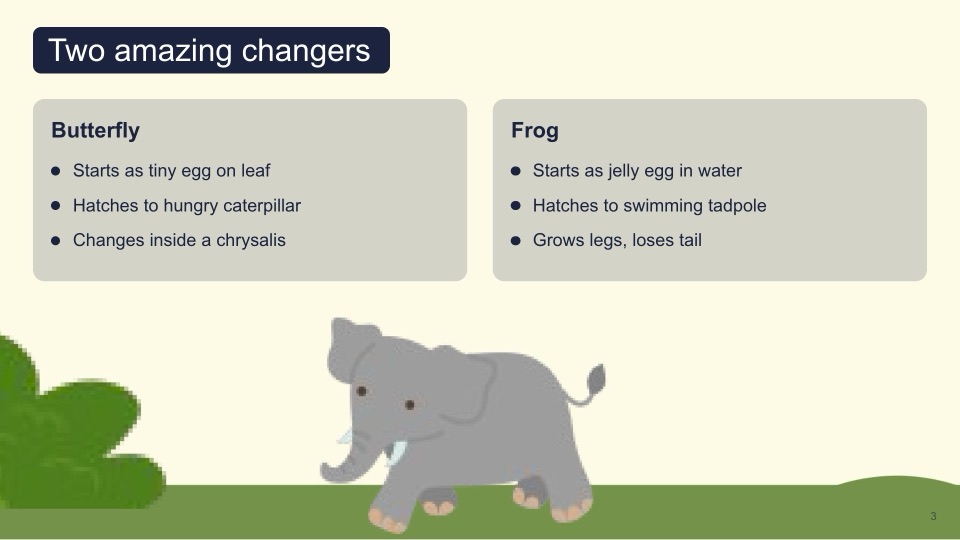
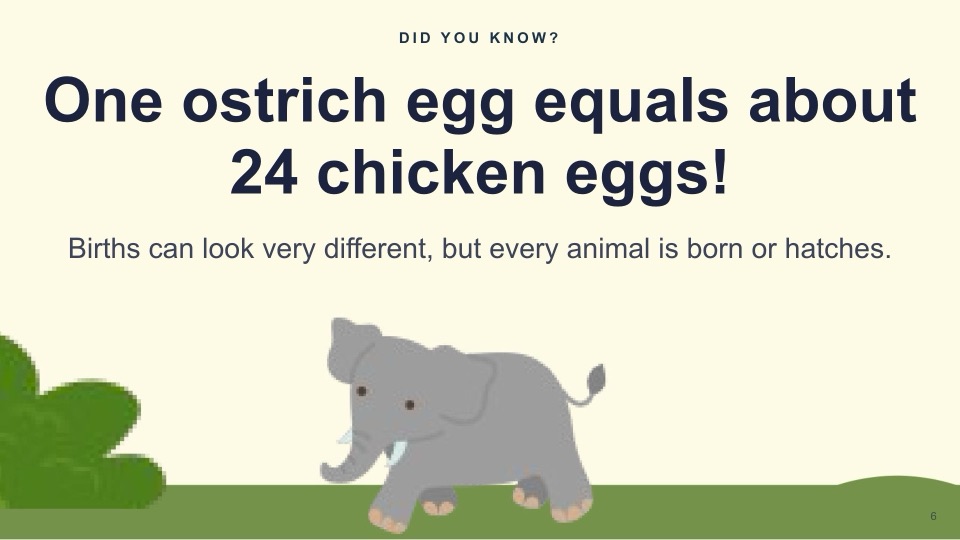
| 10 min | Teaching | Teach the four shared steps and how births and growth can look different. Show Slide 3 and point to butterfly and frog young and adult photos. Teach the four shared steps: birth, growth, reproduction, and death in common. Show Slide 6 and explain births can look very different but every animal is born or hatches. Model how to spot birth and growth in the two examples. |
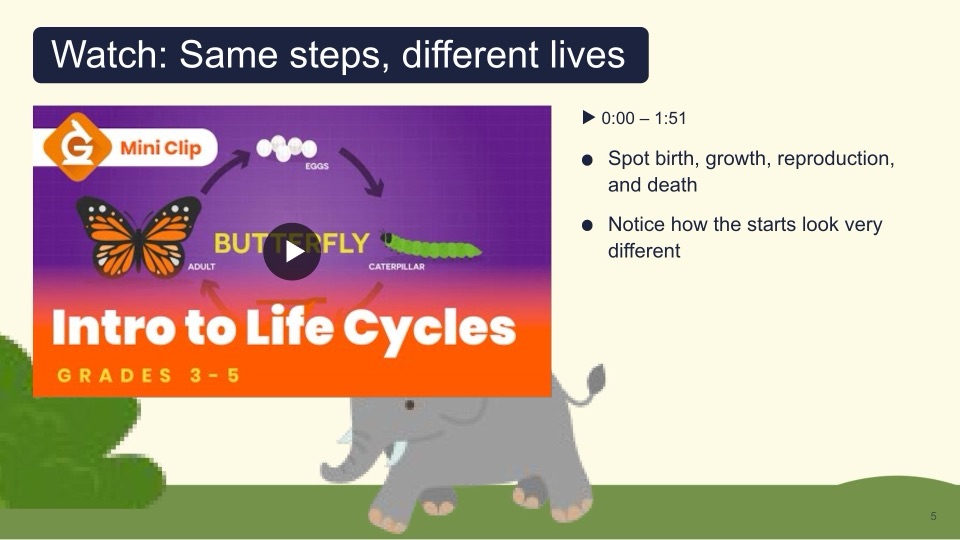
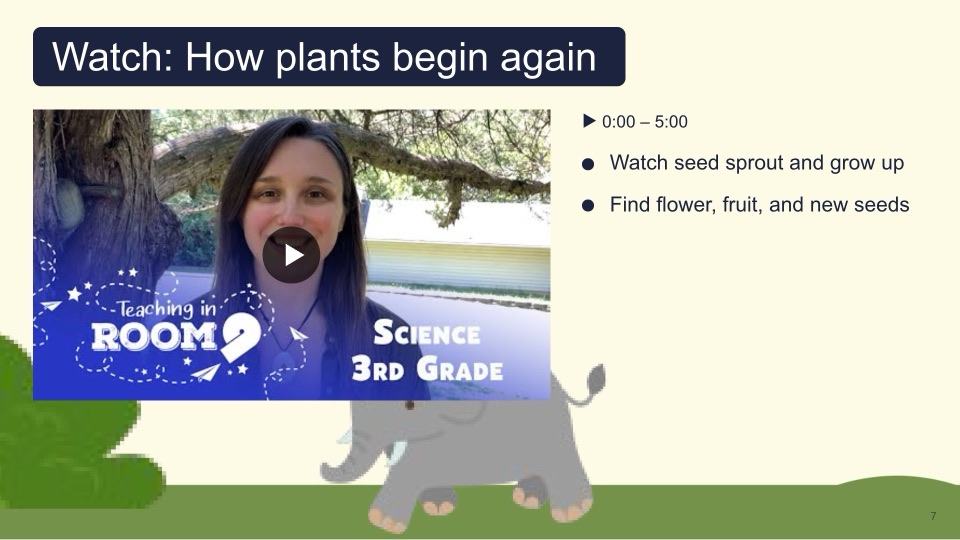
| 15 min | Video Focus | Show unique plant and animal cycles that share the same four steps. Show Slide 5 and play Video clip 1 (0:00–1:51); tell students to spot birth, growth, reproduction, and death. Pause and list one different start and one different way to grow they noticed. Show Slide 7 and play Video clip 4 (0:00–5:00); tell students to watch seed sprout and find flower, fruit, and new seeds. Compare plant and animal starts on the board. |
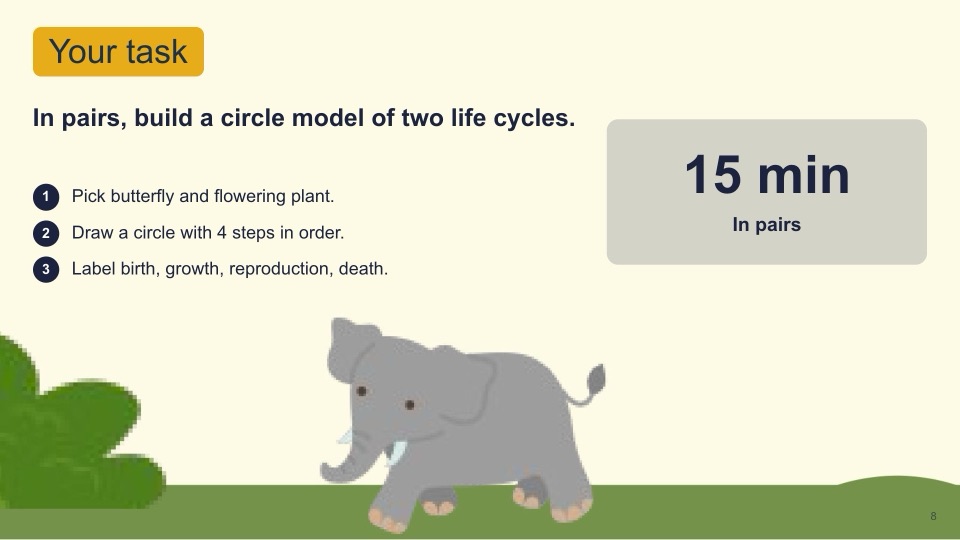
| 20 min | Main Activity | Build circle models that prove different life cycles share the same four steps. Show Slide 8 and explain the task: pick butterfly and flowering plant, draw a circle with 4 steps in order. Hand out 4-stage circle mats, picture cards of butterfly and flowering plant, and glue. Model one circle for butterfly, placing egg, caterpillar, chrysalis, adult in order. Circulate, check labels birth, growth, reproduction, death, and have pairs tell one difference. |
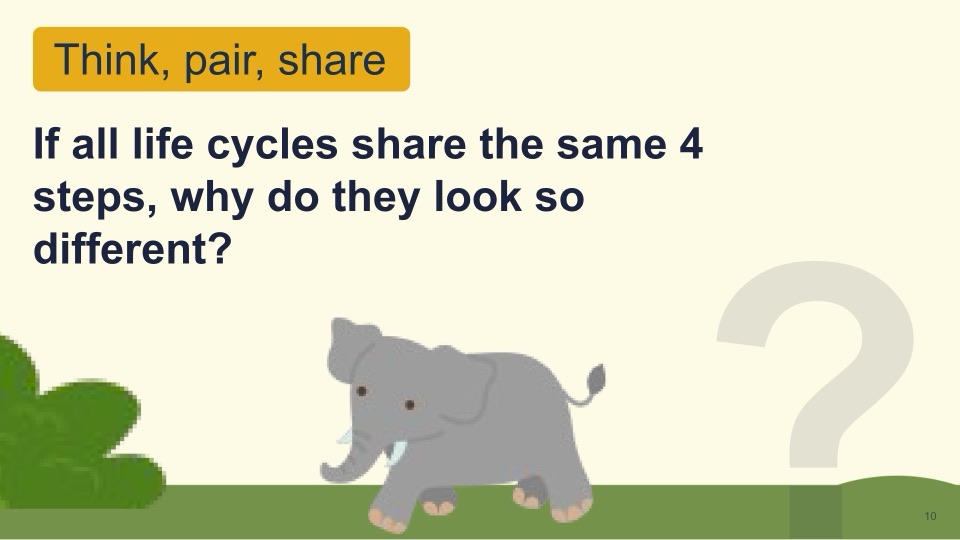
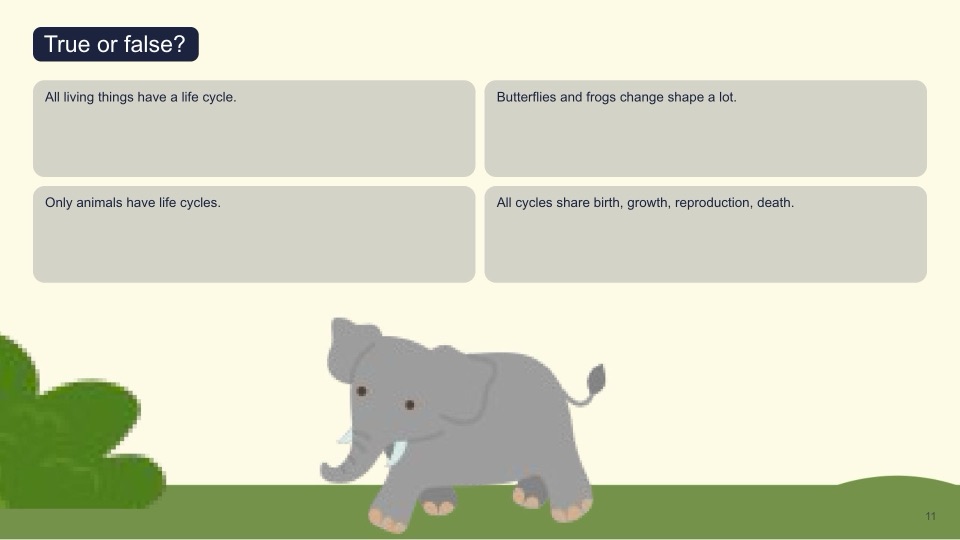
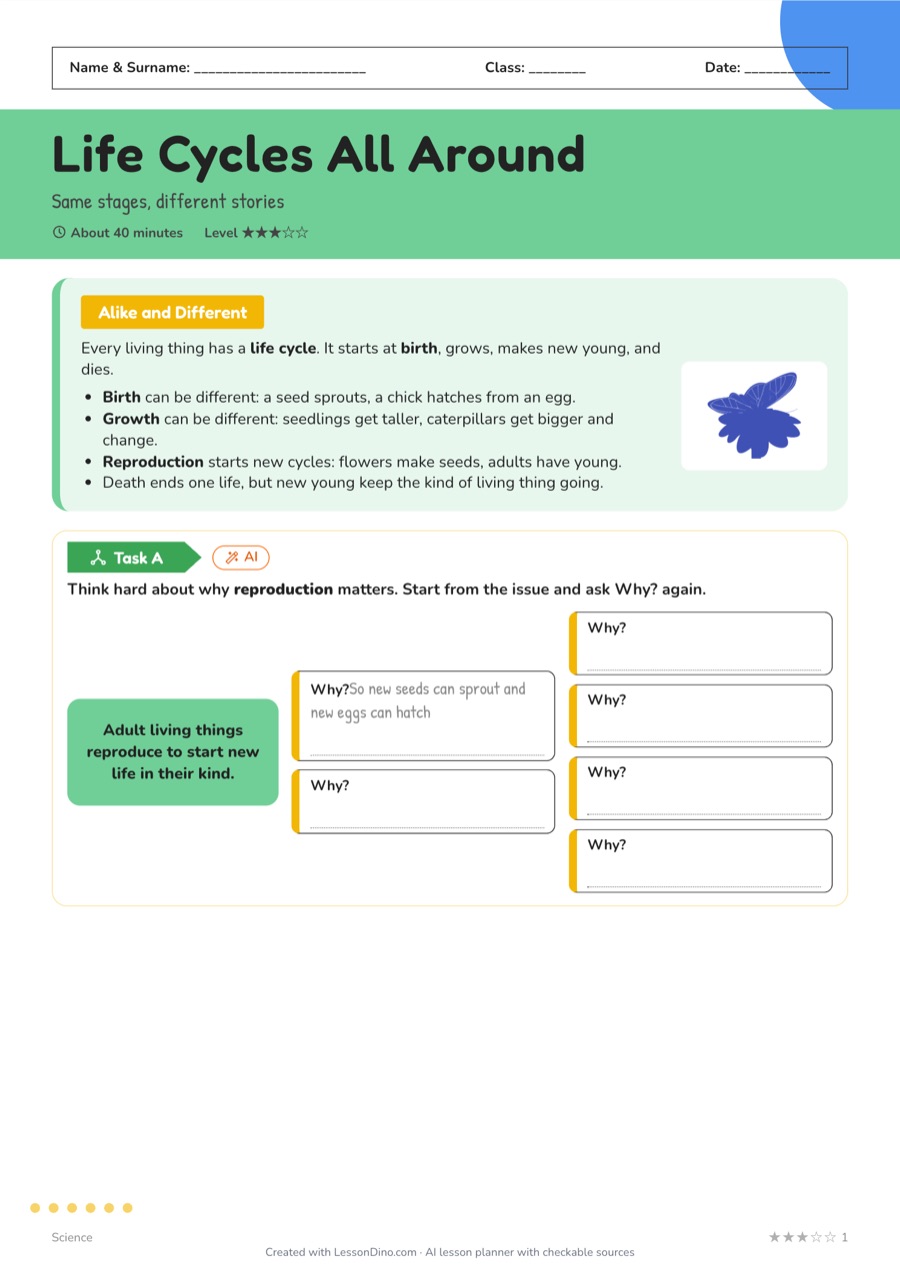
| 10 min | Plenary | Check that unique cycles share birth, growth, reproduction, and death. Show Slide 10 and lead think, pair, share: If all share the same 4 steps, why do they look so different? Show Slide 11 and read each true or false line together for life cycles, plants and animals, and metamorphosis. Have students finish the last column of Worksheet Task B about what they modeled. Sum up same four steps with different details. |
Common mistakes
- Thinking death ends the cycle so it cannot restart
How to spot it: Circle model has no arrow back or student says cycle stops
Show new birth from reproduction: new eggs that hatch or seeds that sprout start the next loop. - Thinking all babies look like small adults
How to spot it: Student labels caterpillar or tadpole as tiny adult
Contrast grow-bigger with change-form: some become bigger versions of the baby, others change completely through metamorphosis, a series of physical changes. - Mixing up order of growth and reproduction
How to spot it: Adult egg-laying placed before growing bigger
Retrace in order: birth, then increase in size and weight, then develop seeds or mate and lay eggs, then death.
Support
- Give pre-labeled mats with the four stage words and matching color dots for each card.
Stretch
- Write one sentence comparing how two organisms reproduce in different ways.
Check questions
- Name the four steps every life cycle shares.
Answer: Birth, growth, reproduction, and death. - Give one way birth can look different in two organisms.
Answer: One sprouts from a seed and one hatches from an egg. - Put this butterfly order right: adult, egg, chrysalis, caterpillar.
Answer: Egg, caterpillar, chrysalis, adult.
Curriculum
Develop models to describe that organisms have unique and diverse life cycles but all have in common birth, growth, reproduction, and death.
Video clips
Clips on YouTube, from the start and end times we chose. Check each one before you show it.
-
Grades 3-5 life cycles intro from 0:00 to 1:51
GenerationGenius: Life Cycles Video Lesson for Kids | Grades 3-5 | Mini-Clip
Made for grades 3-5 so language and pace are perfect for ages 8-9 and it covers the core idea of diverse cycles with common stages.
-
Plant life cycles over time from 0:00 to 5:00
Nine PBS: Change Over Time- Plant Life Cycles | 3rd Grade Science | Teaching In Room 9
Labeled for 3rd grade science so it suits ages 8-9 and adds plant examples to show diversity beyond animals.
Worksheet
Sources
- Core Science Concepts | Grade 3 Curriculum | The Inquiry Project inquiryproject.terc.edu
- Download the Lesson List science.edu
- Life Cycles - Teachers (U.S. National Park Service) nps.gov
- Life Cycles - WHOI Sea Grant seagrant.whoi.edu
- Know the life cycles of plants — annuals, biennials and ... extension.oregonstate.edu
- What is a life cycle? – KS2 Science curriculum - BBC Bitesize bbc.co.uk
- What is a life cycle? - BBC Bitesize bbc.co.uk
- life cycle - Kids | Britannica Kids | Homework Help kids.britannica.com
- Young Geniuses and Old Masters: The Life Cycles of Great Artists… nber.org
- The butterfly life cycle! - National Geographic Kids natgeokids.com
- [2605.12738] Project Life Cycles in Open-Source Software arxiv.org
- Understanding Life Cycles in Simple Terms for Kids learnwisedaily.com
- What Are Life Cycles? – Explained for Kids | SmartOnlineGames smartonlinegames.com
- Interactive Life Cycle Diagrams Of Animals & Plants ecosystemforkids.com
- Life Cycles of Animals for Kids - Kids World Fun kidsworldfun.com
- Life Cycles - Crossword Puzzle crosswords.brightsprout.com
- All About Animal Life Cycles videolibrarian.com
- Life Cycles (BookLife Non-Fiction Readers) - Louise Nelson: 9781801558204 - AbeBooks abebooks.com
- Different Types of Cicada Life Cycles – Cicada Mania cicadamania.com
- What Are Some United States Traditions Through Life Cycles? snippets.com
- What is a life cycle explained to kids? - The Institute for ... iere.org
- Cycle of abuse en.wikipedia.org
Picture credits
Made with Lesson Dino's AI on 17 October 2026. AI can make mistakes, so check facts against the sources before you teach.