Slides
Lesson plan
Around We Go With Perimeter
Students learn to add sides to find perimeter and find a missing side. They build rectangles to compare area and perimeter.
Objectives
- Students will find the perimeter of polygons by adding all side lengths.
- Students will find an unknown side length when the perimeter is known.
- Students will build rectangles with the same area but different perimeters.
Success criteria
- I can add all sides to find the perimeter with correct units.
- I can subtract known sides from the perimeter to find a missing side.
- I can show two rectangles with the same area but different perimeters.
Key words
| Word | Meaning |
|---|---|
| perimeter | distance around the outside of a flat shape |
| polygon | closed flat shape made only with straight edges |
| area | amount of space inside a flat shape |
| subtract | take away one number from another to find what is left |
Timed plan (60 minutes)
| Time | Stage | What happens |
|---|---|---|
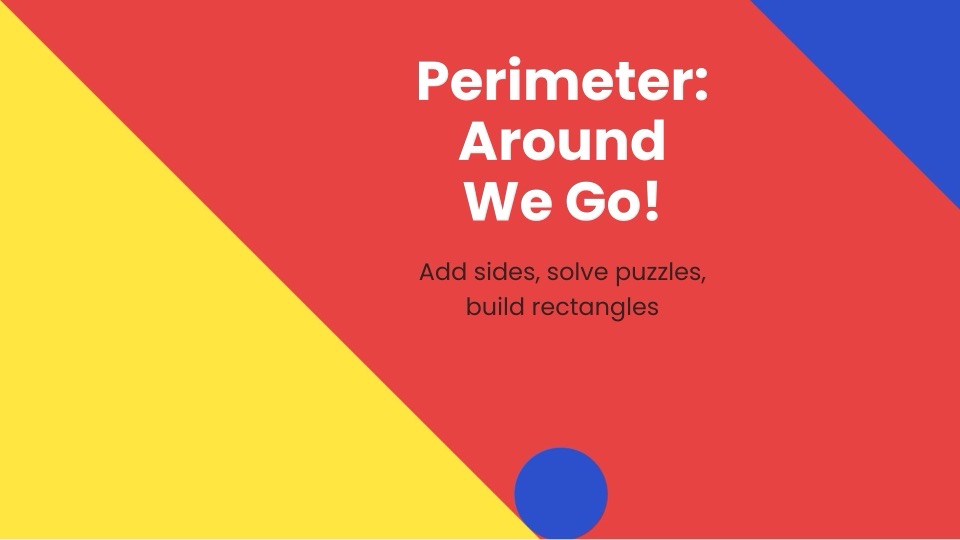
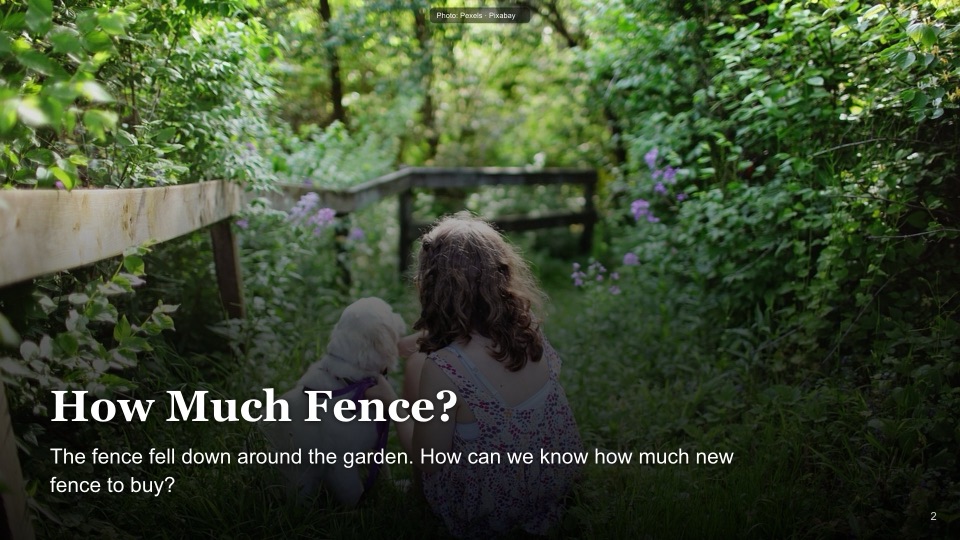
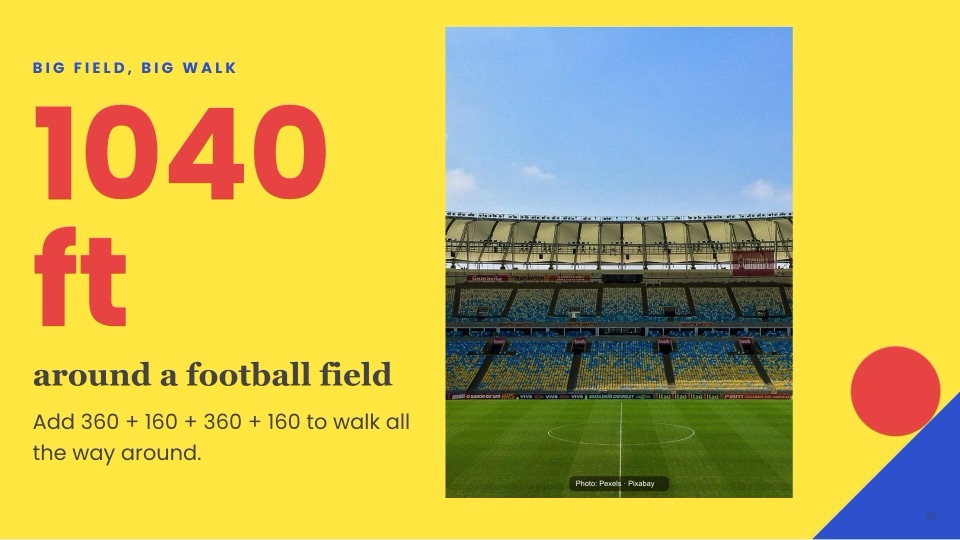
| 8 min | Starter | Hook students with rugs and fences and recall that perimeter is distance around. Show Slide 1 Perimeter: Around We Go! and read the hook from the main activity: Can two rugs cover the same floor space but need different amounts of trim around them? Show Slide 2 How Much Fence? and explain the fence fell down around the garden and we need to know how much new fence to buy. Ask students to trace the edge of their desk with a finger, starting at one corner and stopping back at the same corner. Take quick answers on what they traced: the edge or the middle. |
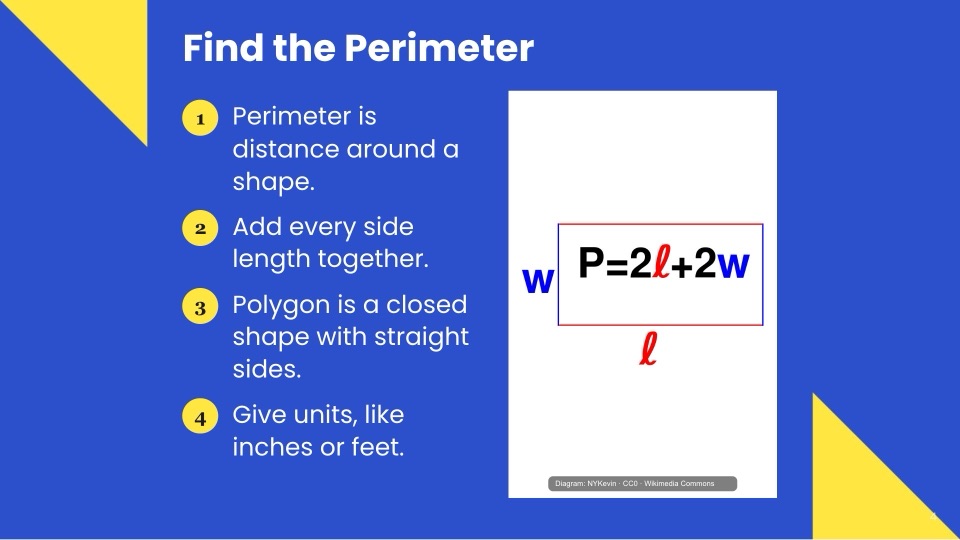
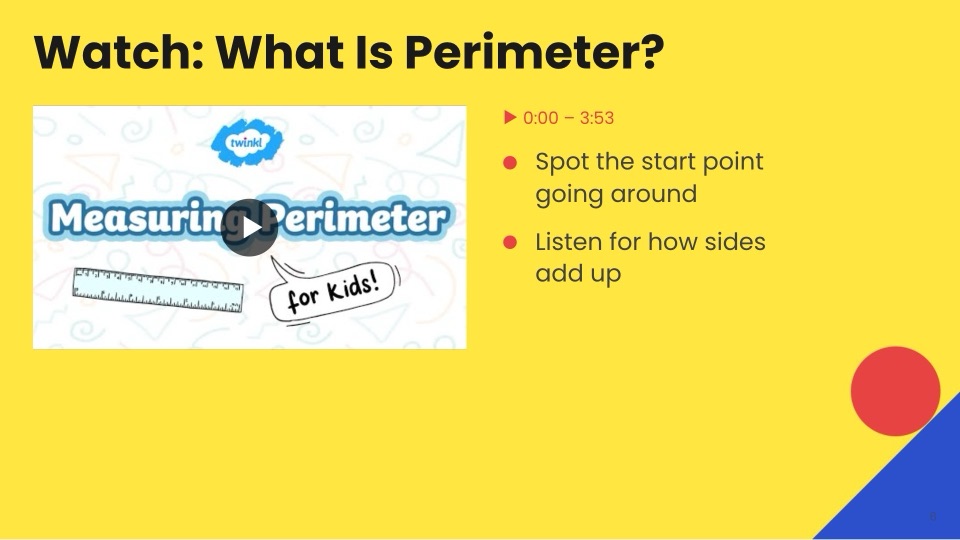
| 12 min | Teaching | Model how to add all sides to find perimeter with correct units. Show Slide 3 Did you know? and Slide 4 Find the Perimeter and read the bullets together. Play Video clip 1 (0:00–3:53) on Slide 6. Tell students to spot the start point going around and listen for how sides add up. Model the triangle from Slide 5 step by step on the board, marking a start dot and ticking each side. Think aloud the opposite-sides rule for rectangles to save measuring. |
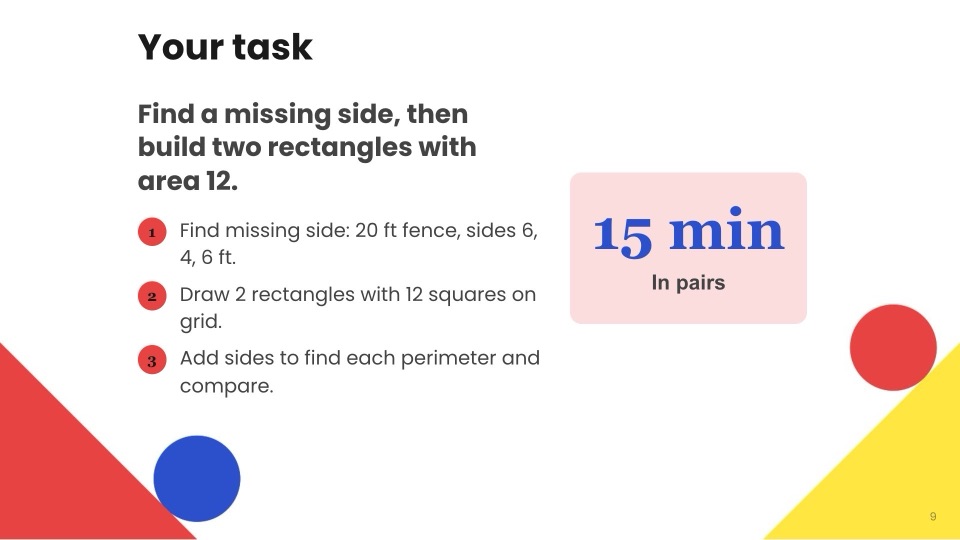
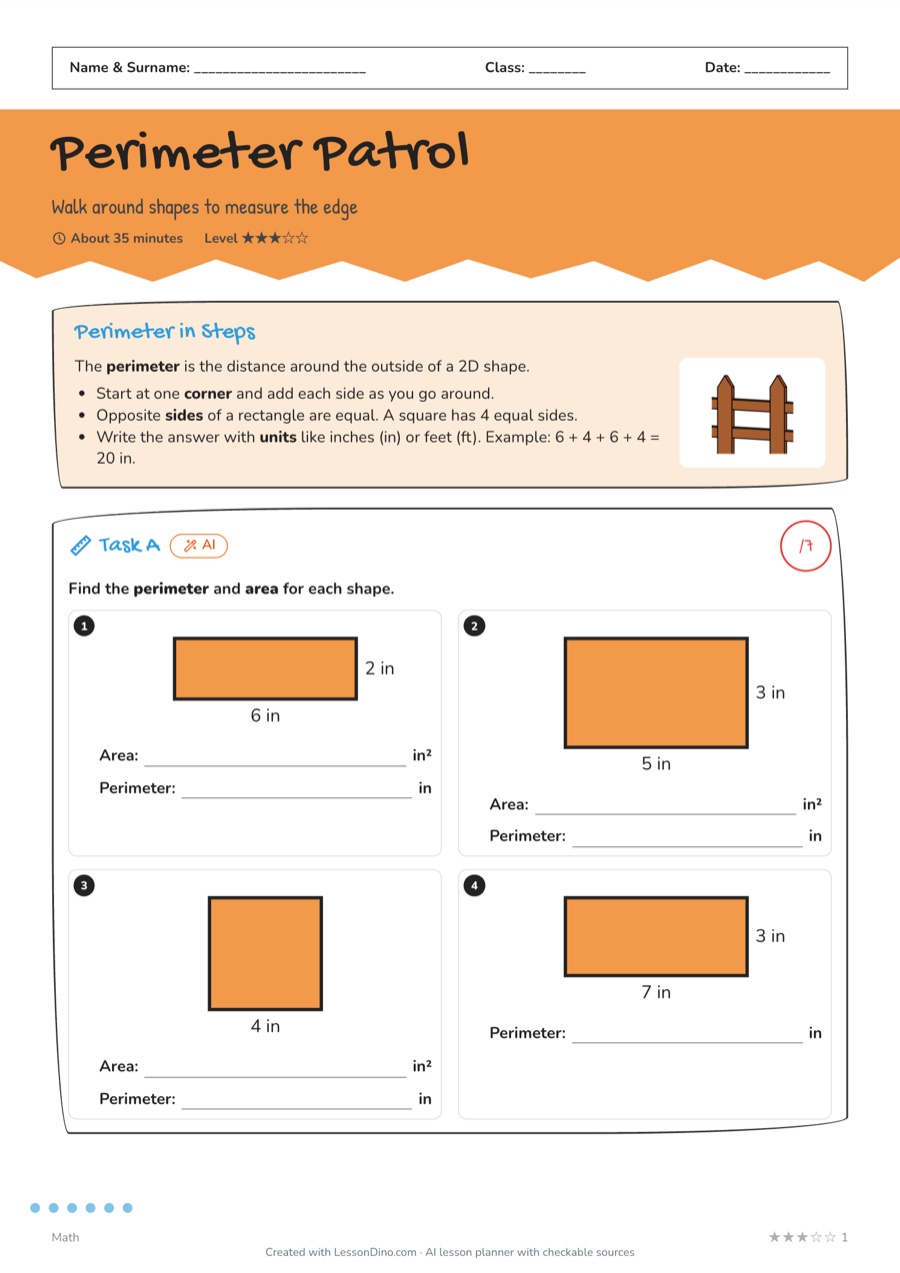
| 10 min | Guided practice | Practice adding sides and subtracting to find a missing side length. Show Slide 5 Think, pair, share triangle question and have pairs solve Worksheet Task B: Practice questions: Add all the sides to find the perimeter. Model a fence with perimeter 20 ft and known sides 6 ft, 4 ft, 6 ft. Add known sides, then subtract from total. Have pairs solve one triangle with perimeter 18 in. and sides 6 in. and 7 in. Connect to real uses like determining the length of fence needed for a backyard. |
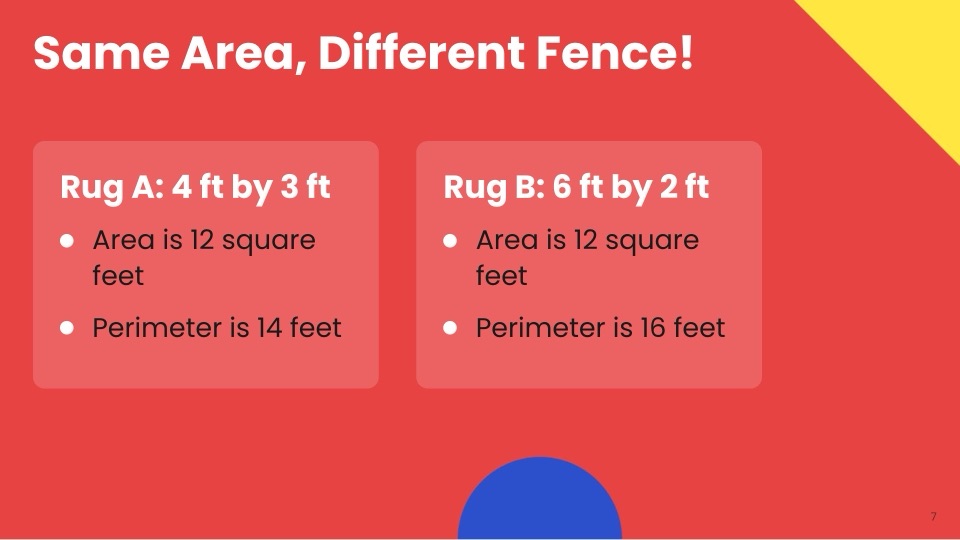
| 20 min | Main activity | Build two rectangles with the same area to show perimeters can differ. Show Slide 7 Same Area, Different Fence! and read Rug A and Rug B facts together. Hand out 12 tiles, grid paper and crayons. Pairs build a 4 by 3 rug and a 6 by 2 rug with tiles. Show Slide 9 Your task: Draw 2 rectangles with 12 squares on grid. Add sides to find each perimeter and compare. Have pairs trace around to find the total distance around, add sides, and do Worksheet Task D: Practice questions: Use perimeter and area to compare rectangles. |
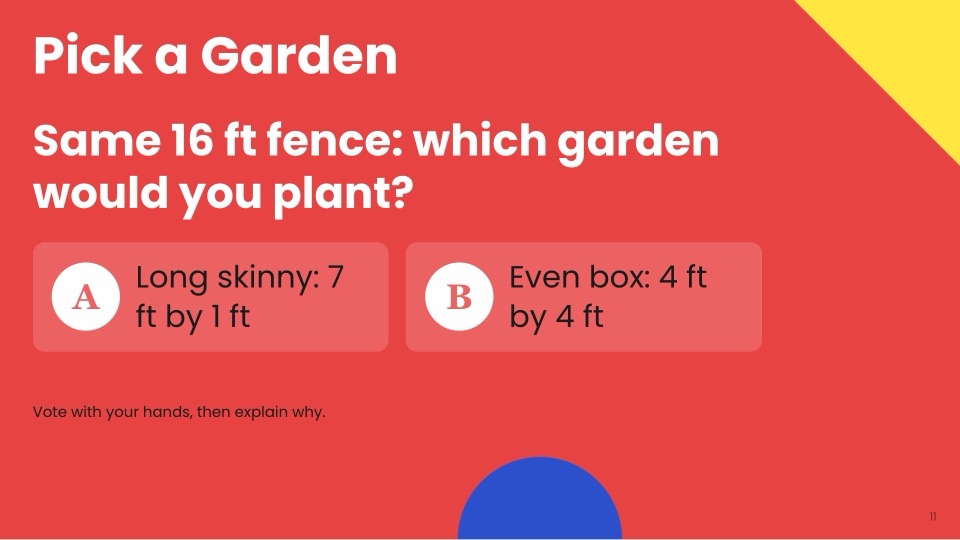
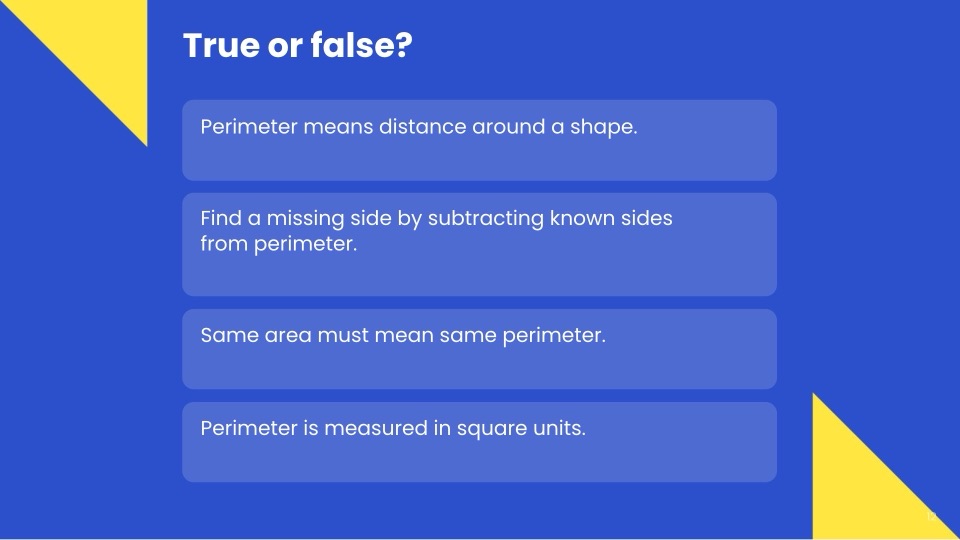
| 10 min | Plenary | Check all three goals and show same fence can make different gardens. Show Slide 11 Pick a Garden: Same 16 ft fence: which garden would you plant? Long skinny 7 ft by 1 ft and Even box 4 ft by 4 ft. Add sides together as a class to prove both are 16 ft but inside squares differ. Show Slide 12 True or false? and vote on each line. Give exit ticket on whiteboards. |
Common mistakes
- Counting a side twice or missing a side
How to spot it: Total too big or too small; ticks do not return to start dot
Mark a start point and tick each side once going around back to the same point. - Mixing perimeter and area
How to spot it: Student counts inside squares for fence or writes square units for perimeter
Trace only the outside edge for perimeter; perimeter is linear units like inches or feet and area is square units. - Adding only known sides to find missing side
How to spot it: Student answers known sum instead of subtracting from total
Add known side lengths together, then subtract the total from the perimeter.
Support
- Start both rectangles for them on grid paper and let them finish with tiles, then count units around the outside edge only once.
- Provide garden outline already drawn with two sides labeled and use equal opposites to fill others.
- Use whiteboard number line to count up from known sum to perimeter total.
Stretch
- Ask students to try to build a third rectangle with 12 tiles and compare its perimeter.
- Test three different rectangles with perimeter 24 and order them from smallest to largest inside space.
- Challenge students to write their own missing-side fence puzzle for a partner.
Check questions
- A triangle has sides 3 in., 4 in., 5 in. What is its perimeter?
Answer: 3 + 4 + 5 = 12 in. - A fence polygon has perimeter 20 ft and known sides 6 ft, 4 ft, 6 ft. What is the missing side?
Answer: 4 ft because 6 + 4 + 6 = 16 and 20 - 16 = 4 - Rug A 4 ft by 3 ft and Rug B 6 ft by 2 ft both have area 12 square feet. Which has the greater perimeter?
Answer: Rug B with 16 ft versus Rug A with 14 ft.
Curriculum
Solve real world and mathematical problems involving perimeters of polygons, including finding the perimeter given the side lengths, finding an unknown side length, and exhibiting rectangles with the same perimeter and different areas or with the same area and different perimeters.
Video clips
Clips on YouTube, from the start and end times we chose. Check each one before you show it.
-
What is Perimeter from 0:00 to 3:53
Twinkl Teaching Resources - United States: Perimeter for Kids | What is Perimeter | Math Lesson Video | Twinkl USA
Made by Twinkl USA for Grade 3 ages 8-9, it clearly defines perimeter and adds side lengths.
-
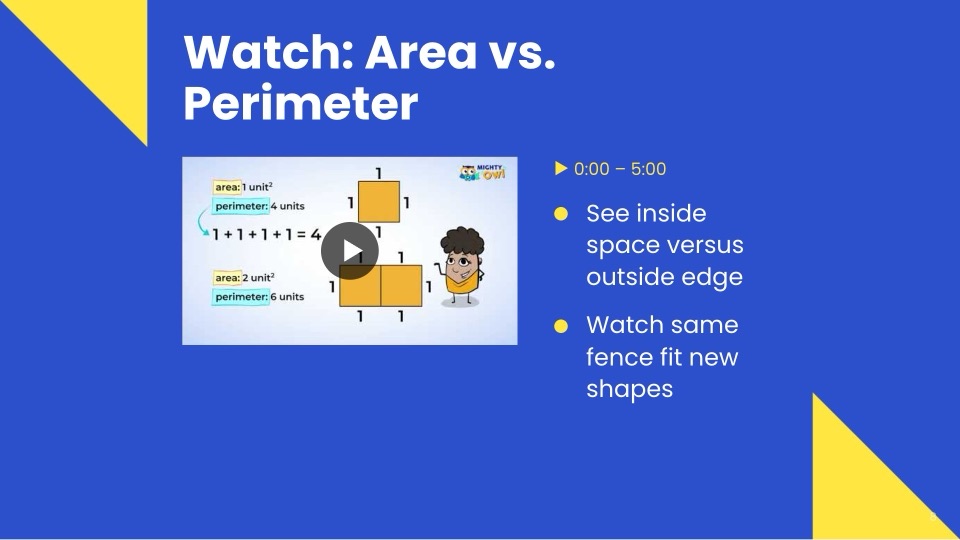
Area vs. Perimeter 3rd Grade from 0:00 to 5:00
MightyOwl: Area vs. Perimeter | MightyOwl Math | 3rd Grade
Made for 3rd grade ages 8-9, it contrasts area and perimeter and helps with same-perimeter different-area ideas.
Worksheet
Sources
- Grade 3 » Introduction | Common Core State Standards Initiative thecorestandards.org
- 2025-2026 3rd grade Math Curriculum boepublic.parkhill.k12.mo.us
- Perimeter - KS3 Maths - BBC Bitesize bbc.co.uk
- What is the perimeter of a 2D shape? - BBC Bitesize bbc.co.uk
- Kids Math: Perimeter - Ducksters ducksters.com
- Perimeter Facts for Kids kids.kiddle.co
- Know that the perimeter is the distance around a 2D shape thenational.academy
- Flexi answers - How to find perimeter of a shape? | CK-12 Foundation ck12.org
- Unit 1: Intro to area and perimeter - Khan Academy khanacademy.org
- Perimeter Explained for Kids: Story, Facts & Activities ... mystorypie.com
- Area and Perimeter | Math Concepts for Kids kidsworldfun.com
- Intro to Perimeter Math Videos for Kids - 3rd, 4th, & 5th Grades generationgenius.com
- Perimeter - Class Playground classplayground.com
- Perimeter = Distance Around OUTSIDE! Educational Resources K12 Learning, Measurement and Data, Math Lesson Plans, Activities, Experiments, Homeschool Help elephango.com
- Perimeter and Circumference – Mathematics for Elementary Education II openwa.pressbooks.pub
- Perimeter Solutions Completes Redomicile from Luxembourg to the U.S | Nasdaq nasdaq.com
- "From Greenland to Guyana, our security perimeter is one hemisphere": Pete Hegseth unveils 'Greater North America' strategy indianeconomicobserver.com
- What Is Perimeter? A Kid-Friendly Math Definition mathnasium.com
- What Is the Perimeter? | Formulas, Definition & Examples - Twinkl twinkl.com.au
Picture credits
- Photo: OnzeCreativitijd · Pixabay
- Photo: Pexels · Pixabay
- Illustration: flutie8211 · Pixabay
- Diagram: NYKevin · CC0 · Wikimedia Commons
- Illustration: stux · Pixabay
- Photo: Pexels · Pixabay
- Pictograms: Sergio Palao, ARASAAC (arasaac.org) · CC BY-NC-SA
Made with Lesson Dino's AI on 17 October 2026. AI can make mistakes, so check facts against the sources before you teach.