Slides
Lesson plan
Word Detectives Crack New Words
Students learn to use sentence clues to figure out new words. They act as detectives with magnifiers and solve word mysteries.
Objectives
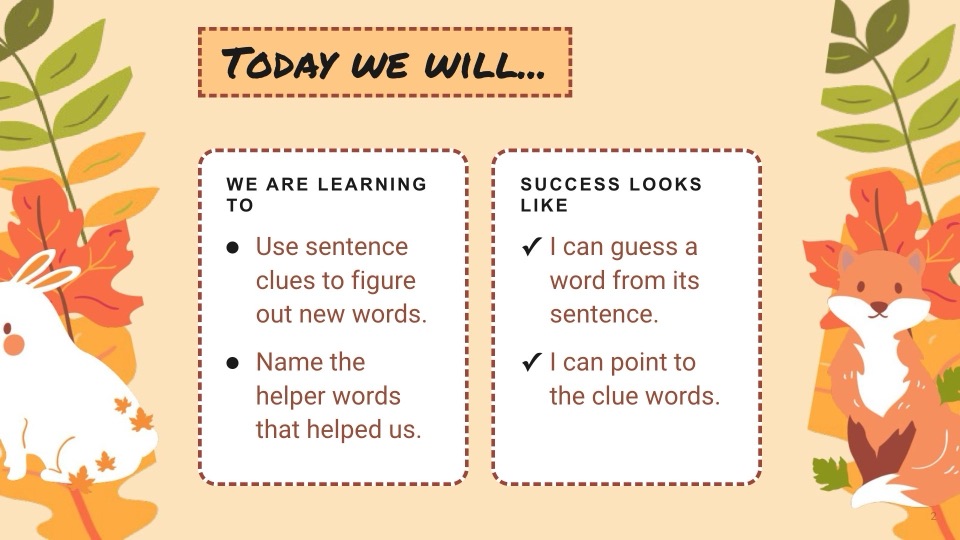
- Students will use sentence clues to figure out unknown words’ meanings.
- Students will point to helper words that show the word’s meaning.
- Students will check guesses by putting them back in the sentence.
Success criteria
- I can guess a word from its sentence.
- I can point to the clue words.
- I can check if my guess makes sense.
Key words
| Word | Meaning |
|---|---|
| context clue | a hint in nearby words that shows what a new word means |
| synonym | a nearby word that means almost the same thing |
| antonym | a nearby word that means the opposite thing |
| definition | words that tell what something is or means |
| example | one or more things that show what a word is about |
Timed plan (60 minutes)
| Time | Stage | What happens |
|---|---|---|
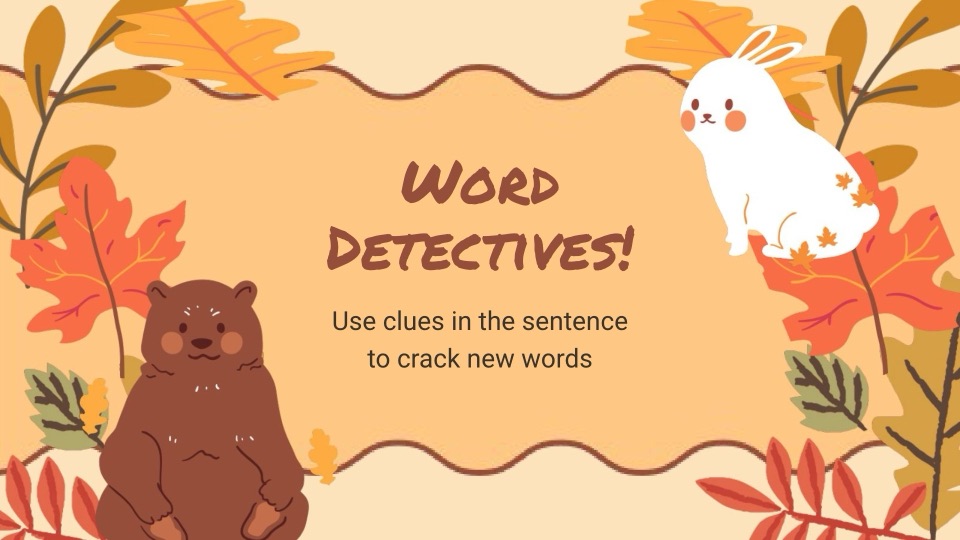
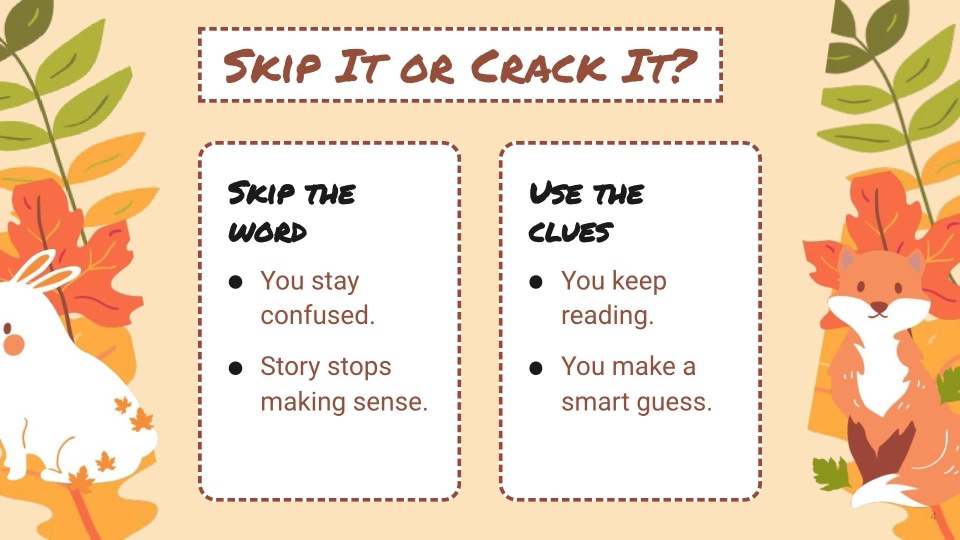
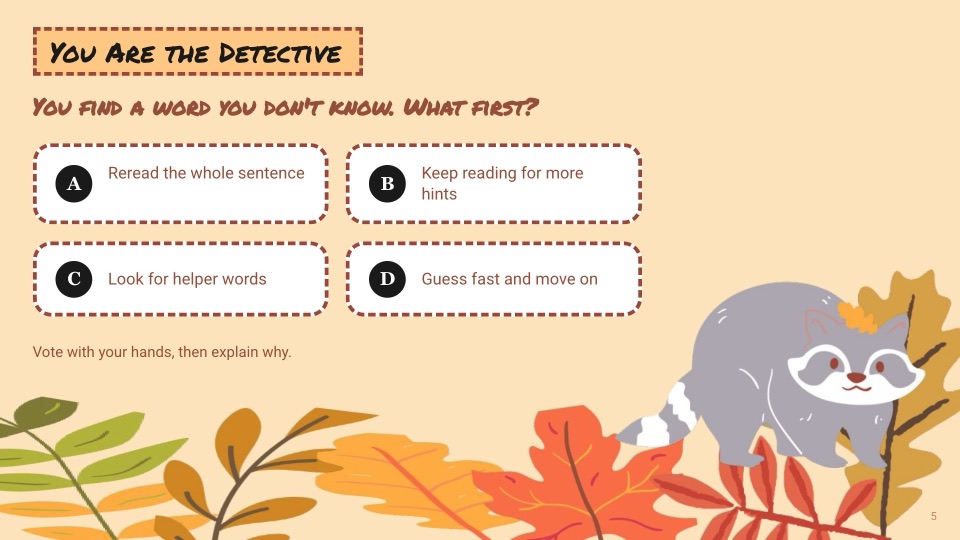
| 10 min | Starter | Hook students as word detectives and recall what to do with a hard word. Welcome class with Slide 1 Word Detectives! and read its line: Use clues in the sentence to crack new words. Show Slide 2 Today we will and read objectives: Use sentence clues to figure out new words. Show Slide 4 Skip It or Crack It? and Slide 5 vote question: You find a word you don't know. What first? Take votes for Reread the whole sentence, Keep reading for more hints, Look for helper words, Guess fast and move on, then praise looking and rereading. |
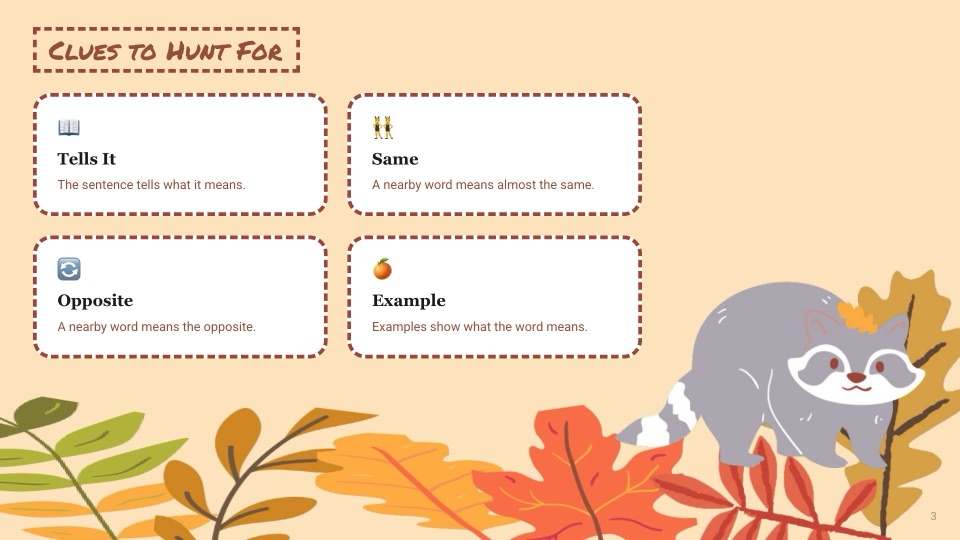
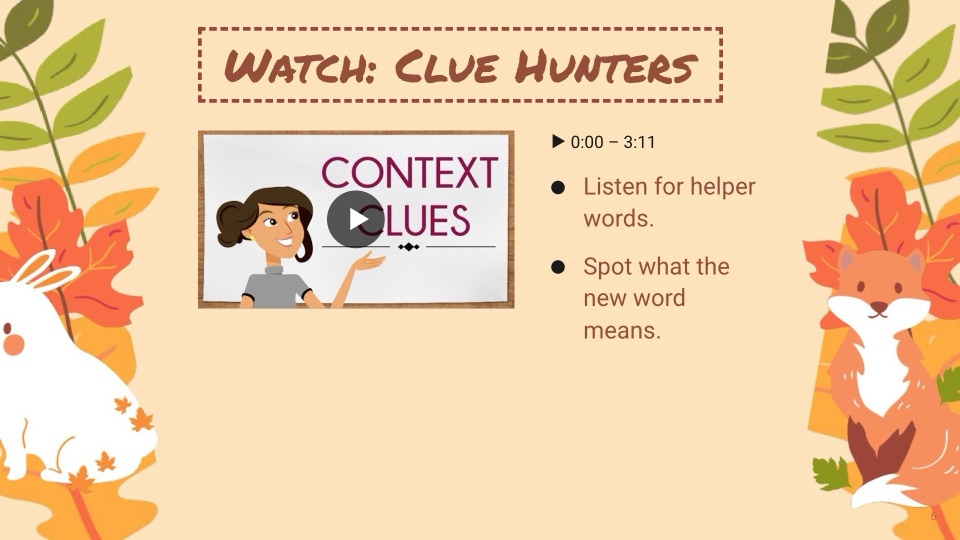
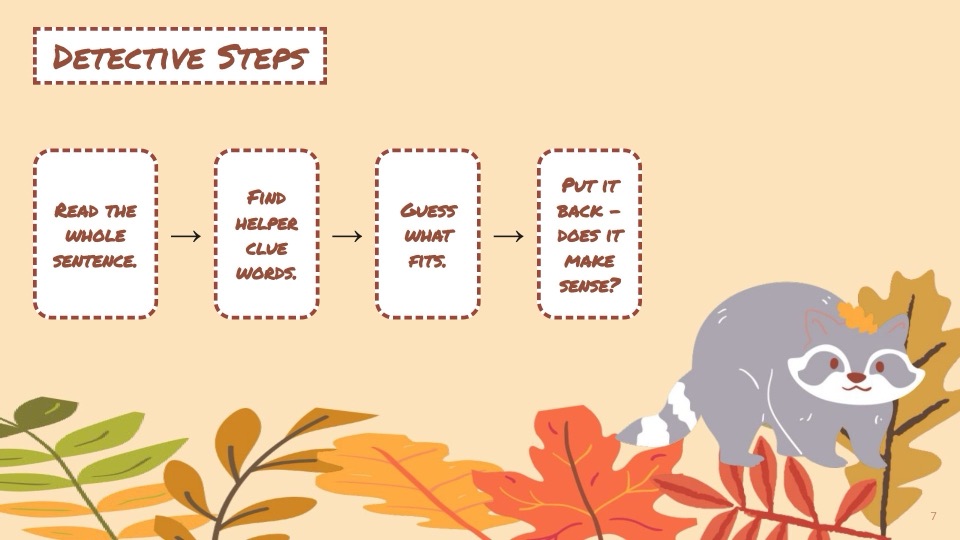
| 15 min | Teaching | Model the four detective steps for using same-sentence clues. Show Slide 3 Clues to Hunt For and explain same-meaning, opposite, telling, and example helpers, since clues typically fall into synonym, antonym, example, and general sense. Play Video clip 6 Context Clues for Kids (0:00-3:11) on Slide 6 and tell students to listen for helper words. Show Slide 7 chain and model steps on the board: underline the unknown word, reread that sentence, look for clues, guess and put it back to see if it makes sense. Remind that the clue may appear within the same sentence as the word. Think aloud the worked example and substitute the guess back to check it. |
| 20 min | Main activity | Practise in pairs to guess words using same-sentence clues. Give each pair a paper magnifier, three-box sheet, and three strips made only from the passage: exhausted sentence, gloomy sentence, and fragile sentences. Remind pairs to underline the unknown word, reread that sentence, look for clues, guess and check by substitution. Circulate, prompt with What words helped you? and ask pairs to swap guesses back into the sentence to see if it makes sense. Stop after 15 minutes and have two pairs share one word, clue, and guess. |
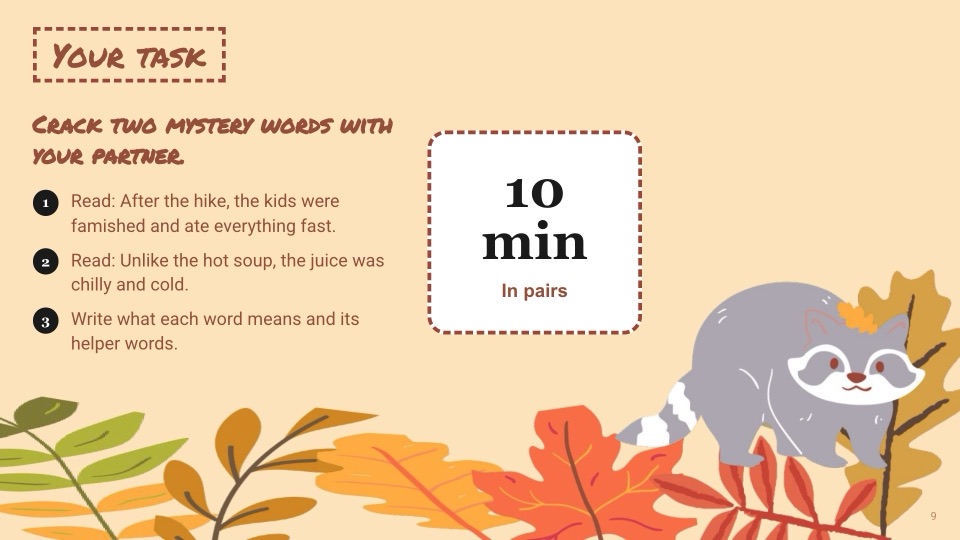
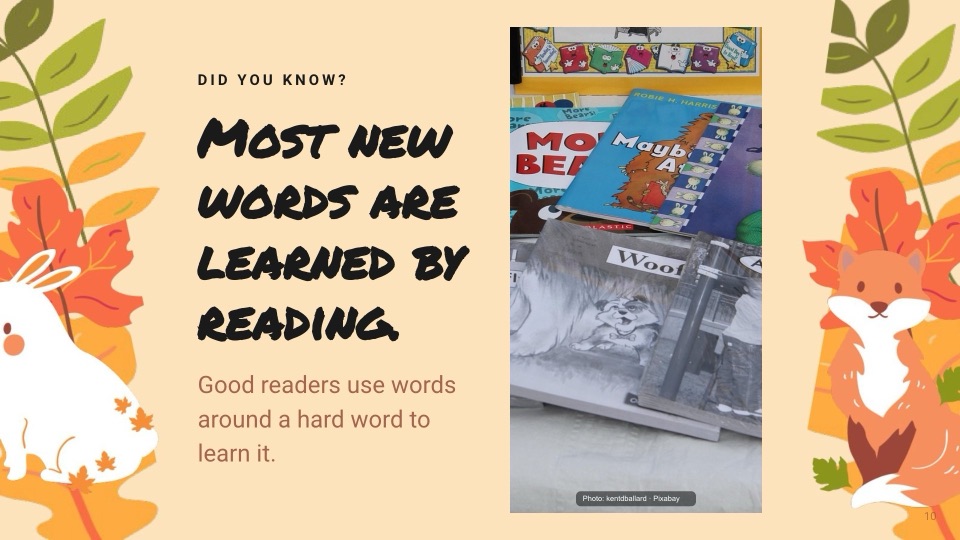
| 10 min | Practice | Apply the steps alone to two new sentence clues. Show Slide 9 and read both lines exactly: After the hike, the kids were famished and ate everything fast. Unlike the hot soup, the juice was chilly and cold. Ask students to write what each word means and underline what helped, using the general sense of the sentence as a clue when needed. Show Slide 10 and remind them that context clues are hints in the surrounding text that help figure out an unfamiliar word. Collect two quick answers and model the swap check for chilly. |
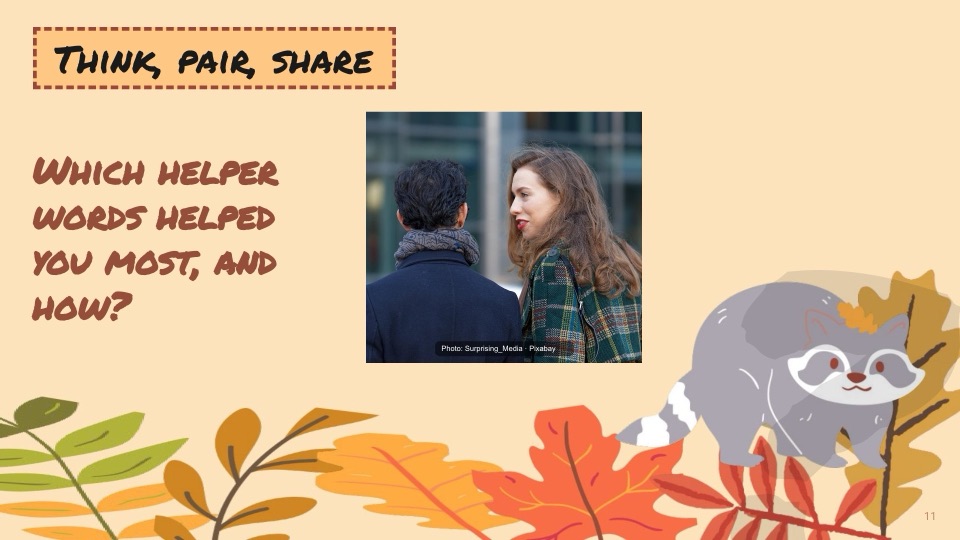
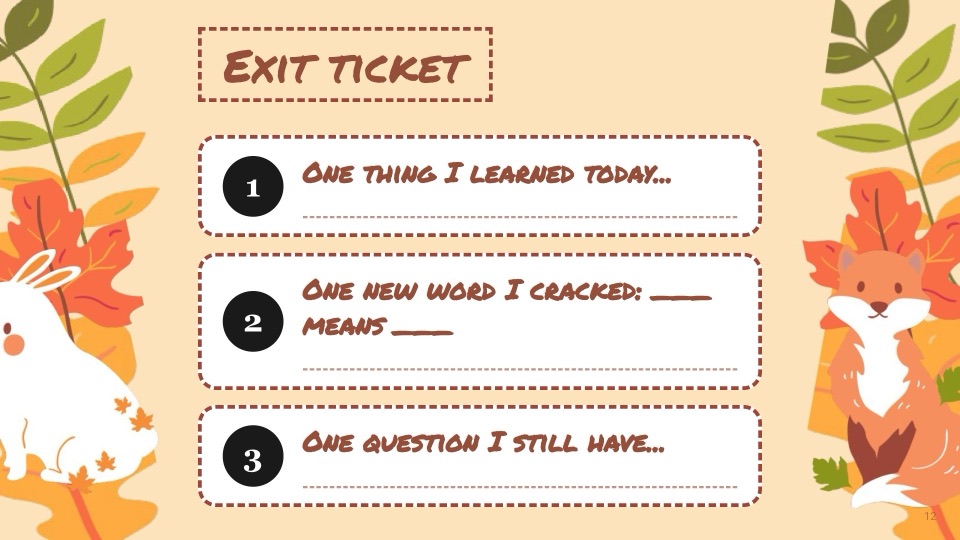
| 5 min | Plenary | Review which helpers worked best and check the objectives. Show Slide 11 Think, pair, share and ask: Which helper words helped you most, and how? Take two pair answers: same word, opposite, telling, or example. Show Slide 12 Exit ticket and have students say or write: One new word I cracked means clue. |
Common mistakes
- Guessing fast without rereading the whole sentence
How to spot it: Guess does not fit when put back, or no clue words underlined
Reread the sentence with the unknown word and the sentences around it and look for clues, then substitute the guess to see if it makes sense. - Mixing opposite clues with same-meaning clues
How to spot it: Student says chilly means hot because they missed Unlike
Look for but, however, yet, and unlike that show a contrast and signal an antonym with opposite meaning. - Looking outside the sentence when the clue is inside
How to spot it: Student says I cannot find it though or, comma, or examples are in the same sentence
Zoom in first: the clue may appear within the same sentence as the word, often set off by a comma or or.
Support
- Pre-underline clue words on strips and keep Slide 7 steps visible
- Provide sentence frame: I think ___ means ___ because I read ___
Stretch
- Name clue as synonym, antonym, or example and find the signal word
- Write a new sentence with a strong same-sentence clue for a known word
Check questions
- After one mile, they felt exhausted, or very, very tired. What does exhausted mean?
Answer: very, very tired - Unlike the rough, bumpy trail, the way back felt smooth and easy. What does smooth mean here and what word signals it?
Answer: easy / not rough and bumpy; Unlike signals opposite - Inside was a map that felt fragile. It would tear very easily. How do you check your guess for fragile?
Answer: Put it back: a map that tears very easily — it makes sense
Curriculum
Use sentence-level context as a clue to the meaning of a word or phrase.
Video clips
Clips on YouTube, from the start and end times we chose. Check each one before you show it.
-
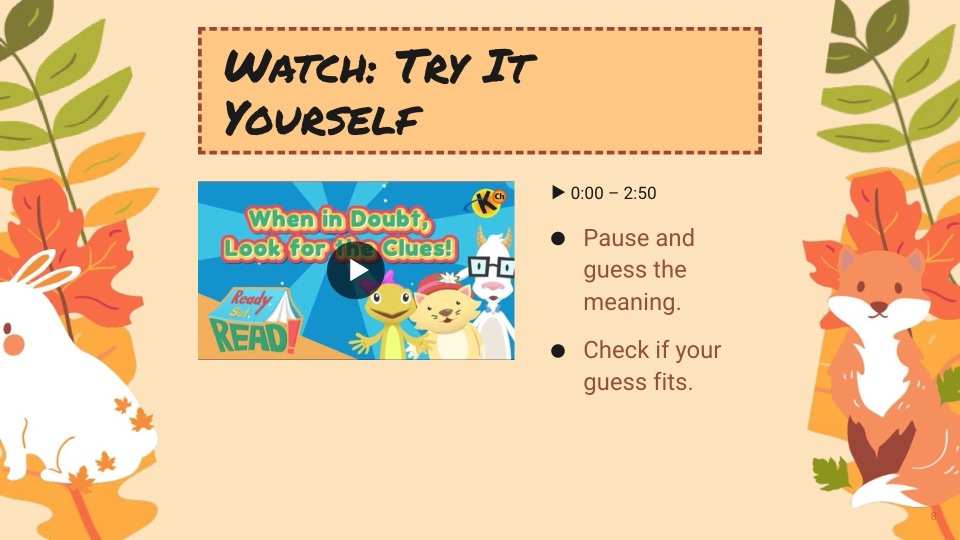
Context Clues in Sentences from 0:00 to 2:50
Knowledge Channel: Context Clues in Sentences | Ready, Set, Read!
Directly teaches sentence-level clues with simple sentences ideal for ages 8-9.
-
Context Clues for Kids from 0:00 to 3:11
Mind Blooming: Context Clues | English For Kids | Mind Blooming
Bright kid-style explainer focused on sentence clues, perfect for Grade 3 ages 8-9.
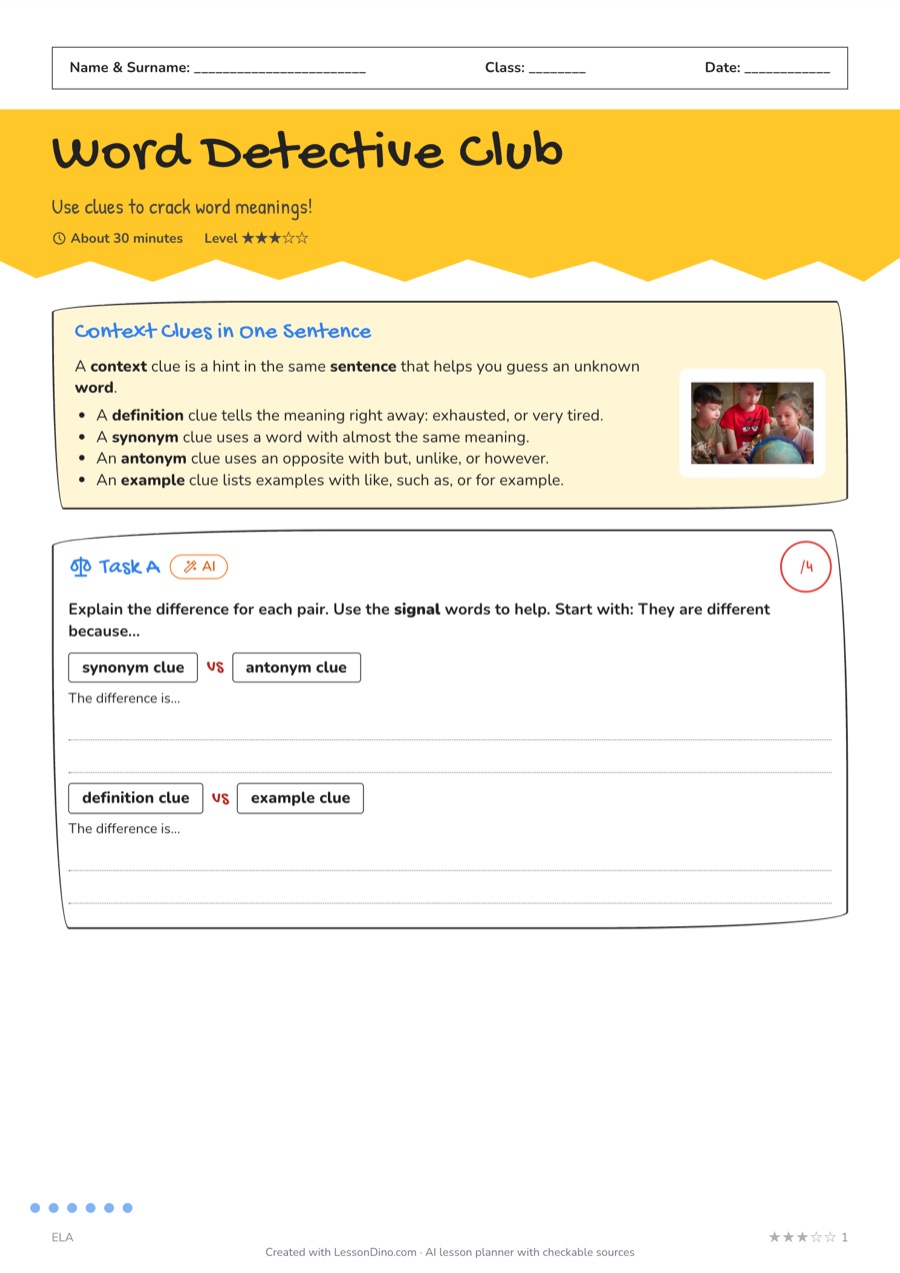
Worksheet
Sources
- English Language Arts Standards » Language » Grade 3 thecorestandards.org
- LearnZillion EL Education Language Arts Correlation Guide Grade 3 ortn.edu
- Context Clues - Cal Poly Pomona cpp.edu
- Steps for Using Context Clues to Determine Word Meanings nces.ed.gov
- 2.7 Using Context Clues – Say It Well: Writing for Real-World ... pressbooks.lib.vt.edu
- Context Clues | Pennsylvania Center for the Book pabook.libraries.psu.edu
- 3.6 Using Context Clues - Open Textbook Library open.lib.umn.edu
- Vocabulary, Context Clues, and Acquiring a Word - The ... libguides.daltonstate.edu
- Context Clues: Types and Examples for Kids (Grades 2-5) whatihavelearnedteaching.com
- The Complete Guide to Context Clues Lessons - Teaching with a ... teachingwithamountainview.com
- Context Clues Worksheets | Printable Vocabulary Inference ... englishlinx.com
- Context Clues: A Free Interactive Lesson | Upper Elementary ... upperelementarysnapshots.com
- Free & Printable Context Clues Worksheets for 3rd to 8th Grades lumoslearning.com
- Use These Context Clues Anchor Charts To Help Kids Master ... weareteachers.com
- IXL | Learn context clues ixl.com
- Context Clues and Vocabulary - MAP 4th Grade Reading Content | My Learning students.varsitytutors.com
- Scientific Text Context Clues - Gameshow quiz wordwall.net
- Context Clues: Definition, 50+ Examples & 5 Types (K-8) readingvine.com
- What are Context Clues? Inference Context Clues Examples - Twinkl twinkl.co.uk
- Context Clue Graphic Organizer - Iowa Reading Research Center irrc.education.uiowa.edu
- Context Clues – ENG114 KnowledgePath – Critical Reading and ... open.baypath.edu
Picture credits
Made with Lesson Dino's AI on 17 October 2026. AI can make mistakes, so check facts against the sources before you teach.