The worksheet
About this worksheet
Students learn to make smart inferences and prove them with short quotes. They read, discuss and write like text detectives. This Year 8 English worksheet gives students (ages 12–13) five pages of practice on reading comprehension: inference and evidence, part of the reading comprehension unit. It goes with our free Reading comprehension: inference and evidence lesson, which has the slides and a timed lesson plan.
What it covers
By the end, students should be able to:
- Students will make clear inferences from what is said and done.
- Students will choose short exact quotes as proof for inferences.
- Students will explain clearly how each quote proves the inference.
How to use it
- Main activity (20 minutes): Hand out Passage After School Corridor paragraphs 1-4, highlighters and Worksheet Task B sheets.
- Support: Sentence frames with I infer ___ because the text says ___ and pre-highlighted clues.
- Stretch: Add a second inference from the same clue and judge which has stronger evidence.
- The answer sheet is the last page, so you can print it on its own or let students check their own work.
Key vocabulary
- inference: a smart conclusion worked out from clues plus what you already know
- evidence: exact words from the text that prove an idea is true
- imply: to suggest something without saying it straight out
- clue: a small detail that helps you work out a hidden meaning
Mistakes to watch for
- Treating a guess as an inference with no quote. Insist on because the text says ___ and remind them inferences are not guesses but conclusions drawn from evidence.
- Quoting a whole paragraph instead of short proof. Model trimming to four to six words and backing up inferences with specific quotes.
- Mixing up what is stated and what is suggested. Sort into Said versus Unsaid columns and check that inferences come from what is said and done.
What's on the worksheet
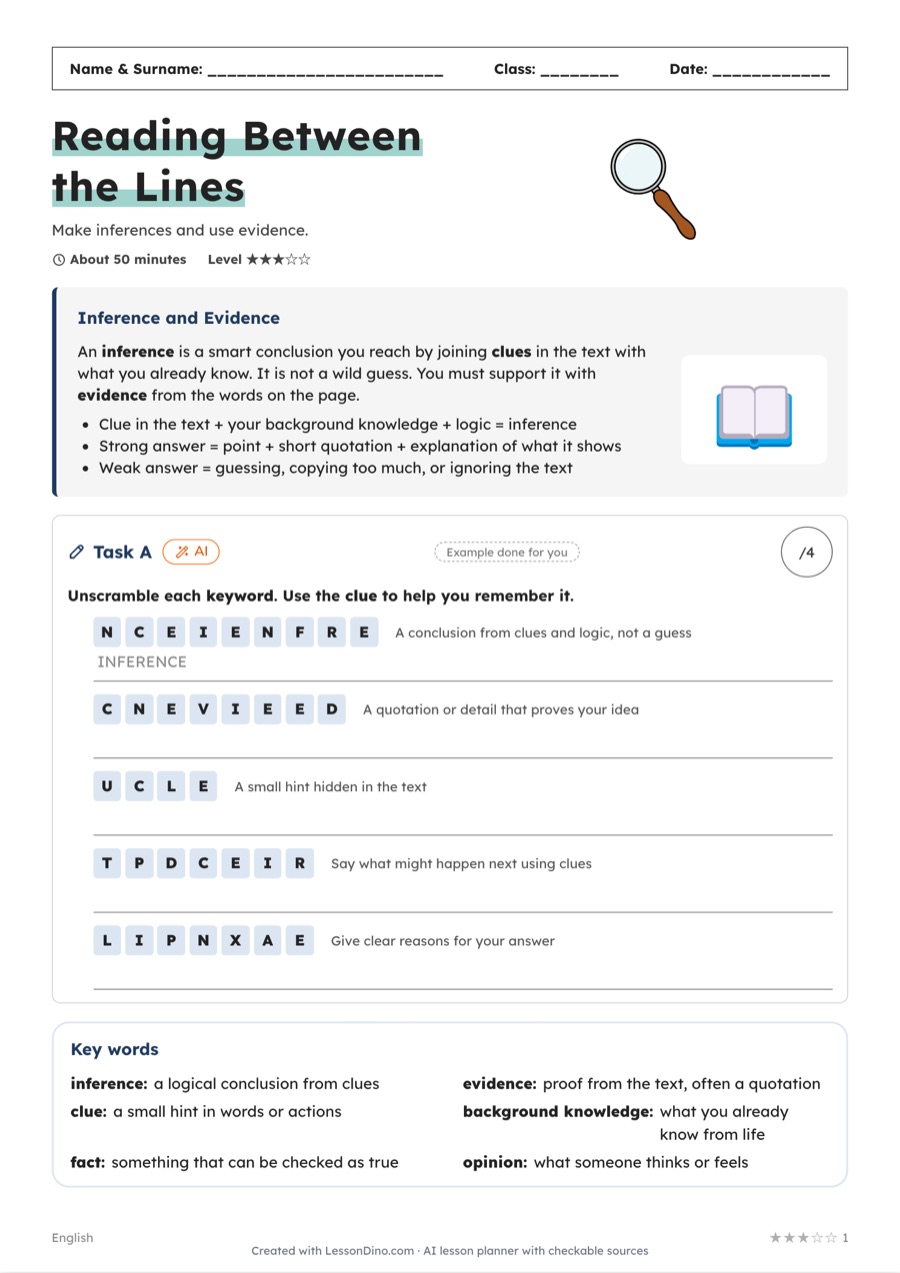
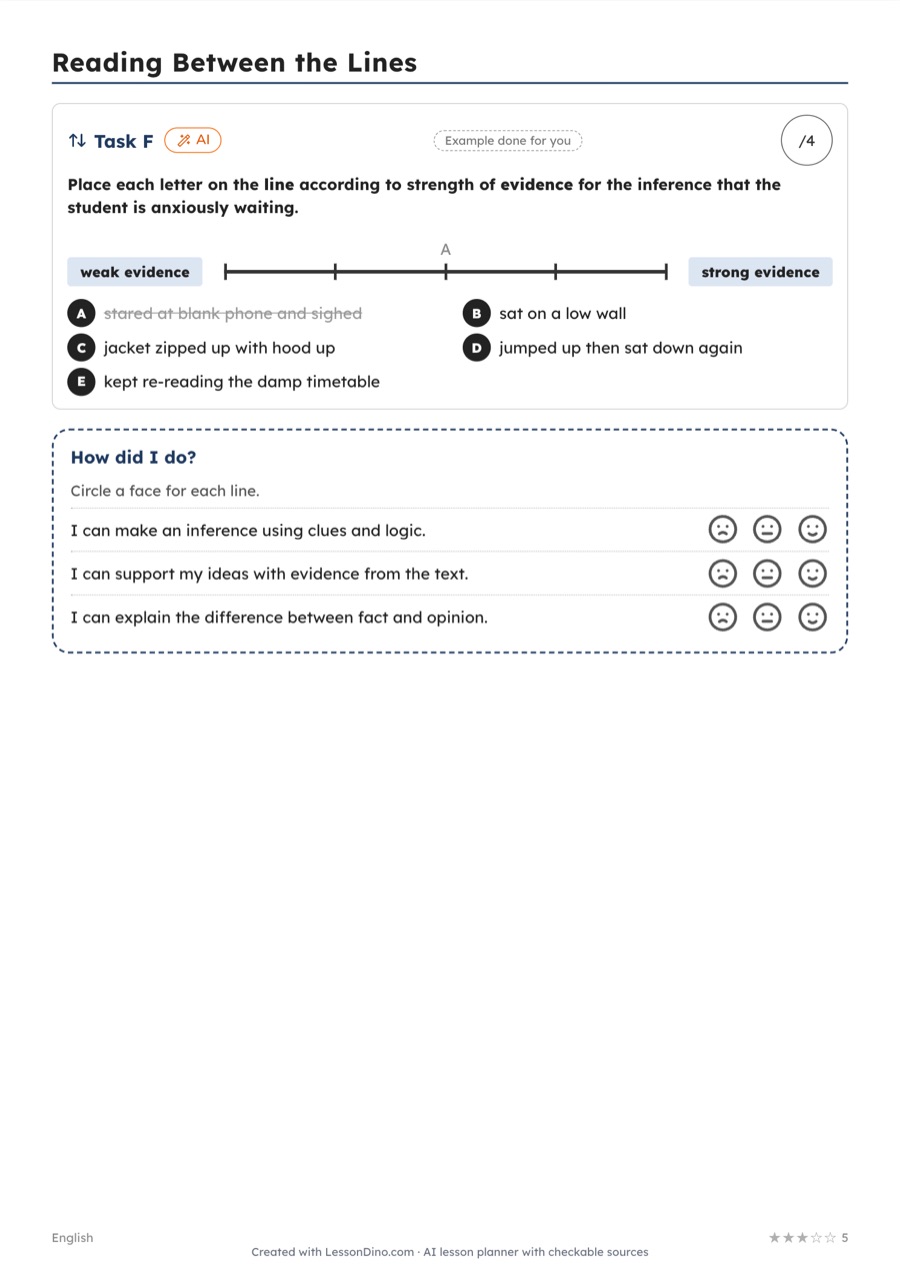
Reading Between Lines
Learn what inference and evidence really mean.
Inference and Evidence
- An inference is a smart conclusion you reach by joining clues in the text with what you already know. It is not a wild guess. You must support it with evidence from the words on the page.
- Clue in the text + your background knowledge + logic = inference
- Strong answer = point + short quotation + explanation of what it shows
- Weak answer = guessing, copying too much, or ignoring the text
Unscramble each keyword. Use the clue to help you remember it.
| Word | Meaning |
|---|---|
| inference | a logical conclusion from clues |
| evidence | proof from the text, often a quotation |
| clue | a small hint in words or actions |
| background knowledge | what you already know from life |
| fact | something that can be checked as true |
| opinion | what someone thinks or feels |
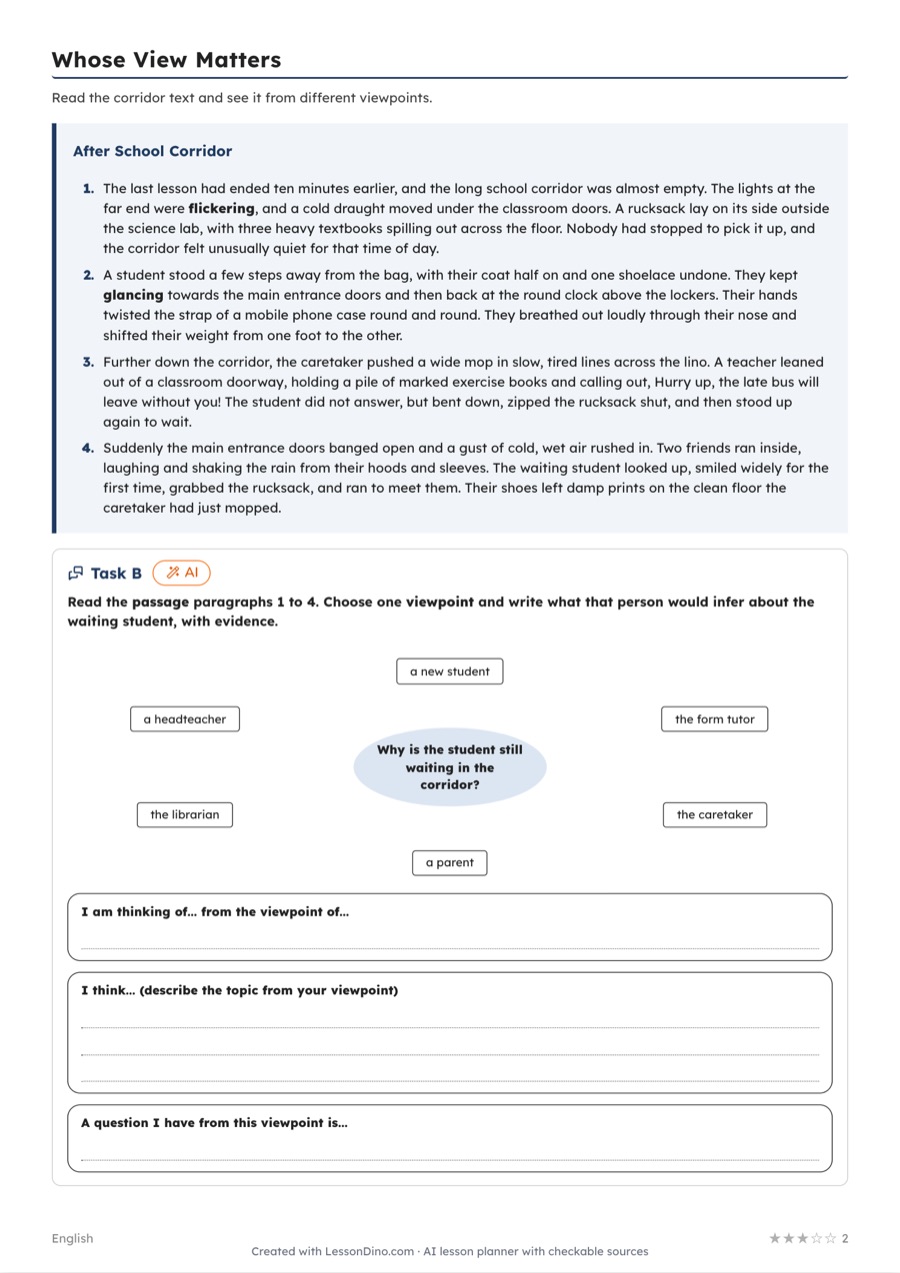
Whose View Matters
Read the corridor text and see it from different viewpoints.
After School Corridor
Read the passage paragraphs 1 to 4. Choose one viewpoint and write what that person would infer about the waiting student, with evidence.
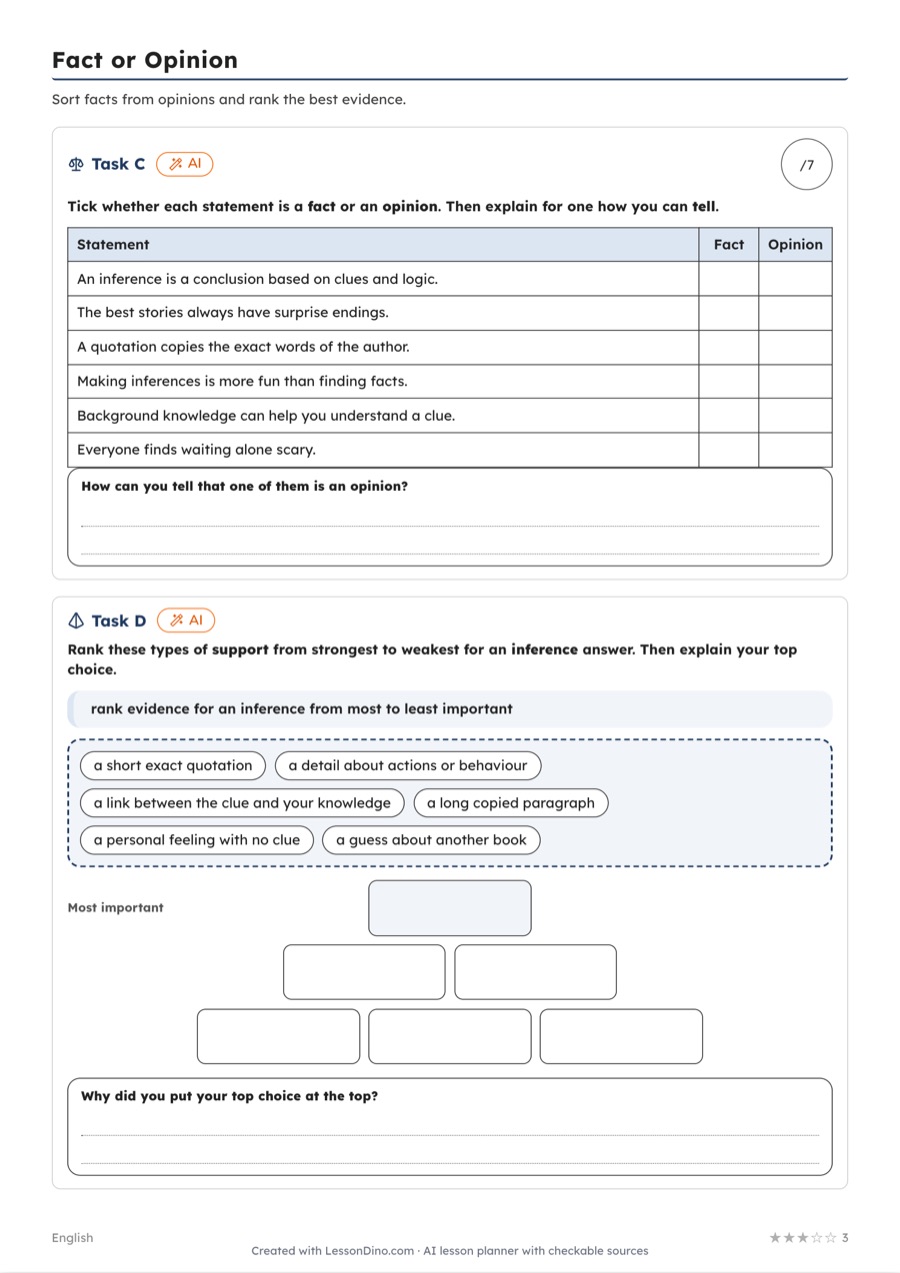
Fact or Opinion
Sort facts from opinions and rank the best evidence.
Tick whether each statement is a fact or an opinion. Then explain for one how you can tell.
Rank these types of support from strongest to weakest for an inference answer. Then explain your top choice.
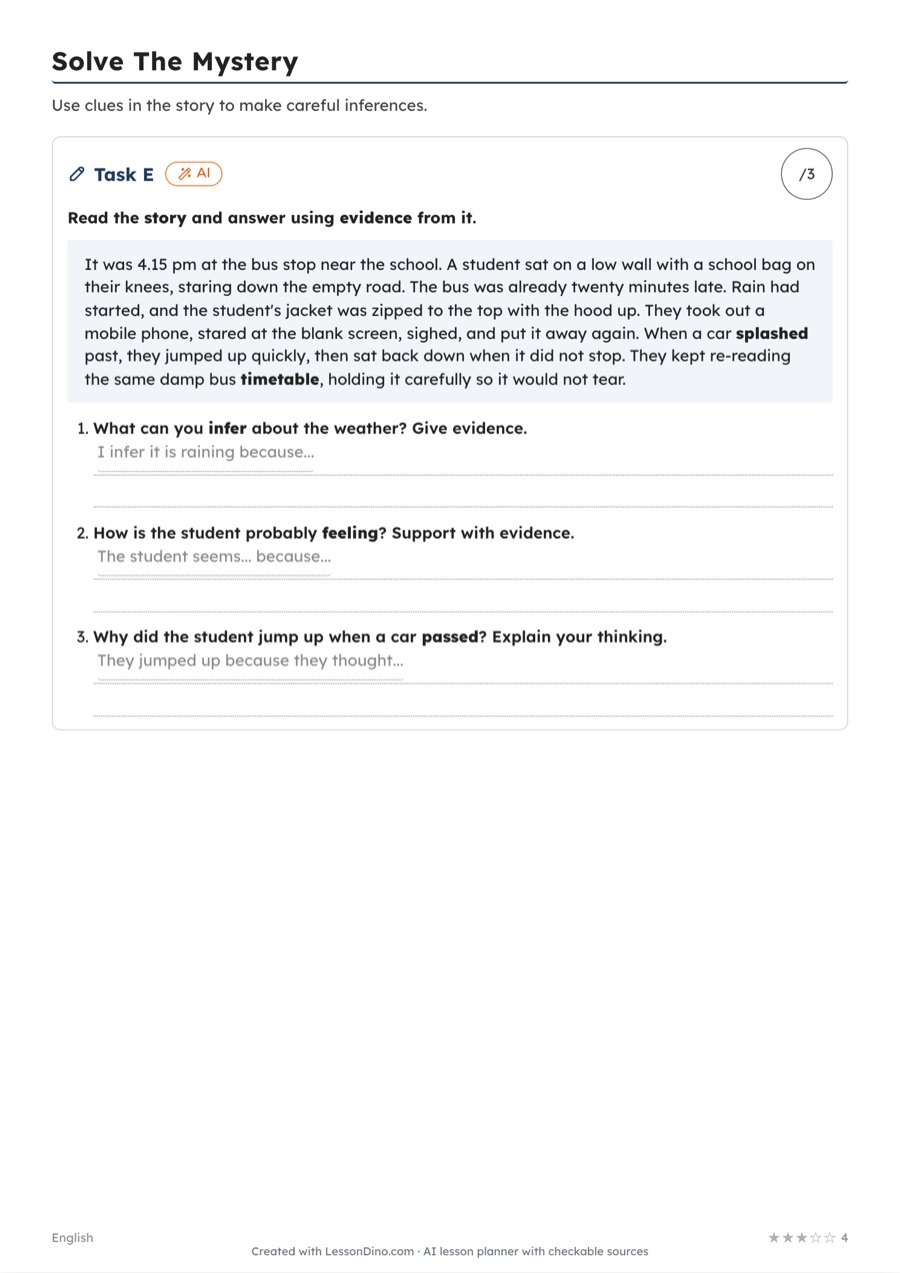
Solve The Mystery
Use clues in the story to make careful inferences.
Read the story and answer using evidence from it.
- What can you infer about the weather? Give evidence.
- How is the student probably feeling? Support with evidence.
- Why did the student jump up when a car passed? Explain your thinking.
Place each letter on the line according to strength of evidence for the inference that the student is anxiously waiting.
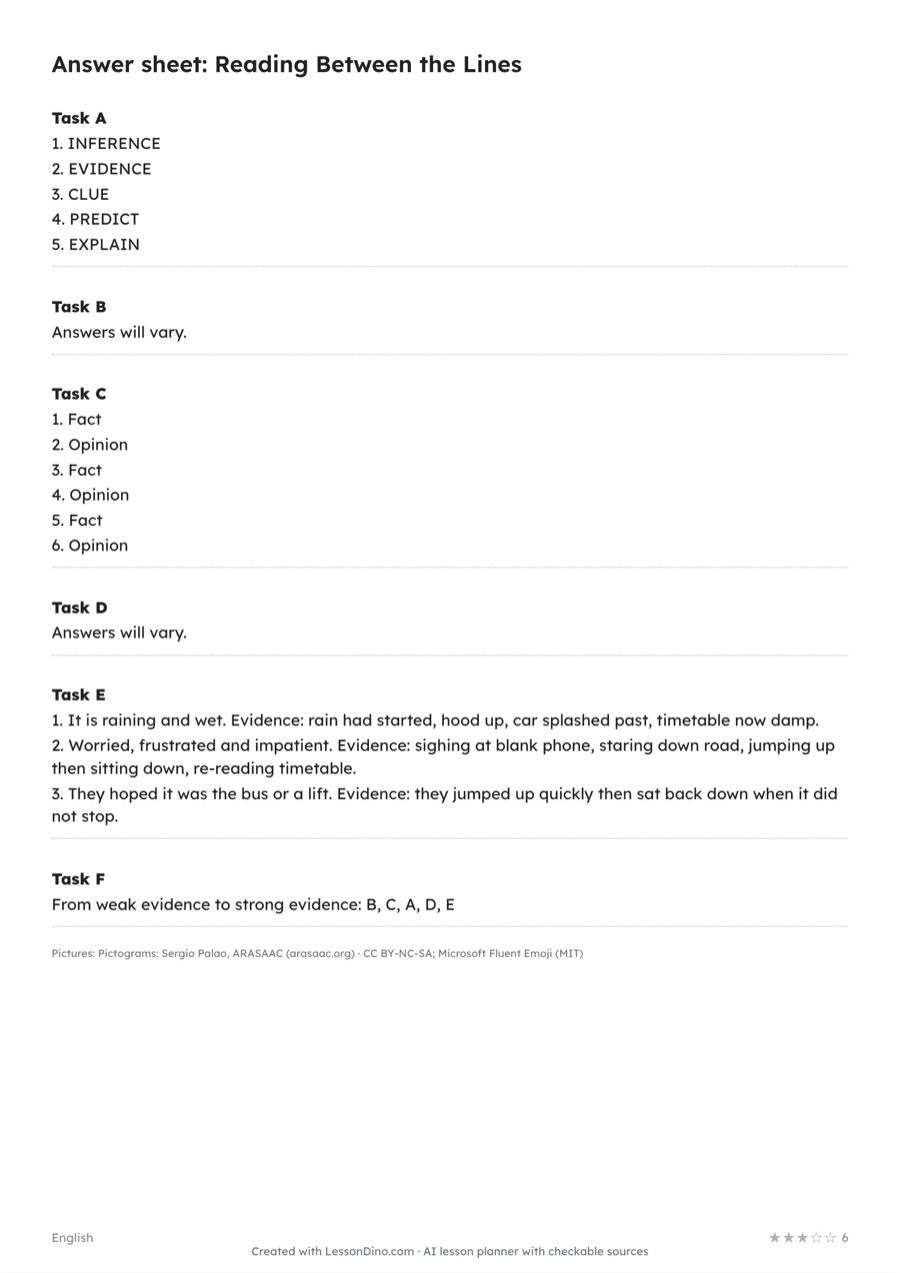
Answers
Show the answers
- What can you infer about the weather? Give evidence. It is raining and wet. Evidence: rain had started, hood up, car splashed past, timetable now damp.
- How is the student probably feeling? Support with evidence. Worried, frustrated and impatient. Evidence: sighing at blank phone, staring down road, jumping up then sitting down, re-reading timetable.
- Why did the student jump up when a car passed? Explain your thinking. They hoped it was the bus or a lift. Evidence: they jumped up quickly then sat back down when it did not stop.
The answer sheet is the last picture above.
Curriculum
making inferences and referring to evidence in the text
Made with Lesson Dino's AI on 17 October 2026. AI can make mistakes, so check the answers and facts against the sources before you teach.