Slides
Lesson plan
The Blue Butterfly Build
We learn to add describing words to nouns. We build and say super phrases with commas.
Objectives
- Students will build expanded noun phrases with one describing word.
- Students will build expanded noun phrases with two describing words and a comma.
- Students will use expanded noun phrases inside full spoken and written sentences.
Success criteria
- I can add one describing word to a noun.
- I can add two describing words with a comma between them.
- I can use my phrase inside a full sentence.
Key words
| Word | Meaning |
|---|---|
| noun | naming word for a person, place or thing |
| adjective | word that tells what something is like, such as colour or size |
| phrase | small set of words that go together without a doing word |
| comma | little mark like this , put between two describing words in a list |
| expanded noun phrase | extra describing words added to a naming word to paint a clearer picture |
Timed plan (60 minutes)
| Time | Stage | What happens |
|---|---|---|
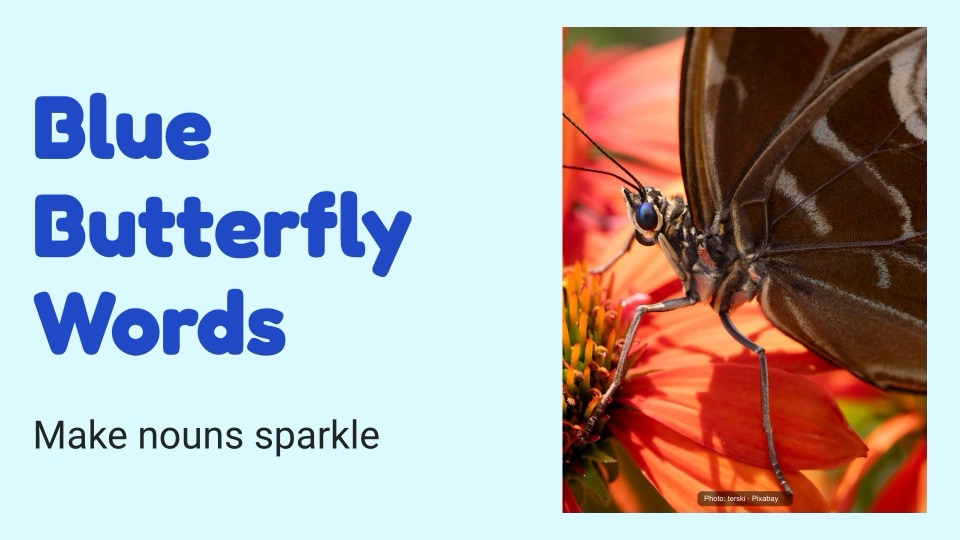
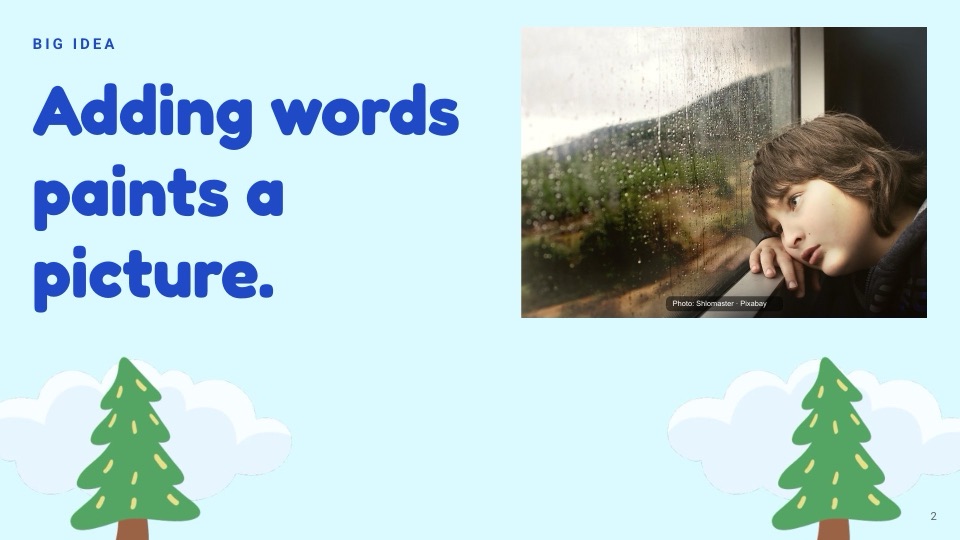
| 10 min | Starter | Hook pupils and recall that describing words make a noun clearer. Show Slide 1 Blue Butterfly Words [title]: Make nouns sparkle and read the title together. Say the hook while holding up a plain butterfly picture: I saw a butterfly at playtime. Just a butterfly? That tells us nothing! What did it look like? Show Slide 2 Big idea [statement]: Adding words paints a picture and model the blue butterfly. Ask pairs to offer a colour or size word, then repeat the best phrases together. |
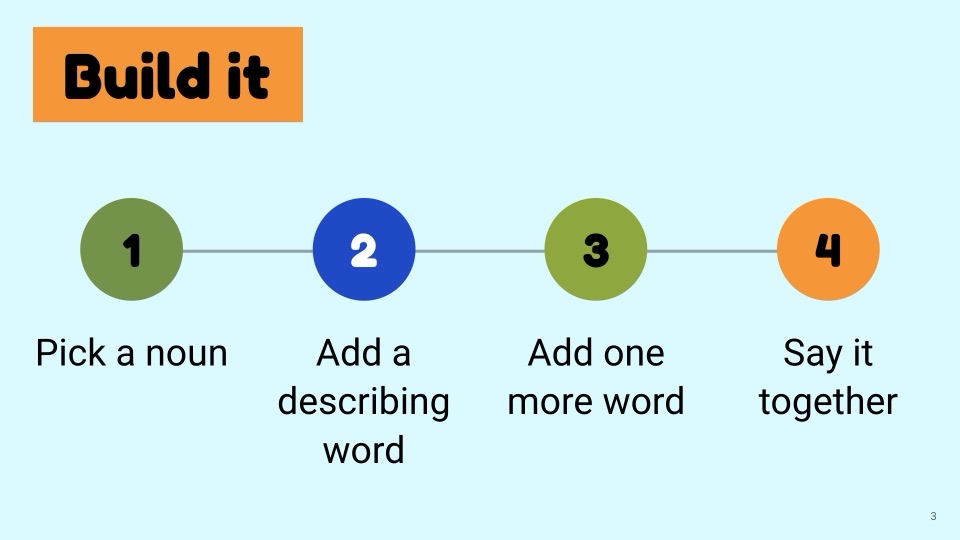
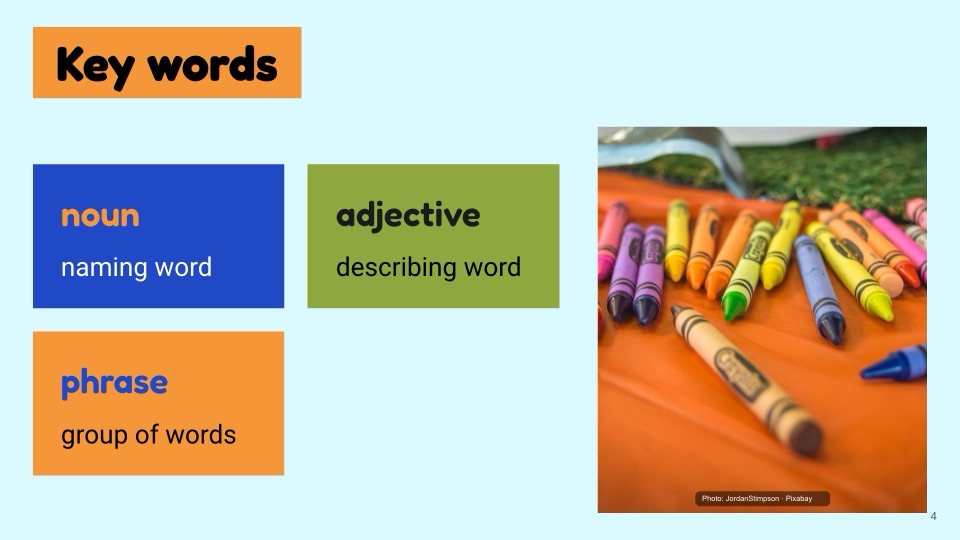
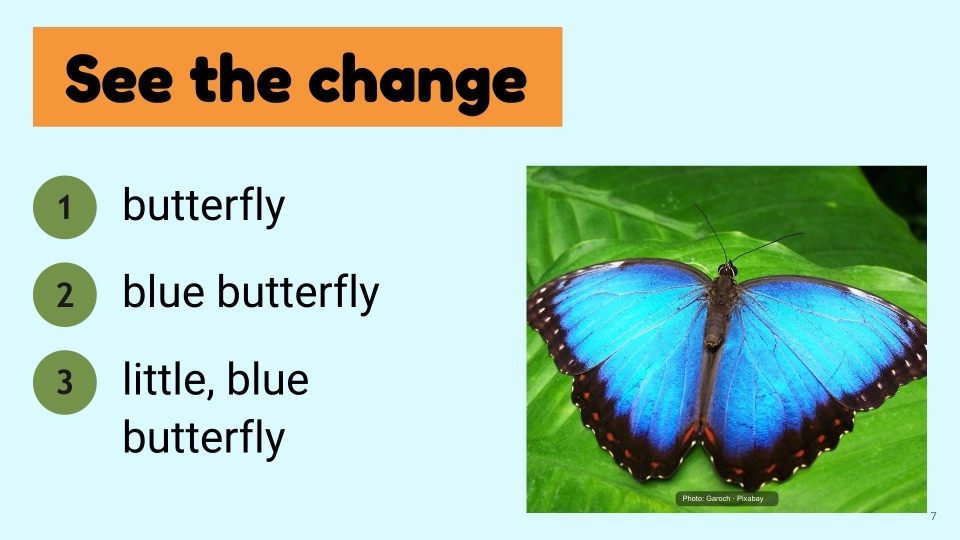
| 10 min | Teaching | Model how to build a phrase with one then two describing words and a comma. Show Slide 4 Key words [words]: noun, naming word, adjective, describing word, phrase, group of words and explain each briefly. Show Slide 3 Build it [steps]: Pick a noun, Add a describing word, Add one more word, Say it together and follow the steps live. Show Slide 7 See the change [bullets]: butterfly, blue butterfly, little, blue butterfly and point to the comma. Think aloud the comma rule: when you use more than one describing word, you need a comma between them. |
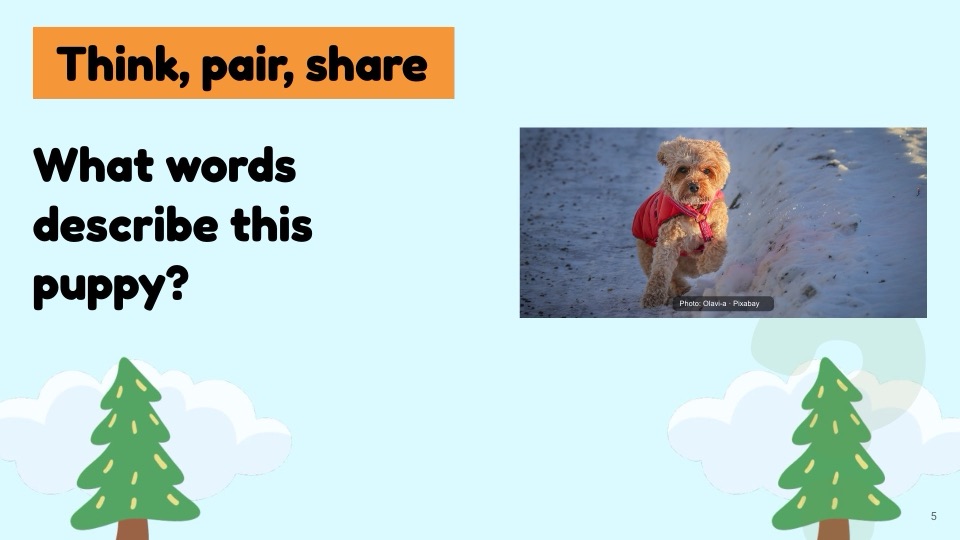
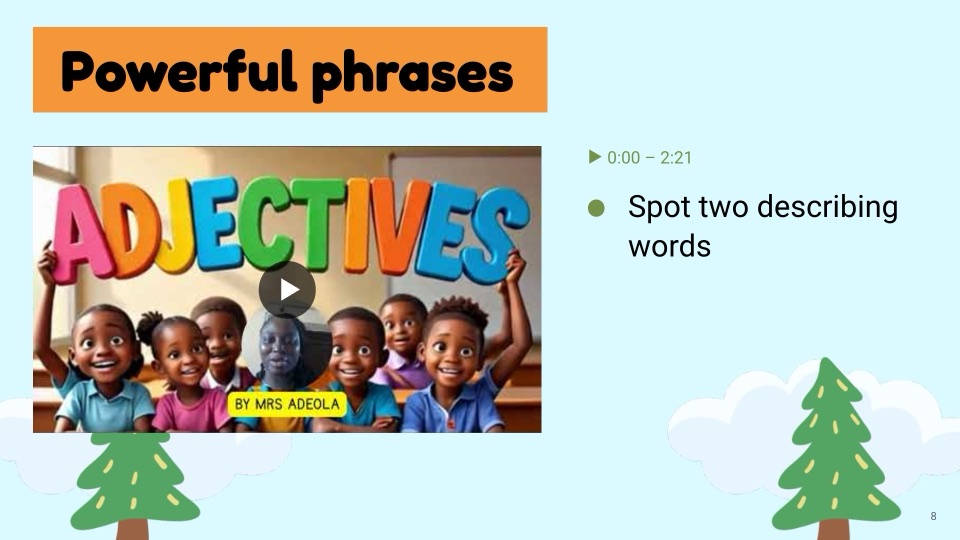
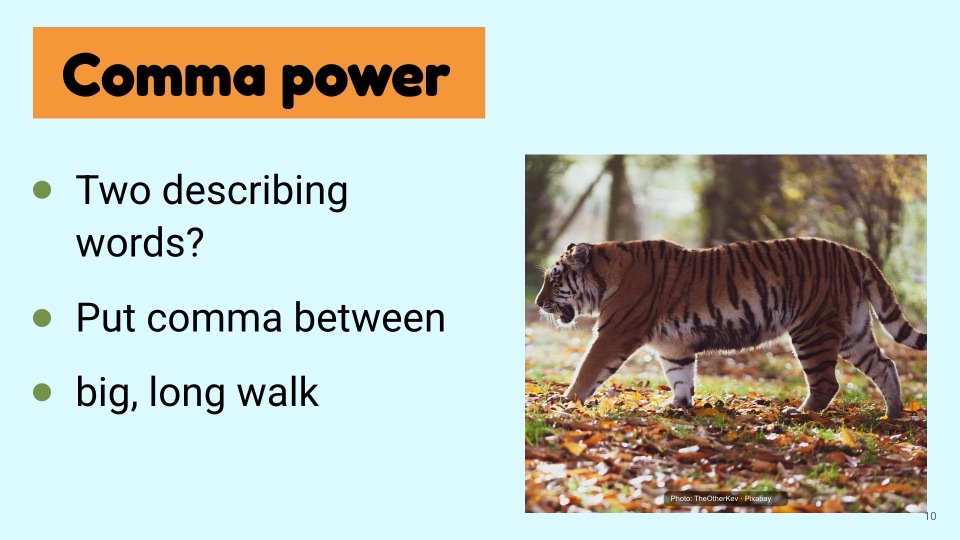
| 15 min | Guided practice | Practise spotting phrases and hearing the comma with the class together. Show Slide 5 Think, pair, share [question]: What words describe this puppy? Give 30 seconds of pair talk. Show Slide 6 Did you know? [fact]: A phrase is not a sentence. It lives inside a sentence. Explain a phrase is a group of words with no verb. Play Video clip 1 (0:00-2:21) on Slide 8 Powerful phrases [video]: Spot two describing words and ask pupils to hands-up for each phrase heard. Show Slide 10 Comma power [bullets]: Two describing words? Put comma between, big, long walk and practise saying a big, long walk. |
| 15 min | Main activity | Build super phrases for classroom things with one then two describing words. Show Slide 9 Your task [activity]: Pick a classroom toy, Choose two describing words, Write your new phrase, Build super phrases for classroom things. Hand out picture cards of everyday objects, whiteboards, pens and the adjective word bank and model with jacket. Remind pairs to start with one word, then add a second word with a comma, then say it together. Stop pairs halfway to share one strong example and remind them the phrase must sit inside a sentence when they read it. |
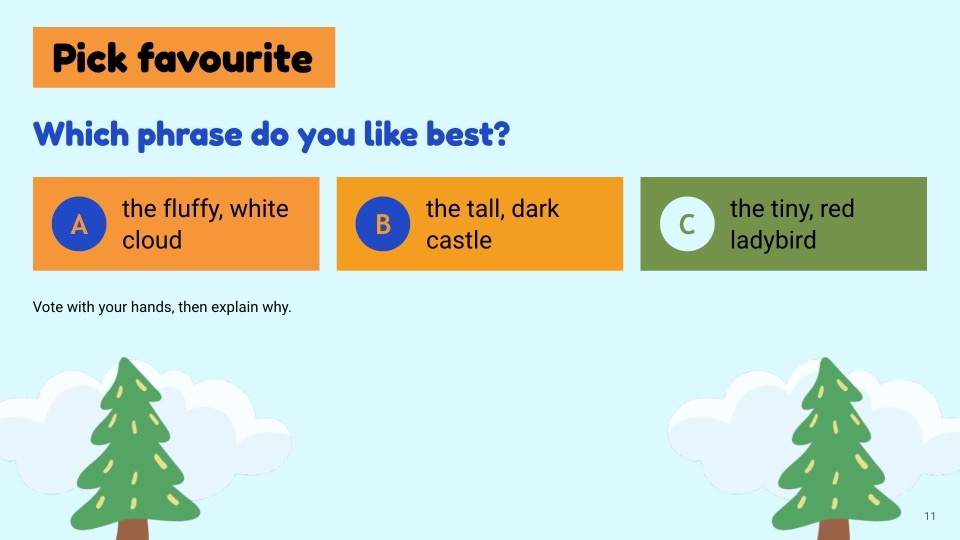
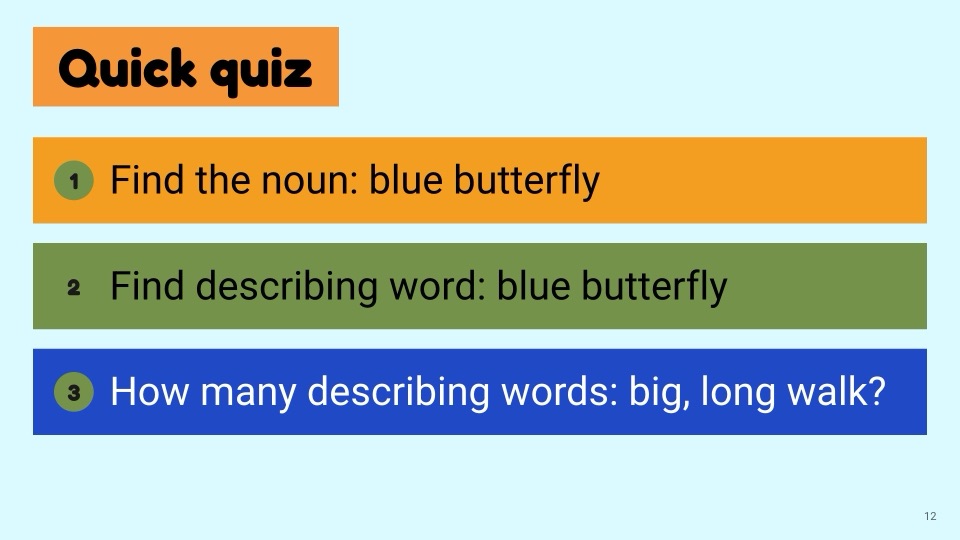
| 10 min | Plenary | Vote for favourite phrases and check nouns, describing words and commas. Show Slide 11 Pick favourite [vote]: Which phrase do you like best? the fluffy, white cloud, the tall, dark castle, the tiny, red ladybird. Read each phrase aloud with clear intonation and take a class vote, asking why each paints a picture. Show Slide 12 Quick quiz [quiz]: Find the noun: blue butterfly, butterfly, Find describing word: blue butterfly, blue, How many describing words: big, long walk? two. Ask pupils to answer on whiteboards and link back to describing and specifying. |
Common mistakes
- Leaving out the comma between two describing words
How to spot it: Writes big blue butterfly or little blue butterfly with no mark
Clap the pause and write the comma together. When you use more than one describing word, you need a comma between them. - Thinking an expanded noun phrase is a full sentence
How to spot it: Says fluffy, white cloud is finished or adds a full stop only
Sort phrase and sentence. An expanded noun phrase is not a sentence on its own but part of a sentence because a phrase has no verb. Add what it did. - Mixing up noun and describing word
How to spot it: Says blue is the noun in blue butterfly
Use the naming test. A noun is a naming word for a person, place or thing. An adjective is a word that describes a noun. Ask: Which word names it?
Support
- Keep the adjective word bank with colour and size words on tables for choosing and copying.
- Underline nouns in one colour and describing words in another, and allow oral answers before writing.
Stretch
- Add where it is to specify, for example on the leaf or under the chair, to show which one.
- Turn phrases into full sentences and improve a dull sentence such as The cat sat with the fluffy, black cat.
Check questions
- Build a phrase for butterfly with one describing word.
Answer: the blue butterfly - Build a phrase for butterfly with two describing words. Where is the comma?
Answer: little, blue butterfly - comma between little and blue - Is little, blue butterfly a sentence? Explain.
Answer: No, it is a phrase / part of a sentence; it has no verb.
Curriculum
expanded noun phrases to describe and specify [for example, the blue butterfly]
Video clips
Clips on YouTube, from the start and end times we chose. Check each one before you show it.
-
Boring words to powerful phrases from 0:00 to 2:21
Greenland Hall: Adjectives: Stop Using Boring Words! ✍️ How to Write Like an Author (Year 4 English)
Shows simple adjective + adjective + noun expanded noun phrases for describing, with quick fun pace Year 2 aged 6-7 can follow, though made for Year 4 so a little old in style.
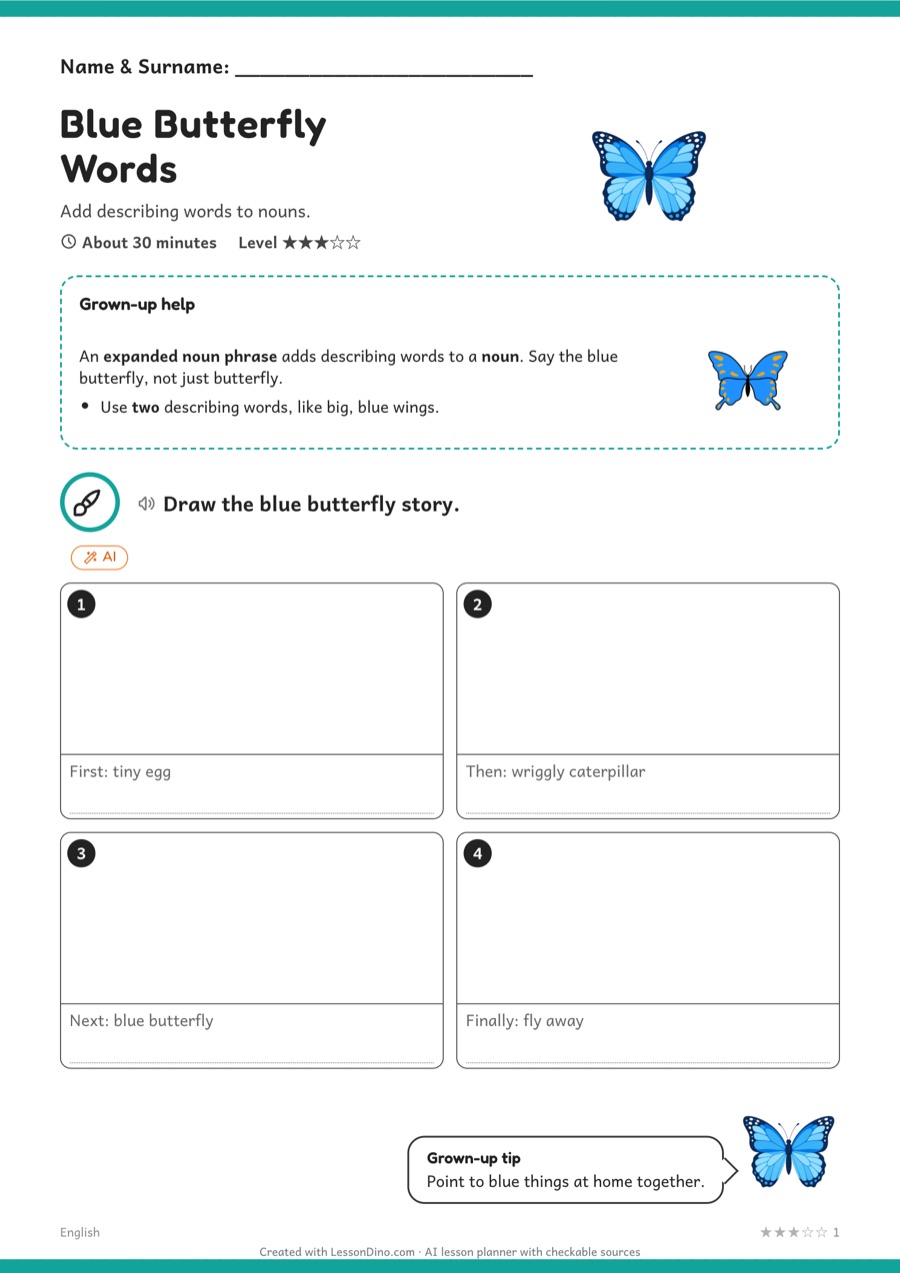
Worksheet
Sources
- year 2 english curriculum lenham.kent.sch.uk
- glossary gov.uk
- Expanded Noun Phrases buckstones.oldham.sch.uk
- What is an expanded noun phrase? - KS2 English - BBC Bitesize bbc.co.uk
- What are Expanded Noun Phrases? KS2 Guide With Examples | Resourcefully resourcefully.co.uk
- What is an expanded noun phrase? - KS1 English - BBC Bitesize bbc.co.uk
- SPaG Exercises: Noun Phrases Objective 2: To use an expanded ... horsfordprimaryschool.co.uk
- Writing Expanded Noun Phrases st-michaels-cofe.eschools.co.uk
- Adjectives: expanded noun phrases KS1 | Y1 English | Lesson ... thenational.academy
- Expanded Noun Phrases – malcolmsmusings.org malcolmsmusings.org
- Expanded Noun Phrases Ks2 - How to Teach Them gplpress.com
- Expanded Noun Phrases: PowerPoint, activity and word bank tes.com
- Expanded Noun Phrases (Years 5-6) | CGP+ Primary Online cgpplus.co.uk
- Expanded noun phrase worksheet year 3 phytocon.com.pk
Picture credits
- Photo: terski · Pixabay
- Photo: Shlomaster · Pixabay
- Photo: JordanStimpson · Pixabay
- Photo: Olavi-a · Pixabay
- Photo: Sunriseforever · Pixabay
- Photo: Garoch · Pixabay
- Photo: TheOtherKev · Pixabay
- Illustration: CreativeCanvasDesign · Pixabay
- Pictograms: Sergio Palao, ARASAAC (arasaac.org) · CC BY-NC-SA
- Picture: unknown · CC0 · rawpixel via Openverse
- Picture: unknown · CC0 · rawpixel via Openverse
Made with Lesson Dino's AI on 17 October 2026. AI can make mistakes, so check facts against the sources before you teach.