Slides
Lesson plan
Detective Readers: Inference with Evidence
Students learn to make smart inferences and prove them with short quotes. They read, discuss and write like text detectives.
Objectives
- Students will make clear inferences from what is said and done.
- Students will choose short exact quotes as proof for inferences.
- Students will explain clearly how each quote proves the inference.
Success criteria
- I can make a smart inference from clues in the text.
- I can quote exact words as evidence for my inference.
- I can explain how my evidence proves my inference.
Key words
| Word | Meaning |
|---|---|
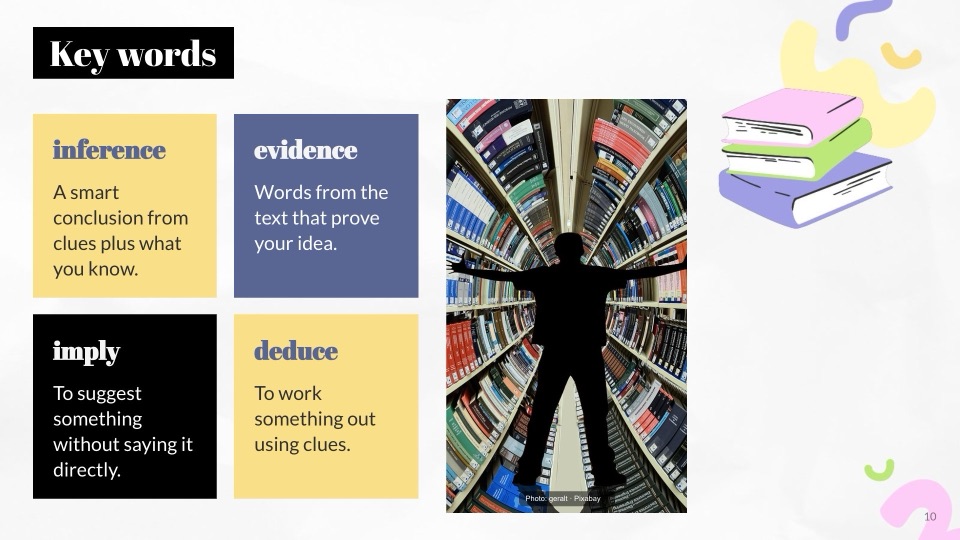
| inference | a smart conclusion worked out from clues plus what you already know |
| evidence | exact words from the text that prove an idea is true |
| imply | to suggest something without saying it straight out |
| clue | a small detail that helps you work out a hidden meaning |
Timed plan (60 minutes)
| Time | Stage | What happens |
|---|---|---|
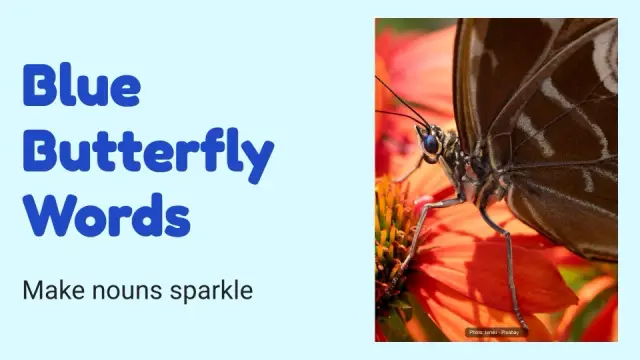
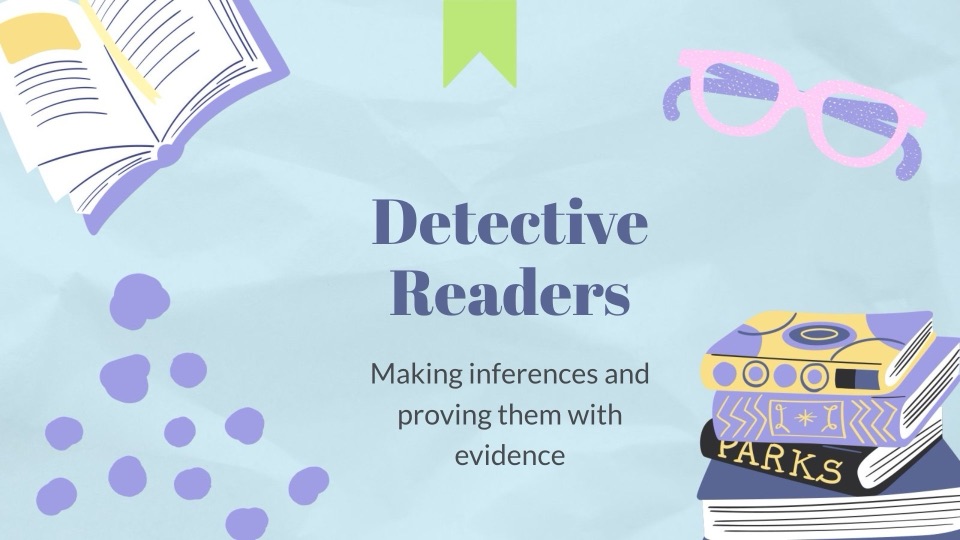
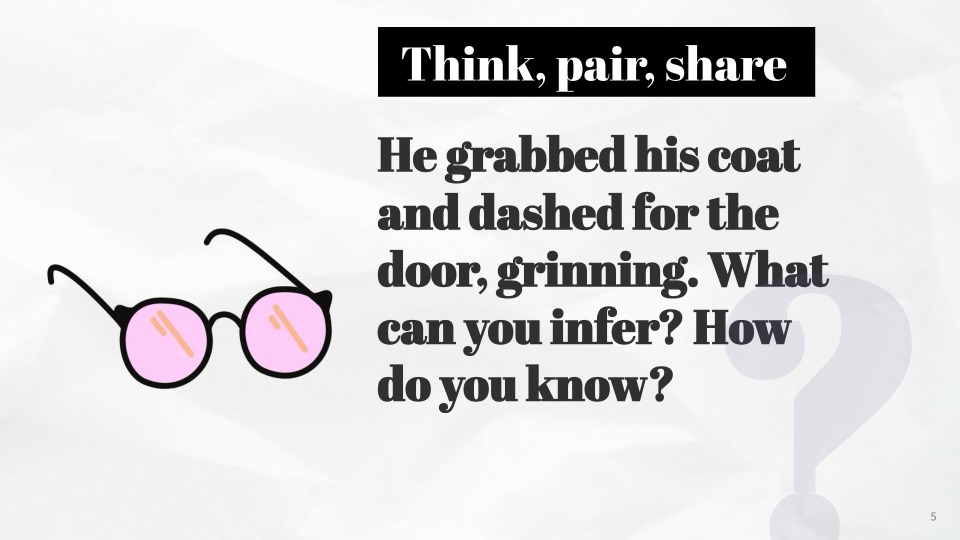
| 10 min | Starter | To hook pupils and recall that inferring means working out hidden meaning from clues. Show Slide 1 Detective Readers and Slide 2 photo and read the line about working out hidden meanings every day. Say the hook and read aloud Slide 5: He grabbed his coat and dashed for the door, grinning. What can you infer? How do you know? Take quick ideas on whiteboards and press for the clue word grinning. Link answers to inferring being like a detective finding clues to work out hidden information. |
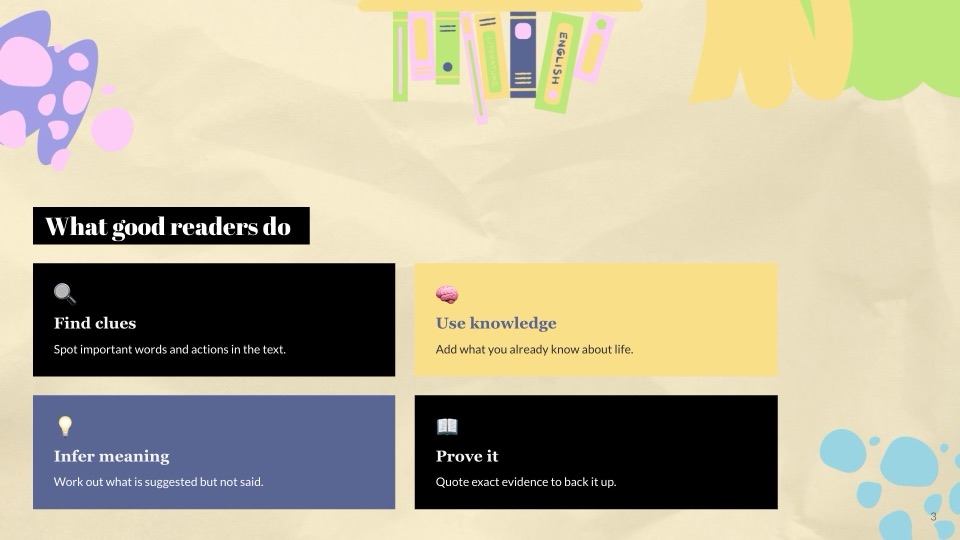
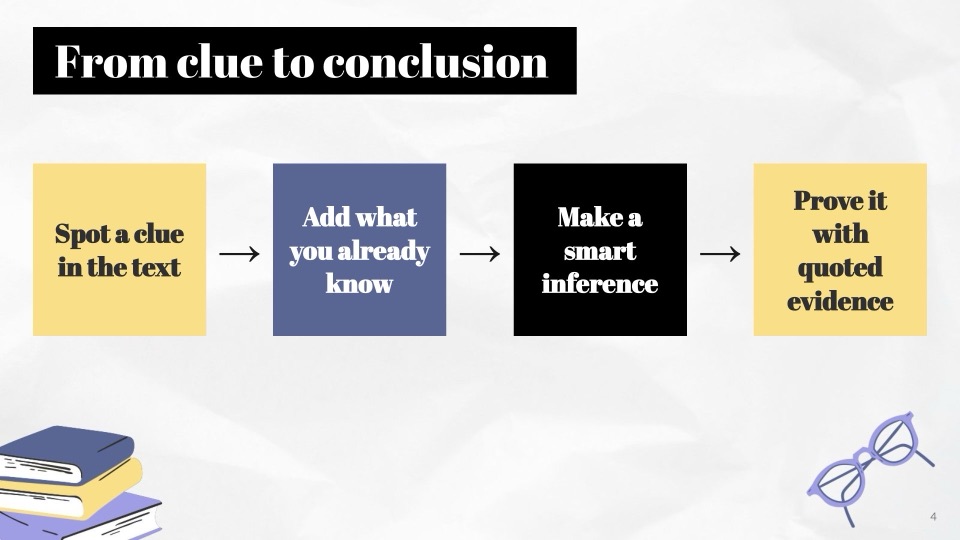
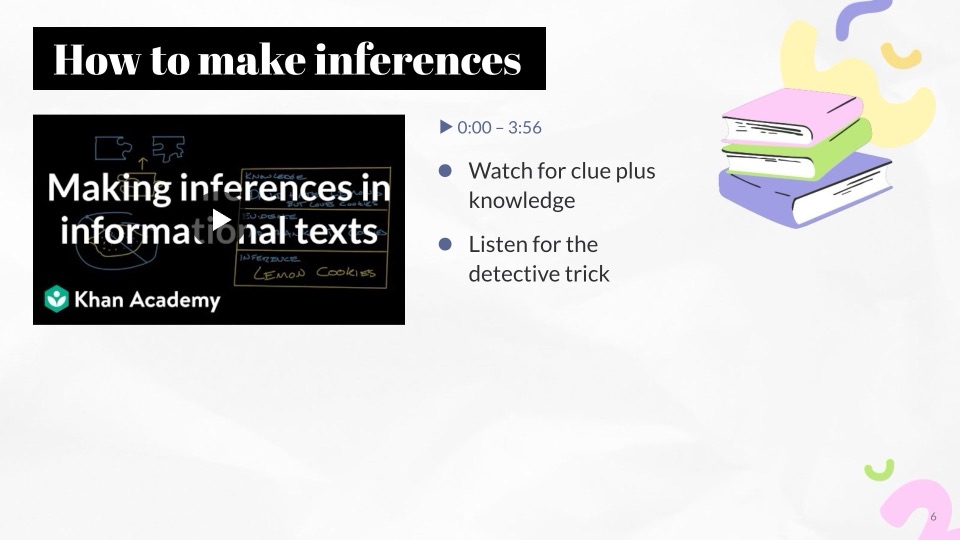
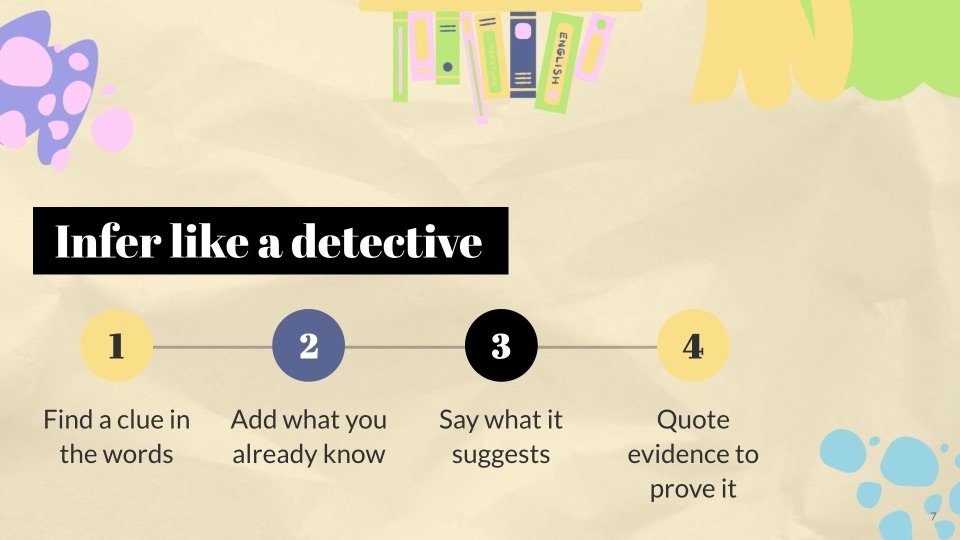
| 10 min | Teaching | To teach the clue to conclusion steps and model quoting evidence. Show Slides 3-4 and talk through the chain from clue to quoted evidence. Play Video clip 1 (0:00–3:56) on Slide 6 and ask pupils to listen for the detective trick. Show Slide 7 steps and model them on the Slide 5 sentence using think-aloud. Stress that an inference is a conclusion you reach by applying logic to the evidence you are given. |
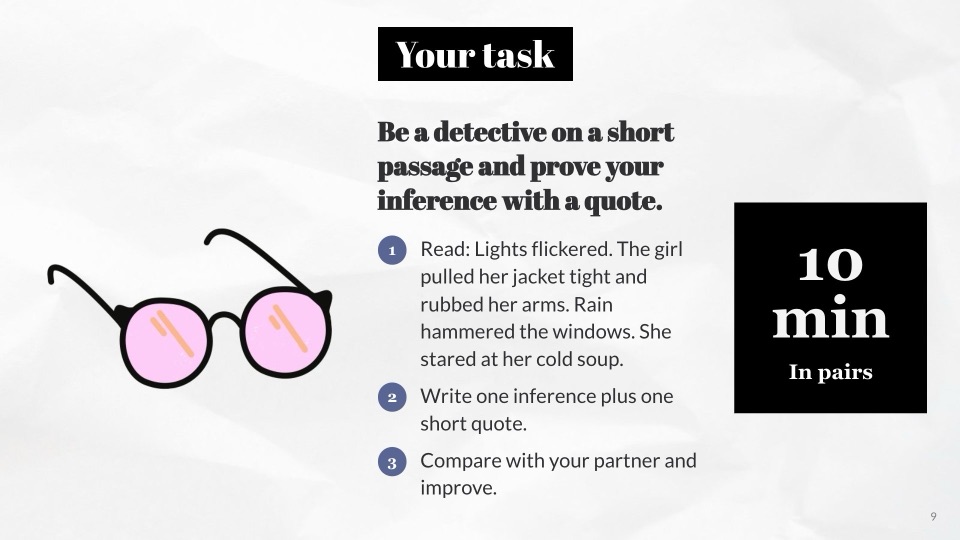
| 10 min | Guided practice | To practise making one shared inference with exact evidence from a short text. Show Slide 9 and read aloud: Lights flickered. The girl pulled her jacket tight and rubbed her arms. Rain hammered the windows. She stared at her cold soup. Model asking questions before, during and after reading to improve understanding, such as what might this be about and what do I already know. Think aloud to link pulled her jacket tight and rubbed her arms to feeling cold and fed up. Show Slide 10 key words and agree the class inference and quote. |
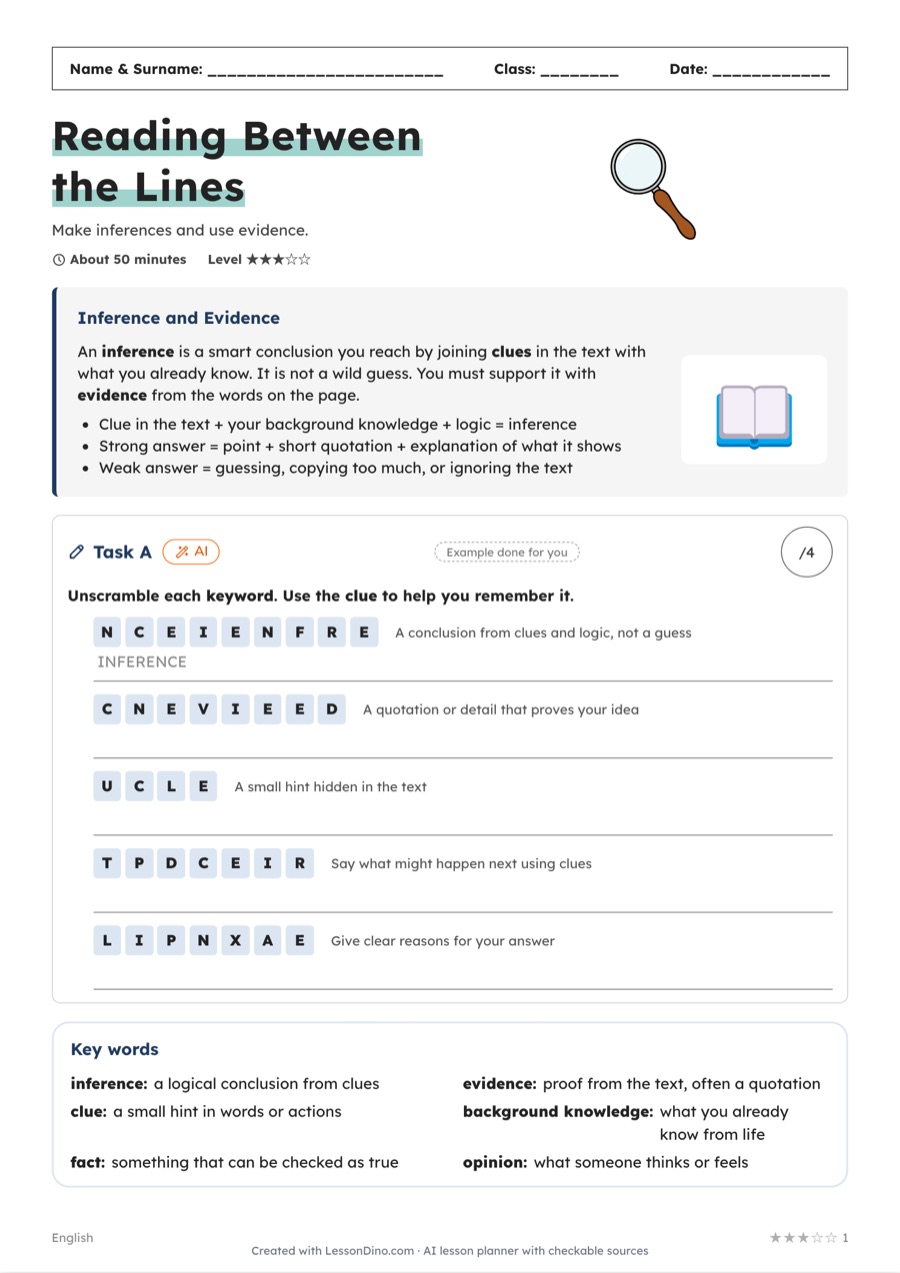
| 20 min | Main activity | To make inferences about the waiting student and prove each with quoted evidence. Hand out Passage After School Corridor paragraphs 1-4, highlighters and Worksheet Task B sheets. Direct pairs to paragraph 2 first and model underlining Their hands twisted the strap of a mobile phone case round and round as a clue. Set the detective task: underline the clue in one colour, write I infer ___ because the text says ___ using a short quote. Remind pupils to be an active reader who wants to make sense of the text and to check that the text makes sense as they read. |
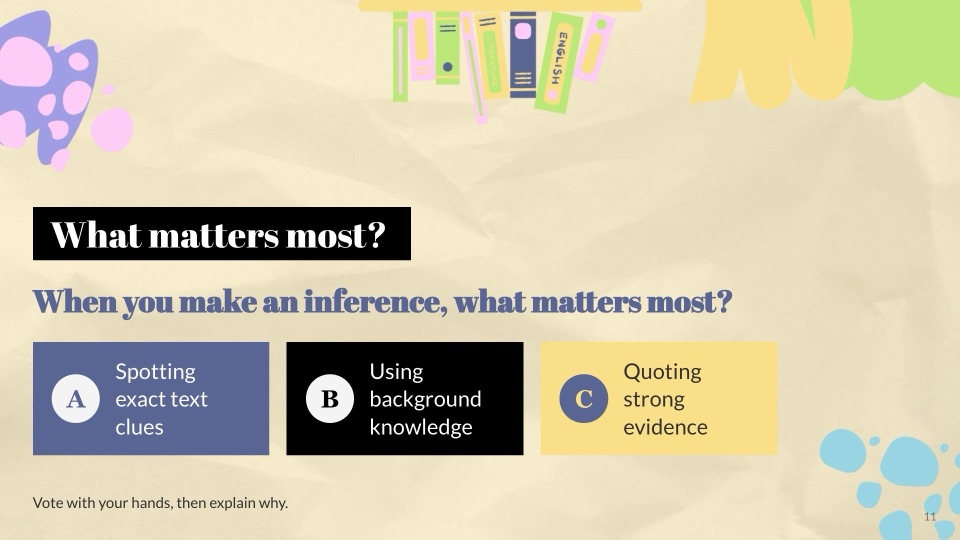
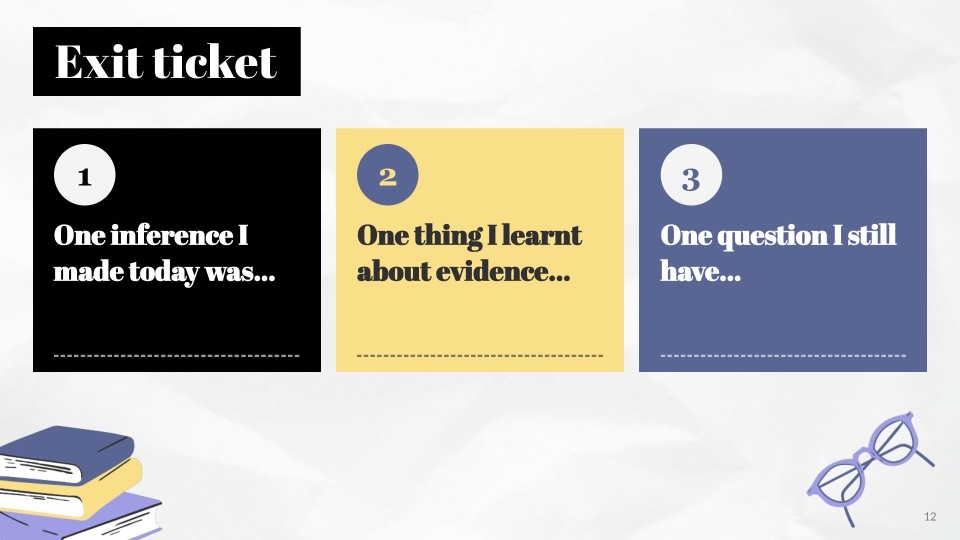
| 10 min | Plenary | To judge what makes strong evidence and check learning against success criteria. Invite two pairs to read their inference and quote aloud and explain the logic linking them. Show Slide 11 and take a quick vote on what matters most for an inference. Show Slide 12 exit ticket and give two minutes silent writing. Close by restating that good answers make inferences on the basis of what is being said and done. |
Common mistakes
- Treating a guess as an inference with no quote.
How to spot it: Answer gives a feeling or event but no words from the text.
Insist on because the text says ___ and remind them inferences are not guesses but conclusions drawn from evidence. - Quoting a whole paragraph instead of short proof.
How to spot it: Long copied chunk that does not point to the clue.
Model trimming to four to six words and backing up inferences with specific quotes. - Mixing up what is stated and what is suggested.
How to spot it: Pupil says the text said nervous when it only showed fidgeting.
Sort into Said versus Unsaid columns and check that inferences come from what is said and done.
Support
- Sentence frames with I infer ___ because the text says ___ and pre-highlighted clues.
- Word bank for behaviour clues like pacing, frowning, sighing and staring.
Stretch
- Add a second inference from the same clue and judge which has stronger evidence.
- Plant two conflicting clues for a partner to weigh and decide the stronger case.
Check questions
- What is an inference?
Answer: A smart conclusion from clues plus what you know. - Give one short quote showing the waiting student is anxious.
Answer: Twisted the strap round and round or shifted their weight from one foot to the other. - Why is twisted the strap stronger than corridor was almost empty?
Answer: It shows nervous behaviour directly linked to the inference.
Curriculum
making inferences and referring to evidence in the text
Video clips
Clips on YouTube, from the start and end times we chose. Check each one before you show it.
-
How to make inferences from 0:00 to 3:56
Khan Academy: How to make inferences | Reading | Khan Academy
Direct intro to inference as clue + knowledge, with pace and vocabulary perfect for 12-13-year-olds.
-
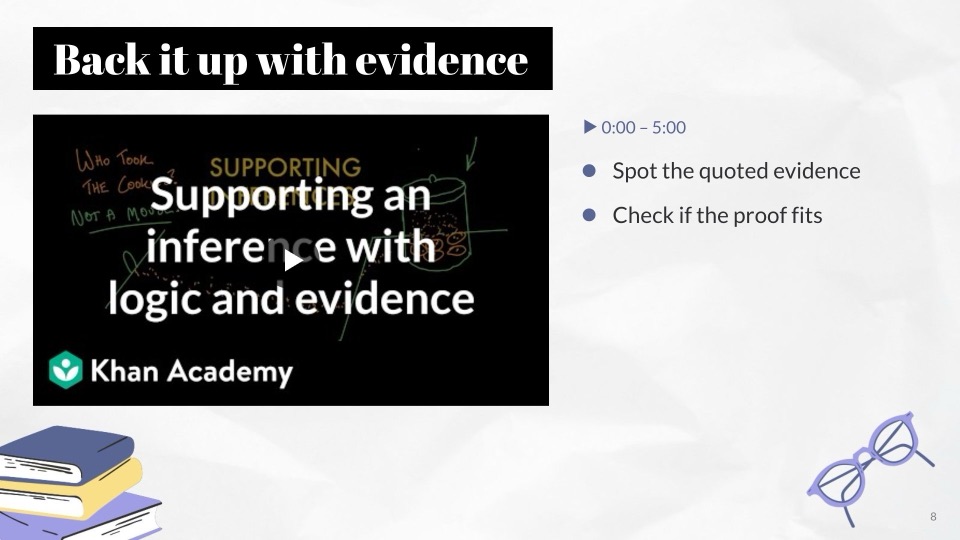
Support inference with evidence from 0:00 to 5:00
Khan Academy: Supporting an inference with logical reasoning and evidence | Reading | Khan Academy
Trustworthy Khan Academy explainer on inference plus logical evidence, ideal for 12-13-year-olds.
Worksheet
Sources
- National curriculum in England: English programmes of study gov.uk
- Year 8 - Curriculum Guide for English jhanson.hants.sch.uk
- Effective Teaching of Inference Skills for Reading nfer.ac.uk
- Understanding and inference - Understanding and inference - Higher ... bbc.co.uk
- Reading - Wikipedia en.m.wikipedia.org
- What is inference? - BBC Bitesize bbc.co.uk
- Reading, Berkshire - Wikipedia en.m.wikipedia.org
- 'The Twisted Tree': Revising inferences KS3 | Y7 English | Lesson ... thenational.academy
Picture credits
- Photo: Alexas_Fotos · Pixabay
- Drawing: Equazcion at English Wikipedia · CC BY-SA 3.0 · Wikimedia Commons
- Photo: geralt · Pixabay
- Pictograms: Sergio Palao, ARASAAC (arasaac.org) · CC BY-NC-SA
- Microsoft Fluent Emoji (MIT)
Made with Lesson Dino's AI on 17 October 2026. AI can make mistakes, so check facts against the sources before you teach.