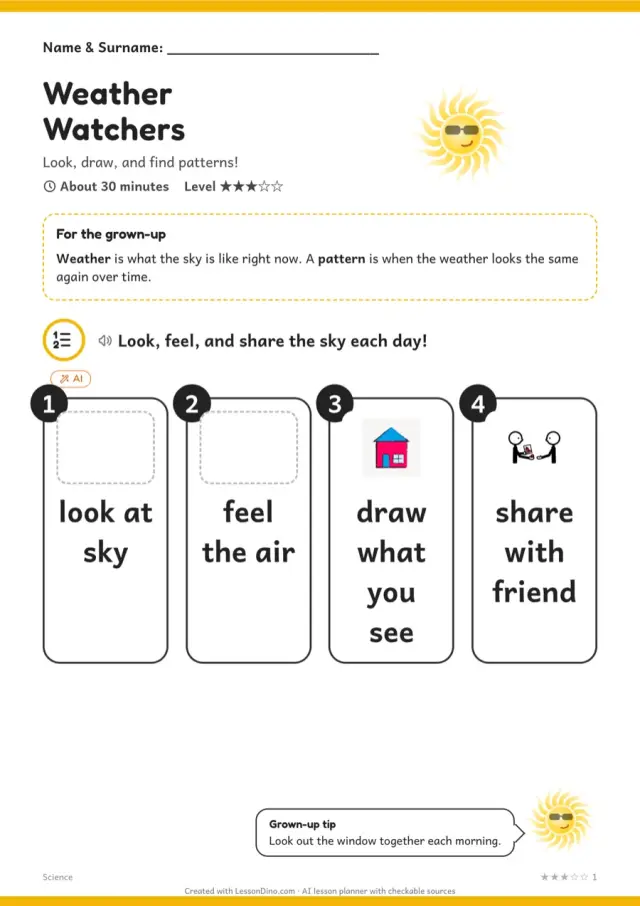
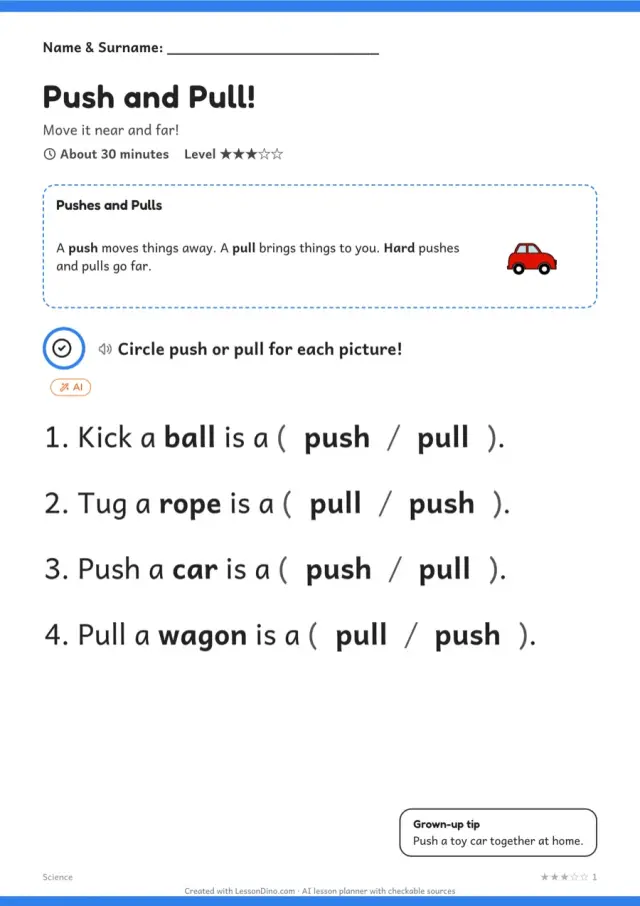
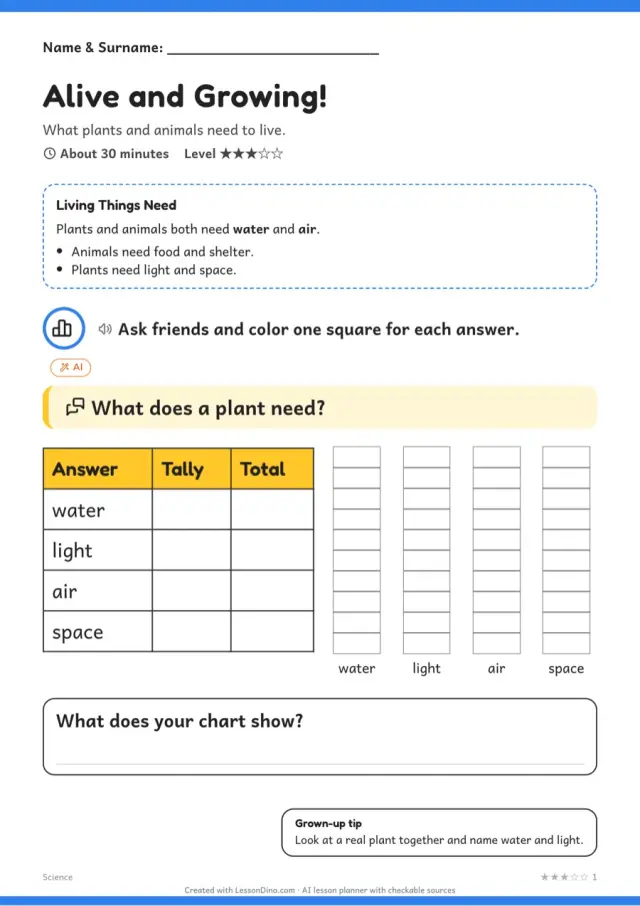
The worksheet
About this worksheet
Students learn the jobs of seven cell parts. They build animal and plant cells from clay and label each job. This Year 7 Science worksheet gives students (ages 11–12) five pages of practice on cell structure and function, part of the cells and organisation unit. It goes with our free Cell structure and function lesson, which has the slides and a timed lesson plan.
What it covers
By the end, students should be able to:
- Students will describe the functions of seven parts of cells.
- Students will compare plant and animal cells by their parts.
- Students will link each cell structure to its job in the cell.
How to use it
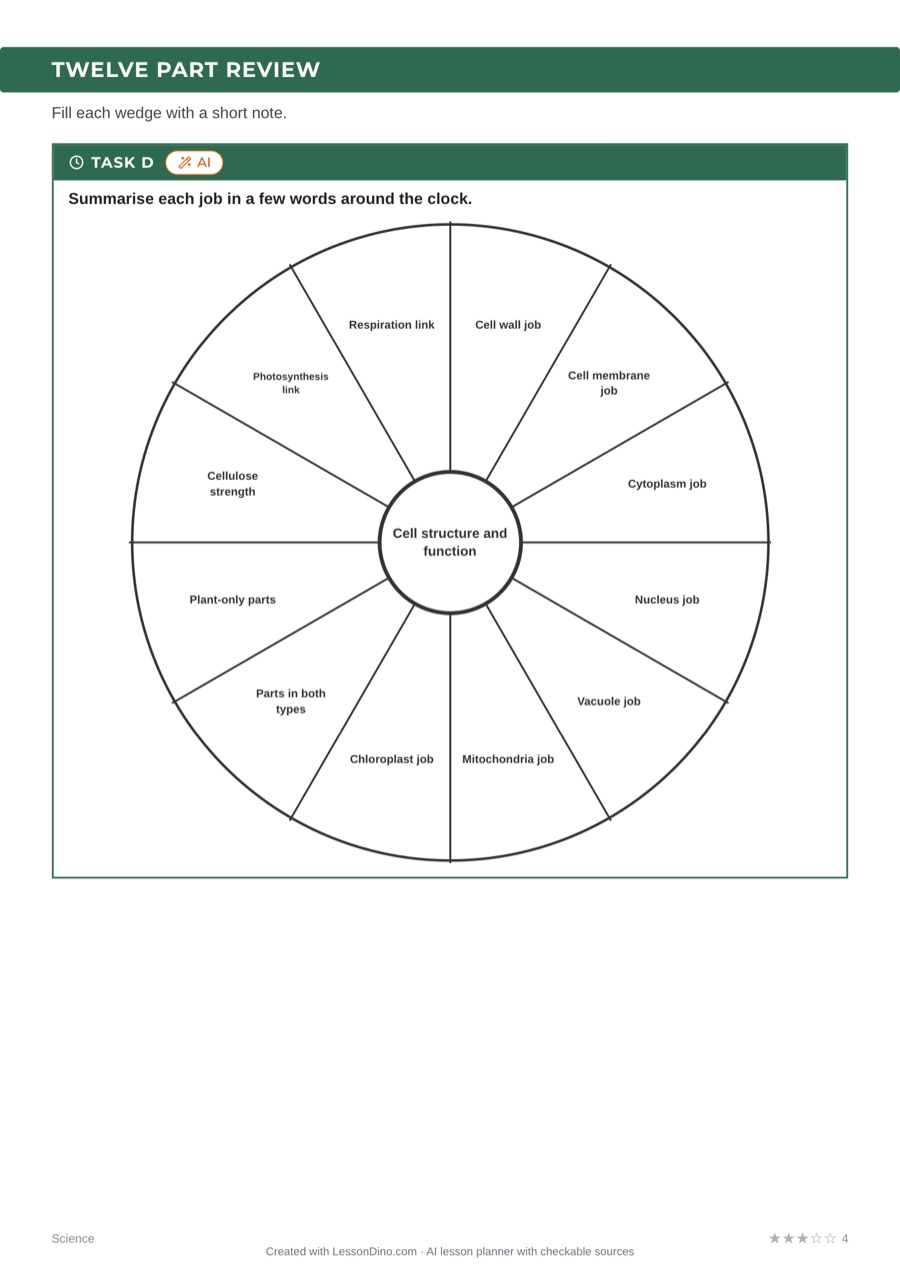
- Plenary (10 minutes): Hand out Worksheet Task D revision clock and ask for a few words per job around the clock.
- Support: Give a word bank with the seven jobs in simple sentences to copy onto labels and clocks.
- Stretch: Write why a plant cell needs both a membrane and a wall, using strength and control.
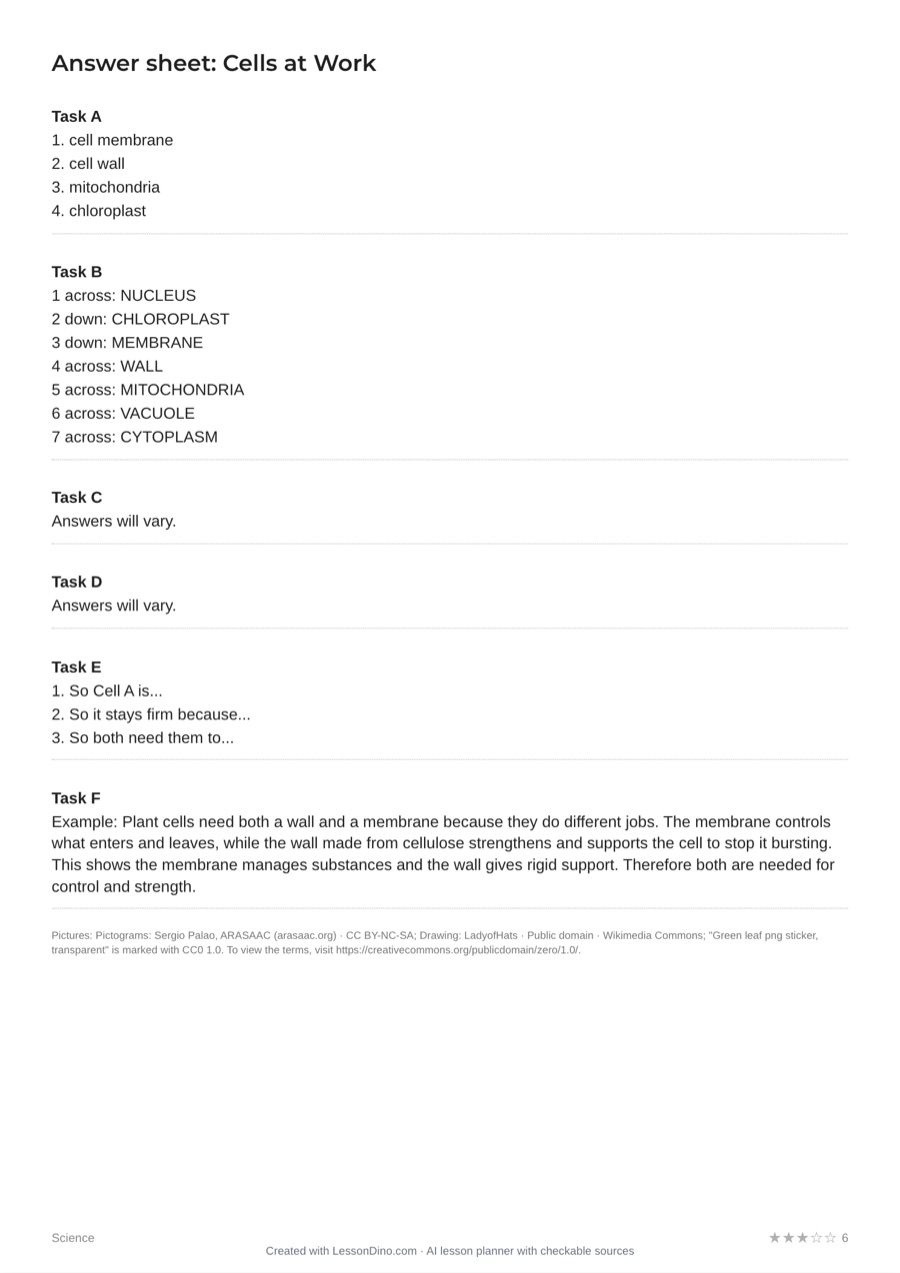
- The answer sheet is the last page, so you can print it on its own or let students check their own work.
Key vocabulary
- nucleus: control centre that holds DNA instructions and switches jobs on
- cell membrane: stretchy skin round the cell that picks what goes in or out
- cytoplasm: clear jelly inside where most of the chemical jobs happen
- mitochondria: tiny power stations that use food and oxygen to free energy
- cell wall: tough outer coat outside the skin, made of cellulose, that holds shape firm
- chloroplasts: green food makers that catch light to make sugar
Mistakes to watch for
- Thinking the cell membrane gives rigid support. Show box and balloon model again: wall outside the membrane is rigid and supports; membrane only controls entry and exit.
- Mixing up mitochondria and chloroplasts. Repeat chain: chloroplasts trap light and make sugar; mitochondria use food and oxygen to free energy.
- Seeing the vacuole as just a water bag with no support job. Stress large vacuole holds cell sap which provides support and keeps turgor.
What's on the worksheet
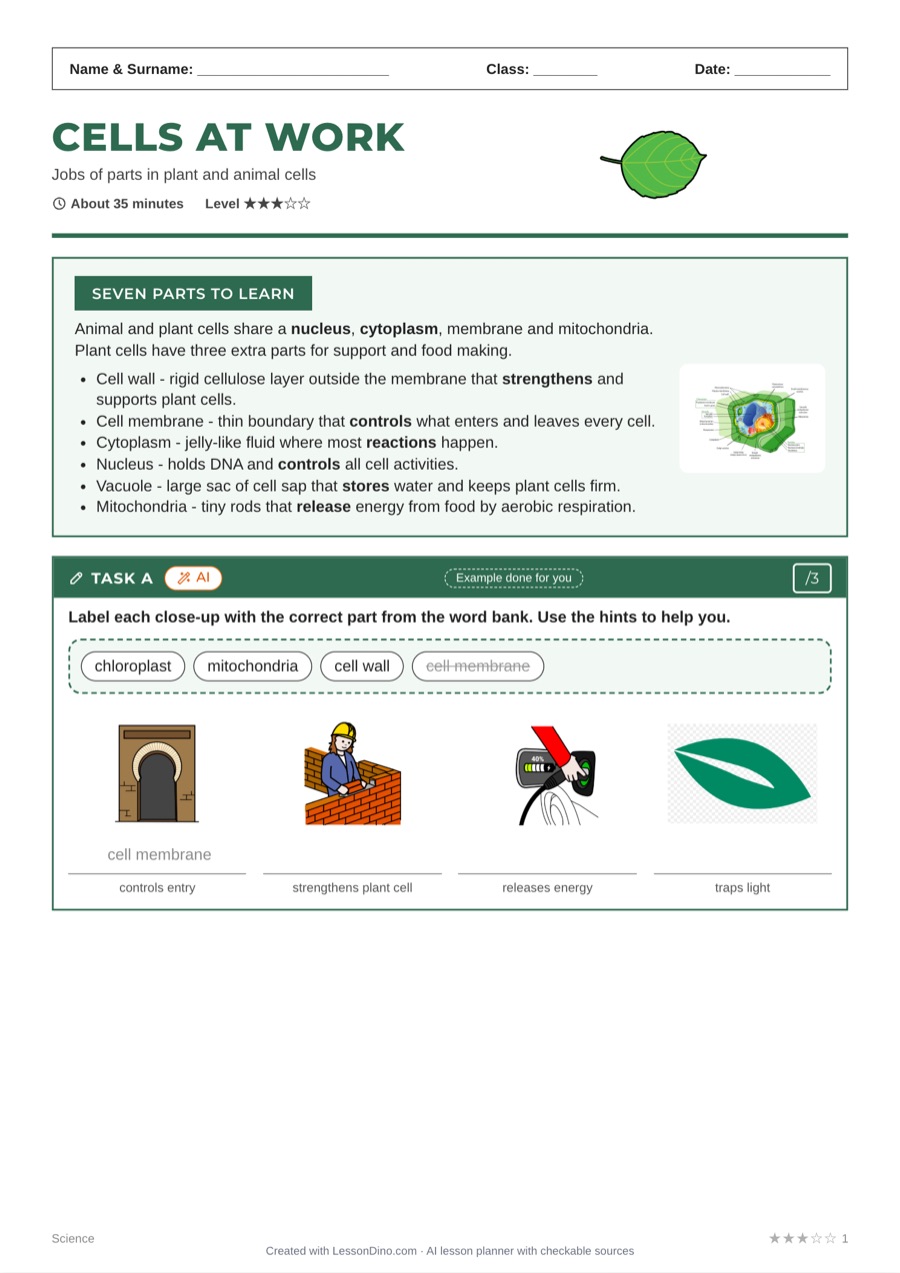
Cells Up Close
Learn the parts and label their jobs.
Seven Parts to Learn
- Animal and plant cells share a nucleus, cytoplasm, membrane and mitochondria. Plant cells have three extra parts for support and food making.
- Cell wall - rigid cellulose layer outside the membrane that strengthens and supports plant cells.
- Cell membrane - thin boundary that controls what enters and leaves every cell.
- Cytoplasm - jelly-like fluid where most reactions happen.
- Nucleus - holds DNA and controls all cell activities.
- Vacuole - large sac of cell sap that stores water and keeps plant cells firm.
- Mitochondria - tiny rods that release energy from food by aerobic respiration.
Label each close-up with the correct part from the word bank. Use the hints to help you.
Words to Know
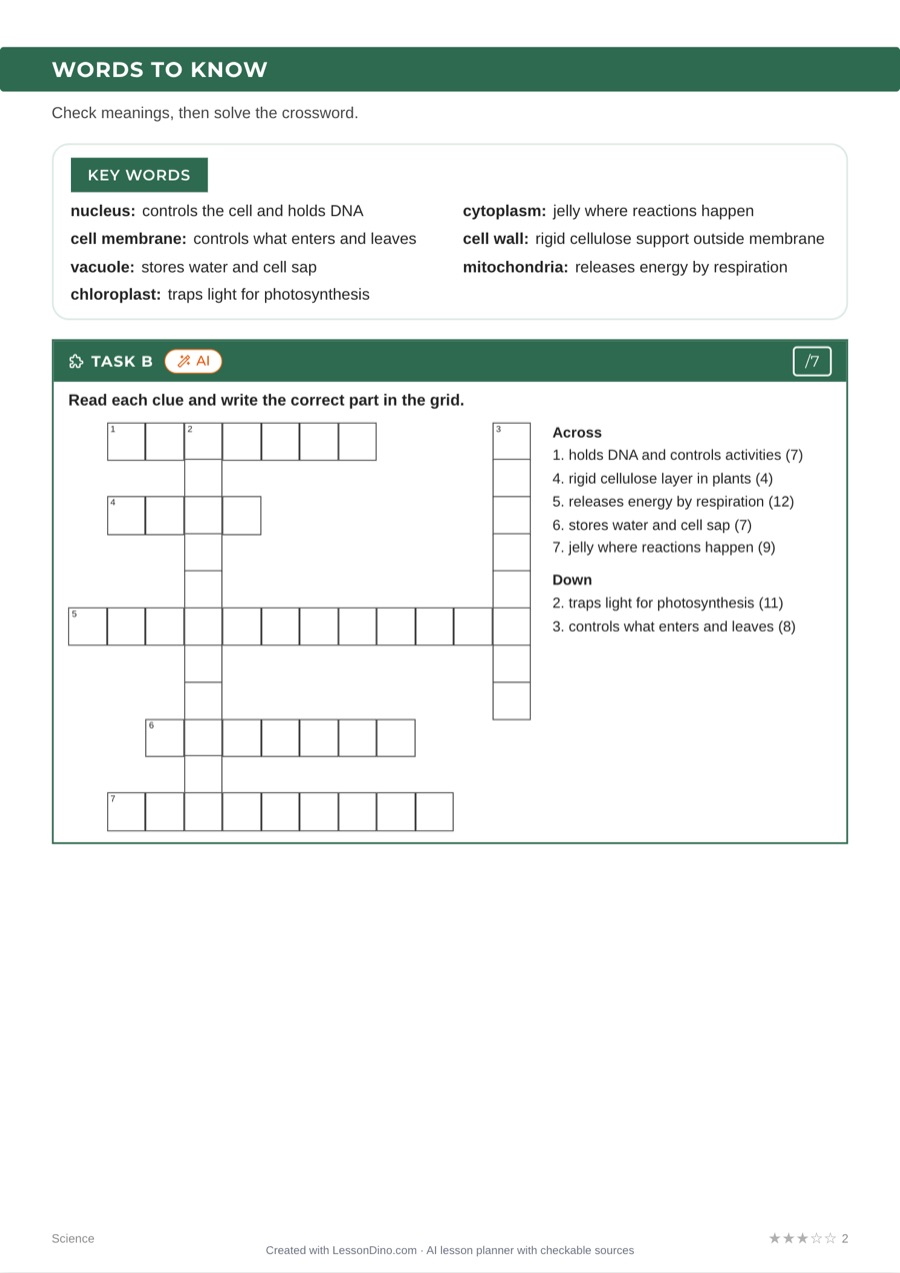
Check meanings, then solve the crossword.
| Word | Meaning |
|---|---|
| nucleus | controls the cell and holds DNA |
| cytoplasm | jelly where reactions happen |
| cell membrane | controls what enters and leaves |
| cell wall | rigid cellulose support outside membrane |
| vacuole | stores water and cell sap |
| mitochondria | releases energy by respiration |
| chloroplast | traps light for photosynthesis |
Read each clue and write the correct part in the grid.
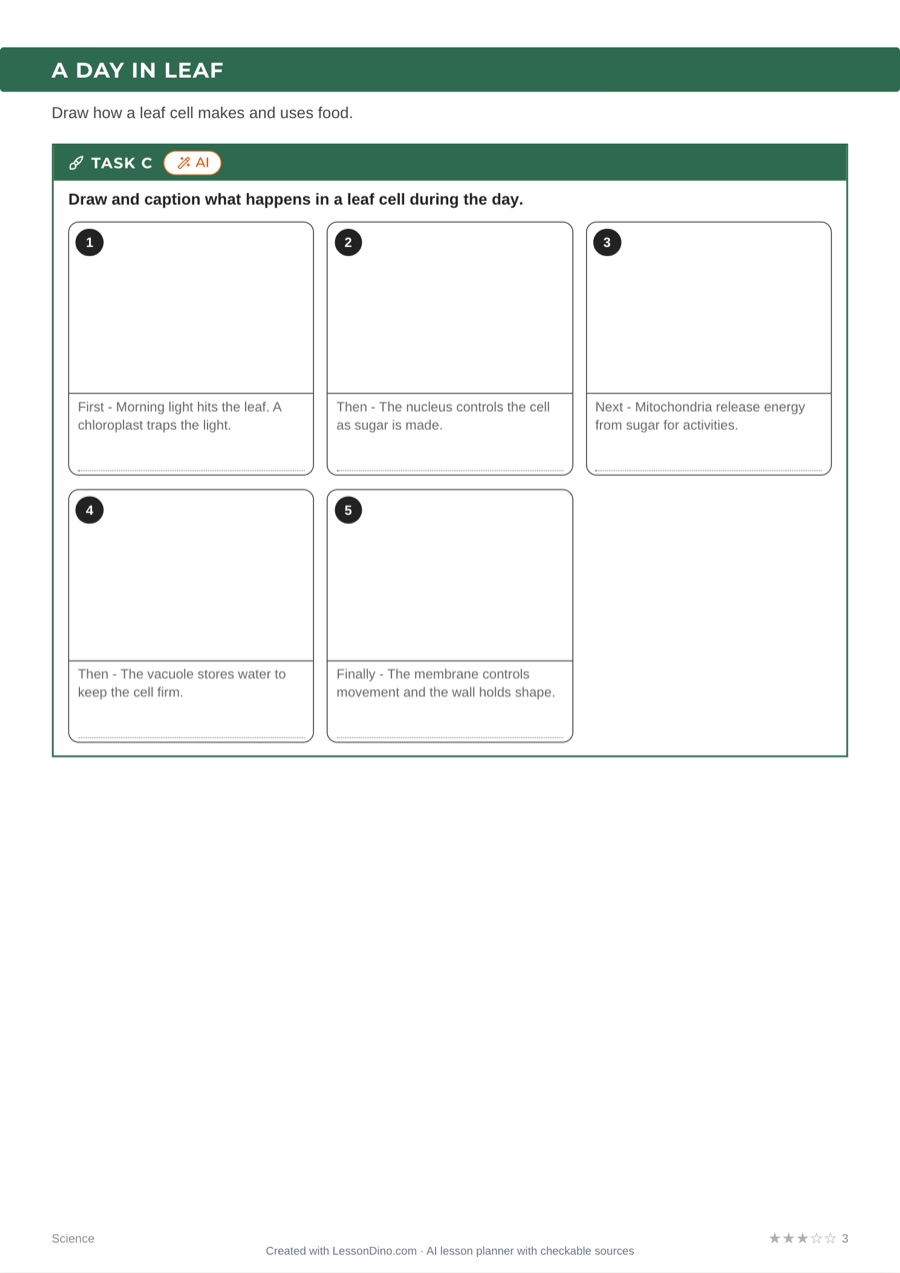
A Day in Leaf
Draw how a leaf cell makes and uses food.
Draw and caption what happens in a leaf cell during the day.
Twelve Part Review
Fill each wedge with a short note.
Summarise each job in a few words around the clock.
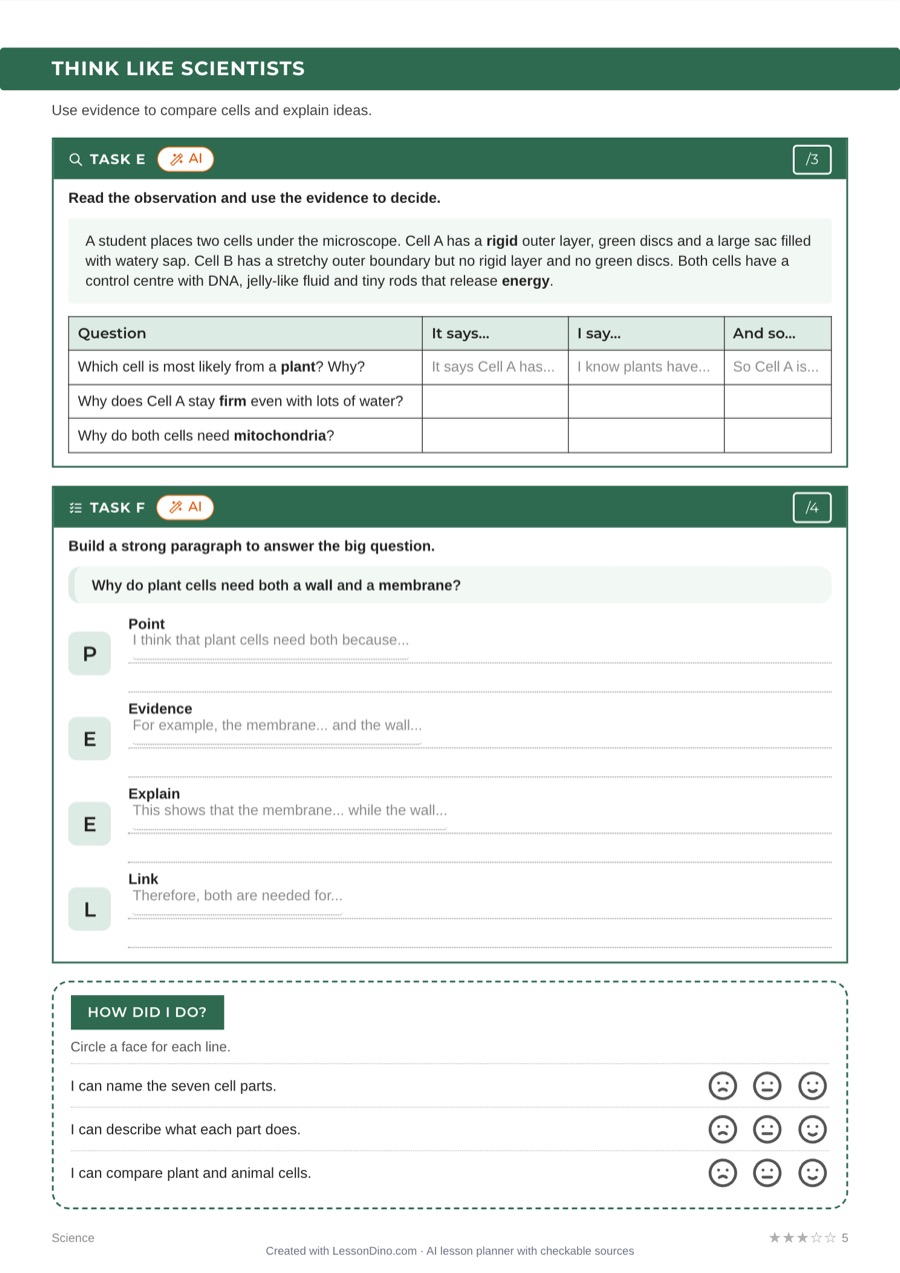
Think Like Scientists
Use evidence to compare cells and explain ideas.
Read the observation and use the evidence to decide.
- A student places two cells under the microscope. Cell A has a rigid outer layer, green discs and a large sac filled with watery sap. Cell B has a stretchy outer boundary but no rigid layer and no green discs. Both cells have a control centre with DNA, jelly-like fluid and tiny rods that release energy.
- Which cell is most likely from a plant? Why?
- Why does Cell A stay firm even with lots of water?
- Why do both cells need mitochondria?
Build a strong paragraph to answer the big question.
Answers
Show the answers
The answers are on the answer sheet, the last picture above.
Curriculum
the functions of the cell wall, cell membrane, cytoplasm, nucleus, vacuole, mitochondria and chloroplasts
Made with Lesson Dino's AI on 17 October 2026. AI can make mistakes, so check the answers and facts against the sources before you teach.