Slides
Lesson plan
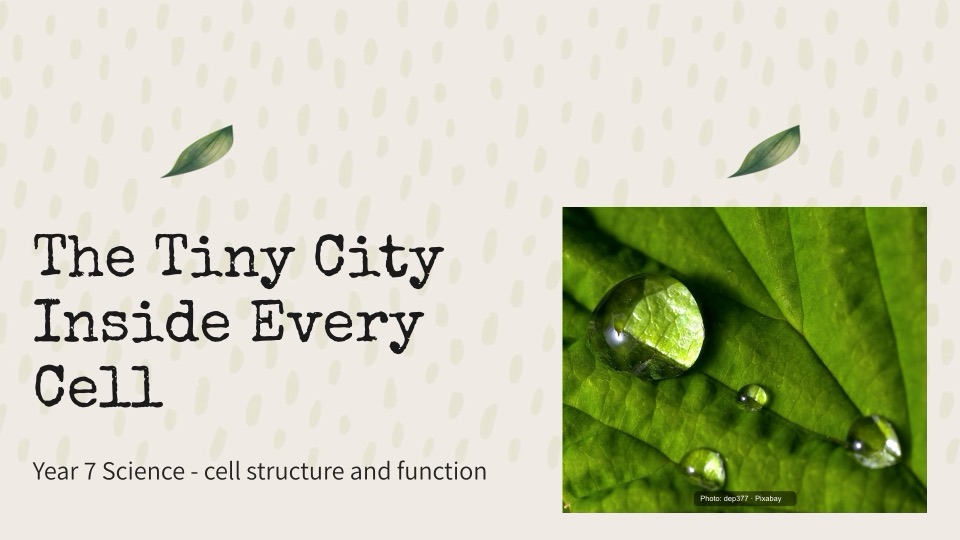
Build-a-Cell: Jobs of Seven Parts
Students learn the jobs of seven cell parts. They build animal and plant cells from clay and label each job.
Objectives
- Students will describe the functions of seven parts of cells.
- Students will compare plant and animal cells by their parts.
- Students will link each cell structure to its job in the cell.
Success criteria
- I can name a cell part from a description of its job.
- I can explain what each of the seven parts does.
- I can compare plant and animal cells using their parts.
Key words
| Word | Meaning |
|---|---|
| nucleus | control centre that holds DNA instructions and switches jobs on |
| cell membrane | stretchy skin round the cell that picks what goes in or out |
| cytoplasm | clear jelly inside where most of the chemical jobs happen |
| mitochondria | tiny power stations that use food and oxygen to free energy |
| cell wall | tough outer coat outside the skin, made of cellulose, that holds shape firm |
| chloroplasts | green food makers that catch light to make sugar |
Timed plan (60 minutes)
| Time | Stage | What happens |
|---|---|---|
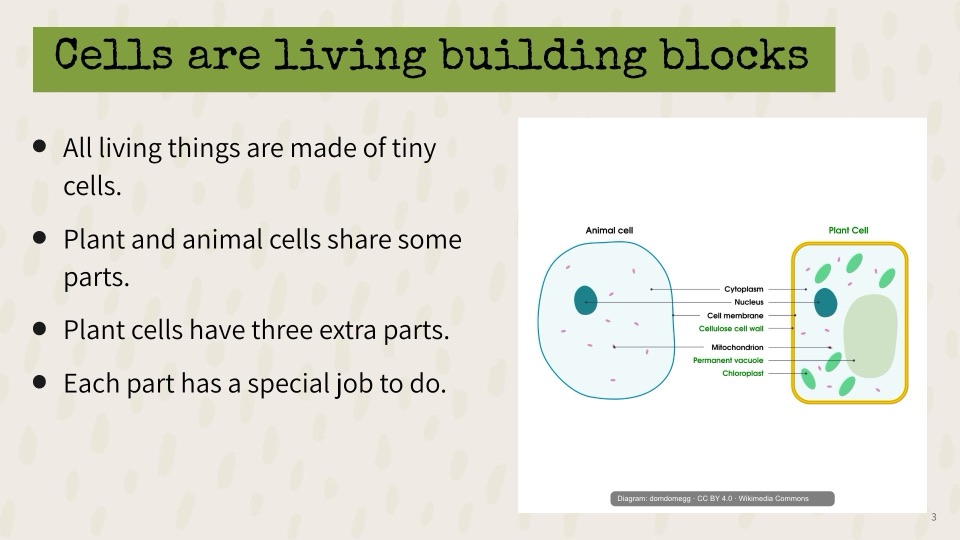
| 5 min | Starter | Recall that cells are building blocks and spark interest in building a cell. Show Slides 1-3 and read the objectives from Slide 2. Point to Slide 3 bullets: all living things are made of tiny cells. Give the hook: If you had to build the smallest living thing in the world, what parts would you put inside? Ask pairs to suggest one part a tiny living thing would need and take two quick ideas. |
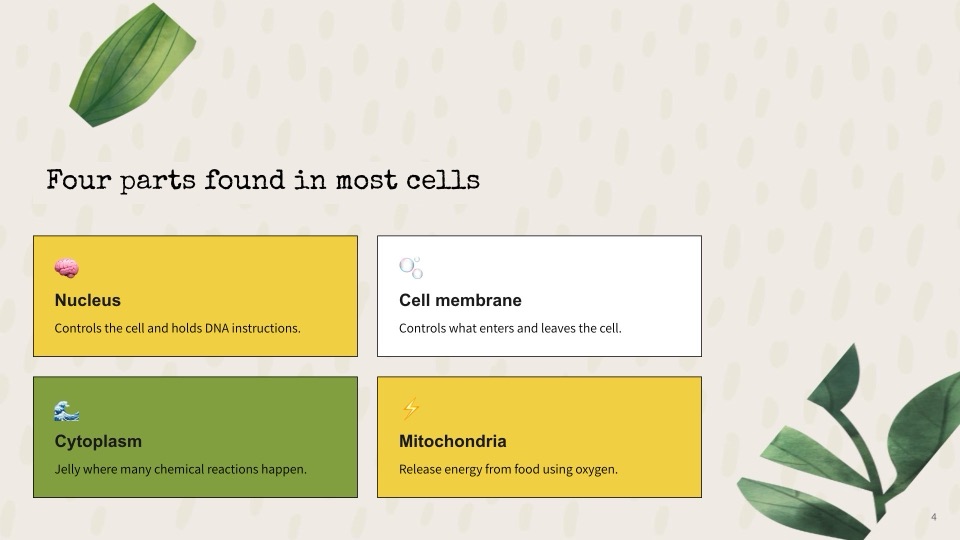
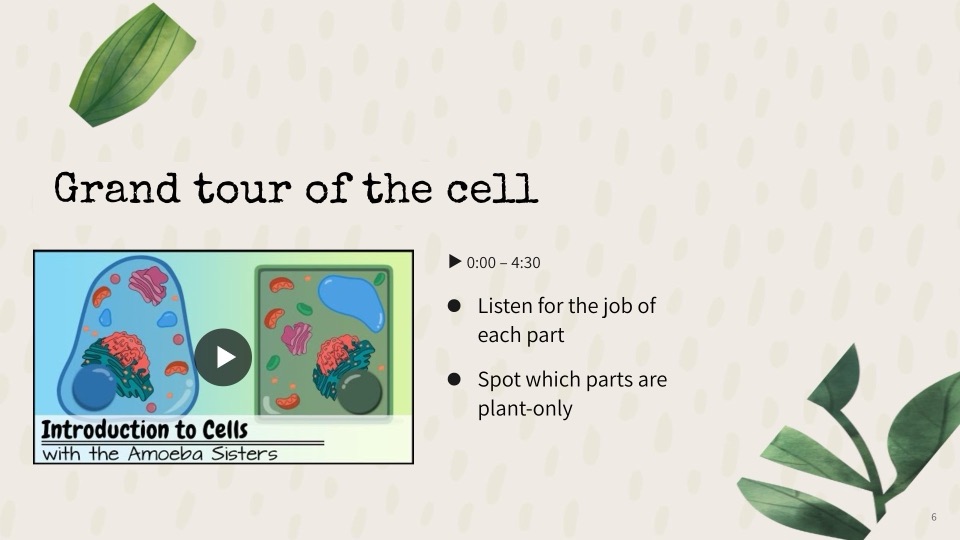
| 13 min | Teaching | Teach the jobs of the four shared parts and three plant-only parts. Show Slide 4 cards and explain the four shared parts: nucleus holds DNA and controls activities, membrane controls what enters and leaves, cytoplasm is jelly where reactions take place, mitochondria provide energy. Show Slide 5 question and let pairs discuss what happens with no strong walls. Play Video clip 1 on Slide 6 and ask students to listen for each job and spot plant-only parts. Summarise after the video that plant cells also have a rigid wall for support, a large vacuole with cell sap for support, and chloroplasts with chlorophyll that trap light for photosynthesis. |
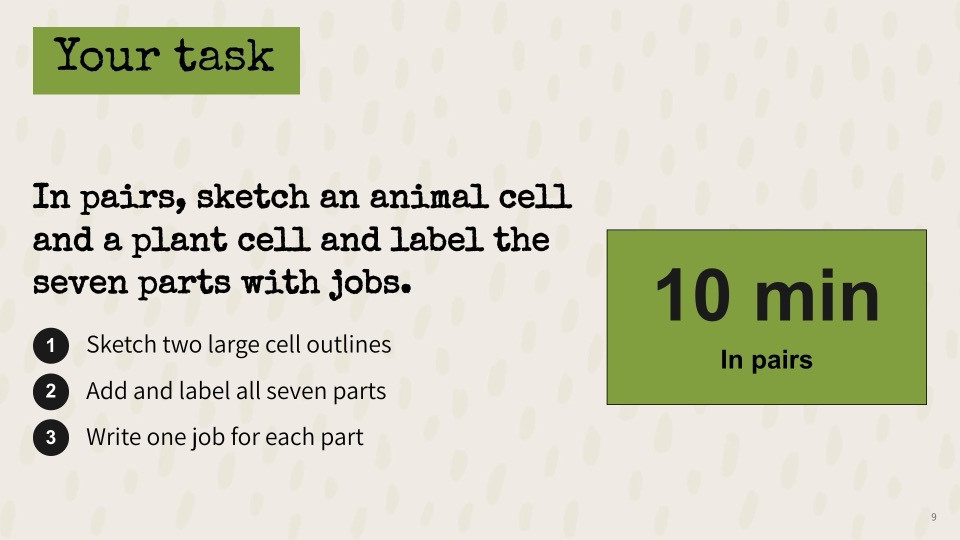
| 20 min | Main activity | Model animal then plant cells and label the function of all seven parts. Model quickly: roll clay for nucleus, flatten cytoplasm, wrap membrane edge. Hand out trays, printed diagrams, labels and toothpicks; pairs build an animal cell with four parts. Tell pairs to add the three plant parts to turn it into a plant cell and talk through each job as they build. Circulate, check links, and stop the class at 15 minutes to write folded-card labels with one job per part. |
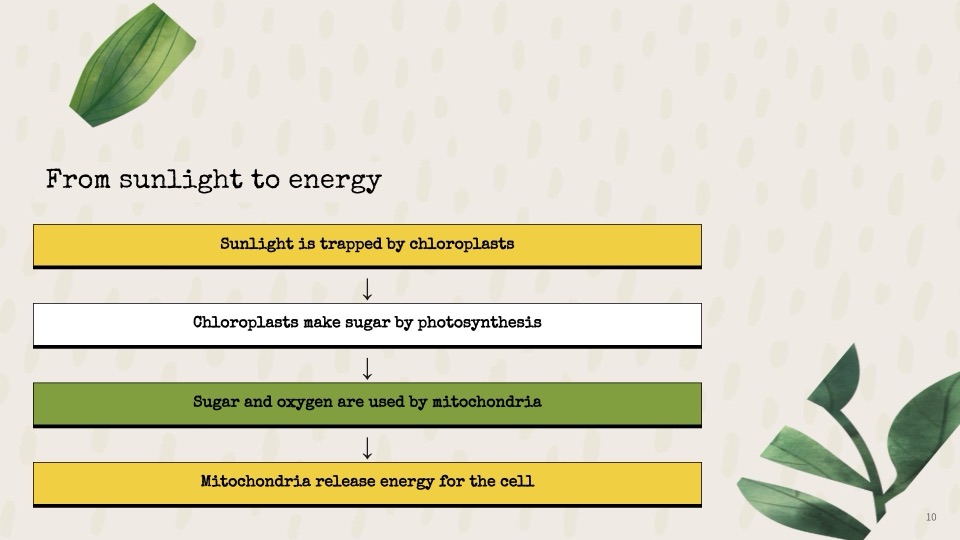
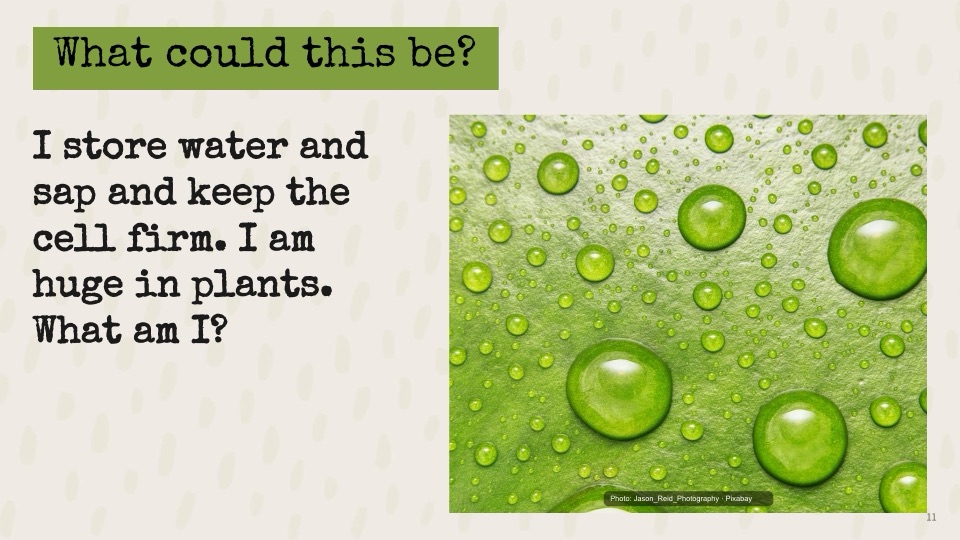
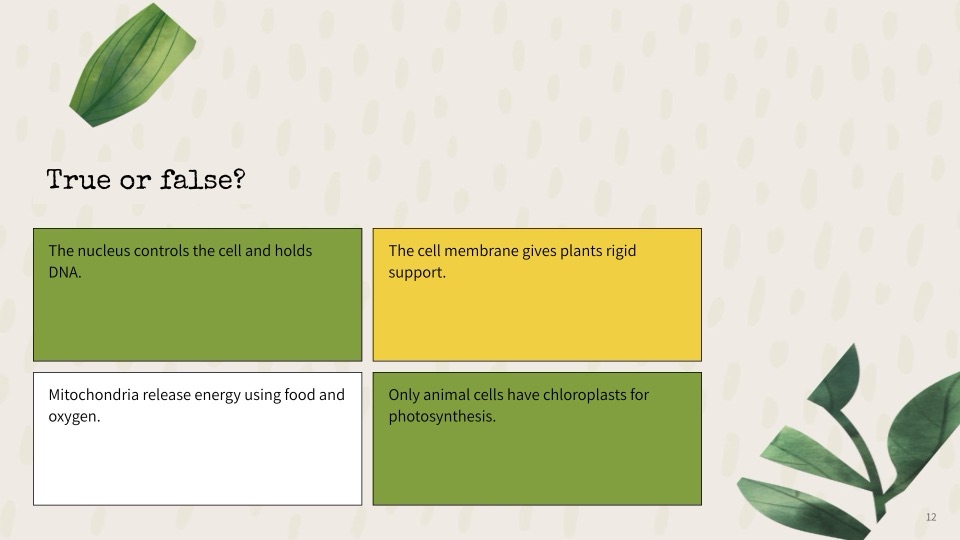
| 12 min | Linking | Link chloroplasts making food to mitochondria releasing energy and fix wall errors. Show Slide 10 chain and talk through sunlight trapped by chloroplasts to make sugar, then sugar used by mitochondria to release energy. Show Slide 11 mystery: read I store water and sap and keep the cell firm; confirm large permanent vacuole with cell sap. Show Slide 12 true or false and take votes on nucleus control and wall support. Correct the false statement that the membrane gives rigid support: the wall gives support. |
| 10 min | Plenary | Summarise the seven jobs and check progress against the success criteria. Hand out Worksheet Task D revision clock and ask for a few words per job around the clock. Show Slide 2 success lines and ask students to tick I can name a part from its job and explain each part. Take three quick answers from clocks for wall, nucleus and mitochondria. Collect clocks and set homework. |
Common mistakes
- Thinking the cell membrane gives rigid support
How to spot it: Labels or votes say membrane makes the plant stiff
Show box and balloon model again: wall outside the membrane is rigid and supports; membrane only controls entry and exit. - Mixing up mitochondria and chloroplasts
How to spot it: Students say mitochondria trap light or make sugar
Repeat chain: chloroplasts trap light and make sugar; mitochondria use food and oxygen to free energy. - Seeing the vacuole as just a water bag with no support job
How to spot it: Comic or clock says stores water but misses firmness
Stress large vacuole holds cell sap which provides support and keeps turgor.
Support
- Give a word bank with the seven jobs in simple sentences to copy onto labels and clocks.
- Provide half-finished diagrams and sentence starters: It should enter because..., When the vacuole is full, the cell is...
Stretch
- Write why a plant cell needs both a membrane and a wall, using strength and control.
- Explain what breaks if gates or power station fail, and what happens with no light for chloroplasts.
Check questions
- Name the part: I control the cell and hold DNA instructions. What am I?
Answer: Nucleus. - Name two parts found in plant cells but not in animal cells, with one job each.
Answer: Cell wall supports; vacuole stores sap and keeps firm; chloroplasts trap light for photosynthesis – any two. - Explain how food made in chloroplasts leads to energy for the cell.
Answer: Chloroplasts make sugar by photosynthesis; mitochondria use sugar and oxygen to release energy.
Curriculum
the functions of the cell wall, cell membrane, cytoplasm, nucleus, vacuole, mitochondria and chloroplasts
Video clips
Clips on YouTube, from the start and end times we chose. Check each one before you show it.
-
Grand Cell Tour from 0:00 to 4:30
Amoeba Sisters: Introduction to Cells: The Grand Cell Tour
Fun, clear tour with vocabulary and pace perfect for 11-12-year-olds covering all seven named parts.
-
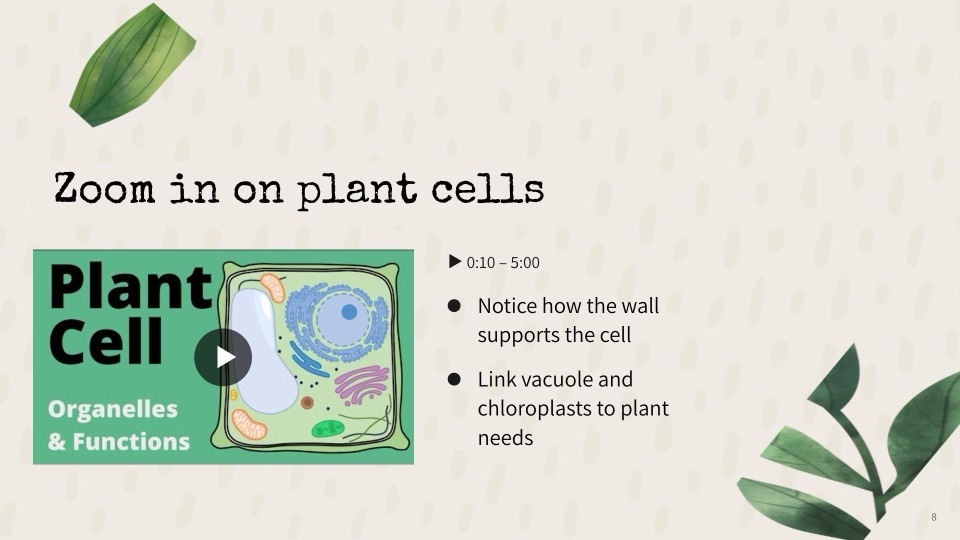
Plant Cell Functions from 0:10 to 5:00
Henrik's Lab: Structure and Function of the PLANT CELL explained (Organelles)
Clear, steady explanation well suited to 11-12-year-olds covering wall, vacuole and chloroplasts plus shared parts.
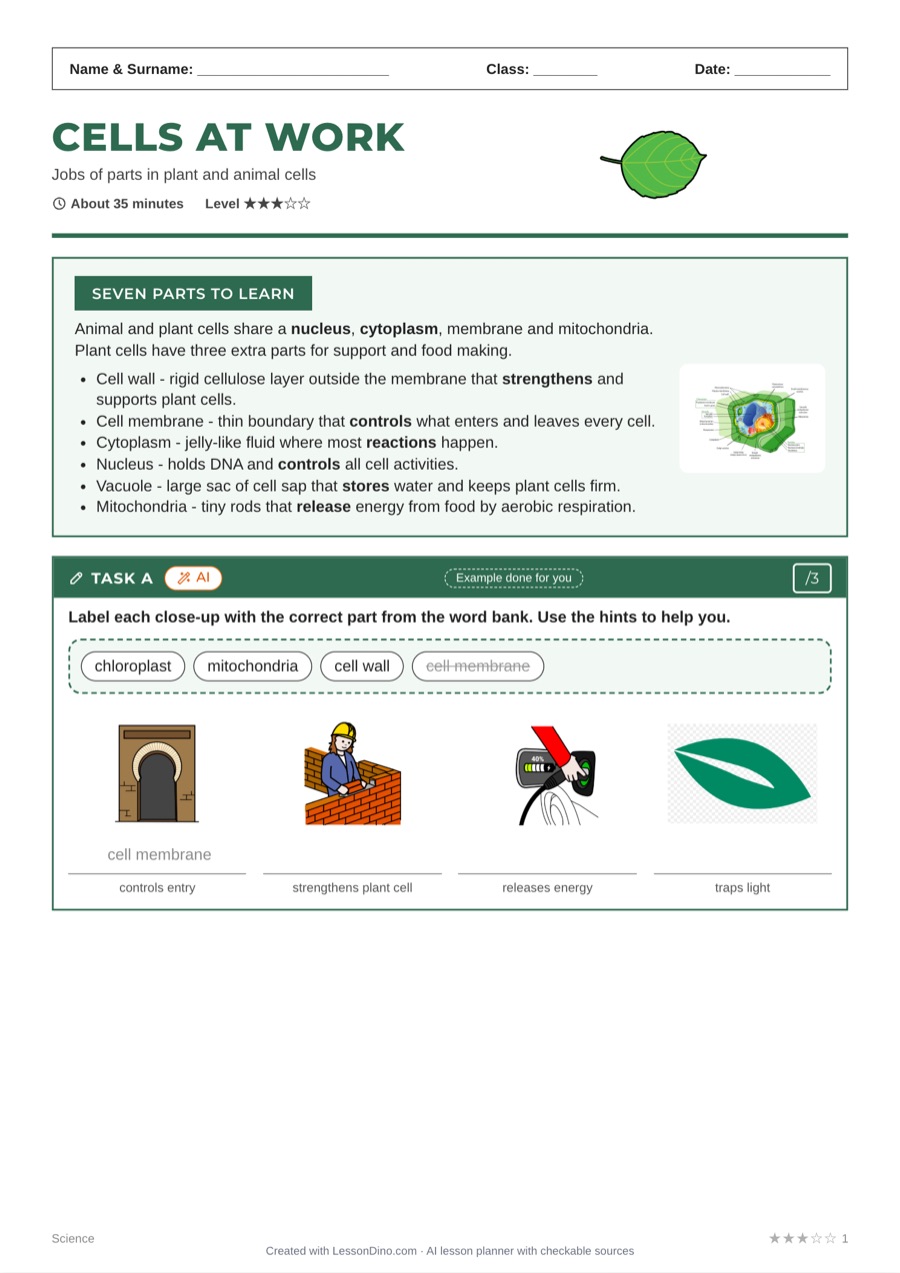
Worksheet
Sources
- Year 7 Science - Curriculum Overview and KS3 Progress ... hgs.herts.sch.uk
- Year 7 Science Curriculum Map - updated 2025 fishermore.lancs.sch.uk
- The functions of cell organelles - Revise: Cell structure ... bbc.co.uk
- Understanding Cell Structure and Function alevelstudynotes.co.uk
- Year 7 Biology: Structure And Function Of Plant And Animal Cells keystagelearning.co.uk
- Animal cell structures and their functions KS3 | Y7 Science ... thenational.academy
- Cell Structure and Function jstage.jst.go.jp
- Cells - Biology - BBC Bitesize bbc.co.uk
- Learn and try: Cell parts and functions - Khan Academy en.khanacademy.org
- Cells and the Versatile Functions of Their Parts - Education education.nationalgeographic.org
- Cell (biology) en.wikipedia.org
- Amazing Cells - University of Utah teach.genetics.utah.edu
- Cell structure and function | AP®︎/College Biology | Science ... home.khanacademy.org
- Cells | AP®︎/College Biology | Science | Khan Academy khanacademy.org
- Introduction to the cell (video) | Cells | Khan Academy khanacademy.org
- Cell Structure and Function - Science for Students kidsworldfun.com
- Home - Cell Structure and Function jscb.gr.jp
- 4.1: Cell Structure and Function - Medicine LibreTexts med.libretexts.org
- Cell Structure and Function - Biology LibreTexts bio.libretexts.org
- Cells Definition Structure and Function - Vedantu vedantu.com
- Chapter 6. Cell Structure and Function – Human Anatomy and ... louis.pressbooks.pub
- The Cell – Definition, Structure, Types, and Functions sciencenotes.org
- Cells Unit: Modeling Cell Structure and Function – SEPUP sepup.lawrencehallofscience.org
Picture credits
- Photo: dep377 · Pixabay
- Diagram: domdomegg · CC BY 4.0 · Wikimedia Commons
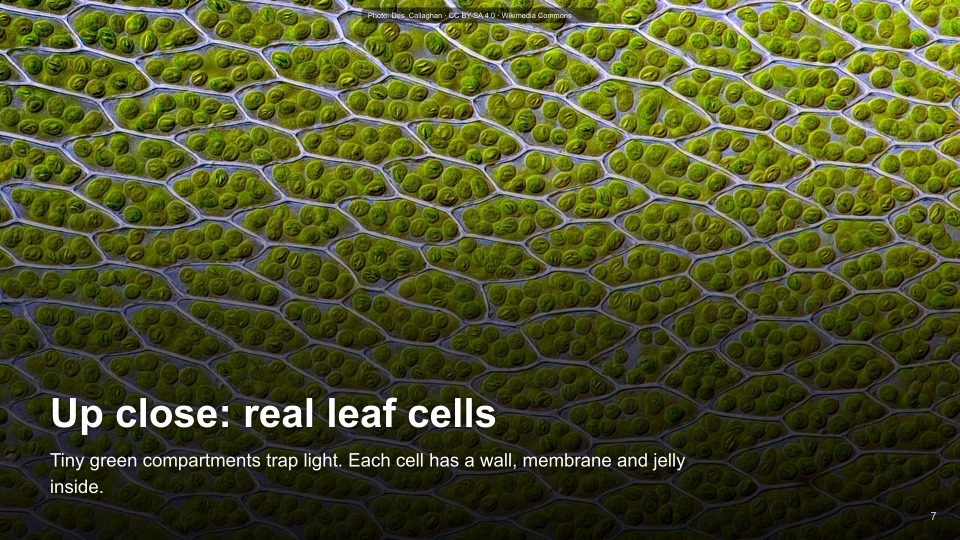
- Photo: Des_Callaghan · CC BY-SA 4.0 · Wikimedia Commons
- Photo: Jason_Reid_Photography · Pixabay
- Pictograms: Sergio Palao, ARASAAC (arasaac.org) · CC BY-NC-SA
- Drawing: LadyofHats · Public domain · Wikimedia Commons
- Picture: unknown · CC0 · rawpixel via Openverse
Made with Lesson Dino's AI on 17 October 2026. AI can make mistakes, so check facts against the sources before you teach.