The worksheet
About this worksheet
Pupils recall multiplication and division facts up to 12 x 12. They play a timed pairs game to beat the tricky facts. This Year 4 Maths worksheet gives students (ages 8–9) five pages of practice on times tables up to 12 × 12, part of the multiplication and division unit. It goes with our free Times tables up to 12 × 12 lesson, which has the slides and a timed lesson plan.
What it covers
By the end, students should be able to:
- Students will recall multiplication facts for tables up to 12 x 12 quickly.
- Students will recall matching division facts for tables up to 12 x 12.
- Students will use known facts to work out tricky facts accurately.
How to use it
- Main activity (22 minutes): Hand out Worksheet Task B Practice questions: recall each fact quickly, use the inverse to check division; stop game at 14 minutes for 8 minutes writing.
- Plenary (10 minutes): Set homework and collect in Worksheet Task B for marking.
- Support: Remove the 6, 7, 8 and 12 cards at first and build up from confident tables.
- Stretch: Add division cards such as 96 ÷ 12 and 84 ÷ 7, with a shorter time limit.
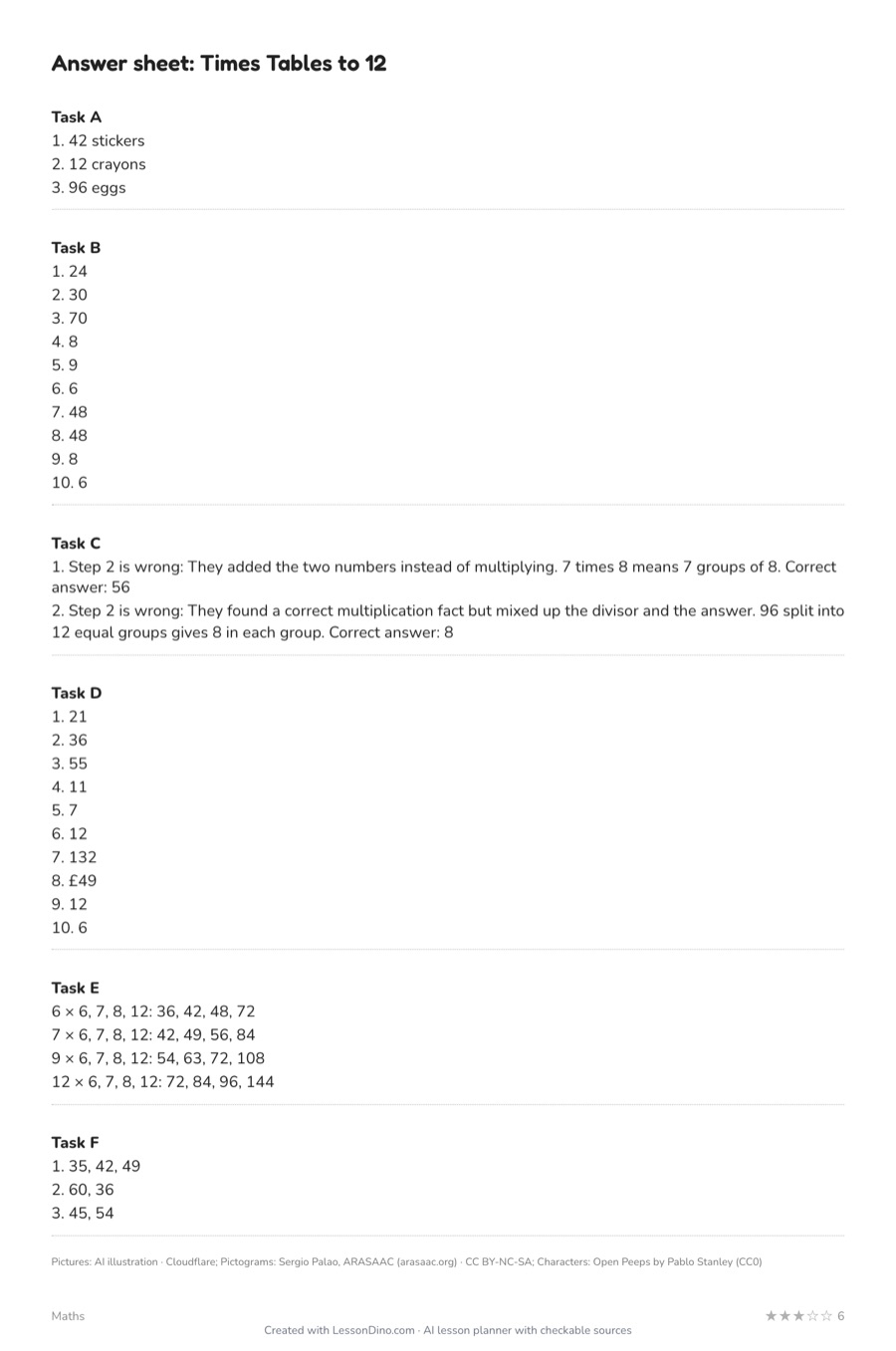
- The answer sheet is the last page, so you can print it on its own or let students check their own work.
Key vocabulary
- multiplication: adding equal groups lots of times
- division: sharing into equal groups
- product: answer you get when you multiply
- factor: number you multiply with another number
Mistakes to watch for
- Mixing 6 x 8 and 7 x 8, saying 54 or 52 instead of 48 and 56. Anchor 6 x 8 = 48 on grid where row 6 and column 8 meet, then build 7 x 8 = 56 as one more 8.
- Reversing division, e.g. 56 ÷ 8 = 7 written as 8 ÷ 56 = 7. Rebuild 3 rows of 4 dots is 12 so 12 ÷ 3 = 4; product always goes first in division.
- Saying 72 ÷ 9 = 7 or 48 ÷ 6 = 7. Check with multiplication: 9 x 8 = 72 so 72 ÷ 9 = 8; use finger pattern and grid.
What's on the worksheet
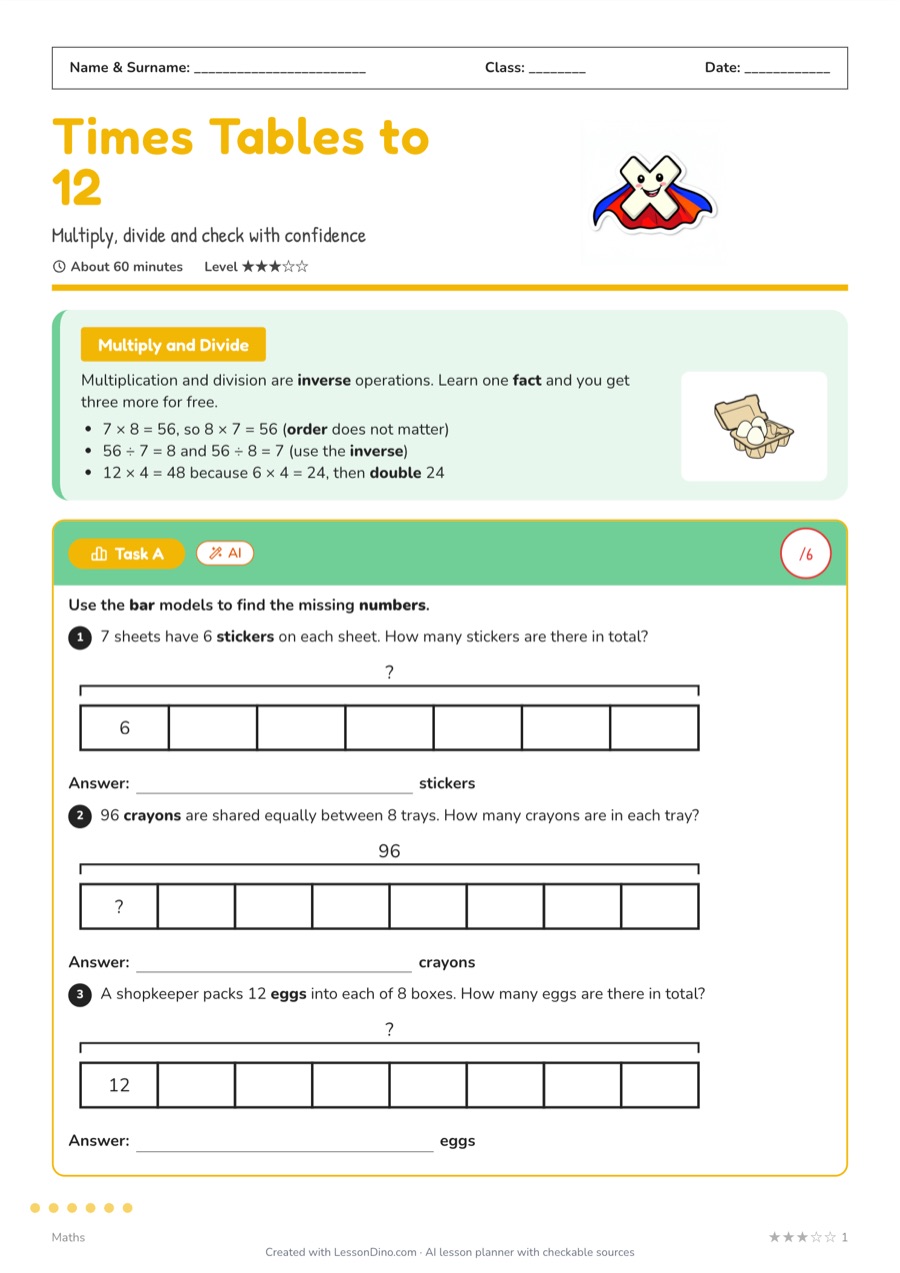
Tables Toolkit
Remember how multiplication and division facts link together.
Multiply and Divide
- Multiplication and division are inverse operations. Learn one fact and you get three more for free.
- 7 × 8 = 56, so 8 × 7 = 56 (order does not matter)
- 56 ÷ 7 = 8 and 56 ÷ 8 = 7 (use the inverse)
- 12 × 4 = 48 because 6 × 4 = 24, then double 24
Use the bar models to find the missing numbers.
Quick Recall
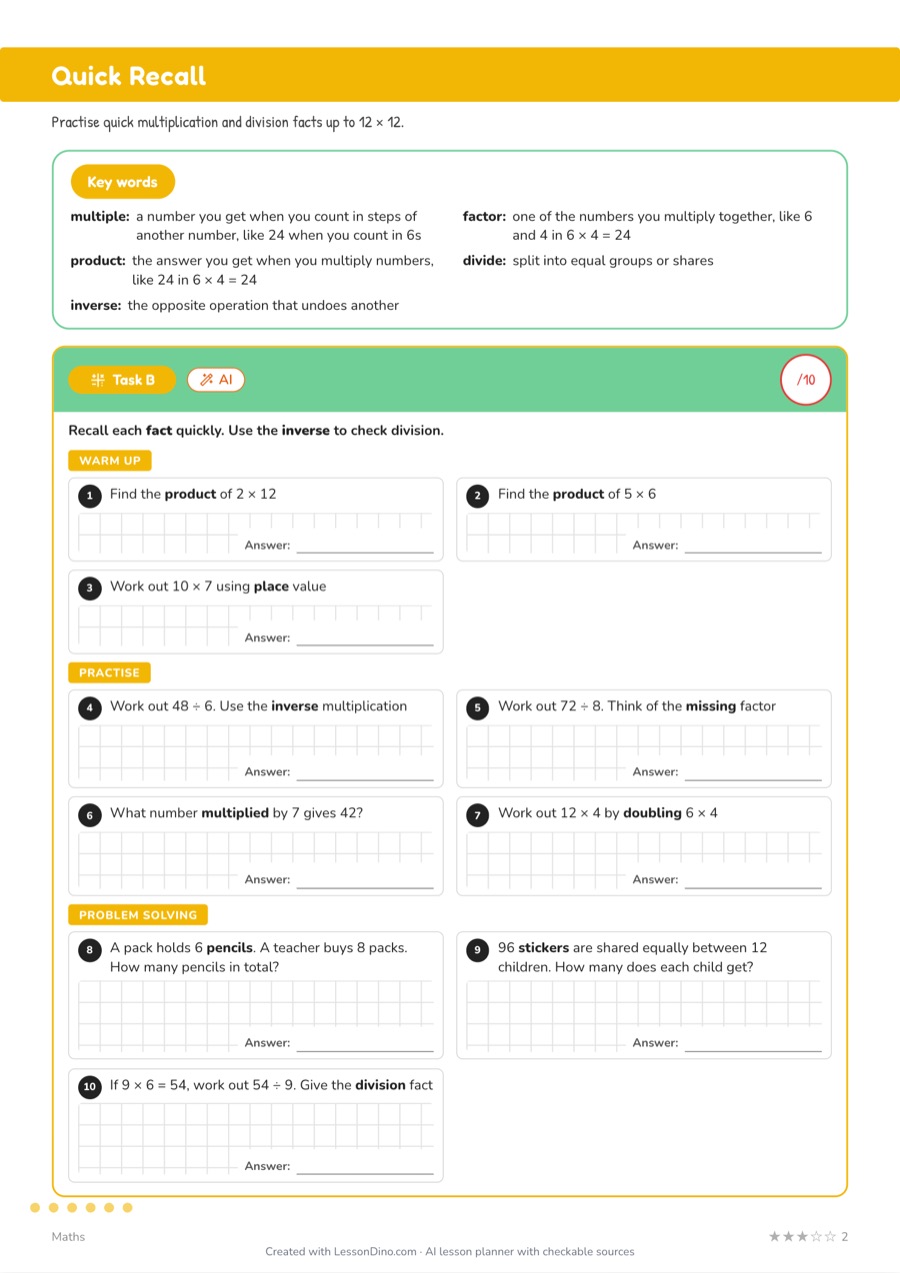
Practise quick multiplication and division facts up to 12 × 12.
| Word | Meaning |
|---|---|
| multiple | a number you get when you count in steps of another number, like 24 when you count in 6s |
| factor | one of the numbers you multiply together, like 6 and 4 in 6 × 4 = 24 |
| product | the answer you get when you multiply numbers, like 24 in 6 × 4 = 24 |
| divide | split into equal groups or shares |
| inverse | the opposite operation that undoes another |
Recall each fact quickly. Use the inverse to check division.
Warm up
- Find the product of 2 × 12
- Find the product of 5 × 6
- Work out 10 × 7 using place value
Practise
- Work out 48 ÷ 6. Use the inverse multiplication
- Work out 72 ÷ 8. Think of the missing factor
- What number multiplied by 7 gives 42?
- Work out 12 × 4 by doubling 6 × 4
Problem solving
- A pack holds 6 pencils. A teacher buys 8 packs. How many pencils in total?
- 96 stickers are shared equally between 12 children. How many does each child get?
- If 9 × 6 = 54, work out 54 ÷ 9. Give the division fact
Spot Mistakes
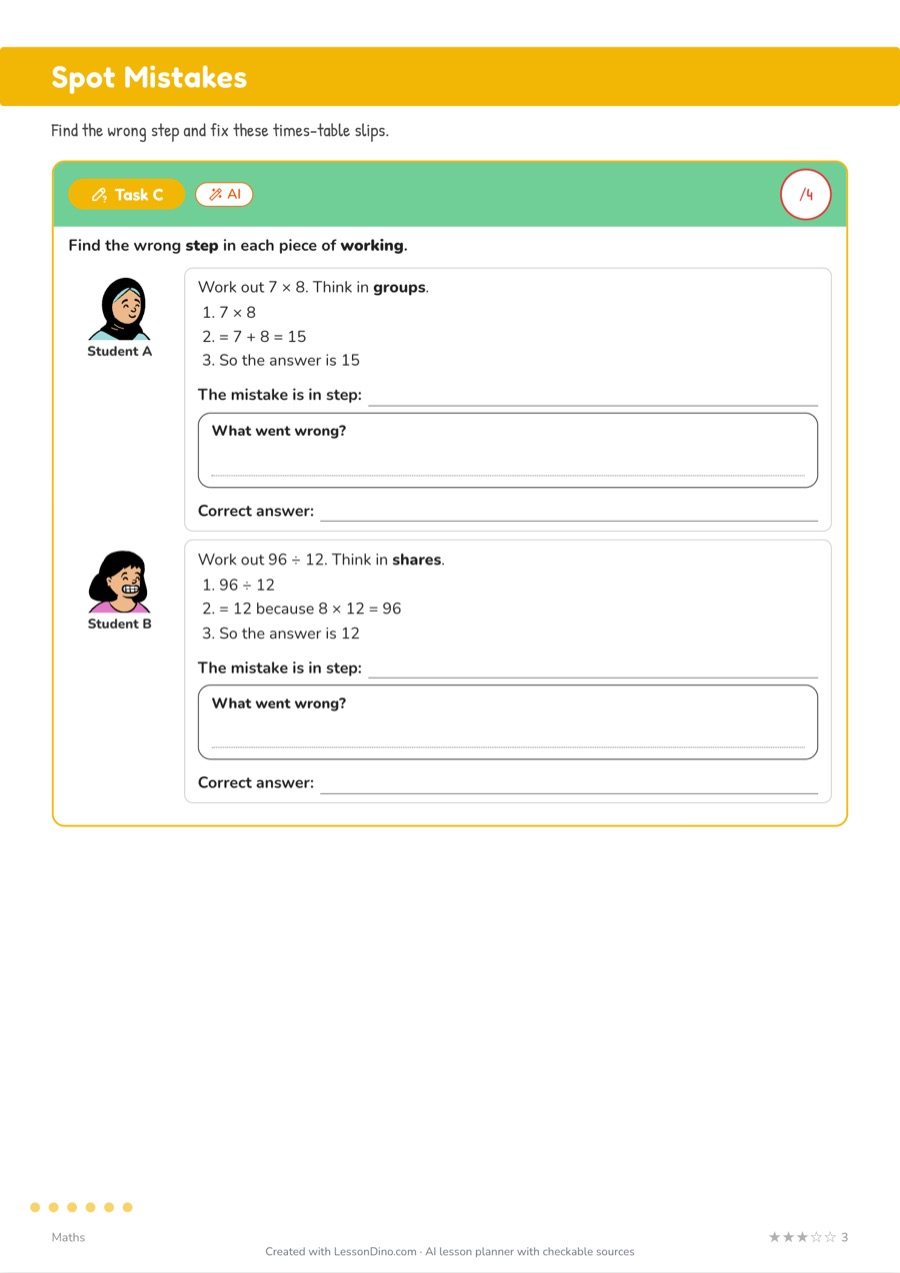
Find the wrong step and fix these times-table slips.
Find the wrong step in each piece of working.
Tables Challenge
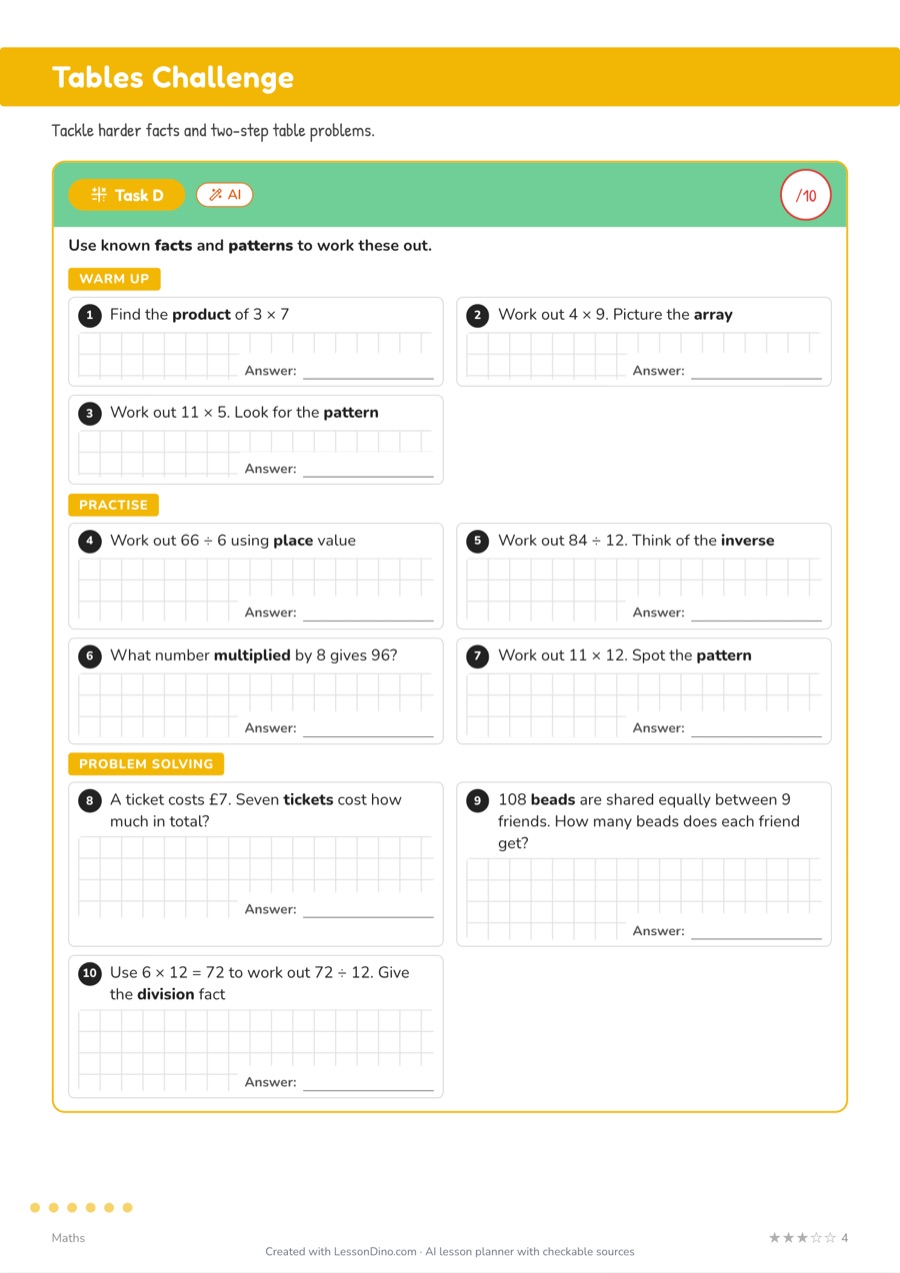
Tackle harder facts and two-step table problems.
Use known facts and patterns to work these out.
Warm up
- Find the product of 3 × 7
- Work out 4 × 9. Picture the array
- Work out 11 × 5. Look for the pattern
Practise
- Work out 66 ÷ 6 using place value
- Work out 84 ÷ 12. Think of the inverse
- What number multiplied by 8 gives 96?
- Work out 11 × 12. Spot the pattern
Problem solving
- A ticket costs £7. Seven tickets cost how much in total?
- 108 beads are shared equally between 9 friends. How many beads does each friend get?
- Use 6 × 12 = 72 to work out 72 ÷ 12. Give the division fact
Grid Masters
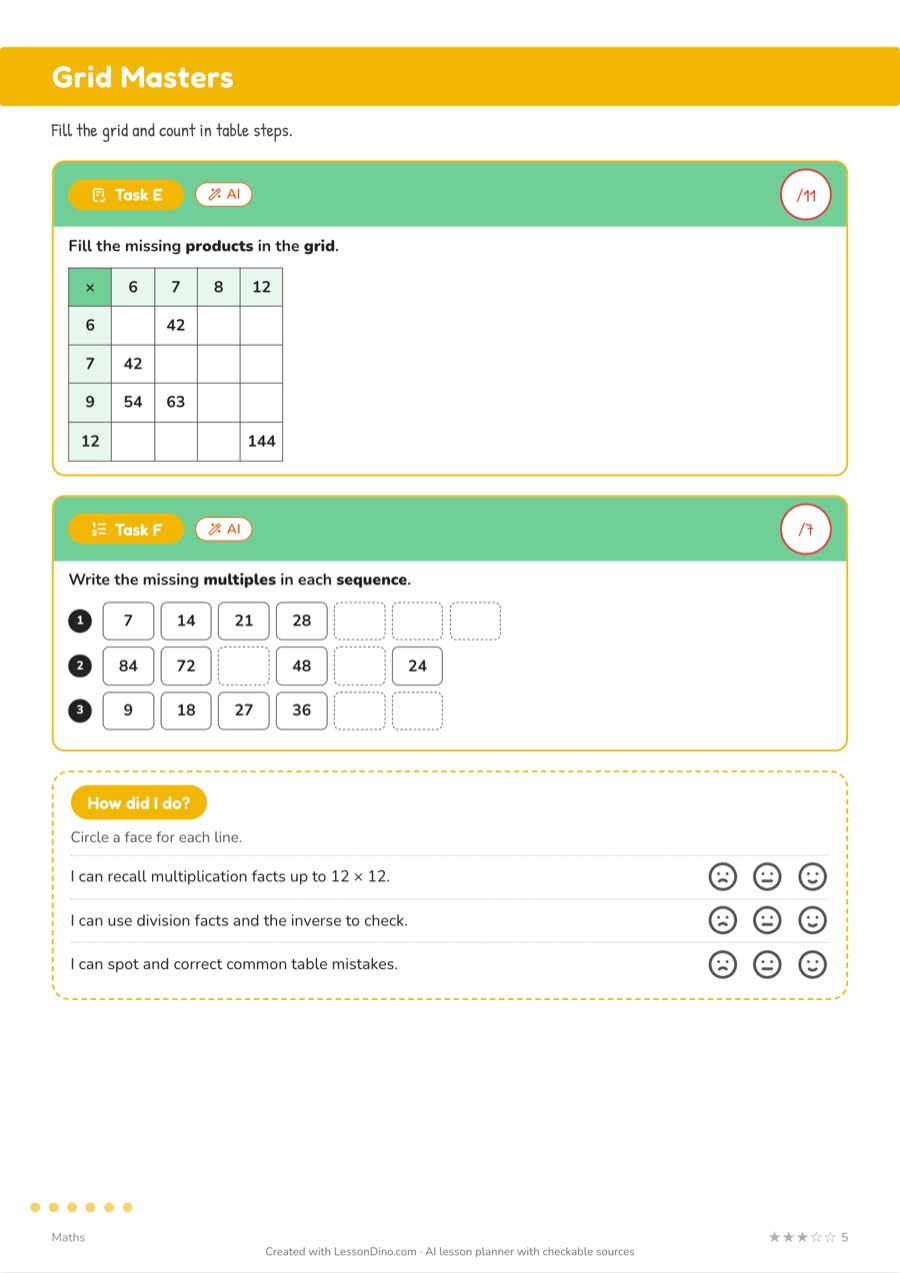
Fill the grid and count in table steps.
Fill the missing products in the grid.
Write the missing multiples in each sequence.
Answers
Show the answers
- Find the product of 2 × 12 24
- Find the product of 5 × 6 30
- Work out 10 × 7 using place value 70
- Work out 48 ÷ 6. Use the inverse multiplication 8
- Work out 72 ÷ 8. Think of the missing factor 9
- What number multiplied by 7 gives 42? 6
- Work out 12 × 4 by doubling 6 × 4 48
- A pack holds 6 pencils. A teacher buys 8 packs. How many pencils in total? 48
- 96 stickers are shared equally between 12 children. How many does each child get? 8
- If 9 × 6 = 54, work out 54 ÷ 9. Give the division fact 6
- Find the product of 3 × 7 21
- Work out 4 × 9. Picture the array 36
- Work out 11 × 5. Look for the pattern 55
- Work out 66 ÷ 6 using place value 11
- Work out 84 ÷ 12. Think of the inverse 7
- What number multiplied by 8 gives 96? 12
- Work out 11 × 12. Spot the pattern 132
- A ticket costs £7. Seven tickets cost how much in total? £49
- 108 beads are shared equally between 9 friends. How many beads does each friend get? 12
- Use 6 × 12 = 72 to work out 72 ÷ 12. Give the division fact 6
The answer sheet is the last picture above.
Curriculum
recall multiplication and division facts for multiplication tables up to 12 × 12
Made with Lesson Dino's AI on 19 October 2026. AI can make mistakes, so check the answers and facts against the sources before you teach.