Slides

Lesson plan
Split the L-Shape to Find Area
Pupils learn that area is covering a shape with squares. They split L-shapes, count squares and add parts.
Objectives
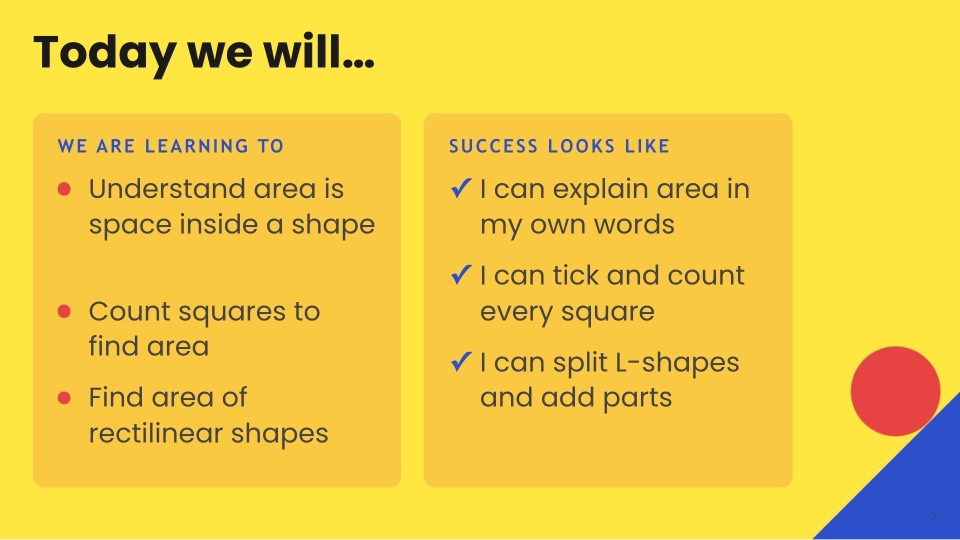
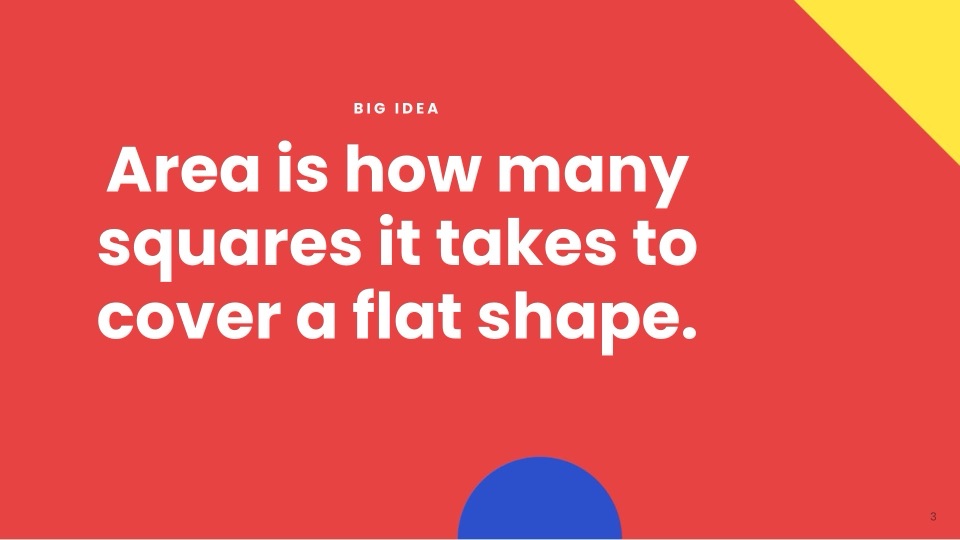
- Students will understand area as squares needed to cover a flat shape.
- Students will find area of rectilinear shapes by counting grid squares.
- Students will split L-shapes into rectangles, count parts and add totals.
Success criteria
- I can explain area as covering a shape with squares.
- I can tick and count every square to find area in cm².
- I can split an L-shape, count parts and add them.
Key words
| Word | Meaning |
|---|---|
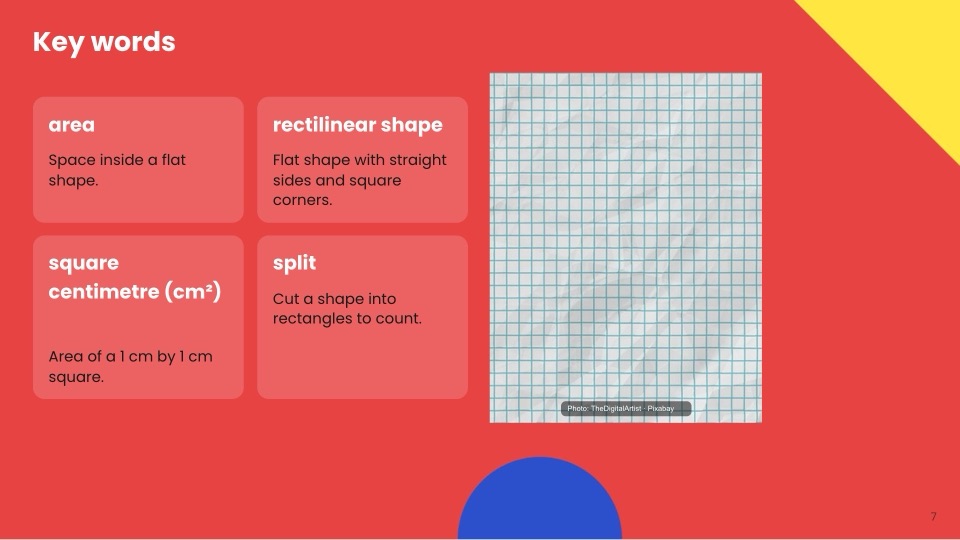
| area | amount of space taken up by a flat shape |
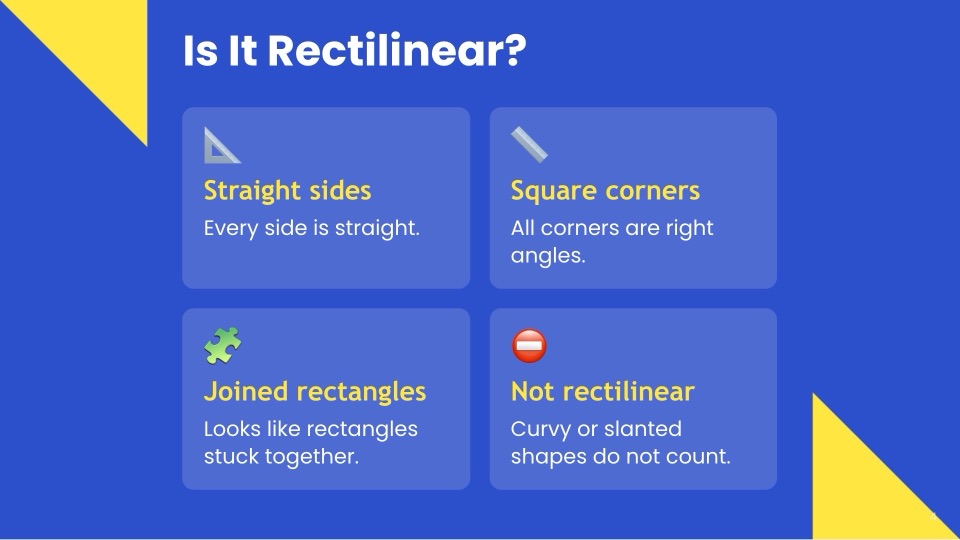
| rectilinear shape | a flat outline with only straight sides and square corners |
| square centimetre (cm²) | how much fits on a tiny 1 cm by 1 cm tile |
| split | cut along a straight line to make smaller parts |
Timed plan (60 minutes)
| Time | Stage | What happens |
|---|---|---|
| 8 min | Starter | Recall what area means and spark curiosity about tricky L-shapes. Show the lesson title and read the three objectives together with the class. Show a simple rectangle and a tricky L-shape on a 1-cm grid. Area is the amount of space taken up by a 2D shape. Say the hook and ask partners to point where they would cut the L-shape to make it easy. Explain the big idea that a rectilinear shape is a 2D, flat shape that has straight sides and all sides meet at right angles. |
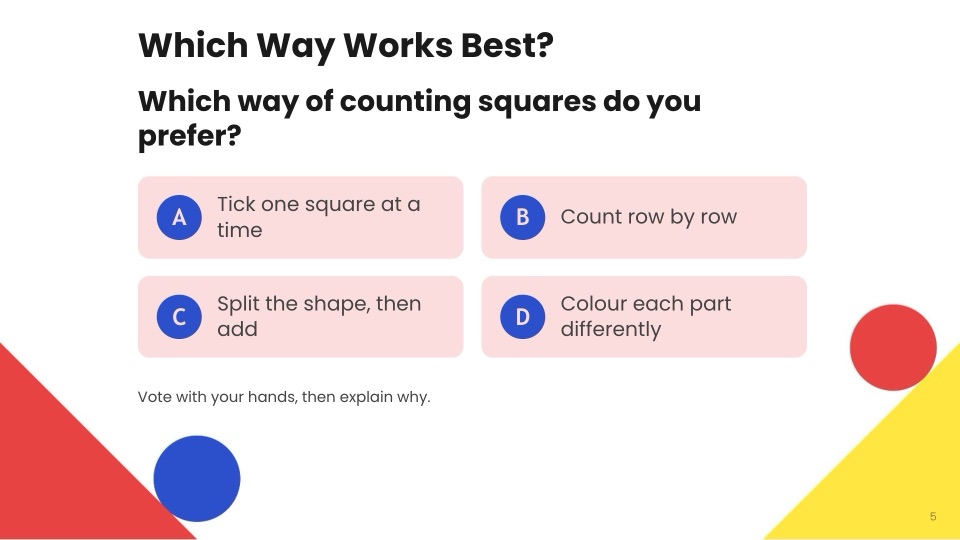
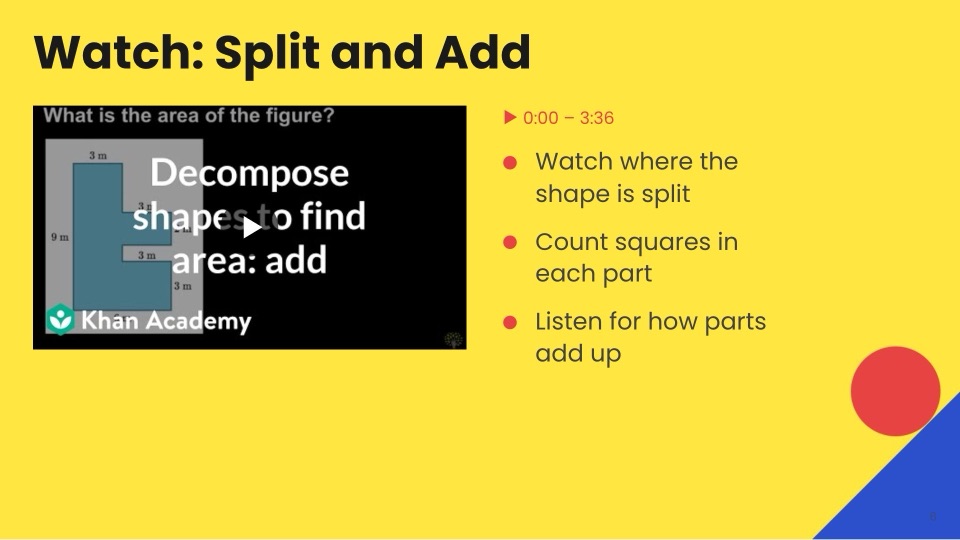
| 12 min | Teaching | Model accurate ticking, counting and splitting an L-shape to add parts. Take a quick vote on favourite ways to count squares, then keep the top two systems. Play the split and add video, pausing where the shape is split to name each part. Model an L-shape live: draw one straight split, tick and count squares inside each part, then add. Introduce key words and stress that area is recorded in square centimetres (cm²). |
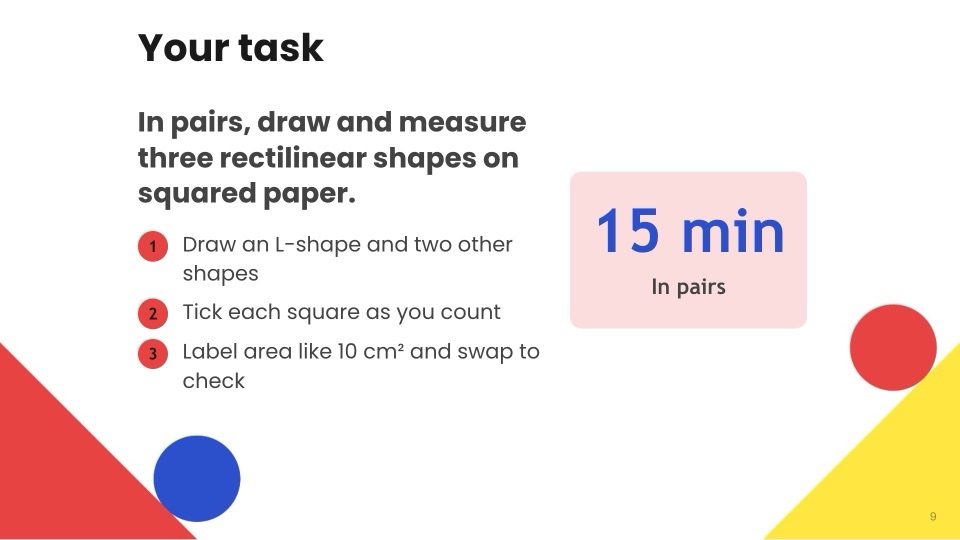
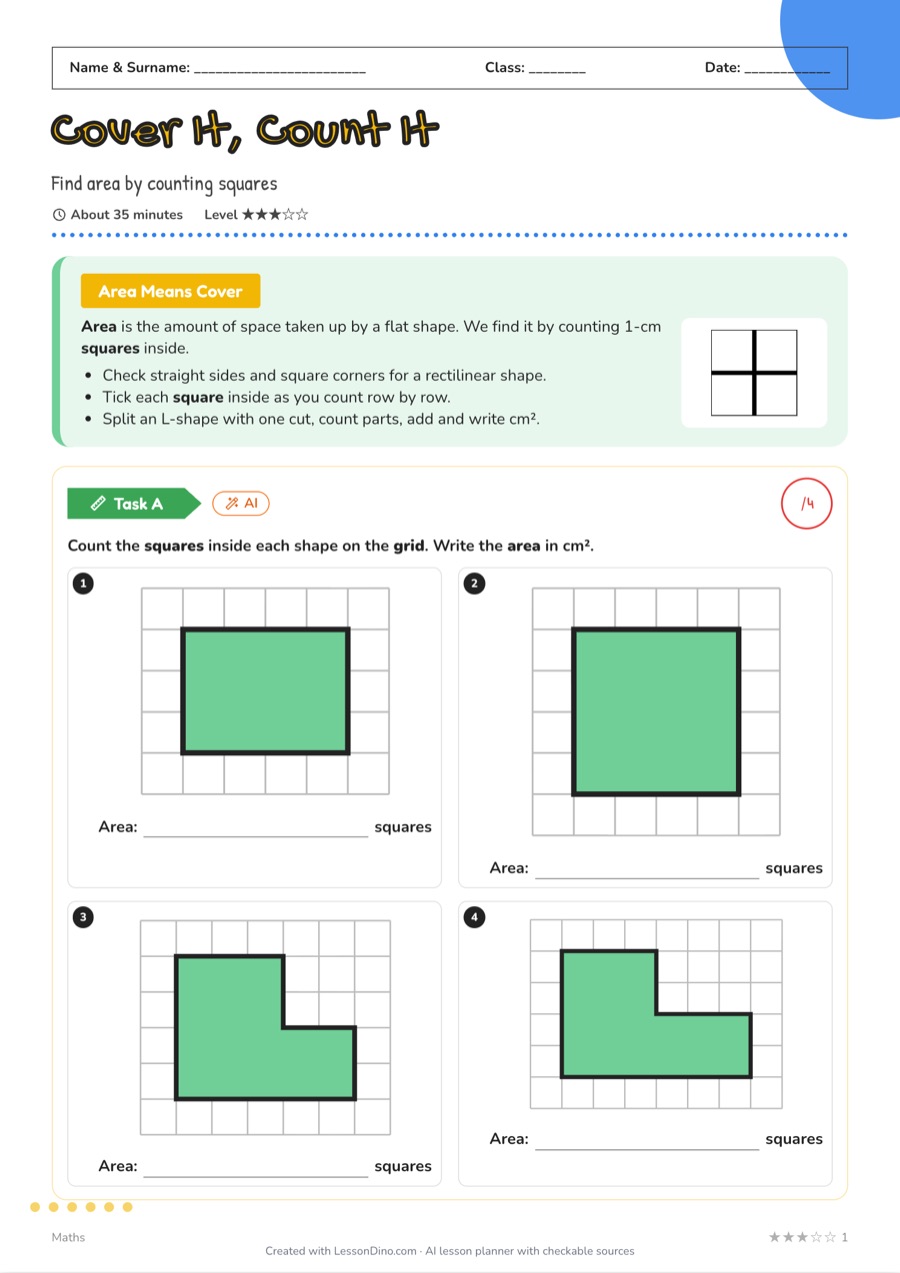
| 22 min | Main activity | Practise splitting L-shapes, counting squares and adding to find total area. Give out squared paper L-shapes, rulers and Worksheet Task C and explain the pair task. Remind pupils that the area of a compound shape may be found by splitting the shape into two rectangles and adding the two separate areas. Circulate, check splits are straight and that pupils tick each counted square to support accuracy. Stop halfway to show one good split and labelling of parts and total in cm². |
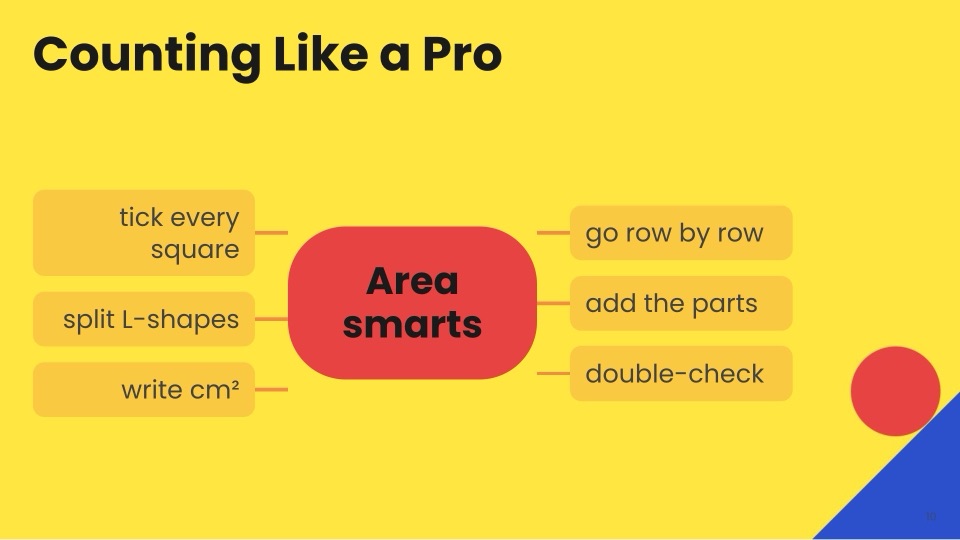
| 10 min | Check and compare | Compare answers and secure a reliable system for accurate counting. Display the counting prompts and ask groups to place their L-shapes side by side. Choose two groups with the same total but different splits to explain their method. Highlight common slips such as missing the corner square or counting it twice. Confirm that marking each counted square supports accuracy. |
| 8 min | Plenary | Return to the objectives and check each pupil can explain area. Revisit the three objectives and ask pupils to self-rate with thumbs. Show the exit ticket prompts and give quiet writing time. Take two examples of clear explanations to share with the class. Link forward by saying next time they will compare areas of different plans. |
Common mistakes
- Double-counting or missing squares, especially at the join or corner
How to spot it: Total is one or two out and ticks show a square with no tick or two ticks
Recount row by row from the top, ticking each square inside the shape once - Forgetting to add both parts after splitting the L-shape
How to spot it: Pupil writes two separate counts like 12 and 8 but no total
Label part A and part B, then write the addition, for example 12 + 8 = 20 cm² - Writing the area without cm² or mixing area with perimeter
How to spot it: Answer says 20 or 20 cm, or pupil adds side lengths
Remind that area is the squares covering the shape and is measured in square centimetres (cm²)
Support
- Show the split line already drawn and ask pupils to count each rectangle separately before adding
- Give shapes up to 10 squares with rows lined up on the grid and tick each square as you count
Stretch
- Ask pupils to split the same L-shape a different way and check they get the same total
- Challenge pupils to design two different rectilinear shapes that both have an area of 20 squares
Check questions
- What is the area of this L-shape made of 12 squares and 8 squares?
Answer: 20 cm² - How do you count squares accurately?
Answer: Tick each square once, go row by row, then add. - Why can two different L-shapes both have an area of 16 cm²?
Answer: Area counts covering squares, so different outlines can hold the same number.
Curriculum
find the area of rectilinear shapes by counting squares
Video clips
Clips on YouTube, from the start and end times we chose. Check each one before you show it.
-
Decomposing shapes to add areas from 0:00 to 3:36
Khan Academy: Decomposing shapes to find area (add) | Math | 3rd grade | Khan Academy
Khan 3rd grade level matches Year 4 age 8-9 and shows rectilinear shapes split to count squares then add.
-
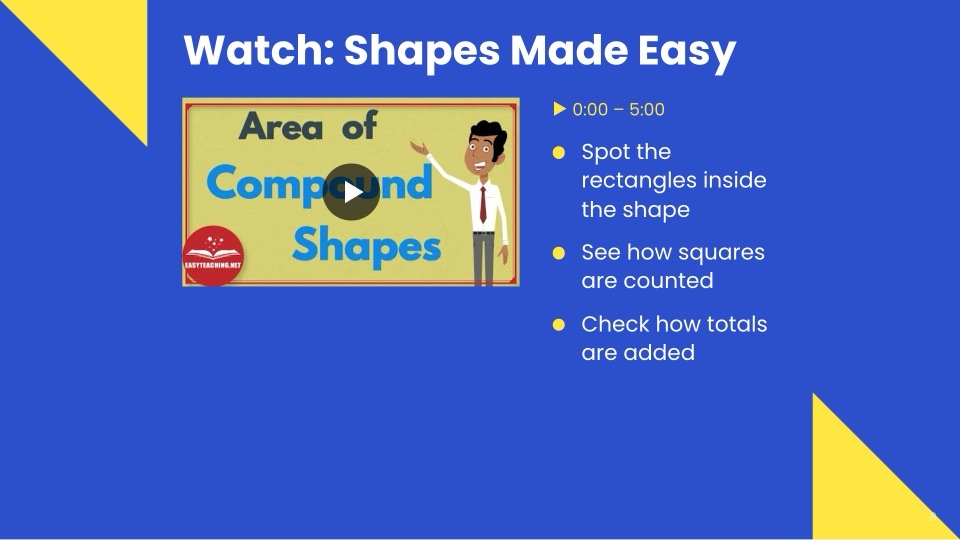
Area of compound shapes from 0:00 to 5:00
EasyTeaching: Finding the Area of Compound Shapes | EasyTeaching
EasyTeaching primary style suits age 8-9 with clear slow visuals for compound rectilinear shapes by counting and splitting.
Worksheet
Sources
- National curriculum in England: mathematics programmes of ... gov.uk
- Year 4 mathematics new curriculum on a page holtsmerejm.herts.sch.uk
- Area of squares, rectangles and compound shapes - BBC bbc.co.uk
- Area of Rectilinear Shapes (Year 4) | CGP+ Primary Online cgpplus.co.uk
- Find the area of rectilinear shapes by counting - Mathsframe mathsframe.co.uk
- Rectilinear shapes: how to find their area and perimeter doodlelearning.com
- Area of rectilinear shapes by counting squares Higher | Teaching Resources tes.com
- Maths KS2 Year 4 Area by counting squares. Engaging activities for area of rectilinear shapes | Teaching Resources tes.com
- How to work out an area - BBC Bitesize bbc.co.uk
Picture credits
Made with Lesson Dino's AI on 17 October 2026. AI can make mistakes, so check facts against the sources before you teach.