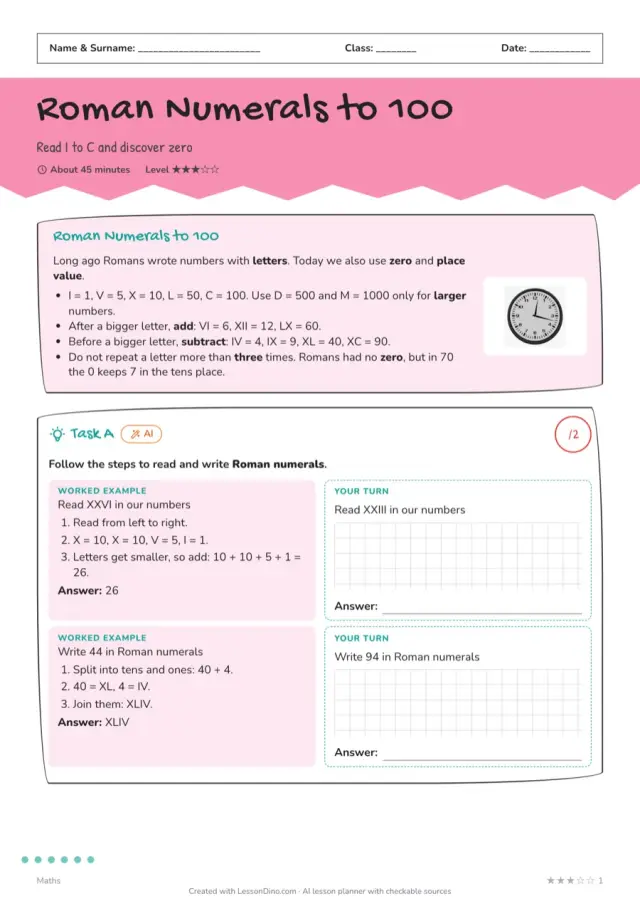
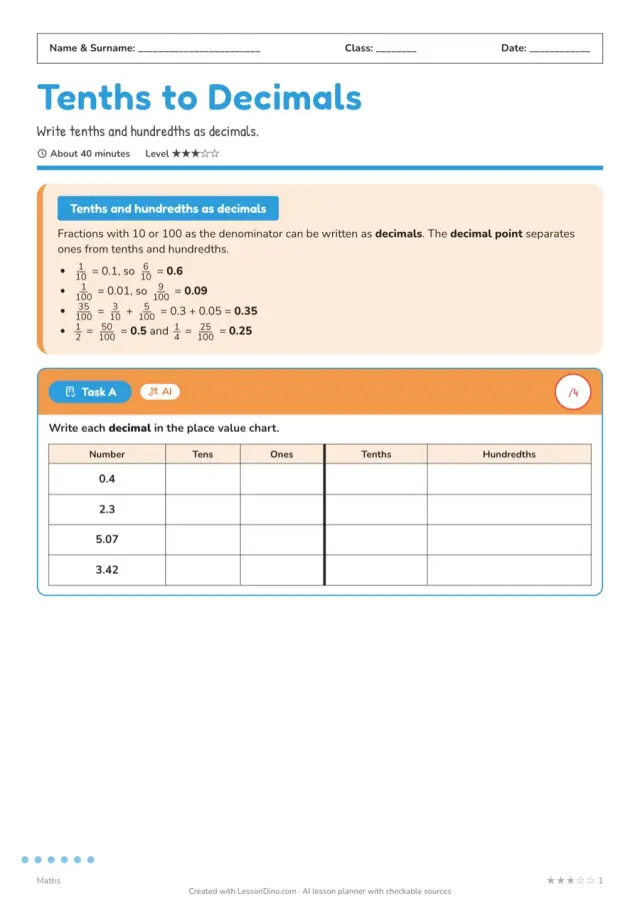
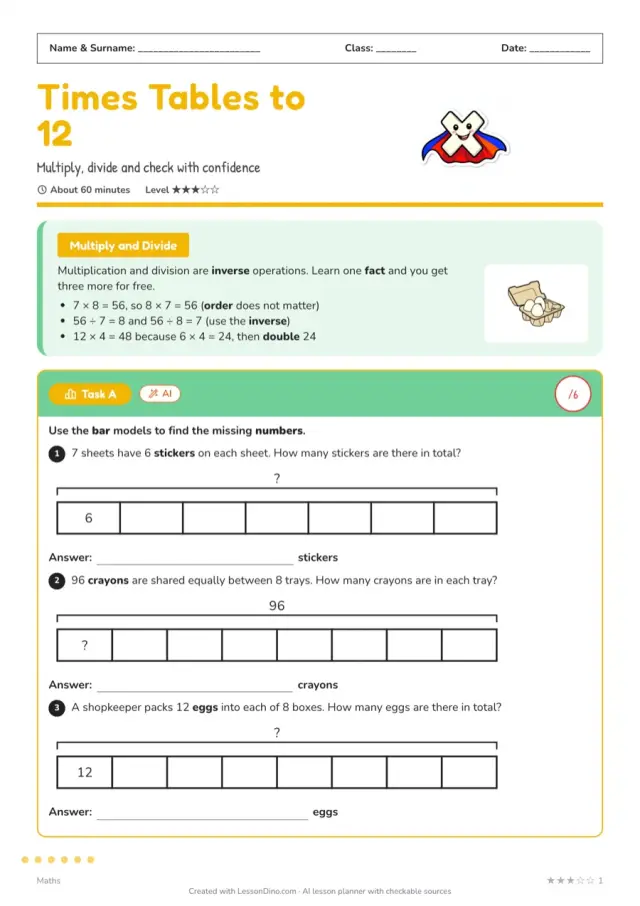
The worksheet
About this worksheet
Pupils learn that area is covering a shape with squares. They split L-shapes, count squares and add parts. This Year 4 Maths worksheet gives students (ages 8–9) six pages of practice on area of rectilinear shapes, part of the measurement unit. It goes with our free Area of rectilinear shapes lesson, which has the slides and a timed lesson plan.
What it covers
By the end, students should be able to:
- Students will understand area as squares needed to cover a flat shape.
- Students will find area of rectilinear shapes by counting grid squares.
- Students will split L-shapes into rectangles, count parts and add totals.
How to use it
- Main activity (22 minutes): Give out squared paper L-shapes, rulers and Worksheet Task C and explain the pair task.
- Support: Show the split line already drawn and ask pupils to count each rectangle separately before adding.
- Stretch: Ask pupils to split the same L-shape a different way and check they get the same total.
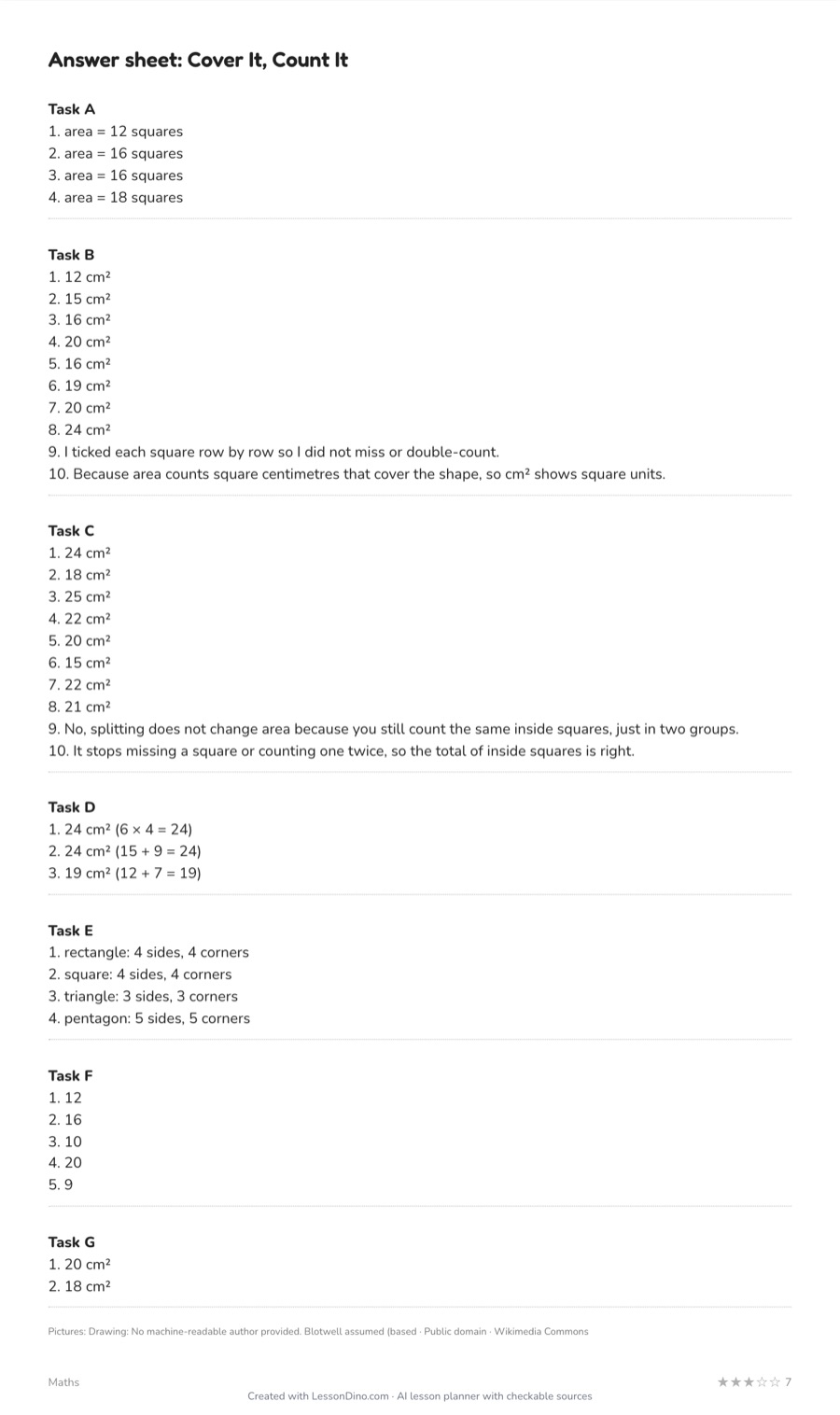
- The answer sheet is the last page, so you can print it on its own or let students check their own work.
Key vocabulary
- area: amount of space taken up by a flat shape
- rectilinear shape: a flat outline with only straight sides and square corners
- square centimetre (cm²): how much fits on a tiny 1 cm by 1 cm tile
- split: cut along a straight line to make smaller parts
Mistakes to watch for
- Double-counting or missing squares, especially at the join or corner. Recount row by row from the top, ticking each square inside the shape once.
- Forgetting to add both parts after splitting the L-shape. Label part A and part B, then write the addition, for example 12 + 8 = 20 cm².
- Writing the area without cm² or mixing area with perimeter. Remind that area is the squares covering the shape and is measured in square centimetres (cm²).
What's on the worksheet
What Is Area?
Learn how squares cover shapes and how to count them.
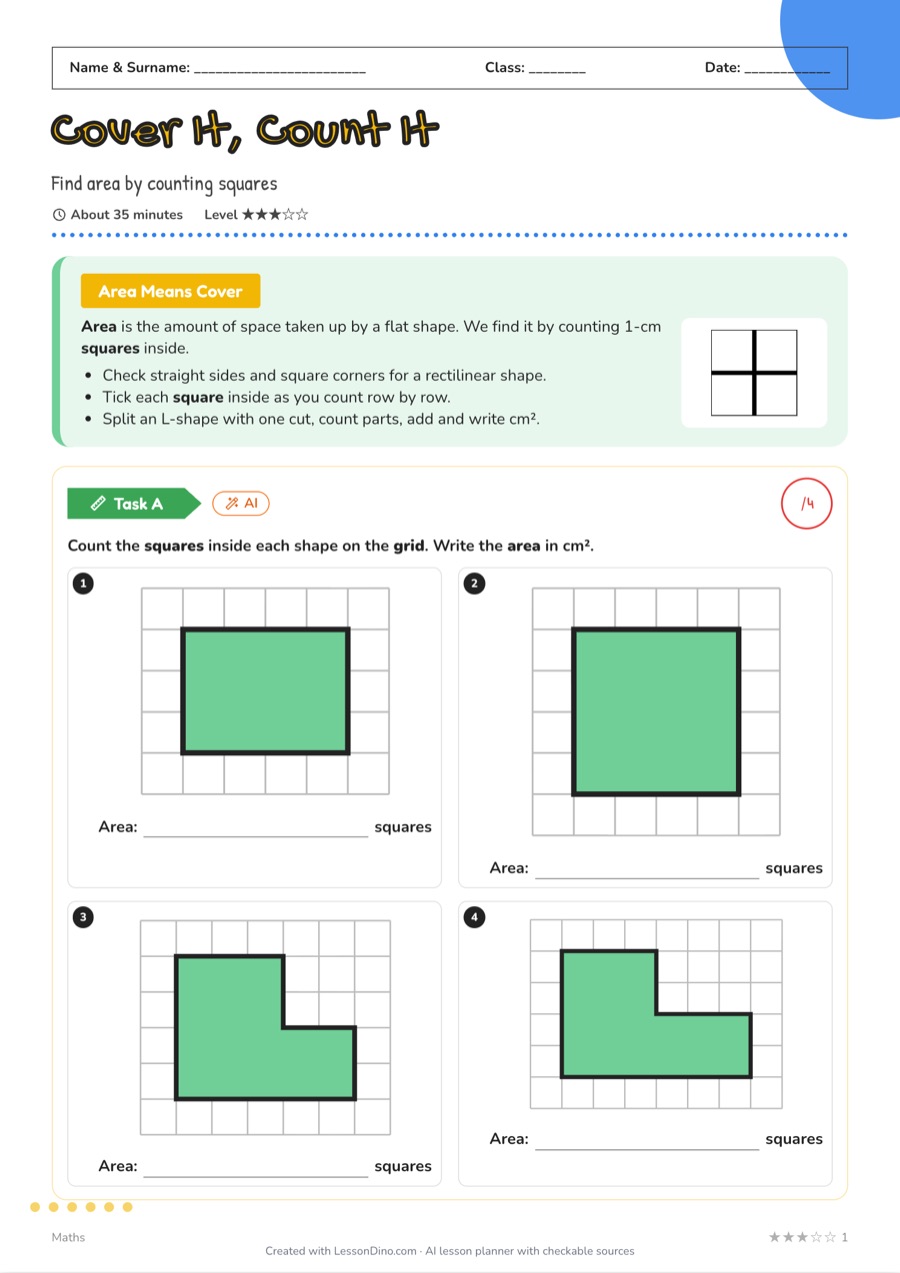
Area Means Cover
- Area is the amount of space taken up by a flat shape. We find it by counting 1-cm squares inside.
- Check straight sides and square corners for a rectilinear shape.
- Tick each square inside as you count row by row.
- Split an L-shape with one cut, count parts, add and write cm².
Count the squares inside each shape on the grid. Write the area in cm².
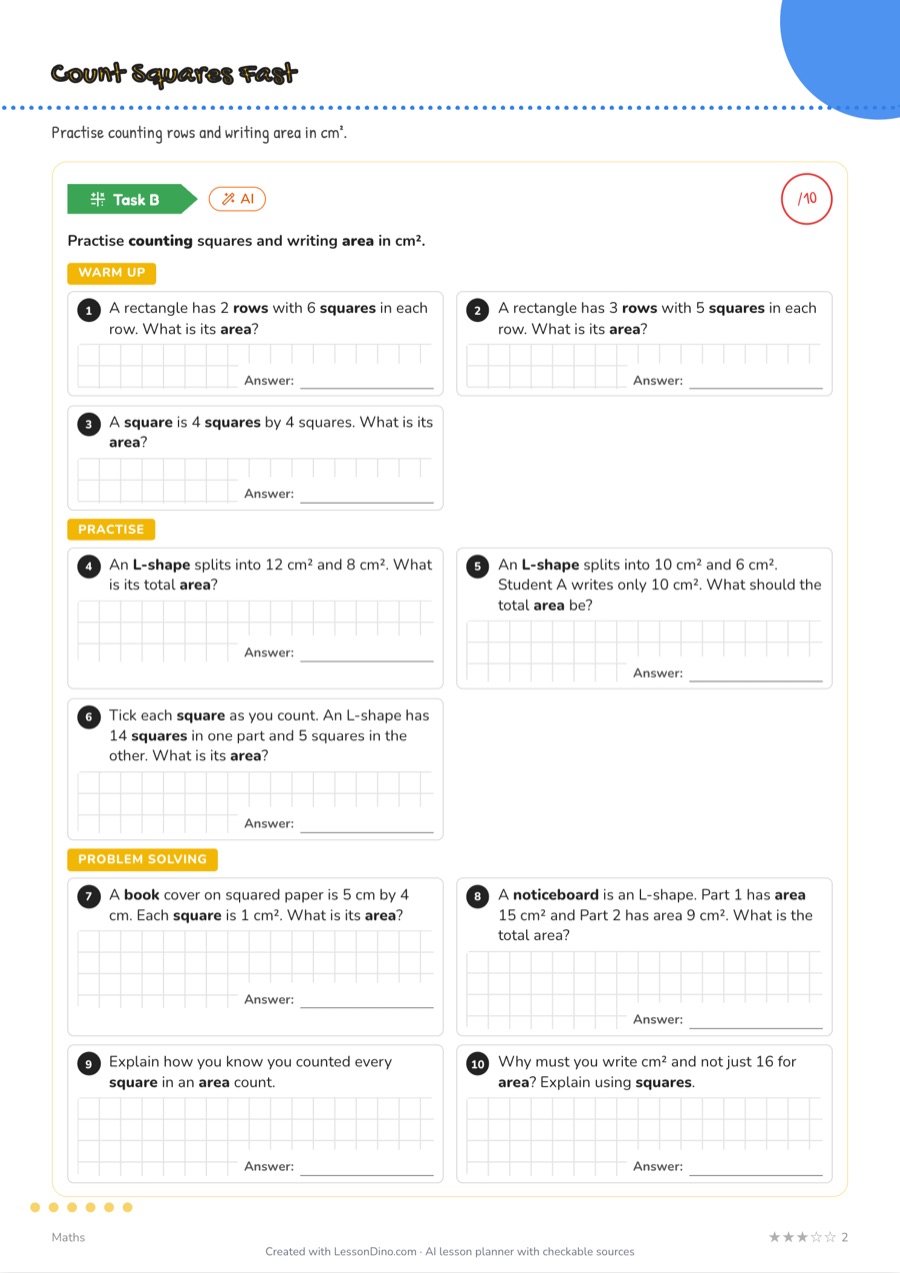
Count Squares Fast
Practise counting rows and writing area in cm².
Practise counting squares and writing area in cm².
Warm up
- A rectangle has 2 rows with 6 squares in each row. What is its area?
- A rectangle has 3 rows with 5 squares in each row. What is its area?
- A square is 4 squares by 4 squares. What is its area?
Practise
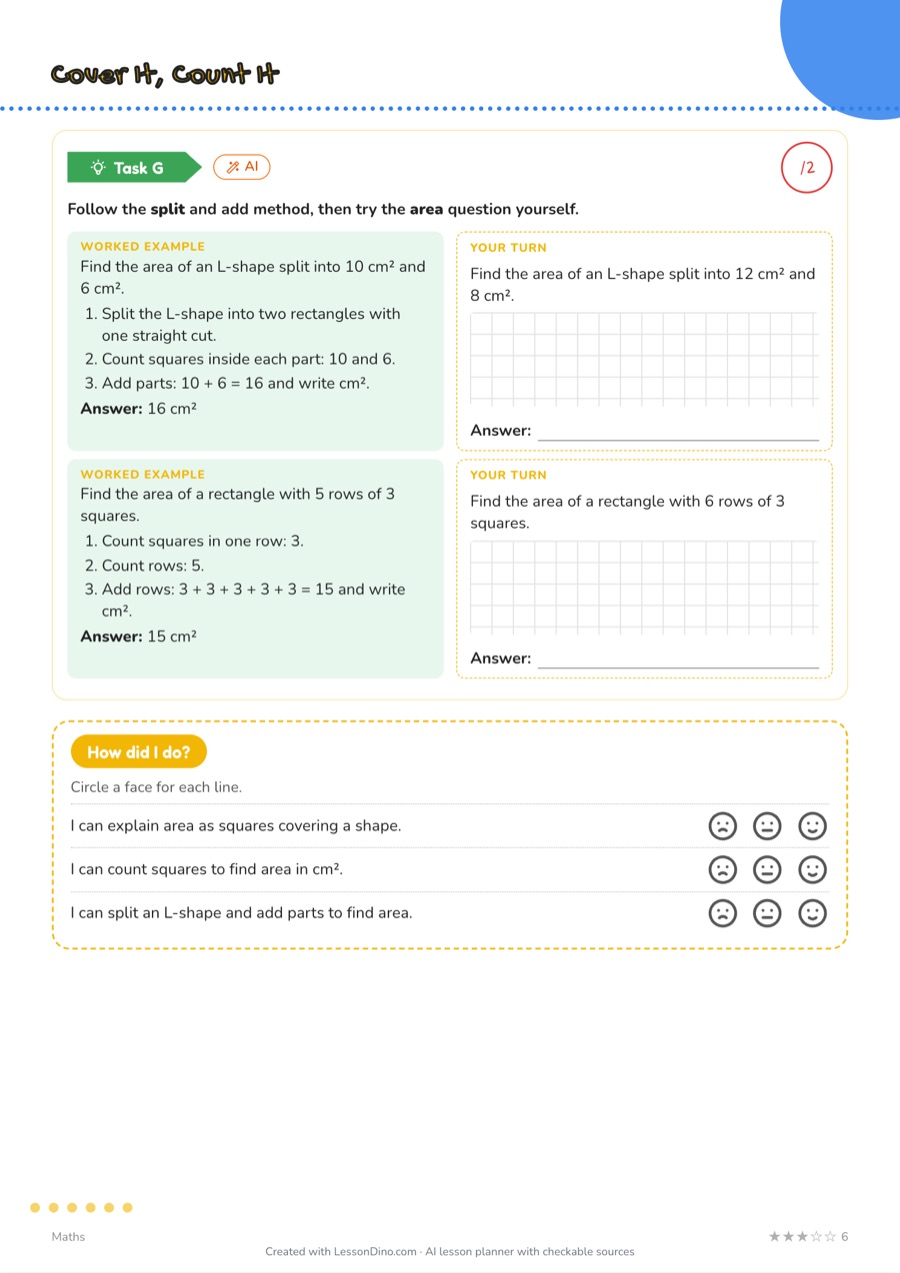
- An L-shape splits into 12 cm² and 8 cm². What is its total area?
- An L-shape splits into 10 cm² and 6 cm². Student A writes only 10 cm². What should the total area be?
- Tick each square as you count. An L-shape has 14 squares in one part and 5 squares in the other. What is its area?
Problem solving
- A book cover on squared paper is 5 cm by 4 cm. Each square is 1 cm². What is its area?
- A noticeboard is an L-shape. Part 1 has area 15 cm² and Part 2 has area 9 cm². What is the total area?
- Explain how you know you counted every square in an area count.
- Why must you write cm² and not just 16 for area? Explain using squares.
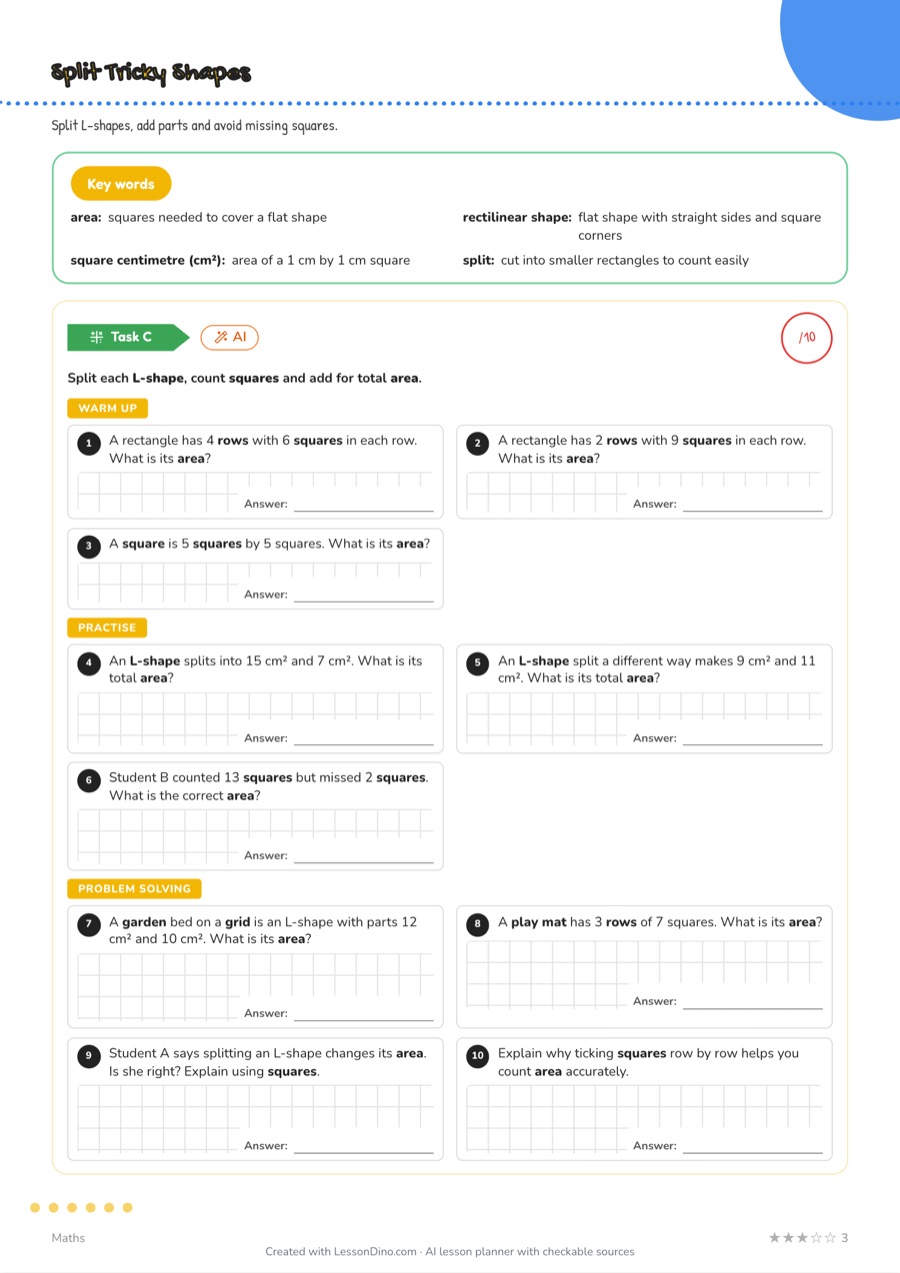
Split Tricky Shapes
Split L-shapes, add parts and avoid missing squares.
| Word | Meaning |
|---|---|
| area | squares needed to cover a flat shape |
| rectilinear shape | flat shape with straight sides and square corners |
| square centimetre (cm²) | area of a 1 cm by 1 cm square |
| split | cut into smaller rectangles to count easily |
Split each L-shape, count squares and add for total area.
Warm up
- A rectangle has 4 rows with 6 squares in each row. What is its area?
- A rectangle has 2 rows with 9 squares in each row. What is its area?
- A square is 5 squares by 5 squares. What is its area?
Practise
- An L-shape splits into 15 cm² and 7 cm². What is its total area?
- An L-shape split a different way makes 9 cm² and 11 cm². What is its total area?
- Student B counted 13 squares but missed 2 squares. What is the correct area?
Problem solving
- A garden bed on a grid is an L-shape with parts 12 cm² and 10 cm². What is its area?
- A play mat has 3 rows of 7 squares. What is its area?
- Student A says splitting an L-shape changes its area. Is she right? Explain using squares.
- Explain why ticking squares row by row helps you count area accurately.
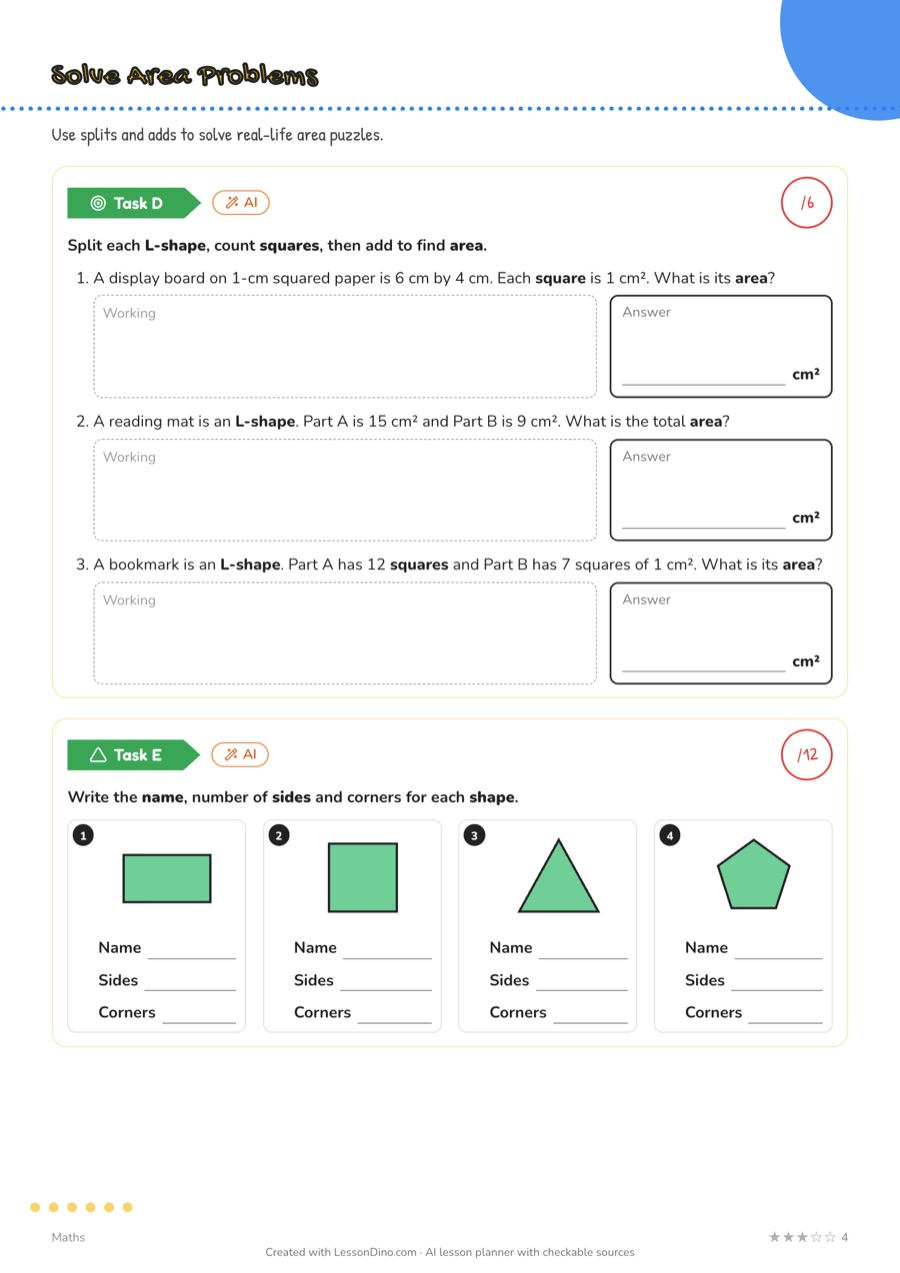
Solve Area Problems
Use splits and adds to solve real-life area puzzles.
Split each L-shape, count squares, then add to find area.
Write the name, number of sides and corners for each shape.
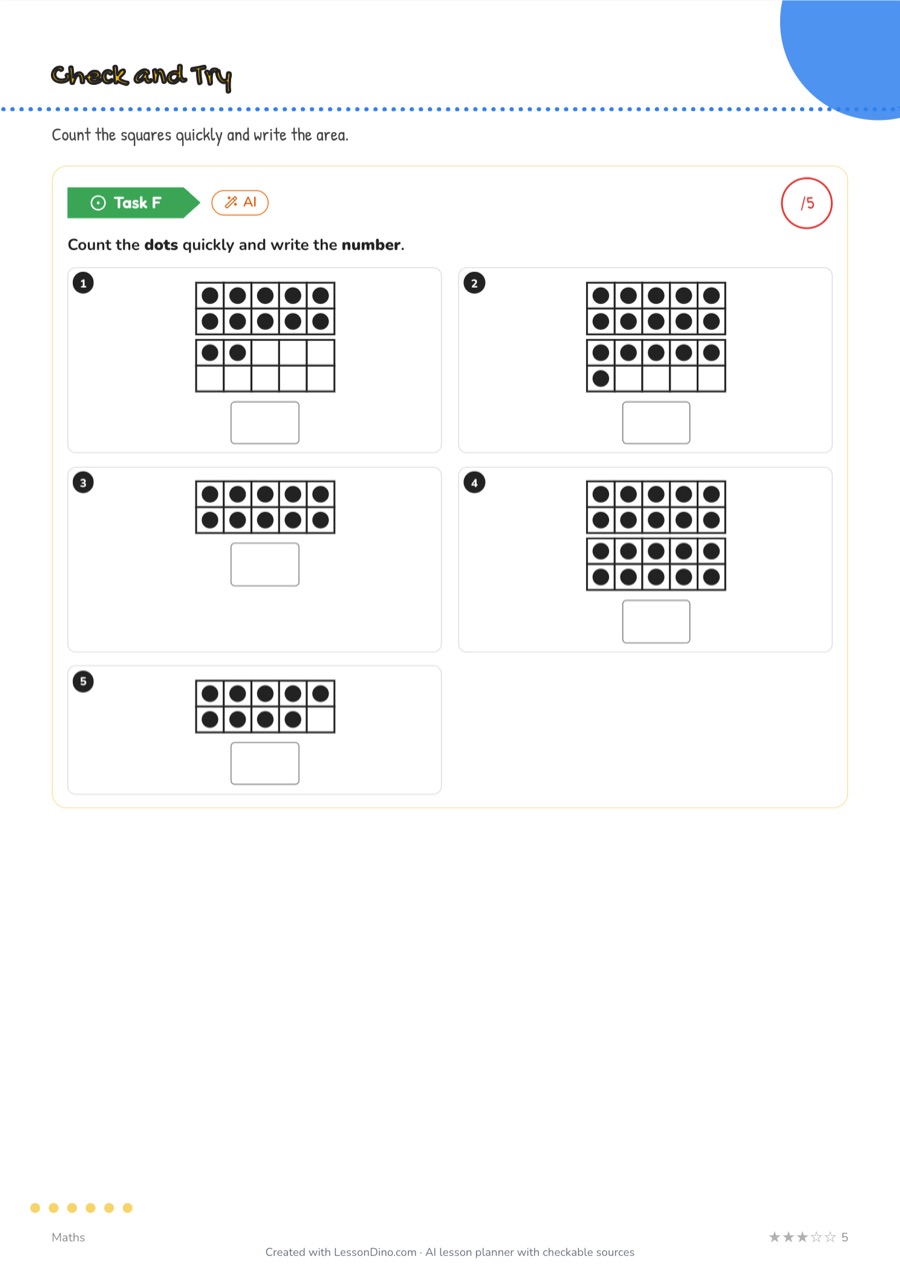
Check and Try
Count the squares quickly and write the area.
Count the dots quickly and write the number.
Page 6
Follow the split and add method, then try the area question yourself.
Answers
Show the answers
- A rectangle has 2 rows with 6 squares in each row. What is its area? 12 cm²
- A rectangle has 3 rows with 5 squares in each row. What is its area? 15 cm²
- A square is 4 squares by 4 squares. What is its area? 16 cm²
- An L-shape splits into 12 cm² and 8 cm². What is its total area? 20 cm²
- An L-shape splits into 10 cm² and 6 cm². Student A writes only 10 cm². What should the total area be? 16 cm²
- Tick each square as you count. An L-shape has 14 squares in one part and 5 squares in the other. What is its area? 19 cm²
- A book cover on squared paper is 5 cm by 4 cm. Each square is 1 cm². What is its area? 20 cm²
- A noticeboard is an L-shape. Part 1 has area 15 cm² and Part 2 has area 9 cm². What is the total area? 24 cm²
- Explain how you know you counted every square in an area count. I ticked each square row by row so I did not miss or double-count.
- Why must you write cm² and not just 16 for area? Explain using squares. Because area counts square centimetres that cover the shape, so cm² shows square units.
- A rectangle has 4 rows with 6 squares in each row. What is its area? 24 cm²
- A rectangle has 2 rows with 9 squares in each row. What is its area? 18 cm²
- A square is 5 squares by 5 squares. What is its area? 25 cm²
- An L-shape splits into 15 cm² and 7 cm². What is its total area? 22 cm²
- An L-shape split a different way makes 9 cm² and 11 cm². What is its total area? 20 cm²
- Student B counted 13 squares but missed 2 squares. What is the correct area? 15 cm²
- A garden bed on a grid is an L-shape with parts 12 cm² and 10 cm². What is its area? 22 cm²
- A play mat has 3 rows of 7 squares. What is its area? 21 cm²
- Student A says splitting an L-shape changes its area. Is she right? Explain using squares. No, splitting does not change area because you still count the same inside squares, just in two groups.
- Explain why ticking squares row by row helps you count area accurately. It stops missing a square or counting one twice, so the total of inside squares is right.
- A display board on 1-cm squared paper is 6 cm by 4 cm. Each square is 1 cm². What is its area? 24 cm²
- A reading mat is an L-shape. Part A is 15 cm² and Part B is 9 cm². What is the total area? 24 cm²
- A bookmark is an L-shape. Part A has 12 squares and Part B has 7 squares of 1 cm². What is its area? 19 cm²
The answer sheet is the last picture above.
Curriculum
find the area of rectilinear shapes by counting squares
Made with Lesson Dino's AI on 17 October 2026. AI can make mistakes, so check the answers and facts against the sources before you teach.