Slides

Lesson plan
Cracking Roman Numerals to 100
Pupils learn to read Roman numerals I to C using add and take-away rules. They compare letters with our zero and place value system.
Objectives
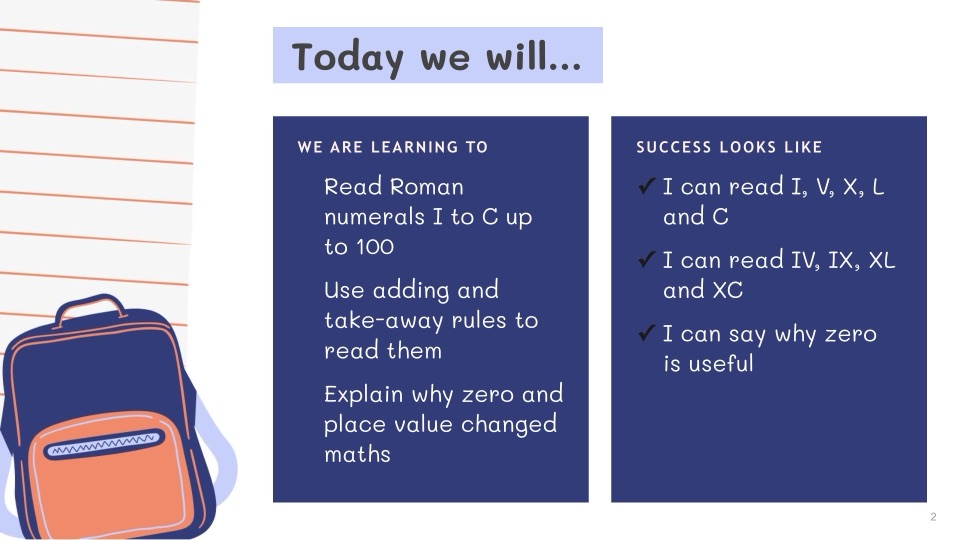
- Students will read Roman numerals I to C to 100 using add and subtract rules.
- Students will explain how zero and place value changed our number system.
Success criteria
- I can read I, V, X, L and C to 100 by adding or taking away.
- I can explain why zero is needed to hold a place in numbers.
Key words
| Word | Meaning |
|---|---|
| Roman numeral | a capital letter used to show a number, like I for 1, V for 5, X for 10, L for 50 and C for 100 |
| add | put values together to make a bigger total when a smaller sign comes after a bigger one |
| subtract | take away a smaller value when it comes before a bigger one, like IV is 5 minus 1 |
| zero | nothing at all, which has no symbol in the Roman system |
| place value | what a digit is worth because of where it sits, like 6 in 64 means sixty |
Timed plan (60 minutes)
| Time | Stage | What happens |
|---|---|---|
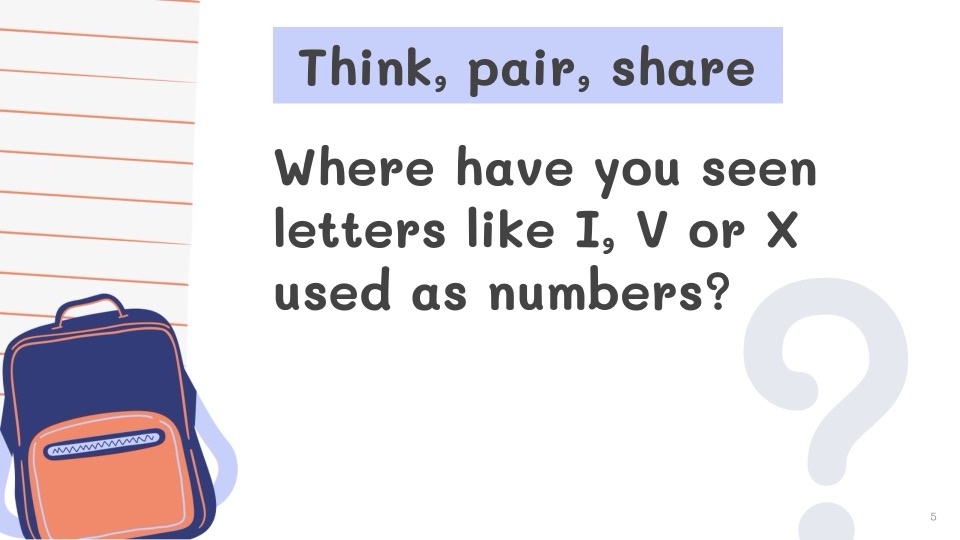
| 8 min | Starter | To spark curiosity about letter-numbers and recall I to XII from clocks. Show Slide 1 title and Slide 2 objectives, then give the hook: same letters, different order, one means 11 and one means 9. Hold up XI and IX cards left to right and ask pupils to vote which is 9 and which is 11. Show Slide 5 question and take quick ideas on where pupils have seen I, V or X as numbers, linking to clocks that use Roman numerals from I to XII. Model reading VIII as 8 o'clock and XI as 11 o'clock on a clock face. |
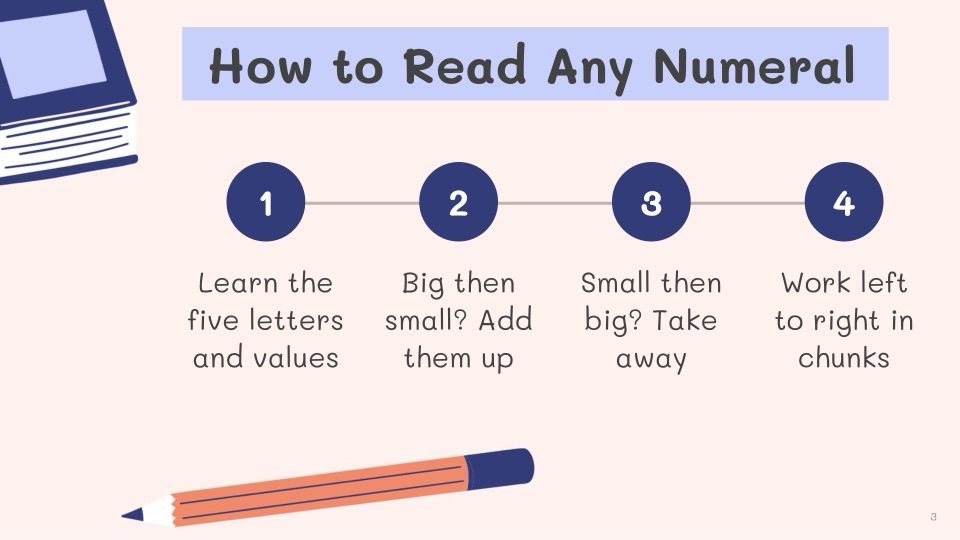
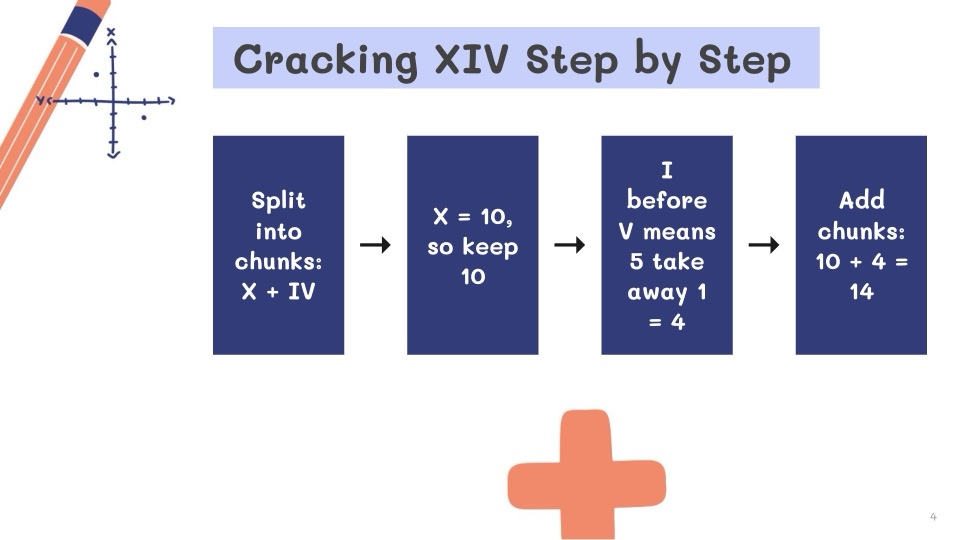
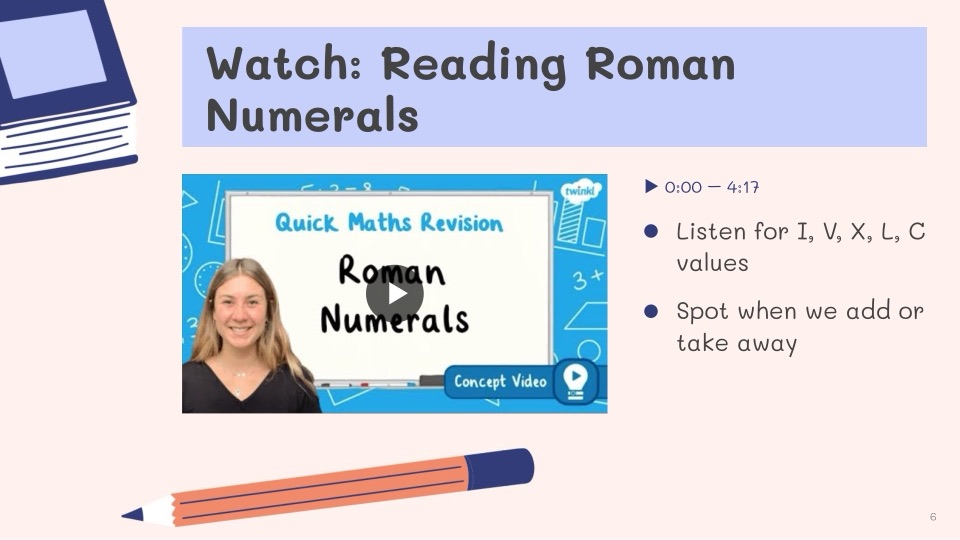
| 14 min | Teaching | To model the adding and subtracting rules for reading numerals to 100. Teach I = 1, V = 5, X = 10, L = 50 and C = 100 and that we read Roman numerals to 100 as I to C. Use Slide 3 steps and Slide 4 chain to model XIV as X + IV, where I before V means 5 take away 1 = 4, then 10 + 4 = 14. Play Video clip 1 (0:00–4:17) on Slide 6 and ask pupils to listen for values and spot when we add or take away. Reinforce that numerals are usually written as capital letters and you usually only write a maximum of three of the same numeral in a row. |
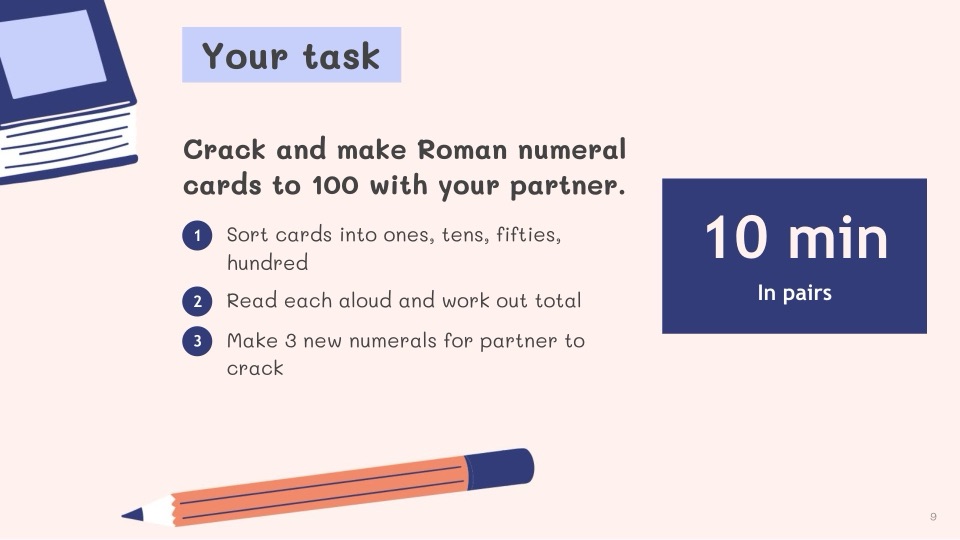
| 20 min | Main activity | To practise reading numerals to 100 by deciding to add or subtract. Set out sets of I, V, X, L, C cards and points board and explain turn-taking: turn two cards, decide add or subtract, score for correct reading. Model with XL: X before L, so 50 - 10 = 40, and with XXXVII as 10 + 10 + 10 + 5 + 1 + 1 = 37. Send pairs to play short rounds, first tens to 100: X, XX, XXX, XL, L, LX, LXX, LXXX, XC, C, then mixed numbers. Hand out Worksheet Task B to warm up memory, then add letters to read and write numerals. |
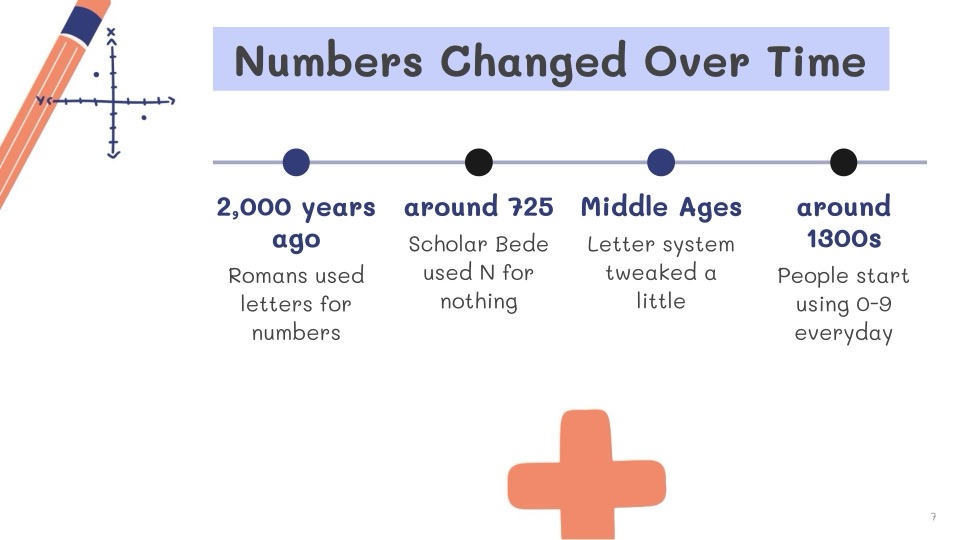
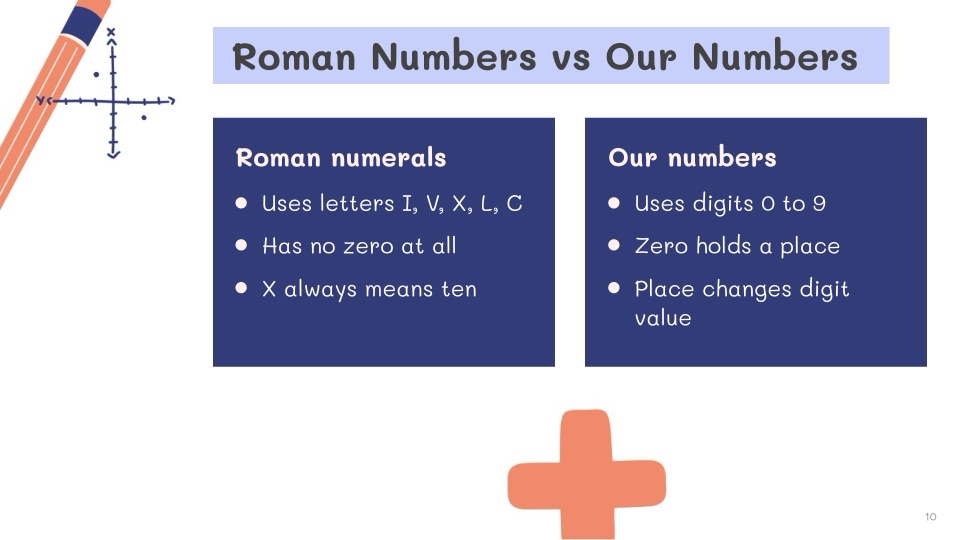
| 10 min | Then and now | To explain why zero and place value changed number writing. Show Slide 7 timeline and explain scholars around 725 used N for nothing from nihil meaning nothing, and the system was tweaked in the Middle Ages. Show Slide 10 compare: Roman X always means ten, but in our Hindu-Arabic system the 6 in 64 means sixty but in 689 means six hundred. Demonstrate with a place-value chart: 10 needs 1 ten and 0 to hold ones empty, while X needs no zero because there is no zero in the system. Direct pupils to fill the chart on Worksheet Task E to show place value and look where zero sits. |
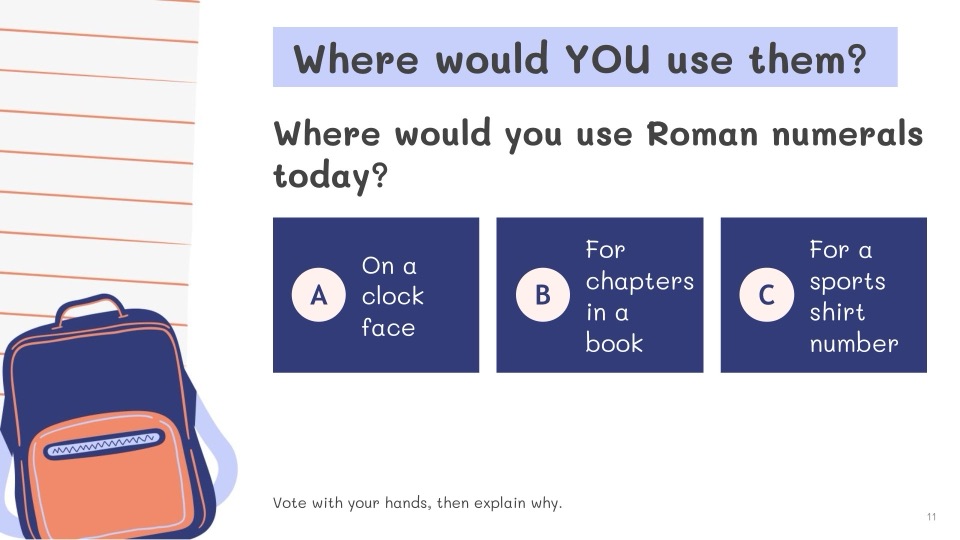
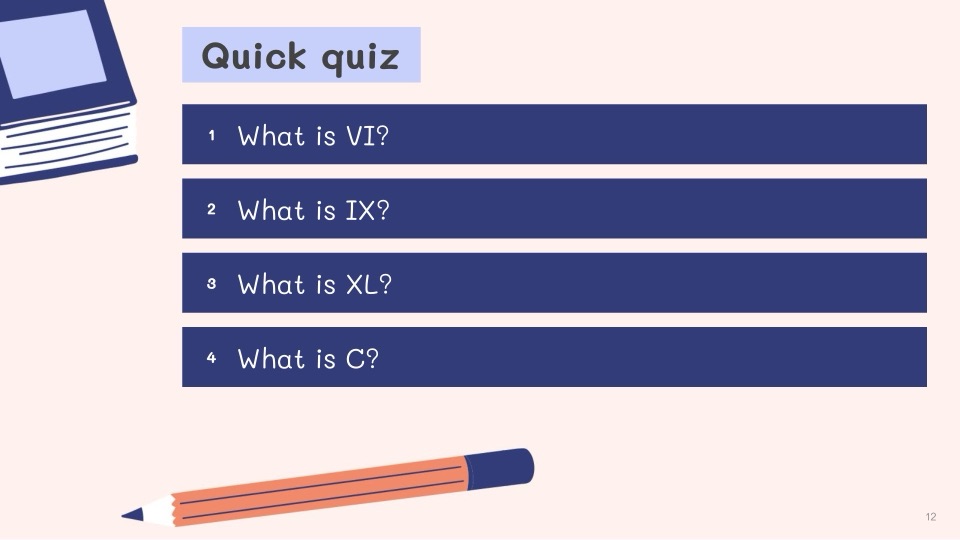
| 8 min | Plenary | To check quick reading to 100 and vote on modern uses. Run Slide 12 quick quiz: VI, IX, XL and C, asking for add or take away each time. Take Slide 11 vote on where you would use Roman numerals today: clock face, chapters in a book, sports shirt number. Ask winners to read back their quiz answers in both systems. Link back to success criteria and set homework. |
Common mistakes
- Reading IV as 6 and IX as 11 by always adding left to right
How to spot it: Whiteboards show 6 for IV or 11 for IX
Point left to right: small before big means take away, so IV is 5 minus 1 = 4 and IX is 10 minus 1 = 9. - Writing 99 as IC or 44 as IL
How to spot it: Pupil builds IC for 99 or uses V, L or D to subtract
Remind only I, X and C can be used as subtractive numerals and 99 is XCIX (90 + 9), not IC. - Thinking Romans had zero or that X can mean 100 if moved
How to spot it: Pupil adds 0 to a numeral or says X means hundred at the front
Show there is no zero in the system and X always represents ten, no matter where it is placed.
Support
- Use colour-coded cards with values on the back and practise only with V, X and L first.
- Give a desk card showing I to XII and tens to C for matching while reading.
- Use base-ten blocks and Worksheet Task E chart to fill the chart to show place value and look where zero sits.
Stretch
- Include three-letter numerals such as XIV and XIX, working left to right by subtracting then adding.
- Challenge pupils to build 44, 49, 94 and 99 as XLIV, XLIX, XCIV and XCIX and spot why IC is not allowed.
- Ask pupils to explain why 42 × 17 is straightforward with place value but nearly impossible with XLII and XVII.
Check questions
- What is IX and how did you work it out?
Answer: 9, because 10 take away 1 - What is XL and how did you work it out?
Answer: 40, because 50 take away 10 - Why do we need zero in our numbers but Romans did not use it?
Answer: Zero holds an empty place so digits show tens, ones; Romans had no zero
Curriculum
read Roman numerals to 100 (I to C) and know that over time, the numeral system changed to include the concept of 0 and place value
Video clips
Clips on YouTube, from the start and end times we chose. Check each one before you show it.
-
KS2 reading Roman numerals from 0:00 to 4:17
Twinkl Educational Publishing: How Do You Read and Write Roman Numerals? | KS2 Maths Concept for Kids
Made for KS2 pupils aged about 7-11 so perfect for Year 4 aged 8-9 and teaches reading Roman numerals.
-
Learn to read Roman numerals from 0:00 to 4:40
Learn Bright: Roman Numerals for Kids | Learn How to Read Roman Numerals
Made for kids aged about 8-9 with clear examples that suit Year 4 reading to 100.
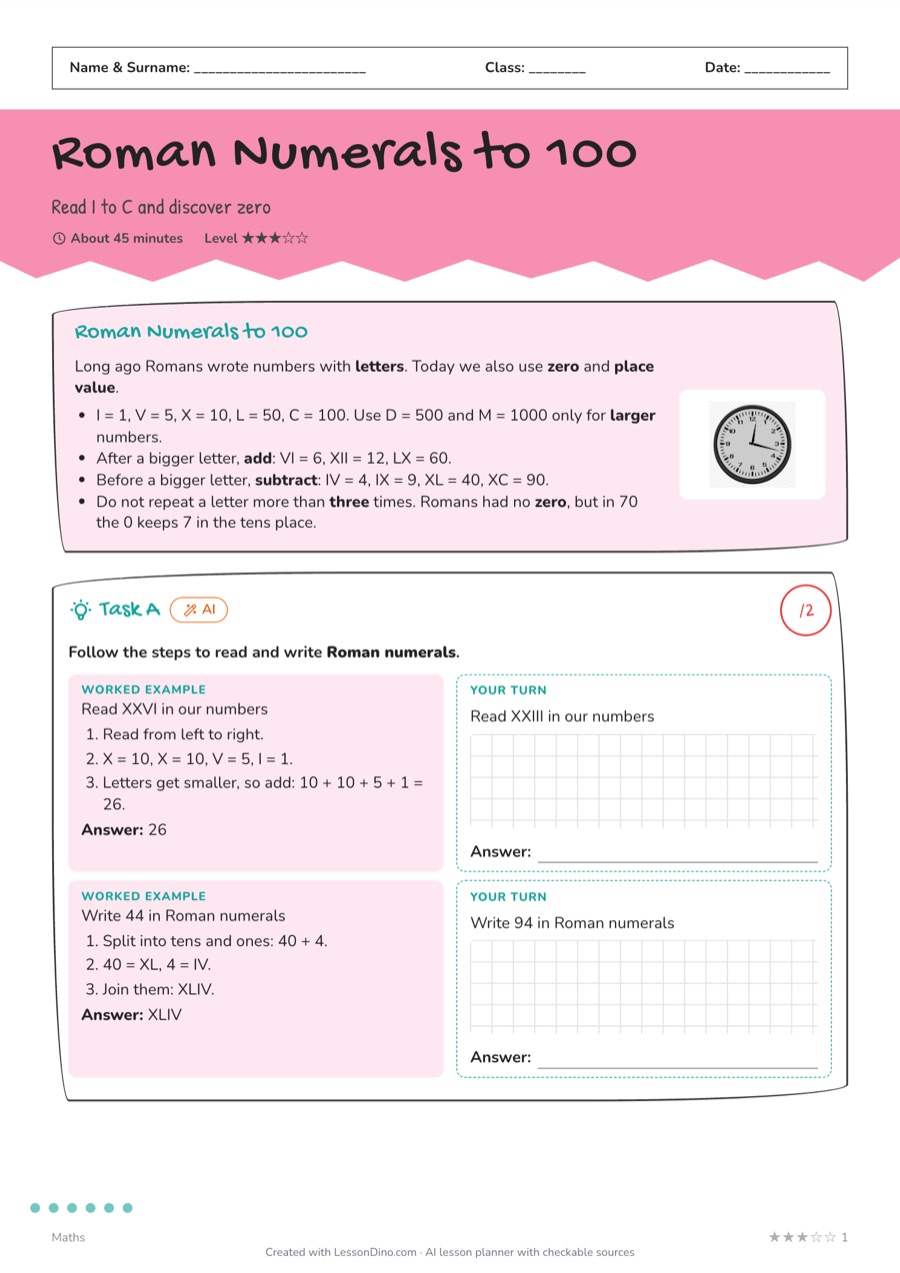
Worksheet
Sources
- National curriculum in England: mathematics programmes of ... gov.uk
- Year 4 mathematics new curriculum on a page holtsmerejm.herts.sch.uk
- Roman numerals to 1000 - KS2 Maths - Year 5 - BBC Bitesize bbc.co.uk
- What Are Roman Numerals lauramasson.co.uk
- Roman numerals - history and use web40571.clarahost.co.uk
- Kids Math: Roman Numerals - Ducksters ducksters.com
- Roman numerals Facts for Kids kids.kiddle.co
- Flexi answers - How to read Roman Numerals? | CK-12 Foundation ck12.org
- Roman numerals - Kids | Britannica Kids | Homework Help kids.britannica.com
- Roman numerals - Wikipedia, the free encyclopedia taggedwiki.zubiaga.org
- Roman Numerals Explained For Kids ️ | Why Is 4 = IV? learnwithsitesforkids.com
- What Are Roman Numerals? – Explained for Kids smartonlinegames.com
- Roman Numerals 🇬🇧 LanGeek langeek.co
Picture credits
Made with Lesson Dino's AI on 17 October 2026. AI can make mistakes, so check facts against the sources before you teach.