The worksheet
About this worksheet
Students verify that slides, flips, and turns keep size and shape. They move triangles and remeasure sides and angles to prove it. This Grade 8 Math worksheet gives students (ages 13–14) five pages of practice on transformations, part of the geometry unit. It goes with our free Transformations lesson, which has the slides and a timed lesson plan.
What it covers
By the end, students should be able to:
- Students will verify experimentally that translations preserve side lengths and angle measures.
- Students will verify experimentally that reflections and rotations preserve side lengths and angle measures.
How to use it
- Main activity (28 minutes): Circulate while pairs complete Worksheet Tasks B and C, prompting remeasure of all three sides in inches and all three angles.
- Support: Give pre-cut triangles with vertices labeled and grid paper with the moves written as arrows.
- Stretch: Have students do a translation followed by a reflection and check if the final image is still congruent to the start.
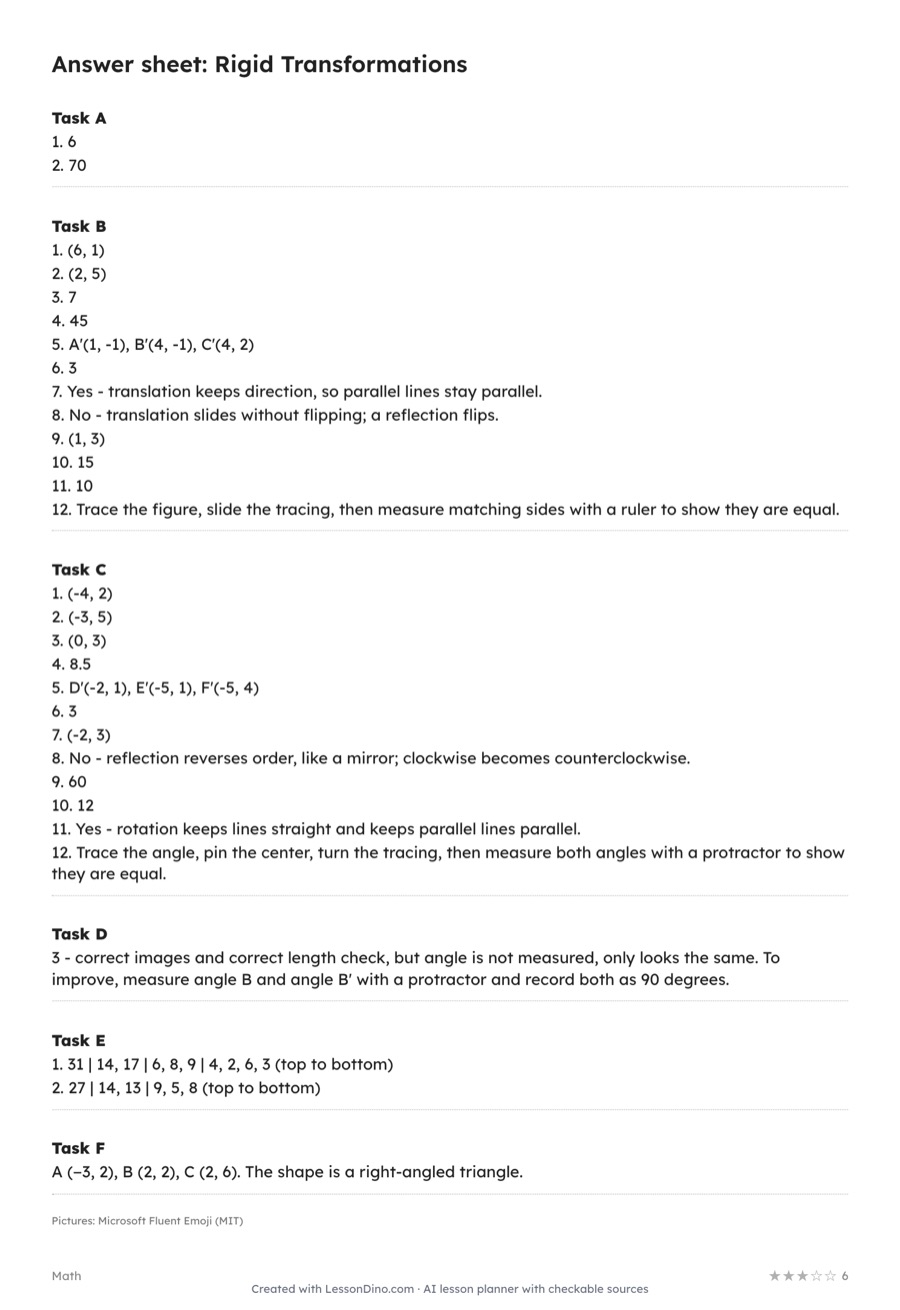
- The answer sheet is the last page, so you can print it on its own or let students check their own work.
Key vocabulary
- pre-image: the original shape before a move
- image: the new shape after a move
- rigid: when size and shape stay the same
- congruent: having exactly the same size and shape
Mistakes to watch for
- Thinking a flip or turn makes the shape bigger or smaller. Remeasure matching sides side-by-side to show after a turn, flip or slide, the shape still has the same size, area, angles and line lengths.
- Confusing changed orientation with changed size. Check side lengths and angles match and note rigid transformations preserve the distances between points and only position and orientation change.
- Matching wrong vertices when measuring image. Label A'B'C' in order and track each point from pre-image to image before measuring.
What's on the worksheet
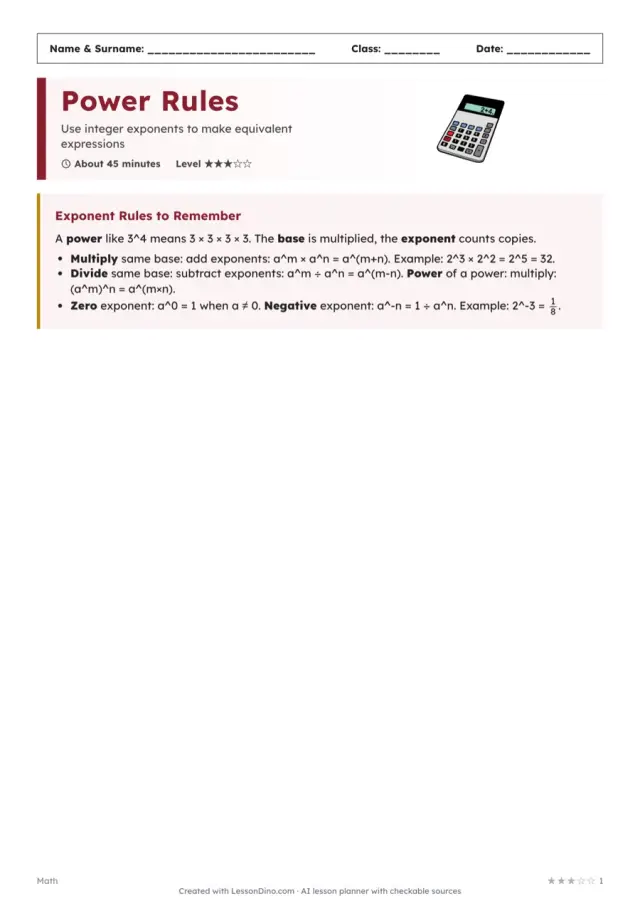
Moves That Preserve
Learn what translations, reflections, and rotations preserve.
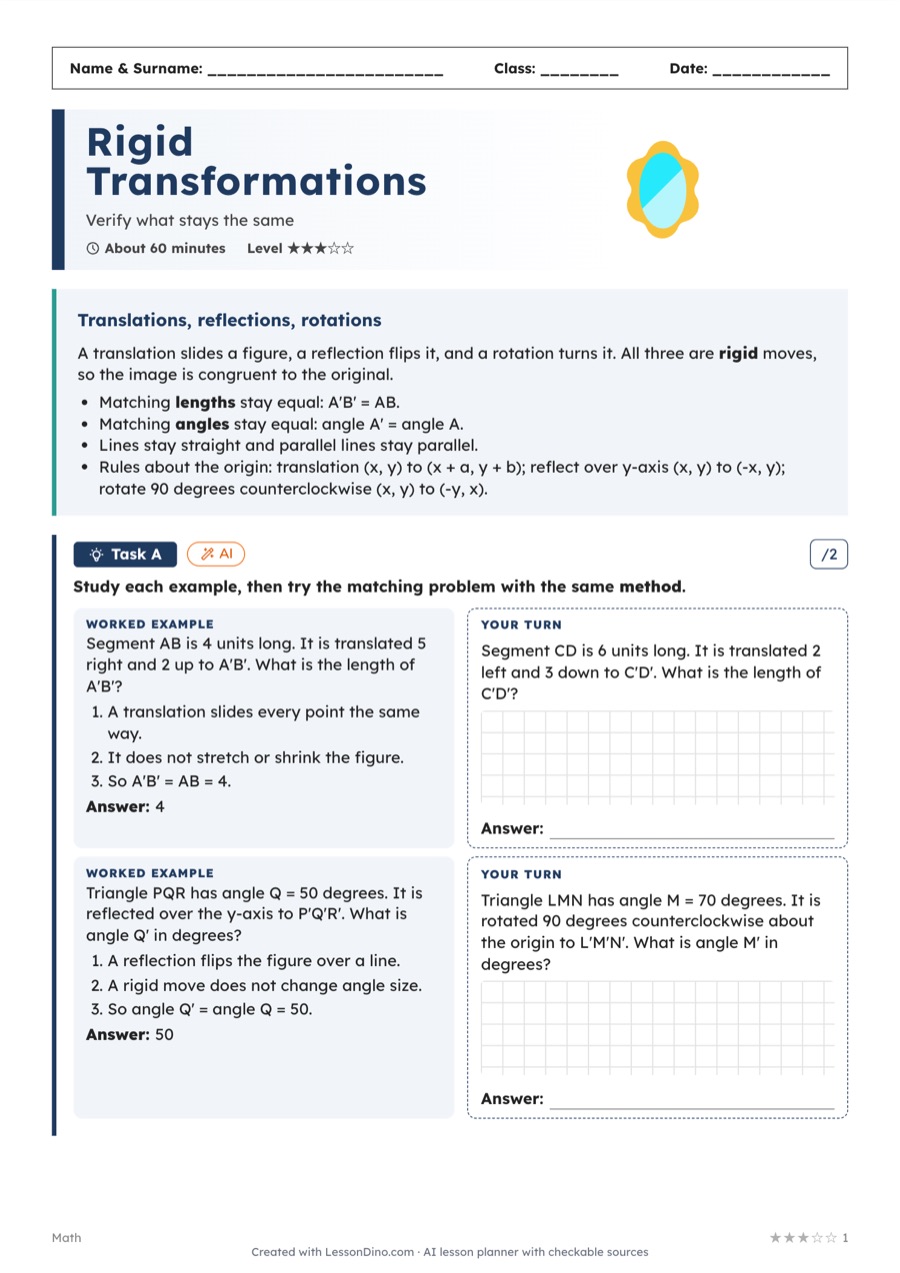
Translations, reflections, rotations
- A translation slides a figure, a reflection flips it, and a rotation turns it. All three are rigid moves, so the image is congruent to the original.
- Matching lengths stay equal: A'B' = AB.
- Matching angles stay equal: angle A' = angle A.
- Lines stay straight and parallel lines stay parallel.
- Rules about the origin: translation (x, y) to (x + a, y + b); reflect over y-axis (x, y) to (-x, y); rotate 90 degrees counterclockwise (x, y) to (-y, x).
Study each example, then try the matching problem with the same method.
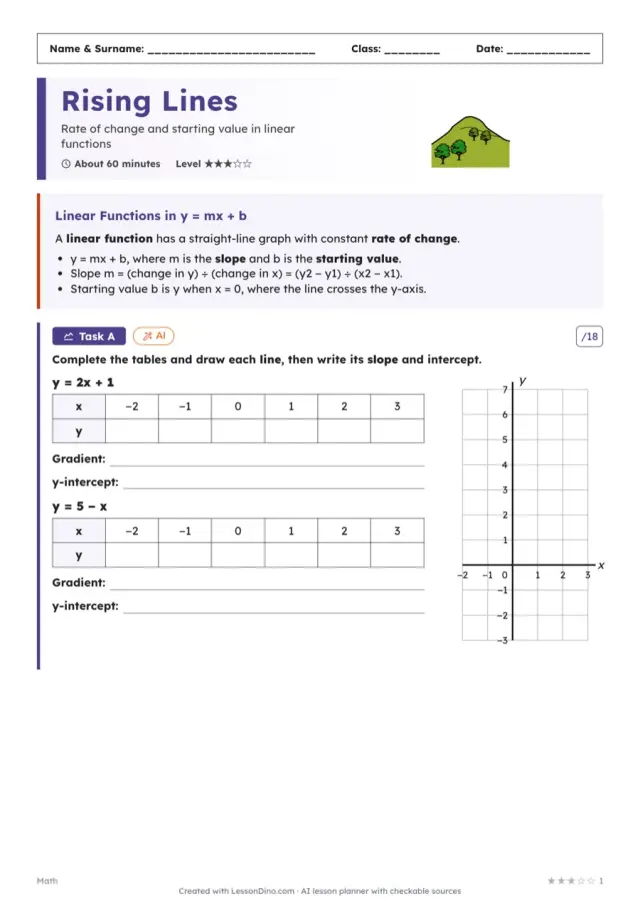
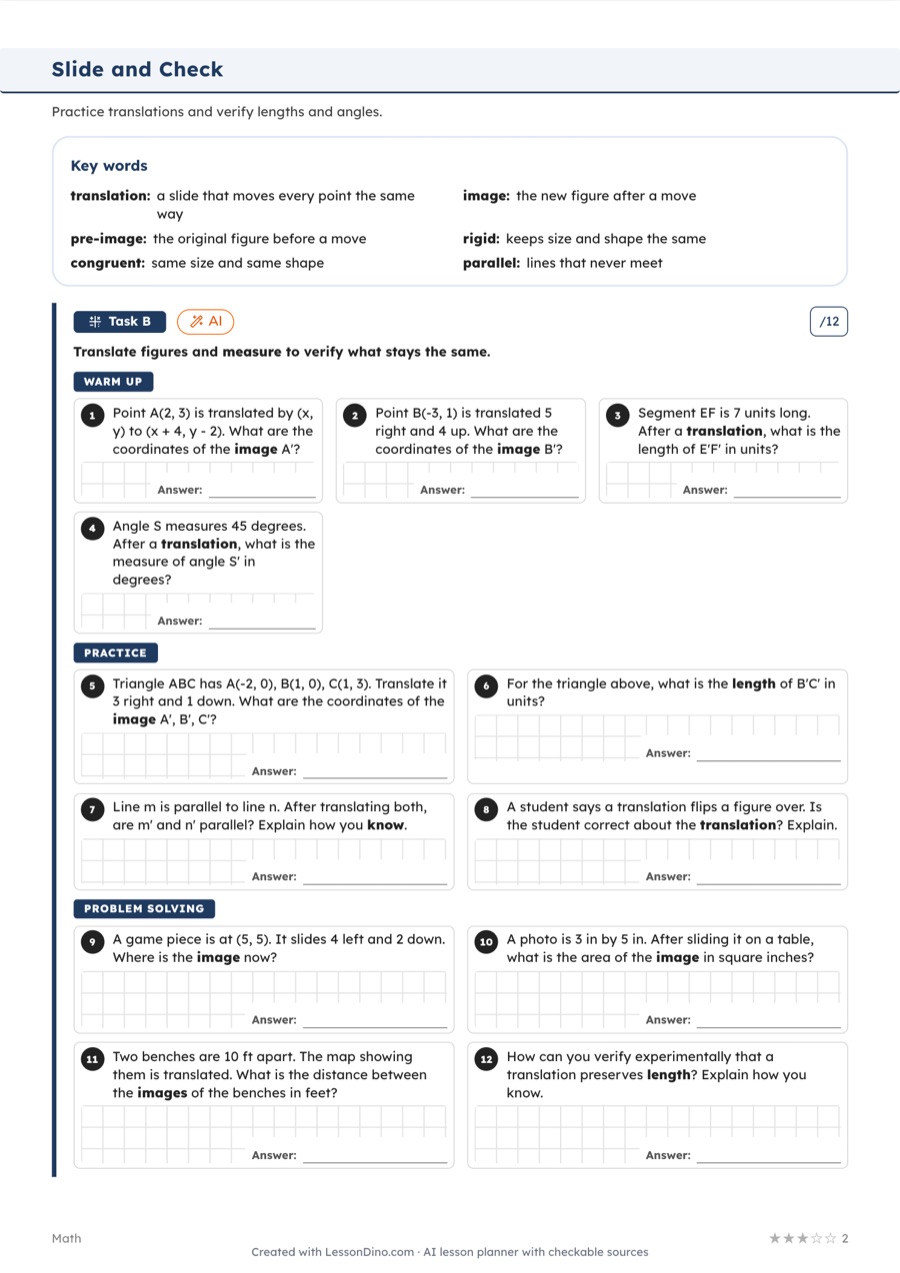
Slide and Check
Practice translations and verify lengths and angles.
| Word | Meaning |
|---|---|
| translation | a slide that moves every point the same way |
| image | the new figure after a move |
| pre-image | the original figure before a move |
| rigid | keeps size and shape the same |
| congruent | same size and same shape |
| parallel | lines that never meet |
Translate figures and measure to verify what stays the same.
Warm up
- Point A(2, 3) is translated by (x, y) to (x + 4, y - 2). What are the coordinates of the image A'?
- Point B(-3, 1) is translated 5 right and 4 up. What are the coordinates of the image B'?
- Segment EF is 7 units long. After a translation, what is the length of E'F' in units?
- Angle S measures 45 degrees. After a translation, what is the measure of angle S' in degrees?
Practice
- Triangle ABC has A(-2, 0), B(1, 0), C(1, 3). Translate it 3 right and 1 down. What are the coordinates of the image A', B', C'?
- For the triangle above, what is the length of B'C' in units?
- Line m is parallel to line n. After translating both, are m' and n' parallel? Explain how you know.
- A student says a translation flips a figure over. Is the student correct about the translation? Explain.
Problem solving
- A game piece is at (5, 5). It slides 4 left and 2 down. Where is the image now?
- A photo is 3 in by 5 in. After sliding it on a table, what is the area of the image in square inches?
- Two benches are 10 ft apart. The map showing them is translated. What is the distance between the images of the benches in feet?
- How can you verify experimentally that a translation preserves length? Explain how you know.
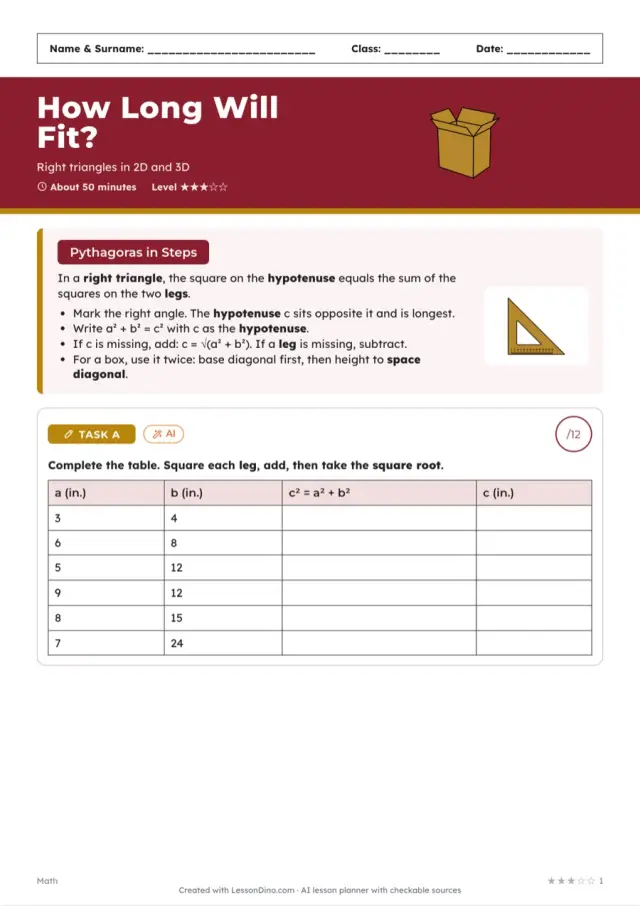
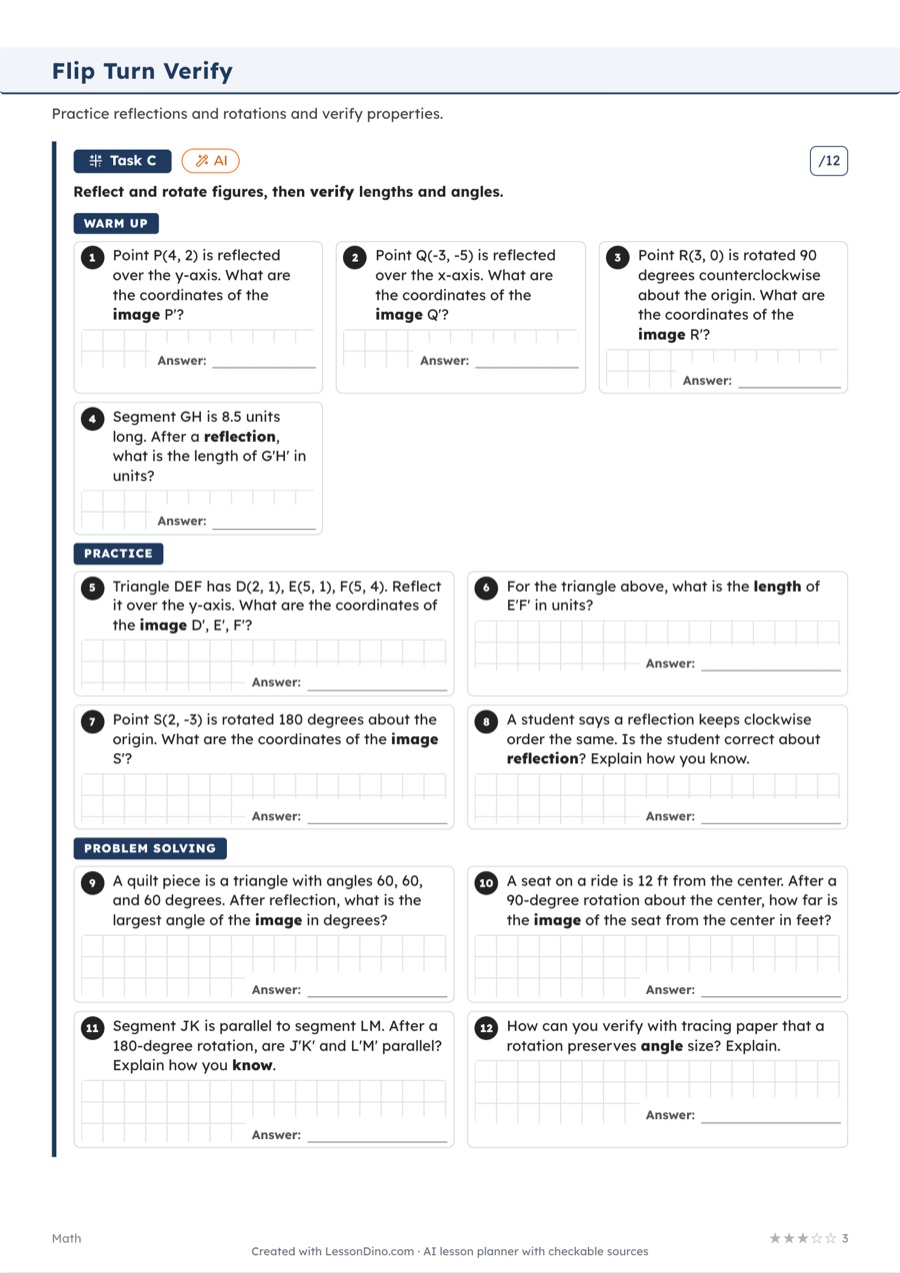
Flip Turn Verify
Practice reflections and rotations and verify properties.
Reflect and rotate figures, then verify lengths and angles.
Warm up
- Point P(4, 2) is reflected over the y-axis. What are the coordinates of the image P'?
- Point Q(-3, -5) is reflected over the x-axis. What are the coordinates of the image Q'?
- Point R(3, 0) is rotated 90 degrees counterclockwise about the origin. What are the coordinates of the image R'?
- Segment GH is 8.5 units long. After a reflection, what is the length of G'H' in units?
Practice
- Triangle DEF has D(2, 1), E(5, 1), F(5, 4). Reflect it over the y-axis. What are the coordinates of the image D', E', F'?
- For the triangle above, what is the length of E'F' in units?
- Point S(2, -3) is rotated 180 degrees about the origin. What are the coordinates of the image S'?
- A student says a reflection keeps clockwise order the same. Is the student correct about reflection? Explain how you know.
Problem solving
- A quilt piece is a triangle with angles 60, 60, and 60 degrees. After reflection, what is the largest angle of the image in degrees?
- A seat on a ride is 12 ft from the center. After a 90-degree rotation about the center, how far is the image of the seat from the center in feet?
- Segment JK is parallel to segment LM. After a 180-degree rotation, are J'K' and L'M' parallel? Explain how you know.
- How can you verify with tracing paper that a rotation preserves angle size? Explain.
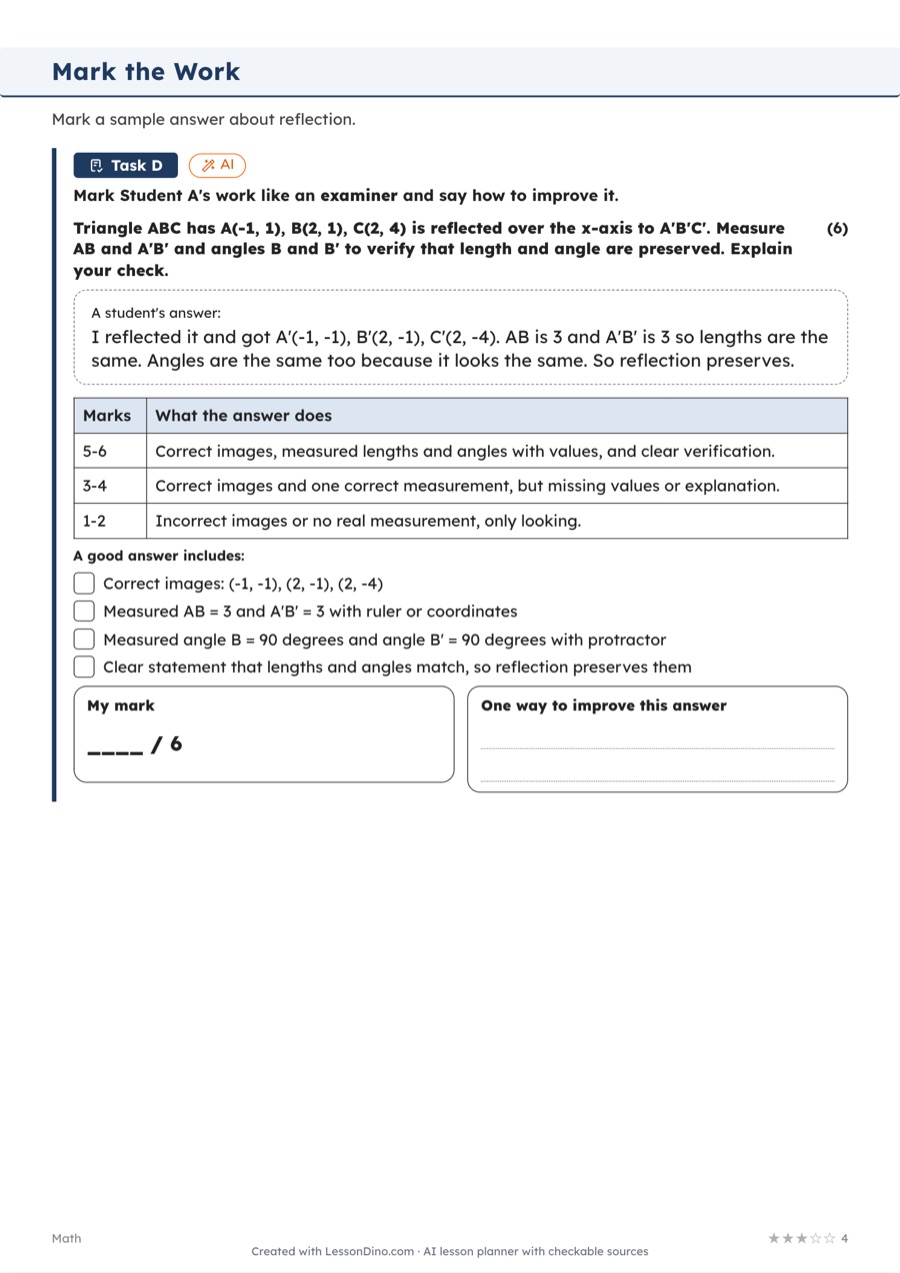
Mark the Work
Mark a sample answer about reflection.
Mark Student A's work like an examiner and say how to improve it.
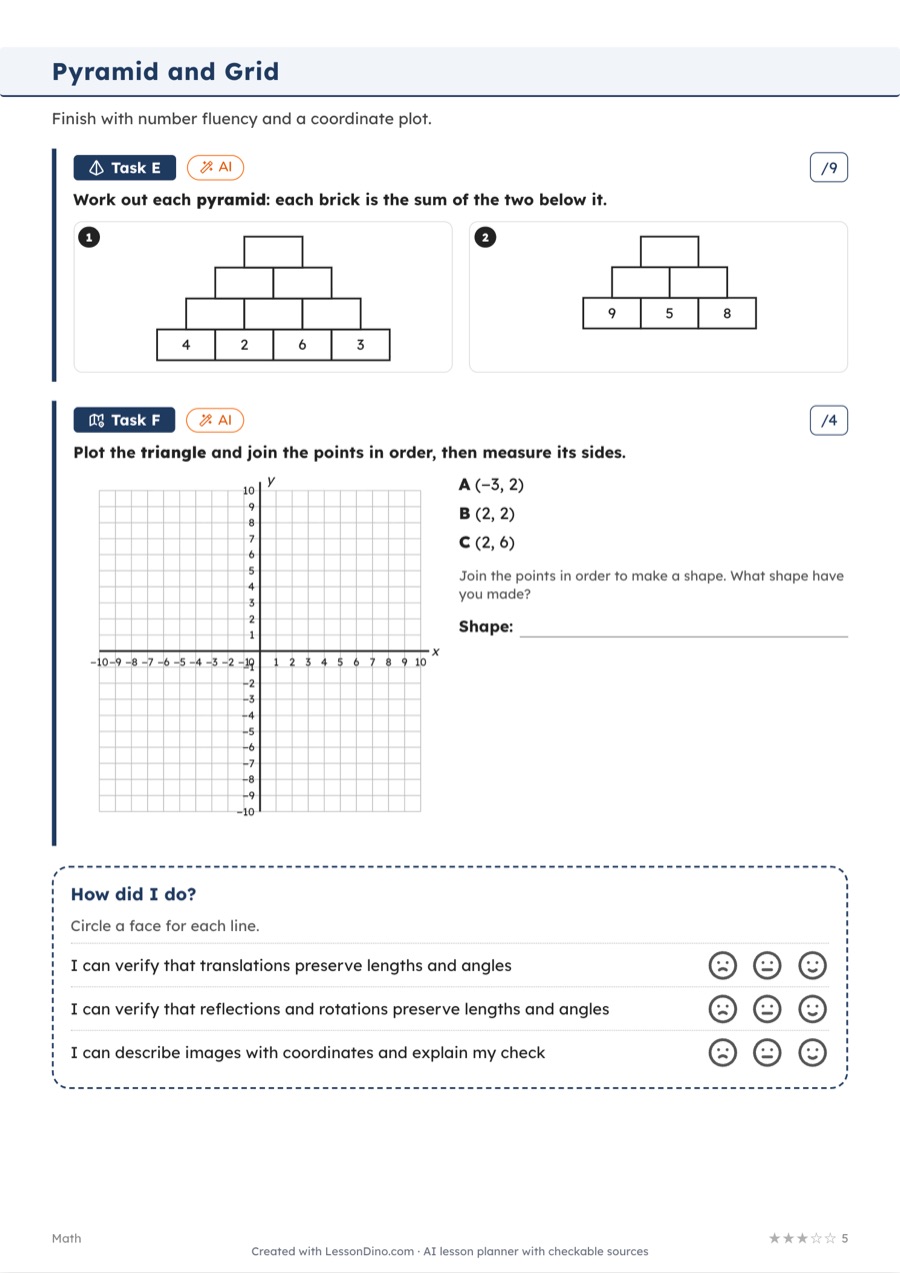
Pyramid and Grid
Finish with number fluency and a coordinate plot.
Work out each pyramid: each brick is the sum of the two below it.
Plot the triangle and join the points in order, then measure its sides.
Answers
Show the answers
- Point A(2, 3) is translated by (x, y) to (x + 4, y - 2). What are the coordinates of the image A'? (6, 1)
- Point B(-3, 1) is translated 5 right and 4 up. What are the coordinates of the image B'? (2, 5)
- Segment EF is 7 units long. After a translation, what is the length of E'F' in units? 7
- Angle S measures 45 degrees. After a translation, what is the measure of angle S' in degrees? 45
- Triangle ABC has A(-2, 0), B(1, 0), C(1, 3). Translate it 3 right and 1 down. What are the coordinates of the image A', B', C'? A'(1, -1), B'(4, -1), C'(4, 2)
- For the triangle above, what is the length of B'C' in units? 3
- Line m is parallel to line n. After translating both, are m' and n' parallel? Explain how you know. Yes - translation keeps direction, so parallel lines stay parallel.
- A student says a translation flips a figure over. Is the student correct about the translation? Explain. No - translation slides without flipping; a reflection flips.
- A game piece is at (5, 5). It slides 4 left and 2 down. Where is the image now? (1, 3)
- A photo is 3 in by 5 in. After sliding it on a table, what is the area of the image in square inches? 15
- Two benches are 10 ft apart. The map showing them is translated. What is the distance between the images of the benches in feet? 10
- How can you verify experimentally that a translation preserves length? Explain how you know. Trace the figure, slide the tracing, then measure matching sides with a ruler to show they are equal.
- Point P(4, 2) is reflected over the y-axis. What are the coordinates of the image P'? (-4, 2)
- Point Q(-3, -5) is reflected over the x-axis. What are the coordinates of the image Q'? (-3, 5)
- Point R(3, 0) is rotated 90 degrees counterclockwise about the origin. What are the coordinates of the image R'? (0, 3)
- Segment GH is 8.5 units long. After a reflection, what is the length of G'H' in units? 8.5
- Triangle DEF has D(2, 1), E(5, 1), F(5, 4). Reflect it over the y-axis. What are the coordinates of the image D', E', F'? D'(-2, 1), E'(-5, 1), F'(-5, 4)
- For the triangle above, what is the length of E'F' in units? 3
- Point S(2, -3) is rotated 180 degrees about the origin. What are the coordinates of the image S'? (-2, 3)
- A student says a reflection keeps clockwise order the same. Is the student correct about reflection? Explain how you know. No - reflection reverses order, like a mirror; clockwise becomes counterclockwise.
- A quilt piece is a triangle with angles 60, 60, and 60 degrees. After reflection, what is the largest angle of the image in degrees? 60
- A seat on a ride is 12 ft from the center. After a 90-degree rotation about the center, how far is the image of the seat from the center in feet? 12
- Segment JK is parallel to segment LM. After a 180-degree rotation, are J'K' and L'M' parallel? Explain how you know. Yes - rotation keeps lines straight and keeps parallel lines parallel.
- How can you verify with tracing paper that a rotation preserves angle size? Explain. Trace the angle, pin the center, turn the tracing, then measure both angles with a protractor to show they are equal.
The answer sheet is the last picture above.
Curriculum
Verify experimentally the properties of rotations, reflections, and translations:
Made with Lesson Dino's AI on 17 October 2026. AI can make mistakes, so check the answers and facts against the sources before you teach.