The worksheet
About this worksheet
Students learn to estimate system solutions by graphing and prove them by algebra. They solve pairs of equations and spot no-solution cases by inspection. This Grade 8 Math worksheet gives students (ages 13–14) six pages of practice on systems of equations, part of the expressions and equations unit. It goes with our free Systems of equations lesson, which has the slides and a timed lesson plan.
What it covers
By the end, students should be able to:
- Students will solve systems of two linear equations by substitution and elimination.
- Students will estimate solutions to systems by graphing both lines.
- Students will decide no solution or infinitely many solutions by inspection.
How to use it
- Graphing estimate (12 minutes): Hand out Worksheet Task D and set estimate-only goal.
- Main activity (23 minutes): Hand out comparison worksheet and Worksheet Tasks B and C for pairs to solve.
- Support: Provide integer-solution systems with graphs that land exactly on grid points.
- Stretch: Students try a system with parallel lines, show empty intersection on the graph, and prove no solution by inspection.
- The answer sheet is the last page, so you can print it on its own or let students check their own work.
Key vocabulary
- system: two equations together that use the same x and y at the same time
- solution: a pair of numbers that makes every equation true together
- intersection: the place where two lines cross on a graph
- substitution: putting an expression for one unknown from one equation into the other equation
- elimination: adding or subtracting equations to remove one unknown
Mistakes to watch for
- Thinking a pair that fits one equation already solves the system. Require two-line check table; a solution must make all equations true at the same time.
- Treating a graphed estimate as exact when lines cross between grid lines. Solve by substitution or elimination after graphing to prove the exact pair.
- Sign error when adding or subtracting to eliminate a variable. Line up y-terms, circle opposites, and check by putting the pair into both original equations.
What's on the worksheet
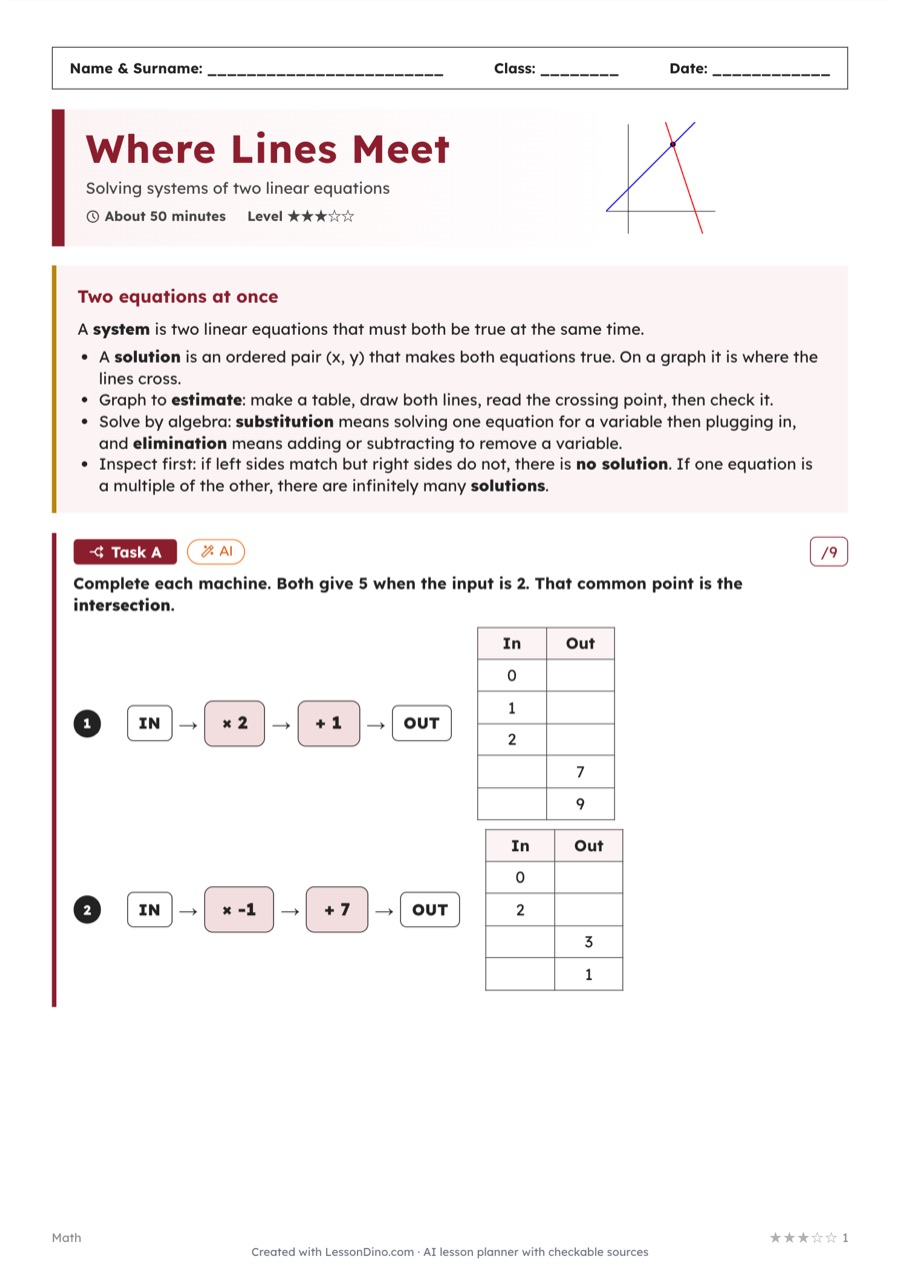
Two Lines Meet
What a system means and how machines show it.
Two equations at once
- A system is two linear equations that must both be true at the same time.
- A solution is an ordered pair (x, y) that makes both equations true. On a graph it is where the lines cross.
- Graph to estimate: make a table, draw both lines, read the crossing point, then check it.
- Solve by algebra: substitution means solving one equation for a variable then plugging in, and elimination means adding or subtracting to remove a variable.
- Inspect first: if left sides match but right sides do not, there is no solution. If one equation is a multiple of the other, there are infinitely many solutions.
Complete each machine. Both give 5 when the input is 2. That common point is the intersection.
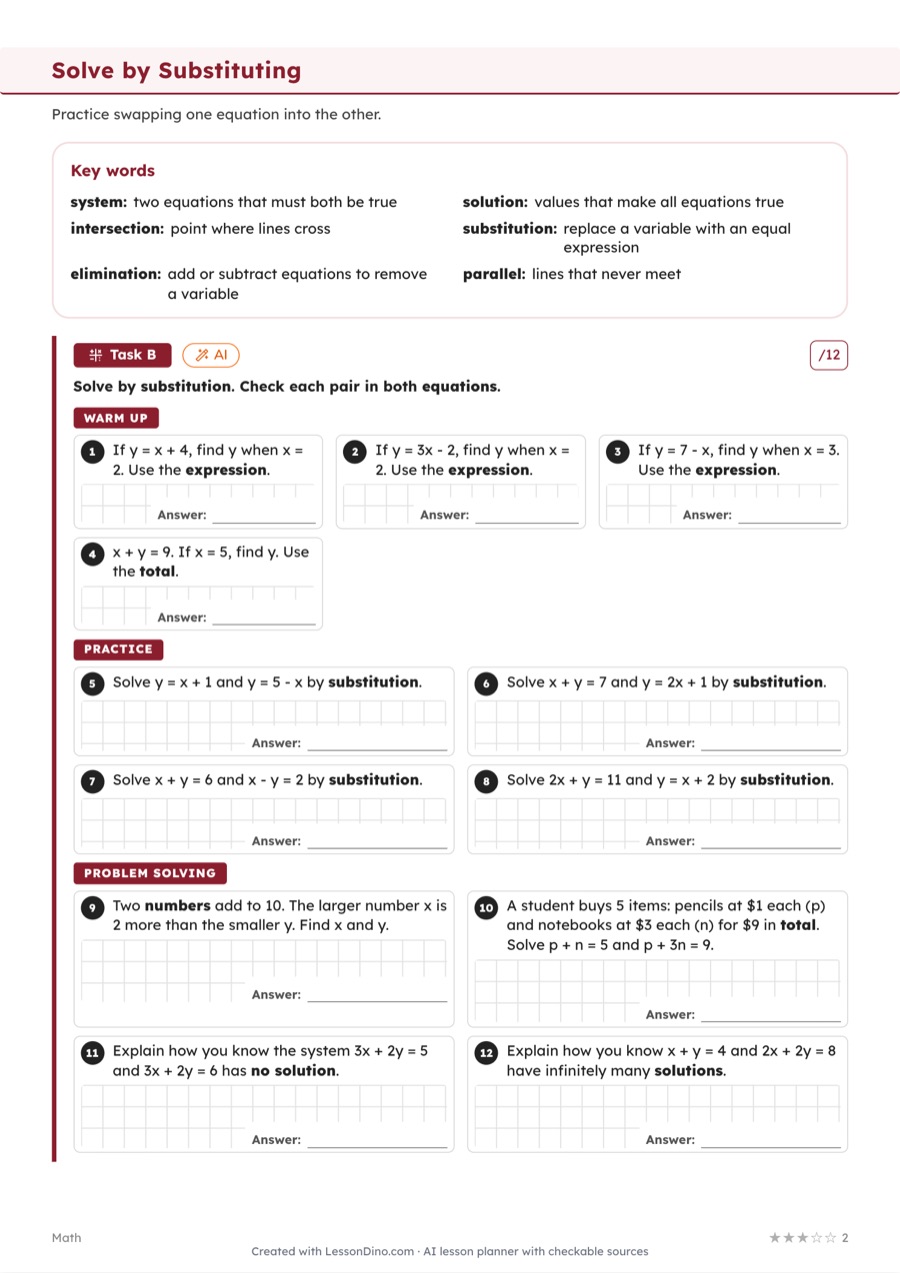
Solve by Substituting
Practice swapping one equation into the other.
| Word | Meaning |
|---|---|
| system | two equations that must both be true |
| solution | values that make all equations true |
| intersection | point where lines cross |
| substitution | replace a variable with an equal expression |
| elimination | add or subtract equations to remove a variable |
| parallel | lines that never meet |
Solve by substitution. Check each pair in both equations.
Warm up
- If y = x + 4, find y when x = 2. Use the expression.
- If y = 3x - 2, find y when x = 2. Use the expression.
- If y = 7 - x, find y when x = 3. Use the expression.
- x + y = 9. If x = 5, find y. Use the total.
Practice
- Solve y = x + 1 and y = 5 - x by substitution.
- Solve x + y = 7 and y = 2x + 1 by substitution.
- Solve x + y = 6 and x - y = 2 by substitution.
- Solve 2x + y = 11 and y = x + 2 by substitution.
Problem solving
- Two numbers add to 10. The larger number x is 2 more than the smaller y. Find x and y.
- A student buys 5 items: pencils at $1 each (p) and notebooks at $3 each (n) for $9 in total. Solve p + n = 5 and p + 3n = 9.
- Explain how you know the system 3x + 2y = 5 and 3x + 2y = 6 has no solution.
- Explain how you know x + y = 4 and 2x + 2y = 8 have infinitely many solutions.
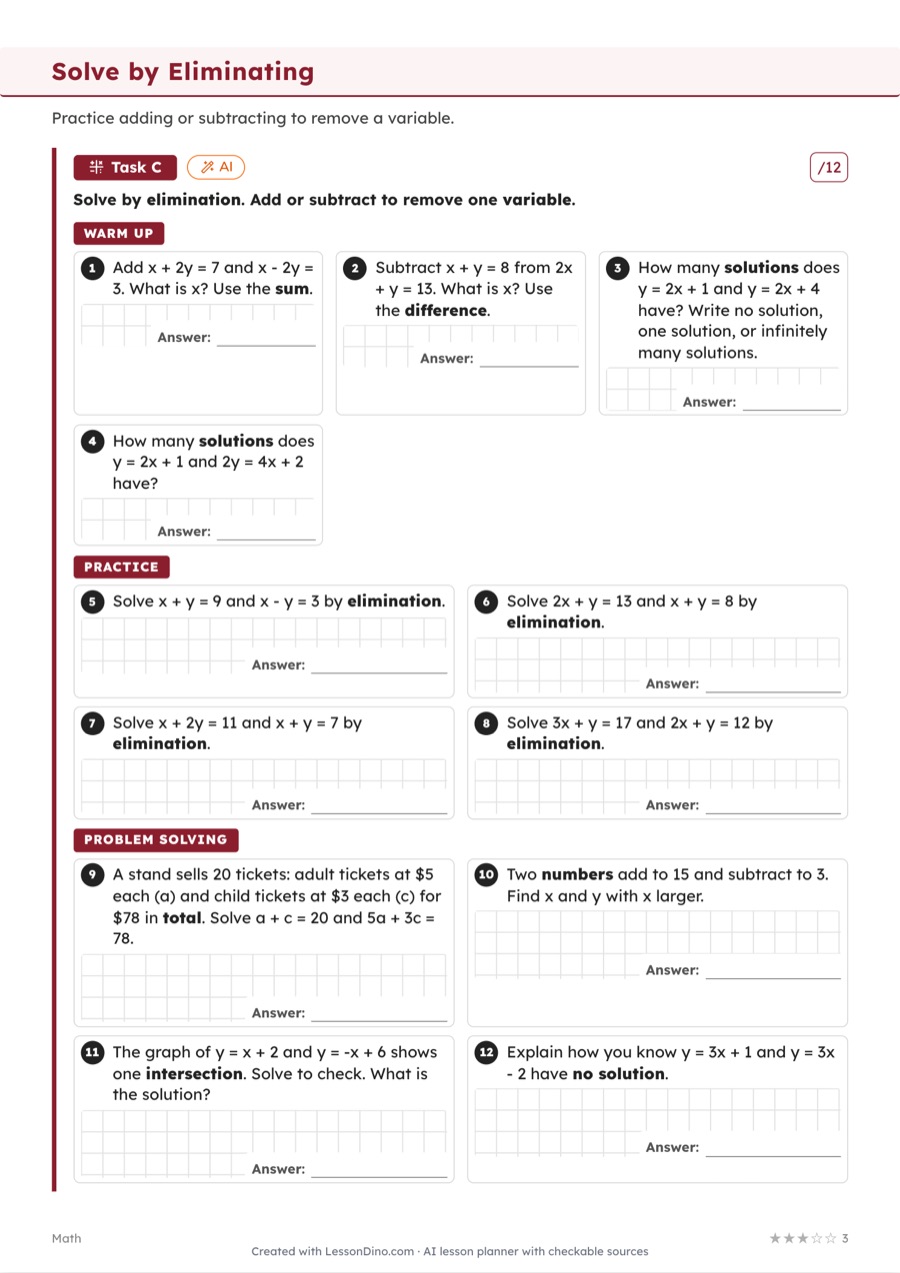
Solve by Eliminating
Practice adding or subtracting to remove a variable.
Solve by elimination. Add or subtract to remove one variable.
Warm up
- Add x + 2y = 7 and x - 2y = 3. What is x? Use the sum.
- Subtract x + y = 8 from 2x + y = 13. What is x? Use the difference.
- How many solutions does y = 2x + 1 and y = 2x + 4 have? Write no solution, one solution, or infinitely many solutions.
- How many solutions does y = 2x + 1 and 2y = 4x + 2 have?
Practice
- Solve x + y = 9 and x - y = 3 by elimination.
- Solve 2x + y = 13 and x + y = 8 by elimination.
- Solve x + 2y = 11 and x + y = 7 by elimination.
- Solve 3x + y = 17 and 2x + y = 12 by elimination.
Problem solving
- A stand sells 20 tickets: adult tickets at $5 each (a) and child tickets at $3 each (c) for $78 in total. Solve a + c = 20 and 5a + 3c = 78.
- Two numbers add to 15 and subtract to 3. Find x and y with x larger.
- The graph of y = x + 2 and y = -x + 6 shows one intersection. Solve to check. What is the solution?
- Explain how you know y = 3x + 1 and y = 3x - 2 have no solution.
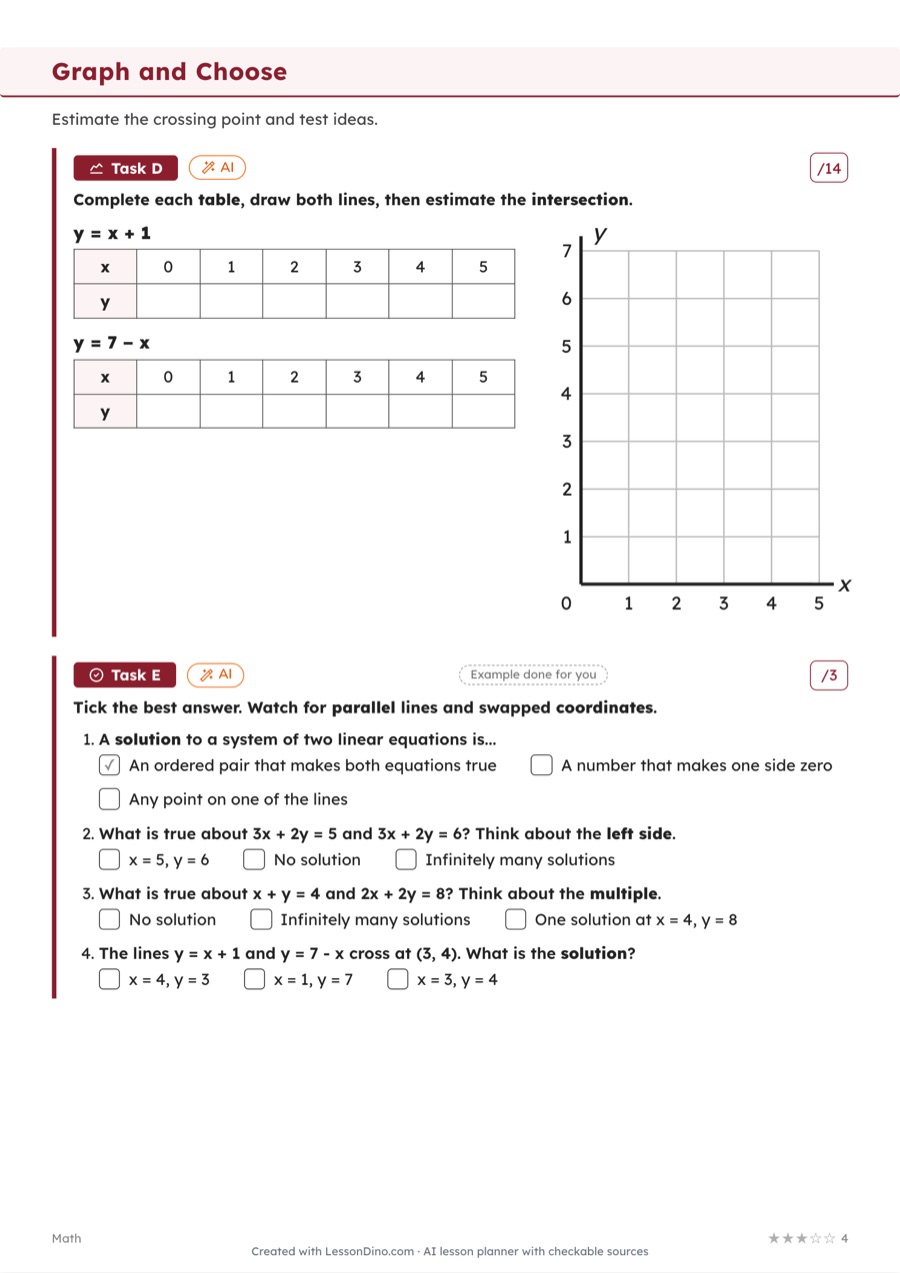
Graph and Choose
Estimate the crossing point and test ideas.
Complete each table, draw both lines, then estimate the intersection.
Tick the best answer. Watch for parallel lines and swapped coordinates.
- A solution to a system of two linear equations is...
- What is true about 3x + 2y = 5 and 3x + 2y = 6? Think about the left side.
- What is true about x + y = 4 and 2x + 2y = 8? Think about the multiple.
- The lines y = x + 1 and y = 7 - x cross at (3, 4). What is the solution?
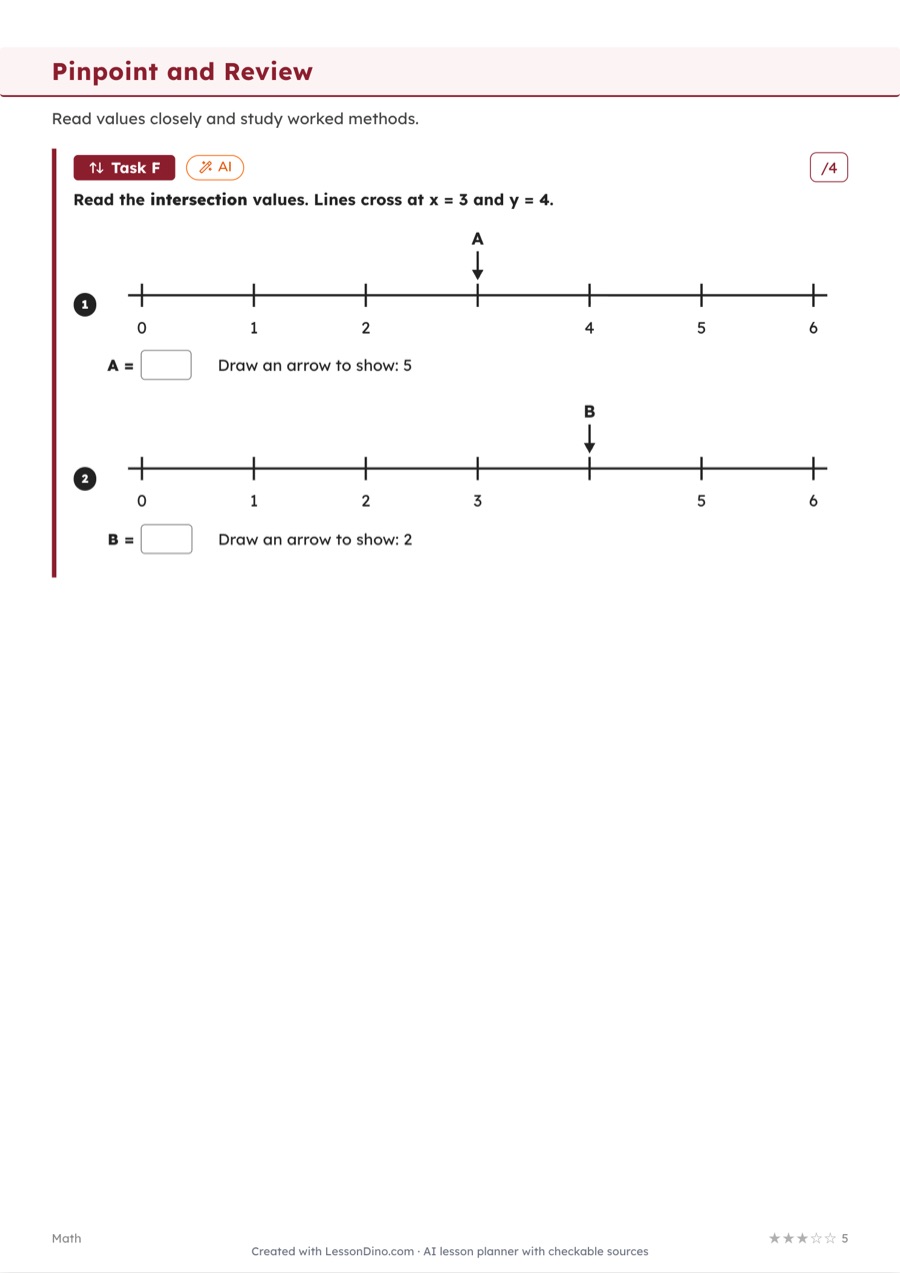
Pinpoint and Review
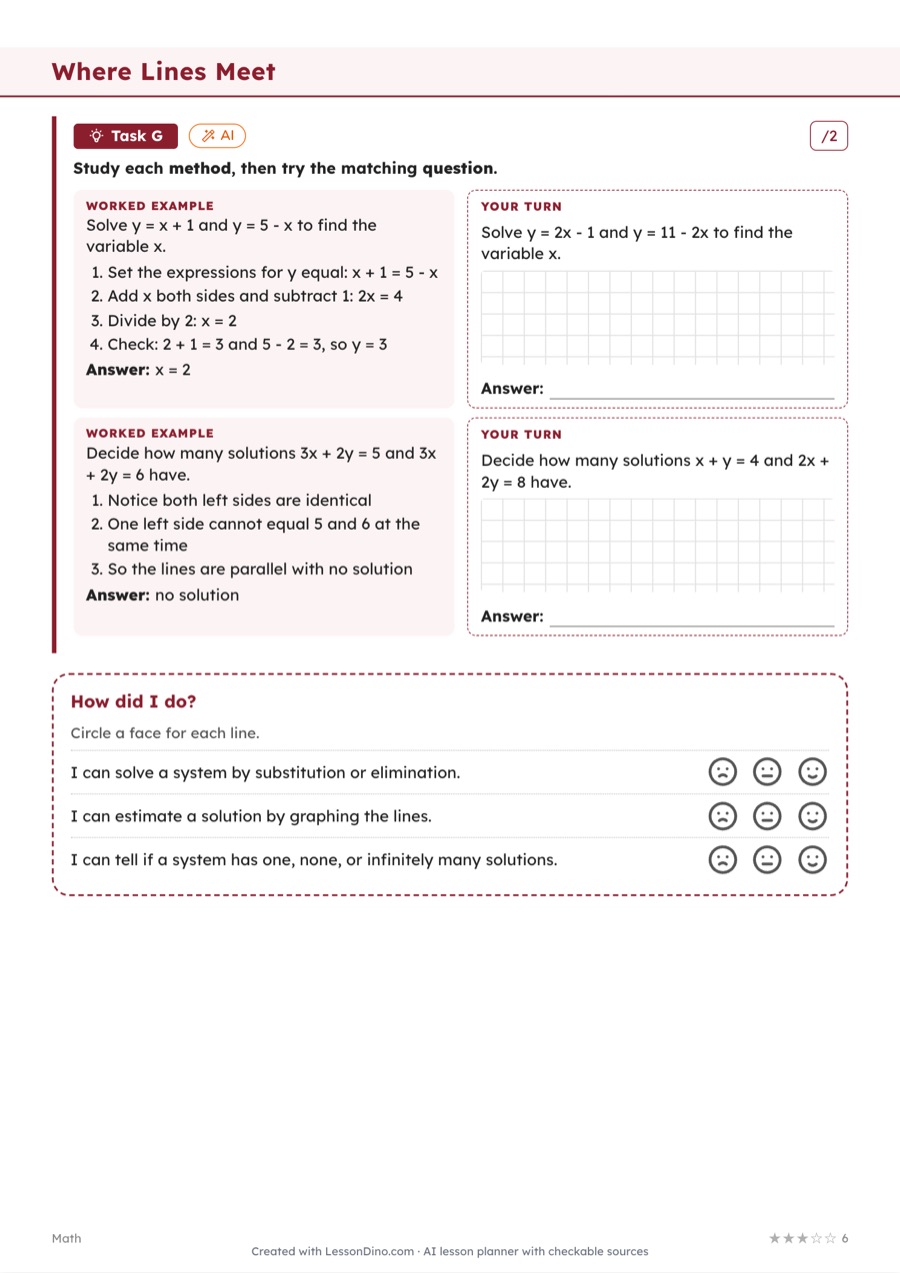
Read values closely and study worked methods.
Read the intersection values. Lines cross at x = 3 and y = 4.
Page 6
Study each method, then try the matching question.
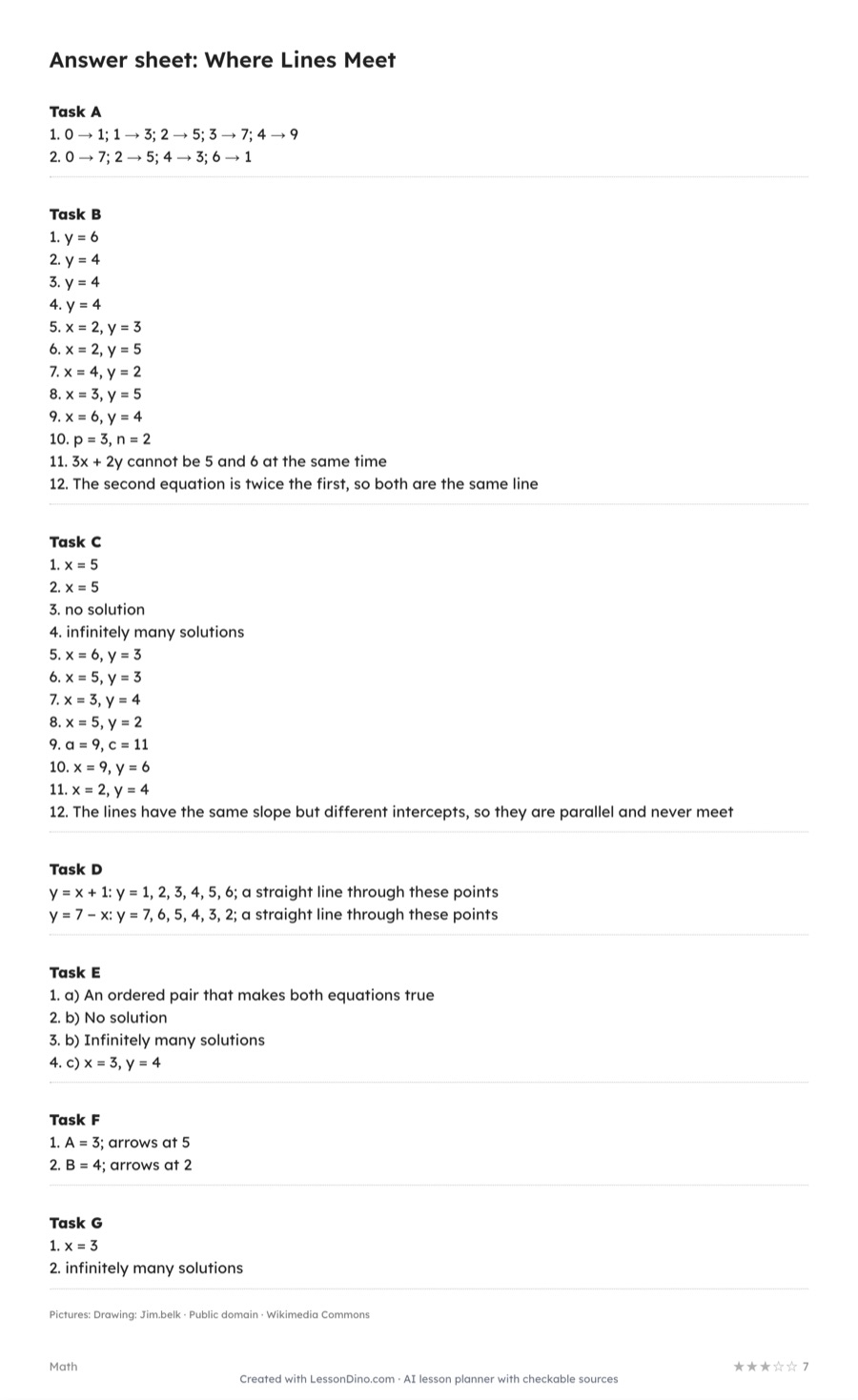
Answers
Show the answers
- If y = x + 4, find y when x = 2. Use the expression. y = 6
- If y = 3x - 2, find y when x = 2. Use the expression. y = 4
- If y = 7 - x, find y when x = 3. Use the expression. y = 4
- x + y = 9. If x = 5, find y. Use the total. y = 4
- Solve y = x + 1 and y = 5 - x by substitution. x = 2, y = 3
- Solve x + y = 7 and y = 2x + 1 by substitution. x = 2, y = 5
- Solve x + y = 6 and x - y = 2 by substitution. x = 4, y = 2
- Solve 2x + y = 11 and y = x + 2 by substitution. x = 3, y = 5
- Two numbers add to 10. The larger number x is 2 more than the smaller y. Find x and y. x = 6, y = 4
- A student buys 5 items: pencils at $1 each (p) and notebooks at $3 each (n) for $9 in total. Solve p + n = 5 and p + 3n = 9. p = 3, n = 2
- Explain how you know the system 3x + 2y = 5 and 3x + 2y = 6 has no solution. 3x + 2y cannot be 5 and 6 at the same time
- Explain how you know x + y = 4 and 2x + 2y = 8 have infinitely many solutions. The second equation is twice the first, so both are the same line
- Add x + 2y = 7 and x - 2y = 3. What is x? Use the sum. x = 5
- Subtract x + y = 8 from 2x + y = 13. What is x? Use the difference. x = 5
- How many solutions does y = 2x + 1 and y = 2x + 4 have? Write no solution, one solution, or infinitely many solutions. no solution
- How many solutions does y = 2x + 1 and 2y = 4x + 2 have? infinitely many solutions
- Solve x + y = 9 and x - y = 3 by elimination. x = 6, y = 3
- Solve 2x + y = 13 and x + y = 8 by elimination. x = 5, y = 3
- Solve x + 2y = 11 and x + y = 7 by elimination. x = 3, y = 4
- Solve 3x + y = 17 and 2x + y = 12 by elimination. x = 5, y = 2
- A stand sells 20 tickets: adult tickets at $5 each (a) and child tickets at $3 each (c) for $78 in total. Solve a + c = 20 and 5a + 3c = 78. a = 9, c = 11
- Two numbers add to 15 and subtract to 3. Find x and y with x larger. x = 9, y = 6
- The graph of y = x + 2 and y = -x + 6 shows one intersection. Solve to check. What is the solution? x = 2, y = 4
- Explain how you know y = 3x + 1 and y = 3x - 2 have no solution. The lines have the same slope but different intercepts, so they are parallel and never meet
The answer sheet is the last picture above.
Curriculum
Solve systems of two linear equations in two variables algebraically, and estimate solutions by graphing the equations. Solve simple cases by inspection. For example, 3x + 2y = 5 and 3x + 2y = 6 have no solution because 3x + 2y cannot simultaneously be 5 and 6.
Made with Lesson Dino's AI on 17 October 2026. AI can make mistakes, so check the answers and facts against the sources before you teach.