The worksheet
About this worksheet
Students learn to solve linear equations in one variable. They practice in pairs with pencil and paper and check each answer. This Grade 8 Math worksheet gives students (ages 13–14) seven pages of practice on solving linear equations, part of the expressions and equations unit. It goes with our free Solving linear equations lesson, which has the slides and a timed lesson plan.
What it covers
By the end, students should be able to:
- Students will solve two-step equations by undoing operations on both sides.
- Students will solve equations with distribution and variables on both sides.
- Students will identify one solution, no solution, or infinitely many solutions.
How to use it
- Main activity: Paper Power Sprint (18 minutes): Show Slide 9 task and hand out Worksheet Task B sheets, pencils, and start timer.
- Support: Allow a multiplication chart and highlight the variable terms in one color to see what to move first.
- Stretch: Add equations with rational number coefficients that need expanding and combining like terms.
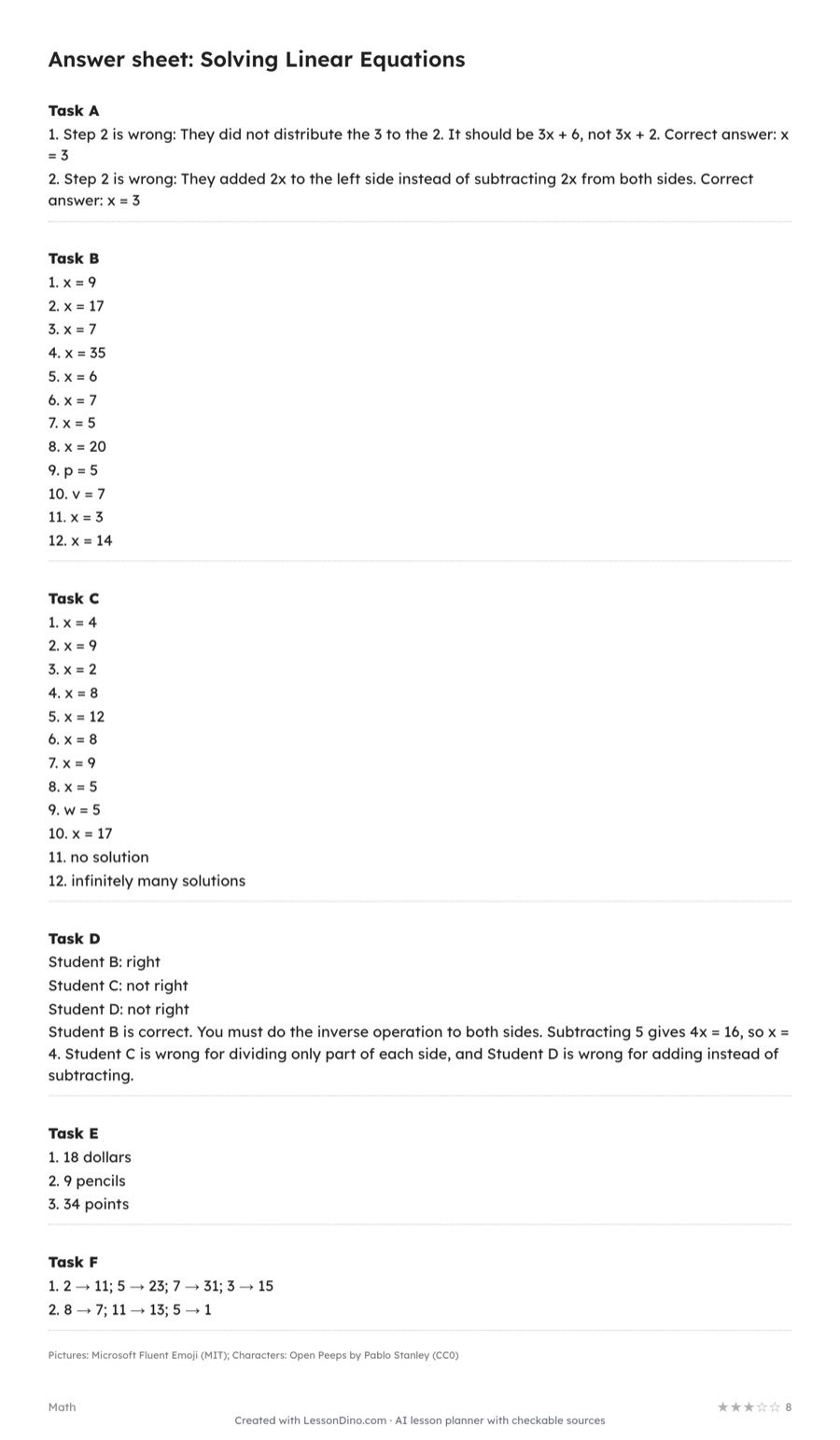
- The answer sheet is the last page, so you can print it on its own or let students check their own work.
Key vocabulary
- equation: a number sentence saying two sides have the same value
- variable: a letter that stands for a number we need to find
- inverse operations: an adding and subtracting pair, or multiplying and dividing pair, that undo each other
- like terms: parts with the same letter raised to the same power that can be combined
- solution: the number that makes both sides equal when plugged back in
Mistakes to watch for
- Doing an operation to only one side of the equation. Redo insisting on the same operation to both sides to keep balance and isolate x.
- Distributing to only the first term, like 2(x + 3) becomes 2x + 3. Multiply the outside number by each term inside, then collect like terms.
- Mixing up 0 = 0 and 0 = 3 solution types. Show 0x = 0 is always true so infinitely many, while 0x = -2.5 is impossible so no roots.
What's on the worksheet
Keep It Balanced
Learn the steps, then spot common mistakes.
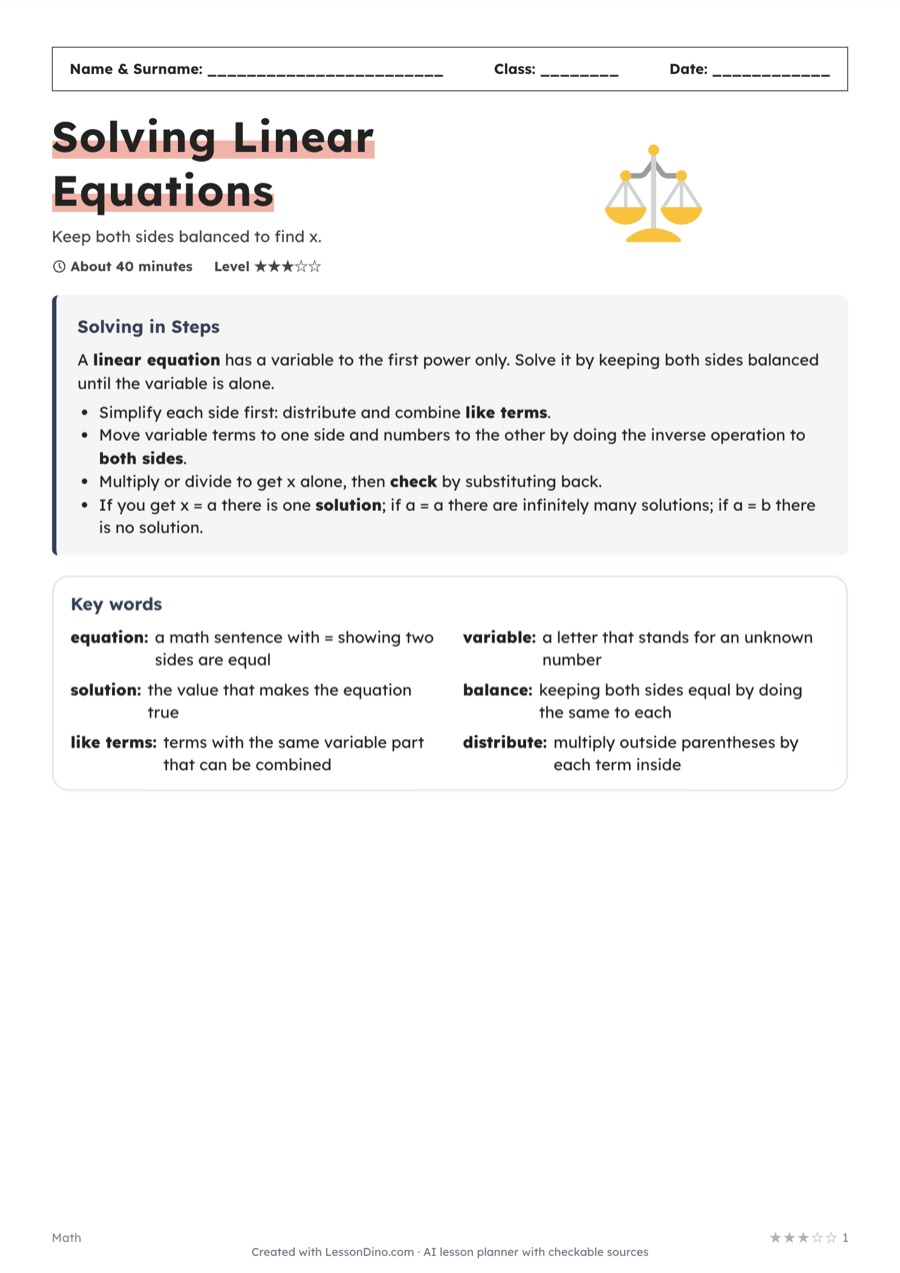
Solving in Steps
- A linear equation has a variable to the first power only. Solve it by keeping both sides balanced until the variable is alone.
- Simplify each side first: distribute and combine like terms.
- Move variable terms to one side and numbers to the other by doing the inverse operation to both sides.
- Multiply or divide to get x alone, then check by substituting back.
- If you get x = a there is one solution; if a = a there are infinitely many solutions; if a = b there is no solution.
| Word | Meaning |
|---|---|
| equation | a math sentence with = showing two sides are equal |
| variable | a letter that stands for an unknown number |
| solution | the value that makes the equation true |
| balance | keeping both sides equal by doing the same to each |
| like terms | terms with the same variable part that can be combined |
| distribute | multiply outside parentheses by each term inside |
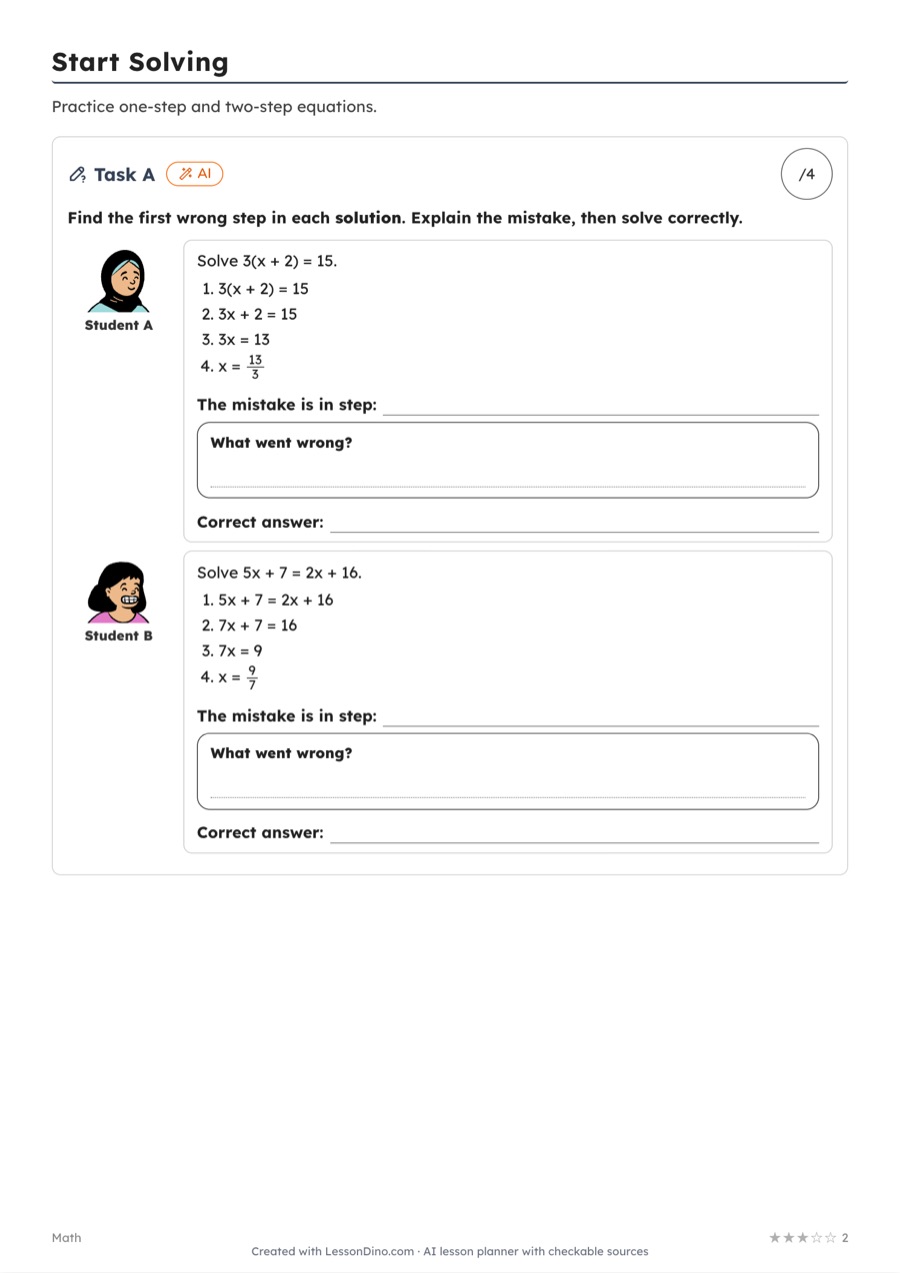
Start Solving
Practice one-step and two-step equations.
Find the first wrong step in each solution. Explain the mistake, then solve correctly.
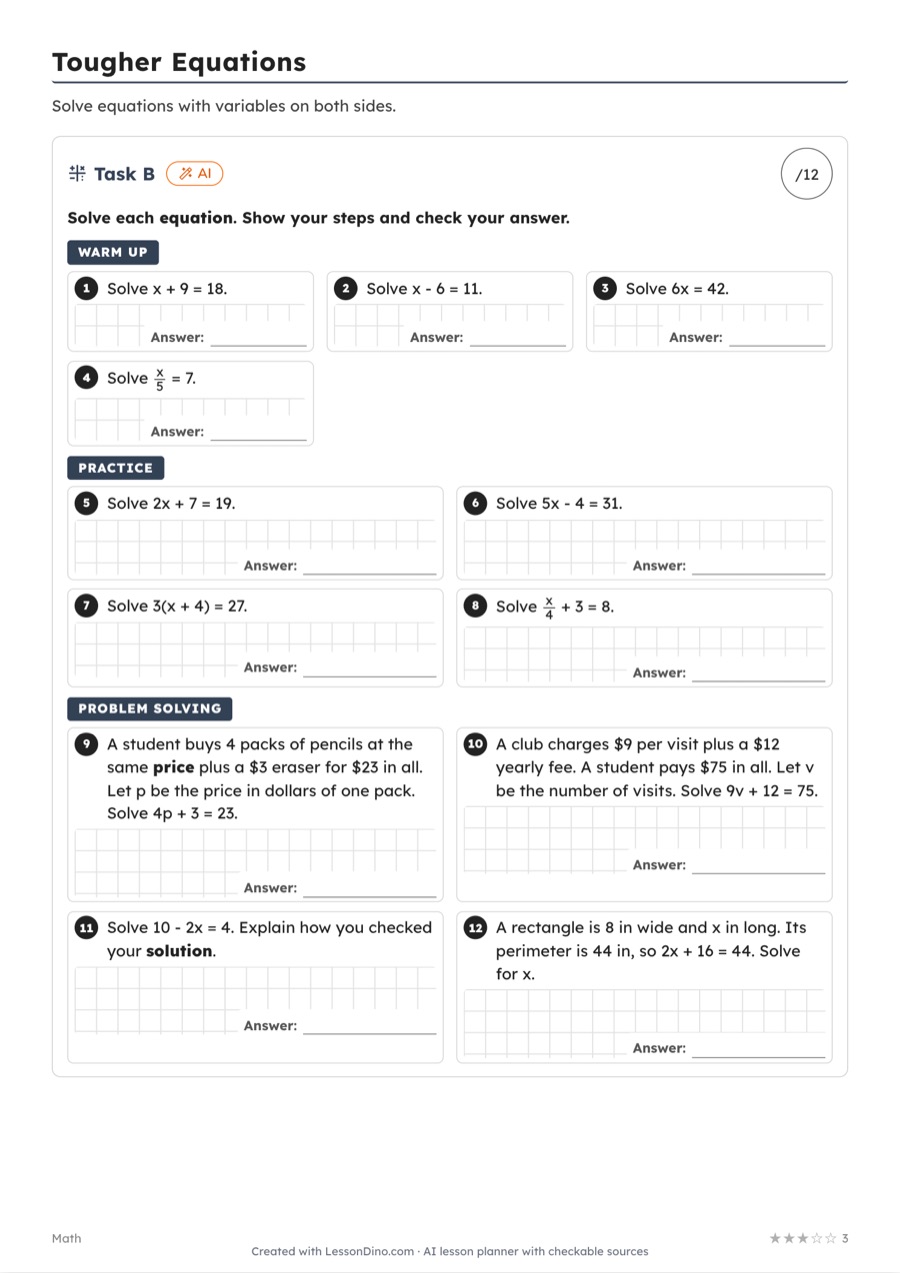
Tougher Equations
Solve equations with variables on both sides.
Solve each equation. Show your steps and check your answer.
Warm up
- Solve x + 9 = 18.
- Solve x - 6 = 11.
- Solve 6x = 42.
- Solve x/5 = 7.
Practice
- Solve 2x + 7 = 19.
- Solve 5x - 4 = 31.
- Solve 3(x + 4) = 27.
- Solve x/4 + 3 = 8.
Problem solving
- A student buys 4 packs of pencils at the same price plus a $3 eraser for $23 in all. Let p be the price in dollars of one pack. Solve 4p + 3 = 23.
- A club charges $9 per visit plus a $12 yearly fee. A student pays $75 in all. Let v be the number of visits. Solve 9v + 12 = 75.
- Solve 10 - 2x = 4. Explain how you checked your solution.
- A rectangle is 8 in wide and x in long. Its perimeter is 44 in, so 2x + 16 = 44. Solve for x.
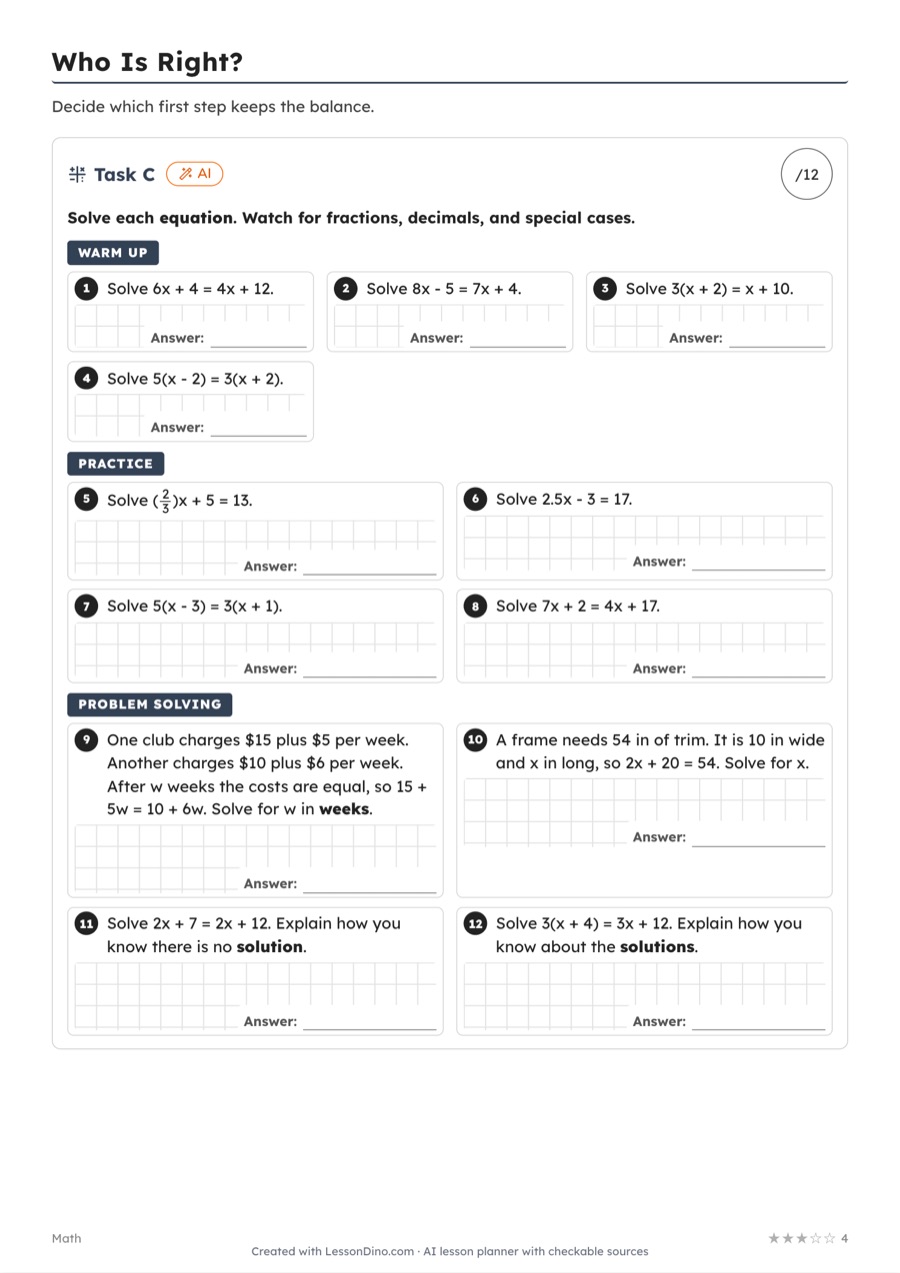
Who Is Right?
Decide which first step keeps the balance.
Solve each equation. Watch for fractions, decimals, and special cases.
Warm up
- Solve 6x + 4 = 4x + 12.
- Solve 8x - 5 = 7x + 4.
- Solve 3(x + 2) = x + 10.
- Solve 5(x - 2) = 3(x + 2).
Practice
- Solve (2/3)x + 5 = 13.
- Solve 2.5x - 3 = 17.
- Solve 5(x - 3) = 3(x + 1).
- Solve 7x + 2 = 4x + 17.
Problem solving
- One club charges $15 plus $5 per week. Another charges $10 plus $6 per week. After w weeks the costs are equal, so 15 + 5w = 10 + 6w. Solve for w in weeks.
- A frame needs 54 in of trim. It is 10 in wide and x in long, so 2x + 20 = 54. Solve for x.
- Solve 2x + 7 = 2x + 12. Explain how you know there is no solution.
- Solve 3(x + 4) = 3x + 12. Explain how you know about the solutions.
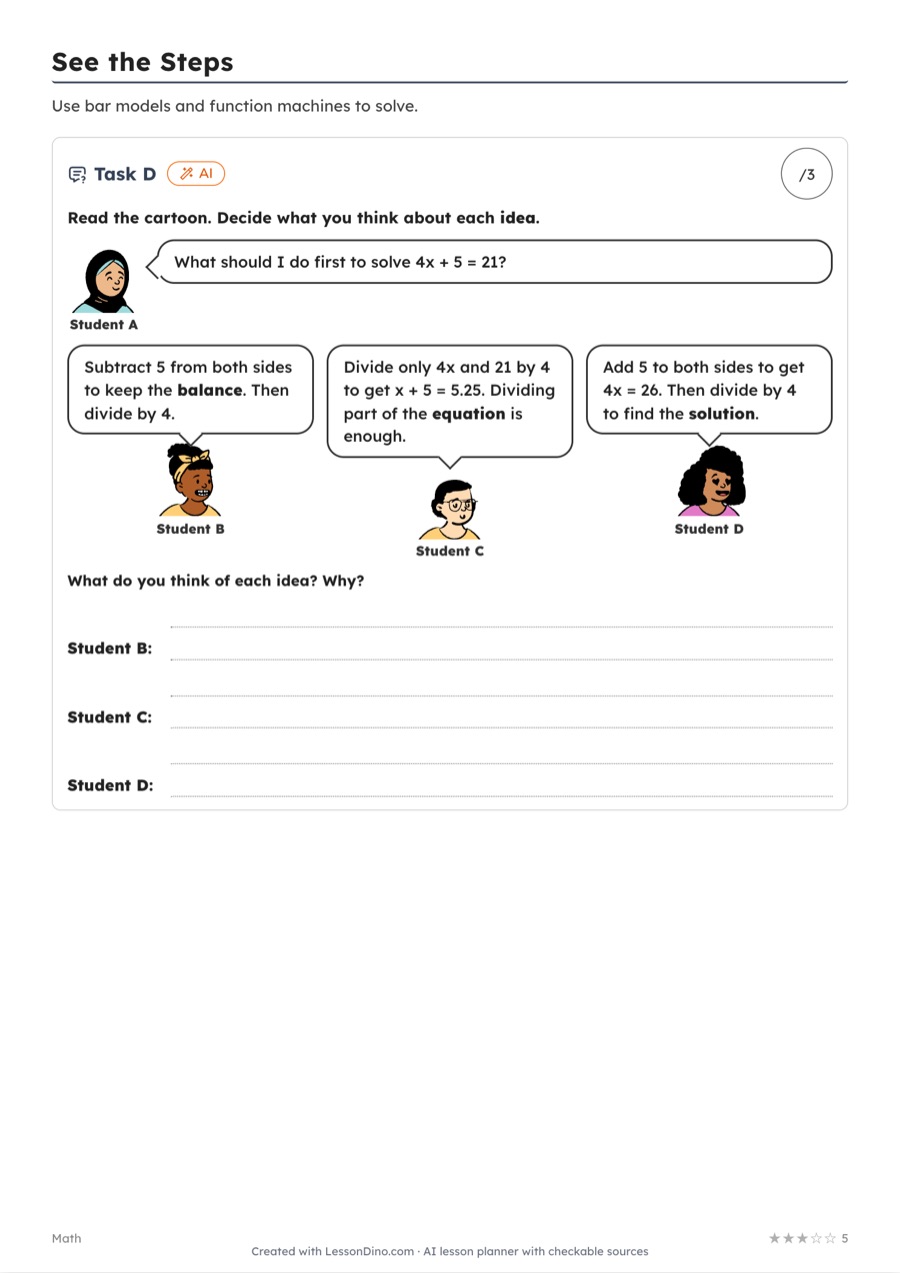
See the Steps
Use bar models and function machines to solve.
Read the cartoon. Decide what you think about each idea.
Page 6
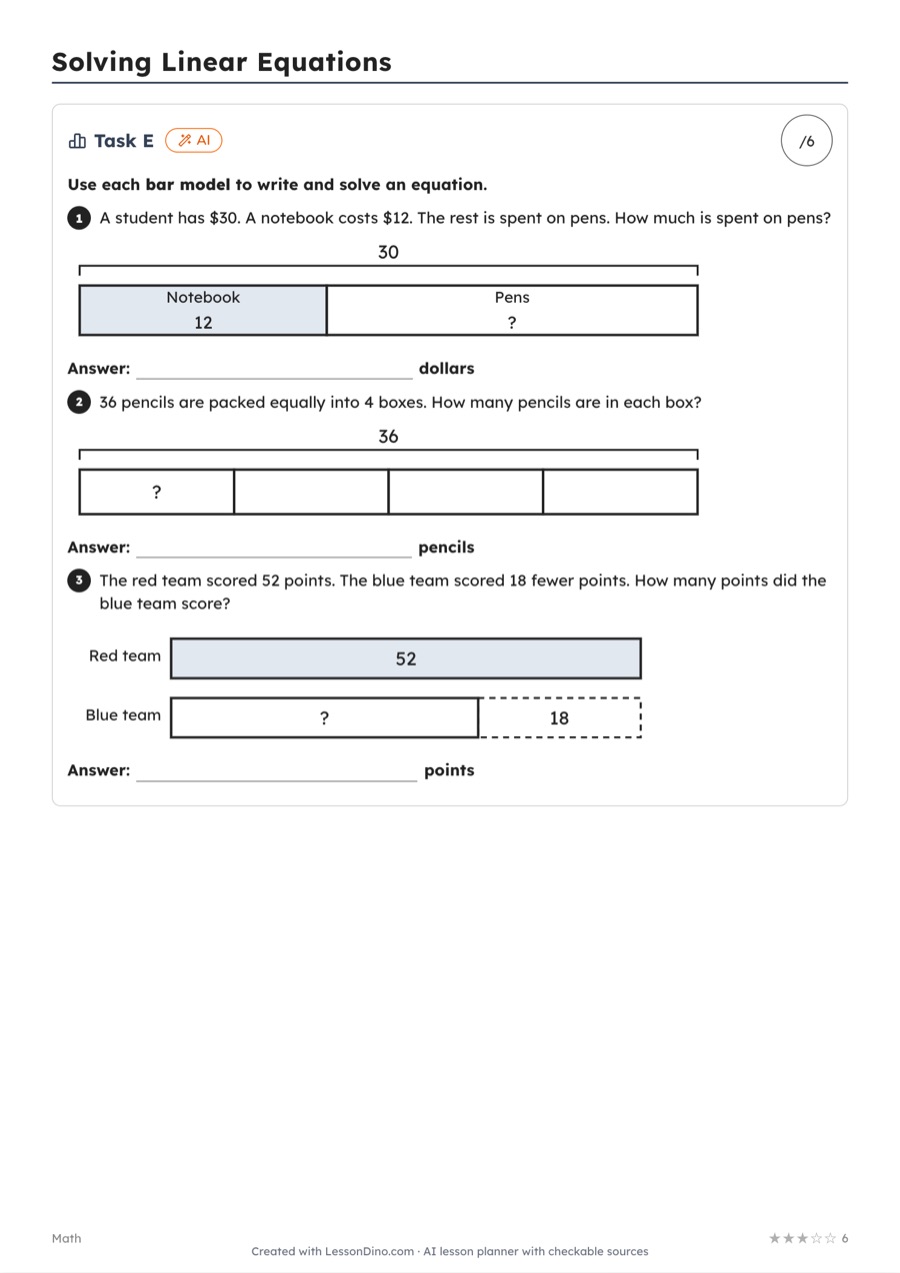
Use each bar model to write and solve an equation.
Page 7
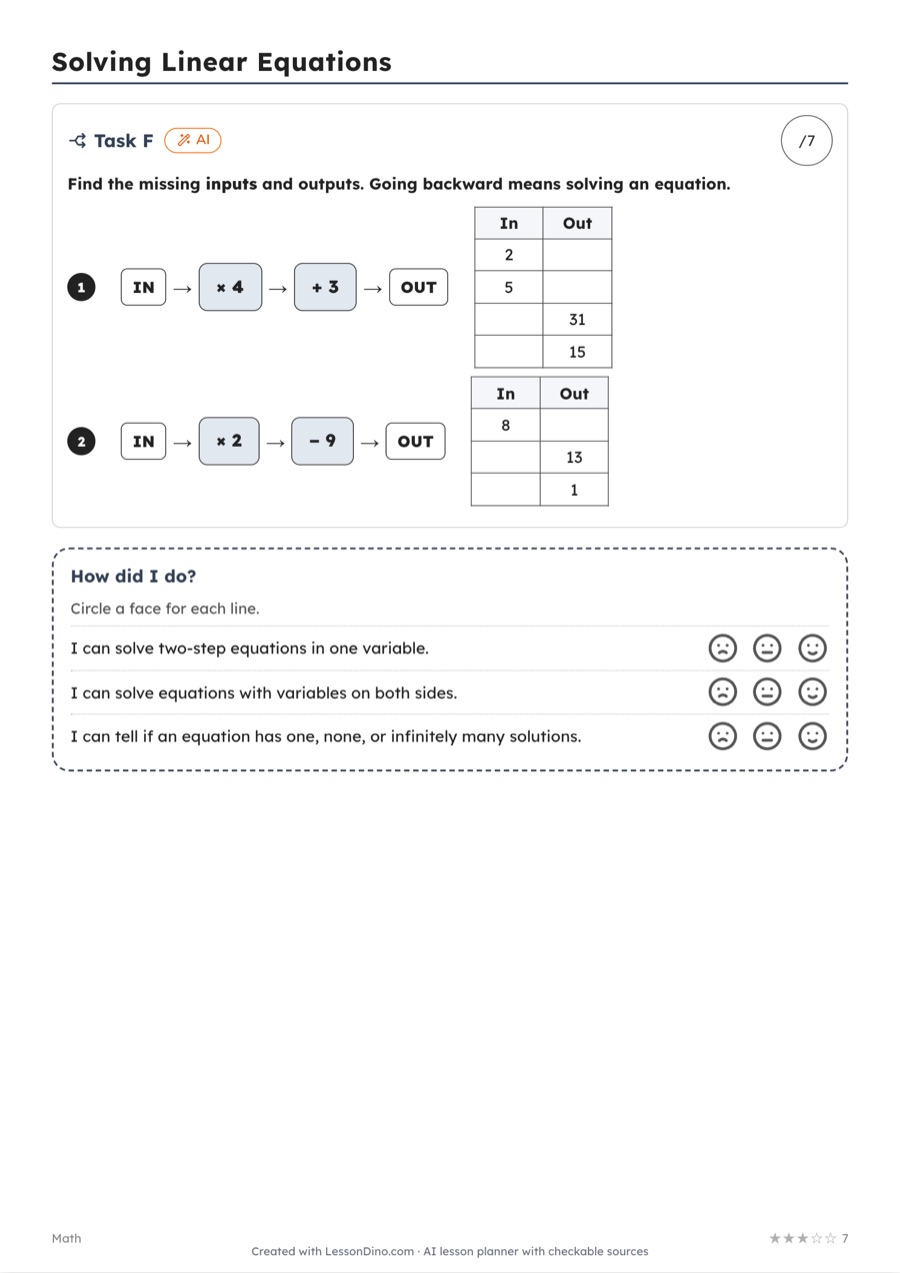
Find the missing inputs and outputs. Going backward means solving an equation.
Answers
Show the answers
- Solve x + 9 = 18. x = 9
- Solve x - 6 = 11. x = 17
- Solve 6x = 42. x = 7
- Solve x/5 = 7. x = 35
- Solve 2x + 7 = 19. x = 6
- Solve 5x - 4 = 31. x = 7
- Solve 3(x + 4) = 27. x = 5
- Solve x/4 + 3 = 8. x = 20
- A student buys 4 packs of pencils at the same price plus a $3 eraser for $23 in all. Let p be the price in dollars of one pack. Solve 4p + 3 = 23. p = 5
- A club charges $9 per visit plus a $12 yearly fee. A student pays $75 in all. Let v be the number of visits. Solve 9v + 12 = 75. v = 7
- Solve 10 - 2x = 4. Explain how you checked your solution. x = 3
- A rectangle is 8 in wide and x in long. Its perimeter is 44 in, so 2x + 16 = 44. Solve for x. x = 14
- Solve 6x + 4 = 4x + 12. x = 4
- Solve 8x - 5 = 7x + 4. x = 9
- Solve 3(x + 2) = x + 10. x = 2
- Solve 5(x - 2) = 3(x + 2). x = 8
- Solve (2/3)x + 5 = 13. x = 12
- Solve 2.5x - 3 = 17. x = 8
- Solve 5(x - 3) = 3(x + 1). x = 9
- Solve 7x + 2 = 4x + 17. x = 5
- One club charges $15 plus $5 per week. Another charges $10 plus $6 per week. After w weeks the costs are equal, so 15 + 5w = 10 + 6w. Solve for w in weeks. w = 5
- A frame needs 54 in of trim. It is 10 in wide and x in long, so 2x + 20 = 54. Solve for x. x = 17
- Solve 2x + 7 = 2x + 12. Explain how you know there is no solution. no solution
- Solve 3(x + 4) = 3x + 12. Explain how you know about the solutions. infinitely many solutions
The answer sheet is the last picture above.
Curriculum
Solve linear equations in one variable.
Made with Lesson Dino's AI on 16 October 2026. AI can make mistakes, so check the answers and facts against the sources before you teach.