Slides
Lesson plan
Acids, Alkalis and Indicators Rainbow
Pupils learn how neutralisation, the pH scale and indicators link together. They test clear liquids with universal indicator to make a pH rainbow.
Objectives
- Students will describe neutralisation as acid plus alkali making salt and water.
- Students will use the pH scale to classify solutions as acidic, neutral or alkaline.
- Students will predict and test indicator colours in acids, alkalis and neutral solutions.
Success criteria
- I can name the products made when an acid and alkali neutralise.
- I can order solutions by pH as acid, neutral or alkali.
- I can state what litmus and universal indicator show in acids and alkalis.
Key words
| Word | Meaning |
|---|---|
| acid | a liquid or dissolved chemical with a pH below 7, such as vinegar |
| alkali | a chemical that dissolves in water and can cancel out an acid, with pH above 7 |
| neutralisation | mixing just the right amounts of acid and alkali to make a neutral liquid of salt and water |
| pH scale | a number line from strongly acidic to strongly alkaline used to show how acidic a liquid is |
| indicator | a dye that changes colour in acids or alkalis because a chemical reaction happens |
Timed plan (60 minutes)
| Time | Stage | What happens |
|---|---|---|
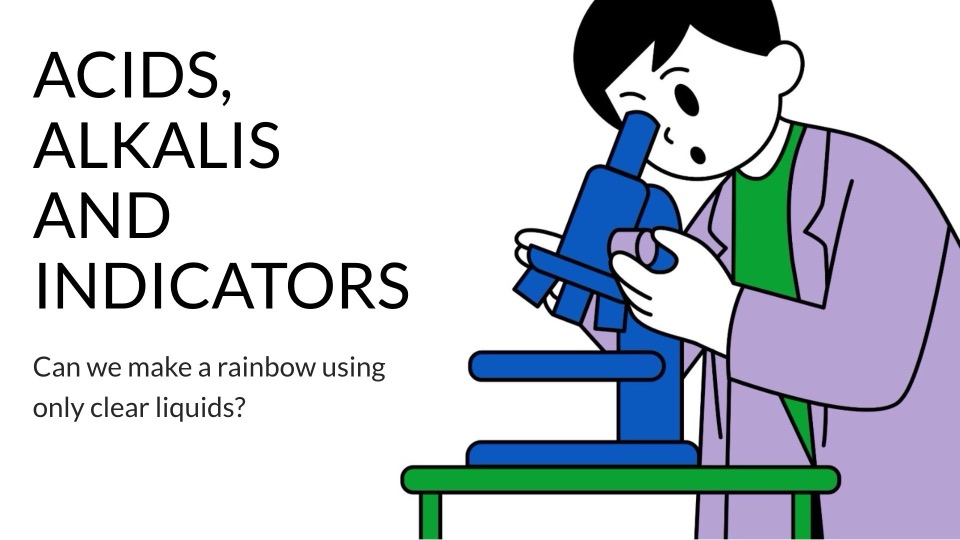
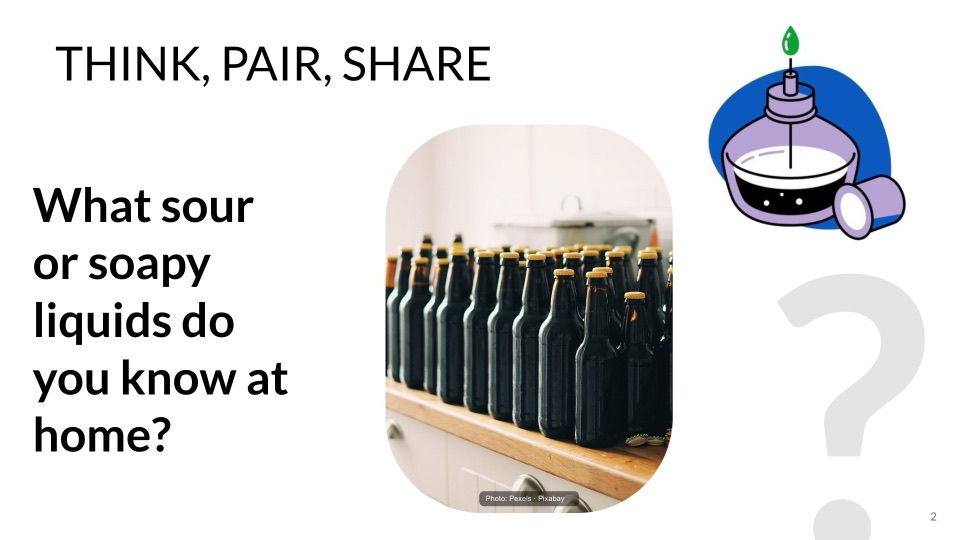
| 5 min | Starter | Link home ideas about sour and soapy liquids to the rainbow question. Show Slide 1 Acids, Alkalis and Indicators and read its question about making a rainbow using only clear liquids. Show Slide 2 Think, pair, share and ask what sour or soapy liquids pupils know at home. Give one minute of pair talk, then take two sour and two soapy ideas without confirming acid or alkali yet. Link answers to the lesson: we will test and order them by pH and indicator colour. |
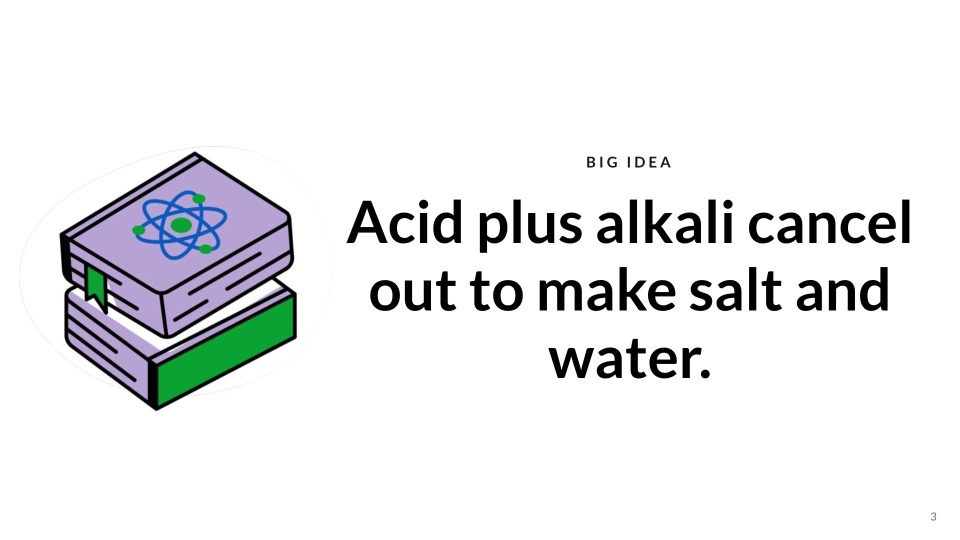
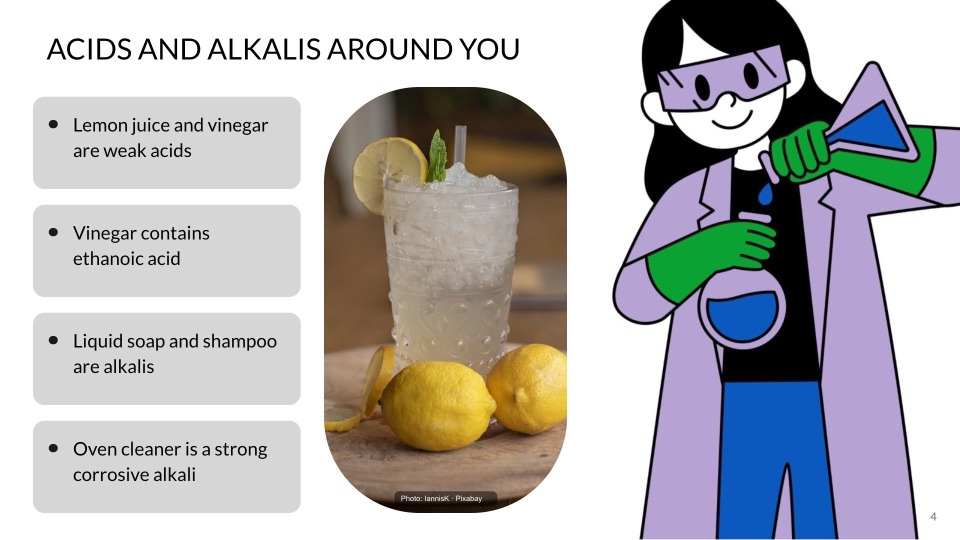
| 12 min | Teaching | Explain acids, alkalis and neutralisation and model the word equation. Show Slide 3 Big idea and explain that acid plus alkali cancel out to make salt and water. Model the example sodium hydroxide + hydrochloric acid -> sodium chloride + water, then show the general pattern acid + alkali -> salt + water. Show Slide 4 Acids and alkalis around you and link vinegar with ethanoic acid and soap and shampoo with alkalis with pH higher than 7. Define the pH rules: acids have pH lower than 7, pure water is neutral at pH 7, and alkalis have pH higher than 7. |
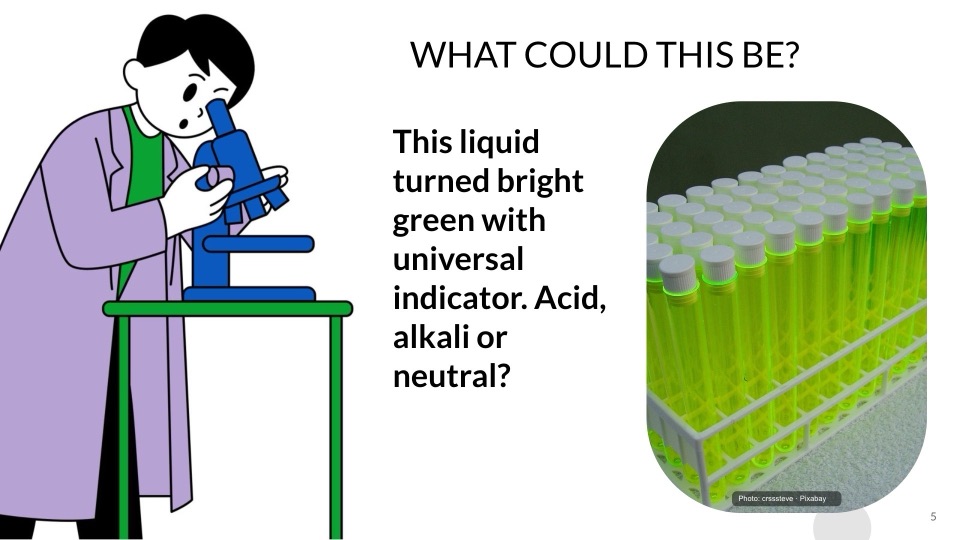
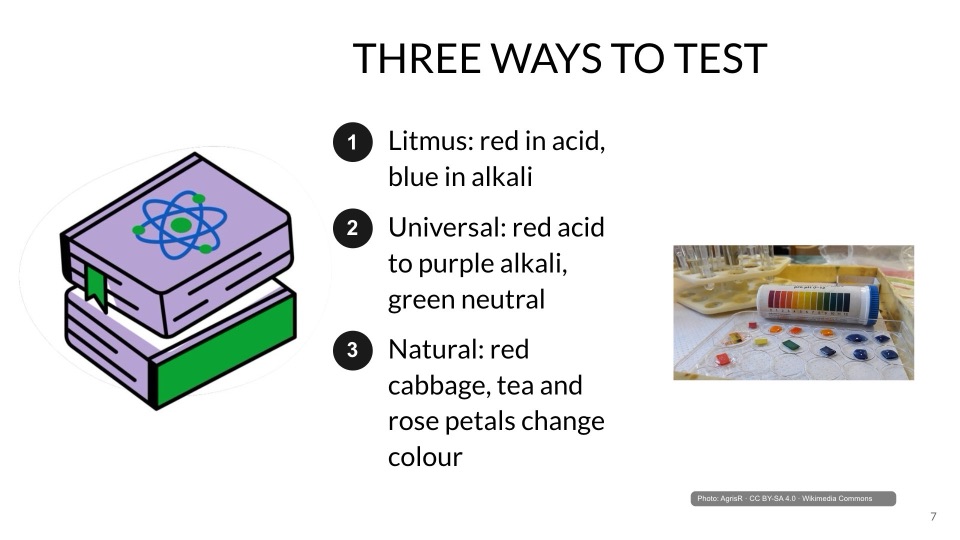
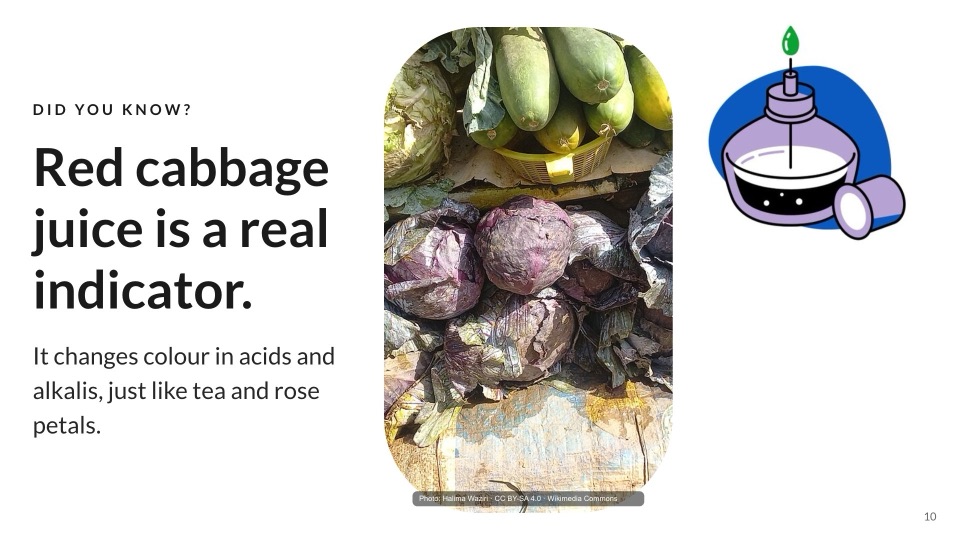
| 10 min | Teaching | Teach litmus, universal and natural indicator colours for the practical. Show Slide 5 mystery liquid that turned bright green with universal indicator and confirm neutral pH 7 like pure water. Show Slide 7 Three ways to test and teach litmus, universal and natural indicators side by side. Model litmus table: red litmus stays red in acid and turns blue in alkali, blue litmus turns red in acid and stays blue in alkali, with purple for neutral solution. Model universal range from red for strongly acidic to dark purple for strongly alkaline, with green for neutral pH 7, and note red cabbage, tea and rose petals also change colour. |
| 23 min | Main Activity | Use universal indicator to order everyday solutions from acidic to alkaline. Show Slide 9 Your task and read the steps: predict acid or alkali, add a few drops of universal indicator, record colour, match pH chart, decide acid, alkali or neutral. Demonstrate safety and method with water: goggles on, few drops only, do not taste, wash hands after soap and shampoo solutions. Circulate as pairs test dilute vinegar, lemon juice, tap water, liquid soap solution and shampoo solution. Stop class at 18 minutes to line tubes up red-orange to green to blue-purple and check order from most acidic to most alkaline. |
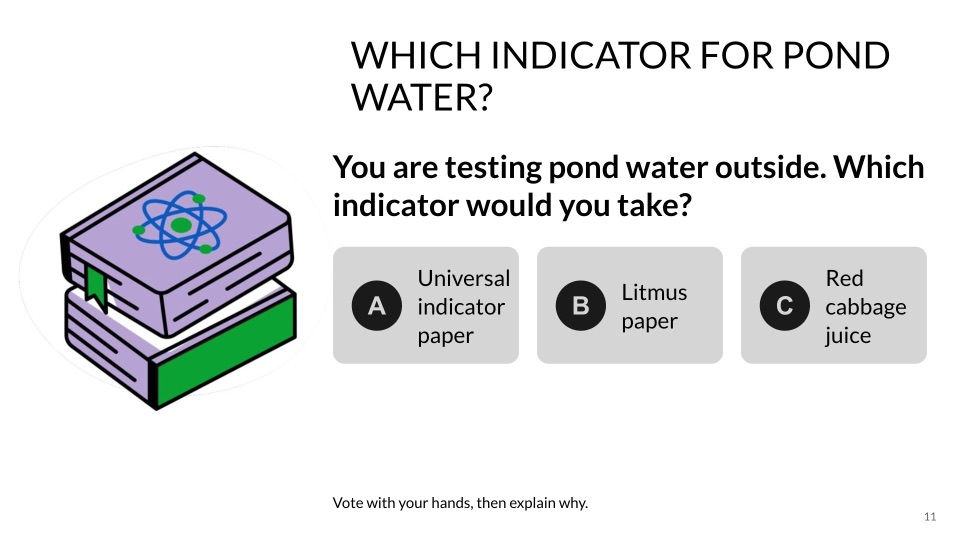
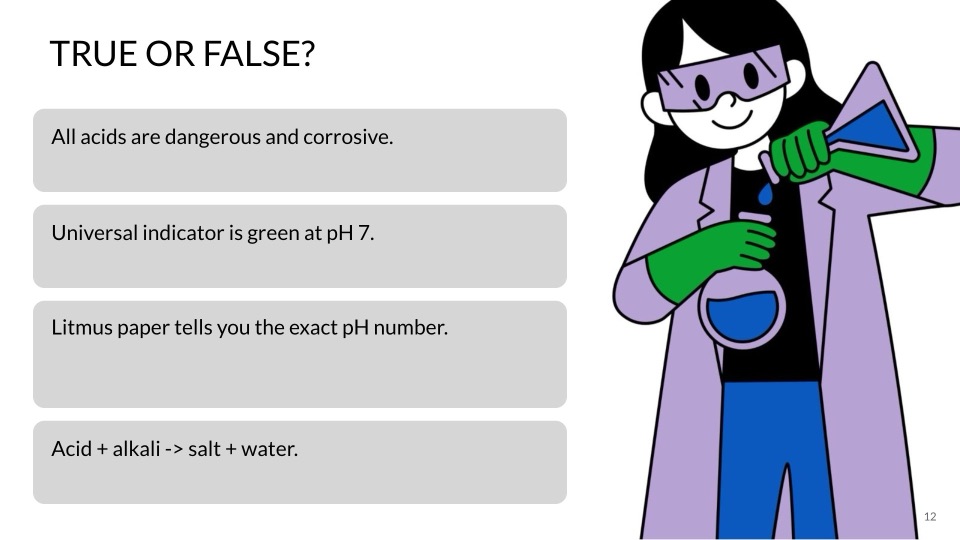
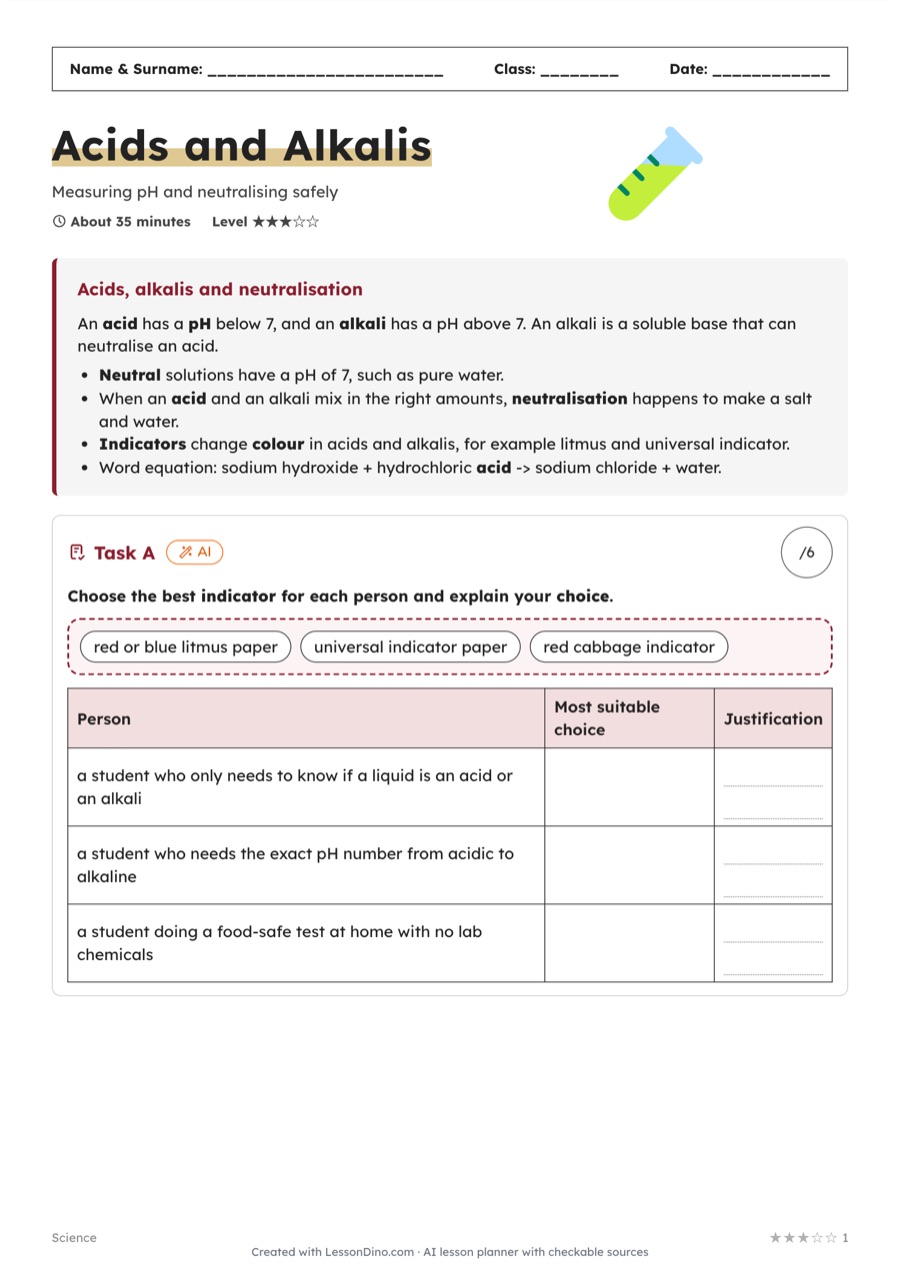
| 10 min | Plenary | Check which indicator to use and correct ideas about acid danger and pH. Show Slide 11 Which indicator for pond water and run a vote: universal indicator paper, litmus paper or red cabbage juice. Confirm universal paper is best for a pH number outside, litmus only tells acid or alkali, cabbage juice is a real indicator but messy to carry. Show Slide 12 True or false and use Worksheet Task G Spot the mistake for pupils to fix the same ideas in writing. Collect exit answers on whiteboards before pack-away. |
Common mistakes
- All acids are dangerous and corrosive.
How to spot it: Pupils mark true on Slide 12 or Task G and avoid testing vinegar.
Show that weak acids like vinegar are safe to handle, while only strong concentrated acids are corrosive and labelled. - Green with universal indicator means acidic.
How to spot it: Pupils label tap water tube as acid despite green colour.
Point to chart: universal is green at neutral pH 7 like pure water, red is strongly acidic and dark purple is strongly alkaline. - Litmus gives a pH number.
How to spot it: Pupils say red litmus shows pH 1 or blue litmus shows pH 13.
Recall litmus only turns red in acid and blue in alkali, with purple neutral; use universal indicator for pH numbers and range of colours.
Support
- Provide a large colour chart that shows green means neutral pH 7 and red means strongly acidic
- Give worked first row, pre-labelled tiles and half-written word equation with word bank
Stretch
- Ask pupils to predict what would happen to the pH and colour if an acidic sample was diluted with pure water
- Challenge pupils to predict the salt name for a different acid and alkali pair and justify choice of indicator for pond water
Check questions
- Acid plus alkali are mixed in just the right amounts. What is made?
Answer: A salt and water, leaving a neutral solution. - Solution A is pH 2 and solution B is pH 7. Which is acidic and which is neutral?
Answer: A is acidic with pH lower than 7 and B is neutral like pure water. - How do litmus and universal indicator differ in what they tell you?
Answer: Litmus turns red in acid and blue in alkali, while universal gives many colours and a pH number with green at pH 7.
Curriculum
defining acids and alkalis in terms of neutralisation reactions; the pH scale for measuring acidity/alkalinity; and indicators
Video clips
Clips on YouTube, from the start and end times we chose. Check each one before you show it.
-
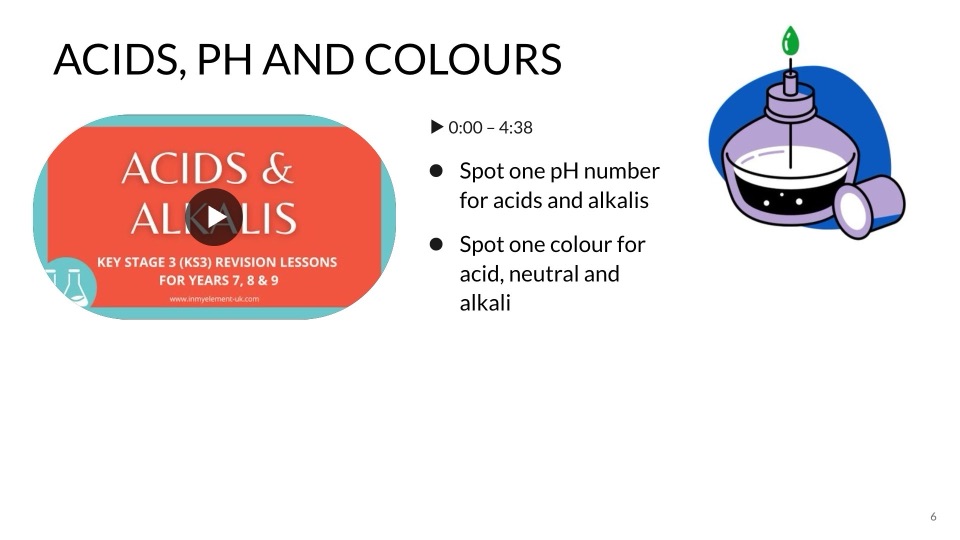
Acids, alkalis, pH and indicators overview from 0:00 to 4:38
In My Element UK: Acids & Alkalis (the Differences, pH Scale, Indicators) - Chemistry Revision (Years 7, 8 & 9)
Made for Years 7, 8 and 9 and covers all three lesson aims in Year 8 language and pace.
-
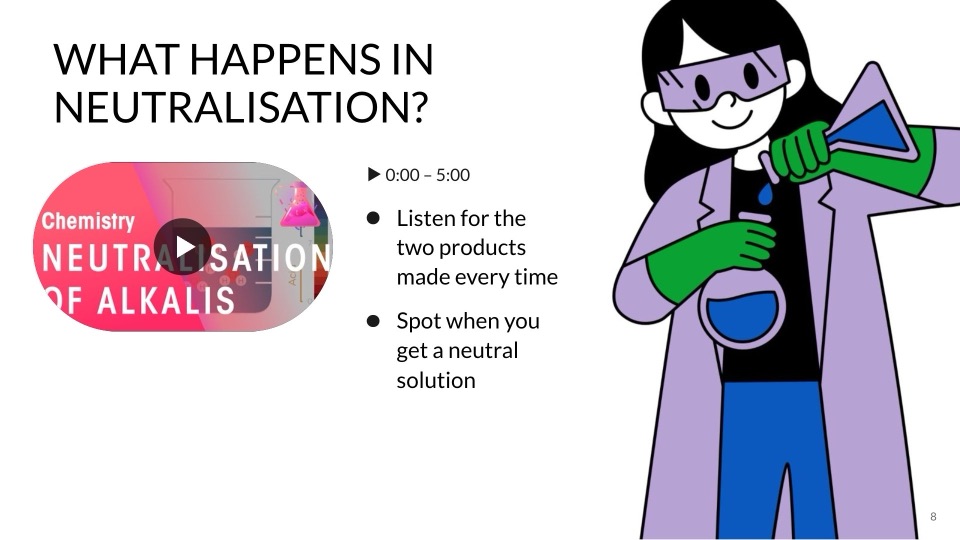
Neutralisation of alkalis from 0:00 to 5:00
FuseSchool - Global Education: Neutralisation of Alkalis | Acids, Bases & Alkali's | Chemistry | FuseSchool
Clear explanation of neutralisation at the right level for 12-13-year-olds with simple models.
Worksheet
Sources
- SCIENCE Curriculum Bklt Yr 8 2023 24 cirencesterkingshill.gloucs.sch.uk
- Yr8 Science Curriculum christscollege.surrey.sch.uk
- Acids and Alkalis westcoventry.atlp.org.uk
- Science Y8 Acids and Alkalis KO turton.uk.com
- Alkali metal Wikipedia
- Benzoic acid Wikipedia
- Sulfuric acid Wikipedia
Picture credits
Made with Lesson Dino's AI on 17 October 2026. AI can make mistakes, so check facts against the sources before you teach.