Slides
Lesson plan
More, Less, Same Groups
Students learn to tell if one group has more, less, or the same as another. They build groups, match one to one, and count to check.
Objectives
- Students will compare two groups up to 10 as greater than, less than, or equal.
- Students will use matching one to one and counting to compare two groups.
Success criteria
- I can say which group has more, less, or if they are the same.
- I can match objects one to one to see extra leftovers.
- I can count both groups to check my comparison.
Key words
| Word | Meaning |
|---|---|
| more | a bigger amount of things |
| less | a smaller amount of things |
| same | having an equal amount on both sides |
| match | putting one thing next to one other thing to pair them |
| count | saying numbers in order to find how many there are |
Timed plan (60 minutes)
| Time | Stage | What happens |
|---|---|---|
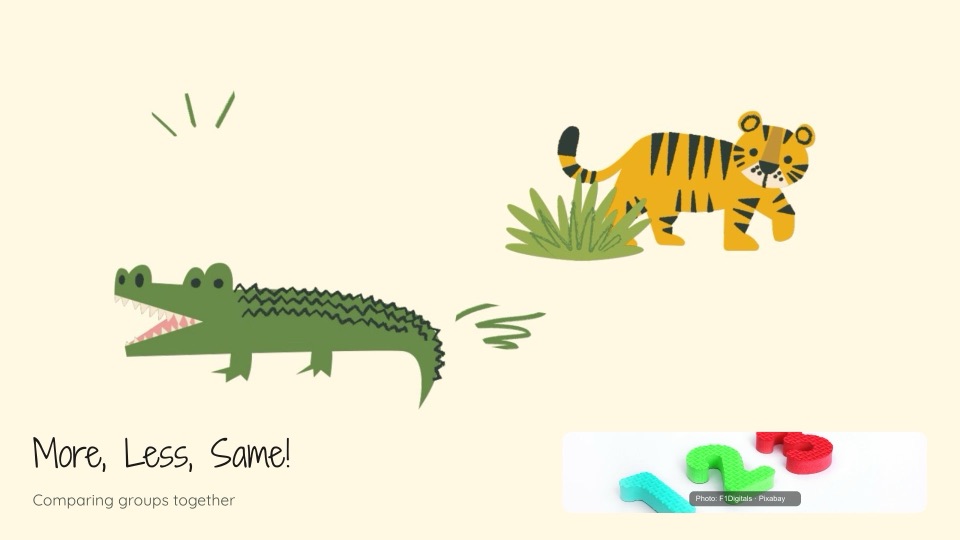
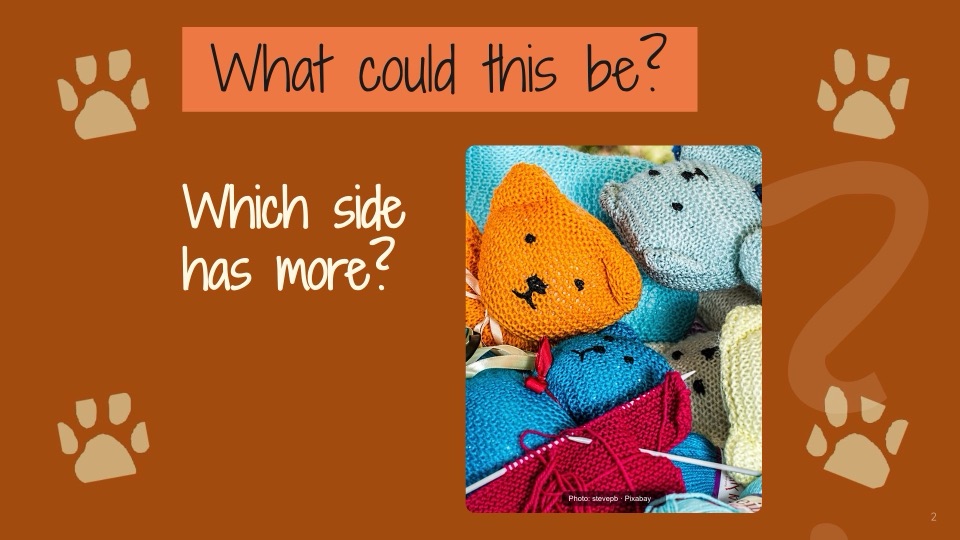
| 8 min | Starter | Hook students with mixed trays and review counting before comparing. Show Slide 1: More, Less, Same! Comparing groups together, then Slide 2 mystery: Which side has more? Match one to one to see! Hold up two trays and say hook: Oh no, my two trays of blocks got mixed! Which tray has more, which has less, or are they the same? Let students look only and vote with thumbs: left side, right side, or flat hands for same. Lead quick count to 6 together while touching blocks to check prior counting. |
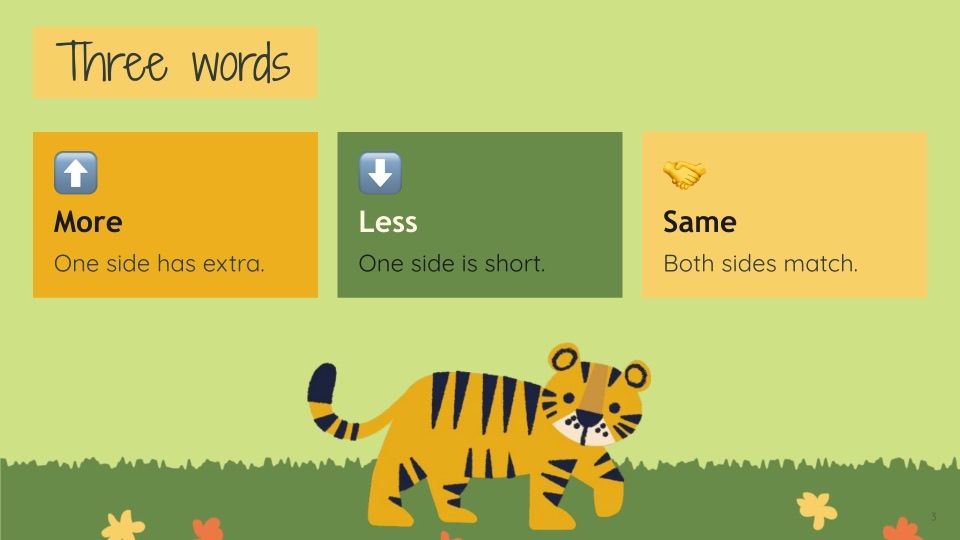
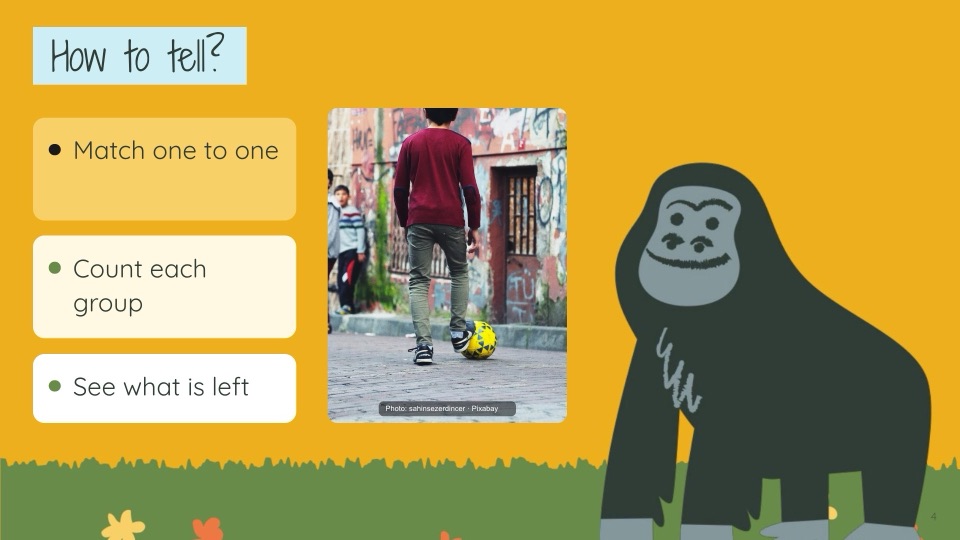
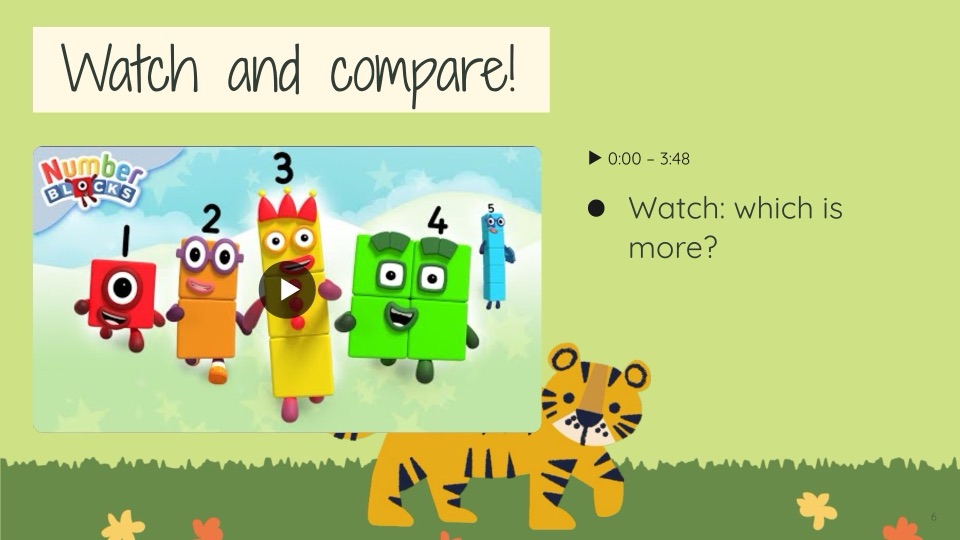
| 12 min | Teaching | Model matching one to one and counting to tell more, less, or same. Show Slide 3 Three words cards and teach actions: More - One side has extra, Less - One side is short, Same - Both sides match. Show Slide 4 How to tell? Match one to one, Count each group, See what is left, and model 5 red and 3 yellow counters in two rows. Show Slide 5 You vote! How do you like to compare? and take quick hands vote for Match them up or Count them. Play Slide 6 Video clip 1 Compare 1 to 5 (0:00–3:48) with prompt Watch: which is more? Pause and restate: the group with objects left over has more. |
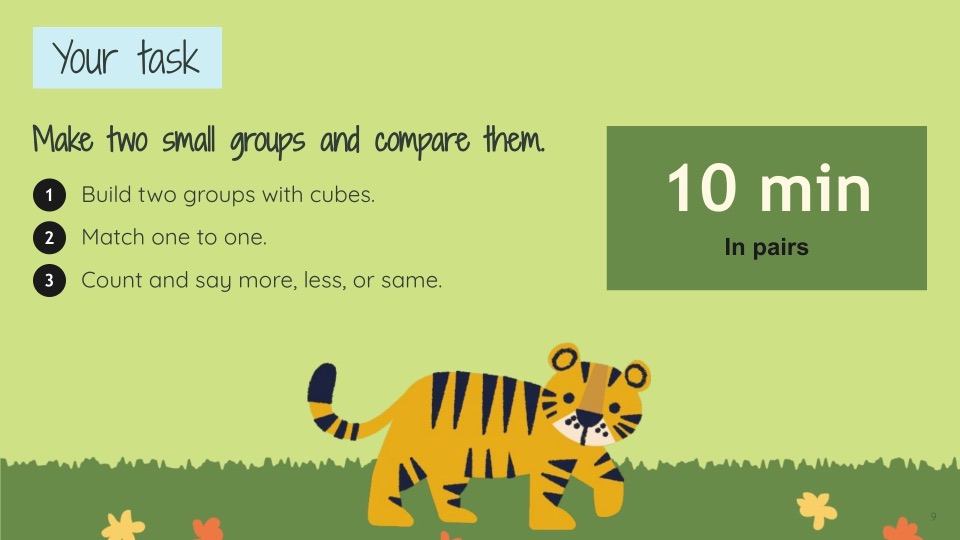
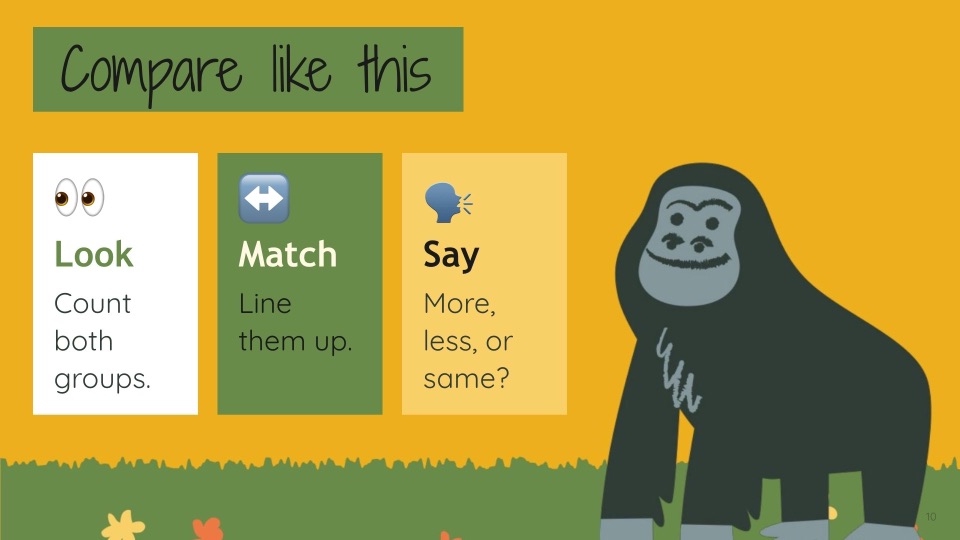
| 25 min | Main activity | Pairs build two small groups and compare by matching and counting. Show Slide 9 Your task: Build two groups with cubes. Match one to one. Count and say more, less, or same. Make two small groups and compare them. Show Slide 10 Compare like this: Look, Count both groups, Match, Line them up, Say, More, less, or same? and model one round with Student A and Student B roles. Send pairs to trays to make two short rows with 1 to 6 counters each, then match by pushing one from each group together. Circulate, ask pairs to point to leftovers and say This side has more than that side or They are the same. |
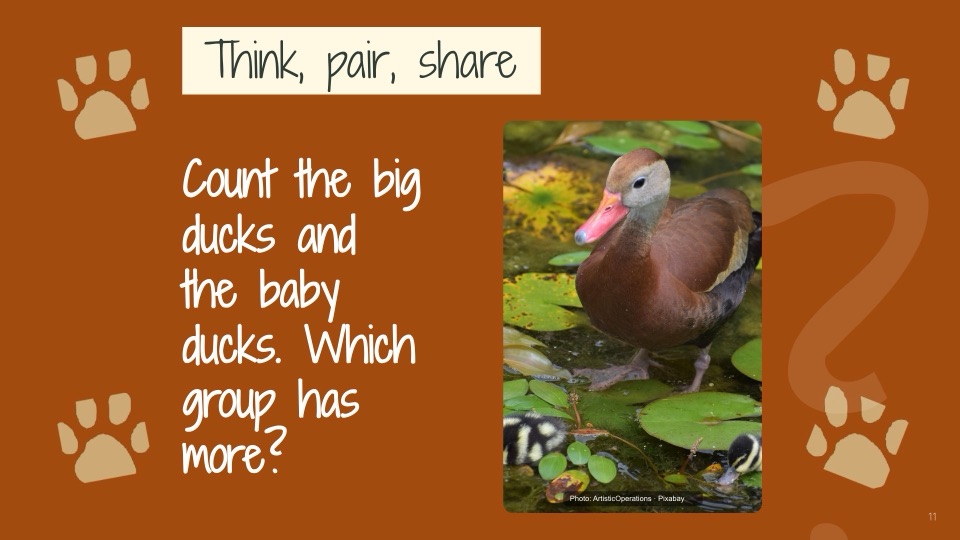
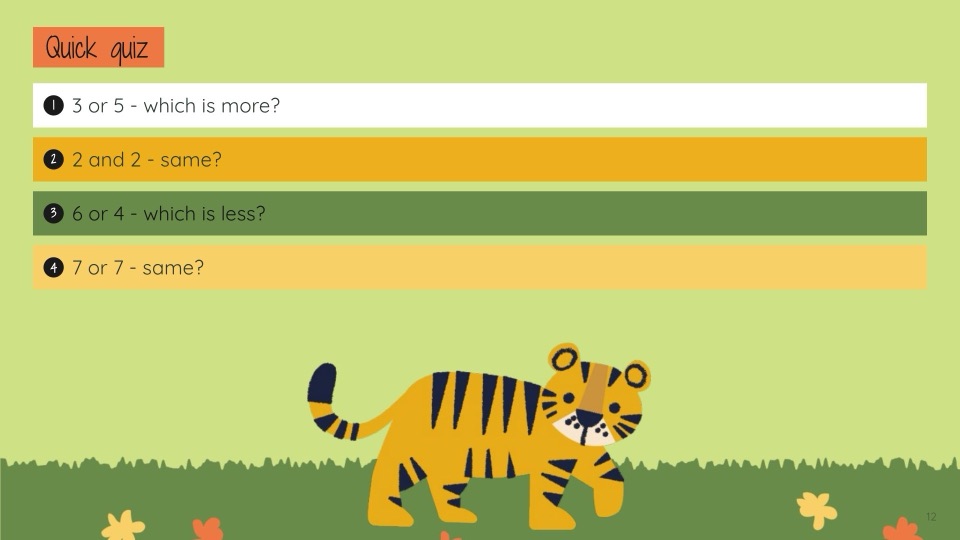
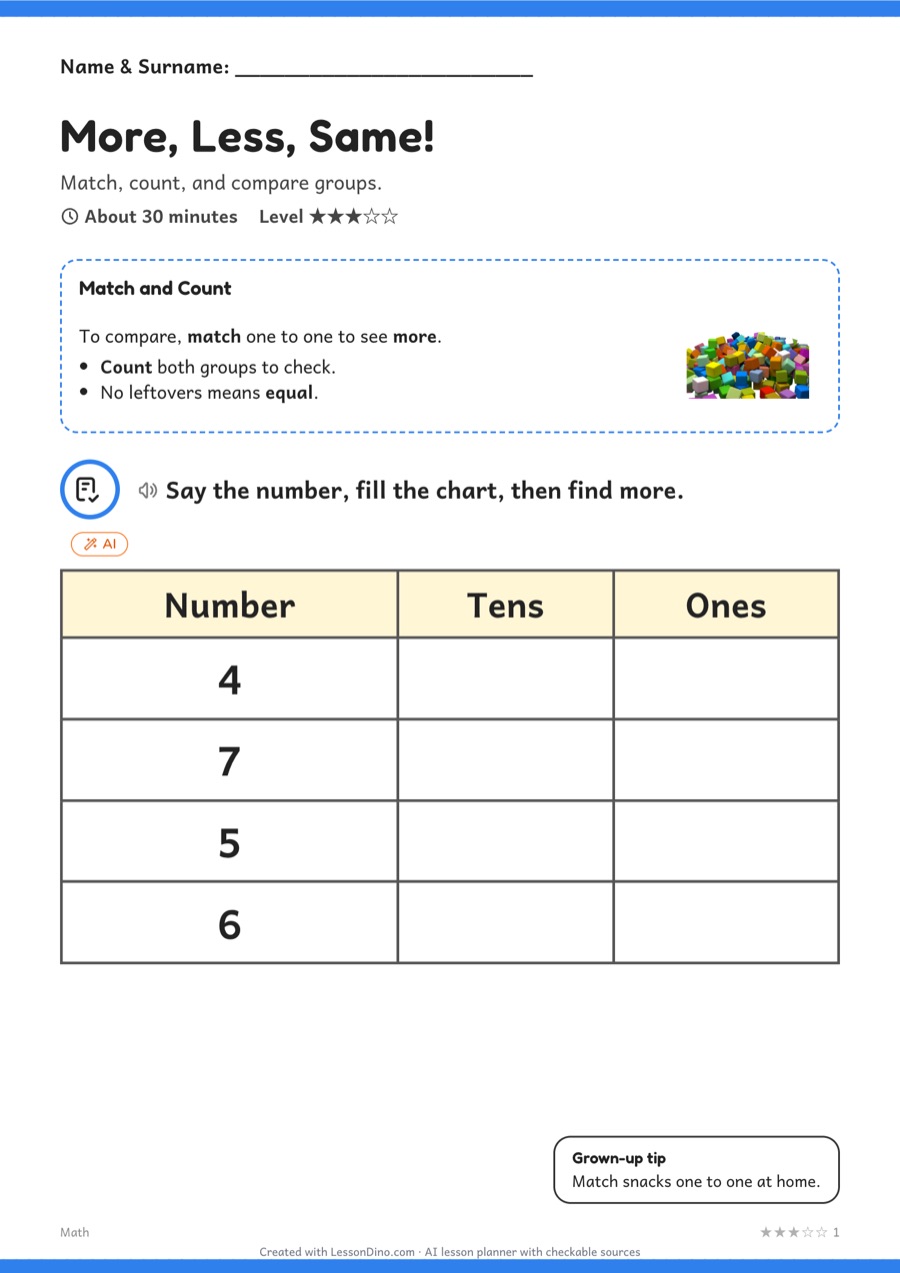
| 15 min | Plenary | Check comparing with shared question, quick quiz, and ten-frame sheet. Show Slide 11 Think, pair, share: Count the big ducks and the baby ducks. Which group has more? Model matching 4 to 5 in the air one to one. Show Slide 12 Quick quiz and read each: 3 or 5 - which is more? 2 and 2 - same? 6 or 4 - which is less? 7 or 7 - same? Hand out Worksheet page 4 Ten frames: Count the dots and tell which has more. Students circle or point to the side with more and say the sentence. Close by restating goal: we compared by matching and counting to say greater than, less than, or equal. |
Common mistakes
- Thinks a longer spread-out row has more even with same number
How to spot it: Says 5 spread out is more than 5 pushed together
Line up one to one in two straight rows to show each has a partner and they are the same. - Only looks without counting and mixes up less and more words
How to spot it: Points to bigger group but says less
Practice sentence frames with actions: more than means extra left, fewer than means short, same as means all matched. - Counts without one-to-one touch and gets wrong total
How to spot it: Skips or recounts counters when counting fast
Touch and move each counter once while saying numbers in order, then count again to check.
Support
- Start with obviously different-sized collections like 2 and 6 and use the words more than, fewer than, and same as.
Stretch
- Count both groups and tell how many extra are left unmatched.
Check questions
- You have 3 counters and your partner has 5 counters. Which group has more?
Answer: The 5 group has more than the 3 group. - You have 2 blocks and your partner has 2 blocks. Are they the same?
Answer: Yes, they are the same, 2 equals 2. - You have 6 dots and your partner has 4 dots. Which group has less?
Answer: The 4 group has less than the 6 group.
Curriculum
Identify whether the number of objects in one group is greater than, less than, or equal to the number of objects in another group, e.g., by using matching and counting strategies.
Video clips
Clips on YouTube, from the start and end times we chose. Check each one before you show it.
-
Compare 1 to 5 from 0:00 to 3:48
Numberblocks: @Numberblocks | Maths Comparison Skills | Let's compare numbers One to Five!
Uses Numberblocks with very small groups and slow counting that is perfect for 5-6-year-olds learning greater than, less than, and equal.
-
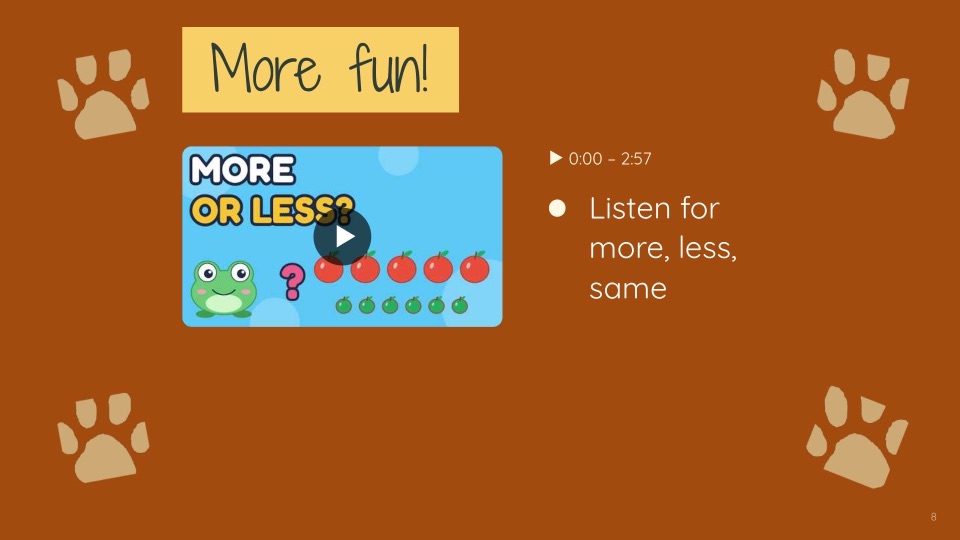
More, Less, or Same from 0:00 to 2:57
Math Pond: More, Less, or the Same? | Comparing Numbers with Pip | Math for Kids
Uses simple more, less, and same language with small groups that matches kindergarten 5-6-year-olds and your matching goal.
Worksheet
Sources
- Standards for Mathematical Practice thecorestandards.org
- Kindergarten Math Curriculum boepublic.parkhill.k12.mo.us
- Comparing Numbers and Fruit—More or Less - University of Oklahoma learn.k20center.ou.edu
- K20 LEARN | Comparing Numbers and Fruit—More or Less learn.k20center.ou.edu
- Math Stories for Comparing and Labeling Magnitudes ies.ed.gov
- 25 Comparing Numbers Worksheets to Try | Endolab Worksheets endolab.ucdavis.edu
- Math: Counting & Comparing - Yale Dyslexia dyslexia.yale.edu
- Comparing numbers with two digits - KS1 Maths - Learning with ... bbc.co.uk
- How to compare numbers | comparing numbers | reception maths - BBC Bitesize bbc.co.uk
- Numbers and Number Systems - Kids | Britannica Kids | Homework Help kids.britannica.com
- What are Comparing Numbers - Definition, Examples, Facts splashlearn.com
- Comparing Numbers (More, Less, Equal) Explained for Kids: Story, Facts ... mystorypie.com
- How to compare numbers - Mathify Kids mathifykids.com
- Comparing Numbers - Math Salamanders math-salamanders.com
- Comparing Numbers | Math Concepts for Kids kidsworldfun.com
- Comparing Numbers - GeeksforGeeks geeksforgeeks.org
- Comparing Numbers1 cdnend.americanhighschool.org
Picture credits
Made with Lesson Dino's AI on 17 October 2026. AI can make mistakes, so check facts against the sources before you teach.