Slides
Lesson plan
Join and Take Away Stories to 10
Students solve joining and take-away stories within 10. They act stories out, then show them with cubes and drawings.
Objectives
- Students will solve joining stories within 10 with objects and drawings.
- Students will solve take-away stories within 10 with objects and drawings.
- Students will write addition and subtraction sentences to show stories.
Success criteria
- I can join groups and count all to solve stories to 10.
- I can take some away and count what is left.
- I can draw dots and say the number sentence.
Key words
| Word | Meaning |
|---|---|
| add | join groups to find how many in all |
| put together | join groups to make one whole group |
| take away | move some things off so fewer stay |
| plus | sign that shows groups join |
| equal | same amount on both sides |
Timed plan (60 minutes)
| Time | Stage | What happens |
|---|---|---|
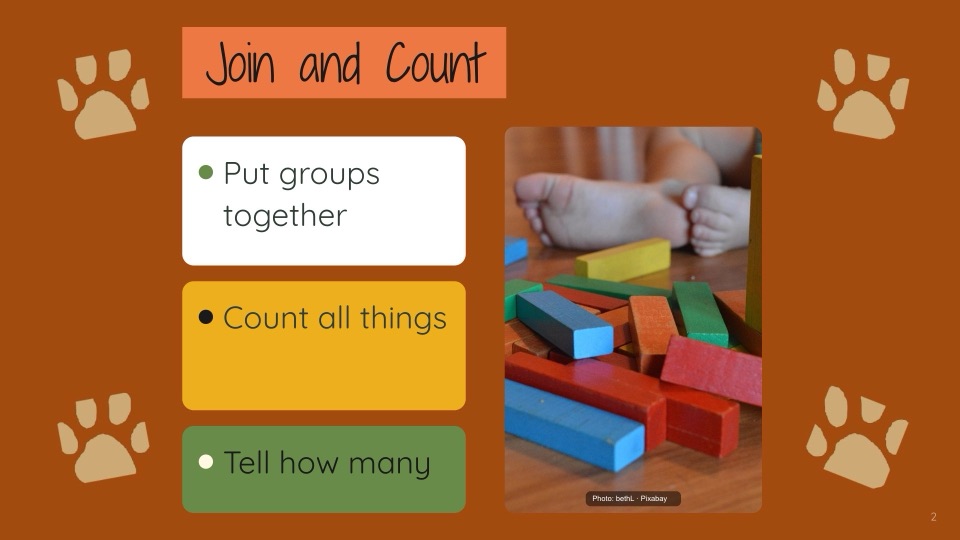
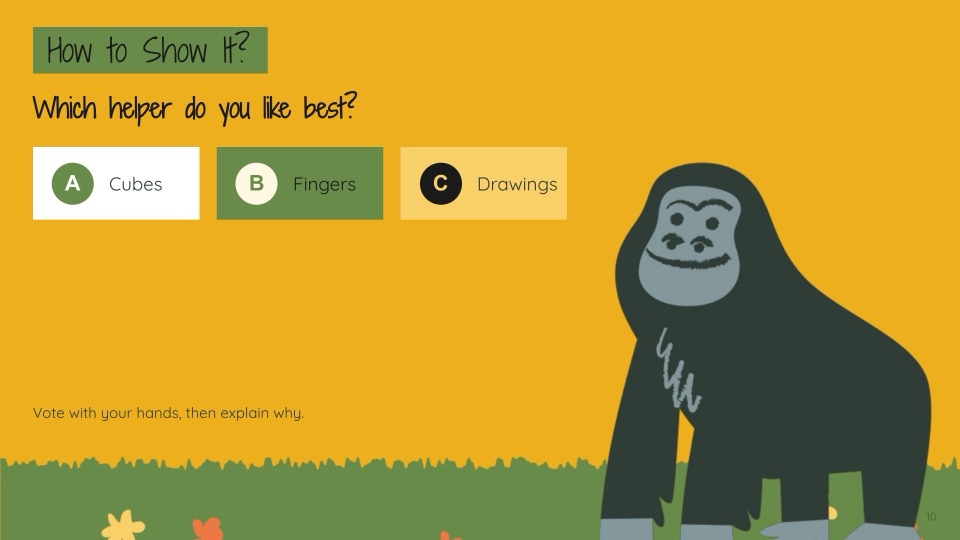
| 5 min | Starter | Wake up joining and counting language to get ready for story problems. Show Slide 1: Let's Add to 10! Join, count, and tell. Show Slide 2 and model: put 3 soft blocks out, then 2 more. Count all together with the class from 1 to 5. Invite the class to show 5 with fingers and say the total. |
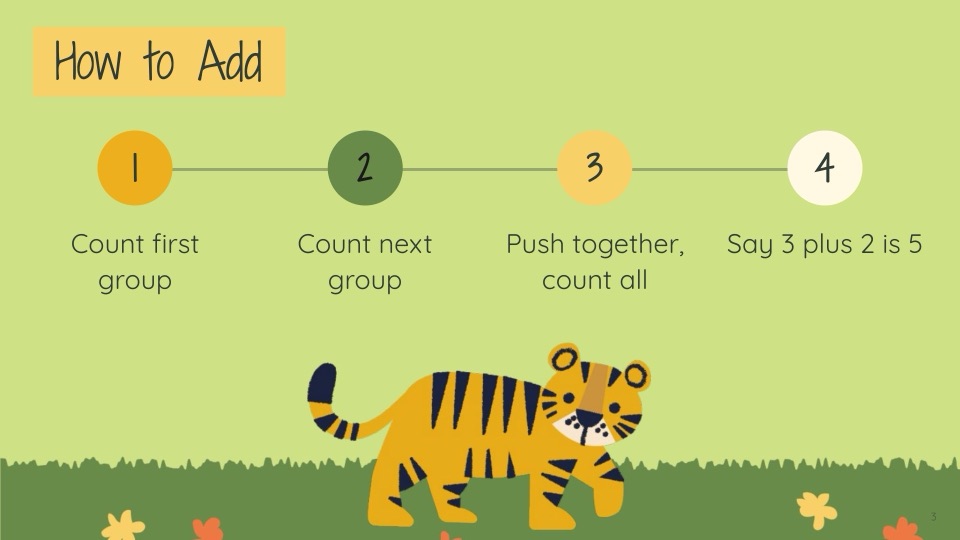
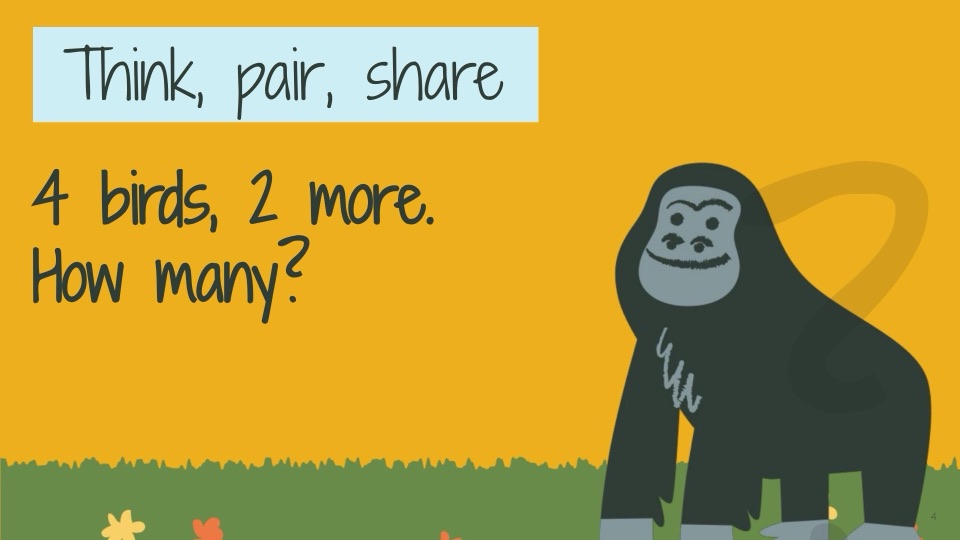
| 10 min | Teaching | Model how to show joining and taking away with objects and a number sentence. Show Slide 3 steps and model with cubes: Count first group, count next group, push together, count all. Write 3 + 2 = 5 and read it using the exact slide words: Say 3 plus 2 is 5. Show Slide 4 question: 4 birds, 2 more. How many? Build 4 cubes and 2 cubes. Push together, count all to 6, and write 4 + 2 = 6. Joining parts to make a whole is one way to think about addition. |
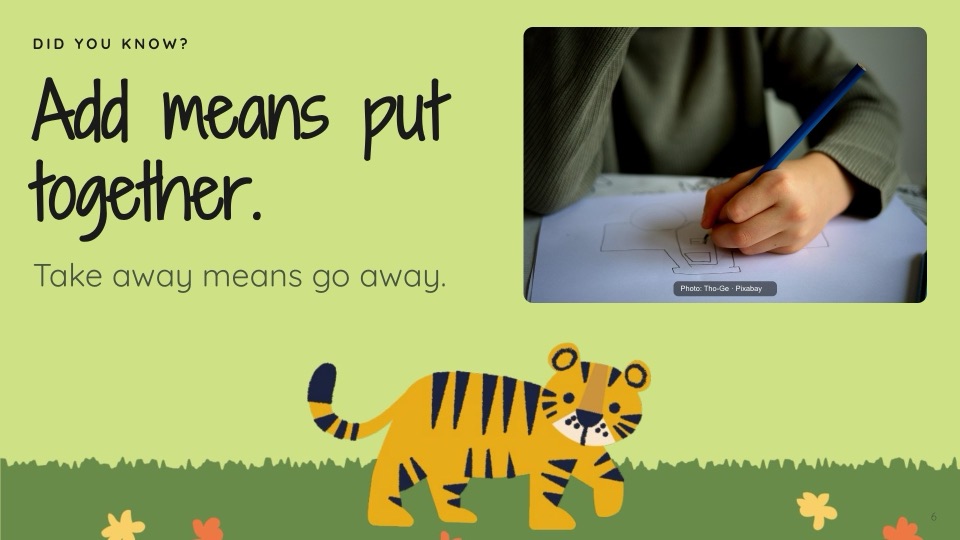
| 20 min | Main Activity | Solve joining and taking-away stories within 10 by acting them out. Bring 4 students to stand together, then call 2 more to join. Ask the class for the total. Write the sentence, explaining joining groups can be shown in an addition expression that uses the plus sign (+). Tell a take-away part: 2 students step away. Ask what is left and write 6 - 2 = 4, explaining taking part of a group away is one way to think about subtraction. Repeat with new stories within 10, like 5 and 3, then 8 take away 3. Show Slide 6 fact: Add means put together. Take away means go away. |
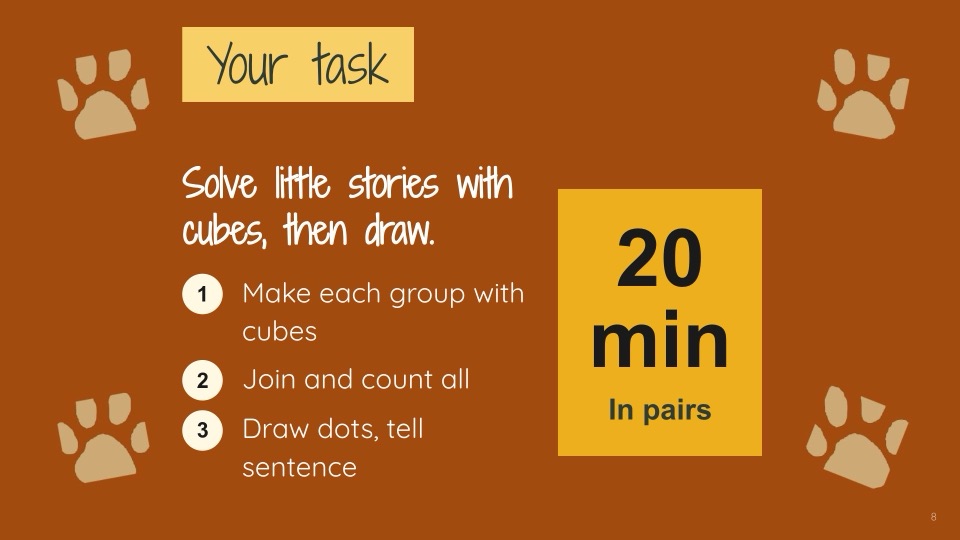
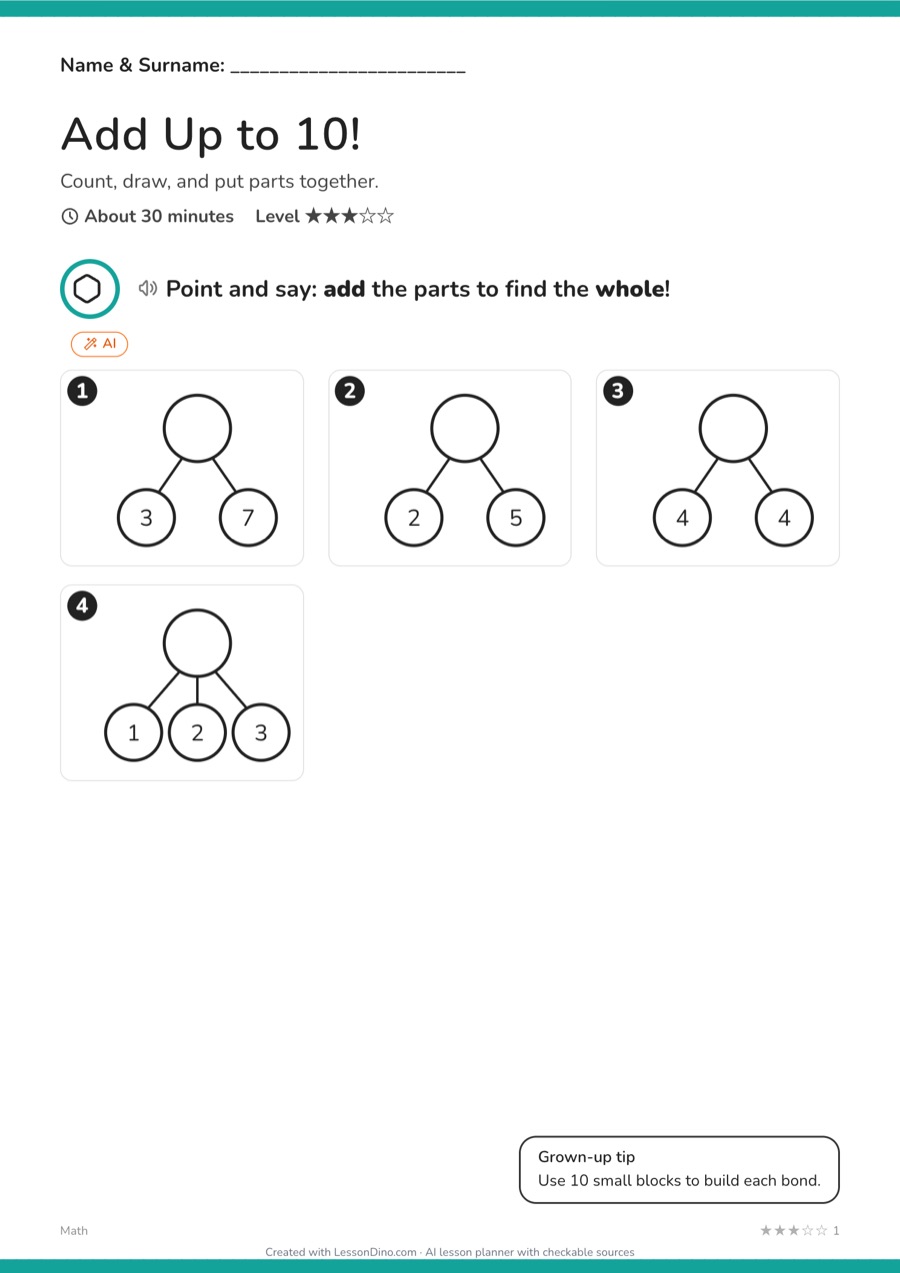
| 15 min | Pair Practice | Show adding and subtracting stories with cubes, drawings, and sentences. Show Slide 8 task and give each pair cubes, paper, and crayons. Read a story: 5 cubes, 1 is taken away. Model moving cubes, then drawing dots. Send pairs to build it, join or take away, draw dots, and tell the sentence. Addition number sentences using + and = can be used to show parts of a whole. Circulate, help write sentences, and ask partners to read pages to each other. |
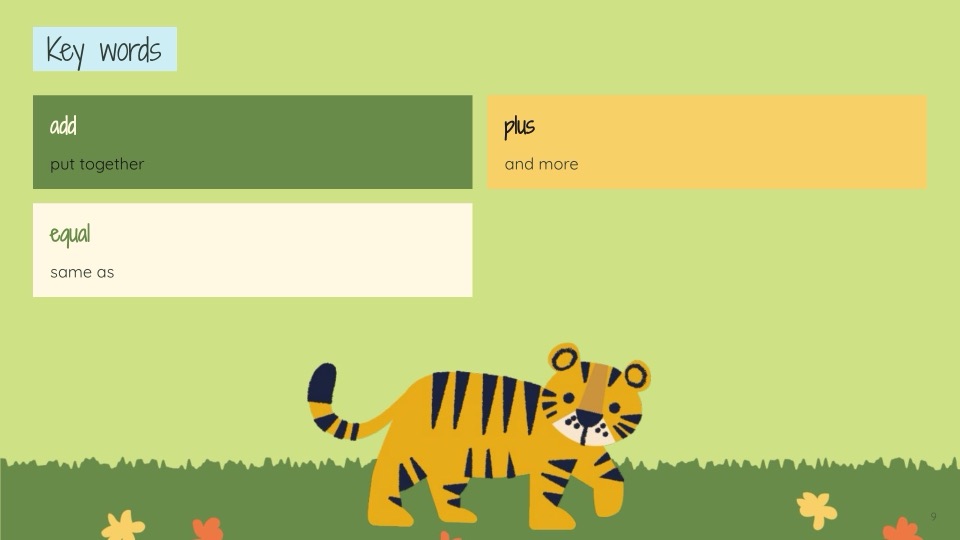
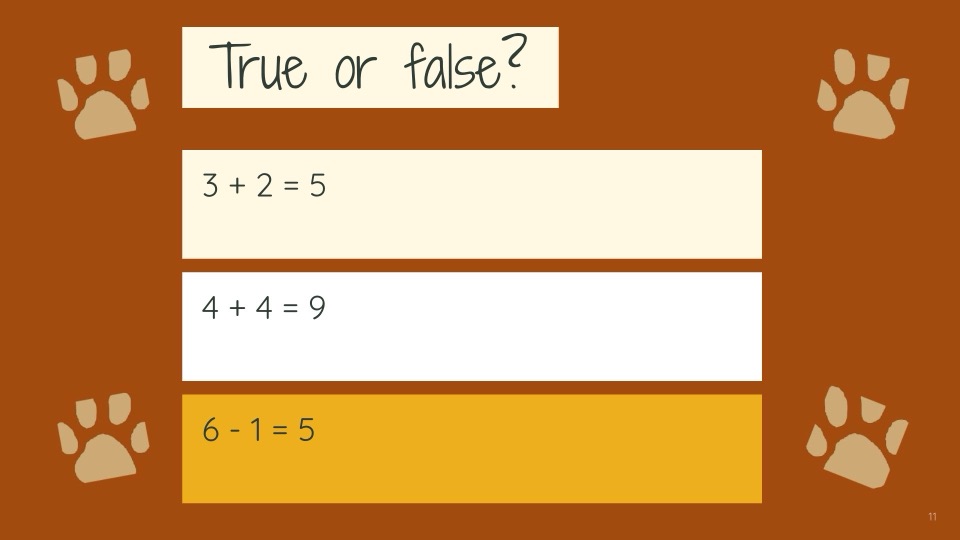
| 10 min | Plenary | Check true and false sentences and confirm adding and taking away to 10. Show Slide 9 key words: add, put together, plus, and more, equal, same as, and add take away. Show Slide 11: 3 + 2 = 5, 4 + 4 = 9, 6 - 1 = 5. Ask smile or thumbs for true or false. Ask students to prove with blocks and fix false ones by moving one block. Close by linking back to joining parts and taking parts away within 10. |
Common mistakes
- Miscounts total by not counting all joined objects.
How to spot it: Drawing shows right groups but total is short or too big.
Push groups together and touch-count from 1 to the whole. - Mixes up join and take-away signs.
How to spot it: Writes + when actors went away or - when they joined.
Act it again: join means put together, take away means go away. - Thinks 4 + 4 = 9 because numbers look bigger.
How to spot it: Says 9 without counting.
Build both 4s with blocks and count all to prove it is 8.
Support
- Keep all stories within 5 and touch-count each actor as they move, to build fluency for addition and subtraction within 5.
- Let students solve first just by moving objects to represent the problem, then copy that with a drawing.
Stretch
- Ask the actors to show a different way to make the same whole number with two new groups.
- Add a second sentence on the same page that starts from the total and takes one part away.
Check questions
- 3 cubes and 2 cubes join. How many in all? Write the sentence.
Answer: 5, 3 + 2 = 5 - 7 cubes, 2 are taken away. What is left? Write the sentence.
Answer: 5, 7 - 2 = 5 - 4 birds, 2 more join. How many? Show with dots.
Answer: 6, 4 + 2 = 6 with 4 dots and 2 dots
Curriculum
Solve addition and subtraction word problems, and add and subtract within 10, e.g., by using objects or drawings to represent the problem.
Video clips
Clips on YouTube, from the start and end times we chose. Check each one before you show it.
-
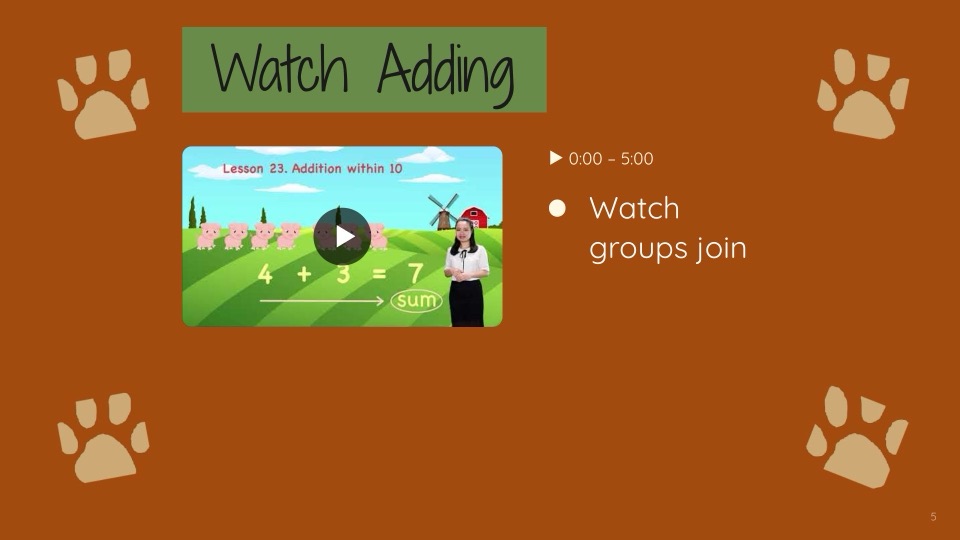
Kindergarten addition within 10 from 0:00 to 5:00
Ignite Study: Math For Kids - Lesson 23. Addition within 10 | Kindergarten
Made for kindergarten and models addition within 10 slowly with visuals ideal for ages 5-6.
-
Learn addition up to 10 from 0:00 to 2:18
Kids Academy: Learn Addition up to 10 | Addition 1 to 9 | Math for Kindergarten & 1st Grade | Kids Academy
Made for kindergarten and first grade with simple 1 to 9 addition perfect for ages 5-6.
Worksheet
Sources
- Kindergarten Math Curriculum boepublic.parkhill.k12.mo.us
- Grade 1 Math sfusd.edu
- Adding Within 10 Worksheets - Great Research epm.cnc.stanford.edu
- Adding and subtracting within 10 - Maths - Learning with BBC ... bbc.co.uk
- A5 Addition Strategies within 10 Practice wacoafterschool.org
- Addition Within 10 Games | Build Mental Math Fluency mental-math-games.net
- Learn addition facts within 10 - video lessons - Math Mammoth mathmammoth.com
- Free addition within 10 worksheets - SIMPLE MATH DAILY simplemathdaily.com
- Addition Clip Cards (Adding within 10) - Math, Kids and Chaos mathkidsandchaos.com
Picture credits
Made with Lesson Dino's AI on 16 October 2026. AI can make mistakes, so check facts against the sources before you teach.