Slides

Lesson plan
Pack It, Multiply It: Volume With Fractions
Students learn that packing with fractional unit cubes gives the same volume as multiplying edge lengths. They pack, multiply, and solve real box problems with fractions.
Objectives
- Students will pack prisms with fractional unit cubes to find volume.
- Students will explain why packing matches multiplying edge lengths.
- Students will use V = l w h and V = B h with fractions.
Success criteria
- I can pack a prism with fractional cubes and count the volume.
- I can show packing gives the same answer as multiplying edges.
- I can use V = l w h and V = B h for fractional prisms.
Key words
| Word | Meaning |
|---|---|
| volume | amount of space taken up inside a solid shape, counted in cubes |
| rectangular prism | box shape with six flat rectangle sides and square corners |
| unit cube | small block for filling space, with tiny edge like 1/2 inch |
| edge length | how long one straight side of a box or cube is |
| base area | size of the bottom face, found by length times width |
| cubic units | small cubes used to state how much space is filled |
Timed plan (60 minutes)
| Time | Stage | What happens |
|---|---|---|
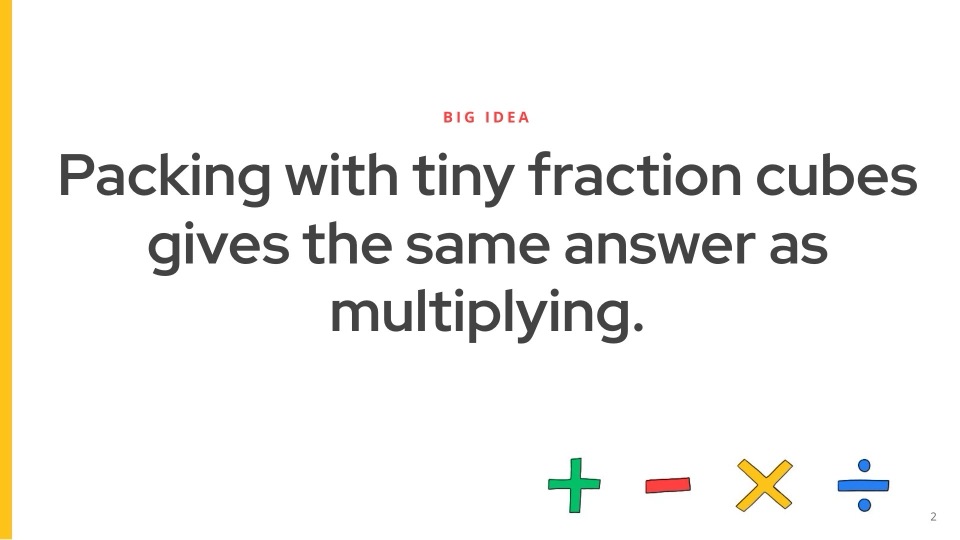
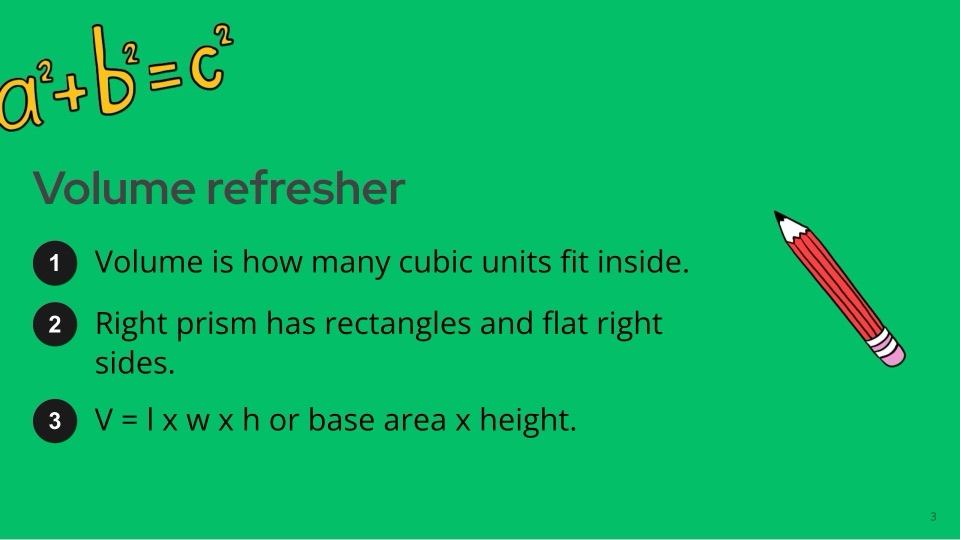
| 5 min | Starter | Recall whole-number volume and create a need for fractional cubes. Show Slides 1-3 and a small empty box that is 2 and 1/2 inches long. Ask the hook and try one whole unit cube inside to show the gap. Elicit that volume is how many cubic units fit inside and that whole cubes will not fill it. Preview the big idea that tiny fraction cubes give the same answer as multiplying. |
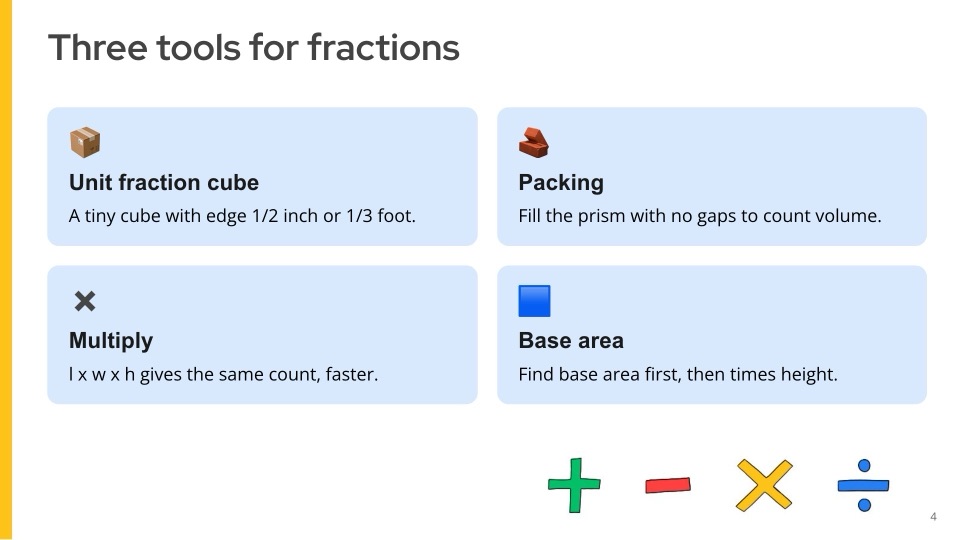
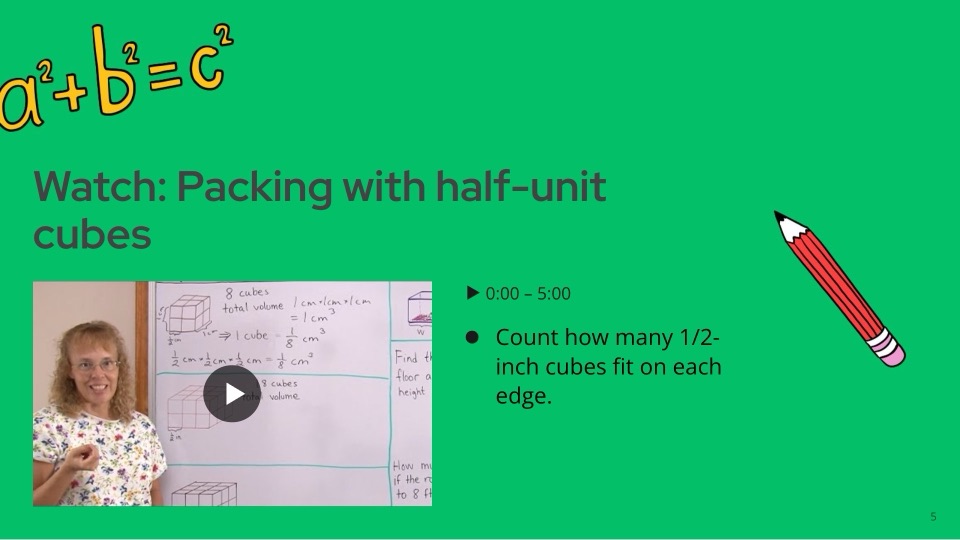
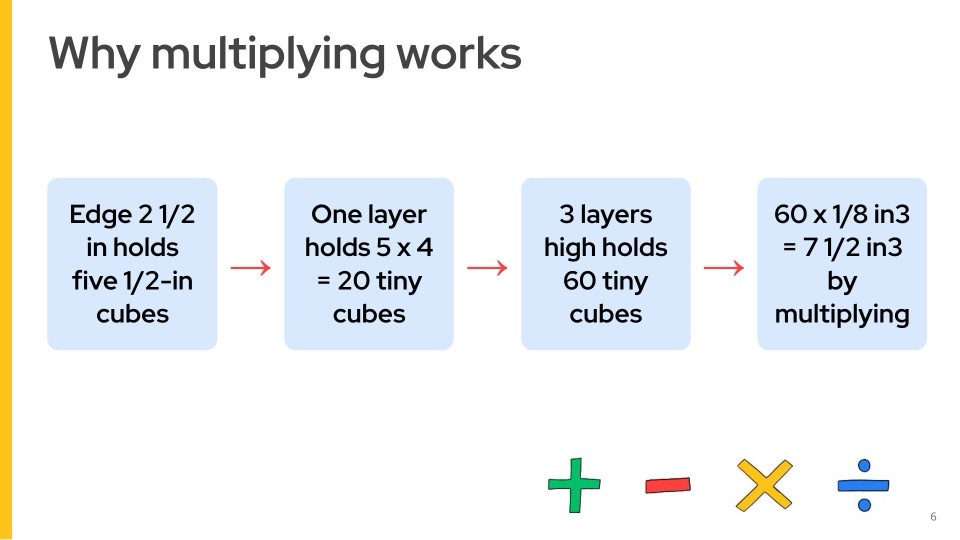
| 12 min | Teach - Packing to Multiplying | Model how counting fractional cubes matches multiplying edge lengths. Show Slide 4 tools, then play Video clip 2 on Slide 5 to model counting 1/2-inch cubes on each edge. Talk through Slide 6 chain: 5 cubes by 4 cubes in a layer, 3 layers, then convert to cubic inches. Model multiplying the three edge lengths to show the same answer. Stress that to calculate the volume of a box you multiply the three dimensions together. |
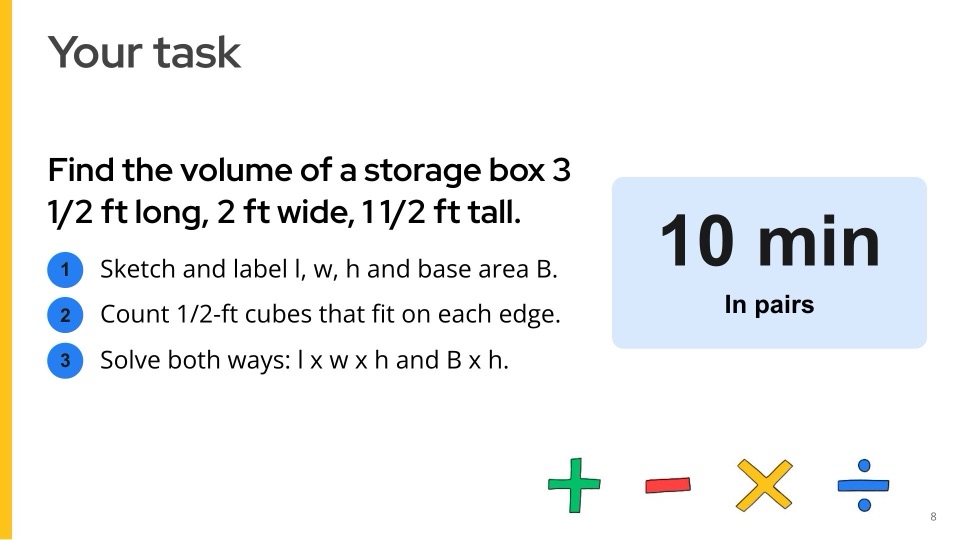
| 23 min | Main - Half-Cube Pack Attack | Find fractional volume by packing and prove it matches multiplication. Hand out 1/2-inch cubes, small empty boxes, rulers, and recording sheet. Assign each group a prism with halves, such as 2 1/2 by 2 by 1 1/2 in, and show Slide 8 task steps. Circulate to check no gaps, correct edge counts, and both calculations. Stop halfway to highlight one group where packing and multiplying matched. |
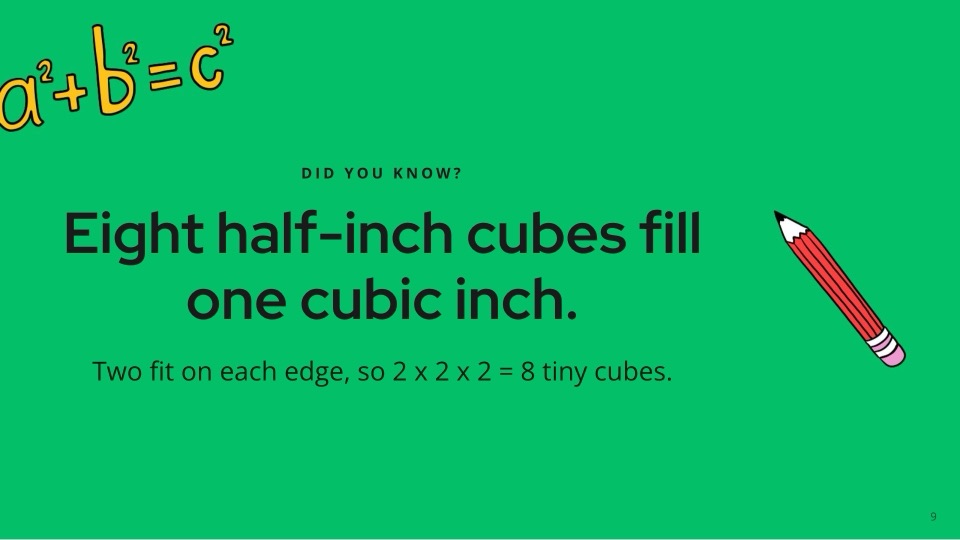
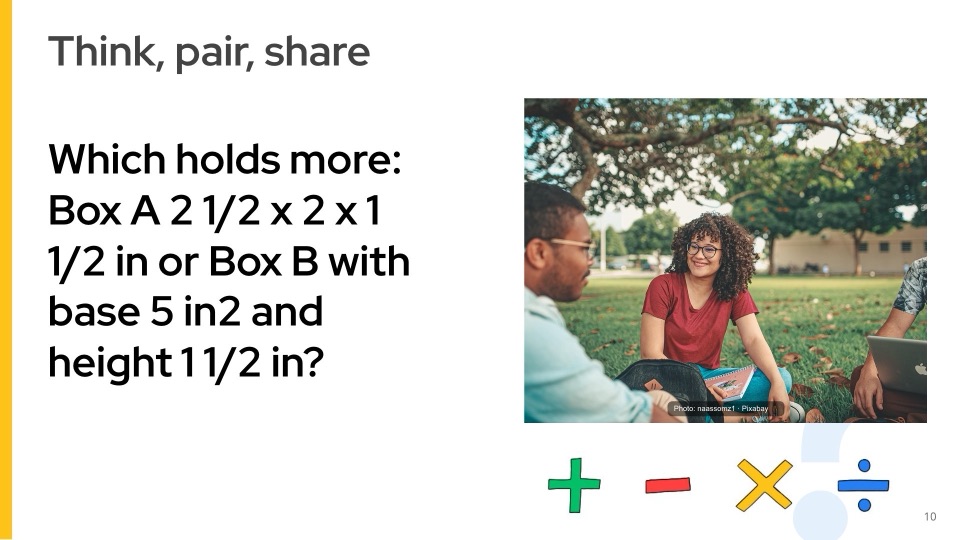
| 12 min | Apply - Both Formulas | Use V = l w h and V = B h with fractions for real box problems. Show Slide 9: eight half-inch cubes fill one cubic inch because 2 x 2 x 2 = 8. Model V = l w h and V = B h on Box A and Box B from Slide 10. Have pairs solve Worksheet Task C using fractions for both formulas. Remind that a box has a volume of length x width x height and the volume V of a prism is V = B h where B is base area. |
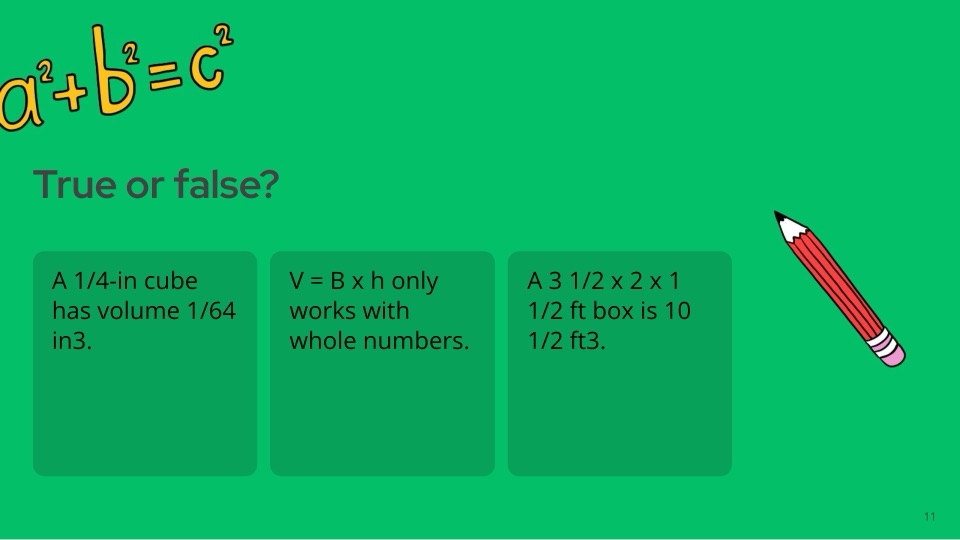
| 8 min | Plenary | Check that packing, multiplying, and both formulas work for fractions. Run Slide 11 true or false with whole-class votes and reasons. Fix the false idea that V = B x h only works with whole numbers. Return to success criteria and have students self-rate thumbs. Give exit ticket on whiteboards. |
Common mistakes
- Saying total tiny cubes equals cubic units, like 60 cubes = 60 in3
How to spot it: Answer far too big and missing conversion by 1/8
Multiply cube count by one tiny cube volume; eight half-inch cubes fill one cubic inch. - Adding edges instead of multiplying, or multiplying all numbers on a diagram
How to spot it: Work shows plus signs or volume without cubic units
Check against a box has volume length x width x height; volume is number of cubes that fit inside. - Thinking V = B h only works for whole numbers
How to spot it: Student will not use base area when height is 1 1/2
Re-solve same prism both ways to show V = l w h and V = B h match for fractions.
Support
- Start with a whole-number box built out of unit cubes, such as by building the prism out of cubes, then move to halves.
- Use fraction multiplication chart and halves-only edges first, with base color-coded as B.
- Provide half-finished recording frame with edge labels and sentence starters.
Stretch
- Try a box with 1/3 or 1/4 inch edges and predict how many tiny cubes fit in one whole cube.
- Design a second box with half the volume but different fractional edges.
- Work backward from volume and base area to find a missing fractional height.
Check questions
- A box is 3 in by 1 1/2 in by 2 in. Find the volume using V = l w h.
Answer: 9 in3, because 3 x 3/2 x 2 = 9 cubic units. - A prism has base area 6 in2 and height 2 1/2 in. Find the volume using V = B h.
Answer: 15 in3, because 6 x 5/2 = 15. - Why does packing with 1/2-in cubes give the same as multiplying edges?
Answer: Counts of 1/2-cubes per edge are numerators over 2; converting total by 1/8 equals the fraction product.
Curriculum
Find the volume of a right rectangular prism with fractional edge lengths by packing it with unit cubes of the appropriate unit fraction edge lengths, and show that the volume is the same as would be found by multiplying the edge lengths of the prism. Apply the formulas V = l w h and V = b h to find volumes of right rectangular prisms with fractional edge lengths in the context of solving real-world and mathematical problems.
Video clips
Clips on YouTube, from the start and end times we chose. Check each one before you show it.
-
packing with half-unit cubes from 0:00 to 5:00
Math Mammoth: Volume of rectangular prism with fractional edge lengths - 6.G.2
Perfect for ages 11-12 in Grade 6 because it packs a unit cube with 1/2-cm cubes to prove the fractional formula.
-
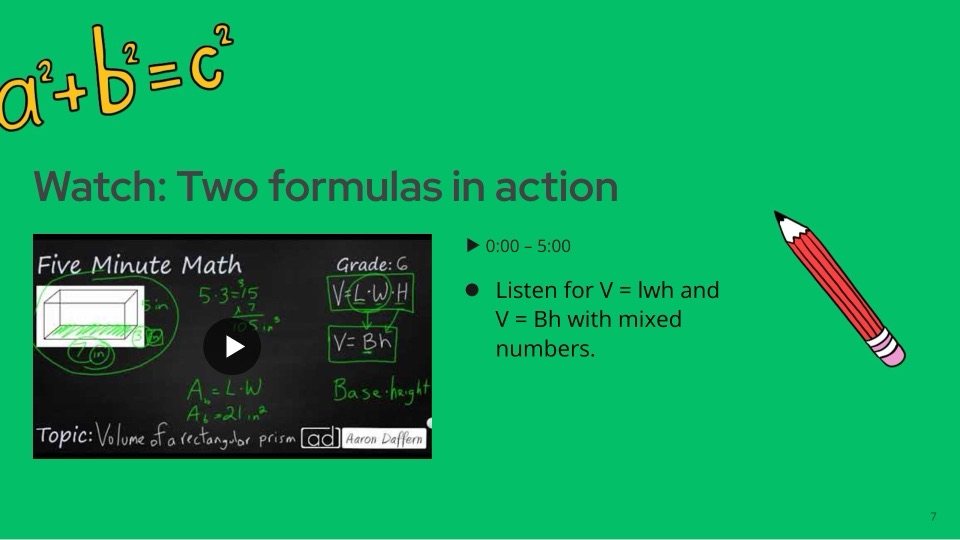
V = lwh and V = Bh with mixed numbers from 0:00 to 5:00
Aaron Daffern: 6th Grade Math Volume of a Rectangular Prism
Perfect for Grade 6 ages 11-12 because it uses both formulas with mixed numbers for real math problems.
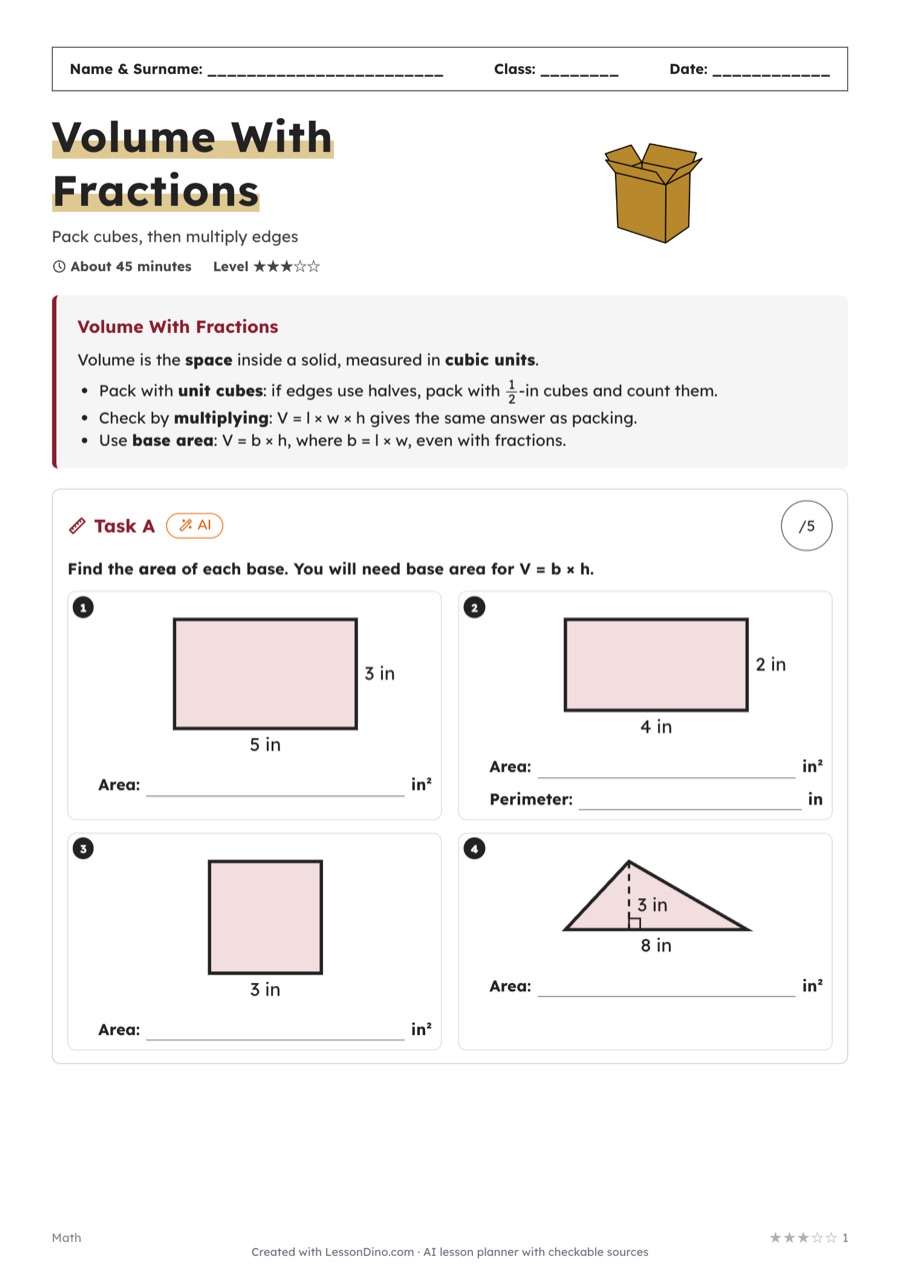
Worksheet
Sources
- Grade 6 » Geometry | Common Core State Standards Initiative thecorestandards.org
- SST Grade 6 Mathematics TEKS - Texas Education Agency tea.texas.gov
- SURFACE AREA AND VOLUME - University of Houston online.math.uh.edu
- Volume Of Rectangular And Triangular Prisms Worksheet epm.cnc.stanford.edu
- Exploring Surface Area and Volume of Rectangular Prisms serc.carleton.edu
- Surface Area and Volume - Andrews University andrews.edu
- Surface Area and Volume of Solids - Andrews University andrews.edu
- Volume Of Rectangular Prism Worksheet - Great Research epm.cnc.stanford.edu
- Volume formula intuition (article) | Khan Academy en.khanacademy.org
- Volume of rectangular prisms review - Khan Academy khanacademy.org
- Surface area and volume of prisms - KS3 Maths - BBC Bitesize bbc.co.uk
- Volume of rectangular prisms - Measurement and Geometry – GeoGeb… geogebra.org
- Flexi answers - How do you solve a rectangular prism? | CK-12 Foundation ck12.org
- Volume of a rectangular prism (video) | Khan Academy en.khanacademy.org
- Volume of Rectangular Prisms (With Example) superteacherworksheets.com
- Volume of a Rectangular Prism Worksheets mathworksheets4kids.com
- Volume of a Rectangular Prism - Formula, Examples, & Diagrams - Math Monks mathmonks.com
- Grade 7 Mathematics - Exploring Surface Area and Volume of Cubes, Rectangular Prisms, and Cylinders - CAPS 123 caps123.co.za
- Lesson: Volume of prisms | Oak National Academy thenational.academy
- Volume formulas review (article) | Khan Academy math.khanacademy.org
- Volume of prisms KS3 | Y8 Maths | Lesson Resources thenational.academy
- Volume of a Rectangular Prism - Steps, Examples & Questions thirdspacelearning.com
- rectangular prisms worksheets | Worksheetzone worksheetzone.org
Picture credits
- Photo: naassomz1 · Pixabay
- Pictograms: Sergio Palao, ARASAAC (arasaac.org) · CC BY-NC-SA
Made with Lesson Dino's AI on 19 October 2026. AI can make mistakes, so check facts against the sources before you teach.