The worksheet
About this worksheet
Students learn that packing with fractional unit cubes gives the same volume as multiplying edge lengths. They pack, multiply, and solve real box problems with fractions. This Grade 6 Math worksheet gives students (ages 11–12) seven pages of practice on volume of rectangular prisms, part of the geometry unit. It goes with our free Volume of rectangular prisms lesson, which has the slides and a timed lesson plan.
What it covers
By the end, students should be able to:
- Students will pack prisms with fractional unit cubes to find volume.
- Students will explain why packing matches multiplying edge lengths.
- Students will use V = l w h and V = B h with fractions.
How to use it
- Apply - Both Formulas (12 minutes): Have pairs solve Worksheet Task C using fractions for both formulas.
- Support: Start with a whole-number box built out of unit cubes, such as by building the prism out of cubes, then move to halves.
- Stretch: Try a box with 1/3 or 1/4 inch edges and predict how many tiny cubes fit in one whole cube.
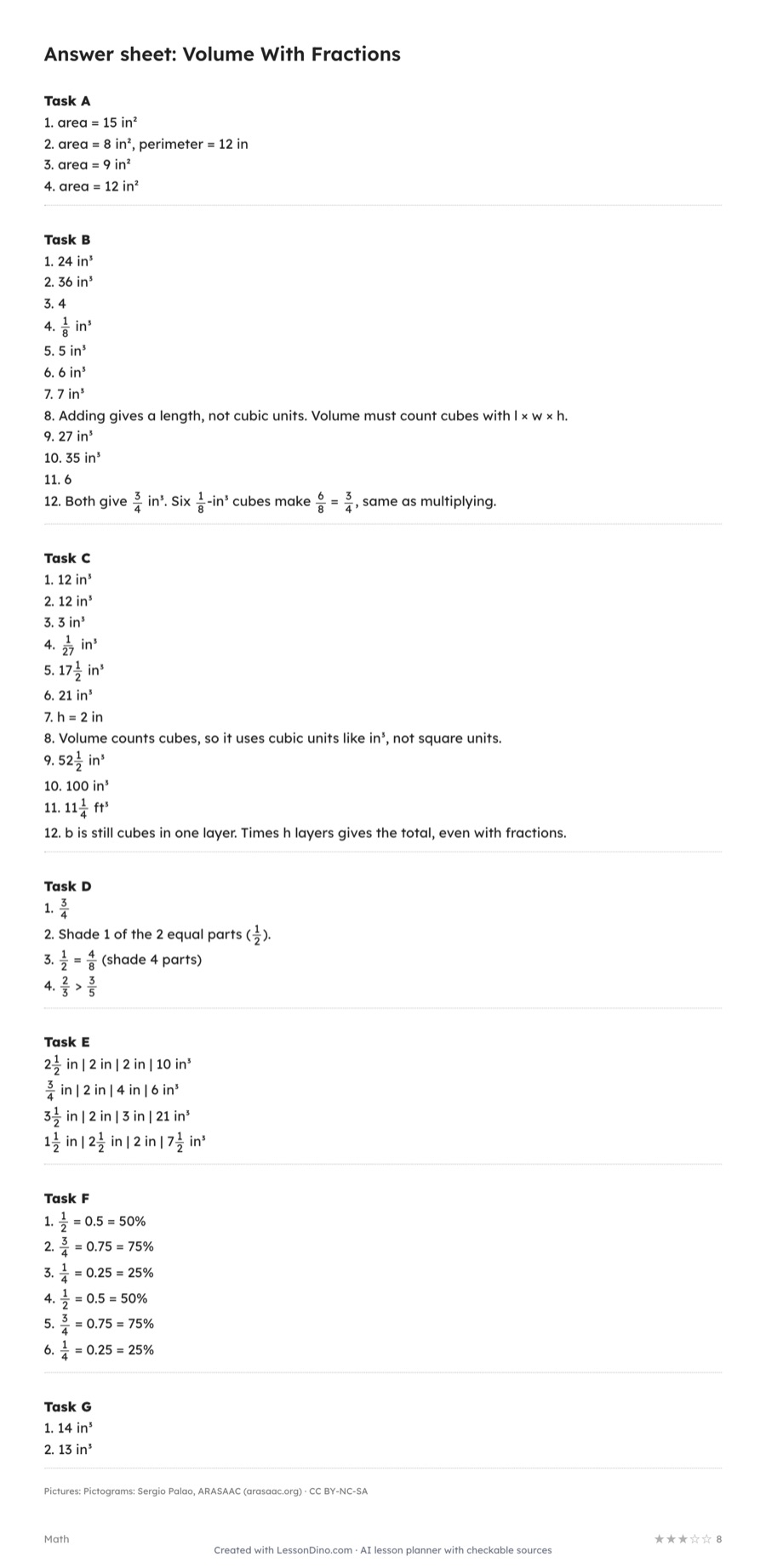
- The answer sheet is the last page, so you can print it on its own or let students check their own work.
Key vocabulary
- volume: amount of space taken up inside a solid shape, counted in cubes
- rectangular prism: box shape with six flat rectangle sides and square corners
- unit cube: small block for filling space, with tiny edge like 1/2 inch
- edge length: how long one straight side of a box or cube is
- base area: size of the bottom face, found by length times width
- cubic units: small cubes used to state how much space is filled
Mistakes to watch for
- Saying total tiny cubes equals cubic units, like 60 cubes = 60 in3. Multiply cube count by one tiny cube volume; eight half-inch cubes fill one cubic inch.
- Adding edges instead of multiplying, or multiplying all numbers on a diagram. Check against a box has volume length x width x height; volume is number of cubes that fit inside.
- Thinking V = B h only works for whole numbers. Re-solve same prism both ways to show V = l w h and V = B h match for fractions.
What's on the worksheet
Pack and Multiply
Review base area and learn volume with fraction cubes.
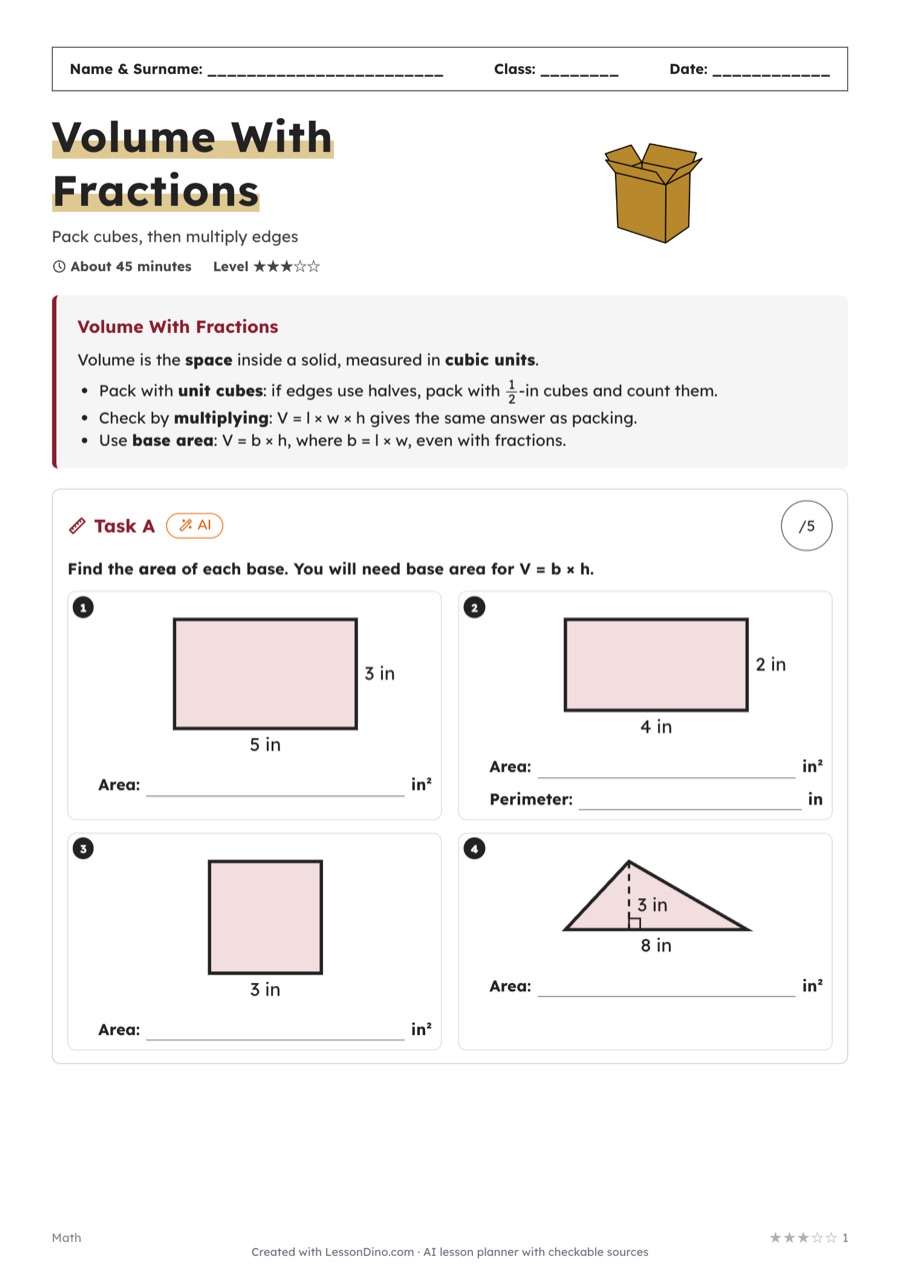
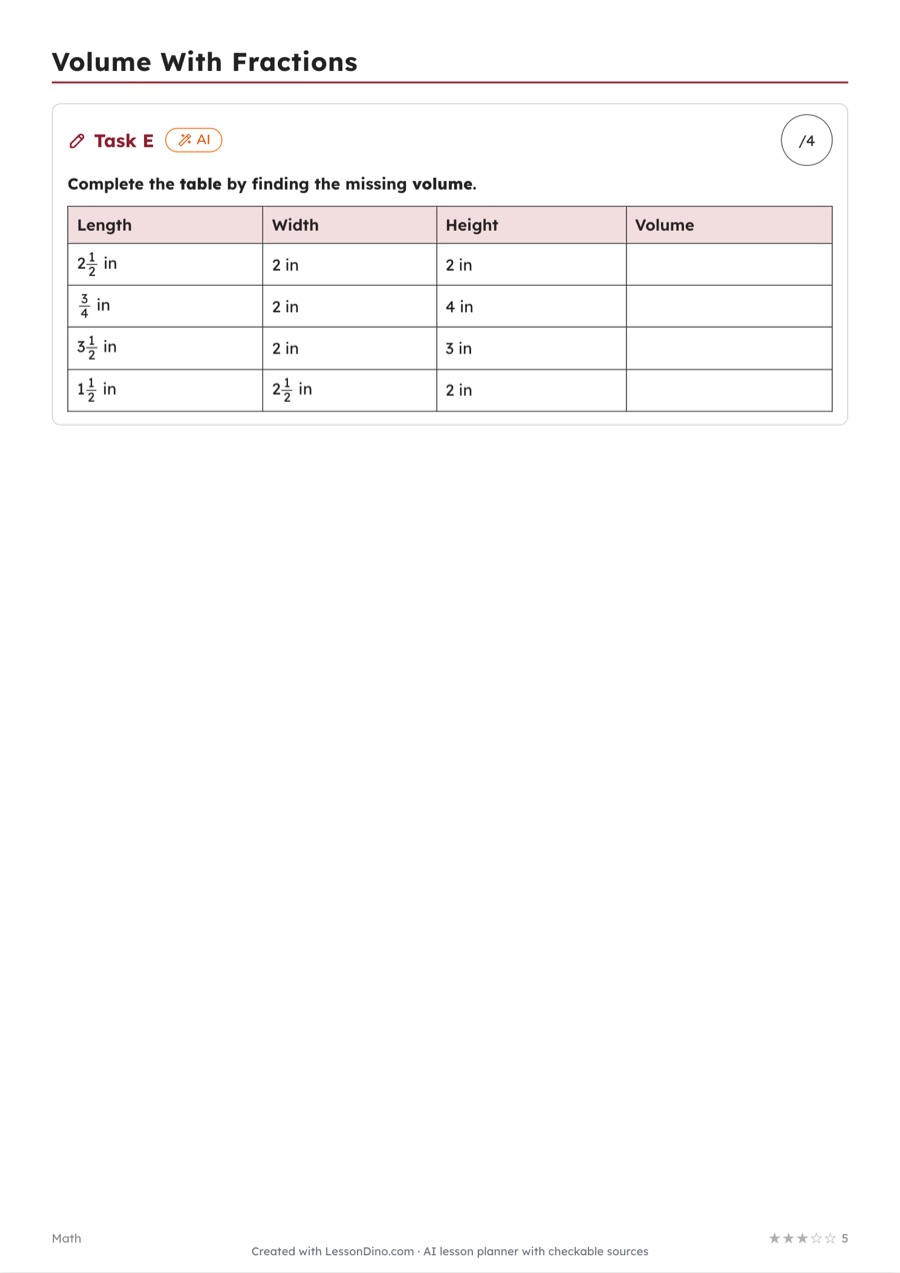
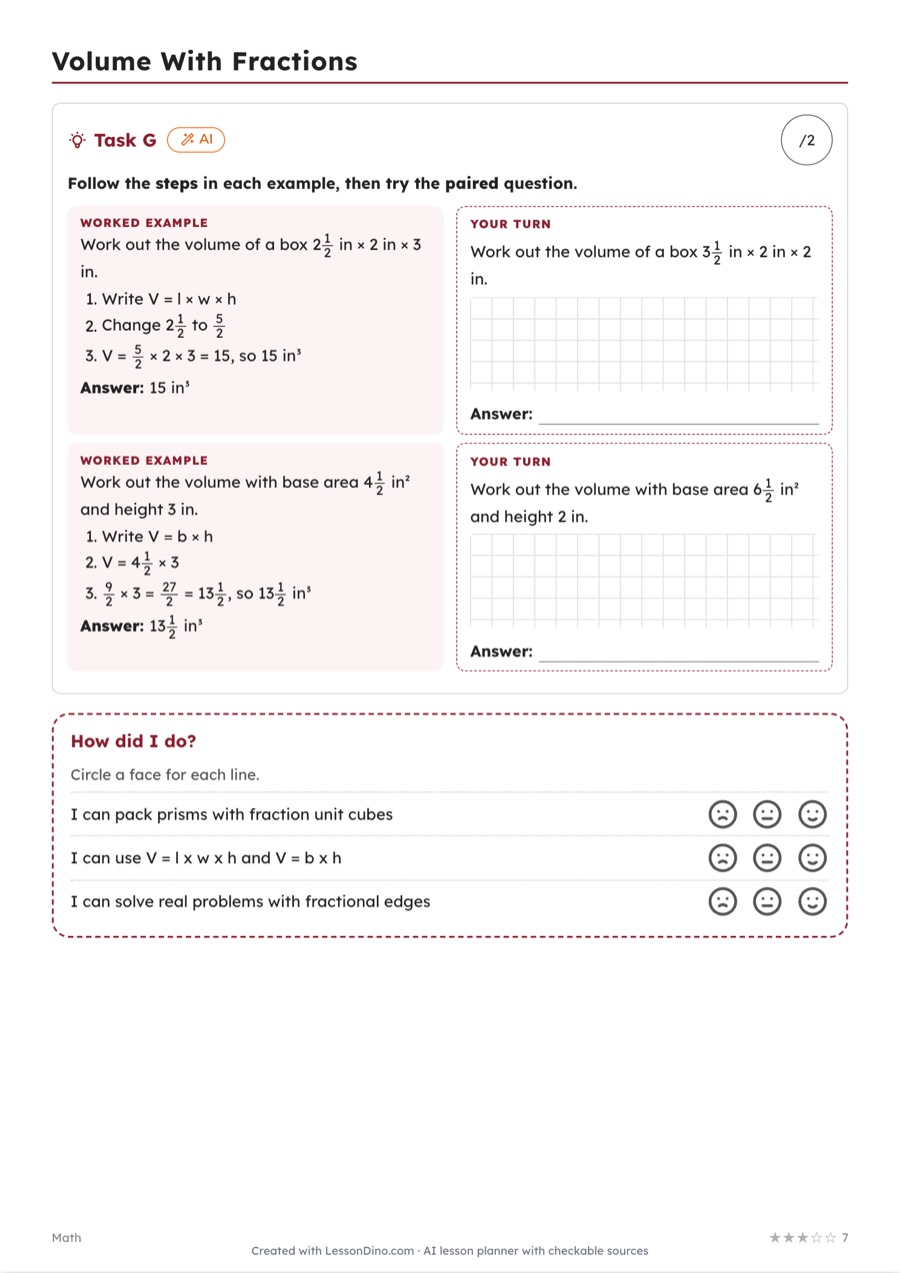
Volume With Fractions
- Volume is the space inside a solid, measured in cubic units.
- Pack with unit cubes: if edges use halves, pack with 1/2-in cubes and count them.
- Check by multiplying: V = l × w × h gives the same answer as packing.
- Use base area: V = b × h, where b = l × w, even with fractions.
Find the area of each base. You will need base area for V = b × h.
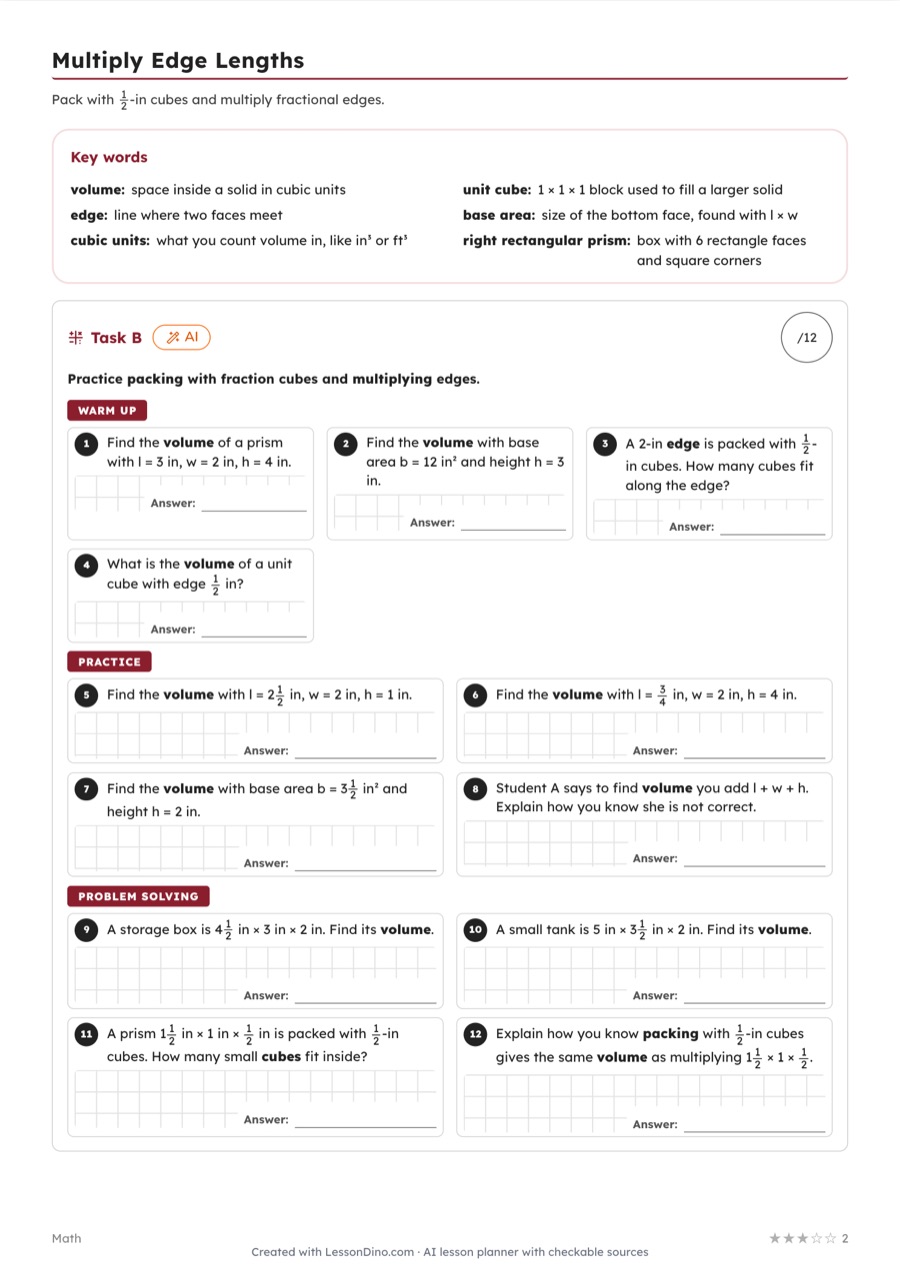
Multiply Edge Lengths
Pack with 1/2-in cubes and multiply fractional edges.
| Word | Meaning |
|---|---|
| volume | space inside a solid in cubic units |
| unit cube | 1 × 1 × 1 block used to fill a larger solid |
| edge | line where two faces meet |
| base area | size of the bottom face, found with l × w |
| cubic units | what you count volume in, like in³ or ft³ |
| right rectangular prism | box with 6 rectangle faces and square corners |
Practice packing with fraction cubes and multiplying edges.
Warm up
- Find the volume of a prism with l = 3 in, w = 2 in, h = 4 in.
- Find the volume with base area b = 12 in² and height h = 3 in.
- A 2-in edge is packed with 1/2-in cubes. How many cubes fit along the edge?
- What is the volume of a unit cube with edge 1/2 in?
Practice
- Find the volume with l = 2 1/2 in, w = 2 in, h = 1 in.
- Find the volume with l = 3/4 in, w = 2 in, h = 4 in.
- Find the volume with base area b = 3 1/2 in² and height h = 2 in.
- Student A says to find volume you add l + w + h. Explain how you know she is not correct.
Problem solving
- A storage box is 4 1/2 in × 3 in × 2 in. Find its volume.
- A small tank is 5 in × 3 1/2 in × 2 in. Find its volume.
- A prism 1 1/2 in × 1 in × 1/2 in is packed with 1/2-in cubes. How many small cubes fit inside?
- Explain how you know packing with 1/2-in cubes gives the same volume as multiplying 1 1/2 × 1 × 1/2.
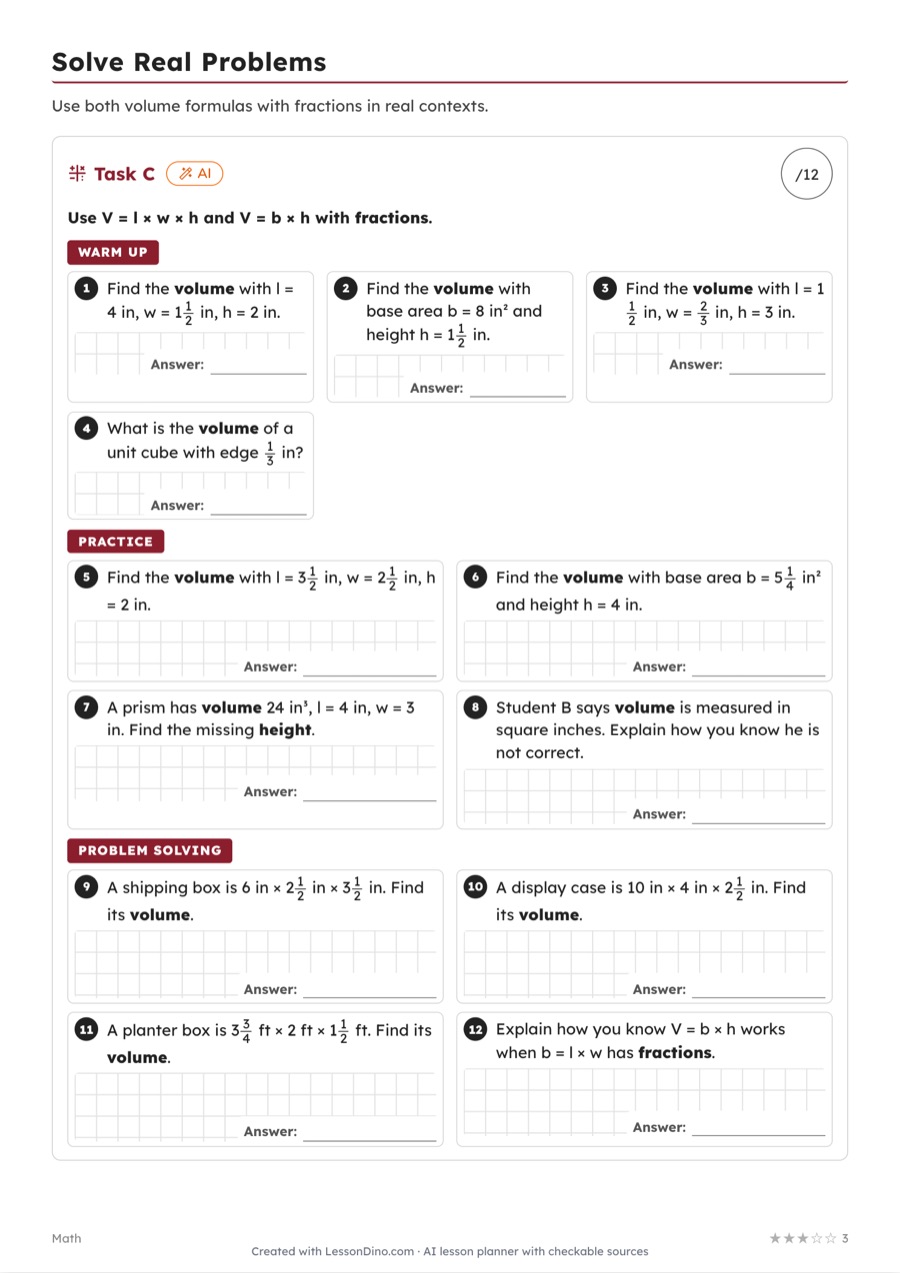
Solve Real Problems
Use both volume formulas with fractions in real contexts.
Use V = l × w × h and V = b × h with fractions.
Warm up
- Find the volume with l = 4 in, w = 1 1/2 in, h = 2 in.
- Find the volume with base area b = 8 in² and height h = 1 1/2 in.
- Find the volume with l = 1 1/2 in, w = 2/3 in, h = 3 in.
- What is the volume of a unit cube with edge 1/3 in?
Practice
- Find the volume with l = 3 1/2 in, w = 2 1/2 in, h = 2 in.
- Find the volume with base area b = 5 1/4 in² and height h = 4 in.
- A prism has volume 24 in³, l = 4 in, w = 3 in. Find the missing height.
- Student B says volume is measured in square inches. Explain how you know he is not correct.
Problem solving
- A shipping box is 6 in × 2 1/2 in × 3 1/2 in. Find its volume.
- A display case is 10 in × 4 in × 2 1/2 in. Find its volume.
- A planter box is 3 3/4 ft × 2 ft × 1 1/2 ft. Find its volume.
- Explain how you know V = b × h works when b = l × w has fractions.
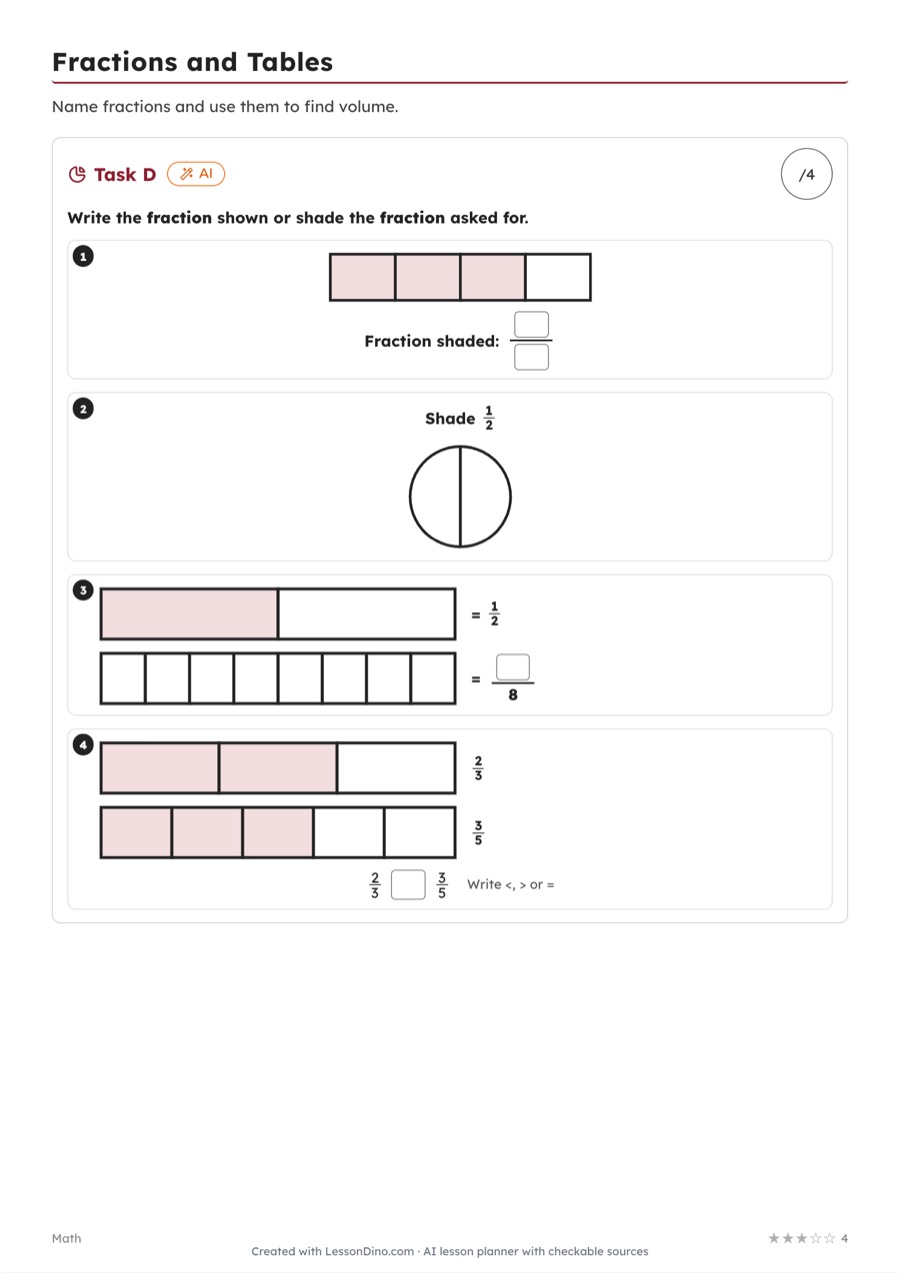
Fractions and Tables
Name fractions and use them to find volume.
Write the fraction shown or shade the fraction asked for.
Page 5
Complete the table by finding the missing volume.
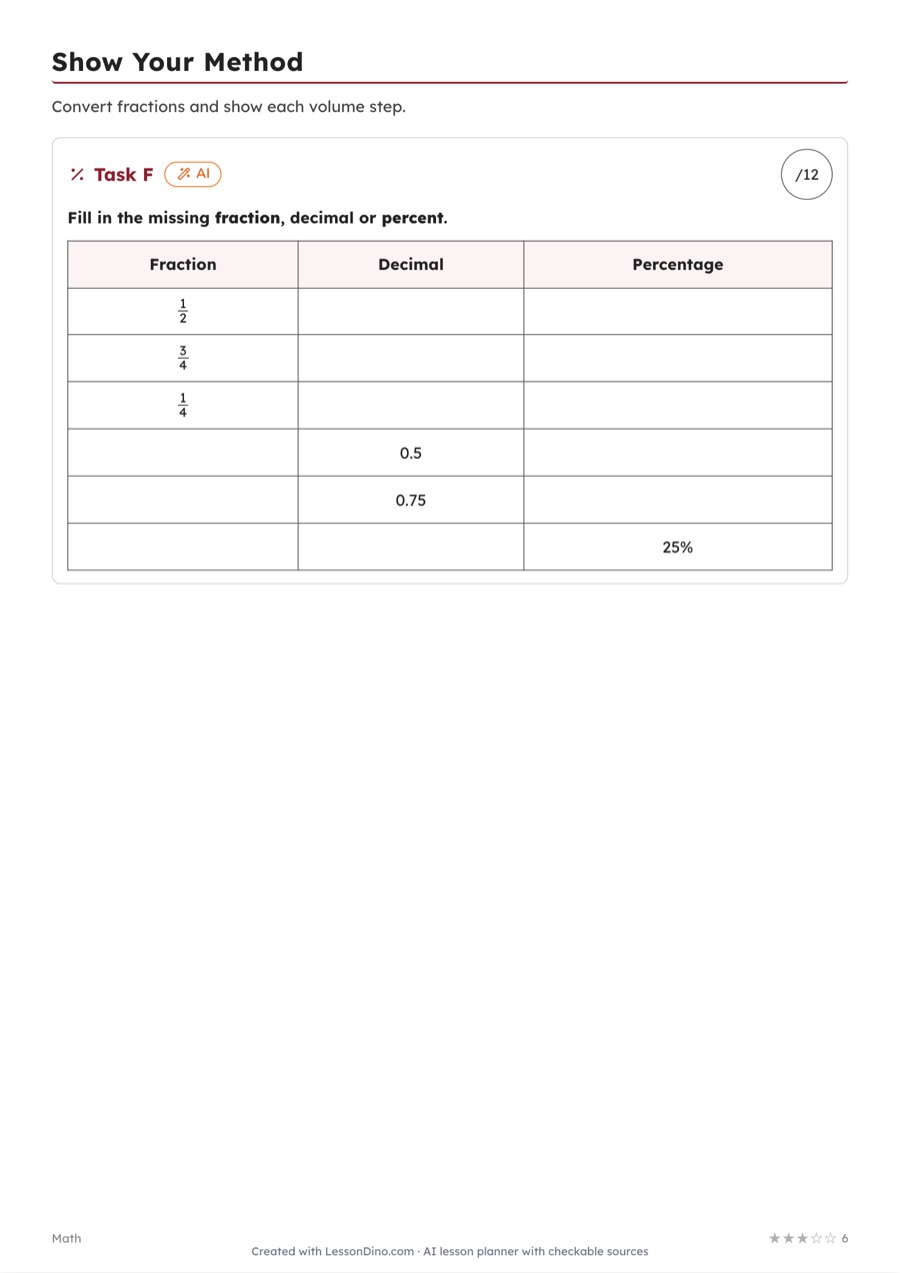
Show Your Method
Convert fractions and show each volume step.
Fill in the missing fraction, decimal or percent.
Page 7
Follow the steps in each example, then try the paired question.
Answers
Show the answers
- Find the volume of a prism with l = 3 in, w = 2 in, h = 4 in. 24 in³
- Find the volume with base area b = 12 in² and height h = 3 in. 36 in³
- A 2-in edge is packed with 1/2-in cubes. How many cubes fit along the edge? 4
- What is the volume of a unit cube with edge 1/2 in? 1/8 in³
- Find the volume with l = 2 1/2 in, w = 2 in, h = 1 in. 5 in³
- Find the volume with l = 3/4 in, w = 2 in, h = 4 in. 6 in³
- Find the volume with base area b = 3 1/2 in² and height h = 2 in. 7 in³
- Student A says to find volume you add l + w + h. Explain how you know she is not correct. Adding gives a length, not cubic units. Volume must count cubes with l × w × h.
- A storage box is 4 1/2 in × 3 in × 2 in. Find its volume. 27 in³
- A small tank is 5 in × 3 1/2 in × 2 in. Find its volume. 35 in³
- A prism 1 1/2 in × 1 in × 1/2 in is packed with 1/2-in cubes. How many small cubes fit inside? 6
- Explain how you know packing with 1/2-in cubes gives the same volume as multiplying 1 1/2 × 1 × 1/2. Both give 3/4 in³. Six 1/8-in³ cubes make 6/8 = 3/4, same as multiplying.
- Find the volume with l = 4 in, w = 1 1/2 in, h = 2 in. 12 in³
- Find the volume with base area b = 8 in² and height h = 1 1/2 in. 12 in³
- Find the volume with l = 1 1/2 in, w = 2/3 in, h = 3 in. 3 in³
- What is the volume of a unit cube with edge 1/3 in? 1/27 in³
- Find the volume with l = 3 1/2 in, w = 2 1/2 in, h = 2 in. 17 1/2 in³
- Find the volume with base area b = 5 1/4 in² and height h = 4 in. 21 in³
- A prism has volume 24 in³, l = 4 in, w = 3 in. Find the missing height. h = 2 in
- Student B says volume is measured in square inches. Explain how you know he is not correct. Volume counts cubes, so it uses cubic units like in³, not square units.
- A shipping box is 6 in × 2 1/2 in × 3 1/2 in. Find its volume. 52 1/2 in³
- A display case is 10 in × 4 in × 2 1/2 in. Find its volume. 100 in³
- A planter box is 3 3/4 ft × 2 ft × 1 1/2 ft. Find its volume. 11 1/4 ft³
- Explain how you know V = b × h works when b = l × w has fractions. b is still cubes in one layer. Times h layers gives the total, even with fractions.
The answer sheet is the last picture above.
Curriculum
Find the volume of a right rectangular prism with fractional edge lengths by packing it with unit cubes of the appropriate unit fraction edge lengths, and show that the volume is the same as would be found by multiplying the edge lengths of the prism. Apply the formulas V = l w h and V = b h to find volumes of right rectangular prisms with fractional edge lengths in the context of solving real-world and mathematical problems.
Made with Lesson Dino's AI on 19 October 2026. AI can make mistakes, so check the answers and facts against the sources before you teach.