The worksheet
About this worksheet
Students learn triangle and polygon area by composing and decomposing. They design a polygon tile and calculate its total area. This Grade 6 Math worksheet gives students (ages 11–12) six pages of practice on area of triangles, part of the geometry unit. It goes with our free Area of triangles lesson, which has the slides and a timed lesson plan.
What it covers
By the end, students should be able to:
- Students will find area of right and other triangles using half base times height.
- Students will find area of quadrilaterals and polygons by composing and decomposing shapes.
- Students will solve real-world problems using triangle and polygon area.
How to use it
- Use it for practice after the teaching part of the lesson, once students have seen the worked examples on the slides.
- Support: Provide a polygon outline already split with dotted lines and labeled base and height for the first shape.
- Stretch: Have students redesign the same total area with a different set of triangles and compare totals.
- The answer sheet is the last page, so you can print it on its own or let students check their own work.
Key vocabulary
- base: the side you choose to start measuring from
- perpendicular height: the straight distance from the opposite corner to the starting side, meeting at 90 degrees
- area: the amount of flat space covering a shape
- compose: to put two or more shapes together to make a new shape
- decompose: to cut or split a shape into smaller parts to measure them
Mistakes to watch for
- Using slanted side length as height. Place right-angle corner at base and show height must meet at 90 degrees to the opposite vertex.
- Forgetting to halve base times height. Recall each triangle is half the rectangle or half the parallelogram formed by two copies.
- Labeling area in inches instead of square inches. Sort units: lengths in inches, covering counts in square inches, and always label sq in..
What's on the worksheet
Halve the Rectangle
Remember the rule, then find the area of triangles.
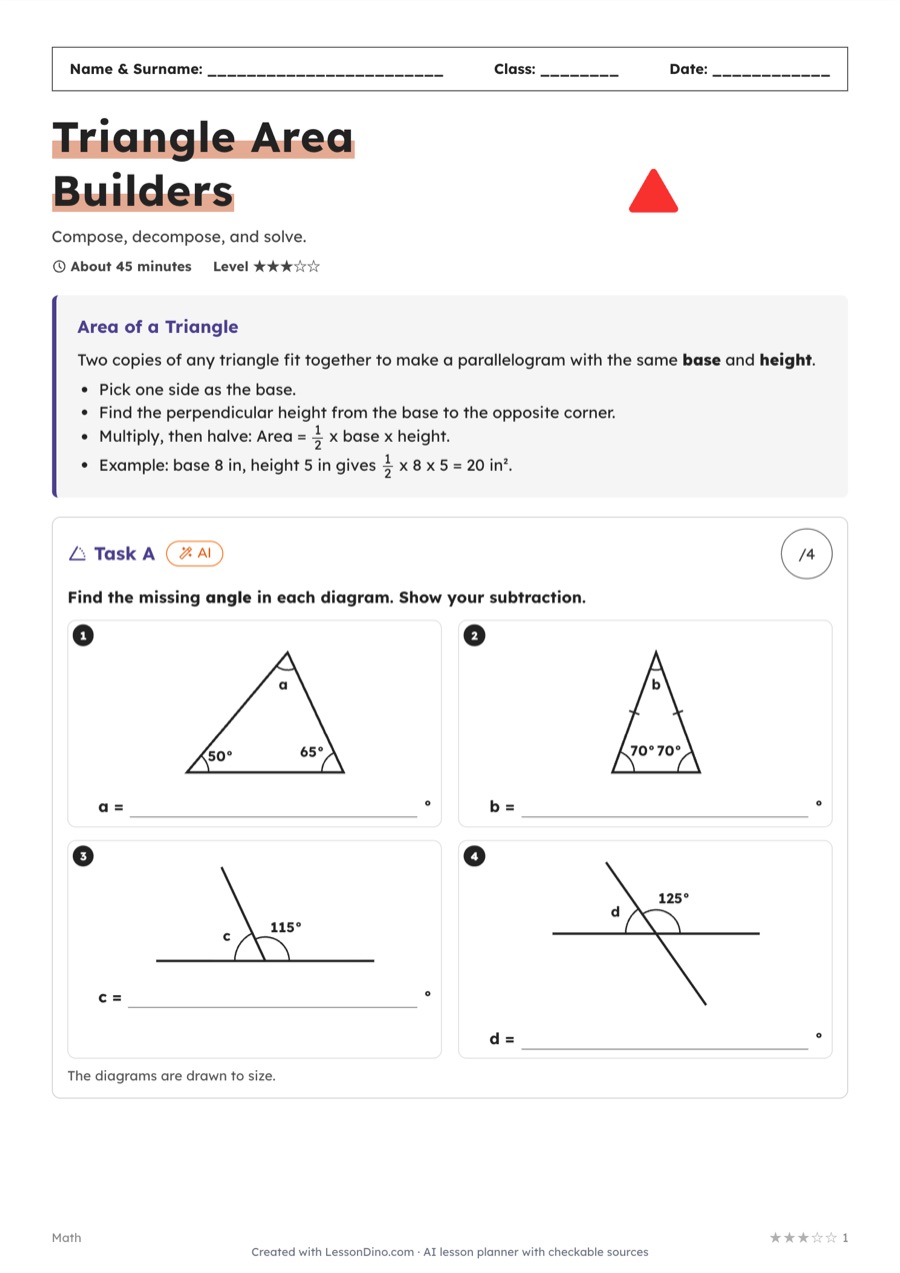
Area of a Triangle
- Two copies of any triangle fit together to make a parallelogram with the same base and height.
- Pick one side as the base.
- Find the perpendicular height from the base to the opposite corner.
- Multiply, then halve: Area = 1/2 x base x height.
- Example: base 8 in, height 5 in gives 1/2 x 8 x 5 = 20 in².
Find the missing angle in each diagram. Show your subtraction.
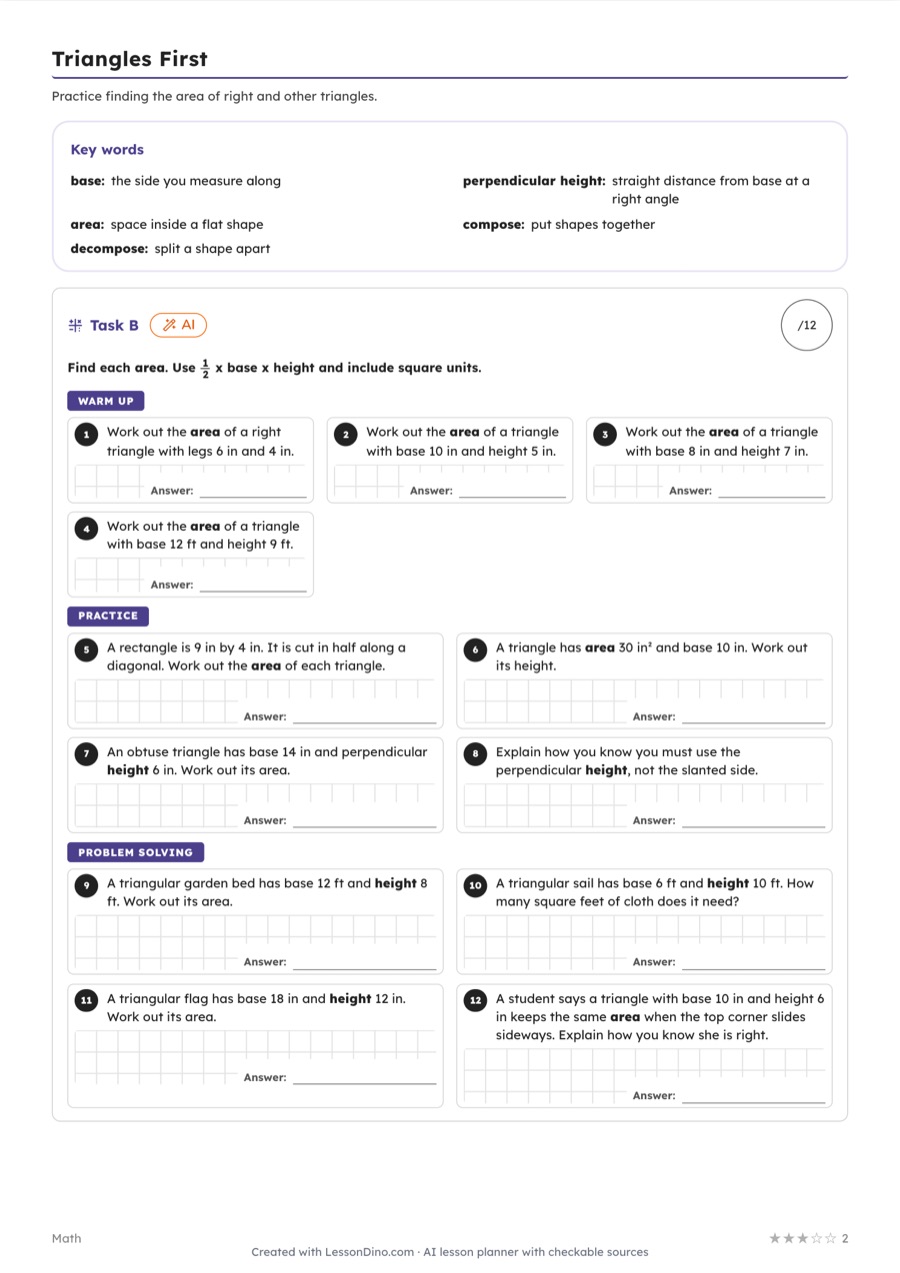
Triangles First
Practice finding the area of right and other triangles.
| Word | Meaning |
|---|---|
| base | the side you measure along |
| perpendicular height | straight distance from base at a right angle |
| area | space inside a flat shape |
| compose | put shapes together |
| decompose | split a shape apart |
Find each area. Use 1/2 x base x height and include square units.
Warm up
- Work out the area of a right triangle with legs 6 in and 4 in.
- Work out the area of a triangle with base 10 in and height 5 in.
- Work out the area of a triangle with base 8 in and height 7 in.
- Work out the area of a triangle with base 12 ft and height 9 ft.
Practice
- A rectangle is 9 in by 4 in. It is cut in half along a diagonal. Work out the area of each triangle.
- A triangle has area 30 in² and base 10 in. Work out its height.
- An obtuse triangle has base 14 in and perpendicular height 6 in. Work out its area.
- Explain how you know you must use the perpendicular height, not the slanted side.
Problem solving
- A triangular garden bed has base 12 ft and height 8 ft. Work out its area.
- A triangular sail has base 6 ft and height 10 ft. How many square feet of cloth does it need?
- A triangular flag has base 18 in and height 12 in. Work out its area.
- A student says a triangle with base 10 in and height 6 in keeps the same area when the top corner slides sideways. Explain how you know she is right.
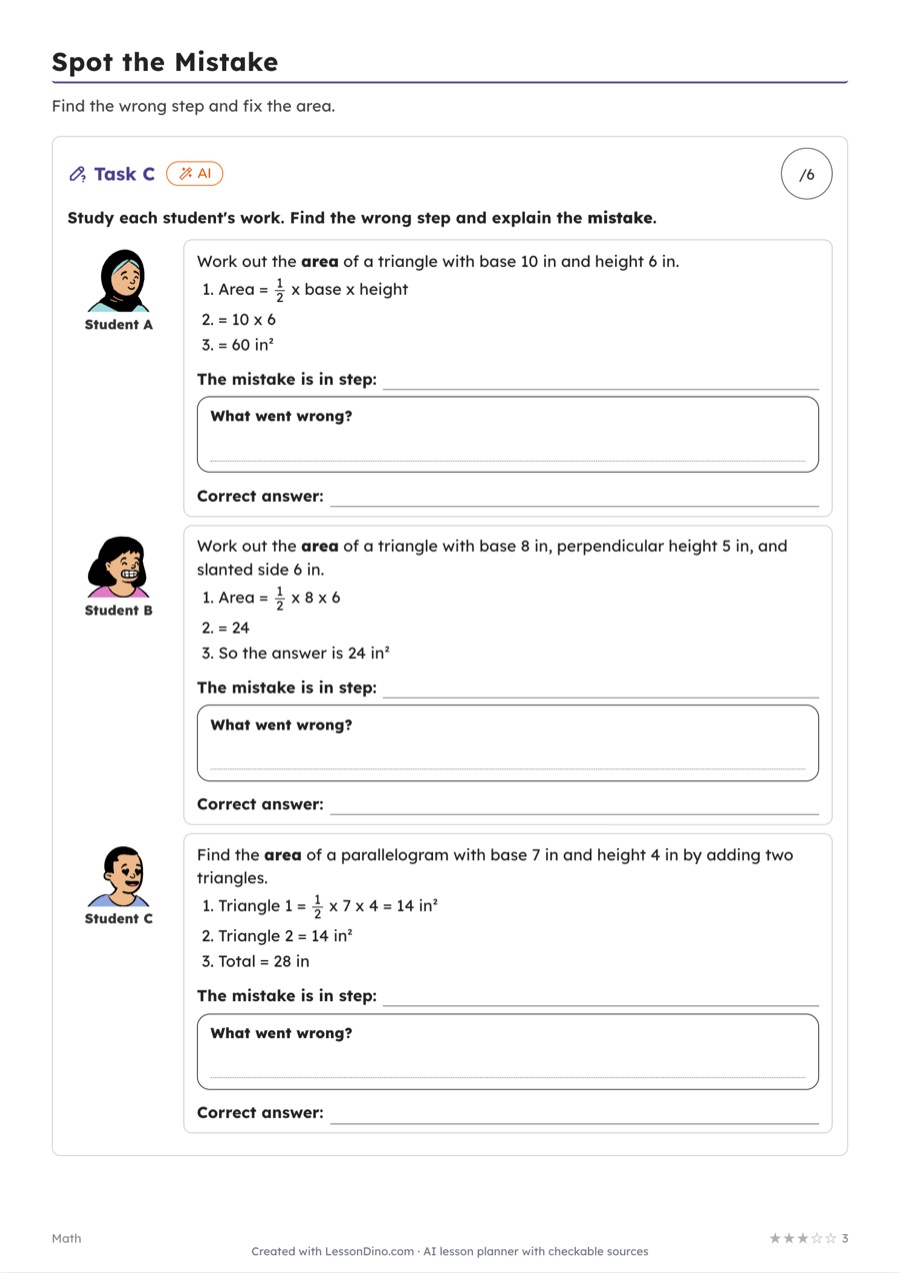
Spot the Mistake
Find the wrong step and fix the area.
Study each student's work. Find the wrong step and explain the mistake.
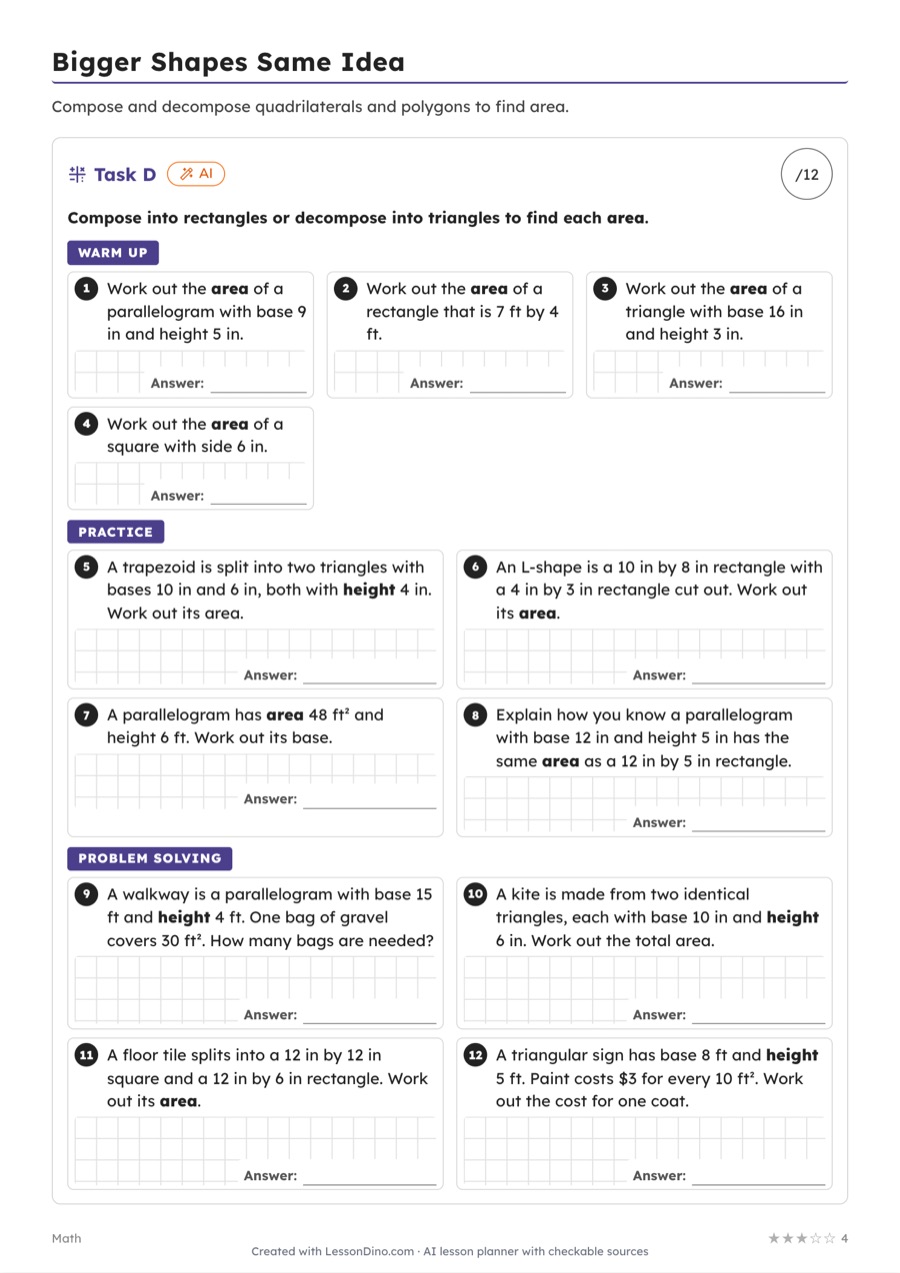
Bigger Shapes Same Idea
Compose and decompose quadrilaterals and polygons to find area.
Compose into rectangles or decompose into triangles to find each area.
Warm up
- Work out the area of a parallelogram with base 9 in and height 5 in.
- Work out the area of a rectangle that is 7 ft by 4 ft.
- Work out the area of a triangle with base 16 in and height 3 in.
- Work out the area of a square with side 6 in.
Practice
- A trapezoid is split into two triangles with bases 10 in and 6 in, both with height 4 in. Work out its area.
- An L-shape is a 10 in by 8 in rectangle with a 4 in by 3 in rectangle cut out. Work out its area.
- A parallelogram has area 48 ft² and height 6 ft. Work out its base.
- Explain how you know a parallelogram with base 12 in and height 5 in has the same area as a 12 in by 5 in rectangle.
Problem solving
- A walkway is a parallelogram with base 15 ft and height 4 ft. One bag of gravel covers 30 ft². How many bags are needed?
- A kite is made from two identical triangles, each with base 10 in and height 6 in. Work out the total area.
- A floor tile splits into a 12 in by 12 in square and a 12 in by 6 in rectangle. Work out its area.
- A triangular sign has base 8 ft and height 5 ft. Paint costs $3 for every 10 ft². Work out the cost for one coat.
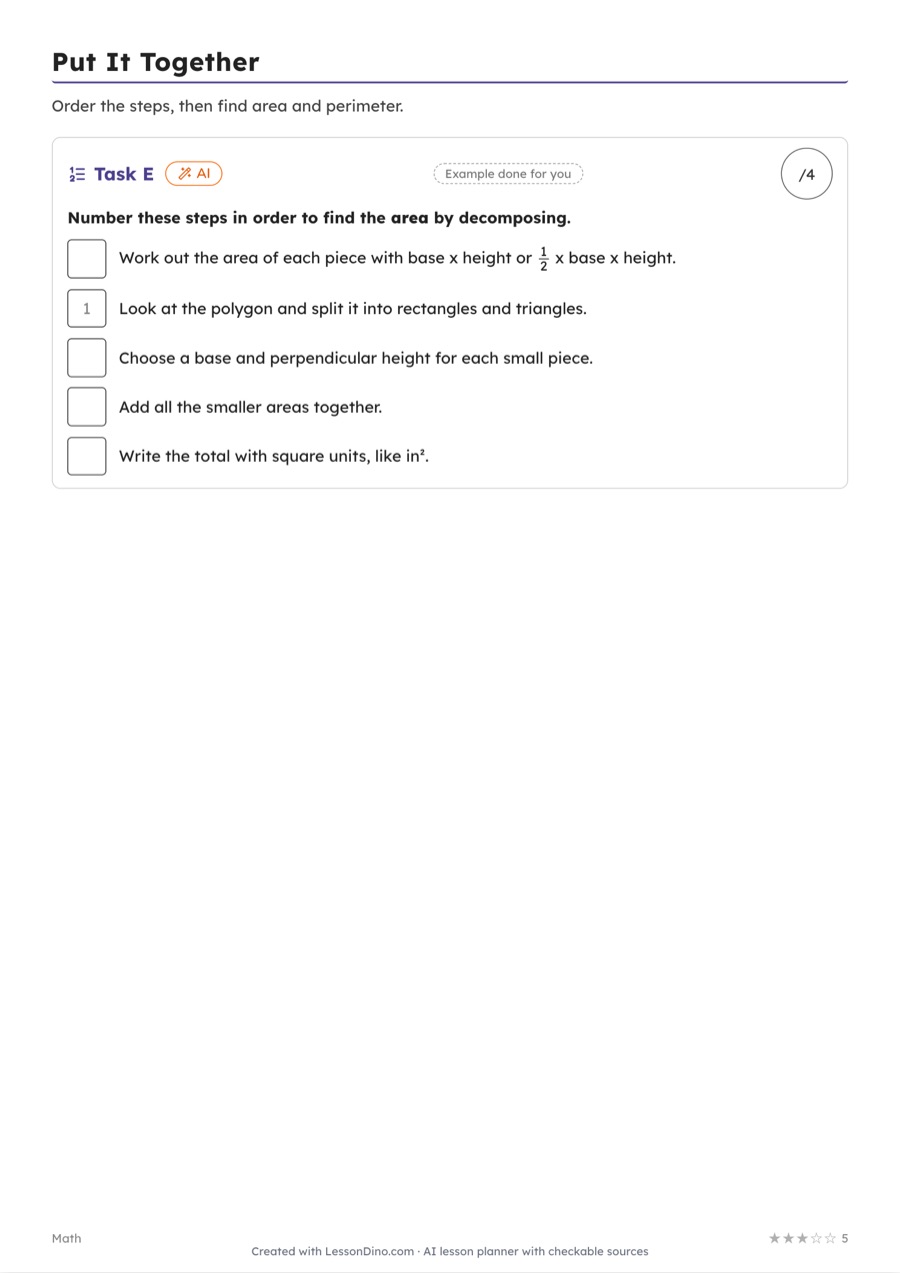
Put It Together
Order the steps, then find area and perimeter.
Number these steps in order to find the area by decomposing.
Page 6
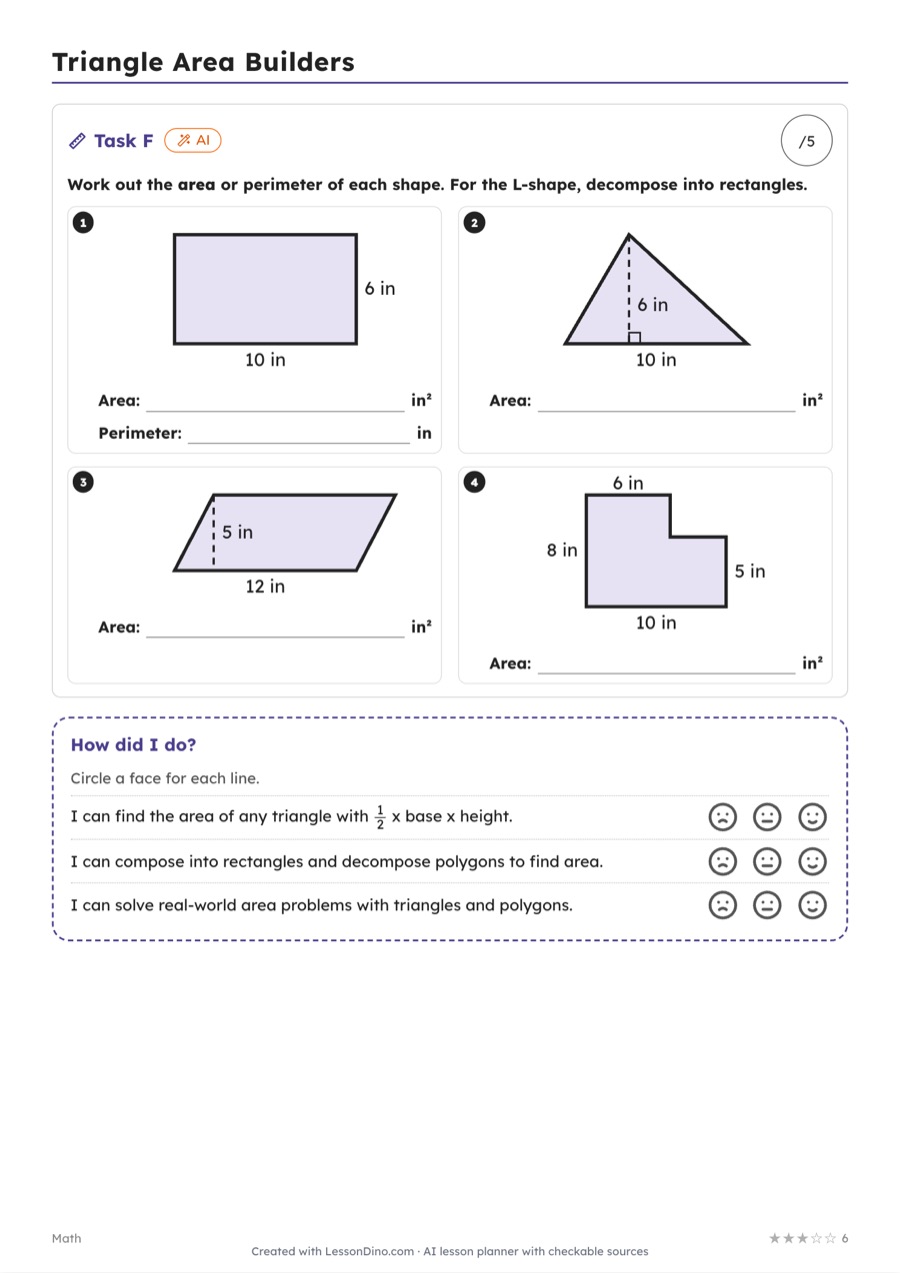
Work out the area or perimeter of each shape. For the L-shape, decompose into rectangles.
Answers
Show the answers
- Work out the area of a right triangle with legs 6 in and 4 in. 12 in²
- Work out the area of a triangle with base 10 in and height 5 in. 25 in²
- Work out the area of a triangle with base 8 in and height 7 in. 28 in²
- Work out the area of a triangle with base 12 ft and height 9 ft. 54 ft²
- A rectangle is 9 in by 4 in. It is cut in half along a diagonal. Work out the area of each triangle. 18 in²
- A triangle has area 30 in² and base 10 in. Work out its height. 6 in
- An obtuse triangle has base 14 in and perpendicular height 6 in. Work out its area. 42 in²
- Explain how you know you must use the perpendicular height, not the slanted side. Only the right-angle distance gives the rectangle the triangle is half of, so base x height works only with the perpendicular height.
- A triangular garden bed has base 12 ft and height 8 ft. Work out its area. 48 ft²
- A triangular sail has base 6 ft and height 10 ft. How many square feet of cloth does it need? 30 ft²
- A triangular flag has base 18 in and height 12 in. Work out its area. 108 in²
- A student says a triangle with base 10 in and height 6 in keeps the same area when the top corner slides sideways. Explain how you know she is right. Sliding along a line parallel to the base keeps the perpendicular height the same, so 1/2 x base x height does not change.
- Work out the area of a parallelogram with base 9 in and height 5 in. 45 in²
- Work out the area of a rectangle that is 7 ft by 4 ft. 28 ft²
- Work out the area of a triangle with base 16 in and height 3 in. 24 in²
- Work out the area of a square with side 6 in. 36 in²
- A trapezoid is split into two triangles with bases 10 in and 6 in, both with height 4 in. Work out its area. 32 in²
- An L-shape is a 10 in by 8 in rectangle with a 4 in by 3 in rectangle cut out. Work out its area. 68 in²
- A parallelogram has area 48 ft² and height 6 ft. Work out its base. 8 ft
- Explain how you know a parallelogram with base 12 in and height 5 in has the same area as a 12 in by 5 in rectangle. Both are made from two triangles with the same base and height, so both have area base x height.
- A walkway is a parallelogram with base 15 ft and height 4 ft. One bag of gravel covers 30 ft². How many bags are needed? 2 bags
- A kite is made from two identical triangles, each with base 10 in and height 6 in. Work out the total area. 60 in²
- A floor tile splits into a 12 in by 12 in square and a 12 in by 6 in rectangle. Work out its area. 216 in²
- A triangular sign has base 8 ft and height 5 ft. Paint costs $3 for every 10 ft². Work out the cost for one coat. $6
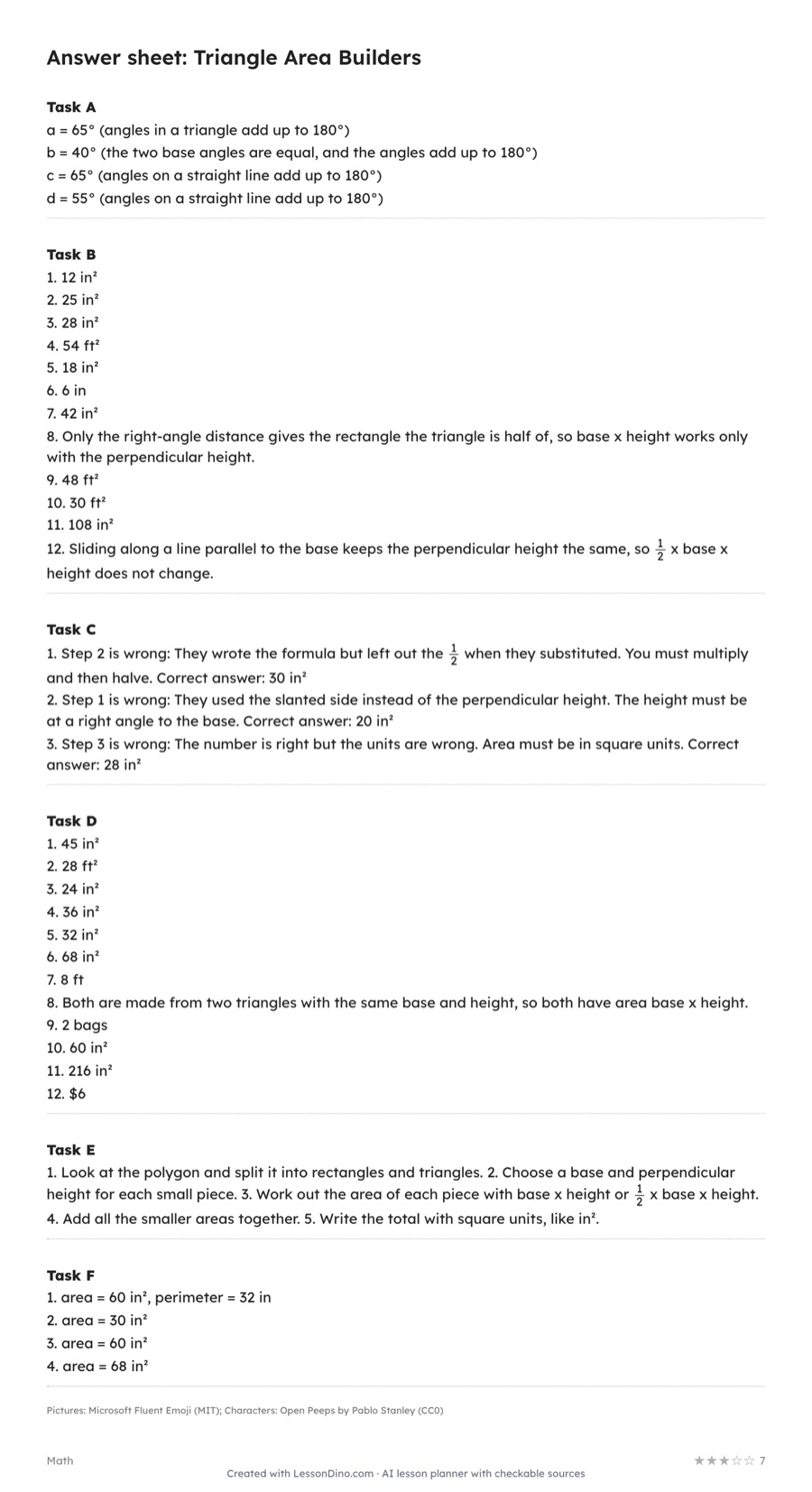
The answer sheet is the last picture above.
Curriculum
Find the area of right triangles, other triangles, special quadrilaterals, and polygons by composing into rectangles or decomposing into triangles and other shapes; apply these techniques in the context of solving real-world and mathematical problems.
Made with Lesson Dino's AI on 17 October 2026. AI can make mistakes, so check the answers and facts against the sources before you teach.