The worksheet
About this worksheet
Students learn the standard ways to add, subtract, multiply, and divide decimals. They run a supply store and make a receipt that balances. This Grade 6 Math worksheet gives students (ages 11–12) six pages of practice on adding, subtracting, multiplying and dividing decimals, part of the the number system unit. It goes with our free Adding, subtracting, multiplying and dividing decimals lesson, which has the slides and a timed lesson plan.
What it covers
By the end, students should be able to:
- Students will add and subtract multi-digit decimals with the standard algorithm.
- Students will multiply multi-digit decimals with the standard algorithm fluently.
- Students will divide multi-digit decimals by making the divisor whole.
How to use it
- Teach Add and Subtract (10 minutes): Students start Worksheet Task B for 3 minutes while teacher circulates.
- Teach Multiply and Divide (15 minutes): Students try Worksheet Task C for 4 minutes while teacher checks point placement.
- Support: Provide a price list with only hundredths and a worked receipt where gaps are filled with zero to line up places.
- Stretch: Add a price per pound, like $2.485 for 2 pounds, and multiply to the thousandths place.
- The answer sheet is the last page, so you can print it on its own or let students check their own work.
Key vocabulary
- decimal point: small dot that separates whole ones from tenths and smaller parts
- dividend: number being split up in a sharing problem
- divisor: number you share by in a sharing problem
- quotient: answer you get after sharing equally
- estimate: a close guess made before you work exactly
Mistakes to watch for
- Lining up right edges instead of points for addition, mixing tenths and hundredths. Rewrite in vertical list with points in line and fill gaps with zero so same-size pieces combine.
- Placing the product point by guessing instead of counting places. Recount digits to the right in each factor and add them for product places, then estimate to check.
- Dividing without making the divisor whole. Rewrite as an equal fraction with a whole-number bottom by shifting both numbers the same places.
What's on the worksheet
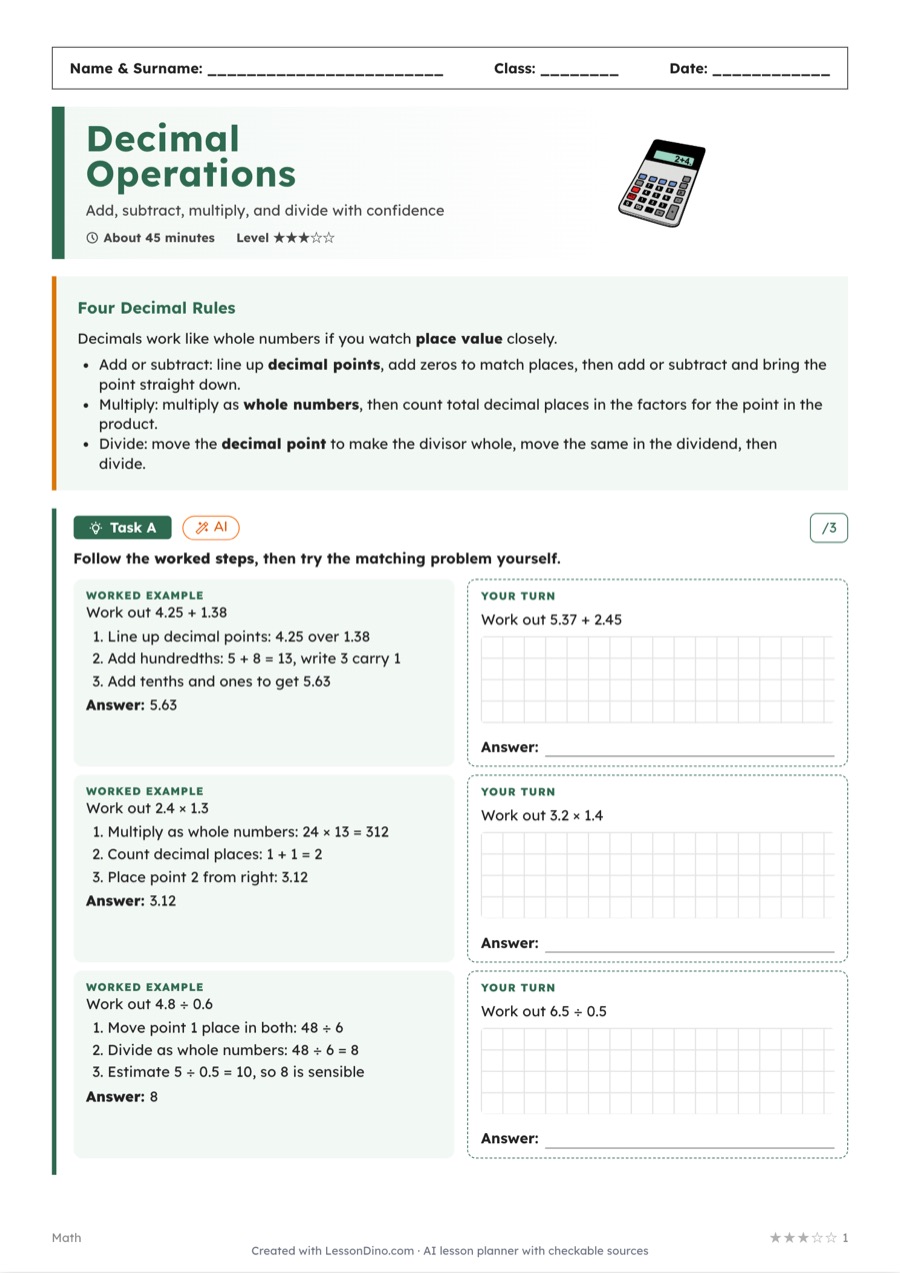
Decimals Refresher
Review the standard algorithms for all four operations.
Four Decimal Rules
- Decimals work like whole numbers if you watch place value closely.
- Add or subtract: line up decimal points, add zeros to match places, then add or subtract and bring the point straight down.
- Multiply: multiply as whole numbers, then count total decimal places in the factors for the point in the product.
- Divide: move the decimal point to make the divisor whole, move the same in the dividend, then divide.
Follow the worked steps, then try the matching problem yourself.
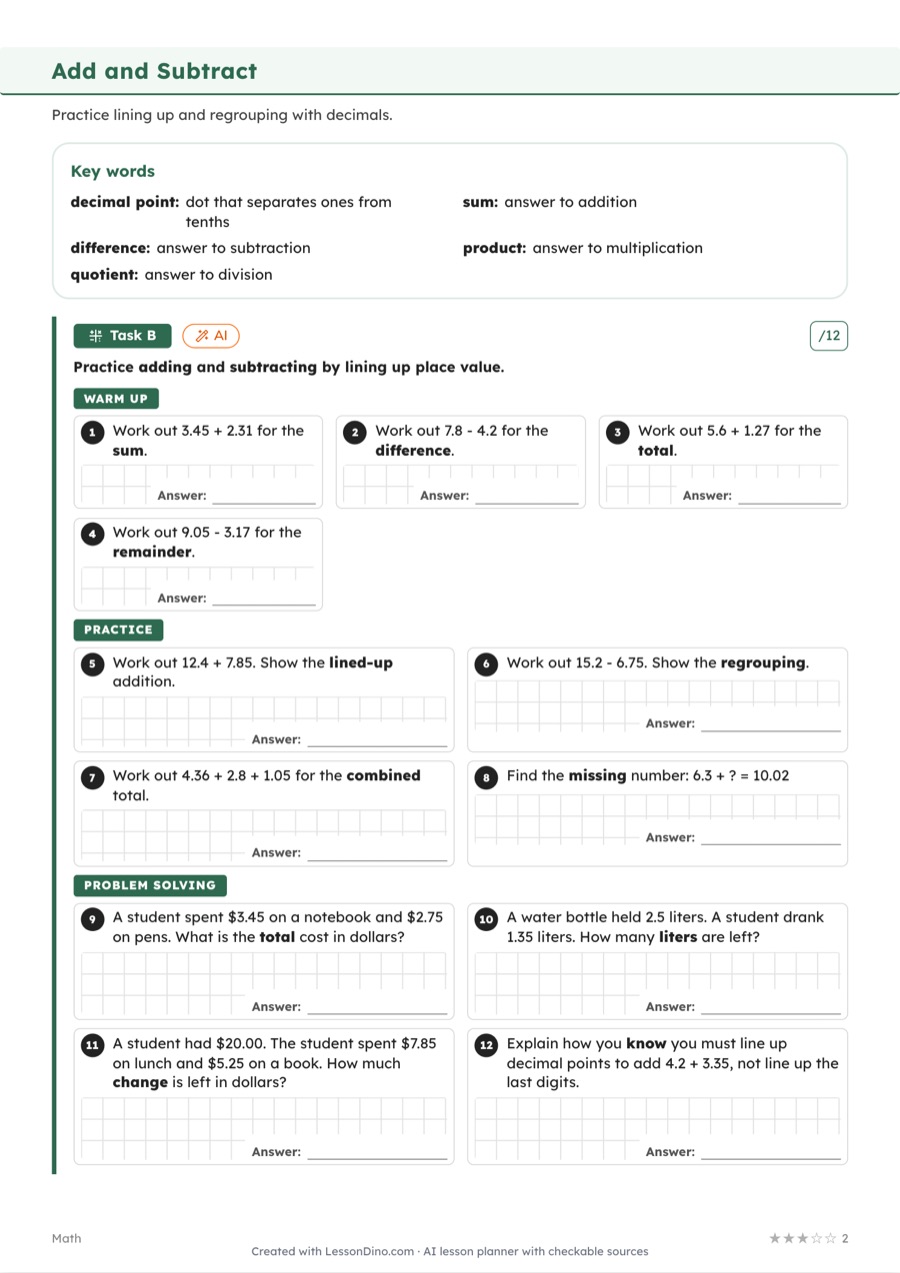
Add and Subtract
Practice lining up and regrouping with decimals.
| Word | Meaning |
|---|---|
| decimal point | dot that separates ones from tenths |
| sum | answer to addition |
| difference | answer to subtraction |
| product | answer to multiplication |
| quotient | answer to division |
Practice adding and subtracting by lining up place value.
Warm up
- Work out 3.45 + 2.31 for the sum.
- Work out 7.8 - 4.2 for the difference.
- Work out 5.6 + 1.27 for the total.
- Work out 9.05 - 3.17 for the remainder.
Practice
- Work out 12.4 + 7.85. Show the lined-up addition.
- Work out 15.2 - 6.75. Show the regrouping.
- Work out 4.36 + 2.8 + 1.05 for the combined total.
- Find the missing number: 6.3 + ? = 10.02
Problem solving
- A student spent $3.45 on a notebook and $2.75 on pens. What is the total cost in dollars?
- A water bottle held 2.5 liters. A student drank 1.35 liters. How many liters are left?
- A student had $20.00. The student spent $7.85 on lunch and $5.25 on a book. How much change is left in dollars?
- Explain how you know you must line up decimal points to add 4.2 + 3.35, not line up the last digits.
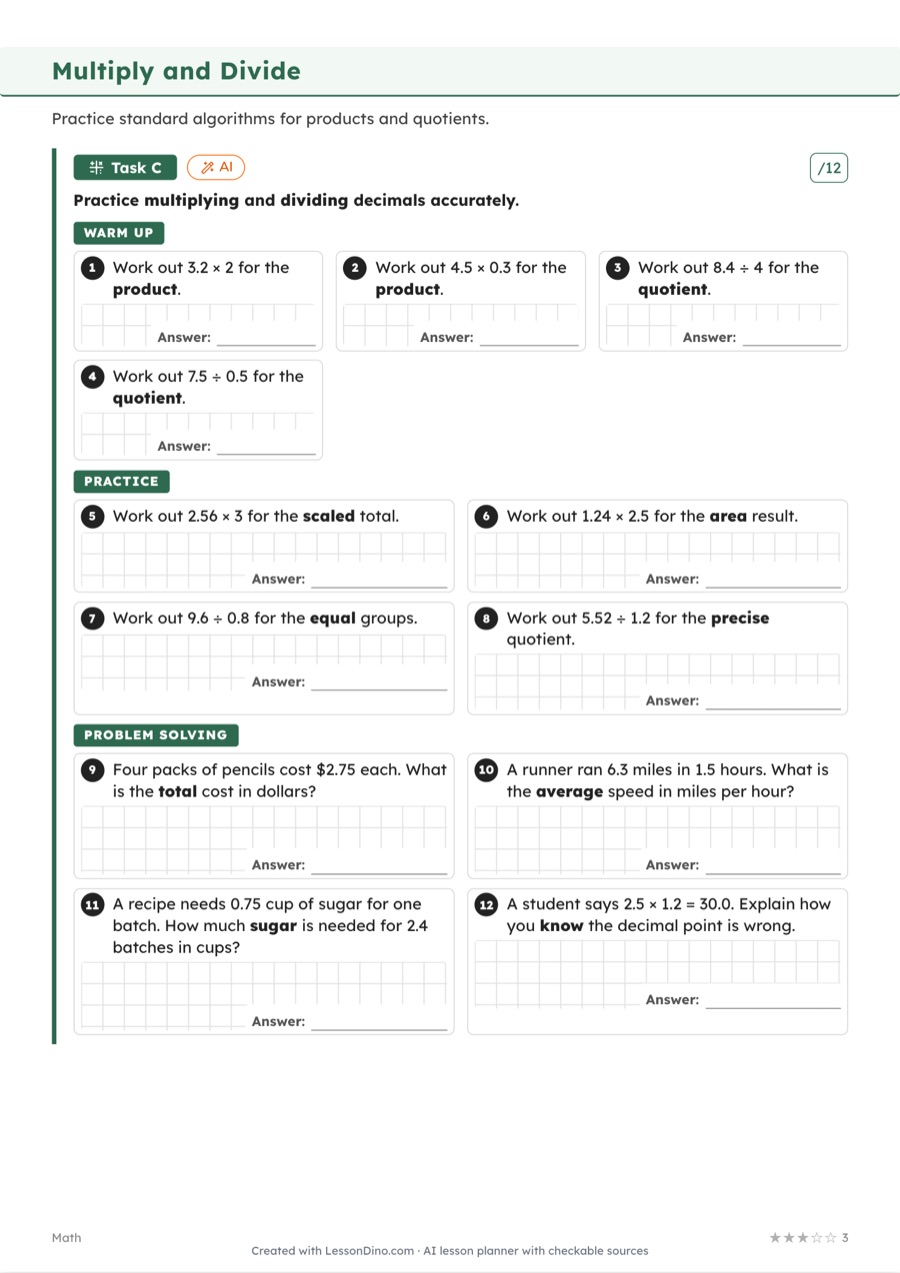
Multiply and Divide
Practice standard algorithms for products and quotients.
Practice multiplying and dividing decimals accurately.
Warm up
- Work out 3.2 × 2 for the product.
- Work out 4.5 × 0.3 for the product.
- Work out 8.4 ÷ 4 for the quotient.
- Work out 7.5 ÷ 0.5 for the quotient.
Practice
- Work out 2.56 × 3 for the scaled total.
- Work out 1.24 × 2.5 for the area result.
- Work out 9.6 ÷ 0.8 for the equal groups.
- Work out 5.52 ÷ 1.2 for the precise quotient.
Problem solving
- Four packs of pencils cost $2.75 each. What is the total cost in dollars?
- A runner ran 6.3 miles in 1.5 hours. What is the average speed in miles per hour?
- A recipe needs 0.75 cup of sugar for one batch. How much sugar is needed for 2.4 batches in cups?
- A student says 2.5 × 1.2 = 30.0. Explain how you know the decimal point is wrong.
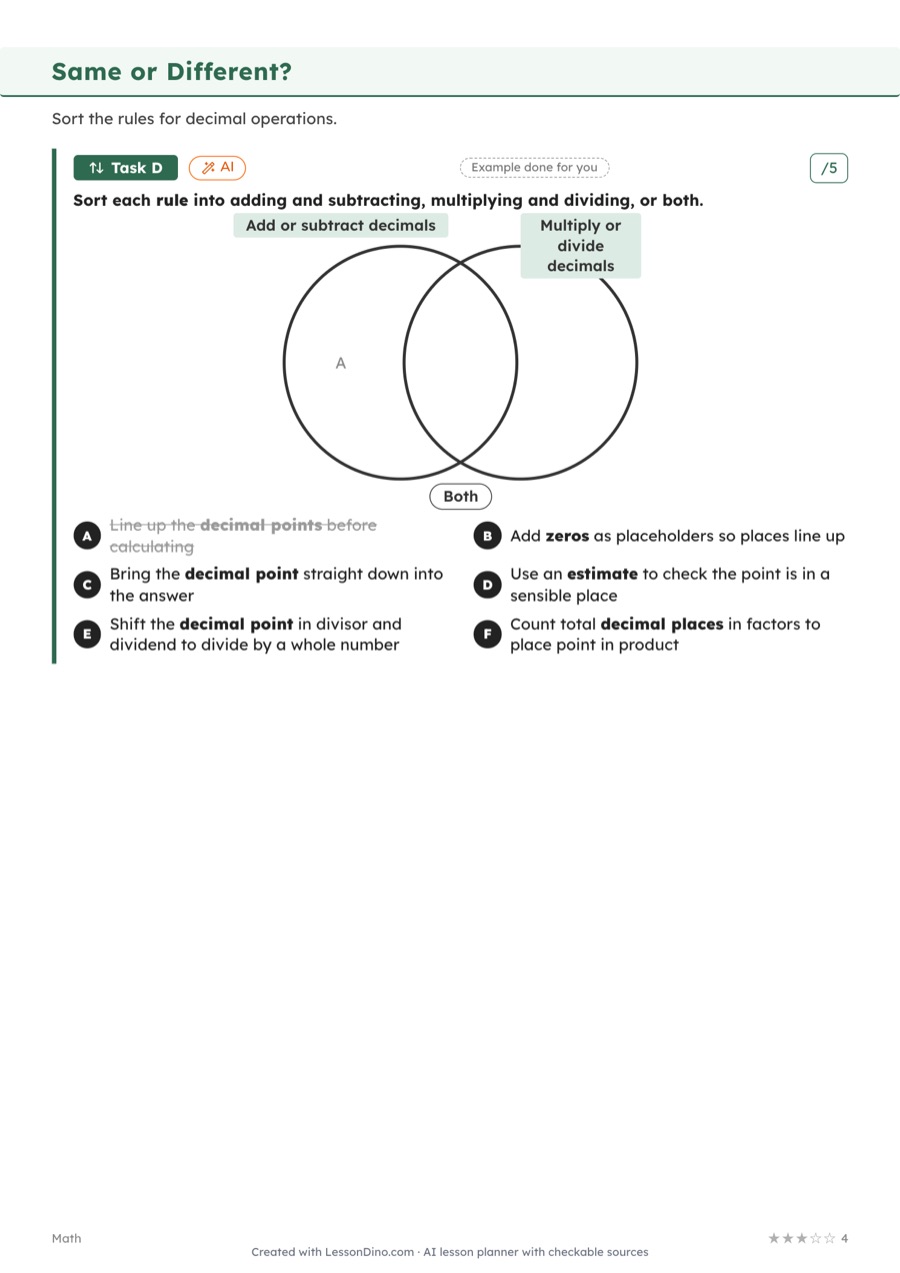
Same or Different?
Sort the rules for decimal operations.
Sort each rule into adding and subtracting, multiplying and dividing, or both.
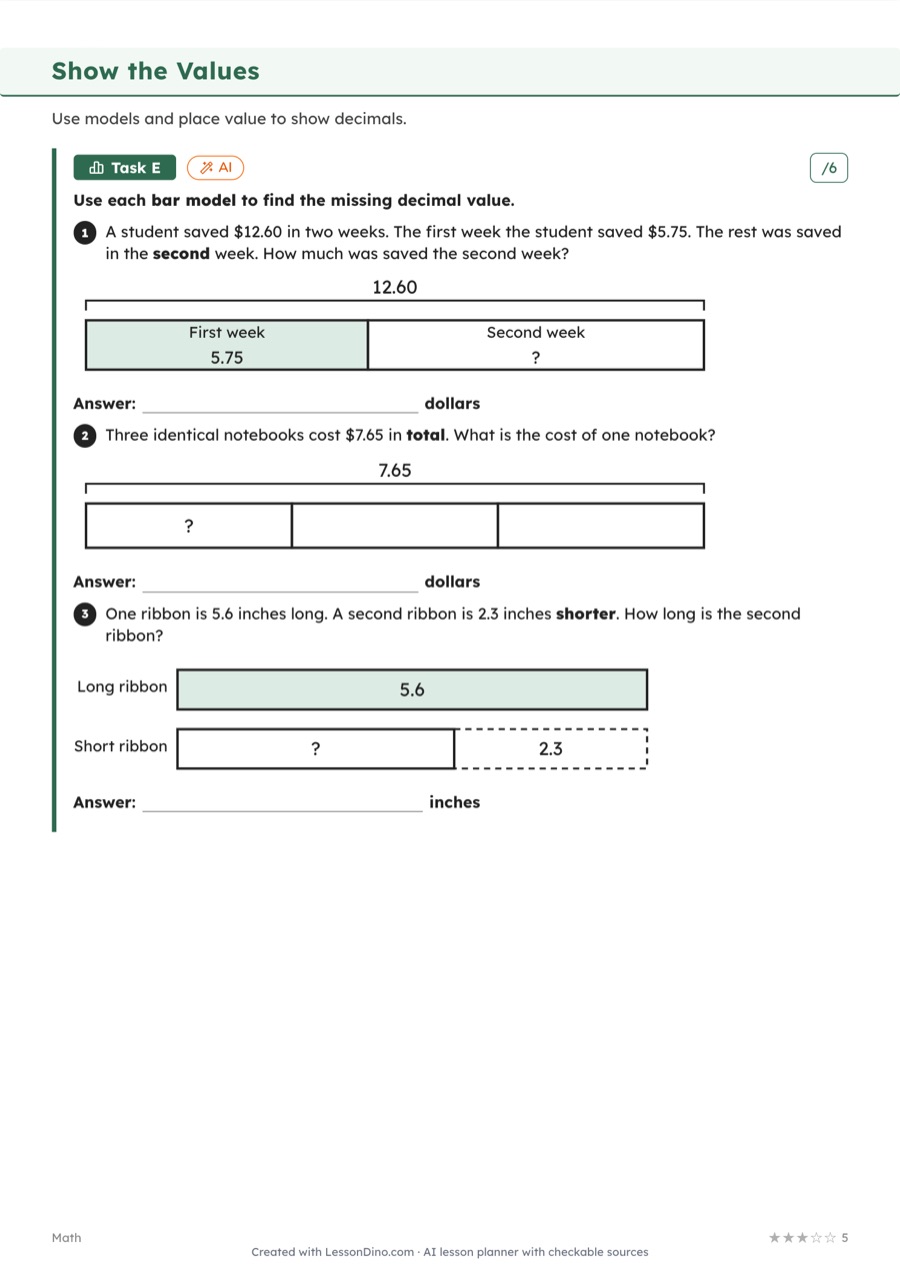
Show the Values
Use models and place value to show decimals.
Use each bar model to find the missing decimal value.
Page 6
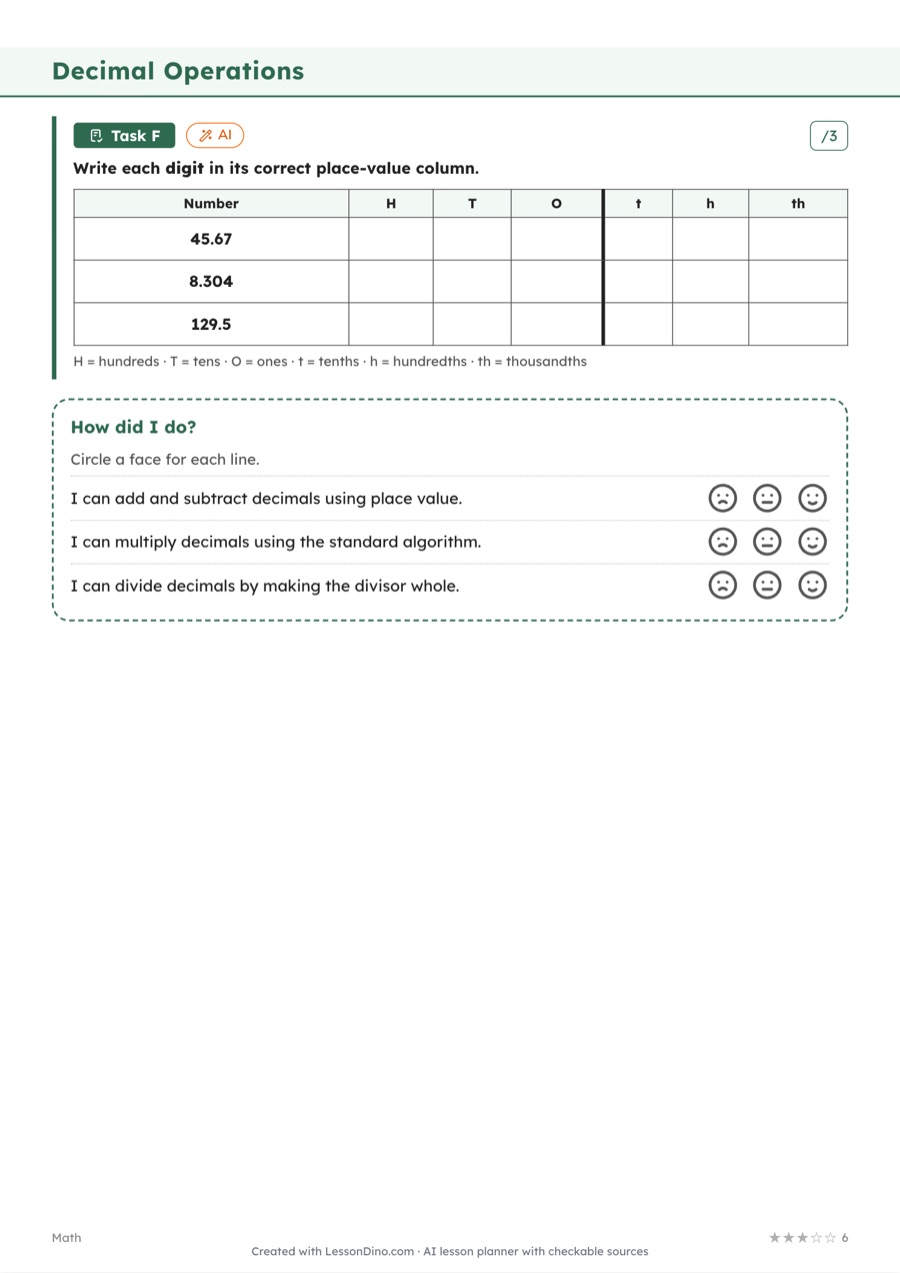
Write each digit in its correct place-value column.
Answers
Show the answers
- Work out 3.45 + 2.31 for the sum. 5.76
- Work out 7.8 - 4.2 for the difference. 3.6
- Work out 5.6 + 1.27 for the total. 6.87
- Work out 9.05 - 3.17 for the remainder. 5.88
- Work out 12.4 + 7.85. Show the lined-up addition. 20.25
- Work out 15.2 - 6.75. Show the regrouping. 8.45
- Work out 4.36 + 2.8 + 1.05 for the combined total. 8.21
- Find the missing number: 6.3 + ? = 10.02 3.72
- A student spent $3.45 on a notebook and $2.75 on pens. What is the total cost in dollars? 6.20
- A water bottle held 2.5 liters. A student drank 1.35 liters. How many liters are left? 1.15
- A student had $20.00. The student spent $7.85 on lunch and $5.25 on a book. How much change is left in dollars? 6.90
- Explain how you know you must line up decimal points to add 4.2 + 3.35, not line up the last digits. You line up decimal points so tenths add to tenths and hundredths to hundredths. Lining up last digits would add 2 tenths to 5 hundredths, which have different values.
- Work out 3.2 × 2 for the product. 6.4
- Work out 4.5 × 0.3 for the product. 1.35
- Work out 8.4 ÷ 4 for the quotient. 2.1
- Work out 7.5 ÷ 0.5 for the quotient. 15
- Work out 2.56 × 3 for the scaled total. 7.68
- Work out 1.24 × 2.5 for the area result. 3.10
- Work out 9.6 ÷ 0.8 for the equal groups. 12
- Work out 5.52 ÷ 1.2 for the precise quotient. 4.6
- Four packs of pencils cost $2.75 each. What is the total cost in dollars? 11.00
- A runner ran 6.3 miles in 1.5 hours. What is the average speed in miles per hour? 4.2
- A recipe needs 0.75 cup of sugar for one batch. How much sugar is needed for 2.4 batches in cups? 1.8
- A student says 2.5 × 1.2 = 30.0. Explain how you know the decimal point is wrong. 2.5 is between 2 and 3 and 1.2 is between 1 and 2, so the product is between 2 and 6. Counting places gives 1 + 1 = 2 places, so 300 becomes 3.00, not 30.0.
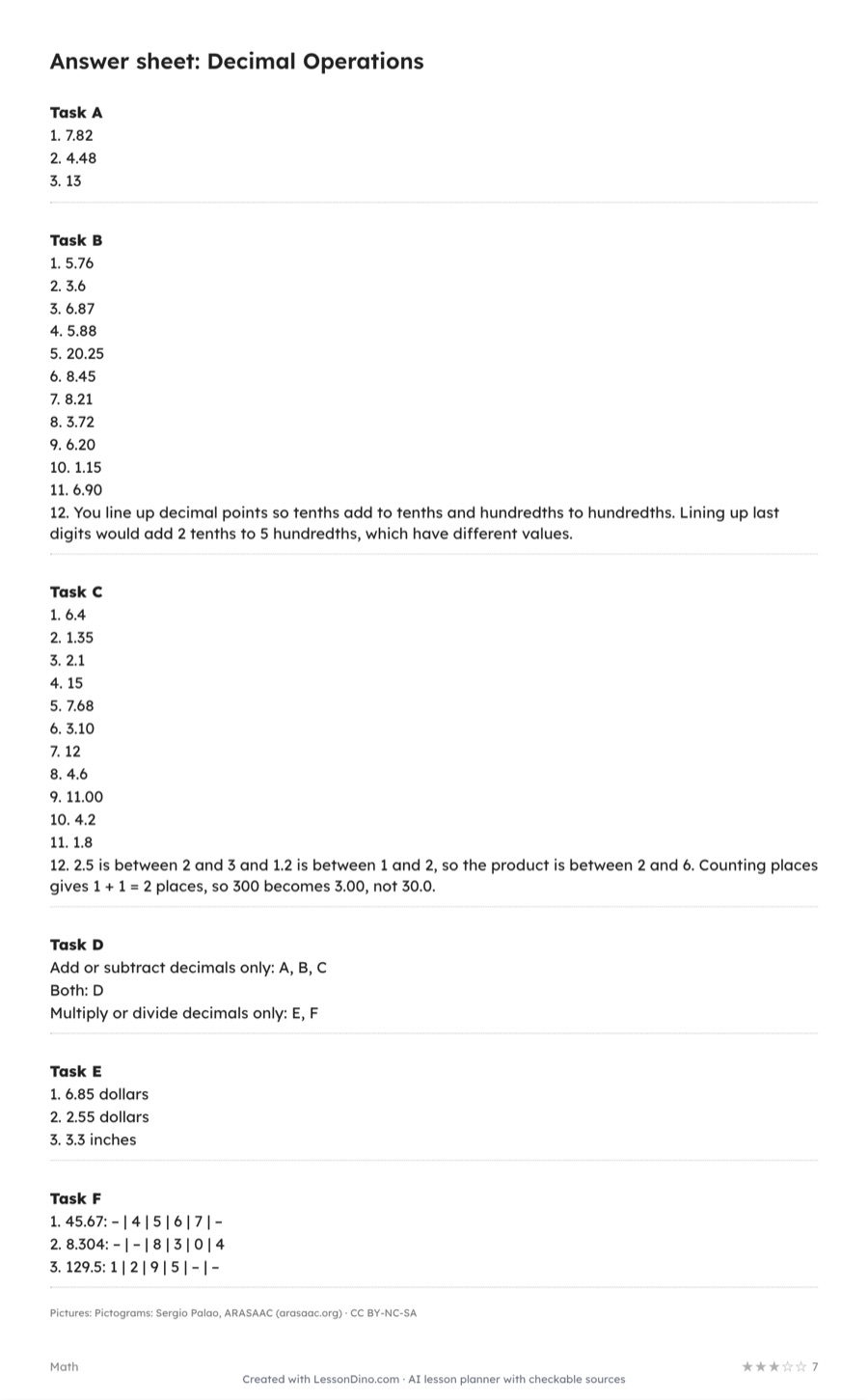
The answer sheet is the last picture above.
Curriculum
Fluently add, subtract, multiply, and divide multi-digit decimals using the standard algorithm for each operation.
Made with Lesson Dino's AI on 19 October 2026. AI can make mistakes, so check the answers and facts against the sources before you teach.