Slides
Lesson plan
Store Receipt Decimals
Students learn the standard ways to add, subtract, multiply, and divide decimals. They run a supply store and make a receipt that balances.
Objectives
- Students will add and subtract multi-digit decimals with the standard algorithm.
- Students will multiply multi-digit decimals with the standard algorithm fluently.
- Students will divide multi-digit decimals by making the divisor whole.
Success criteria
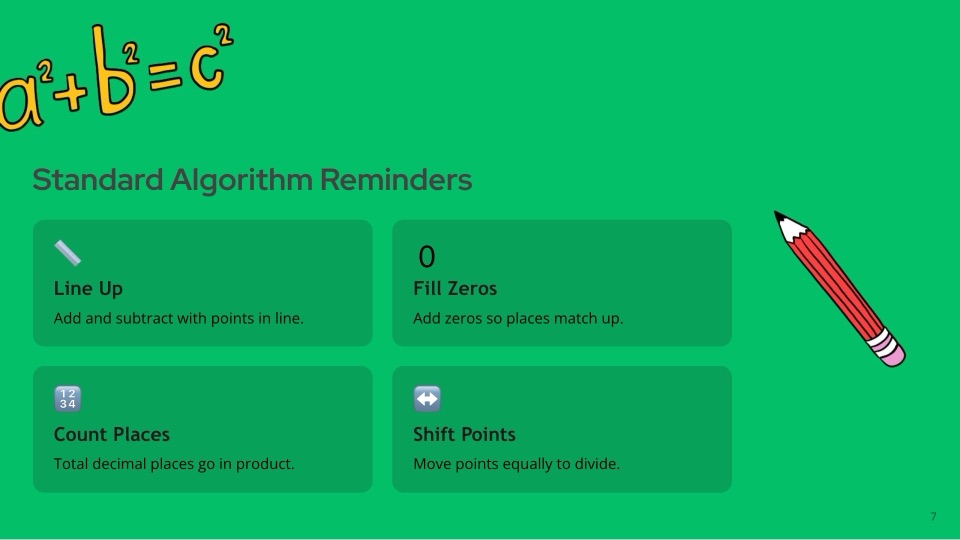
- I can line up points to add and subtract decimals.
- I can place the point correctly when I multiply.
- I can shift the point to divide decimals.
Key words
| Word | Meaning |
|---|---|
| decimal point | small dot that separates whole ones from tenths and smaller parts |
| dividend | number being split up in a sharing problem |
| divisor | number you share by in a sharing problem |
| quotient | answer you get after sharing equally |
| estimate | a close guess made before you work exactly |
Timed plan (60 minutes)
| Time | Stage | What happens |
|---|---|---|
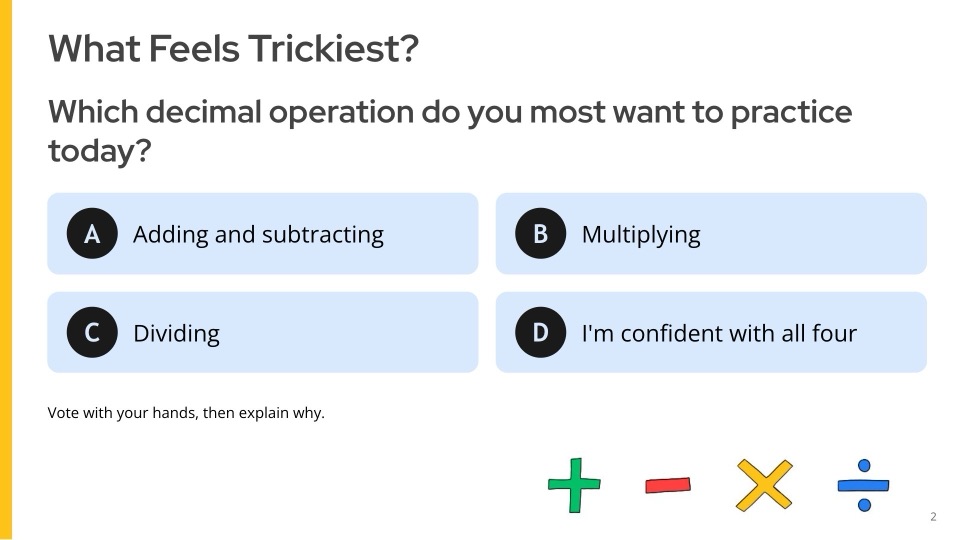
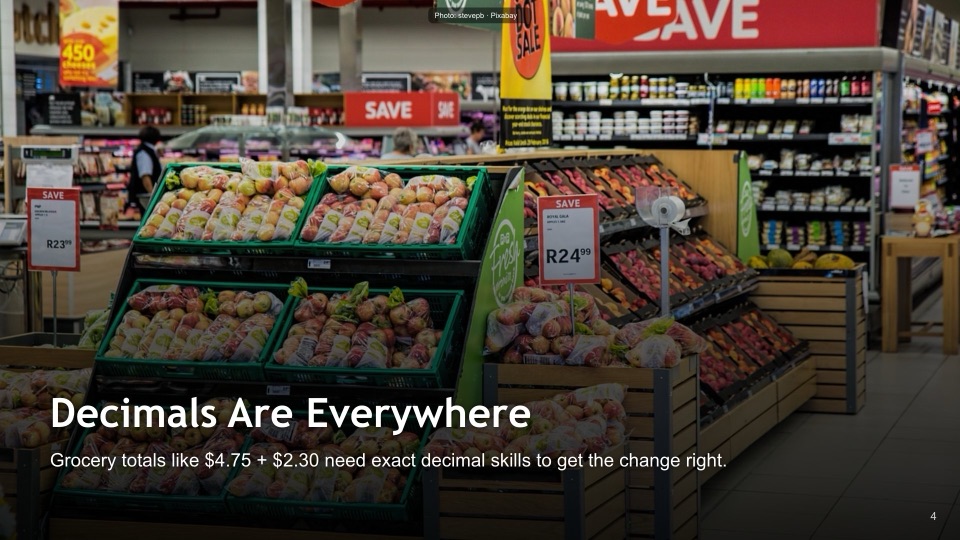
| 5 min | Starter | Hook with the store and surface which decimal operation needs practice. Show Slide 4 grocery photo and read the store hook. Show Slide 2 vote: Which decimal operation do you most want to practice today? Tally votes and link to goal: today we will use all four decimal operations with money. Preview the receipt task so students listen for each operation. |
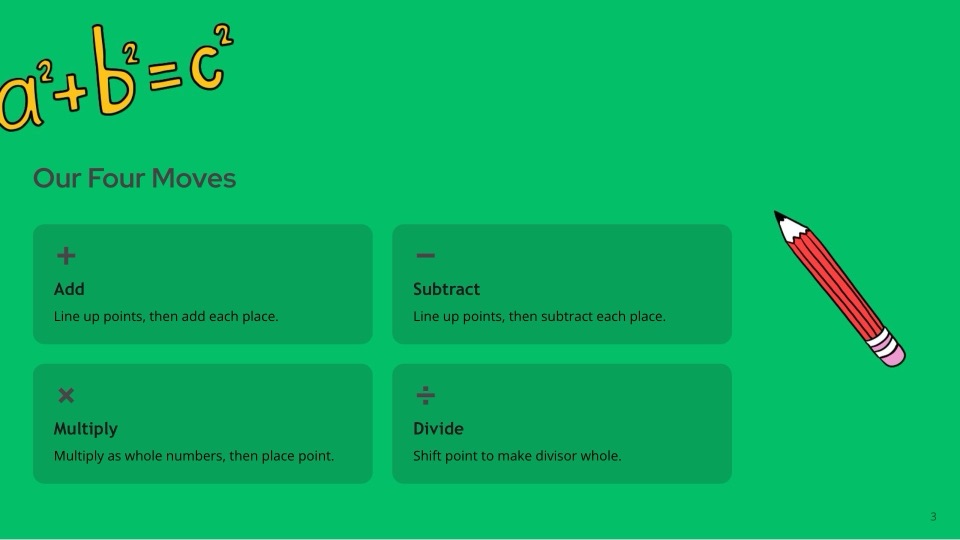
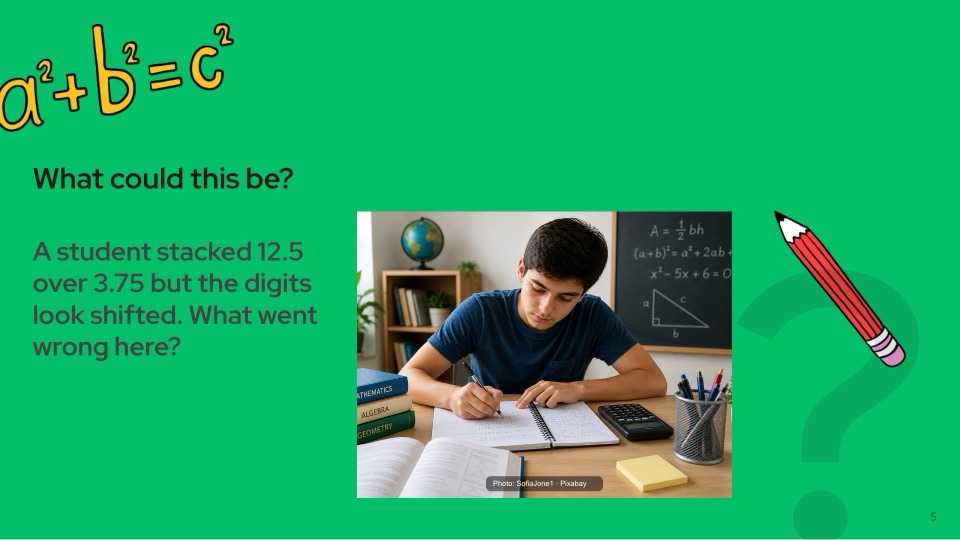
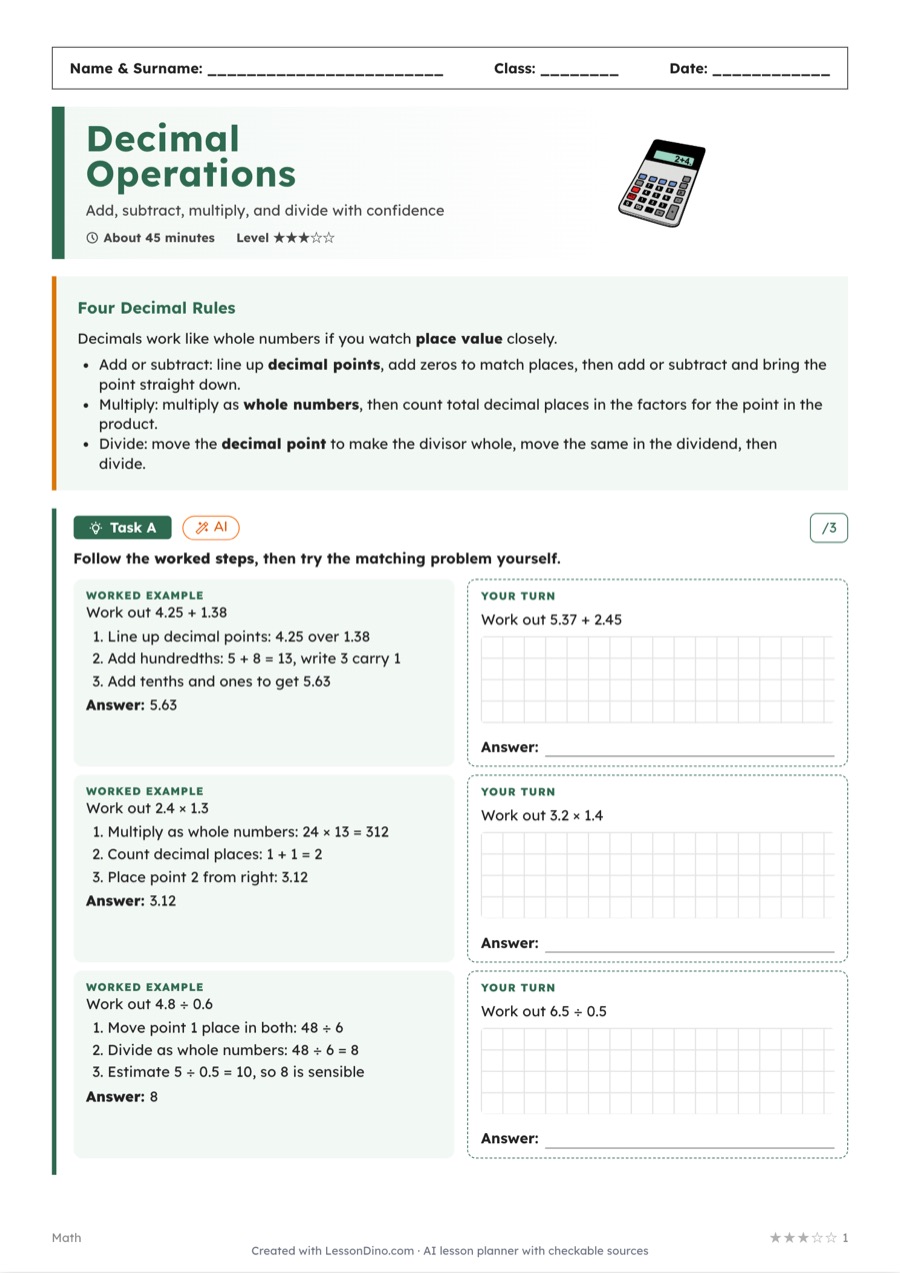
| 10 min | Teach Add and Subtract | Model lining up points and filling zeros for adding and subtracting. Show Slides 3, 5 and 7 and model lining up decimal points in a vertical list. Think aloud the mystery shift: points were not lined up, so tenths and hundredths got mixed. Model 4.275 + 2.36 by filling the gap with zero so places match. Students start Worksheet Task B for 3 minutes while teacher circulates. |
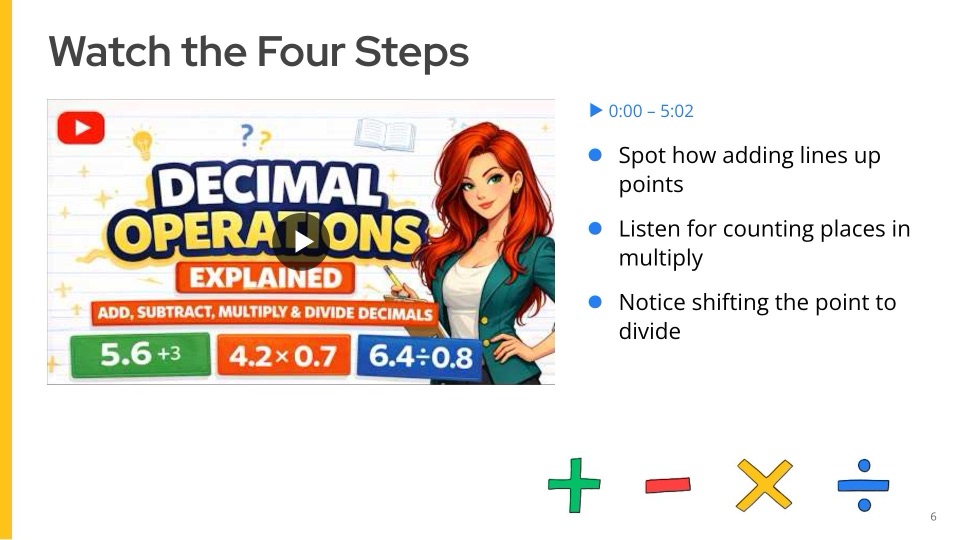
| 15 min | Teach Multiply and Divide | Model whole-number multiplication with point placement and shifting to divide. Play Video clip 1 on Slide 6 and tell students to spot lining up, counting places, and shifting. Model 4.25 x 1.6 as whole numbers, then count places for the product. Model 8.64 ÷ 2.4 by shifting to make the divisor an integer. Students try Worksheet Task C for 4 minutes while teacher checks point placement. |
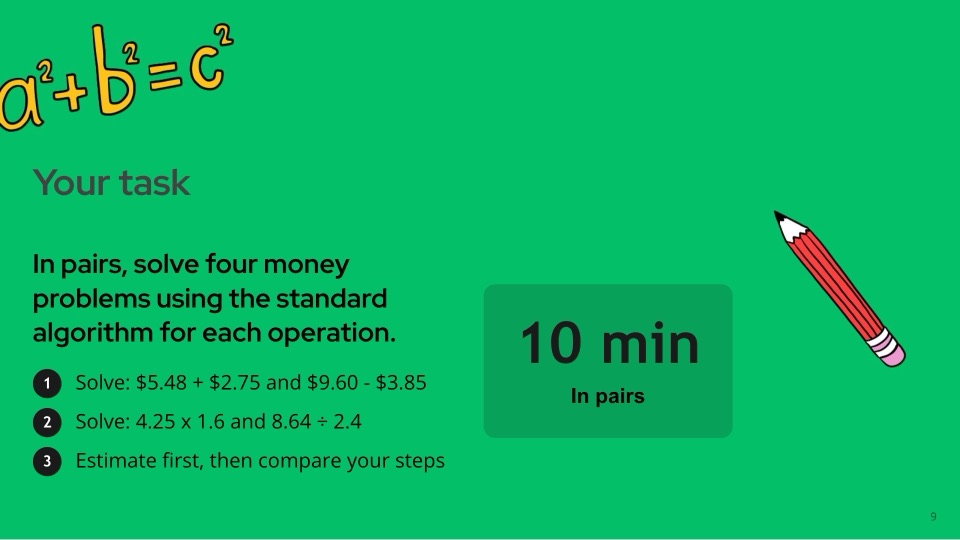
| 20 min | Main Activity | Use all four operations to build an exact store receipt. Hand out blank receipt forms, pencils, and colored pencils and show Slide 9 task. Give the price list: notebook $2.49, pen $3.75, eraser $0.65, pencil $1.15, pack $7.50. Require four lines: add $5.48 + $2.75, subtract $9.60 - $3.85, multiply 4.25 x 1.6 style, divide 8.64 ÷ 2.4 style with money. Circulate, check lined-up work and whole divisor, and stamp exact receipts. |
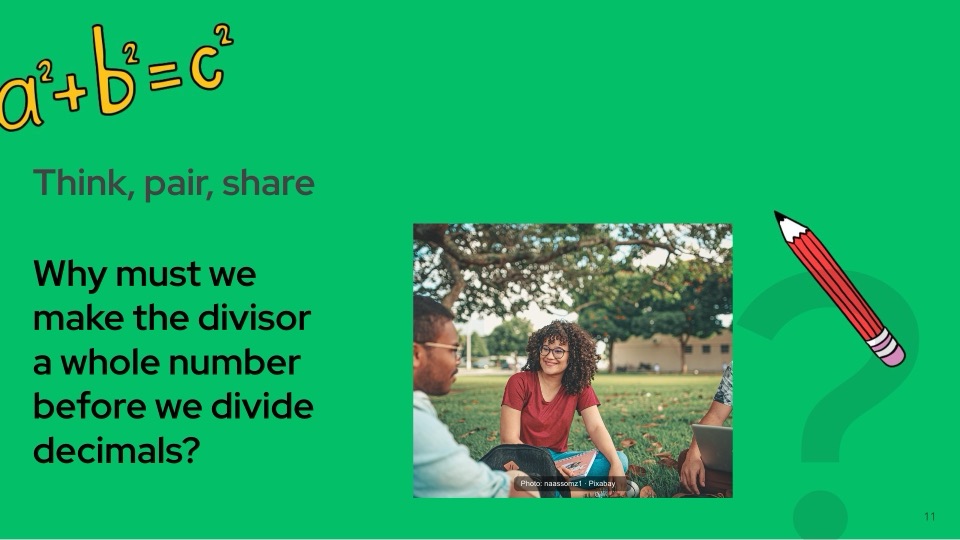
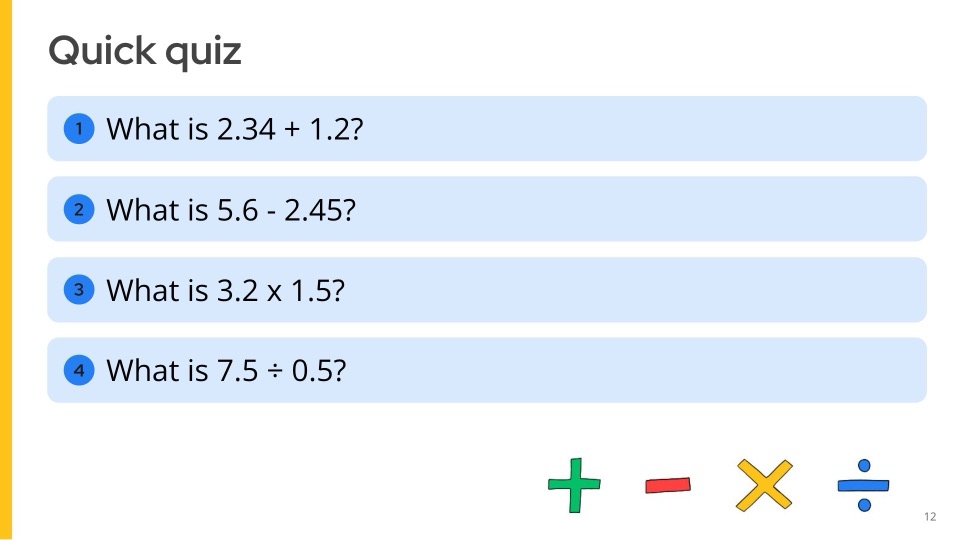
| 10 min | Plenary | Explain the division shift and check fluency with all four moves. Pose Slide 11: Why must we make the divisor a whole number before we divide decimals? Run think, pair, share for one sentence plus example like 0.8 ÷ 0.4 = 8 ÷ 4 = 2. Run Slide 12 quick quiz for the four operations. Close by linking each quiz answer back to the success lines. |
Common mistakes
- Lining up right edges instead of points for addition, mixing tenths and hundredths
How to spot it: Digits look shifted and thousandths column has mixed places
Rewrite in vertical list with points in line and fill gaps with zero so same-size pieces combine - Placing the product point by guessing instead of counting places
How to spot it: Answer 10 or 100 times too big, estimate far from exact
Recount digits to the right in each factor and add them for product places, then estimate to check - Dividing without making the divisor whole
How to spot it: Long division starts with a decimal divisor and point is misplaced
Rewrite as an equal fraction with a whole-number bottom by shifting both numbers the same places
Support
- Provide a price list with only hundredths and a worked receipt where gaps are filled with zero to line up places
Stretch
- Add a price per pound, like $2.485 for 2 pounds, and multiply to the thousandths place
Check questions
- What is 2.34 + 1.2?
Answer: 3.54 - What is 3.2 x 1.5?
Answer: 4.8 - What is 7.5 ÷ 0.5?
Answer: 15
Curriculum
Fluently add, subtract, multiply, and divide multi-digit decimals using the standard algorithm for each operation.
Video clips
Clips on YouTube, from the start and end times we chose. Check each one before you show it.
-
All four decimal operations overview from 0:00 to 5:02
LearningHubX: Decimal Operations Explained | Add, Subtract, Multiply & Divide Decimals
Covers adding, subtracting, multiplying, and dividing decimals with clear steps at a pace and vocabulary ideal for ages 11-12.
-
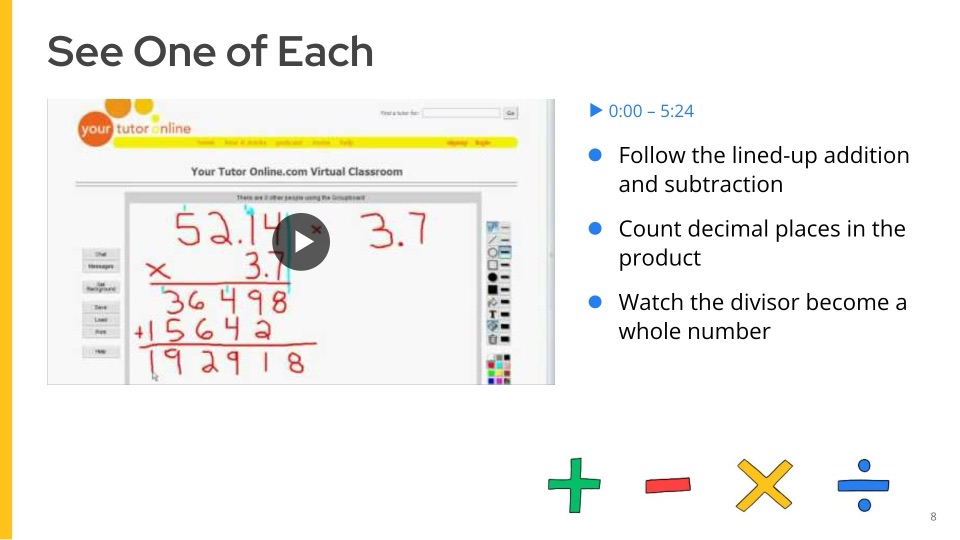
Add, subtract, multiply, divide examples from 0:00 to 5:24
Joel Tutors Math: All About Decimals - add, subtract, multiply and divide
Shows one worked example of each operation with simple language that suits Grade 6 ages 11-12.
Worksheet
Sources
- SST Grade 6 Mathematics TEKS - Texas Education Agency tea.texas.gov
- Grade 6 Advanced Math Curriculum What is taught in grade 6 Advanced Mathematics? fcps.edu
- Operations on Decimals – Mathematics for Elementary Teachers pressbooks-dev.oer.hawaii.edu
- OPERATIONS WITH DECIMALS - concord.edu concord.edu
- Operations on Decimals - Mathematics for Elementary Teachers open.maricopa.edu
- Arithmetic procedures with integers and decimals KS3 | Y7 ... thenational.academy
- Divide decimals | 5th grade math | Khan Academy learnstormindia.khanacademy.org
- How to add and subtract decimals - BBC Bitesize bbc.co.uk
- Dividing with decimals KS3 | Y7 Maths | Lesson Resources thenational.academy
Picture credits
- Illustration: Elf-Moondance · Pixabay
- Photo: stevepb · Pixabay
- Photo: SofiaJone1 · Pixabay
- Photo: danydory · Pixabay
- Photo: naassomz1 · Pixabay
- Pictograms: Sergio Palao, ARASAAC (arasaac.org) · CC BY-NC-SA
Made with Lesson Dino's AI on 19 October 2026. AI can make mistakes, so check facts against the sources before you teach.