Slides

Lesson plan
Three Jobs: Join, Place, and Feeling Words
Students learn the jobs of conjunctions, prepositions, and interjections. They sort words in sentences and explain each job.
Objectives
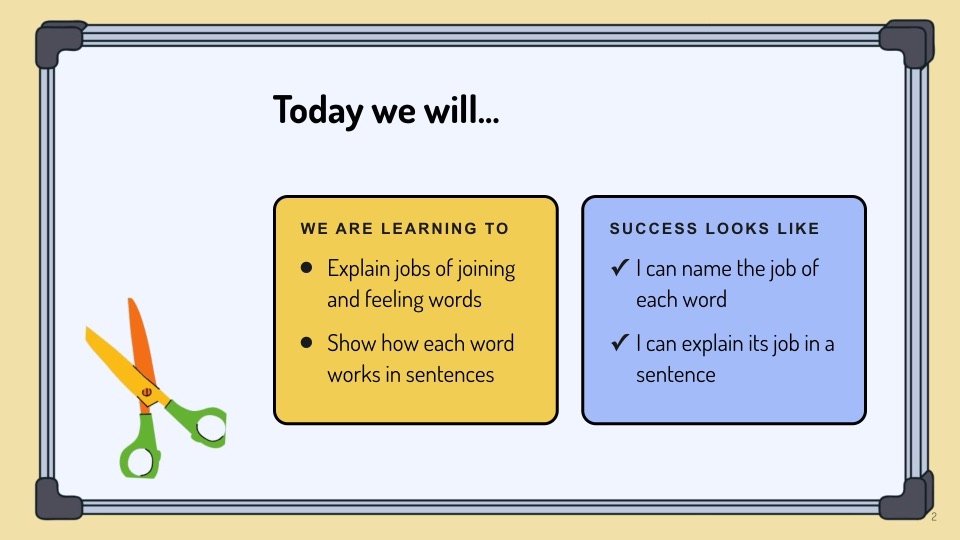
- Students will explain the general jobs of conjunctions, prepositions, and interjections.
- Students will tell the job of a target word in particular grade-level sentences.
- Students will use and, but, or, because, and when to join ideas clearly.
Success criteria
- I can name the job of a conjunction, preposition, and interjection.
- I can explain what a joining or feeling word does in my sentence.
- I can join two short ideas with the correct conjunction.
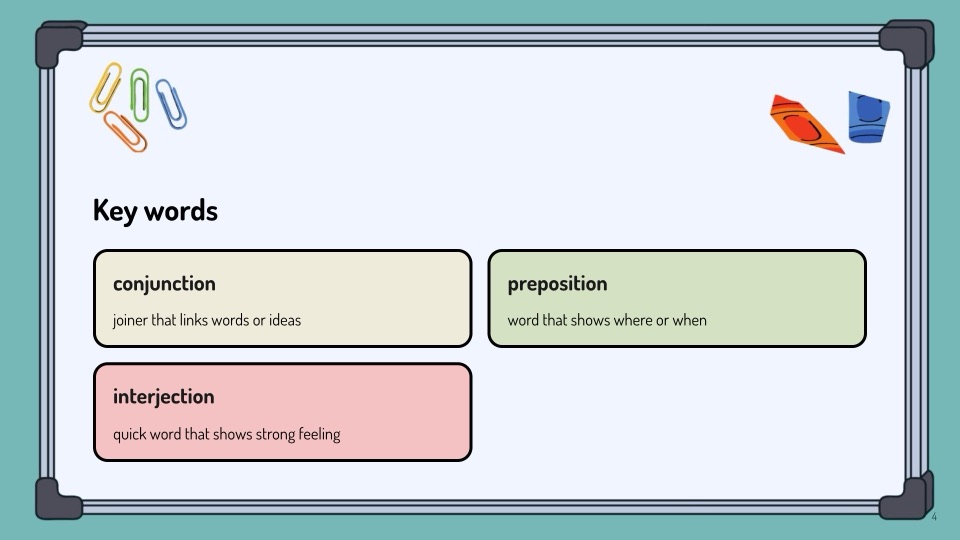
Key words
| Word | Meaning |
|---|---|
| conjunction | a joiner that links words, phrases, or clauses together |
| preposition | a word that tells where, when, or how things relate |
| interjection | a short outburst that shows surprise, greeting, or strong feeling |
| subordinating conjunction | a joiner that hooks a dependent idea onto a main sentence part |
Timed plan (60 minutes)
| Time | Stage | What happens |
|---|---|---|
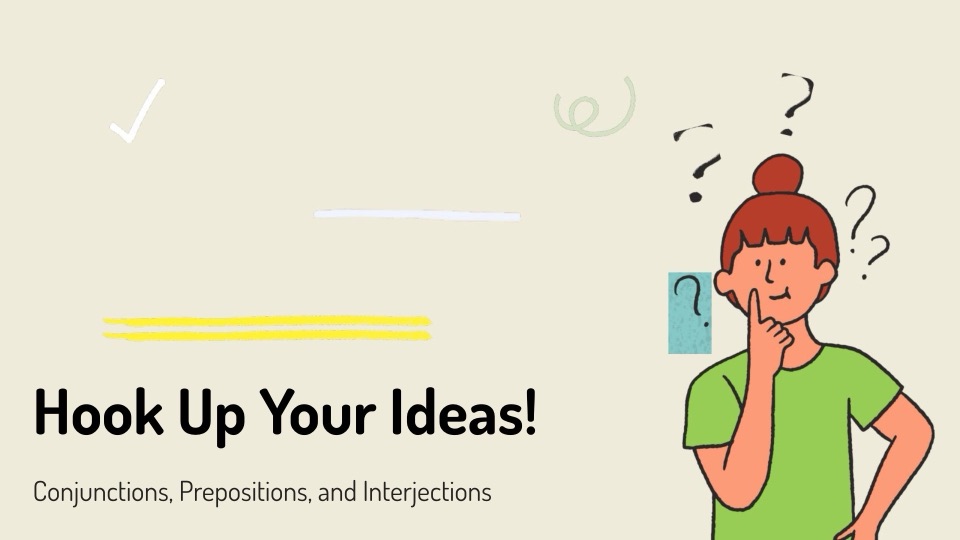
| 7 min | Starter | Hook students and surface what they know about joining words. Welcome class and say the hook line with energy and pause for guesses. Show Slide 1 Hook Up Your Ideas! and read its focus on Conjunctions, Prepositions, and Interjections. Show Slide 5 mystery text and read it aloud word for word with class. Collect 3-4 quick guesses and link answers to prior knowledge of and, but, or. |
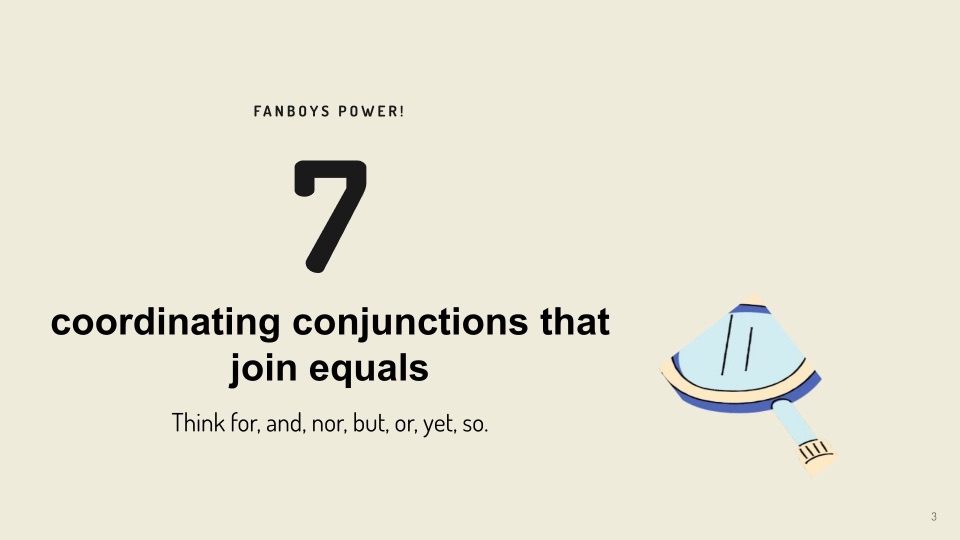
| 12 min | Mini-lesson | Teach the three jobs and model how to name a word's job in a sentence. Show Slide 4 Key words and teach each job in simple terms. Show Slide 3 FANBOYS Power! and explain coordinating conjunctions join equals. Show Slide 10 Bridges Join Sides photo and compare bridge to conjunction. Model worked example on board, thinking aloud through join, place, or feeling. |
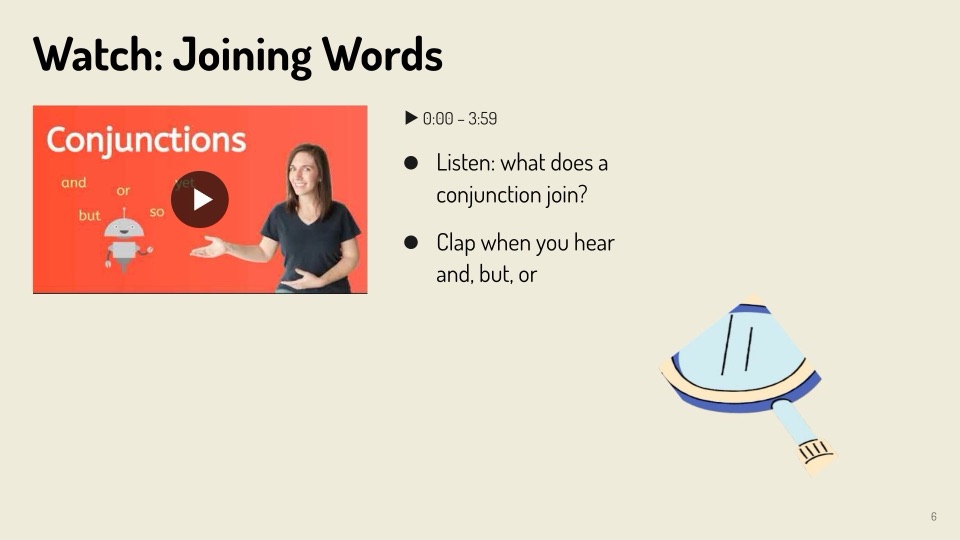
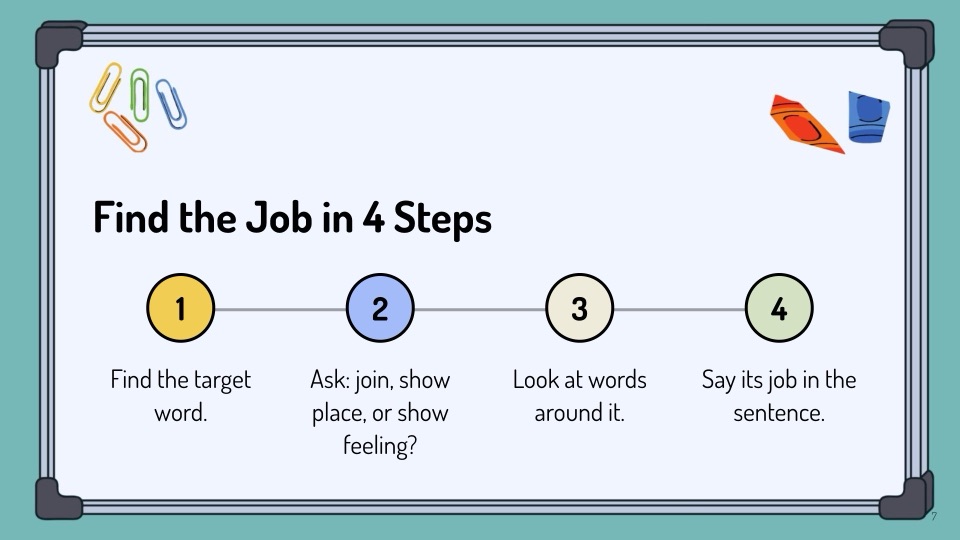
| 11 min | Watch and Try | See conjunctions joining ideas and practice the 4-step job check together. Show Slide 6 Watch: Joining Words and play Video clip 1 from 0:00-3:59. Pause twice for students to clap when they hear and, but, or. Show Slide 7 Find the Job in 4 Steps and model steps with after sentences. Guide class to decide why after changes jobs in two sentences. |
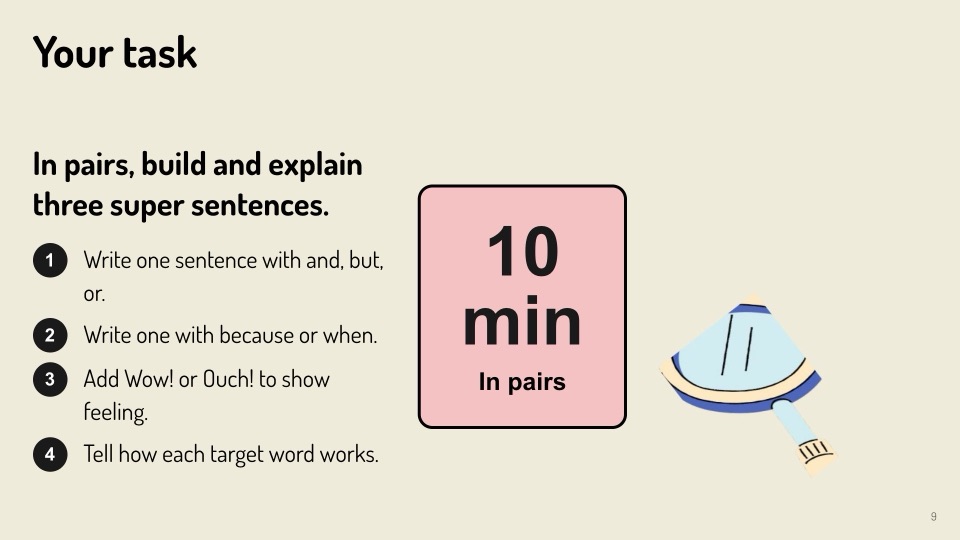
| 20 min | Main activity - Three Jobs Sort | Sort words by job and explain the function in particular sentences. Hand out sorting mats with Connects, Shows place or time, Shows feeling and 6 strips. Model one sort aloud with sentence 1, placing because under Connects and Wow! under Shows feeling. Send groups to sort 6 strips, then choose one strip to explain like detectives. Circulate, ask why, and call two groups to share their explanation. |
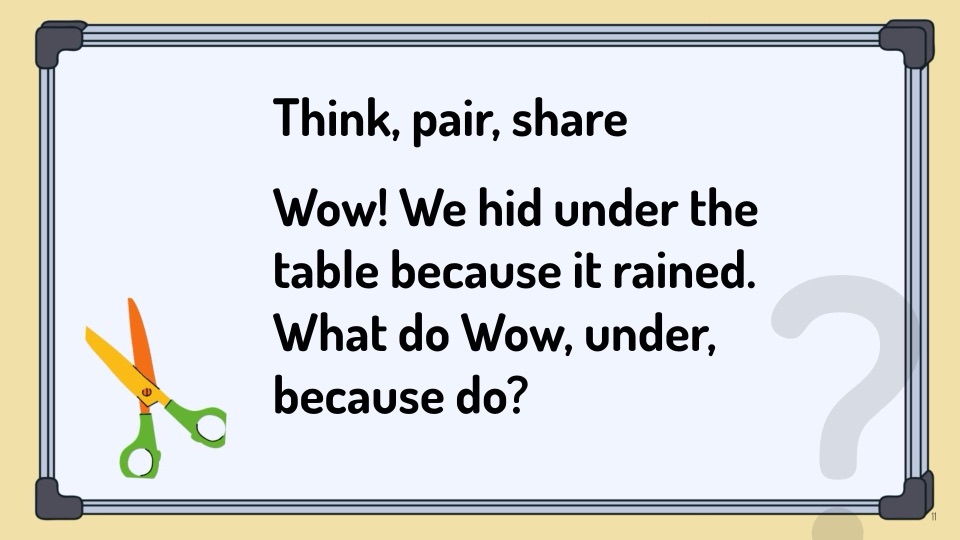
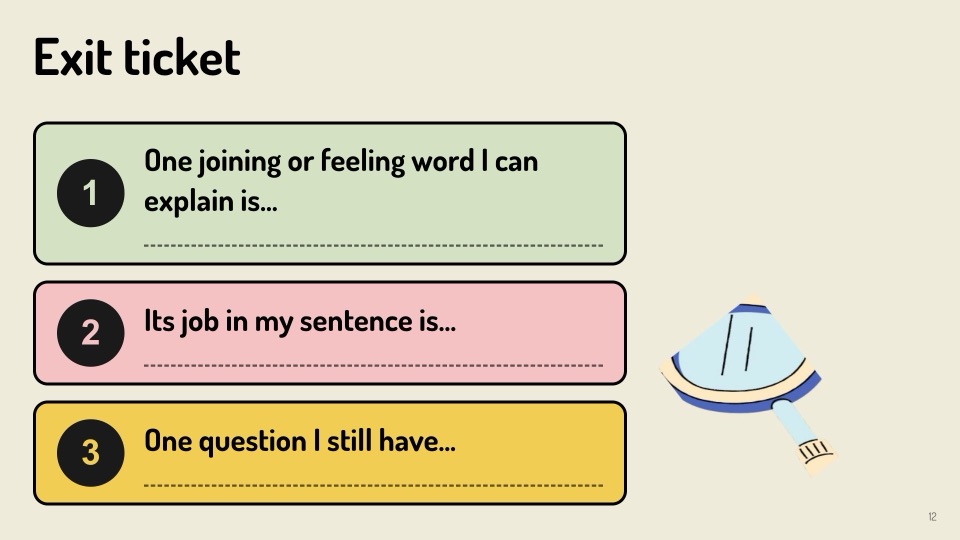
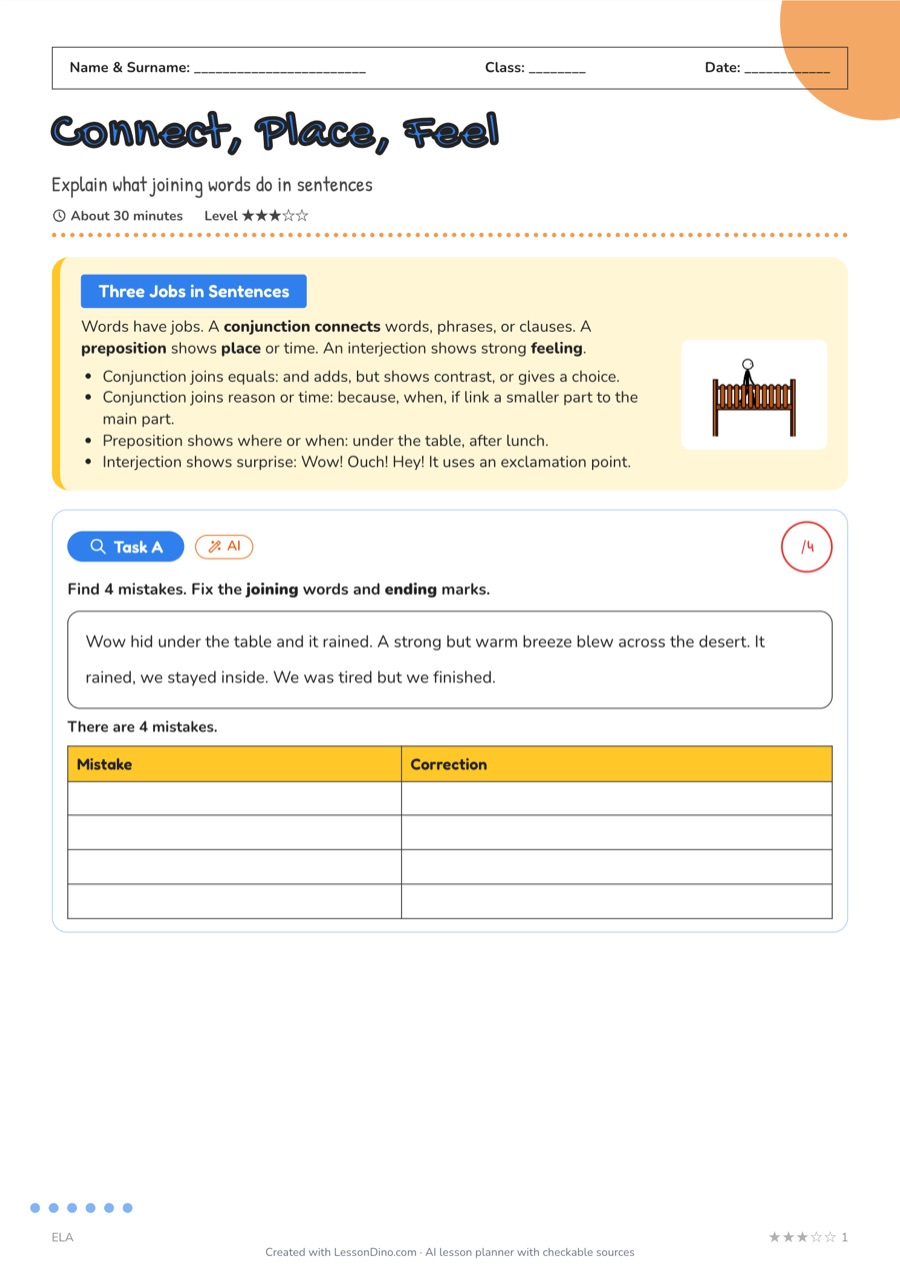
| 10 min | Plenary | Review the three jobs and check each student can explain one word. Show Slide 11 and read the think-pair-share sentence aloud. Give 2 minutes for Think, pair, share on what Wow, under, because do. Hand out Worksheet Task F Fill the blanks and do first blank together. Collect exit slips using Slide 12 prompts as final check. |
Common mistakes
- Thinking a word like after or before is always the same part of speech.
How to spot it: Student labels after as preposition even when it joins two verbs.
Use look-around test: if a verb follows, it connects actions so it is a conjunction in this sentence. - Calling any feeling word a conjunction or missing the exclamation point.
How to spot it: Student says Wow is joining two ideas.
Remind interjections convey greeting or show surprise and are usually followed by an exclamation point. Ask: does it join or just burst out? - Joining two full sentences with only a comma and no joiner.
How to spot it: Writes It rained, we stayed inside.
Add conjunction and comma: It rained, so we stayed inside. Teach when connecting two independent clauses with a coordinating conjunction, a comma must be placed before the conjunction.
Support
- Use hint cards with and = add, but = different, or = pick and interjection list Wow! Ouch! Hey!
- Pre-mark one strip as model and limit hunt to because, when, if for overwhelmed groups
- Offer sentence frames: ___ is a ___ in this sentence because it ___
Stretch
- Rewrite a sorted sentence by swapping and / but / so and explain meaning flip
- Move a because or when clause to front or back and check sense and comma
- Build a not only...but also sentence with two verbs and name the two equal parts joined
Check questions
- In We were tired but we finished, what is but and what is its job?
Answer: But is a conjunction that joins and shows contrast between tired and finished. - In Ouch! The box is under the desk, what are Ouch! and under?
Answer: Ouch! is an interjection showing feeling; under is a preposition showing place. - In We stayed inside because it snowed, what does because do?
Answer: Because is a subordinating conjunction that joins the reason to the main part.
Curriculum
Explain the function of conjunctions, prepositions, and interjections in general and their function in particular sentences.
Video clips
Clips on YouTube, from the start and end times we chose. Check each one before you show it.
-
Let's Learn About Conjunctions from 0:00 to 3:59
Miacademy & MiaPrep Learning Channel: Let's Learn About Conjunctions
Clear upper-elementary explanation perfect for 10-11-year-olds learning conjunction function.
-
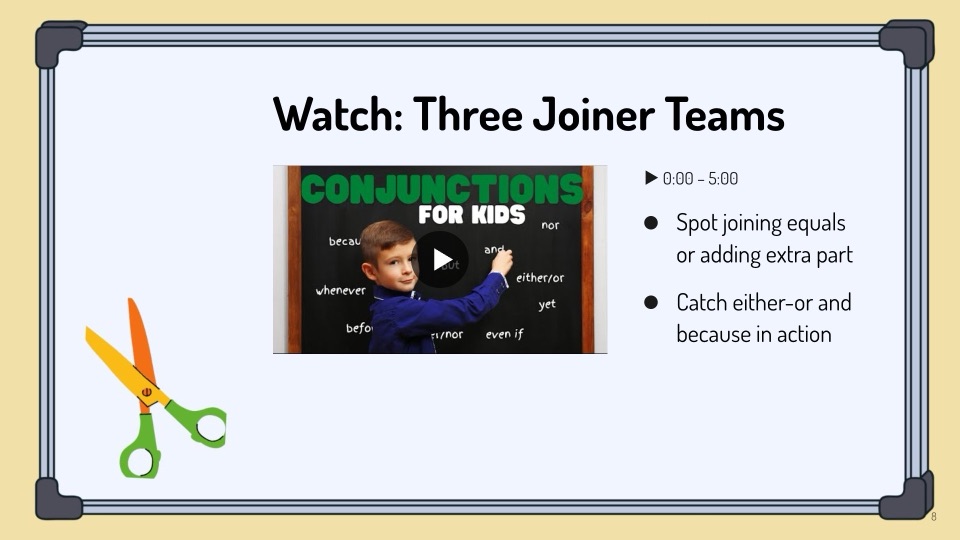
coordinating, subordinating, correlative from 0:00 to 5:00
Learn Bright: Conjunctions for Kids | Learn about coordinating, correlative, and subordinating conjunctions
Covers all three types at the right vocabulary and pace for 10-11-year-olds in Grade 5.
Worksheet
Sources
- English Language Arts Standards » Language » Grade 5 thecorestandards.org
- English Language Arts Standards » Language » Grade 5 » 1 » a thecorestandards.org
- Conjunctions - University of New Hampshire unh.edu
- Conjunctions - Excelsior OWL owl.excelsior.edu
- Conjunctions and Interjections – College Reading & Writing: A ... pressbooks.howardcc.edu
- Conjunctions unh.edu
- Conjunctions | Writing Center writing-center.phsc.edu
- Learn about conjunctions and how they are used. - BBC Bitesize bbc.co.uk
- Using conjunctions to join ideas - KS1 English - Learning ... bbc.co.uk
- Conjunction Facts for Kids kids.kiddle.co
- Conjunction (grammar) Facts for Kids kids.kiddle.co
- Conjunctions for Kids - Grammar Monster grammar-monster.com
- Conjunctions for Kids: Types, Examples, Rules, and Practice engrary.com
- What Are Conjunctions? | Grammar for Kids kidsworldfun.com
- Conjunction Words List for Kids: A Complete Guide to ... grammardiary.com
- Types of Conjunctions in English: What is a Conjunction? eslkidsworld.com
- G Conjunctions english.acadiau.ca
- What are Conjunctions | Definition & Examples | Twinkl twinkl.co.uk
- Conjunctions - Fifth Grade ELA fifthgradeela.weebly.com
- Conjunctions in English | Definition, Types & Rules study.com
Picture credits
- Illustration: Clker-Free-Vector-Images · Pixabay
- Photo: Christian David · CC BY-SA 4.0 · Wikimedia Commons
- Pictograms: Sergio Palao, ARASAAC (arasaac.org) · CC BY-NC-SA
Made with Lesson Dino's AI on 17 October 2026. AI can make mistakes, so check facts against the sources before you teach.