Slides
Lesson plan
Reading Detectives Prove the Main Idea
Students learn to find the main idea and use details as proof. They make posters that show the big idea with pictures and words.
Objectives
- Students will determine the main idea of an informational text in one sentence.
- Students will recount key details and explain how they support the main idea.
Success criteria
- I can tell the main idea of the text in one sentence.
- I can recount two key details from the text.
- I can explain how each detail proves the main idea.
Key words
| Word | Meaning |
|---|---|
| main idea | what a whole text is mostly about |
| key details | important facts and examples that tell more about the topic |
| support | to show with proof why something is true |
| recount | to tell again in your own words what you read |
Timed plan (60 minutes)
| Time | Stage | What happens |
|---|---|---|
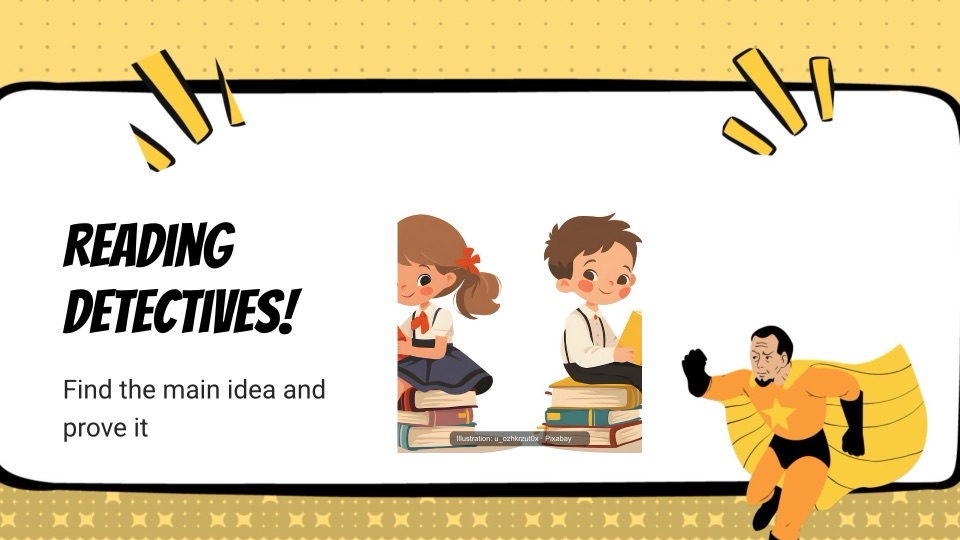
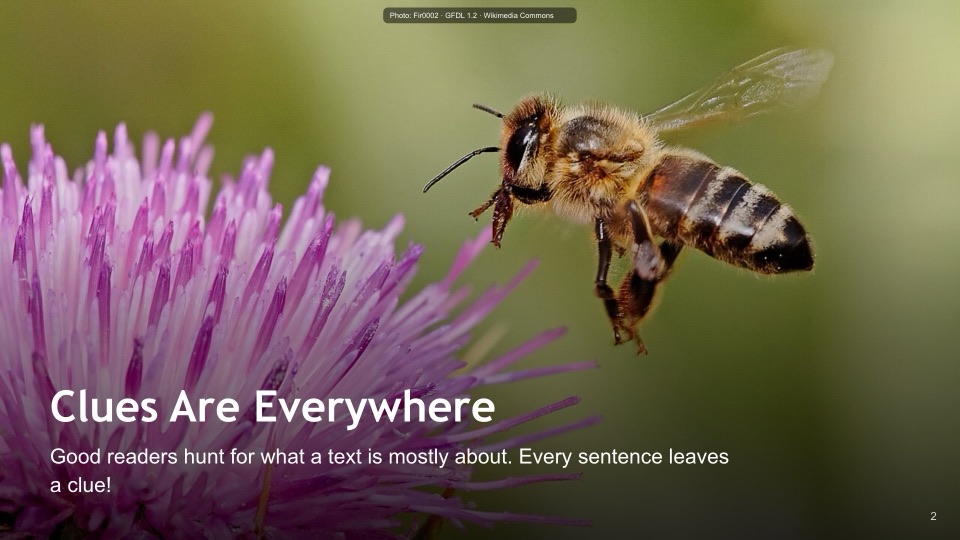
| 5 min | Starter | Hook students and recall that good readers ask what a text is mostly about. Show Slide 1 Reading Detectives! Find the main idea and prove it and read it aloud. Show Slide 2 photo and say good readers hunt for what a text is mostly about. Say the poster hook and point to large paper to build excitement. Ask partners to whisper what their poster will need in the middle and around it. |
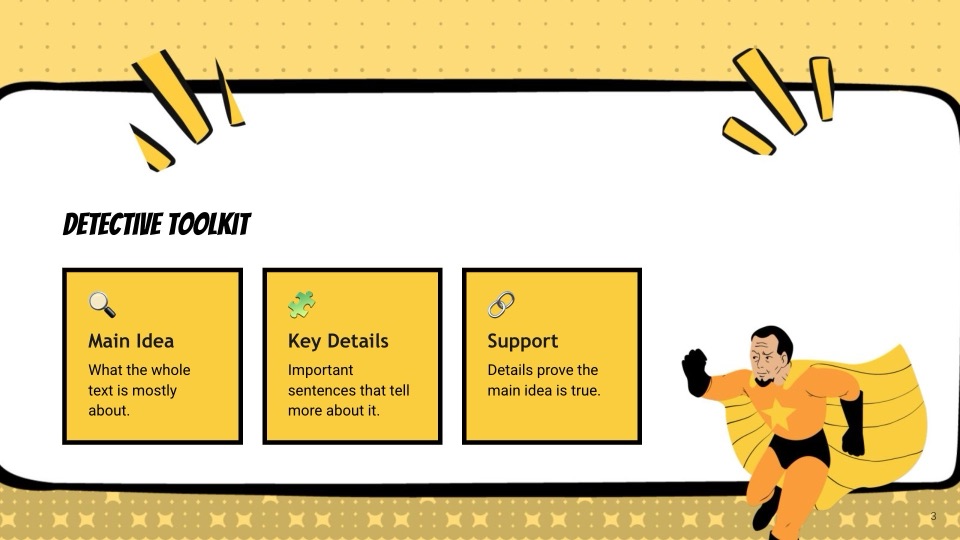
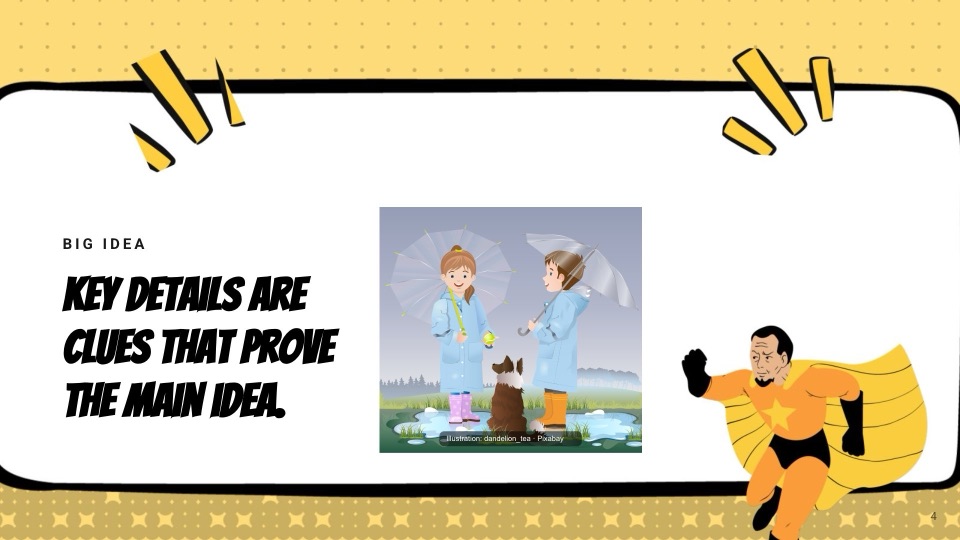
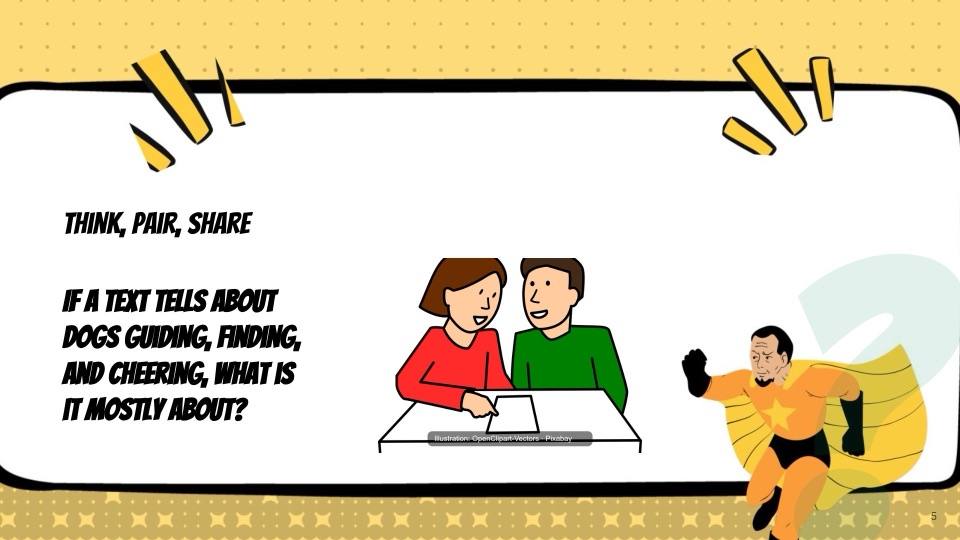
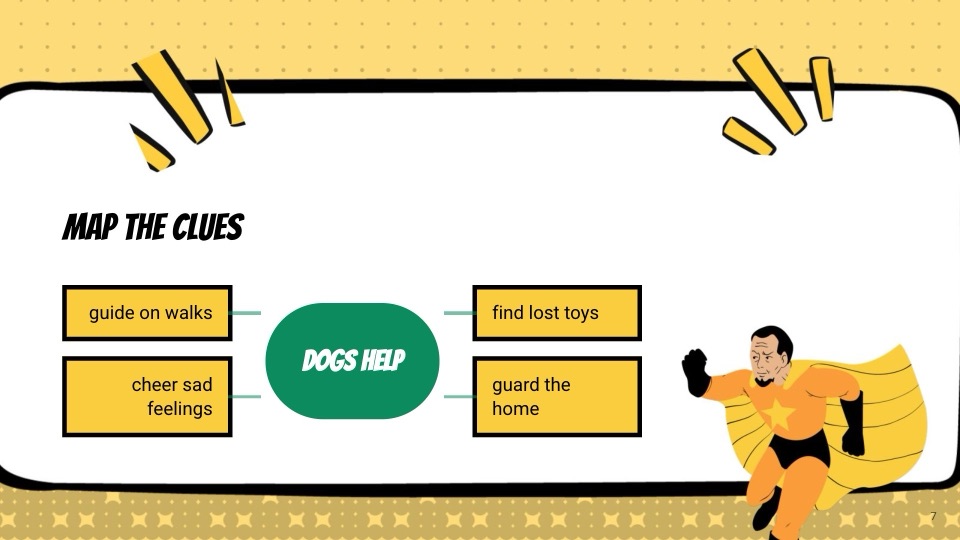
| 10 min | Teaching | Model how the main idea covers all details and details prove it. Show Slide 3 Detective Toolkit and read the three cards aloud. Show Slide 4 statement Key details are clues that prove the main idea and explain it. Show Slide 7 mindmap and think aloud through the dog clues. Ask the Slide 5 question and fix the main idea into one sentence. |
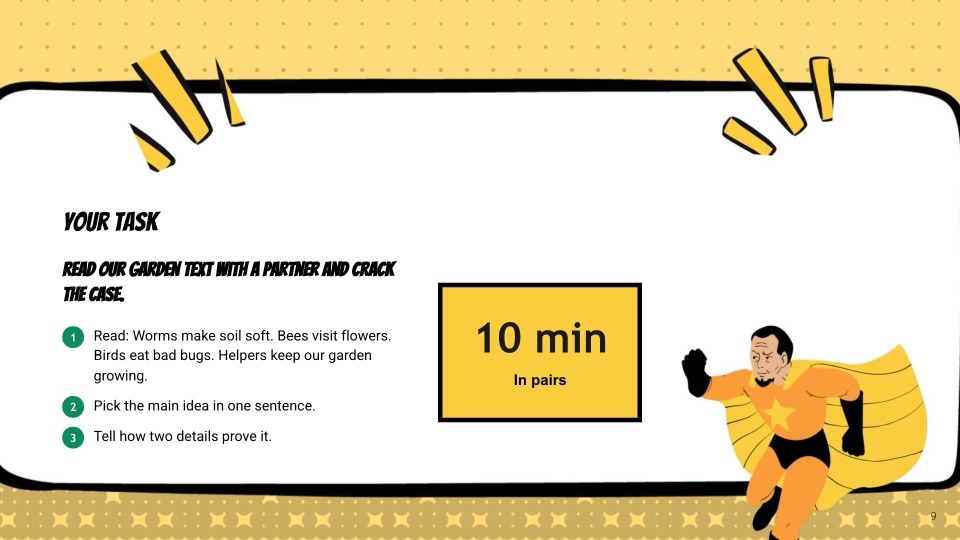
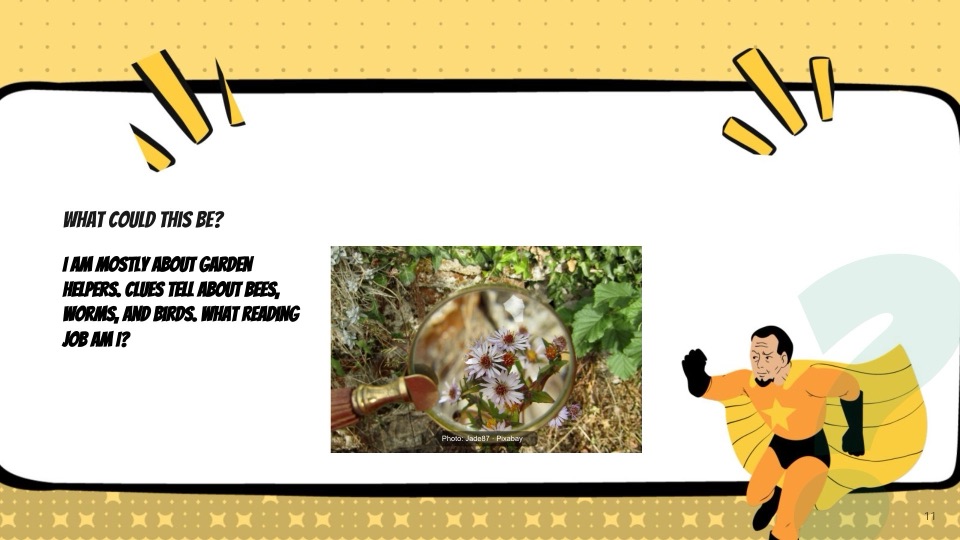
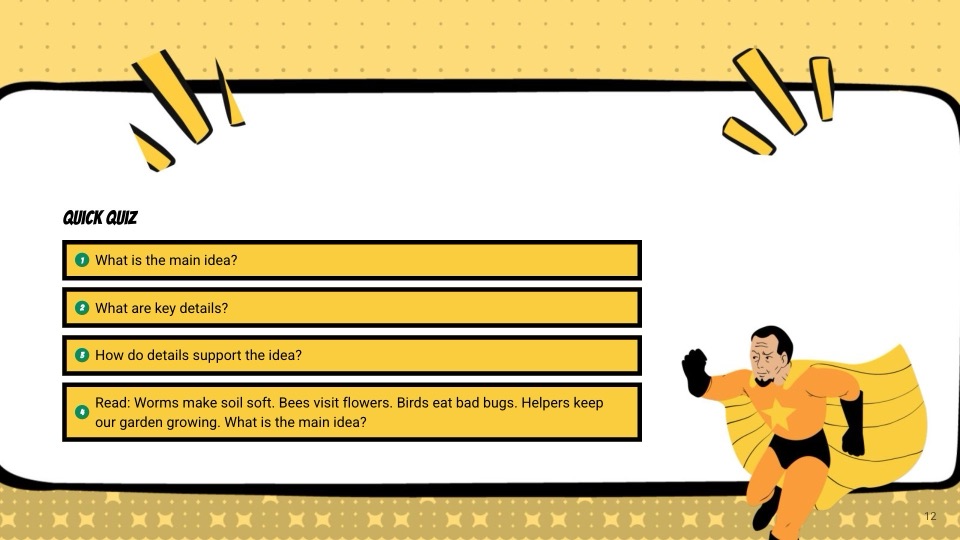
| 15 min | Guided Practice | Practise finding the main idea and linking two details to it together. Project Slide 9 and read aloud: Worms make soil soft. Bees visit flowers. Birds eat bad bugs. Helpers keep our garden growing. Ask what two words describe the general idea to stay focused. Model picking the main idea in one sentence from the last sentence. Model how two details support it with because. |
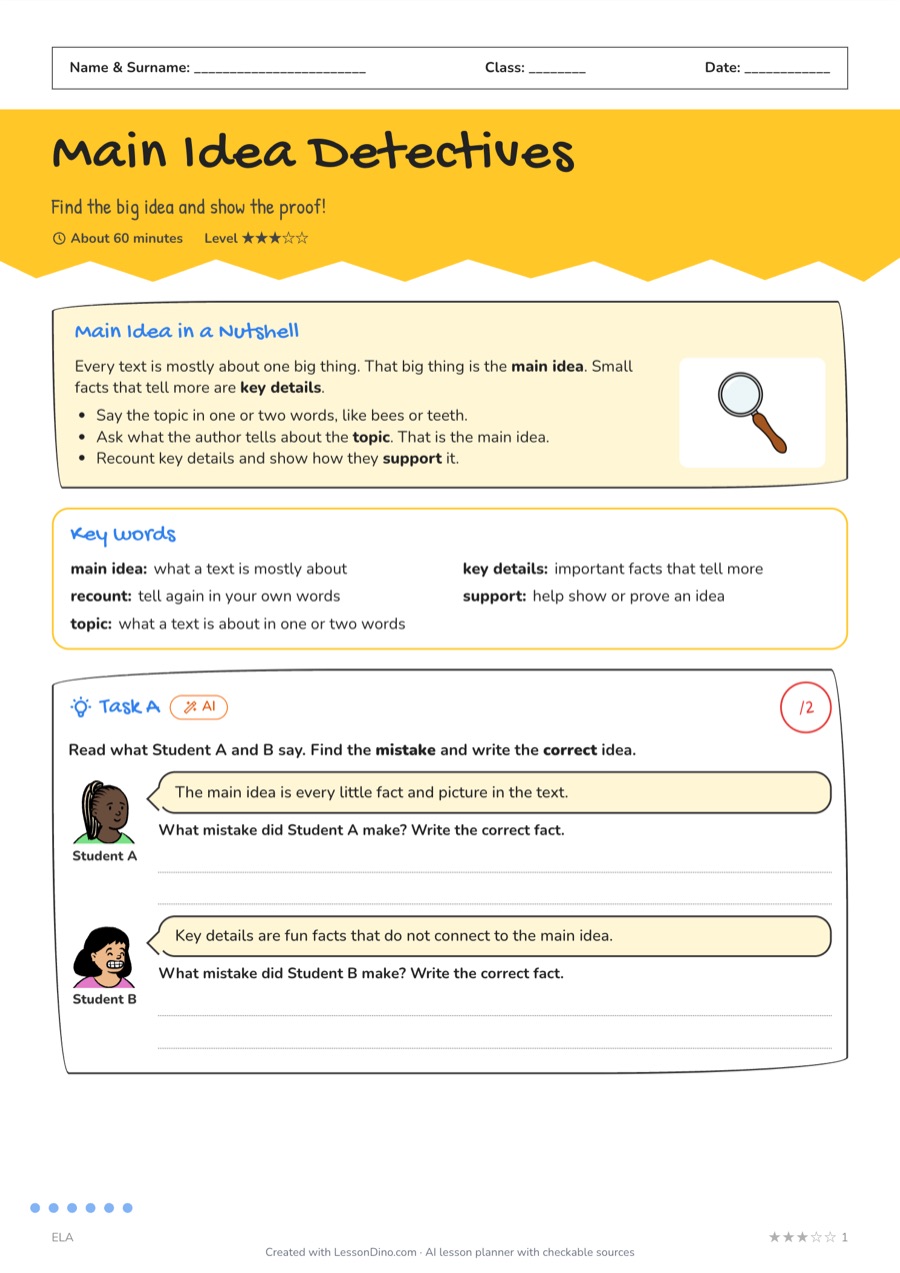
| 20 min | Main Activity | Make posters that state the main idea and show details that prove it. Hand out Worksheet Task C with Busy Honeybees and large paper, markers and crayons. Read Busy Honeybees paragraphs 1-4 aloud while pairs follow and point to job words. Direct pairs to write the main idea in the center and draw three labeled boxes for details. Remind pairs to add a because caption under each box to connect detail to center. |
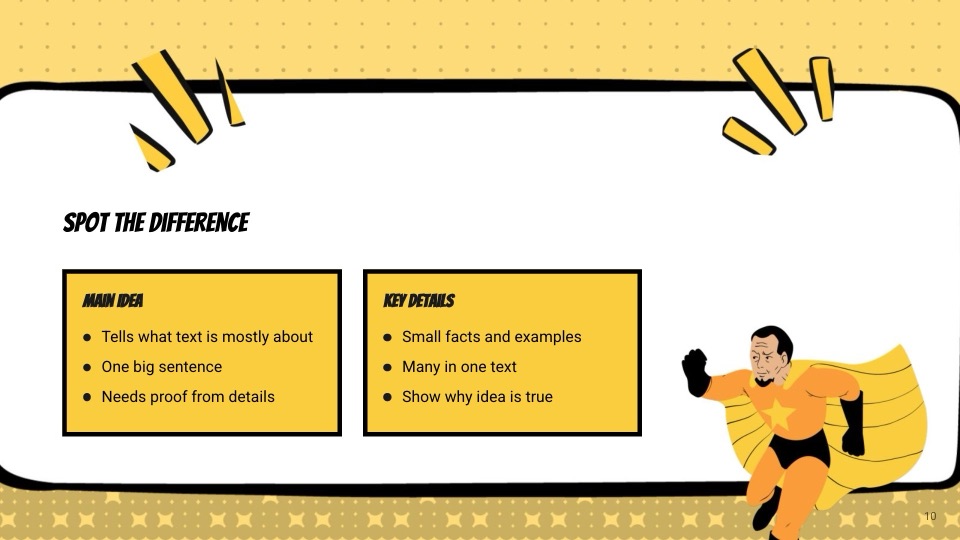
| 10 min | Plenary | Compare learning and check that details prove the main idea. Lead a quick gallery walk and have students leave a sticky dot on a detail that clearly supports the center. Show Slide 10 to compare main idea and key details. Use Slide 12 quiz to ask and answer questions by pointing to words in the text. Close by restating the poster goal and collecting exit lines. |
Common mistakes
- Saying one interesting detail is the main idea
How to spot it: Poster center names only flowers, teeth-brushing, or one job
Ask what two words cover the whole text and check if every detail fits them. - Listing details that do not prove the main idea
How to spot it: Poster box cannot be linked with because to the center
Ask how this detail shows the big idea and replace it with a sentence from the text that does. - Copying a sentence instead of recounting the main idea
How to spot it: Center repeats one text sentence word for word
Model saying it in your own words and have students retell it without looking.
Support
- Let partners copy two key phrases from the text to use as labels before drawing.
- Provide sentence frames like The main idea is ___. One detail that shows it is ___.
Stretch
- Partners add a caption under each box with because to connect the detail to the main idea.
- Pairs write one tricky extra sentence that does not belong and challenge another pair to spot it.
Check questions
- What is the main idea of Busy Honeybees paragraph 4?
Answer: Honeybees show teamwork to keep the hive alive. - Name one key detail that proves it.
Answer: They share jobs, gather food, and save it for winter. - How does that detail support the main idea?
Answer: It shows teamwork / sharing jobs keeps the hive alive with honey.
Curriculum
Determine the main idea of a text; recount the key details and explain how they support the main idea.
Video clips
Clips on YouTube, from the start and end times we chose. Check each one before you show it.
-
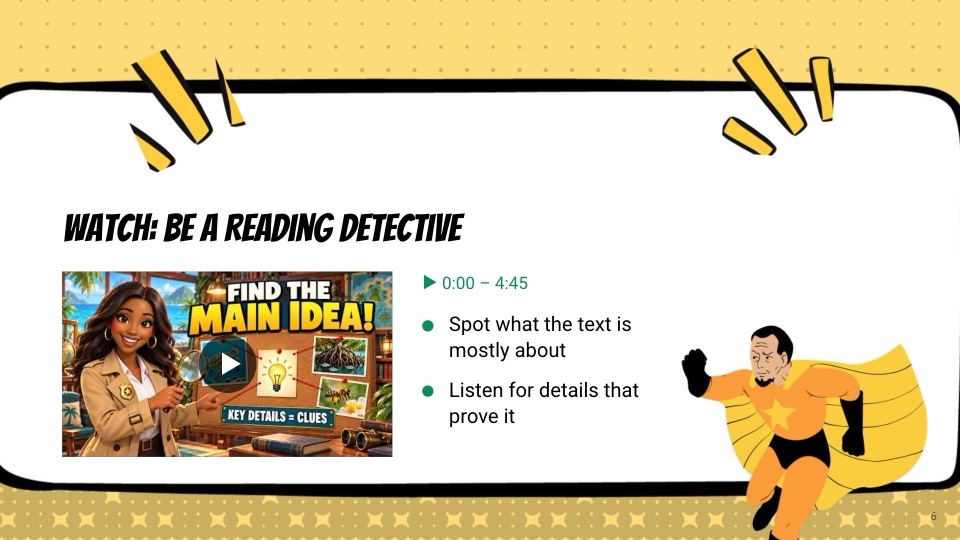
Reading detective from 0:00 to 4:45
Mrs. Randall's Reading Island: Main Idea & Key Details for Kids | Reading Detective Lesson (Grades 2–3)
Made for grades 2-3 so pace and vocabulary fit ages 8-9 while modeling main idea and key details.
-
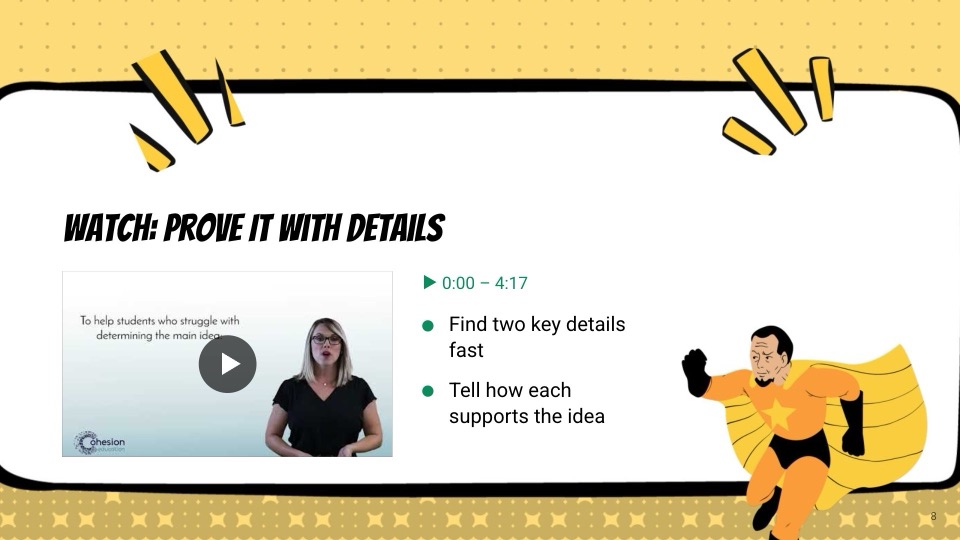
3rd grade main idea from 0:00 to 4:17
Cohesion Education: Main Idea & Key Details (3rd Grade ELA)
Made exactly for 3rd grade so level and examples fit ages 8-9 for main idea and key details.
Worksheet
Sources
- English Language Arts Standards » Reading: Informational Text ... thecorestandards.org
- How to Read the Standards thecorestandards.org
- MODULE 5 Differentiating Between Main Ideas and Supporting ... elcamino.edu
- Main - Wikipedia en.m.wikipedia.org
- Aung San Suu Kyi Wikipedia
- The Art of Personal Chaos Wikipedia
- Peter Pan (play and novel) Wikipedia
Picture credits
- Illustration: u_ozhkrzut0x · Pixabay
- Photo: Fir0002 · GFDL 1.2 · Wikimedia Commons
- Illustration: dandelion_tea · Pixabay
- Illustration: OpenClipart-Vectors · Pixabay
- Photo: Jade87 · Pixabay
- Pictograms: Sergio Palao, ARASAAC (arasaac.org) · CC BY-NC-SA
- Illustration: TyliJura · Pixabay
- Illustration: jureeq · Pixabay
- Picture: unknown · CC0 · rawpixel via Openverse
Made with Lesson Dino's AI on 16 October 2026. AI can make mistakes, so check facts against the sources before you teach.